INTRODUCTION
The Atlantic marine algae of France are well studied as they have been researched since the 19th Century by numerous phycologists (Crouan and Crouan, Debray, Le Jolis, Sauvageau, Lemoine, Chemin, Dangeard, Davy de Virville, Fischer-Piette, Hamel, Lami, Meslin, Prenant, Dizerbo, Feldmann, Parriaud, Ardré, Cabioc'h, Floc'h, Gayral, Gehu, Lancelot, Magne, Gruet, L'Hardy-Halos, etc.) and recently Dizerbo & Herpe (Reference Dizerbo and Herpe2007) reported species distribution of more than 400 Atlantic taxa.
During recent collections for the study of intertidal habitats (mainly sand-covered rocks) along the Atlantic Iberian Peninsula, we sampled the neighbouring coast of France, finding some interesting species (rare, non-native and/or exhibiting reproductive traits). In this paper we add new records, report chorological data and settle some gaps in the species distribution of marine algae on the coasts of France.
MATERIALS AND METHODS
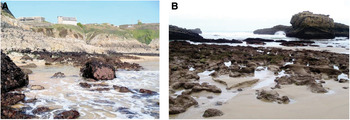
We sampled the French Atlantic coast in March 2011, visiting localities with sand-covered rock habitats: Fort du Minou and Locquemeau in the north (Brittany) and Biarritz in the south (Basque Country) (Figure 1). Epilithic seaweeds were mainly collected on sand-covered lower intertidal hard substrata, as well as both epiphytic and epizoic macroalgae in the middle intertidal zone. Materials were preserved in 4% formalin–seawater and stored in the dark to avoid bleaching of the thallus. Sections of plants were made by hand with a stainless steel razor blade and observed under a stereo microscope. Voucher specimens were deposited at the herbarium of the Santiago de Compostela University (SANT) and mounted permanently in 50% Karo® corn syrup. Herbaria acronyms follow those in Holmgren & Holmgren (Reference Holmgren and Holmgren1998).
Sampling sites on the French Atlantic coast consisting of intertidal sand-covered rocks: (A) Fort du Minou in the north; (B) Biarritz in the south.

RESULTS AND DISCUSSION
We report here both new records and chorological data for seven species of marine algae in France. Three species (Erythroglossum lusitanicum, Hildenbrandia occidentalis and Ulva bifrons) are new records for France, two species (Antithamnion hubbsii and Pterocladiella melanoidea) are new records for the French Atlantic coast and two species (Haraldiophyllum bonnemaisonii and Ptilothamnion sphaericum) are new records for the South Atlantic coast of France. From the biogeographical point of view, the presence of both H. occidentalis and P. melanoidea in Brittany is a considerable expansion of their distribution northward. Otherwise, both E. lusitanicum and U. bifrons extend their distribution eastward along the Atlantic Iberian Peninsula and the finding of both H. bonnemaisonii and P. sphaericum in the south completes the distribution gap between northern Atlantic France and the north of Spain. These new findings show that it is still necessary to carry out further floristic studies in this area to increase our knowledge about the French marine algae and to complete the French National Inventory of Natural Patrimony (http://inpn.mnhn.fr/accueil/index). In Lomentaria orcadensis we describe for the first time mixed phases bearing both cystocarps and tetrasporangia.
Rhodophyta
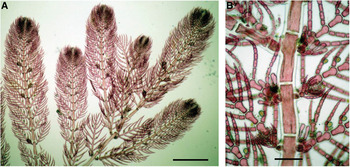
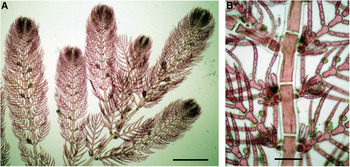
Antithamnion hubbsii: (A) habit of distichous thallus; (B) main axis with opposite pinnae branches supported by isodiametric coxal cells that bear initial rhizoids and new indeterminate axes. Gland cells covering two cells of the pinnules in the adaxial face. Scale bars: A, 500 µm; B, 100 µm.
France, South Atlantic, Basque Country, Biarritz, 43°29′03″N 001°33′46″W, 19 March 2011, lower intertidal, epiphyte of Ahnfeltia plicata (Hudson) Fries and Ahnfeltiopsis devoniensis (Greville) Silva & DeCew, SANT-Algae 25383, 25377, 25422.
Dense epiphytic plants 3–5 cm high consisting of main axes 50–70 µm in diameter, made by cylindrical cells (100–350 µm long) and distichously bearing pairs of opposite pinnate determinate branches 400–600 µm long, supported by isodiametric coxal cells 20–40 µm in diameter. New indeterminate axes are formed together in pairs of determinate branches. Rhizoids are common in middle parts of the thallus, on the rachis cells of main axes. Gland cells ovate (12–17 × 10–12 µm), on pinnules in the adaxial face of two cells. The Biarritz collection mostly consisted of vegetative plants, but cruciate tetrasporangia 50–60 × 30–40 µm were occasionally found.
Antithamnion hubbsii, previously reported in Europe as A. nipponicum, is an exotic species on both the Mediterranean coasts of France (Verlaque & Riouall, Reference Verlaque and Riouall1989) and the Atlantic coasts of Europe, where it is considered as an invasive epiphytic species in both Norway (Rueness et al., Reference Rueness, Heggøy, Husa and Sjøtun2007) and the Basque Country (Secilla et al., Reference Secilla, Díez, Santolaria and Gorostiaga2007). Although the first Atlantic European plants could have been introduced via shipping (Rueness et al., Reference Rueness, Heggøy, Husa and Sjøtun2007), the newly observed population in south-western France probably appeared by marginal colonization from the Basque Country as predicted by Secilla et al. (Reference Secilla, Díez, Santolaria and Gorostiaga2007). The plants of Biarritz are a new record for the Atlantic coast of France.
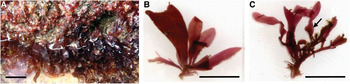
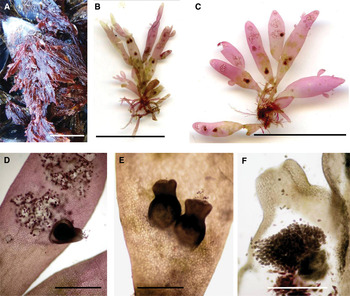
Erythroglossum lusitanicum: (A) turfs on sand-covered rocks; (B) vigorous vegetative plant with oblanceolate blades; (C) proliferous tetrasporangial plant with lengthened blades and basal sori (arrow). Scale bar: A–C, 1 cm.

France, South Atlantic, Basque Country, Biarritz, 43°29′03″N 001°33′46″W, 19 March 2011, middle intertidal pools on sand-covered rocks, SANT-Algae 25410.
Blades brownish-pink with a midrib. Variable in both morphology and size (up to 20 mm long × 2–7 mm wide) in agreement with previous descriptions (Ardré, Reference Ardré1970; Díaz et al., Reference Díaz, Berecibar, Bárbara, Cremades and Santos2009). Plants form dense turfs mainly composed of vigorous vegetative thallus with oblanceolate blades growing from a single apical cell. Tetrasporophytes are scarce, irregular in form and with proliferous axes and slender blades. Tetrasporangial sori (1000–2500× 500–1000 µm) developed in basal parts of blades at both sides of midrib and containing isodiametric tetraedric tetrasporangia (40–100 × 20–32 µm).
Erythroglossum lusitanicum is a Lusitanian species described from the north of Portugal (Ardré, Reference Ardré1970) that is widely distributed on sand-covered rocks from lower intertidal to upper subtidal along the Atlantic Iberian Peninsula, except in the eastern area (Díaz et al., Reference Díaz, Berecibar, Bárbara, Cremades and Santos2009). It is also present in the north of Morocco (Benhissoune et al., Reference Benhissoune, Boudouresque, Perret-Boudouresque and Verlaque2003). The collection of Biarritz is a new record for France and indicates that it could also be present in north-eastern Spain.
France, Atlantic South, Biarritz, 43°29′03″N 001°33′46″W, 19 March 2011, lower intertidal, over rock together with Erythroglossum laciniatum (Lightfoot) Maggs & Hommersand, male and tetrasporangial plants up to 3 cm, SANT-Algae 25386.
New record to Atlantic south-western France that completes the distribution gap between Brittany and the north of Spain.
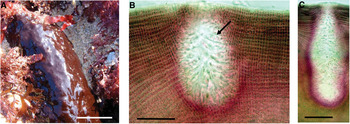
Hildenbrandia occidentalis: (A) crust on lower intertidal sand-covered rocks; (B) crust (in transverse section) made by quadrangular cells and immersed tetrasporangial conceptacles with zonate tetrasporangia (arrow); (C) tetrasporangial conceptacles extremely lengthened. Scale bars: A, 5 cm; B, C, 50 µm.
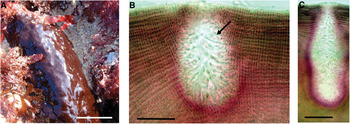
France, Brittany, Fort du Minou, 43°20′12″N 004°36′52″W, 21 March 2011, lower intertidal sand-covered rocks, SANT-Algae 26815.
Dense crusts (500–900 µm thick) composed of 170–220 quadrangular cells (3–4 × 2–3 µm). Mature tetrasporangial conceptacles lengthened (350–500 × 130–180 µm) containing zonate subcylindrical tetrasporangia 25–30 × 8–10 µm. Immature tetrasporangial conceptacle isodiametric (120–220 × 120–160 µm). The crust thickness in Brittany is twice that of Portugal (350–500 µm thick) as reported by Ardré (Reference Ardré1970).
Hildenbrandia occidentalis was described from California and it has a wide distribution (North America, South America, Japan and the Canary Islands: Guiry & Guiry, Reference Guiry and Guiry2012), however on the European coasts it was only reported in the north-west of the Iberian Peninsula (Bárbara et al., Reference Bárbara, Cremades, Calvo, López Rodríguez and Dosil2005) and Portugal (Ardré, Reference Ardré1959, Reference Ardré1970). The collection from Brittany is a new record for France. Hildenbrandia crouanii J. Agardh is another species reported in Brittany (Dizerbo & Herpe, Reference Dizerbo and Herpe2007) that contains isodiametric conceptacles with zonate tetrasporangia. A revision of these species would be required in Brittany, since immature conceptacles of H. occidentalis could be identified as H. crouanii.
Lomentaria orcadensis: (A) plants from the middle intertidal growing over Mytilus sp; (B, C) habit of plants with cystocarps and tetrasporangial sori in the same branches; (D) cystocarp close to a tetrasporangial sori; (E) two cystocarps at the base of the thallus, with carposporangia released through the carpostome; (F) cystocarp in transverse section with prominent carpostoma and inner gonimocarp. Scale bars: A–C, 1 cm; D, E, 1 mm; F, 500 µm.

France, Brittany, Fort du Minou, 43°20′12″N 004°36′52″W, 21 March 2011, middle intertidal over Mytilus sp., with Spermothamnion repens at the base, SANT-Algae 27289, 27290.
From a homogeneous collection of 40 plants similar in morphology, we found more than 30 tetrasporangial plants (10–22 mm high and 1.5–3 mm wide) and only 4 individuals (10–20 mm high and 1.5–2.5 mm wide) bearing cystocarps and tetrasporangial sori in the same branches. Cystocarps are arranged from basal to central parts of axis and branches, while tetrasporangial sori are located in distal parts. Tetrasporangia (35–55 µm in diameter) are isodiametric and tetrahedrally arranged. Cystocarps were found on both sides of branches, up to 11 per individual and up to 8 per branch. They are mostly conical (400–1200 µm high, 400–900 µm in diameter) and ending in a prominent asymmetric, distally turned, carpostome (300–600 µm high). Carposporangia are isodiametric, 25–40 µm in diameter.
This is the second observation of cystocarps in Lomentaria orcadensis after the description reported by Bárbara et al. (Reference Bárbara, Cremades and Veiga1996) based on Galician material. The arrangement and morphology of cystocarps found in plants from both Brittany and Galicia were similar, but the Galician cystocarps were smaller (400–600 µm in diameter) than those of the French plants.
This is the first observation of mixed phases bearing both cystocarps and tetrasporangia in Lomentaria orcadensis. Our observations of Brittany plants could be deemed as an apomeiotic thallus in agreement with Svedelius (Reference Svedelius1937), who affirms that only apomeiotic processes occur in L. orcadensis. Similar apomeiotic state in L. orcadensis was inferred in the study of Foran & Guiry (Reference Foran and Guiry1983) as they produced tetrasporangial plants by culture of tetraspores. Taking into account that the collection of Brittany was mainly composed of tetrasporangial plants and that it contained only 4 plants with cystocarps and tetrasporangia on the same thallus, this phenomenon could be interpreted as cystocarps developing in tetrasporangial plants, supposedly diploid. However, it should be confirmed by cytogenetic studies as Magne (Reference Magne1964) reported Brittany plants with chromosome numbers of N = 10 and N = 20.
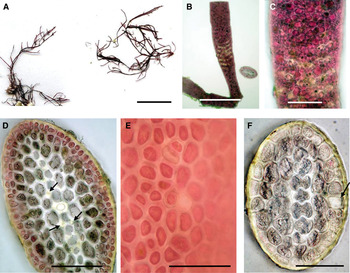
Pterocladiella melanoidea: (A) habit; (B) axis with tetrasporangial stichidium; (C) tetrasporangia arranged in chevrons; (D) middle axis in transverse section with central row of 11 axial cells and internal rhizoids (arrows) confined to the central thallus region; (E) surface view of basal part of axis showing cortical cells longitudinally arranged with hyaline cells; (F) transverse section of basal part of axis with a row of axial cells and a hyaline cortical cell (arrow). Scale bars: A, 1 cm; B, 500 µm; C, D, 100 µm; E, F, 50 µm.

France, Brittany, Fort du Minou, 43°20′12″N 004°36′52″W, 21 March 2011, lower intertidal sand-covered rocks and Lithophyllum incrustans Philippi, together with Gelidium crinale (Turner) Lamouroux and Pterocladiella capillacea (Gmelin) Santelices & Hommersand, tetrasporangial plants, SANT-Algae 26719, 26762.
Plants 10–25 mm high, with axes compressed from the base to the apex. In transverse section, axes are elliptical 140–170 × 80–130 µm at the base and 140–300 × 80–200 µm in the middle and are composed of a central row of 9–13 thick-walled cells. Inner rhizoids are scarce and confined to the medulla in the middle part of the thallus. In surface view, cortical cells are 8–20 long × 6–15 µm wide and longitudinally arranged only at the base of the thallus; sometimes cortical cells becoming as hyaline ones. Tetrasporangial stichidia (up to 2 mm long) placed in both branches and main axes, bearing tetrahedral tetrasporangia (18–35 µm in diameter) arranged in chevrons; with up to 3–4 pairs of tetrasporangia per row and 8–12 rows in the tetrasporangial stichidium. The morphology of Brittany plants matches var. gracile (Feldmann & Hamel, Reference Feldmann and Hamel1936).
Pterocladiella melanoidea is a common species along the Atlantic Iberian Peninsula which is confined to sand-covered intertidal hard substrata and can be misidentified with Gelidium crinale and other typical filiform species common in this habitat. Pterocladiella melanoidea in Brittany is a new record for the Atlantic coast of France and extends its distribution towards the north (Fredriksen & Rueness, Reference Fredriksen and Rueness1990). In addition, it corroborates that the plants from Brittany live in similar habitats to the Atlantic Iberian Peninsula populations.
Gelidiella calcicola Maggs & Guiry is present in Brittany (Dizerbo & Herpe, Reference Dizerbo and Herpe2007) and it is similar to Pterocladiella melanoidea in inner structure (central row of cells) and tetrasporangia arranged in chevrons. By contrast, it grows on maërl substrata, and is therefore mostly subtidal (Maggs & Guiry, Reference Maggs and Guiry1987; Bárbara et al., Reference Bárbara, Cremades and Veiga2004), while P. melanoidea develops on sand-covered intertidal rocks, and sometimes on Lithophyllum incrustans but mainly it was attached to rocks. Pterocladiella melanoidea has an erect habit and is larger than G. calcicola which mainly consists of prostrate plants (Maggs & Guiry, Reference Maggs and Guiry1987). The inner rhizoids are very scarce in P. melanoidea and absent in G. calcicola, except in holdfast regions (Maggs & Guiry, Reference Maggs and Guiry1987). In agreement with the study of P. melanoidea from Portugal (Cremades et al., Reference Cremades, Bárbara and López Rodríguez1999) the cortical layer of Brittany plants contains some hyaline cells, probably similar to the observation of Maggs & Guiry (Reference Maggs and Guiry1987) in G. calcicola. In some characters (axis compressed throughout thallus and the bigger size of cortical cells), P. melanoidea from Brittany differs from both the description of Feldmann & Hamel (Reference Feldmann and Hamel1936) and the observations made on robust Portuguese plants (Cremades et al., Reference Cremades, Bárbara and López Rodríguez1999). Also, material from Brittany lacks longitudinally arranged cortical cells in the middle parts of the thallus, but this feature is questionable because Fredriksen & Rueness (Reference Fredriksen and Rueness1990) detected a less regular arrangement in their cultured material and in Schousboe's type specimens of P. melanoidea. Using the criteria of Akatsuka (Reference Akatsuka1986) concerning the shape and orientation of surface cortical cells, Fredriksen & Rueness (Reference Fredriksen and Rueness1990) found that their material was intermediate between Gelidium and Pterocladiella. This is in agreement with our material from Brittany, since longitudinal arrangement of cortical cells was only observed in basal axes. In conclusion and in agreement with their habitat, habit and general features we assigned the Breton plants to P. melanoidea. Conversely, taking into account the similarity between G. calcicola and P. melanoidea and the differences detected in P. melanoidea between plants from different regions, as well as between described varieties (typus, gracile and filamentosum, Feldmann & Hamel, Reference Feldmann and Hamel1936), it would be necessary to undertake further studies to clarify differences among these varieties or ‘growing forms’ and to verify the taxonomic entities of P. melanoidea and G. calcicola.
France, Atlantic South, Biarritz, 43°29′03″N 001°33′46″W, 19 March 2011, sand-covered lower intertidal rocks, sterile plants up to 5 mm high, SANT-Algae 25408.
New record for Atlantic south-western France that completes the distribution gap between Brittany and the north of Spain.
Chlorophyta
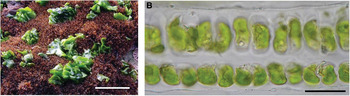
Ulva bifrons: (A) blades epiphyte of Caulacanthus ustulatus in the middle intertidal; (B) transverse section in the middle of the thallus with different cell layers. Scale bars: A, 2 cm; B, 20 µm.

France, Atlantic South, Basque Country, Biarritz, 43°29′03″N 001°33′46″W, 19 March 2011, middle intertidal on Caulacanthus ustulatus (Mertens ex Turner) Kützing, SANT-Algae 25437.
Numerous small blades 7–16 mm long and 50–60 µm thick formed by two different cell layers. In transverse section, one layer with isodiametric cells 12–15 × 10–12 µm and the other one with cells 15–22 × 8–10 µm.
Ulva bifrons was described from Portugal by Ardré (Reference Ardré1967). Although it is present on the Atlantic coast of the Iberian Peninsula (Gorostiaga et al., Reference Gorostiaga, Santolaria, Secilla, Casares and Díez2004; Bárbara et al., Reference Bárbara, Cremades, Calvo, López Rodríguez and Dosil2005; Araújo et al., Reference Araújo, Bárbara, Tibaldo, Berecibar, Díaz Tapia, Pereira, Santos and Sousa Pinto2009) and Morocco (Benhissoune et al., Reference Benhissoune, Boudouresque and Verlaque2001) it is an uncommon species in the European floras. The collection from Biarritz is a new record for France.
ACKNOWLEDGEMENTS
This work was supported by the project CGL2009-09495/BOS (Ministerio de Educación y Ciencia, FEDER). We appreciate the comments and corrections of Christine Maggs and an anonymous referee.