Legislative scholars have intensely studied the power distribution within legislatures and the factors that promote gridlock.Footnote 1 Some scholars have argued that gridlock can improve the quality of legislative output,Footnote 2 but a common view in legislative research is that gridlock reduces the likelihood of policy change.Footnote 3 Drawing on theories of veto players,Footnote 4 party cartels,Footnote 5 presidential approval,Footnote 6 coalition governments,Footnote 7 unified or divided government,Footnote 8 and ideological conflict in parliaments,Footnote 9 the empirical research mainly supports the effect of this risk on the scale and scope of adopted legislative acts.Footnote 10 But how does the risk of gridlock affect the power of the bureaucracy and the type of legislative output? We argue that the risk of gridlock may also change the distribution of power between the legislature and the bureaucratic agents, and thus change the nature of the legislative output toward a more bureaucratic type. Our argument builds on insights from recent delegation studies, which have shown that legislative decision making requires a significant amount of bureaucratic delegation and discretionary power. This literature also revealed that such powers are most often granted to bureaucratic agents when the legislature is unified and implementation uncertainty is high.Footnote 11 However, once this power has been delegated to the bureaucracy and the risk of gridlock increases, the question arises what the empowered bureaucracy will do when the legislature becomes less likely to overrule bureaucratic activities.
In this article, we examine the effect of the risk of gridlock on the type of legislative output, which we expect to become more bureaucratic as conflict within the legislature increases. When the legislature is more divided, other actors – such as the bureaucracy or judiciary – can become more active because the legislature is less likely to overrule.Footnote 12 This hypothesis draws attention to another inter-institutional perspective on gridlock, according to which the legislature has already delegated some powers to the bureaucracy, but has difficulty controlling the expansion of bureaucratic activities when the risk of gridlock increases due to diverging policy interests. However, empirically evaluating the conditions under which the bureaucratic machinery expands its activities is demanding, because it requires simultaneously (1) estimating the bureaucracy's expectations of the risk of gridlock and (2) investigating the likelihood of the different types of legislative output. Accordingly, our empirical analysis of this effect in the EU contributes to the existing literature on gridlock in three important ways. First, we examine the implications for the power relationship between the Council of the EU and the European Parliament on the one side, and the European Commission on the other by combining two data sources on all EU secondary and tertiary acts from 1983 to 2009. To our knowledge, this is the first analysis that combines data on legislative and bureaucratic activities to test this hypothesis in a systematic manner. Secondly, we introduce a novel approach to calculate the size of the core in a two-dimensional policy space, in which we distinguish between unicameral and bicameral procedures and between two different voting rules in the Council.Footnote 13 Because the EU experienced fundamental periodical changes through treaty revisions and the accession of new members, we also measure the policy positions of the legislative actors in the Council and the European Parliament using indicators from the EULIS dataset, which accounts for agenda-related variation across policy areas and over time.Footnote 14 Thirdly, we use Bayesian statistics for an in-depth analysis of our hypothesis on the risk of gridlock and the type of legislative acts. Compared to frequentist statistics designed to report sampling uncertainty in sampled data, the Bayesian approach is more appropriate for the analysis of our full sample data, and allows us to report model uncertainty and directly compare the explanatory power of competing models.
To evaluate our hypothesis in greater detail, we further consider a set of additional factors and investigate whether more informational complexity and legal grounding support our argument on the expansion of bureaucratic activities when there is a higher risk of gridlock. In addition to the type of legislative instrument (directive, regulation, decision or other act), we control for area- and time-specific effects because a large portion of the activities belongs to a few specific areas that were subject to treaty changes over the years.
The findings provide strong support for our hypothesis that tertiary acts replace secondary acts when the risk of gridlock increases and, as a consequence, the likelihood of an overruling by the (bicameral) legislature shrinks. When there is a high risk of gridlock, the bureaucratic machinery of the Commission is more active, and the type changes from secondary to tertiary, which does not require formal adoption by the Council and/or the European Parliament. This result is supported by the findings on informational complexity and legal grounding: the more complex an act and the more acts delegate power to the Commission, the more likely becomes the tertiary type.
These results also provide new substantive insights into the relationship between the Council and the European Parliament on the one side, and the Commission on the other. So far, scholars have argued that delegation to the Commission improves legislation, since the bureaucracy can provide special expertise to reduce implementation uncertaintyFootnote 15 or to solve commitment problems on the part of the member states.Footnote 16 We show that legislation becomes more bureaucratic when the Commission expects a higher risk of gridlock once these powers have been delegated. Admittedly, one might argue that the Commission only keeps EU decision-making productivity going by tertiary acts, in particular when the diversity in the policy positions of the Council and the European Parliament increases due to enlargements. We indeed find evidence of an enlargement effect, but the key problem concerns the increasing bureaucratic nature of legislation, which may raise further questions and discussions on democratic legitimacy and the representation of interests in the EU.
The remainder of the article is organized as follows. In the next section we discuss the literature in order to develop our argument and describe the analytical concept for identifying the (expected) risk of gridlock. Then we explore the empirical development and distribution of secondary and tertiary acts across policy areas and over time. Next we describe the EULIS dataset, which contains agenda-related estimates of policy positions varying across policy areas and over time. We also explain how we calculate the size of the two-dimensional core for the most important legislative procedures and voting rules, and present the operationalization of the other independent variables. We then discuss the statistical analysis with Bayesian econometrics and conclude.
TWO IMPLICATIONS OF THE RISK OF GRIDLOCK
A common proposition in legislative studies is that the likelihood of policy change decreases when the risk of gridlock increases.Footnote 17 Several studies have evaluated the empirical implications of this proposition on the number of proposals or adopted acts and the duration of the legislative process, within and outside research on the EU. For the EU, which distinguishes between procedural settings and voting rules, the empirical results remain mixed and somehow puzzling. Scholars find that more divergence in the policy positions of member state governments affects the speed of EU legislative decision making,Footnote 18 but there is mixed evidence that the number of adopted legislative acts has also decreased.Footnote 19 A similar puzzle is reported for the United States and Germany, where the number of adopted acts does not shrink in times of divided government.Footnote 20
Two related analytical concepts are used to identify the risk of gridlock: the size of the winset of the status quo and the core.Footnote 21 The winset comprises all policies for which a winning coalition exists to alter the status quo. The core, by contrast, is the set of status quo policies for which no such winset exists. Consequently, the larger the size of the core, the less likely is policy change, and the more likely is gridlock. Because the location of the status quo is often difficult to identify, scholars use the size of the core to measure the risk of gridlock.
While it is common to simplify the policy space to a single left-right policy dimension in order to facilitate its calculation or avoid problems of instability, such an approach risks excluding the bicameral nature of conflicts between the Council members and the European Parliament by design. This is because the representatives of both chambers belong to political parties that commonly compete on the left-right scale, while their bicameral tensions result from their more national or supranational views of a policy.Footnote 22 Following the Hix-Lord model on European integration,Footnote 23 we propose a two-dimensional EU policy space and consider each member state in the Council and each political group in the European Parliament. Moreover, we model exactly how the size of the core and the risk of gridlock are shaped by legislative procedures and voting rules, and take this dependence on institutional design into account. Figure 1 illustrates how the core size differs in the two-dimensional space for the most important legislative procedures, the unicameral consultation procedure and the bicameral co-decision procedure; and the two voting rules, unanimity and qualified majority voting rule in the Council.
Size of the EU-15 core under different institutional arrangements (example from the EU policy area ‘competitiveness’)

In the upper part of Figure 1 that shows the consultation procedure, the Council decides alone, while the co-decision procedure (lower part of Figure 1) establishes a bicameral procedure with the European Parliament, which decides by 314 out of 626 votes in our example. When the unanimity rule applies in the Council (left part of Figure 1), all governments are veto players and must support a change of the status quo, while a smaller proportion of votes (sixty-two out of eighty-seven in our example) is required under qualified majority rule (right part of Figure 1). Under this voting rule, the governments use voting weights (numbers in brackets) in the Council.
Keeping the distribution of the policy positions constant indicates how much the voting rule and the procedure affect the size of the core. When Council members unanimously decide in the unicameral consultation procedure (upper left part of Figure 1), no status quo policies that are located inside the light grey area of the ‘unanimity core’ can be changed. Outside the unanimity core, however, the governments can change all policies, because there is a winset for policy change even under unanimity rule. When qualified majority voting applies in the same consultation procedure (upper right part of Figure 1), the size of the core drastically decreases.
In addition to the voting rule, the bicameral co-decision procedure requires support from the Council and the European Parliament, while the Council can adopt policies alone in the unicameral consultation procedure. Under unanimity rule in the Council (lower left part of Figure 1), we observe a similar size of the core under both procedures. This means that the necessary support from the European Parliament is irrelevant for the size of the core. However, when qualified majority rule applies in the Council (lower right part of Figure 1), the core is much larger under the bicameral co-decision procedure than it is under the unicameral consultation procedure.
These illustrations show how the distribution of policy positions, in interaction with the procedure and the voting rule, affect the size of the core in a legislature, and under what conditions the legislature is most likely to be gridlocked. The first implication of such gridlock is that legislative activity decreases. As already mentioned, this implication has most often been studied in legislative research within and outside the EU. The most recent analysis with a one-dimensional left-right space finds support for the impact of the core on the legislative productivity of secondary acts in the EU from 1979 to 2009.Footnote 24 But what is the implication of this finding for the productivity of tertiary acts and the power of the bureaucracy?
Our analysis focuses on this second implication of gridlock. Accordingly, a high risk of gridlock may not necessarily decrease overall productivity, but shift decision making to the bureaucracy. Legislatures often delegate considerable powers to bureaucratic agents for specific purposes and keep ex post oversight that allows the legislature to overrule any bureaucratic decision. However, once the legislature is more divided as the size of the core increases, the effectiveness of ex post oversight decreases with the lower likelihood of an overruling.Footnote 25 In this situation, the bureaucracy may find it easier to expand its own activities by reinterpreting the original purposes of delegation and thereby maintaining overall productivity through more bureaucratic activities. Consequently, our argument suggests that the larger the size of the core, the more discretion the bureaucracy can expect to have in reinterpreting status quo policies.Footnote 26 Instead of looking at the adoption rates or speed of secondary acts, we draw attention to the type of acts that may change to a more bureaucratic type.Footnote 27
The argument that agents’ power may depend on the risk of gridlock has already been investigated for other contexts. For example, research on central banks shows that their independence increases with the number of veto players and institutional constraints.Footnote 28 Similarly, studies of courts find that judges are more likely to reinterpret laws according to their own point of view when politicians are unlikely to overrule their decision due to gridlock.Footnote 29 Focusing on the power of bureaucratic agents in the EU, we argue that the Commission can reinterpret the status quo policy in EU decision making by drafting and implementing tertiary acts alone, while the Council and the European Parliament may only overrule tertiary acts if this reinterpretation was conducted outside the core.
On closer inspection, it seems that the Council and the European Parliament are aware of this problem: tertiary acts are sometimes scrutinized in the so-called Comitology system, which involves specialized committees controlling the Commission's activities and may result in decisions being referred to the Council (and the European Parliament) if there is a suspected violation of the original delegation purposes.Footnote 30 Because Council and European Parliament can scrutinize tertiary acts, we have to model the decision of the Commission for using tertiary acts in relation to the bureaucracy's expectation to be overruled by either a qualified majority or unanimity in the Council with an absolute majority in the European Parliament in case of a bicameral procedure. As the size of the respective core increases, the bureaucratic agent may accordingly derive an expectation about the legislature's resistance to its activities. Thus the analysis of the Commission's expectation that it will be overruled may not only provide empirical insight into the power distribution between the legislature and the bureaucratic agent, but also a normative perspective on the legitimacy of the legislative output.
Until now, little has been discovered about the shift from secondary to tertiary acts, because the existing literature on EU legislation has excluded tertiary acts from its sampling.Footnote 31 This is surprising, because analysing tertiary acts may clarify the implications of three fundamental developments in EU decision making, which are expected to have opposite effects on the power relationship between the bureaucracy and the legislature:
-
• the increasing application of qualified majority in the Council should limit the bureaucracy's power to interpret status quo policies;
-
• the participation of the European Parliament by the expansion of the co-decision procedure should promote the Commission's ability to interpret the status quo; and
-
• the accession of new member states with diverse interests should increase the scope for bureaucratic interpretations by the Commission.
To our knowledge, the few existing studies on delegation in the EU emphasize the (positive) reasons why powers are delegated to the Commission via primary and secondary legislation, but do not consider the above-mentioned negative consequences.Footnote 32 These studies find that the complexity of a directive; the policy conflict between the Commission, European Parliament and Council; and a non-statutory control mechanism are important for the delegation of powers. However, this begs the question why (and when) secondary legislation shifts to tertiary legislation once the Commission has received the power to act alone. Before examining whether an increased risk of gridlock promotes more bureaucratic activities by tertiary acts, we introduce our data on secondary and tertiary acts and measuring the risk of gridlock.
SECONDARY AND TERTIARY ACTS IN THE EU
The dependent variable of our analysis describes whether an act is adopted as a secondary (coded as 0) or tertiary act (coded as 1). Our full sample consists of almost 80,000 acts adopted from 1983 to 2009. We have extracted information from both the texts and bibliographic notices of EU acts, which are stored in the EUR-Lex database.Footnote 33 This allows us to consider all adopted acts, regardless of the end of validity, respectively new or amending legislation. Moreover, we can differentiate between directives, regulations, (ordinary) decisions and other acts, which allows us to control for instrumental effects. For example, instrumental effects address the question of whether an act's provisions directly apply (regulations and decisions) or need transposition into national law (directives).
As shown in Online Appendix 1, most tertiary acts are regulations. Their number sharply increased in 1995. A closer inspection indicates that this sharp increase was (co-)produced by new agricultural and external Commission regulations after the foundation of the World Trade Organization. Compared to tertiary regulations, the number of Council (and European Parliament) regulations decreased in most years. The number of tertiary directives is continuously increasing, whereas secondary directives fluctuate widely. The opposite is true for decisions. Other acts reveal a considerable shift toward Commission acts since the mid-1990s.
The development of EU legislation suggests that the number and type of acts vary not only over time but also across policy areas. To account for this variation in our argument on the size of the core, we assign each act to one of nine Council policy areas by the (first) two-digit code of the directory of EU legislation that is denoted in the respective bibliographic notice of each act. These areas are classified according to the nine configurations of the Council before the Treaty of Lisbon entered into force in 2009. Online Appendices 2 and 3 provide detailed information about the distribution of secondary and tertiary acts by policy area and instrument, as well as policy area and Commission term, respectively.
Most acts are adopted in the area of agriculture and fisheries (61 per cent), followed by competitiveness (20 per cent), and general affairs and external relations (13 per cent). Secondary and tertiary acts, as well as the instrument, differ considerably across the nine policy areas. Regulations have the largest share in the area of agriculture and fisheries, and decisions are especially important for education policy and general affairs and external relations. Regarding the type, secondary acts preponderate in economic and financial affairs, justice and home affairs, employment and social policy as well as education. We find similar variation in Commission terms over time, for example an increasing number of (secondary) acts in justice and home affairs since the third Commission led by Jacques Delors. In the two policy areas that dominate overall EU legislation, the number of tertiary acts almost continuously falls after the sharp increase in 1995 (agriculture and fisheries) or fluctuates slightly (competitiveness).
The explorative analysis of our data on the type of legislative output and the instrument reveals variation across policy areas and over time. In the following, we will show how we intend to capture this variation in the bureaucracy's expectation on the risk of gridlock – that is, the bureaucracy's expectation of being overruled in a specific policy area at a particular point in time.
MEASURING THE RISK OF GRIDLOCK
To measure the risk of gridlock, we start by calculating the size of the core for each policy area and year. We use agenda-specific estimates of the policy positions of the partisan representatives in the Council and the political groups in the European Parliament, and distinguish between Council unanimity and qualified majority voting as well as unicameral consultation and bicameral co-decision procedures. From the relative distribution of each voting rule and procedure over the last three years, we derive the Commission's expectation of the risk of gridlock by legislative instrument.Footnote 34
More specifically, our calculation of the core proceeds in two steps. In the first step, we follow the procedure from the EULIS approachFootnote 35 to capture area- and time-specific variation in the policy positions of the political actors in EU legislation. The original EULIS dataset only contains estimates of the policy positions of the Council members from the CMP's (Comparative Manifestos Project) coding of party manifestos for national elections.Footnote 36 We extend this dataset by utilizing the EMP's (Euromanifesto Project) coding of manifestos for European Parliament electionsFootnote 37 in order to provide additional estimates for the political groups. Briefly summarized, the EULIS approach constructs three issues with national-supranational (ns) poles and ten issues with left-right (lr) poles on the basis of thirty-eight CMP categories and corresponding EMP categories (see Online Appendix 4).Footnote 38 To relate these categories to the EU's legislative agenda, the keywords of the CMP and EMP coding schemes are matched with the contents of EU legislative acts.
As illustrated in Online Appendix 5, we observe high area- and time-specific variation in the prominence of issues on the EU's legislative agenda. For example, the ‘protectionism’ issue is particularly important in three policy areas. Compared to a decreasing prominence in general affairs/external relations and competitiveness, it is still significant in agriculture and fisheries. We also find that the ‘quality of life’ issue is especially relevant for environmental politics and gains increasing prominence in transport as well as in agriculture and fisheries, while the trend is the reverse in education politics. To improve the scaling, the EULIS approach accounts for the length of election manifestos and applies the logit scale proposed by Lowe et al. for calculating issue-specific policy positions.Footnote 39 The agenda prominence of the assigned categories weights the issues, which we finally aggregate by their weighted mean on the national-supranational and left-right dimensions (see formulas in Online Appendix 6).Footnote 40
In a second step, we use the EULIS estimates of the policy positions of the Council membersFootnote 41 and the political groups in the European Parliament to specify the size of the two-dimensional core in each area and year. With the ‘analytical politics’ package in R we calculate the size of the two-dimensional core for four different situations that distinguish between the unicameral consultation and the bicameral co-decision procedure as well as Council unanimity and qualified majority voting.Footnote 42 Because it is difficult to identify a (parliamentary) median in a two-dimensional policy space, we implement an algorithm that screens the whole policy space to specify the area in which no winset of the status quo exists – that is, where no (bicameral) winning coalition can change the status quo policies. The size of this area expresses the risk of gridlock for a secondary act in the four situations (unicameral, bicameral, unanimity and qualified majority voting) for each area and year.
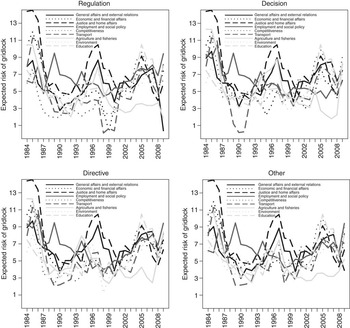
When the Commission seeks to anticipate the consequences of its decision to propose a secondary or tertiary act, we can identify the type of legislative instrument and suppose that the bureaucracy takes into account the chances of an instrument-specific act. In other words, we check whether the Commission distinguishes between a directly applicable instrument and one that provides for some discretion in the implementation stage. We approximate the threat that an act will be overruled by the legislature by the relative frequency of each procedure and voting rule in the same area in the past three years – that is, how often a similar act was decided in the consultation or co-decision procedure under unanimity or qualified majority rule in this policy area. Put differently, we suppose that there is an area-specific distribution of procedure and voting rule, which the Commission takes into account. In combination with the size of the core for each situation, we use this information to measure the expected risk of gridlock.Footnote 43 This risk determines (but does not depend on) the likelihood of a tertiary and secondary act. Figure 2 illustrates how these expectations for each instrument vary across areas and over time.
Expected risk of gridlock by instrument, year and policy area

According to Figure 2, the expected risk of gridlock does not continuously increase over time, which is in itself a noteworthy result – especially due to the more frequent use of the unanimity rule in early periods. More importantly, this indicates that our main explanatory variable is not confounded by long-term time trends such as the Commission's increasing right to use tertiary acts. We, however, observe that the expected risk of gridlock increases for each major enlargement of the EU in all policy areas.Footnote 44
A closer inspection of the graphs reveals that the expected risk of gridlock differs more across areas and over time than between instruments.Footnote 45 This risk is accordingly relatively large in justice and home affairs, general affairs and external relations, and employment and social policy, but much smaller in agriculture and fisheries as well as transport. Another finding is that the risk of gridlock was greater in the 1980s due to the more frequent use of unanimity rule at this time. By contrast, the increasing application of the bicameral co-decision procedure since the mid-1990s hardly affects the expected risk of gridlock. This result is consistent with the fact that the European Parliament applies a lower voting threshold of absolute majority voting than the Council, and that the policy positions of the political groups in the European Parliament overlap with those of the governments in the Council, in particular along the left-right dimension.
OTHER FACTORS
Whether the Commission prefers secondary or tertiary acts may not exclusively depend on the expected risk of gridlock. Other factors may also play an important role in the Commission's power vis-à-vis the Council and the European Parliament. We therefore control for two alternative explanations in order to disentangle the impact of the expected risk of gridlock. A simple explanation is that tertiary acts become more likely because there are more primary or secondary acts that empower the Commission to use tertiary legislation. The more decision-making authority these acts transfer to the Commission, the more frequently we would expect the bureaucracy to use tertiary acts. We therefore control for an act's informational complexity and legal grounding. Another argument in the literature is that complex acts facilitate decision making by the Commission, since the bureaucracy finds it easier to acquire the necessary information.Footnote 46
To measure informational complexity, we use an indicator of previous studies on the number of recitals in EU legislative acts.Footnote 47 The recitals are placed in the preambles (between the titles and enacting terms of each act) after the citations of legal bases and procedural steps and report the main informational elements of a policy that need to be considered in the application of an act. They begin with the word ‘whereas’ and ‘set out concise reasons for the chief provisions of the enacting terms’.Footnote 48 As regards the legal grounding, we use the number of different primary and secondary acts previously referred to by tertiary acts in a specific area at a given time in the same policy area and for the same instrument. We expect that the Commission's formal authority to use tertiary acts – and thereby also the likelihood of tertiary acts – is higher, the more acts in primary and secondary legislation there are that formally delegate this authority to the bureaucracy.
To calculate the Commission's expectations on the informational complexity of acts and their legal grounding for each policy area, year and instrument, we follow the same procedure as described for the expected risk of gridlock. Because we cannot observe the characteristics of a secondary and tertiary act at the same time, we infer the missing information from similar cases that were decided in the same policy area in the past three years using the same instrument. Admittedly, data are available for the level of informational complexity, but we prefer to apply the same procedure to maintain a consistent analysis of the bureaucracy's expectations. The reason is that the time variances of our variables become similar, and this approach helps us avoid differences in their explanatory power being caused by differences in the variance of these variables.
To cope with event-specific effects (indicated by the sharp increase of tertiary regulations in the mid-1990s), we control for the type of instrument and the different influences of changes in the risk of gridlock over time. For this purpose, we include interaction terms between the type of instrument and the risk of gridlock. For example, since decisions usually refer to single countries, the heterogeneity of policy positions and a higher number of countries may increase the likelihood of decisions. By distinguishing between instruments, we can isolate such effects. Table 1 displays the distribution of our variables without the interaction terms and dummy variables for policy areas and years, taking into account that the time lags in some of the explanatory variables effectively reduce the period studied by one year (i.e. to 1984–2009) since no information on the previous year is available for the first year (i.e. for 1983).
Distribution of Explanatory Variables of the Analysis

While our sample consists of a large number of tertiary regulations, all other variables are more symmetrically distributed and cover the full range of possible outcomes. Given that most variables average time for a specific subsample of the dataset, this distribution is not self-evident. In order to control for area- and time-specific distributions, we employ dummy variables that capture the specific baseline likelihood of tertiary acts in these subsamples. This allows us to distinguish their effects from those of the other variables. These dummy variables also take into account the different legal preconditions for tertiary acts, levels of power delegation and degrees of integration in the EU.
STATISTICAL ANALYSIS
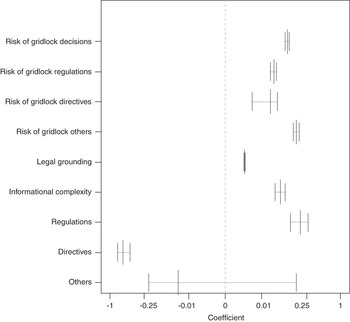
To evaluate our argument, we use Bayesian econometrics to determine the explanatory power and level of uncertainty for different models. We employ a probit model with the type of act (secondary/tertiary) as binary dependent variable and non-informative priors, which therefore produces similar predictions to maximum likelihood estimates of probit models. However, the Bayesian approach allows for more robust and straightforward interpretations of the impact of each explanatory variable, the associated uncertainty and the overall performance of each model. Before we present our findings on the impact of the risk of legislative gridlock on bureaucratic activities, we therefore inspect how much our statistical model outperforms a simpler alternative explanation. A comparison of the Bayes factors for the full model and a reduced version that does not consider the impact of core size or include any core-related variables reveals that the core-related variables increase the explanatory power by 3.6×1052 times, which is a very strong result with respect to the conventional classification of Bayes factors.Footnote 49 It is noteworthy that the model performance improves in spite of four additional variables, which Bayes factors severely punish in model comparisons. This suggests that our results strongly support our argument that the expected risk of gridlock increases the likelihood of tertiary acts. Figure 3 depicts the mean values of the sampling iterations and the 2.5 per cent and 97.5 per cent boundaries for the explanatory variables, controlling for area- and time-specific patterns shown in Figures 4 and 5.Footnote 50
Risk of gridlock and the likelihood of tertiary acts

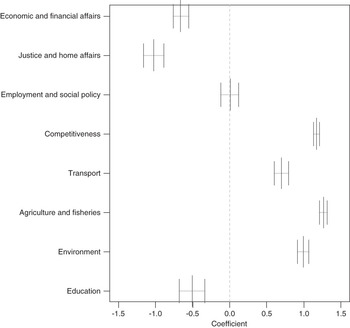
Area-specific differences in the likelihood of tertiary acts

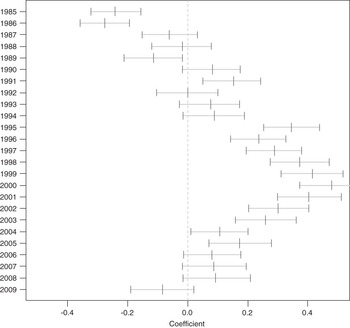
Time-specific variation in the likelihood of tertiary acts

The joint coefficientsFootnote 51 of the expected risk of gridlock on the likelihood of tertiary acts are displayed for each instrument on a quadratic scale. They report the aggregated effect of the constitutive term plus the interaction effect. Support of our hypothesis is indicated by positive values for all coefficients, whereby the parameter distribution should not overlap with zero. The results reveal that the Commission indeed increases the level of tertiary acts at the expense of secondary acts when the expected risk of gridlock increases. Consequently, the bureaucracy is more active and produces more legislation in the form of tertiary acts when the (actual) legislature is more divided. This basic finding holds true for all instruments. The impact of the expected risk of gridlock on the likelihood of tertiary acts is clearly positive for each instrument, and the sizes of the impacts can hardly be distinguished from each other, since their 95 per cent confidence ranges overlap. Hence we can exclude the possibility that the impact of the expected risk of gridlock on bureaucratic activity is caused by instrument only.
In order to distinguish between the effects of the expected risk of gridlock and alternative explanations for secondary and tertiary acts, we have argued that tertiary acts are more likely the more power that has been delegated to the Commission in a policy area at the time by previous primary or secondary acts. The positive coefficient of legal grounding shows that the likelihood of tertiary acts indeed increases when the number of laws that delegate power to the Commission increases. With regard to informational complexity, we expect that acts with different main elements and heterogeneous policy goals increase the Commission's power. Application and implementation may be more difficult to monitor for these acts, which further advantages the Commission vis-à-vis the Council and the European Parliament. The variable informational complexity captured by the number of recitals indeed reveals a positive coefficient (sixth row) and thus supports our expectation. Figures 4 and 5 illustrate the impact of policy areas and time.
Figure 4 illustrates the extent to which policy areas differ in the relative frequency of tertiary acts when differences in the characteristics of acts (as displayed in Figure 3) and time periods (see Figure 5) are controlled for. General affairs and external relations is the reference category, and the differences reveal a lower baseline frequency of tertiary acts in economic and financial affairs, justice and home affairs as well as education, while the frequency of tertiary acts is high in agriculture and fisheries, competitiveness, transport and environment. However, these patterns do not drive our explanatory variables as discussed above, which are conditional on the variance within areas and between acts once differences between areas are controlled for. The baseline frequencies for areas thus only add to – and do not replicate – the effects we observe for the main variables. This is also true for the time-specific variation of tertiary acts illustrated in Figure 5.
Accordingly, the baseline frequency of tertiary acts cannot be distinguished from the reference year 1984 in most years until 1994, but we observe a sharp increase in the baseline frequency for the following years; it returns to its long-term average of zero with the Eastern enlargement due to a drop in the proportion of tertiary acts by almost 10 per cent. In sum, the differences in the relative frequency of tertiary acts over time cannot be explained by the other variables in the model.
CONCLUSION
Our findings strongly support our argument that power shifts from the Council and the European Parliament to the Commission when the expected risk of gridlock increases.Footnote 52 More specifically, the Council and the European Parliament are unlikely to monitor and overrule bureaucratic decisions when the interests of these institutions and/or their members are more divided. As a consequence, the bureaucracy can expand its activities and increase its power by reinterpreting status quo policies. In addition to the expected risk of gridlock (measured by the size of the two-dimensional core) the Commission's discretion (measured by the level of informational complexity and the legal grounding of each act) explains the shift of power to the bureaucracy.Footnote 53 Each of these variables is related to institutional constraints on the decision-making process. The more the legislature is divided, the more information is needed, and the more power that has been transferred to the Commission by previous acts, the more likely are tertiary acts. Tertiary acts are also very likely in the areas of agriculture and fisheries, competitiveness, transport and environment.
In our opinion, the empirical analysis provides strong support for our perspective on bureaucratic agents and legislatures. Our analysis combined two large datasets on secondary and tertiary acts in the EU and presented context-related estimates of policy positions of the governments in the Council and the political groups in the European Parliament. These partisan estimates provide for area- and time-specific variation – which is an important precondition for an accurate test of our argument – and relate the policy positions of the political actors to the content of the EU's legislative agenda. Together with information on legislative procedures and voting rules, the policy positions allowed us to calculate the size of the core in two-dimensional policy spaces and thereby to estimate the expected risk of gridlock for each instrument. We further applied Bayesian econometrics to test our argument on the impact of the expected risk of gridlock using a full sample of secondary and tertiary acts that were adopted from 1984 to 2009.
Based on these data and specifications, our findings draw a different picture of the power relationship between the bureaucracy and the legislature than previous EU decision-making analyses have suggested. While this literature concludes that the level of new powers delegated to the Commission decreases when gridlock increases in primary and secondary legislation, we show that the activities shift from secondary to tertiary acts, for which the Commission alone has the power to enact law. This shift to tertiary acts can also explain the puzzle of previous analyses, because the overall number of acts can remain the same when the share of tertiary acts expands at the expense of secondary acts.
We conclude that the Commission increases bureaucratic activities based on tertiary acts when the expected risk of gridlock increases. In this way, it can maintain overall productivity even if the Council and the European Parliament are likely to be blocked. Hence, a high risk of gridlock does not necessarily reduce legislative productivity in the EU, but it promotes a more bureaucratic type of decision making. Though the shift toward tertiary acts may therefore help the EU to function in times of crisis and gridlock, which can be highly desirable in the short run, we believe that it raises considerable normative concerns in the long run. In particular, this change may have important implications for the legitimacy of EU politics, because this type of legislative output lacks a direct democratic basis. Hence, the reasons for an increased risk of gridlock – for example the accession of new members with diverse interests, a bicameral procedure or high voting rules in the Council – may reduce legitimacy not in terms of a decreasing number of acts, but with a less-democratic decision-making approach when the power of the bureaucracy is increased. Ex ante controls of the bureaucracy – such as the legal grounding required for tertiary acts – can, according to our findings, only prevent this development to a limited extent when the legislature is divided. Ex post controls, such as formal decisions to overrule bureaucratic powers, are also constrained by a divided legislature and may lead to a distortion of policy making and the representation of interests toward the status quo – even if bureaucratic agents fully comply with the legal parameters of their powers.
With respect to the current situation in the EU, we expect that these effects will be strongest in times of crisis, exactly when the democratic legitimacy of decision making is most important for maintaining public support. It will also be most severe in legislative arenas that are still restricted by high decision-making thresholds in order to maximize control over specific outcomes, such as economic and financial affairs and justice and home affairs. When these areas continue to gain importance, the second implication of a higher risk of gridlock for the empowerment of the bureaucracy may thus constitute a permanent trend in EU politics that finally reduces public support. Although the EU is a prime example of a complex institutional architecture with a great heterogeneity of political actors’ policy positions and high voting thresholds, it would be interesting to investigate this second implication in other supranational and national parliamentary or presidential systems. While bureaucratic legislation can maintain decision-making productivity when there is a divided legislature, there may be a higher risk of instability in these political systems as a whole.Footnote 54