Introduction
Social interaction represents the fundamental fabric of human existence. Children are continually reading the actions, gestures, and faces of those around them, seeking to recognize their underlying mental states and emotions to determine what they are thinking and feeling, and how they should act. What appears to happen so naturally is, in fact, a highly complex process involving the activation of a distributed neural network and the culmination of the individual's life experiences (Beauchamp & Anderson, Reference Beauchamp and Anderson2010; Blakemore, Reference Blakemore2010; Frith & Frith, Reference Frith and Frith2012).
Disruption to social function at any stage across the lifespan has negative implications for mental health, academic progress, career achievement, and quality of life. An example of such “disruption” in childhood is traumatic brain injury (TBI). It is well established that TBI occurring during childhood may result in significant brain pathology associated with physical dysfunction, cognitive deficits, and behavioral disturbance (Anderson, Catroppa, Morse, Haritou, & Rosenfeld, Reference Anderson, Catroppa, Morse, Haritou and Rosenfeld2009; Catroppa & Anderson, Reference Catroppa and Anderson2002, Reference Catroppa and Anderson2005; Yeates et al., Reference Yeates, Swift, Taylor, Wade, Drotar, Stancin and Minich2004); however, the social consequences of such injuries are less well-documented.
To understand disruption of social skills following childhood TBI, it is important to draw on findings from developmental psychology and social neuroscience which highlight the many influences that will shape a child's social development, including cognition, brain, and environment. Social skills are intimately linked with cognitive functions (Beauchamp & Anderson, Reference Beauchamp and Anderson2010; Cavell, Reference Cavell1990; Muscara, Catroppa, & Anderson, Reference Muscara, Catroppa and Anderson2008; Yeates et al., Reference Yeates, Bigler, Dennis, Gerhardt, Rubin, Stancin and Vannatta2007). To be socially competent, an individual must attend to others, inhibit inappropriate behaviors, and respond flexibly in social contexts (attention/executive functions), communicate effectively (expressive and receptive language, pragmatics), and be able to perceive and interpret others’ meanings/interactions (social cognition). While deficits in attention, executive function, and communication skills following child TBI are well established, until recently, social cognition has been rarely studied, despite available research describing several weaknesses in this domain following child TBI. Several authors report reduced social problem solving skills (Dooley, Anderson, Hemphill, & Ohan, Reference Dooley, Anderson, Hemphill and Ohan2008; Ganesalingham, Yeates, Sanson, & Anderson, 2007; Hanten et al., Reference Hanten, Wilde, Menefee, Li, Lane, Vasquez and Levin2008; Janusz, Kirkwood, Yeates, & Taylor, Reference Janusz, Kirkwood, Yeates and Taylor2002; Muscara et al., Reference Muscara, Catroppa and Anderson2008; Warschausky, Cohen, Parker, Levendosky, & Okun, Reference Warschausky, Cohen, Parker, Levendosky and Okun1997), including difficulties choosing optimal solutions, or initiating new solutions. Turkstra and colleagues (Turkstra, Dixon, & Baker, Reference Turkstra, Dixon and Baker2004; Turkstra, Williams, Tonks, & Frampton, Reference Turkstra, Williams, Tonks and Frampton2008) report that, post-TBI, young people show poorer identification of sarcasm and irony and greater difficulties interpreting inference in both photographs and stories. Similarly, Dennis and colleagues report deficits in understanding deceptive emotions, literal truth, irony, and deceptive praise (Dennis, Guger, Rondacin, Barnes, & Schachar, Reference Dennis, Guger, Rondacin, Barnes and Schachar2001). Studies investigating theory of mind (ToM) post child TBI illustrate significant problems, particularly for young children with severe TBI (Dennis et al., Reference Dennis, Simic, Taylor, Bigler, Rubin, Vannatta and Yeates2012; Walz, Yeates, Taylor, Stancin, & Wade, Reference Walz, Yeates, Taylor, Stancin and Wade2010). Children with TBI have also been reported to have difficulty recognizing emotions (Tonks, Williams, Framton, Yates, & Slater, Reference Tonks, Williams, Framton, Yates and Slater2007).
At the level of “brain”, social competence is mediated by an integrated, distributed “social” neural network that is refined through childhood and adolescence (Adolphs, Reference Adolphs2009; Beauchamp & Anderson, Reference Beauchamp and Anderson2010). Brain regions identified as contributing to the social network include prefrontal cortex, temporo-parietal junction, insula, and amygdala (Adolphs, Reference Adolphs2001, Reference Adolphs2009; Burnett, Sebastian, & Kadosh, Reference Burnett, Sebastian and Kadosh2012; Choudhury, Blakemore, & Charman, Reference Choudhury, Blakemore and Charman2006; Frith & Frith, Reference Frith and Frith2012). TBI, particularly during the formative childhood years, has the potential to disrupt this network and result in social dysfunction (Kaldoja & Kolk, 2012; Yeates et al., Reference Yeates, Bigler, Dennis, Gerhardt, Rubin, Stancin and Vannatta2007).
The influence of the environment on social competence is well established in typically developing children (Belsky & de Haan, Reference Belsky and de Haan2011; Bos, Fox, Zeanah, & Nelson, Reference Bos, Fox, Zeanah and Nelson2009), with both distal (e.g., socio-economic status, parent education) and more proximal influences (e.g., family function, parent mental health) important for normal acquisition of social skills (Ackerman & Brown, Reference Ackerman and Brown2006; Bowlby, Reference Bowlby1962; Bulotsky, Fantuzzo, & McDermott, Reference Bulotsky, Fantuzzo and McDermott2008; Guralnick, 1999; Masten et al., Reference Masten, Hubbard, Gest, Tellegen, Garmezy and Ramirez1999). Recent research has also identified a clear link between such factors and children's social and behavioral adjustment (Anderson et al., Reference Anderson, Catroppa, Dudgeon, Morse, Haritou and Rosenfeld2006; Anderson, Godfrey, Rosenfeld, & Catroppa, Reference Anderson, Godfrey, Rosenfeld and Catroppa2012; Yeates, Taylor, Wal, Stancin, & Wade, 2010). Not surprisingly, each of these independent dimensions—cognition, brain, environment—has also been found to combine to determine social outcomes in healthy populations (Adolphs, Reference Adolphs2009; van Overwalle, Reference Van Overwalle2009). Recent conceptualizations of social outcomes from child TBI have also emphasized the critical role of these factors (Beauchamp & Anderson, Reference Beauchamp and Anderson2010; Yeates et al., Reference Yeates, Bigler, Dennis, Gerhardt, Rubin, Stancin and Vannatta2007), although these are yet to be tested via data driven studies.
A recent systematic review of social outcomes following TBI (Rosema, Crowe, & Anderson, Reference Rosema, Crowe and Anderson2012) suggests that children with TBI demonstrate problems in social competence, however it also highlights the inadequacies of previous work in the social domain. In particular, it identifies limitations in the definitions available to describe, and quantify, social competence. To overcome this weakness, and provide a more theory-driven framework for our research, we have drawn from the more seminal approaches described in the developmental social literature (e.g., Beauchamp & Anderson, Reference Beauchamp and Anderson2010; Cavell, Reference Cavell1990; Crick & Dodge, Reference Crick and Dodge1994; Yeates et al., Reference Yeates, Bigler, Dennis, Gerhardt, Rubin, Stancin and Vannatta2007). Each of these models has attempted to break down “social function” into specific components, which can then be operationalized and measured. While there is no firm agreement on these components and how they relate to one another, several core social components emerge, including social adjustment, social interaction, and social participation.
Social adjustment, “the degree to which children engage in adaptive, competent social behavior; and the extent to which they inhibit aversive, incompetent behavior” (Crick & Dodge, Reference Crick and Dodge1994, p. 82) is commonly impaired post TBI. Deficits include reductions in self-esteem and adaptive behavior as well as behavioral problems (Andrews, Rose, & Johnson, Reference Andrews, Rose and Johnson1998; Fletcher, Ewing-Cobbs, Miner, Levin, & Eisenberg, Reference Fletcher, Ewing-Cobbs, Miner, Levin and Eisenberg1990; Levin, Hanten, Li, Reference Levin, Hanten and Li2009; Max et al., Reference Max, Koele, Lindgren, Robin, Smith and Arndt1998; Poggi et al., Reference Poggi, Liscio, Adduci, Galbiati, Massimino, Sommovigo and Castelli2005; Yeates et al., Reference Yeates, Swift, Taylor, Wade, Drotar, Stancin and Minich2004), with some evidence that more severe TBI is linked to greater impairment in socialization, communication, and social competence (Asarnow, Satz, Light, Lewis, & Neumann, Reference Asarnow, Satz, Light, Lewis and Neumann1991; Fletcher et al., Reference Fletcher, Ewing-Cobbs, Miner, Levin and Eisenberg1990; Max et al., Reference Max, Koele, Lindgren, Robin, Smith and Arndt1998).
Social interaction refers to the social actions and reactions between individuals or groups modified to their interaction partner(s), and is closely linked to social participation, where the focus is on the social activities of the child (Beauchamp & Anderson, Reference Beauchamp and Anderson2010). For survivors of child TBI, review findings with respect to social interaction are somewhat equivocal. Using self-report, Bohnert, Parker, and Warschuausky (Reference Bohnert, Parker and Warschausky1997) found no differences between children with and without TBI in friendship quality or networks, while Prigatano and Gupta (Reference Prigatano and Gupta2006) described a dose-response relationship whereby children with severe TBI had less close friendships than children with milder injuries and Andrews and colleagues (1998) reported elevated levels of loneliness and aggressive or antisocial behavior. In contrast, studies exploring social participation consistently reported disadvantages for child survivors of TBI (Anaby, Law, Hanna, & Dematteo, Reference Anaby, Law, Hanna and Dematteo2012; Anderson, Brown, & Newitt, Reference Anderson, Brown and Newitt2010; Bedell & Dumas, Reference Bedell and Dumas2004).
Only a very small number of studies have attempted to examine possible links between specific cognitive domains implicated in social function and social outcomes following child TBI, with early results supporting the presence of such relationships. In particular, aspects of attention and executive function, including attentional control and emotional regulation, appear most closely related to social outcomes (Ganesalingham, Sanson, Anderson, & Yeates, 2007; Ganesalingham, Yeates, et al., Reference Yeates, Bigler, Dennis, Gerhardt, Rubin, Stancin and Vannatta2007; Ganesalingham et al., Reference Ganesalingham, Yeates, Taylor, Wade, Stancin and Wade2011; Greenham, Spencer-Smith, Anderson, Coleman, & Anderson, Reference Greenham, Spencer-Smith, Anderson, Coleman and Anderson2010; Muscara et al., Reference Muscara, Catroppa and Anderson2008). However, various methodological and conceptual limitations have contributed to slow progress and contradictory results. First, a major emphasis on parent/caregiver perspectives of their child's social skills may provide an inadequate account of a child's true social abilities (Bohnert et al., Reference Bohnert, Parker and Warschausky1997). Second, a lack of reference to other related fields, such as developmental psychology, may fail to take account of current knowledge of typical social development and important influences, for example sex differences, or impact of family. Finally, as there are few developmentally driven and psychometrically sound social measurement tools available, assessment within the social domain is problematic (Crowe, Beauchamp, Catroppa, & Anderson, Reference Crowe, Beauchamp, Catroppa and Anderson2011).
This study aimed to improve our understanding of the social consequences of child TBI, by building on the existing literature while addressing some of the methodological weaknesses in the field. To achieve this goal, we evaluated a group of children with TBI 6 months post-injury and compared them to typically developing controls (TD), matched for age, sex, and socio-economic status (SES). We hypothesized that: (i) children with TBI would exhibit poorer social competence (adjustment, interaction, participation) than healthy peers, with a dose-response relationship between injury severity and social outcome, and (ii) poorer social competence would be associated with (a) deficits in cognitive skills (attention/executive function, communication and social cognition), (b) more severe injury and involvement of brain regions involved in the social neural network, and (c) social environmental disadvantage (lower SES, poorer family function, and parent mental health).
Methods
Participants
This study comprised 136 children: 93 survivors of TBI (68 males) and 43 TD children (24 males), matched for age, gender, and SES. All participants were ascertained between 2007 and 2010, and were aged between 5.3 and 15.4 years at time of recruitment. Children with TBI were recruited at time of injury, and represented consecutive admissions to the Royal Children's Hospital (RCH), Melbourne, Australia. TD children were recruited from the community, through local schools chosen to provide a range of socio-economic backgrounds. Children were recruited to participate in a longitudinal study, which aimed to investigate the psychosocial consequences of TBI.
For the TBI group, inclusion criteria were: (i) age between 5.0 and 16 years at recruitment; (ii) documented evidence of closed head injury, including a period of altered consciousness or presence of at least two post-concussive symptoms; (iii) medical records sufficiently detailed to determine injury severity, including the Glasgow Coma Scale (GCS: Teasdale & Jennett, 1974), and neurological and radiological findings; (iv) no history of documented pre-injury neurological or developmental disorder (including learning or attentional disability, or autistic spectrum disorder), non-accidental injury, or previous TBI; and (v) no prior intervention for social impairment; (vi) English speaking. The TD group were required to meet inclusion criteria (i), (iv), (v), and (vi) above.
For the TBI group, injury severity was initially classified into four groups (mild: n = 48; mild complicated: n = 12; moderate: n = 20; severe: n = 13). Due to small cell sizes, and following initial subgroup analyses, these groups were collapsed as follows: (i) mild (n = 60): GCS 13–15 on admission, loss of consciousness (LOC) <1 hr, and skull fracture not requiring surgical intervention; (ii) moderate/severe TBI (n = 33): GCS 3–12 on admission, LOC 1–24 hr, and/or evidence of intracranial pathology on computed tomography (CT) or magnetic resonance imaging (MRI) scan, skull fracture requiring surgical intervention. All children with TBI received standard care following their injuries, and no child participated in any interventions targeting either social skills or behavior.
Measures
Social outcome measures at 6 months post-injury
Social adjustment
Adaptive Behavior Assessment System – II (ABAS-II: Harrison & Oakland, Reference Harrison and Oakland2003): a parent rated questionnaire that examines functional skills necessary for daily living: Conceptual (communication and academic skills), Social (interpersonal and social competence skills), and Practical (independent living and daily living skills) (M = 100; SD = 15). A Global Adaptive Composite is also calculated. For the ABAS-II, average reliability coefficients are available for skill areas (.86 – .83; Social skills .92), adaptive domains (.96 –.97; Social domain .95), and the GAC (.98). Test–retest Reliability Coefficients are as follows: skill areas (.84 –.92; Social skills .91), adaptive domains (.89 – .94; Social domain .89), and the GAC (.93).
Social interaction
Ratings of friendship was elicited from children on a self-report questionnaire. The Friendship Quality Questionnaire-Revised (FQQ: Parker & Asher, Reference Parker and Asher1989) is a 41-item self-report instrument that measures various aspects of children's friendships across six subscales: Companionship and Recreation, Validation and Caring, Help and Guidance, Intimate Disclosure, Conflict Resolution, and Conflict and Betrayal. The Total Positive Relationships score was used in analyses. Reliability coefficients across the 6 subscales range from 0.56 to 0.82 (Sullivan, Barcelos, Winchester, Parker, & Marks, Reference Sullivan, Barcelos, Winchester, Parker and Marks2012).
Social participation
This domain was assessed with the Child and Adolescent Scale of Participation (CASP: Bedell, 2009), a 20-item, a parent-rated measure of child participation in home, school and community life situations and activities as reported by family caregivers. It is divided into four sub sections: Home Participation; Community Participation; School Participation; Home and Community Living Activities, and an overall summary score. Higher scores indicate greater extent of age-expected participation. The CASP has demonstrated good internal consistency (alpha = 0.96) and test–re-test reliability (intraclass correlation coefficient = 0.94) and correlates with scores from other social participation scales (Bedell, 2009).
For all measures above, higher scores indicate better social outcomes.
Predictors of Outcome
Injury
Injury characteristics (acutely post-injury): For participants with TBI, the following details were collected via standard clinical report forms: GCS (Teasdale & Jennet, 1974), duration of coma, surgical intervention, and cause of injury.
MRI scans: All participants underwent structural MRI as part of the research protocol. MR images were acquired as soon as possible after recruitment on a 3 Tesla Siemens Trio scanner (Siemens Medical Systems, Erlangen, Germany) using a 32-Channel matrix head coil, and using a standard acquisition sequence as follows; Transverse Turbo Spin-Echo (TSE) aligned parallel to the anterior commissure–posterior commissure line [repetition time (TR) = 6380 ms; echo time (TE) = 93 ms; ETl = 17; bandwidth (BW) 189 Hz/Px; resolution 0.6 × 0.6 × 3.5 mm], sagittal three-dimensional (3D) MPRAGE (TR = 1900 ms; TE = 2.15 ms; IR prep = 900 ms; parallel imaging factor (GRAPPA) 2; flip angle 9 degrees; BW 200 Hz/Px; 176 slices; resolution 1 × 1 × 1 mm), sagittal 3D T2 Weighted non-selective inversion preparation SPACE (Sampling Perfection with Application-optimized Contrast using different flip-angle Evolution) [TR = 6000 ms; TE = 405 ms; inversion time (TI) = 2100 ms; water excitation; GRAPPA Pat2; 176 slices; 1 × 1 × 1 mm resolution matched in alignment to the 3D T1-weighted sequence]. The location of neuroanatomical lesions was identified based on visual inspection of MRI by a pediatric neuroradiologist and neuropsychologist with neuroimaging experience, blind to injury severity. Lesions were identified and coded according to location (frontal, extra-frontal, subcortical) using a modification of the Coffey classification system (Beauchamp et al., Reference Beauchamp, Ditchfield, Maller, Catroppa, Godfrey, Rosenfeld and Anderson2011; Coffey & Figiel, Reference Coffey and Figiel1991), which assessed the signal abnormality and volume changes as seen on T1, T2, and FLAIR images. Specifically signal change and volume loss identified on MRI scans were coded in grey and white matter in the following cortical and subcortical regions: frontal/temporal/parietal/occipital lobes, cerebellum, hippocampus, amygdala, corpus callosum, thalamus, and basal ganglia. Regions of particular interest of social competence were those linked to the social brain (Yeates et al., Reference Yeates, Bigler, Dennis, Gerhardt, Rubin, Stancin and Vannatta2007), including frontal cortices, amygdala, and corpus callosum.
Environment
Socioeconomic status (SES) was determined using the Australian Socioeconomic Index 2006 (AUSIE06), which translates data coded in accordance with the official occupational classifications of the ABS—the Australian and New Zealand Standard Classification of Occupations (ANZSCO)—into occupational status. The AUSIE06 converts scores for ANZSCO major, sub-major, minor and unit group codes into a continuous scale, ranging from 0 (laborers) to 100 (medical practitioners).
Parent and family function
The Family Assessment Device (FAD: Epstein, Baldwin, & Bishop, Reference Epstein, Baldwin and Bishop1983) is a 60-item questionnaire which assesses the overall health/pathology of the family.
The General Health Questionnaire (GHQ-28: Jackson, Reference Jackson2007) screens two major areas: inability to carry out normal functions and appearance of new and distressing phenomena. The total GHQ Score maximum is 28. A total score >4 is suggestive of distress.
The Family Burden of Injury Inventory (FBII: Wade, Taylor, Drotar, Stancin, & Yeates, Reference Wade, Taylor, Drotar, Stancin and Yeates1998) assesses the burdens and challenges of child TBI for families. It has a Total score and five subscales: Child, Spouse, Others, Siblings, Family Routines. Scores range from 0 (not at all stressful) to 4 (extremely stressful).
Cognitive abilities 6 months post-injury
Intelligence: The two-subtest version of the Wechsler Abbreviated Intelligence Scale (WASI: Wechsler, Reference Wechsler1999) was administered and Full Scale Intelligence Quotients (FSIQ) were calculated (M = 100, SD = 15).
Communication
Pragmatic language: Making Inferences from the Test of Language Competence—Expanded Edition (TLC-E: Wigg & Secord, Reference Wigg and Secord1989): scaled score (M = 10; SD = 3) evaluates children's ability to interpret propositions, recognize and generate underlying scripts, and make logical inferences based on knowledge of possible causal chains.
Verbal knowledge: Vocabulary Wechsler, 1999): (M = 10; SD = 3).
Attention/executive function
Speed of processing: (i) Processing Speed Index (PSI: Wechsler, Reference Wechsler2003): index score (M = 100; SD = 15); (ii) Attention capacity: Digit Span (DS: Wechsler, Reference Wechsler2003); (iii) Mental flexibility: Creature Counting (CC: Manly et al., Reference Manly, Robertson, Anderson and Nimmo-Smith1999); (iv) Response inhibition: Walk Don't Walk (WDW: Manly et al., Reference Manly, Robertson, Anderson and Nimmo-Smith1999); (v) Divided attention: Sky Search Dual Task (SSDT: Manly et al., Reference Manly, Robertson, Anderson and Nimmo-Smith1999). Scaled scores (M = 10, SD = 3) were used for each of these measures.
Social cognition
Emotional and Emotive Faces (EEFT: Dennis, Barnes, Wilkinson, & Humphreys, Reference Dennis, Barnes, Wilkinson and Humphreys1998) evaluates children's understanding of real and deceptive emotion in short narratives about a hypothetical character, Terry. The task requires judgments about socially expressed emotion in the context of belief. Children must indicate (a) how they think Terry would feel and (b) what facial expression he would show in various vignettes. For example, children are read the following scenario “Terry is watching a scary movie with his/her friends and feels really afraid. Terry doesn't want to show how he/she feels because his/her friends will think he/she's a baby. They are first asked to give a reason why the real emotion should be hidden. Then they are asked “How did Terry look on his face?” (EEF: LOOK) and “How did Terry feel inside?” (EEF: FEEL). The first question assesses emotion identification, and the second assesses the understanding that felt and expressed emotion may differ (i.e., emotive communication). Children make these judgments by choosing from a series of 11 line drawings of faces on which 6 emotions (happy, yucky, scared, angry, sad, neutral) are represented to different degrees (e.g., very sad, a little sad). The EEFT is a recently developed tool, which has been used to differentiate children with autism and traumatic brain injury, and associated social impairment from healthy controls (Dennis et al., Reference Dennis, Barnes, Wilkinson and Humphreys1998, Reference Dennis, Agostino, Taylor, Bigler, Vannatta, Gerhardt and Yeates2012; Dennis, Lokyer, & Lazenby, Reference Dennis, Lockyer and Lazenby2000).
After completing a practice example, children were administered a modified 10-item version of the original 25-item task. Feel Inside Total Raw Score (EEF:FEEL), Look on Face Total Raw Score (EEF: LOOK) were analyzed.
Attribution and Coping Questionnaire – Friend (ACQ-Friend: Burgess, Wojslawowicz, Rubin, Rose-Krasnor, & Booth-LaForce, Reference Burgess, Wojslawowicz, Rubin, Rose-Krasnor and Booth-LaForce2006) measures children's attributions, emotional reactions, and coping strategies in hypothetical situations via five hypothetical vignettes describing social situations with a close friend. Each vignette describes a situation which has a negative outcome, caused by the friend, but with the intent of the friend ambiguous. For example, “Imagine you are sitting in the lunchroom at school. You look up and see your friend coming over to your table with a milkshake. You turn around to eat your lunch, and the next thing that happens is that he/she spills the milkshake all over your back. The drink gets your shirt all wet.” On completion of the story children are asked: “Why did your friend get the milkshake all over your back?” (intent attribution) and “How would you handle the situation if it happened to you?” (coping) and “How would you feel if this really happened to you?” (emotional response). The child must select a response from a set of options: or interpretation of attributions—prosocial, external blame, internal blame, neutral; coping styles—avoidance, adult intervention, revenge, emotional, appeasement; emotional response—OK, sad, angry, embarrassed. Participants’ responses were coded 1 (preferred response = prosocial) or 0 (remaining 3 options). An average score for each category was derived by summing scores across the five vignettes and dividing by 5. The ACQ has been used to differentiate children with obesity (Bowker, Spencer, & Salvy, Reference Bowker, Spencer and Salvy2010) and others with aggressive behaviors and associated social impairment from healthy controls (Bowker, Rubin, Rose-Krasnor, & Booth-LaForce, Reference Bowker, Rubin, Rose-Krasnor and Booth-LaForce2007; Bowker et al., Reference Bowker, Spencer and Salvy2010; Burgess et al., Reference Burgess, Wojslawowicz, Rubin, Rose-Krasnor and Booth-LaForce2006; Dwyer et al., Reference Dwyer, Fredstrom, Rubin, Booth-LaForce, Rose-Krasnor and Burgess2010).
Procedure
This study was approved by the Human Research Ethics Committee, Royal Children's Hospital, and the Victorian Department of Education Research Ethics Committee, Melbourne, Australia. Children with TBI were identified via daily Emergency Department admissions records, screened for eligibility, and recruited to the study immediately post-injury. MRI scans were conducted between 2 and 8 weeks post-injury (M = 39.25; SD = 27.64 days). Cognitive testing and completion of questionnaires were completed 6 months post-injury. TD controls were recruited via their schools. All families were initially contacted to ascertain their willingness to participate in the study and then mailed details of the study and requests for written consent. For children older than 8 years, verbal assent was sought. Participating families were seen at an outpatient clinic or at home. Children were assessed individually, by a trained child psychologist, and tests were administered in fixed order. Assessments lasted approximately 2 hr.
Statistical Analysis
Differences between groups in demographic and injury variables were examined using either analysis of variance (ANOVA) for continuous data or χ2 for categorical variables. To test hypothesis 1, that TBI would be associated with poor social outcome, differences between groups on social measures were analyzed using ANOVA (TD controls, mild TBI, moderate/severe TBI), with post hoc comparisons conducted using Bonferroni correction. Secondary social outcome subscale analyses (i.e., ABAS-II and CASP) were also carried out using a family-wise error adjusted p-value. ANOVAs were further used to examine group differences on putative cognitive, injury, and environmental predictor measures, again followed with Bonferroni-corrected post hoc comparisons.
For hypothesis 2, following checks for multicollinearity, hierarchical regression analyses were used (using TBI sample only) to explore the predictive value of cognitive, injury and environmental measures on social outcomes. Predictor variables—deemed significant between groups at p < .10—were entered in a two-step process: Step 1 included demographic variables, and Step 2 included cognitive, injury and environmental predictors. R 2 Change explored the effect of the cognitive, injury and environmental variables beyond the influence of demographic variables.
Due to negative skewness and censored data, ordinary regression (and ANOVA) would likely yield biased estimates for the CASP, and so this measure was analyzed using Tobit regression for both hypotheses 1 and 2 (UCLA: Academic Technology Services, 2012). When a participant was too impaired to participate on a specific task, data were winsorized, with a rescored value two standard deviations below the mean (Tabachnick & Fidell, Reference Tabachnick and Fidell2000). With 80% power and an alpha-level of 0.05, ANOVA and regression analyses were powered to detect a medium-to-large effect size (eta2 = 0.10 and R 2 = 0.20, respectively).
Results
Demographic Variables
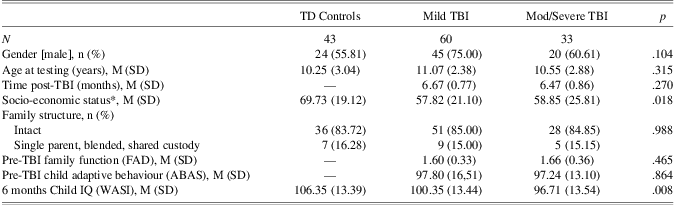
Group comparisons identified no differences for gender, age at testing, time post injury, or family structure. Similarly, pre-injury measures of family function and child adaptive behavior were equivalent across groups. Significant differences were present for SES and child IQ (Table 1).
Sample demographics
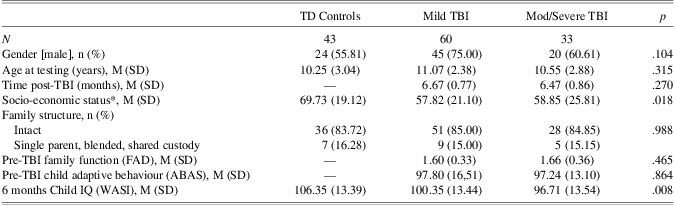
*Australian Socioeconomic Index 2006; FAD = Family Assessment Device: ABAS-II = Adaptive Behavior Assessment System-II; WASI = Wechsler Abbreviated Intelligence Scale.
Social Competence at 6 Months Post-TBI
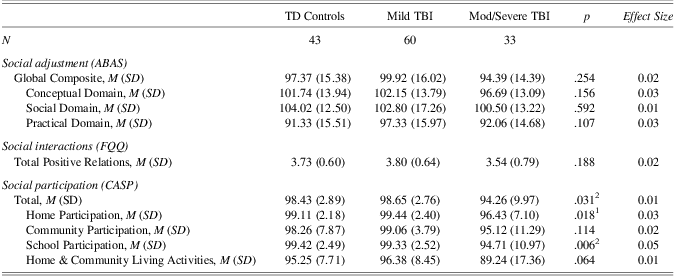
Significant group differences were identified for social participation (CASP) (Table 2). For the CASP, children with moderate/severe TBI were rated with less age-appropriate levels of participation than both TD controls and mild TBI groups for School and Total Participation (p = .006 and p = .031, respectively), with post hoc analyses showing significant difference between the two TBI groups. After using a family-wise error adjusted p-value, group differences identified for Home Participation became non-significant (p = .018).
Social outcomes at 6-months post-TBI
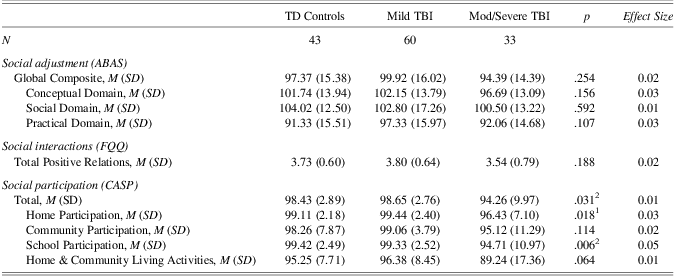
Effect size = eta2/Pseudo R2 (for CASP), where 0.01 = small, 0.06 = medium, and 0.14 = large (Cohen, 1988); ABAS-II = Adaptive Behavior Assessment System-II; FQQ = Friendship Quality Questionnaire; CASP = Child and Adolescent Scale of Participation.
1=Not significant following family-wise error p-value adjustment.
2=Significant post hoc comparison; TD Controls vs. Moderate/Severe, Mild vs. Moderate/Severe.
Cognitive Abilities at 6 Months Post-TBI
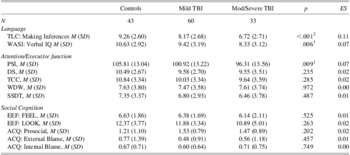
Significant group differences were detected for communication measures (TLC: p < .001; and VIQ: p = .009). For the TLC, post hoc analysis showed significant differences between the TD and moderate/severe TBI groups, and the mild TBI and moderate/severe TBI groups, with more severe TBI associated with poorer performance. For Vocabulary, the moderate/severe TBI group scored significantly more poorly than the mild TBI group. A significant group difference was also found for processing speed (PSI: p = .002), with post hoc results again identifying differences between TD controls and moderate/severe TBI groups. No group differences were detected on other measures of attention/executive function, nor on any of the social cognition measures (Table 3).
Cognitive outcomes at 6-months post-TBI

Effect size = eta2; TLC = Test of Language Competence–Making Inferences; WASI = Wechsler Abbreviated Scale of Intelligence; PSI = Processing Speed Index; DS = Digit Span; CC = Creature Counting; WDW = Walk Don't Walk; SSDT = Sky Search Dual Task; EEF = Emotional and Emotive Faces; ACQ = Attributions and Coping Questionnaire.
1=Significant post hoc comparisons; TD control vs. moderate/severe TBI.
2=Significant post hoc comparison; TD control vs. moderate/severe TBI, mild TBI vs. moderate/severe TBI.
Injury Characteristics
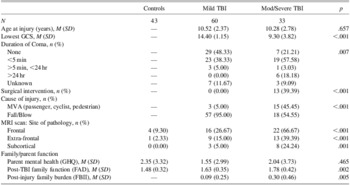
For injury variables, comparisons of Mild and Moderate/Severe TBI groups showed expected differences: radiological findings, surgical intervention, lowest GCS (all p < .001), and duration of coma (p = .007). Cause of injury was predominately falls/blows for Mild TBI (95.16%). For the Moderate/Severe group, falls/blows (55%) and motor vehicle accidents (45%) were equally common. The groups did not differ for age at injury. Lesion site differed across groups (all p < .01), with frontal pathology most common for all severity groups, and identified in 26% of children with Mild TBI and 63% of those with Moderate/Severe TBI. Of note, incidental findings were identified on MRI for 4 TD children (Chiari 1 malformation, arachnoid cyst, calcification of choroid plexus, and small pineal cyst). In each case, these were non-symptomatic (see Table 4).
Injury and environmental characteristics

GCS = Glasgow Coma Scale; GHQ = General Health Questionnaire; FAD = Family Assessment Device; FBII = Family Burden of Injury Inventory.
Environment
There were no group differences for post-injury parent mental health (GHQ) (see Table 5), but the groups did differ on other proximal factors including family function (FAD: p = .002) and perceived family burden (FBII: p = .005), with more severe TBI associated with poorer family function and higher perceived burden.
Hierarchical regression analysis predicting social outcomes from cognitive, injury, and environmental factors

B = Unstandardized correlation coefficient; ABAS-II = Adaptive Behavior Assessment System-II; FQQ = Friendship Quality Questionnaire; CASP = Child and Adolescent Scale of Participation; TLC = Test of Language Competence–Making Inferences; VIQ = Verbal IQ; PSI = Processing Speed Index; GCS = Glasgow Coma Scale; FAD = Family Assessment Device; SES = Socio-economic Status (AUSIE06).
Predictors of Social Outcomes
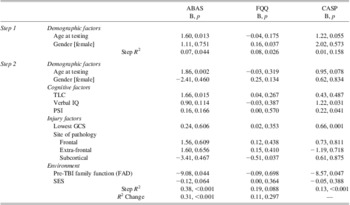
To predict social outcomes, we conducted hierarchical regression/Tobit regression analyses using significant between-group variables to predict total scores from the ABAS, CASP, and FQQ. Step 1 of the models included demographic information (age at testing, gender), and Step 2 included cognitive (TLC, Vocabulary and PSI), injury (lowest GCS, site of pathology) and environmental (SES, FAD) variables as predictors. Inspection of variance inflation factors found no indication of multicollinearity (highest VIF = 1.82). Findings from these analyses are provided in Table 5.
Hierarchical regression results showed that, for self-report measures of friendship (FQQ), very few variables significantly predicted child scores. For the FQQ, gender was the single significant predictor with females reporting more positive friendship quality (p = .037) at Step 1 (step p = .026). Step 2 found that those with subcortical pathology reported lower friendship quality (p = .037); however, the R 2 Change was not significant, indicating that injury, cognitive, and environmental factors do not better predict FQQ beyond demographic information.
For parent-rated measures of social competence (ABAS-II, CASP), several significant predictors were detected. For ABAS-II at Step 1, higher child age at testing was associated with better adaptive function (p = .011). Beyond demographic factors, better family function (FAD, p = .044) and language competence (TLC, p = .015) significantly predicted higher social competence (R 2 Change p < .001). For the CASP, demographic information did not significantly predict participation. However, communication and processing speed (Vocabulary: p = .031; PSI: p = .041), as well as poorer family function (FAD: p = .047) and higher injury severity (GCS: p < .001) were found to be significant predictors of lower participation. SES and frontal and extra-frontal site of pathology did not contribute significantly to any of the social outcomes.
Discussion
Consistent with previous research (Anaby et al., Reference Anaby, Law, Hanna and Dematteo2012; Ganesalingam, Sanson, et al., Reference Ganesalingam, Sanson, Anderson and Yeates2007; Ganesalingam, Yeates, et al., Reference Ganesalingam, Yeates, Sanson and Anderson2007; Rosema et al., Reference Rosema, Crowe and Anderson2012), results from the current study provide partial support for elevated risk of reduced social competence in the early recovery period following childhood TBI, although problems were only evident for social participation. Furthermore, children with mild TBI scored similarly to TD controls across all social domains. Based on parent ratings, children with moderate to severe TBI were found to have reduced levels of social participation overall and within the school environment. There was a trend for group differences at Home as well (p = .018). In contrast, at 6 months post-injury, there was no evidence of disturbances on parent ratings of social adjustment or to social interactions from child self-report questionnaires. These results may be simply interpreted to suggest that social adjustment and interactions are intact following child TBI, despite reductions in social participation and adjustment. However, given that the reported data refer to 6-month outcomes, when more severely injured children may still be in the transition to return to school, the magnitude of social problems may not yet be apparent. Follow-up of these children is planned for 12 and 24 months post-injury, where these alternatives may be better addressed.
Examination of predictors purported to contribute to social function (cognitive function, injury characteristics, and environment) revealed the expected pattern of findings, with more severe TBI associated with poorer outcomes overall. Within the cognitive domain, children with moderate/severe TBI performed poorest on measures of communication and processing speed. In addition, poorer communication contributed to lower social adjustment and reduced social participation. Within the attention/executive function domain, other than for processing speed, there was a non-significant trend for lower scores to be associated with more severe TBI. For social cognition, no consistent relationship was identified for injury severity, and none of these measures predicted social outcomes.
Analysis of environmental influences demonstrated severity effects for post-injury family function and perceived burden at 6 months post-TBI, and contributed significantly to 6-month social adjustment and participation. SES, the “distal” measure of environment, was not related to social outcomes. Findings from previous research examining early outcomes from child TBI, which suggest that environmental effects increase with time since injury, with social and behavioral problems increasing in the context of environmental problems such as family dysfunction (Anderson et al., Reference Anderson, Catroppa, Morse, Haritou and Rosenfeld2009, Reference Anderson, Brown and Newitt2010; Yeates et al., Reference Yeates, Taylor, Walz, Stancin and Wade2010), need to be considered in future studies of this sample.
Exploration of injury-related factors revealed the expected effects of injury severity, particularly for social participation, as described above. However, site of pathology did not assist in explaining social outcomes, despite findings from previous studies linking regions of the social network to specific aspects of social cognition, such as theory of mind and intent attribution (Adolphs, Reference Adolphs2001, Reference Adolphs2009; Hanten et al., Reference Hanten, Wilde, Menefee, Li, Lane, Vasquez and Levin2008). It may be, however, that while specific social cognition skills map onto discrete brain regions, social competence requires the integrity of a broad range of brain regions.
Examination of child characteristics found that younger age at testing was associated to poorer social adjustment and male gender was the single predictor of impaired friendship quality.
Study results must be interpreted in the context of methodological limitations. In particular, the lack of findings for the social cognition domain are surprising, and may be due to limitations of the measures used, which are largely experimental with less established psychometric properties. Unfortunately, few psychometrically sound and age-appropriate measures are currently available which are sensitive to the social problems experienced by children with acquired brain injury. Disparate findings achieved from parent-rated and child-based questionnaires are also noteworthy, and the design of the current study is unable to tease out the possible causes of these results. An additional weakness, inherent in all TBI research, is the heterogeneity of the sample and the broad categories used to differentiate injury severity. Further review of this sample will be valuable in describing the trajectory of social recovery post-TBI.
Conclusions
Children with TBI are at risk for social impairments in the first 6 months post-injury, although these social problems do not appear to be global. Social participation appears most vulnerable, with more severe injuries leading to greater problems in this domain. A search for predictors of social outcomes identified few consistent findings at this early stage post-injury. Greater injury severity and lower communication skills were associated with lower social adjustment and social participation, with the impact of family function also significant. Other contributions to poorer social outcomes came from reduced processing speed (participation), younger age (social adjustment), and male gender (social interactions). SES and site of brain pathology were not predictive of social competence. Further follow-up of this sample is required to track the recovery of social skills post-TBI, to detect the possible emergence of new social problems as children begin to re-establish normal lives, and to explore the changing influences of cognition, brain and environment over time.
Acknowledgments
The Victorian Neurotrauma Initiative funded this research, and it was also supported by the Victorian Government Operational Infrastructure Scheme. The authors declare no conflicts of interest.