Older adults constitute the fastest growing, low vision group within industrialized countries (Watson, Reference Watson2001). Low vision is defined as a permanent “loss of visual acuity (i.e., less than 6/18 but at least 3/60) or visual field (i.e., less than 20 degrees) in the better eye, not correctable by spectacles, contact lenses, or intraocular lenses” (Spafford, Laliberte Rudman, Leipert, Klinger, & Huot, Reference Spafford, Laliberte Rudman, Leipert, Klinger and Huot2010, p. 580). The most common low vision conditions include age-related macular degeneration (AMD), glaucoma, and diabetic retinopathy, with such conditions often collectively referred to as age-related vision loss (ARVL) (Watson, Reference Watson2001). The severity of age-related vision loss typically increases over time, resulting in particular functional difficulties (Watson, Reference Watson2001). For example, macular degeneration, which results in central vision loss, impacts the performance of activities such as reading, writing, and recognizing faces; glaucoma results in a loss of peripheral vision, which commonly impacts tasks such as community mobility and driving whereas diabetic retinopathy is associated with fluctuating visual acuity leading to variability in functional losses. It is not uncommon for older adults to have multiple ARVL conditions at once, which further complicates functional difficulties.
An abundance of research has focused on demonstrating the association between ARVL and disability, including activity limitations in the areas of self-care (Berger & Porell, Reference Berger and Porell2008; Grue et al., Reference Grue, Ranhoff, Noro, Finne-Soveri, Jensdottir, Ljunggren and Jonsson2008; Knudtson, Klein, Klein, Cruickshanks, & Lee, Reference Knudtson, Klein, Klein, Cruickshanks and Lee2011), leisure (Boerner & Wang, Reference Boerner and Wang2010; Desrosiers et al., Reference Desrosiers, Wanet-Defalgue, Temisijian, Gresset, Dubois, Renaud and Overbury2009), and productivity (Alma, Van der Mei, Groothoff & Suurmeijer, Reference Alma, Van der Mei, Groothoff and Suurmeijer2012; Lamoureux et al., Reference Lamoureux, Pallant, Pesudovs, Rees, Hassell and Keeffe2007). For the most part, this research locates the causes of disability within characteristics of the individual, including various measures of visual impairment in combination with other bodily impairments, behaviours, and characteristics (Laliberte Rudman et al., Reference Laliberte Rudman, Egan, McGrath, Gardner, King and Ceci2016; McGrath & Laliberte Rudman, Reference McGrath and Laliberte-Rudman2013). Although disability studies’ perspectives have highlighted the ways in which disability is produced through social, cultural, institutional, and political environmental features (Ferguson & Nusbaum, Reference Ferguson and Nusbaum2012), research addressing how the environment shapes disability among older adults with vision loss is sparse. When environmental factors are addressed, research is often centred exclusively on physical and, to a lesser degree, social environmental components. From a physical standpoint, environmental features such as weather, season, time of day, and lighting have emerged as influences on activity participation among older adults with ARVL in qualitative studies (Laliberte Rudman, Huot, Klinger, Leipert & Spafford, Reference Laliberte Rudman, Huot, Klinger, Leipert and Spafford2010; MacLachlan, Laliberte Rudman, & Klinger, Reference MacLachlan, Laliberte Rudman and Klinger2007). Research has addressed the impact of physical environmental modifications on supporting activity engagement (Stevens-Ratchford & Krause, Reference Stevens-Ratchford and Krause2004; Wahl, Oswald, & Zimprich, Reference Wahl, Oswald and Zimprich1999), and fostered the development of vision-specific assessments regarding lighting, contrast, visual distractions, and glare to detect home safety issues (Barstow, Bennett & Vogtle, Reference Barstow, Bennett and Vogtle2011). From a social environmental perspective, studies have focused predominantly on social support and challenging social interactions for older adults with ARVL. For example, Girdler, Packer, and Boldy (Reference Girdler, Packer and Boldy2008) found that relying on social networks helped to support adaptation to vision loss and foster inclusion in activity engagement. Other studies have found that older adults expressed feelings of resentment associated with dependence on family members and often limited their engagement in daily activity rather than ask for help (Laliberte Rudman et al., Reference Laliberte Rudman, Huot, Klinger, Leipert and Spafford2010; Laliberte Rudman & Durdle, Reference Laliberte Rudman and Durdle2008). Teitelman and Copolillo (Reference Teitelman and Copolillo2005) have highlighted how social environmental difficulties faced by older adults with ARVL are connected to feelings of stigma and embarrassment, particularly in public settings.
To date, consideration of the environmental production of disability among seniors with ARVL has been limited in two ways. First, little attention has been paid to the ways in which cultural, political, and institutional environmental components are implicated. Second, this research is pervaded by an individualist approach that tends to look at the impact of physical and social environmental components as factors that can be overcome through individual adaptation (Hooyman & Kiyak, Reference Hooyman and Kiyak2008), thereby disregarding the “configuration of sociomaterial space as an important site for the (re)production of disability” (Korotchenko & Hurd Clarke, Reference Korotchenko and Hurd Clarke2014, p. 432). Such a perspective is limited because it fails to acknowledge that older adults with ARVL often struggle to access their environments as a result of a societal prioritization of the nondisabled body coupled with a social failure to accommodate difference, including difference based on age and disability (Kitchin, Reference Kitchin2000; Oliver, Reference Oliver, Swain, French, Barnes and Thomas2004).
Moving away from this individualizing framework is disability studies, an interdisciplinary approach to research and scholarship (Ferguson & Nusbaum, Reference Ferguson and Nusbaum2012). Disability studies refers to a broad matrix of theories, pedagogies, and practices directly antagonistic to the view of disability as personal tragedy or individual pathology, instead explicating disability as a social, political, and cultural phenomenon (Ferguson & Nusbaum, Reference Ferguson and Nusbaum2012; Linton, Reference Linton1998; Mallett & Runswick-Cole, Reference Mallett and Runswick-Cole2014). Within the aging literature, there is an emerging body of critically informed research addressing how disability for older adults is constructed through environmental contexts. For example, Grenier (Reference Grenier2005) undertook narrative interviews with 12 older women with the intent of understanding meanings of frailty, disability, and decline within the context of their everyday lives. Using the examples of the home and bus, she showed that understandings of disability were overwhelmingly focused on the body yet the women’s experiences of disability were connected more to the environmental context in which disability was experienced than to their impairment and associated functional restrictions.
Raymond, Grenier, and Hanley (Reference Raymond, Grenier and Hanley2014) explored how 12 aging people with disabilities experienced and understood the notion of social participation, of which access to inclusive community settings was one key component. They found that the disabling impact of the environment increased the risk of community participation exclusion, and they advocated for “shifting responsibility for inclusive practices to society, rather than onto the individual” (p. 57). Lastly, Korotchenko and Hurd Clarke (Reference Korotchenko and Hurd Clarke2014) engaged 29 older adults (aged 51–92 years old) in qualitative interviews to understand the experience of power mobility within the context of the built environment. Participants revealed a variety of environmental barriers to mobility encountered in public spaces that served to transform “their power mobility devices into machines of disablement” (p. 438) and caused them to feel “out of place” relative to their nondisabled counterparts.
This article adds to this emerging body of critical gerontological work by addressing the socio-political production of disability for older adults with ARVL. For this article, we drew on data from a broader critical ethnographic study that focused on situating the day-to-day experiences of older adults with ARVL within physical, social, cultural, political, and institutional environmental factors. This study aimed to reveal the ways in which environmental barriers, embedded in an ageist and disablist society, produced and perpetuated the experience of disability for older adults with ARVL. Ageism, a term first coined by Robert Butler in 1968, refers in this article to discrimination and stereotyping against people on the basis of their age. It is a socially constructed concept, which reinforces the structural inequalities faced by older adults (Angus & Reeve, Reference Angus and Reeve2006), resulting in stigmatization, discrimination, and social exclusion (Bytheway, Ward, Holland, & Peace, Reference Bytheway, Ward, Holland, Peace, Bernard and Scharf2007; Calasanti, Reference Calasanti2008; Clarke & Griffin, Reference Clarke and Griffin2008; Katz, 2001–Reference Katz2002). Similarly, the term disablism here refers to discriminatory and oppressive behaviour arising from the belief that people with disabilities are inferior to others, which serves not only to shape the identities of individuals with disabilities but also shapes existing social and political processes (Miller, Parker, & Gillinson, Reference Miller, Parker and Gillinson2004). Lastly, as supported by a disability studies perspective, the term disability in this article is understood as a social and political category versus something to diagnose, identify, and label in individuals (Ferguson & Nusbaum, Reference Ferguson and Nusbaum2012, p. 76). Unlike impairment, which refers to the functional limitations of the body caused by physical, psychological, or sensory impairment, disability is defined in social terms, as the consequence of physical and social barriers which limits opportunities for persons with disabilities (Mallett & Runswick-Cole, Reference Mallett and Runswick-Cole2014). The findings generated from this study can inform the development of age and low-vision-friendly environments that more fully support the activity engagement and inclusion of older adults with vision loss.
Guiding Theoretical Frameworks
This study was underpinned by the key tenets of critical gerontology (Estes, Biggs, & Phillipson, Reference Estes, Biggs and Phillipson2003; Minkler & Holstein, Reference Minkler and Holstein2008; Ray & Cole, Reference Ray and Cole2009) and disability studies perspectives (Ferguson & Nusbaum, Reference Ferguson and Nusbaum2012; Linton, Reference Linton1998; Mallett & Runswick-Cole, Reference Mallett and Runswick-Cole2014). Critical gerontology aims to question taken-for-granted assumptions about what it means to age well and “the seemingly un-reflexive ways in which gerontological knowledge is created” (Holstein & Minkler, Reference Holstein and Minkler2003, p. 789). It makes the inequality of the aging process visible and highlights how older adults are disenfranchised by political and social oppressive forces (Estes et al., Reference Estes, Biggs and Phillipson2003; Minkler & Holstein, Reference Minkler and Holstein2008). Disability studies reflect not only an intellectual but also a political endeavour (Linton, Reference Linton1998). There were a series of motivating forces behind the establishment of disability studies including (a) the individualization of disability; (b) the objectification of people with disabilities in scholarship; (c) the categorization/labelling of disability; (d) the medicalization of disability and pathologizing of difference; and (e) the conflation of impairment and disability (Linton, Reference Linton1998). Disability studies re-conceptualizes disability by recognizing the social, cultural, political, and historical aspects of disability while at the same time acknowledging the impact of the body and associated physiological aspects of impairment (Baglieri, Valle, Connor, & Gallagher, Reference Baglieri, Valle, Connor and Gallagher2010; Ferguson & Nusbaum, Reference Ferguson and Nusbaum2012). Disability studies, however, advocates for moving beyond helping people with disabilities deal with their “personal tragedies” and instead focuses on mobilizing resources to alter the social terrain (Linton, Reference Linton1998). In this sense, it represents a shift away from “person-fixing” towards “context-changing” (Trickett, Watts, & Birman, Reference Trickett, Watts, Birman, Trickett, Watts and Birman1994, p. 18). Disability studies seeks to augment current understandings of disability, promote greater awareness of the experiences of persons with disabilities, and advocate for social, cultural, and political change (Ferguson & Nusbaum, Reference Ferguson and Nusbaum2012).
Methodology and Methods
We adopted a critical ethnographic approach for this study. Conventional ethnography asks “what is?” while critical ethnography asks “what is?” and “what can be done about it?” (Cook, Reference Cook2005; Madison, Reference Madison2012). In this sense, critical ethnography is focused on eliciting not only the research participants’ point of view but also questioning the prevailing status quo and dominant power structures present within a particular culture that serve to constrict marginalized people’s lives (Cook, Reference Cook2005; Simon & Dippo, Reference Simon and Dippo1986; Thomas, Reference Thomas1993). As such, we focused not only on understanding the day-to-day experiences of older adults with ARVL, but we also aimed to situate those experiences in larger social systems and structures in order to reveal the ways in which disability is socio-politically constructed and results in marginalization and barriers to activity engagement for older adults with ARVL.
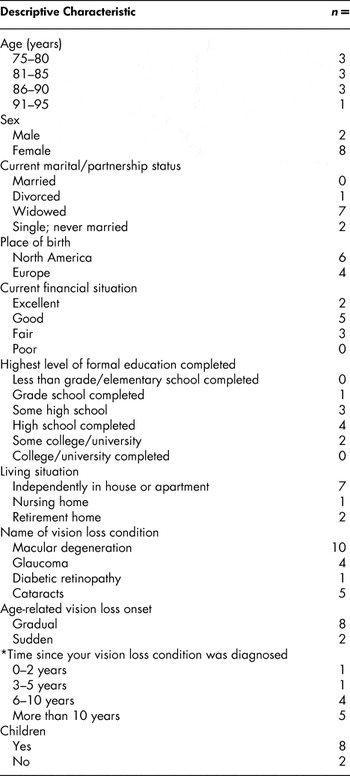
We purposively sampled 10 older adults with low vision for this critical ethnographic study because of their rich lived experience with vision loss. Participant recruitment occurred in a mid-sized Canadian city and surrounding rural communities. Following discussion with the research team, it was iteratively decided to stop data collection after 10 participants had been interviewed given the richness of the data collected at that point. The first author recruited participants through in-person presentations, organizational contacts, and newspaper advertisements. To participate in the study, participants needed to meet the following inclusion criteria: (1) age 75 years and older; (2) a diagnosis of ARVL (macular degeneration, glaucoma, and/or diabetic retinopathy); (3) self-identify as experiencing functional impairments due to ARVL; and (4) able to communicate effectively in English (see Table 1 for full sample details).
Participant demographic chart (n = 10)

* Eleven time points have been noted as participant P7 noted different dates of diagnosis for the macular degeneration and glaucoma.
We adopted a modified version of Carspecken’s (Reference Carspecken1996) five-stage approach for critical ethnography. In stage one, building a primary record, Carspecken calls for the collection of data through passive observation. Coding begins in stage two, labelled reconstructive analysis, where speculations are made regarding the interactions recorded in the primary record. As part of the third stage, dialogical data generation, Carspecken integrates interviews or researcher-facilitated group discussion to gain an insider, or ‘emic’ position. Stage four, discovering systems relations, is centred on uncovering relationships between specific social sites, and in stage five, there is a focus on explaining study findings through existing macro-level social theories. Although the steps of Carspecken’s five-stage model are presented linearly, he supports the adoption of a loosely cyclical process in which the researcher is able to move fluidly from one stage to another and back again. For example, Carspecken engaged primarily in educational research but recognized that, in certain contexts, beginning with unobtrusive observation may be impractical for the proposed research, as it was in the case of this study. As such, although Carspecken’s model was used to focus the data collection process, we adopted a modified version of the multi-stage critical ethnographic approach, as described next. Changes were made primarily to the sequence in which data was collected, starting with dialogical generation and then shifting to observation, with various forms of analysis occurring throughout.
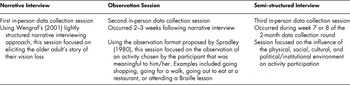
Data collection occurred over a period of nine months. All meetings were scheduled on dates, times, and locations that were convenient for the participants. Older adult informants participated in a narrative interview, participant observation session, and a semi-structured, in-depth interview (see Table 2). The first data collection method involved an audiotaped narrative style interview focusing on participants’ stories of living with ARVL. Wengraf’s (Reference Wengraf2001) narrative interviewing approach was used in order to elicit the participants’ stories. The second stage of data collection involved a participant observation session in which the primary author participated in an activity chosen by the participants. These activities ranged from community-based activities such as grocery shopping or going out to eat at a restaurant to activities done in the home such as attending a Braille lesson or enjoying a home-cooked meal with others. By engaging in these observations, the first author was able to attend to how various layers of the environment influenced the participants’ ability to carry out their chosen activity. A semi-structured, in-depth interview was the third, and final, data generation method for the older adult participants with ARVL. During this stage of data collection, the first author focused on understanding the impact of various physical, social, cultural, political, and institutional environmental factors on daily activity engagement. Ethics approval for this study was obtained through The University of Western Ontario Research Ethics Board in October 2012.
Data collection process for the older adults with ARVL

Data analysis occurred simultaneously with data collection, such that emerging findings informed subsequent data collection. All interviews were audiorecorded and transcribed verbatim. The first author subsequently analysed each transcript; however, resulting codes and categories were refined through ongoing team meetings to engage in collective reflexivity, which expanded possibilities for coding. In addition, the first author maintained a reflexive journal throughout the analysis process as a way to challenge assumptions and be open to multiple ways of “seeing” the data. Each transcript and observation field note was coded individually, using both low level (open) and high level (theoretical) coding in order to develop a rich understanding of the data before codes were compared across participants to form categories and themes (Carspecken, Reference Carspecken1996). The theoretical perspectives previously described were drawn into the analysis to explain the findings in ways that inter-connected with broader environmental elements.
Results
To illustrate the various ways that environmental elements contributed to the shaping of disability for the participants, three commonly discussed activities –shopping, eating, and community mobility – are presented. Within the presentation of the results, code numbers are used to identify participants, and the names of people, places, and organizations have been removed from quotes to protect participant anonymity. Within each of these examples, the complex ways that various environmental elements interacted to shape and perpetuate disability for older adults with ARVL are foregrounded.
Eating
Relative to the task of eating, participants related a variety of challenges to their visual impairment including not being able to appropriately portion manageable bites; dropping food unknowingly; not being able to identify food items; and misidentifying cutlery. In speaking about the inability to recognize food on her plate, P5 stated:
The girls put a plate down, and if they don’t tell me what’s on it, the salmon is white, the potatoes are white, and sometimes the vegetables white … I look at the girl sitting beside me at the table and I’ll say … can you tell me what’s this over here? And she’ll say, oh, you got potatoes there, you got fish there, and you got your vegetable here. Okay, fine, I’m all right now, long as I know where things are.
In addition, the participants highlighted a variety of disabling environmental features faced when engaging in the daily activity of eating. For example, as an alternative to cooking, some participants chose to eat their meals out at local restaurants; however, this was not accomplished without challenges, including difficulty reading menus. That is, the use of small print and glossy materials on restaurant menus created and sustained the disability experience for the participants. Congruent with disability studies perspectives, the participants had impairment (i.e., age-related vision loss) at all times; however, they were “disabled” when the environmental context did not accommodate difference and was unsuitable to meet their needs.
To address this environmentally located challenge, participants did not question why materials were presented in inaccessible ways. Rather, they described the adoption of individual strategies, such as planning where to eat based on the restaurant’s daily special so that consulting a menu was unnecessary. Although such strategies were often described as effective, they also narrowed the range of possibilities in terms of where participants could engage in the activity of eating out:
I can’t read most menus because they’re on glossy paper or they have that laminated thing. So I know most of their menus now. (P7)
For many participants, their challenges with eating had less to do with the physical act of feeding themselves and more to do with a fear of social embarrassment. For example, participants described feeling embarrassed about eating out at restaurants and so adopted certain individual-level compensatory strategies such as choosing a non-messy meal option and being cautious in order to minimize embarrassment caused to themselves or others:
So I pick a dish that is not messy … Try not to … I never really thought that I would be embarrassing to people who’d bring me for dinner, but I have to be a little more careful now that I don’t spill it or something or knock something over. I gotta pay attention, more than before. (P1)
Based on the choices participants made to go to restaurants where they were familiar with the menu options, thereby eliminating the need to ask for help, and choosing meals that were perceived as “non-messy”, older adults took personal steps to function as “normal” as possible when engaging in eating tasks.
Such feelings of perceived social embarrassment further led participants to limit their eating out at restaurants as a result. For example, P1 stated:
I don’t go out much anymore because I can’t see, I can’t see what I’m eating on my plate, eh, and I don’t want to make a mess or I’m a little embarrassed if I spill something eh, so I really don’t feel as relaxed eating in a restaurant as I used to.
By limiting their social engagement, the participants may be at a greater risk of social exclusion, which, in turn, may lead to a sense of disablement and a heightened sense of vulnerability, marginalization, and social devaluation (Korotchenko & Hurd Clarke, Reference Korotchenko and Hurd Clarke2014).
Shopping
Shopping was a frequently discussed activity in which the organization of environmental spaces disabled older adults with ARVL. Concerning the task of shopping, some of the more frequently noted and/or observed difficulties participants encountered included reading prices; finding items on crowded shelves; and navigating around store displays. Instead of situating such features of the environment as being within the responsibility of society to address, commensurate with broader socio-political forces that individualize disability, study participants frequently individualized such challenges and attempted to devise personal strategies to deal with the environmental barriers. For example, participants discussed adapting how they completed their shopping, including asking for help, using assistive devices such as a magnifying glass, and/or only shopping in familiar stores or buying familiar products. P7 stated:
I mean I have a magnifier with me when I go to the stores but it’s so difficult to read that small print, even with a magnifier, that it’s not worth it. So I only buy the brands that I’m used to.
Another commonly discussed challenge of shopping was managing money, including using debit machines. Participants described asking family, friends, or store employees to help them distinguish bills as well as navigate debit machines. Due to the limiting features of the debit machines, including difficult-to-read print and screen glare, participants were forced to rely on others, including strangers, to help manage their private banking affairs, thereby posing a potential financial risk to the participants. During the observation visit with P4, for example, the participant requested that the first author pay the cashier at the convenience store they had visited. Further examples include these:
I need a lot of help … Even my debit card – I have to, they [referring to store clerk] even have to put my number in, I can’t see it. (P2)
I can see them; it’s just that, there again, every once in a while, it’s a different kinda machine, and I think, “What does that mean?” I have to ask. You know, if they were all the same, it would be easy, wouldn’t it? (P9)
The lack of consistency between devices was a significant source of frustration surrounding the use of debit machines. Indeed, the importance of familiarity and consistency was discussed frequently by participants within the context of shopping, with a great deal of frustration expressed when product layout and/or labels were changed as well:
I usually, I’m a creature of habit with food now especially, I have to. And I know what it is. I know by looking at the label unless they change it. That makes me angry because they keep changing the bottles. (P9)
The pharmacy changed where the things are on the shelf. When you go to the drugstore, you know where the toothpaste is and now it’s gone because they moved it … They seem to delight in changing things. (P10)
These examples demonstrate the subtle ways in which participants felt that their bodies were “out of place” (Kitchin, Reference Kitchin1998, p. 354) in a predominantly nondisabled environment. Their feelings of distress and frustration reflected a deeper entrenched feeling of being unwelcomed in a space that did not consider the needs of older adults with vision loss. By moving items around the store, placing obstacles in aisles, changing product labels, and affixing difficult-to-read prices on store shelving, participants were “disabled” as a result of their changing environments, which significantly contributed to their struggles with day-to-day activity.
In addition to the above-mentioned challenges with shopping, participants, such as P6, also discussed a deeply entrenched sense of vulnerability and fear of being taken advantage of in the community when completing shopping errands:
When I go out I don’t wear any rings or anything and I don’t dress fancy or anything … I don’t want to look like a mark. If I can’t see that something is coming that way, I’d be taken advantage of. Of course, I’m a sitting duck. If I can’t see, they can grab it [referring to her purse] and I don’t even know which way they’ve gone. (P6)
Community Mobility
A number of mobility enablers existed in the communities where participants lived, such as audible crosswalks, urban Braille, sidewalks outlined in yellow paint to identify the sidewalk boundary, and automated bus announcements. Despite these enablers, nearly all of the participants recounted experiences where they faced barriers to community mobility. For example, participants travelling outside their immediate neighbourhood expressed fear stemming from not being able to see the “hand” and “walk” symbols at crosswalks, having to rely on listening for traffic surges to determine when it was safe to cross the road, and having to cross busy intersections when not enough time was provided to cross safely. Several participants spoke to these challenges:
Well, actually, I mean I listen to the sound of traffic at stop lights. We at this corner are fortunate, we have the whistle sound [audible crosswalk], but when you cross over to the other streets it’s strictly by traffic sound and that can be scary. (P8)
Especially with the sunlight, you know, you don’t see the lights [referring to crosswalk signals], like the sunlight shines in the light, and you can’t see it, and then usually I just hope there’s someone else I can ask if it is safe to go across. (P2)
There are such busy streets around here, and they only give you just enough time to get across. As soon as the light changes you gotta be there, ready to go, and the cars are ready to go also when it’s their time. It’s really tight … They just don’t give you any time and if you’re just a little slow, it’s gonna change before you get across. (P10)
These examples further highlight how disability is produced by the transaction of the bodily experience of visual impairment with inaccessible features of the environment. For example, the amount of time provided at a crosswalk is based on ageist and disablist social assumptions – mainly, that all persons are able to see the hand and walk symbol, and they have the necessary capabilities to cross the road in a given amount of time. When sufficient time is not provided, older adults with ARVL are disabled on account of the environmental context failing to accommodate or support differences from normative standards.
Several participants also spoke about their fear of falling within the community as well as when taking public transportation:
I watch the cracks in the sidewalk. I watch where I put my feet when I walk because I don’t want to trip. It’s so easy to trip. That can spoil your whole life. I’ve seen it happen to seniors around here. (P6)
And if I go in with a walker, and he [bus driver] drives away while I’m still walking, that’s a no-no, they’re not supposed to do that, they have to wait until I sit down, and sometimes they don’t. (P2)
These fears were often actualized due to largely system-level issues such as poorly maintained infrastructure (e.g., cracked sidewalks) as well as the apparent poor training of bus drivers regarding the needs of older adults with vision loss. In fact, during the observation visits with P2, P6, and P9, bus drivers were observed to begin driving before the participants were safely seated.
Participants managed their community mobility as they did other environmentally produced challenges. They discussed using a variety of individual-level compensatory strategies such as the following: listening for traffic surges; planning trips ahead; using landmarks; visualizing a space; counting steps; using familiar routes; concentrating and being cautious; and asking for help. For example, in speaking about the importance of planning trips ahead of time, P6 stated:
I have the schedule so that if I happen to miss one of the buses I know what time the next one is coming because I can’t be stuck somewhere where I’m not quite sure where I am and not to know what time the next bus is coming. If I could see perfectly, I would know, I walk over here … or the next bus stop is here. I can’t see where the next bus stop is. That’s why it’s important for me to know what time the next bus is coming.
During the observation visit, P7 was observed to use landmarks in order to navigate her physical space. For example, in the pharmacy, she walked until she reached the eyeglasses and then turned left down the aisle that brought her directly to the exit. Unfortunately, a promotional display had been placed in the aisle, which P7 hit twice in her attempt to navigate around it.
Participants also discussed their use of a white cane and/or a “Traveler with Vision Loss” sign affixed to their walker as a means of conveying their vision loss to others when travelling in the community. For example, P6 noted:
Once you are blind, you have your white cane. I guess if you have your white cane with you all the time it’s more obvious then to people [that you have a disability].
For some participants, the use of “obvious” identifiers of vision loss also minimized the risk of confrontations with other pedestrians, in a case whereby the older adults with ARVL accidentally bumped into them. For example, in speaking about her friend with vision loss and a recently obtained white cane, P9 stated:
Before she got the white cane, people were rude. One guy even stopped and said “What’s the matter with you lady? You blind or something?” I said, “Yes, she is!” Then, he shut up. Once she had the white cane, she said, “Boy, with this thing, I can move mountains.” Oh what a difference it made. Isn’t that funny? They don’t stop and think; they just snap.
Similarly, P7 stated that her reason for carrying a white cane in the community was for insurance, so that if she accidentally hit someone, her visible white cane meant people were not justified in getting angry with her:
Usually they have a scowl on their face when they turn around and then they see the white cane and they’re almost syrupy sweet afterwards, which doesn’t cut it as far as I’m concerned. They should be observant of their environment, just as much as I try to be.
The use of the white cane was described as simultaneously enabling and disabling as it related to community mobility. Although, for some participants, the use of the white cane promoted their independence, others noted how their use of a white cane caused their impairment to be highlighted and otherwise brought to the foreground, thus marking their bodies as “other” relative to the nondisabled norm (Korotchenko & Hurd Clarke, Reference Korotchenko and Hurd Clarke2014). These latter participants remained hesitant to use such identifiers in the community not only because of the stigma associated with being “disabled”, but also because they feared it would signal their vulnerability to others. For example, P1 spoke about her hesitation of affixing a “Traveler with Vision Loss” sign to her walker:
Like somebody said to me that works for [name of organization], maybe they’re right but I think they’re dead wrong, “put a sign up on your walker, visually impaired.” And that sounds good, right? So if you bump into something they know you’re not drunk or stupid, that you’re visually impaired. But what about all the rotten people in the world that are just waiting to put you as a victim. You’re saying, look at me, I’m a victim. I’m easy to pick on, I’m easy pickings. Do I want to do that? No. (P1)
Even with the use of obvious identifiers of vision loss, participants found a general lack of understanding among the public particularly when the impairment was invisible, as age-related vision loss often is. This assumption, that the older adult was impairment-free, meant that requests for assistance were sometimes met with skepticism. For example, P6 spoke about the difficulty she encountered while trying to have her toenails cut at a local community church, because there were no obvious markers identifying P6 as having ARVL:
If you don’t look as if you have a problem, you don’t have a problem. That’s part of it, I think. It’s not obvious to people. A lot of seniors get their toenails clipped because they have arthritis or they can’t bend down. Why I go is because I can’t see my toenails. I told her – I said, “I have to make an appointment for next time.” She’s like, “I’ll try and fit you in.” I said, “I can’t see them. They won’t get cut. You have to fit me in somehow.” She couldn’t understand somebody who can’t see their toenails. She can understand people with arthritis or people in wheelchairs or something like that, which is pretty obvious; you just have to look at them. Somebody who can’t see very well, I guess it’s not obvious to somebody.
Discussion
In this article, we examined the production of disability for older adults with age-related vision loss when they encountered environmental features that were embedded in an ageist and disablist society. Across the findings, it was difficult to disentangle issues of age and ability. By using intersectionality theory, oppressions are shown not to operate independently, but, rather, social relations and positions related to gender, age, culture, dis(ability), ethnicity, social class, race, and other socially defined attributes are seen to intersect in complex patterns to compound issues of oppression or social disadvantage (Cronin & King, Reference Cronin and King2010; McGibbon & McPherson, Reference McGibbon and McPherson2011; Samuels & Ross-Sheriff, Reference Samuels and Ross-Sheriff2008; Yuval-Davis, Reference Yuval-Davis2006). As applied to the study findings, it was not age or ability alone but the intersection of these social attributes, among others, that served to influence the participants as they engaged with their environments. To extend research beyond a focus on age and ability only, future scholarly work would benefit from the consideration of intersectionality theory to account for the variable impact of different social identities such as gender, ethnicity, race, class, and other socially defined attributes on environmental access.
Similar to the existing ARVL literature (Barstow et al., Reference Barstow, Bennett and Vogtle2011; Girdler et al., Reference Girdler, Packer and Boldy2008; Laliberte Rudman & Durdle, Reference Laliberte Rudman and Durdle2008; Laliberte Rudman et al., Reference Laliberte Rudman, Huot, Klinger, Leipert and Spafford2010; MacLachlan et al., Reference MacLachlan, Laliberte Rudman and Klinger2007; Stevens-Ratchford & Krause, Reference Stevens-Ratchford and Krause2004; Teitelman & Copolillo, Reference Teitelman and Copolillo2005; Wahl et al., Reference Wahl, Oswald and Zimprich1999), the older adults in our study spoke, in detail, of the physical and, to a lesser degree, the social environmental barriers that influenced their activity engagement. With such an overwhelming focus on the physical and social environment, few participants discussed those underlying cultural, political, and/or institutional assumptions and practices that shape environmental access or of the need for systemic-level change in order for older adults with ARVL to feel included in various spaces and places. Thus, in addition to privileging the voices of older adults with ARVL and their lived experiences to better understand environmental influences on the production of disability, it may also be useful for future research to employ methodological approaches that aim to work with collectives to not only describe experiences reflective of the production of disability but also to collectively situate experiences of marginalization or exclusion within cultural, political, and institutional environmental influences (Mertens, Sullivan, & Stace, Reference Mertens, Sullivan, Stace, Denzin and Lincoln2011).
Participants discussed, albeit implicitly, their feelings of being out of place in a predominantly nondisabled world; a finding that has been supported by Korotchenko and Hurd Clarke (Reference Korotchenko and Hurd Clarke2014) who found that the environment is “socially constructed to perpetuate the dominance of the non-impaired body, while simultaneously marginalizing and excluding those whose bodies fail to conform to rigid normative conceptions of fitness, youth, health, mobility, and independence” (p. 432). The participants in this study experienced feelings of being out of place, including the social embarrassment they felt when eating out in a restaurant, the frustration experienced with ever-changing product layout and labels at the grocery store, or the anxiety faced when crossing the intersection at an insufficiently timed crosswalk. Those feelings were shaped via subtle ageist and disablist features of the environment, thereby serving to further perpetuate disability and a range of negative outcomes associated with ARVL, including social isolation and marginalization. Moving forward, the concept of “normal” must be critiqued as representing an ideological social construct, which has the unintended consequence of excluding persons with disabilities, and those who do not otherwise meet youthful standards of function, by a society that was not designed to meet their needs (Terzi, Reference Terzi2004). In this sense, disability has resulted from the prioritization of the nondisabled body and the inability of the environment to accommodate or support differences from normative standards.
The participants in this study primarily individualized their disability and took on a personal responsibility for managing their vision loss. For example, participants discussed, at length, the adoption of individual-level compensatory strategies to mitigate the disabling effects of the environment. This finding has been reinforced within the existing ARVL literature that is focused on such individual-level management strategies as the use of assistive technology (Copolillo & Teitelman, Reference Copolillo and Teitelman2005; Dahlin-Ivanoff & Sonn, Reference Dahlin-Ivanoff and Sonn2005; Eklund, Sjostrand, & Dahlin-Ivanoff, Reference Eklund, Sjöstrand and Dahlin-Ivanoff2008; Girdler et al., Reference Girdler, Packer and Boldy2008; Lamoureux et al., Reference Lamoureux, Pallant, Pesudovs, Rees, Hassell and Keeffe2007; Moore & Miller, Reference Moore and Miller2003; Pankow, Luchins, Studebaker, & Chettleburgh, Reference Pankow, Luchins, Studebaker and Chettleburgh2004; Ryan, Anas, & Bajorek, Reference Ryan, Anas and Bajorek2003; Stelmack, Moran, Dean, & Massof, Reference Stelmack, Moran, Dean and Massof2007) and treatment approaches focussed increasingly on self-management (Birk et al., Reference Birk, Hickl, Wahl, Miller, Kämmerer, Holz and Völcker2004; Dahlin-Ivanoff, Reference Dahlin-Ivanoff2002; Eklund, Sonn, & Dahlin-Ivanoff, Reference Eklund, Sonn and Dahlin-Ivanoff2004; Eklund & Dahlin-Ivanoff, Reference Eklund and Dahlin-Ivanoff2006; Eklund et al., Reference Eklund, Sjöstrand and Dahlin-Ivanoff2008; Packer, Girdler, Boldy, Dhaliwal, & Crowley, Reference Packer, Girdler, Boldy, Dhaliwal and Crowley2009). Although such strategies can result in positive effects, what is apparent is that the types of individual-level strategies often employed cannot overcome “disability” because disability is created and sustained through the struggles that individuals with impairment encounter when met with an inaccessible environment. By moving away from the tendency to place disability within the individual and by moving towards an understanding of disability as socially created, a shift from “person-fixing” towards “context-changing” (Trickett et al., Reference Trickett, Watts, Birman, Trickett, Watts and Birman1994, p. 18) can begin to take form.
One of the primary goals of critical theory is to facilitate social change (Cooney, Reference Cooney2006). Our findings support a focus on change as it relates to the creation of age and low-vision-friendly environments that enable the full participation of older adults with ARVL. To accomplish this goal, there is a need for researchers, policy developers, and health care providers to work collaboratively to develop inclusive social policy that expands on a prioritization of physical accessibility in the built environment towards a greater holistic framework, which includes attention to physical, social, cultural, political, and institutional environmental change (Estes & Wallace, Reference Estes, Wallace and Phillipson2010). Although environmental modification is one step towards eliminating physical barriers, it is insufficient for addressing the deeply entrenched social exclusion faced by older adults with impairments. Accordingly, in addition to eliminating those environmental obstacles that limit accessibility, efforts must also be directed towards changing discriminatory social practices and establishing more inclusive social policy. Advocacy provides another approach to address those underlying policies and unquestioned social norms that serve to disable older adults. By adopting the ideals of advocacy, social transformation, and emancipatory social change, all of which are defining features of critical social theory (Budd, Reference Budd and Given2008), future research efforts can begin to reject broader environmental barriers, such as those discussed herein, as static “givens” and instead question how such barriers are legitimized within largely ageist and disablist environments.
In addition to inclusive social policy and advocacy, a focus on education is paramount. A focus on the development and sustainment of age and low-vision-friendly environments should be integrated into educational curriculum for various professional programs including optometry; ophthalmology; gerontology; environmental studies; disability studies; low vision rehabilitation; and allied health professional programs. In addition, educational training programs, focused on understanding the complex needs of seniors with ARVL and how best to meet those needs, should be developed and delivered to those individuals who come into regular contact with older adults aging with disability, such as customer service personnel and city transit officials. It is only through education that society can begin to understand the influence of environmental barriers on the participation of older adults with ARVL and how the presence of an age and low-vision-friendly environment is a key determinant in enabling both individual and community well-being.
Limitations of this study point to additional directions for future research. For example, for each participant, data were collected over a period of one to three months. Following participants over a greater period of time may have resulted in a more complete understanding of how environmental barriers change over time as well as the impact of season on the environmental enablers and barriers discussed. A further limitation of the study related to the demographic makeup of the participants. All research participants were either born in Canada (n = 6) or Western Europe (n = 4), immigrating to Canada as young adults. Future research would benefit from the recruitment of a more culturally diverse sample to ensure that varied perspectives are captured.
This study represents the beginning of a much larger discussion. Given the limited number of vision loss studies that have addressed environmental influences in any form, it is apparent that further research is required to elucidate the complex ways in which environmental features support and detract from the activity engagement of older adults with ARVL. This study provides one step forward, yet further research is critical. As well, beyond considerations of physical and social environmental aspects, more critically informed ARVL research is necessary to address those macro-level aspects of the environment, including cultural, political, and institutional factors that influence the health, well-being, and participation of individuals aging with vision loss.