

Introduction
Climate change will aggravate the effects of hot weather in welfare, health, performance and survival of farm animals (Segnalini et al., Reference Segnalini, Bernabucci, Vitali, Nardone and Lacetera2013). Few farm whole models (e.g. Del Prado et al., Reference Del Prado, Crosson, Olesen and Rotz2011b; Rotz et al., Reference Rotz, Skinner, Stoner and Hayhoe2015) have been used for assessing climate change impacts, adaptation and mitigation (Del Prado et al., Reference Del Prado, Shepherd, Wu, Topp, Moran, Tolkamp, Gallejones and Chadwick2013). In the framework of the ERANET+project OptiBarn, our aim is to present a risk assessment for three potential impacts of climate change at farm scale in dairy cow systems: welfare, economic costs and greenhouse gas emissions. Our first objective is to evaluate the effects of heat stress in a baseline scenario to incorporate a valid sub-model to allow SIMSDAIRY (Del Prado et al., Reference Del Prado, Misselbrook, Chadwick, Hopkins, Dewhurst, Davison, Butler, Schröder and Scholefield2011a) predict heat stress and introduce the effects of farm-level adaptation measures.
Material and methods
Our initial case study is located in the south of Spain. As in most semi-arid areas, barns are loose and open and management practices to face summer heat stress are already implemented. It is an intensive system that has large herd sizes of high yielding Holstein cows without access to grass although the barn has a yard with some shade. A literature review was carried out to assess the state of the art in understanding the effects on milk yield and milk traits of heat stress in permanently housed dairy cows.
We used meteorological 20-years (1995–2014) data from Valencia airport Agencia Estatal de Meteorología to calculate the daily temperature humidity index (THI):
 $$\eqalignno{{\rm THI{\,\equals\,}}\left( {{\rm 1}{\rm .8}{\times}{\rm Tdb{\plus}32}} \right){\,\minus\,}\left( {{\rm 0}{\rm .55}{\,\minus\,}{\rm 0}{\rm .55}{\times}{\rm RH/100}} \right) \cr{\times}\left( {{\rm 1}{\rm .8}{\times}{\rm Tdb}{\,\minus\,}{\rm 26}} \right)$$
where Tdb is the dry bulb temperature (°C) and RH the relative humidity (%).
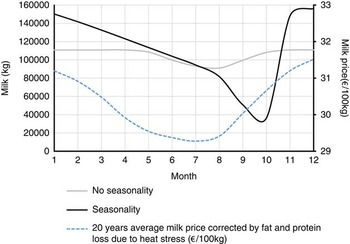
We simulated the effects of heat stress in milk production (St-Pierre et al., Reference St-Pierre, Cobanov and Schnitkey2003) in a farm of 100 cows in southern Spain with two scenarios of seasonality. ‘No seasonality’ scenario assumes constant calving season. ‘Seasonality’ scenario assumes that lactation of 25 cows started in October and 75 in November to avoid insemination and lactation peaks in summer months. Prices are the monthly mean for Spain for the years 1995–2014 (Milk Market Observatory, 2016).
Results and discussion
Mean daily THI in July and August between 1995 and 2014 is above the threshold of 73 THI for heat stress described for Spanish dairy cows (Carabaño et al., Reference Carabaño, Logar, Bormann, Minet, Vanrobay, Díaz, Tychon, Gengler and Hammami2016), and it is above the general threshold for high yielding dairy cows of 69 THI (Zimbelman et al., Reference Zimbelman, Rhoads, Rhoads, Duff, Baumgard and Collier2009) from June to September.
The THI in the area is expected to increase in the next years (Segnalini et al., Reference Segnalini, Bernabucci, Vitali, Nardone and Lacetera2013). The use of THI has been criticized as it does not account for solar radiation or wind speed, and other indicators combining different climatic variables have been proposed (Hammami et al., Reference Hammami, Bormann, M’hamdi, Montaldo and Gengler2013). However, we used it for the purpose of this study as we did not find a better approximation for farm scale in literature.
In Figure 1, the seasonality scenario produces annually 5.3% more milk than the scenario without seasonality because cows exposed to highest THI are either dry or in late lactation. Prices for the last 20 years have been lower in summer months. Hence, the difference of annual farm income increases up to 5.7% when combined with the effect on losses in percentage of fat and protein (calculated from Carabaño et al., Reference Carabaño, Logar, Bormann, Minet, Vanrobay, Díaz, Tychon, Gengler and Hammami2016) in the warmest months. In warm areas of Spain, it is common to have fans functioning permanently when temperature is above 23°C to 25°C; also it is common to manage the herd in order to avoid lactation peaks and insemination periods in the warmest months, when conception rates are affected by warm temperatures (Schüller et al., Reference Schüller, Burfeind and Heuwieser2014). However, in the present study neither the effects of THI on conception rates nor other factors that contribute to farm economics such as health, death rates or potential variation in feed prices were simulated. Including these variables might be expected to increase the differences between the two scenarios shown here. Moreover, the interaction of THI with welfare and farm-level emissions is yet unknown.
Farm production scenarios in southern Spain. Heat stress effects according to St-Pierre et al. (Reference St-Pierre, Cobanov and Schnitkey2003) for a herd of 100 cows located in the south of Spain. Prices are the monthly average for Spain for the years 1995–2014 (Milk Market Observatory, 2016).

Conclusion
In semi-arid climates, the combination of heat abatement structures with herd management techniques (such as seasonality of calving) reduces the effects of heat stress on milk yield. Our results show the potential for adaptation measures to heat stress at farm scale. Future scenarios are needed to predict the effects of climate change on farm economics, also taking into account reproductive performance, welfare, death rates and farm greenhouse gas emissions.
Acknowledgement
This study was funded by ERA44-OPTIBARN-BC3 project.