

Introduction
Modeling has become a widespread tool for understanding and analyzing dynamic systems in the agricultural and environmental sciences. However, many of the researchers who develop and use these models have only a limited amount of training specifically in the field of modeling. Many tend to learn about the field by doing. Post-graduate short courses in various aspects of modeling are therefore important, in order to give these researchers on the one hand a broader view of modeling, and on the other tools for applying more rigorous methods in their work. Many short courses related to modeling have been offered in the past, but there does not seem to be any general discussion of how these short courses fit into an overall strategy for training modelers. This paper is an attempt to consider the general question of how to train modelers, with specific emphasis on short courses.
The types of competence required in modeling
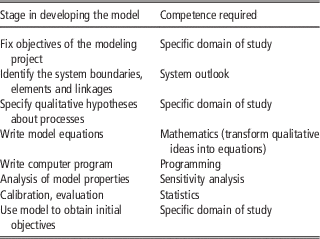
Table 1 shows the steps involved in developing and using a model, and the main types of competence required in each step. Overall, a modeler needs not only be competent in his/her particular domain of application (crop physiology, agronomy, etc.) he/she also requires knowledge about how to analyze the object of study as a system, how to formalize knowledge in terms of mathematical equations, how to code those equations in a computer program and finally how to analyze, calibrate and evaluate the model.
Stages of a modeling project and associated competence required

The use of existing models is another facet of modeling, with somewhat different requirements. In this case one needs to understand the model that one is using, including both software aspects and scientific content, and again one needs to be able to analyze, calibrate and evaluate the model.
The required domain knowledge is usually obtained in a graduate studies program. This is usually the basic background of a modeler. In addition, he/she may have some initial exposure to modeling at the university level, though this is not necessarily so.
The purpose of post-graduate courses is to furnish the other types of competence required for modeling. These courses typically last 3 to 5 days, for a total of perhaps 20 to 35 h. Many different types of courses have been proposed, but they seem mostly to fall into four categories: initiation to modeling, advanced notions of modeling in a specific domain, methods of modeling and training in a specific model.
Types of short course
Many short courses in modeling fit into the four categories below. They differ as to the audience (novice or advanced modelers, model developers or model users) and as to the specific subjects (general dynamic system modeling, advanced modeling for a specific domain, methods of modeling or using a specific model).
Initiation courses are intended to give an overview and first experience with modeling of dynamic systems. Such courses often concentrate on the notion of a system and the principles and usefulness of modeling dynamic systems, illustrated using simple examples. If practical work is included, this may be based on software specifically adapted to dynamic system modeling such as PowerSim, Stella or others, which are taught as part of the course. Such courses may give an overview of various different approaches to modeling, including process models, agent-based models, statistical models or others.
More advanced courses specific to a particular domain usually focus on how the processes important for that domain are translated into equations. Examples would be equations for modeling crop phenology, insect age classes or lactation over time. These courses also in general involve practical work, which may use software specifically adapted to dynamic systems, or an existing model that is used for illustrative purposes.
Courses on methods of modeling usually focus on several methods, typically sensitivity analysis, calibration and evaluation, although there are also courses exclusively devoted to each of those topics individually. In this case, practical work may be based on the R statistical language, which is taught as part of the course.
Finally, the courses that teach the use of a specific model focus on both the scientific content of the model, that is, what processes are represented, how they are modeled, what choices are available to the model user in terms of representation of the processes and on the software aspects, that is, how to prepare input data, how to control output, etc. For example, there are regularly short courses offered on the crop models DSSAT, APSIM, STICS and others.
Some specific problems of a modeling short course
There are general guidelines that apply to a short course in any area, which include in particular the definition of the subject, identification of the audience and statement of the exact goals of the course (see e.g. http://www.minsocam.org/msa/sc/SC_Guide.pdf).
There are additional specific difficulties that arise in short courses in modeling. One major question that arises in most short courses is the choice of software that will be used in practical work. In general, it is felt important to include practical work with a computer during the course, but this poses the difficult problem of the software that will be used. A common choice is to teach a software language as part of the course. However, this poses major problems. First, since the software is just a tool rather than the main focus of the course, one does not want to devote too much time to this. However, it is difficult to teach even a rather simple language in a day or so. The second related problem is that students cannot really fully master a programming language in such a short time, and as a result much of the time for exercises is taken up by problems related to the programming, at the expense of the core material of the course. A third problem is that much of the software is commercial. It may be possible to obtain a free temporary license, or a free stripped-down version, but if the student wants to adopt this software after the course, it must be bought. There is no fully satisfactory solution to this problem.
The R statistical programming language is a rather special case. It is more and more widely taught, so that many students are already familiar with this language before taking a short course in modeling. (Also it is completely free.) This is helpful for those students familiar with R, but introduces the additional difficulty of having students at very different levels with respect to R. One possibility then is to require students who do not already know R, to follow an online course on the programming language before the short course. The teacher then probably still needs to spend time on R during the short course, but this can be treated as a review of known concepts rather than as presentation of new material. Another possibility is to offer an optional 1st day, where R is taught to those who do not know the language.
A second recurrent question for modeling courses concerns the project that one asks students to undertake. This is systematic in semester courses, but is also often asked for in a short course. The objective is to have the students do independent work, but in a short course once again the time constraint is a major problem. A single day, at most 2 can be devoted to the project. One possibility here is to ask each student to choose his/her own problem. The advantage is that the problem is relevant to the student. The difficulty is that it is often difficult for students to define a sufficiently simplified version of the problem they are working on. Other students may not have a project that lends itself to a project in the framework of the course. The teacher must therefore have examples ready that can be treated by these students. A different approach is to choose a common, simple model for all students (e.g. a simple plant disease model), which is taught and programmed during the first days of the course. For the project, each student or group is asked to define a specific question that they want to answer using the model (e.g. effect of changing biological characteristics of the disease), then to use the model to answer the question and analyze the results.
Conclusion
Short courses will no doubt continue to play an important role in modeler training. To make these courses as useful as possible, it would be very helpful to have an overall training program, rather than to treat each short course individually.
Acknowledgments
The author gratefully acknowledges the support from INRA for participation in MACSUR.
Further information
The LiveM International Livestock Modelling and Research Colloquium was hosted by the Basque Centre for Climate Change (BC3) at the Maritime Museum in Bilbao, Spain between 14 and 16 October 2014. LiveM is the livestock and grassland modeling theme of the EU knowledge hub Modelling European Agriculture with Climate Change for Food Security (MACSUR). The MACSUR project is a pilot knowledge hub started by FACCE-JPI in 2012. It provides an opportunity to explore the role and potential of multi-disciplinary networking structures to address complex regional and global issues. More information on MACSUR and the LiveM theme can be found at www.macsur.eu, with PDFs of slides from conference presentations available through the conference website (http://www.livem2014bilbao.com/).