Implications
The leaves and oil seeds of the Moringa oleifera tree are currently being fed to livestock in tropical regions of the world. However, there is little research regarding its effect on rumen fermentation and whether its supplementation into ruminant diets may inhibit enteric methane (CH4) production. Moringa seeds present as a viable alternative to expensive protein and energy sources in which producers in these regions cannot afford or do not have access to. Therefore, this study will provide preliminary information on the effects of Moringa seeds on rumen fermentation, as modelled by using the rumen simulation technique (Rusitec), which can be used by producers for its effective utilisation as a feed.
Introduction
Livestock production systems are responsible for producing ~14.5% of total anthropogenic emissions of greenhouse gases (GHG), with CH4 production from enteric fermentation accounting for ~40% of total GHG from livestock production systems (Gerber et al., Reference Gerber, Steinfeld, Henderson, Mottet, Opio, Dijkman, Falcucci and Tempio2013). Brazil makes a large contribution to these emissions as it has the second largest population of cattle in the world, emphasising the need to develop approaches to reduce CH4 emissions from Brazilian ruminants. It is estimated around 88% of cattle in Brazil are raised on pasture (ANUALPEC, 2015) that consist of ≈50% Urochloa forage species (Berchielli et al., Reference Berchielli, Messana and Canesin2012).
Moringa oleifera is a multipurpose tree originating from India and is adapted to survive in tropical regions. It is characterised by its high biomass production and its tolerance to drought conditions (Melesse, Reference Melesse2012). The Moringa is a common tree used for plantations in tropical and subtropical regions in the world with successful cultivation happening throughout Africa (Busani et al., Reference Busani, Patrick, Arnold and Voster2011). The tree has many purposes with the leaves and oilseeds currently used for human and animal consumption. In addition, there is an interest in using oil from the seed pods for biodiesel production (Azad et al., Reference Azad, Rasul, Khan, Sharma and Islam2015). For animal feed, the seeds present as a high oil, protein rich feed source with bioactive compounds including phenolics, flavonoids and health-promoting phytochemicals including glucosinolates and isothiocyanates (Maldini et al., Reference Maldini, Maksoud, Natella, Montoro, Petretto, Foddai, De Nicola, Chessa and Pintore2014; Premi and Sharma, Reference Premi and Sharma2017).
Suppression of ruminal methanogenesis through fat supplementation is considered one of the most effective CH4 mitigation methods (Beauchemin et al., Reference Beauchemin, McGinn and Petit2007). Moringa seeds have a high content of unsaturated fatty acids (82%), of which about 70% consists of oleic acid (Ogunsina et al., Reference Ogunsina, Indira, Bhatnagar, Radha, Debnath and Gopala Krishna2014). Unsaturated fatty acids can act as a hydrogen sink through biohydrogenation (Johnson and Johnson, Reference Johnson and Johnson1995), favouring a shift in fermentation towards propionate production resulting in a decrease of CH4 production. Due to the high-fat content in the Moringa seed, as well as the presence of bioactive compounds, it may abate CH4 emissions.
Whilst there have been several studies investigating Moringa leaves (Soliva et al., Reference Soliva, Kreuzer, Foidl, Foidl, Machmüller and Hess2005; Mendieta-Araica et al., Reference Mendieta-Araica, Spörndly, Reyes-Sánchez, Spörndly and Sveriges2011; Melesse et al., Reference Melesse, Steingass, Boguhn and Rodehutscord2013), oils (Hoffmann et al., Reference Hoffmann, Muetzel and Becker2003), press cakes (Olivares-Palma et al., Reference Olivares-Palma, Meale, Pereira, Machado, Carneiro, Lopes, Maurício and Chaves2013; Moreira et al., Reference Moreira, AMdA Bezerra, Carneiro, Morais RKdO and Medeiros2016) and defatted seed meals (Salem and Makkar, Reference Salem and Makkar2009) as ruminant feed, this is the first study to examine the effects of the raw seeds on rumen fermentation. The objective of this study was to examine the effects of substituting increasing concentrations of raw ground Moringa seeds from the concentrate on rumen fermentation and CH4 production in an Urochloa brizantha-based forage diet using the rumen stimulation technique (Rusitec).
Material and methods
This experiment was conducted at the facilities of Lethbridge Research and Development Centre (LeRDC), Agriculture and Agri-Food Canada, Lethbridge, Alberta, Canada. Donor cows used in this experiment were cared for in accordance with the guidelines of the Canadian Council on Animal Care (2009).
Sample collection and preparation
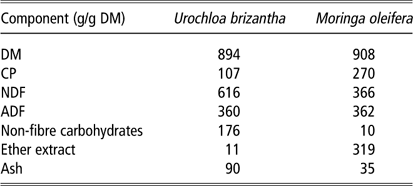
Urochloa brizantha was sampled from a pasture located in Ribeirão do Largo, Bahia, Brazil (15°25′ S, 40°40′ W). Pasture sample collection imitated grazing technique (Johnson, Reference Johnson1978). Moringa seeds were collected from fallen pods in September 2012, from mature trees (5 to 8 years old) located at Embrapa Semiárido, Petrolina, Brazil (9° 04′17″S 40°19′6″W; 382 m elevation). After collection, forage and Moringa seeds were dried at 55°C for 72 h and shipped to the LeRDC. The chemical composition of U. brizantha and the Moringa seeds are presented in Table 1.
Dry matter (DM) and chemical composition of forage (Urochloa brizantha) and Moringa seeds (Moringa oleifera) using a Rusitec to study the effects of Moringa seeds on rumen fermentation and methane production

Experimental design
The experiment was conducted as a completely randomised design with four treatments (diets), duplicated in two identical Rusitec apparatus with eight fermenter vessels in each Rusitec. Treatments were randomly allocated to two vessels in each Rusitec, with a total of four replicates per treatment. The experimental period was 16 days in duration, with days 1 to 8 used for adaptation and the last 8 days for sampling and measurements.
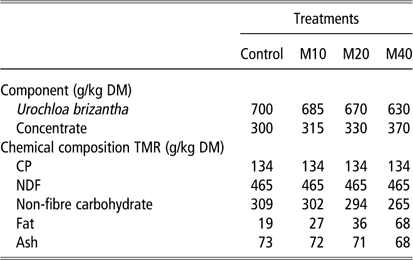
Treatments consisted of a control (M0) diet as well as three treatments with increasing concentrations of Moringa seeds substituting for concentrates in the diet at 100 (M10), 200 (M20) and 400 g/kg (M40) dry matter (DM). These concentrations were selected based on a previous in vitro experiment that showed that Moringa oilseed press cakes included at 400 g/kg DM had the greatest CH4 reduction potential, without adversely affecting nutrient degradability (Olivares-Palma et al., Reference Olivares-Palma, Meale, Pereira, Machado, Carneiro, Lopes, Maurício and Chaves2013). The substrate was formulated as a total mixed ration which comprised of U. brizantha and a concentrate feed based on corn grain, soya bean meal, a mineral mixture and Moringa seeds (Table 2).
Quantities of concentrate components used in a Rusitec to study the effects of Moringa seeds on rumen fermentation and methane production

DM=dry matter; Control=no Moringa seeds; M10=100 g/kg DM of concentrates inclusion of Moringa seeds; M20=200 g/kg DM of concentrates inclusion of Moringa seeds; M40=400 g/kg DM of concentrates inclusion of Moringa seeds.
To ensure that the diets would be iso-nitrogenous and iso-fibrous, the forage:concentrate used was 70 : 30, 68.5 : 31.5, 67 : 33, 63 : 37 for the control, M10, M20 and M40 treatments, respectively. Feed was ground through a 4-mm screen (Wiley Mill standard model 4; Arthur H. Thomas, Philadelphia, PA, USA) with concentrates and the forage placed in separate nylon bags. A total of 15 g diet DM was used for each bag. The proportion of ingredients and their chemical composition are presented in Table 3.
Forage and concentrate amounts and chemical composition of each dietary treatment as a total mixed ration (TMR) used in a Rusitec to study the effects of Moringa seeds on rumen fermentation and methane production

DM=dry matter; Control=no Moringa seeds; M10=100 g/kg DM of concentrates inclusion of Moringa seeds; M20=200 g/kg DM of concentrates inclusion of Moringa seeds; M40=400 g/kg DM of concentrates inclusion of Moringa seeds.
Inoculum, sampling and incubation procedure
Mixed rumen microbial inoculum was obtained from two ruminally cannulated, non-lactating Herefords, 2 h after morning feeding. The cows were fed a forage based diet, consisting of alfalfa hay (75% DM basis), barley grain and a mineral supplement (25% DM basis). Rumen contents were obtained from four different sites within the rumen and filtered through four layers of pre-warmed cheesecloth to obtain both liquid and solid contents. Approximately 12 l of rumen fluid, 6 l from each donor cow, was taken, pooled together and placed in a pre-warmed thermos (39°C) which was flushed with oxygen (O2)-free carbon dioxide (CO2) to maintain anaerobic conditions. In addition, 400 g of squeezed solid digesta was collected for the initial inoculation of the fermenters and stored in the thermos under the same anaerobic conditions. Samples were immediately transported to the laboratory after collection.
Pre-warmed fermentation vessels were filled with 180 ml of warmed McDougall’s buffer (pH 8.2; McDougall, Reference McDougall1948) modified to contain 1 g NH4SO4/l. Subsequently, 720 ml of strained rumen fluid was poured into the vessel, along with one bag containing 20 g of solid digesta (Fraser et al., Reference Fraser, Chaves, Wang, McAllister, Beauchemin and Benchaar2007), and two bags containing forage and concentrate, respectively. Fermenters were immediately placed within the Rusitec units and infused with McDougall’s buffer at a dilution rate of 2.9%/h. After 24 h the solid rumen digesta bag was replaced with new feed bags (one with forage and one with concentrate), and daily thereafter feed bags were replaced after 48 h of incubation such that only two diets (four bags) were present in one fermenter at any time. During the feed bag exchange, fermentation vessels were flushed with O2-free CO2 to maintain anaerobic conditions. Bags placed in the fermenter on day 14 were not used for fermentation measurements as they were only incubated for 24 h. Effluent was collected in plastic flasks (2 l) prefilled with 5 ml of aqueous solution of sodium azide (1 g/l) to arrest microbial growth. Effluent was collected and measured daily during feed bag exchange.
Sample collection
Dry matter disappearance (DMD) at 48 h was determined from days 9 to 15. After removal from the vessel, feed bags were washed in cold running distilled water, until the water was clear. Bags were then dried at 55°C for 48 h for the determination of DMD and the dried contents of the bags were ground through a Wiley Mill (standard model 4; Arthur H. Thomas) with a 1-mm screen for NDF and ADF analysis.
During bag exchange, fermenter pH, gas production and effluent volume from each fermenter was measured. A pH meter (Orion, model 260A; Fisher Scientific, Toronto, ON, Canada) was used to measure the pH of the fermenter liquid. Gas was collected in reusable vinyl bags as described by Fraser et al. (Reference Fraser, Chaves, Wang, McAllister, Beauchemin and Benchaar2007) and gas volume was measured using a wet-type gas flow metre (Alexander-Wright, London, UK).
From days 9 to 16, before measurement of total gas, a 20 ml gas aliquot was sampled from the septum of each vinyl gas bag using a 26-gauge needle (Becton Dickinson, Franklin Lakes, NJ, USA), and stored in evacuated exetainers (5.9 ml; Labco Ltd, Wycombe, Bucks, UK) for subsequent CH4 analysis. Methane was expressed as % in the gas samples, parts per million of total gas and CH4 production (mg/day, mg/g DM incubated and mg/g DM disappeared). In addition, two 4-ml aliquots of fermentation liquid were taken from each fermentation vessel and stored in screw-capped vials containing either 400 µl of 25% (w/w) metaphosphoric acid or 400 µl of trichloroacetic acid for volatile fatty acid (VFA) and NH3-N analysis, respectively. The samples were immediately stored at −20°C until analysis.
Microbial protein synthesis
From day 8, the buffer was modified by replacing (NH4)2 SO4 with 15N-enriched (NH4)2 SO4 (Sigma Chemical Co., St. Louis, MO, USA; minimum 15N enrichment 10.01 atom%) for estimation of microbial protein synthesis using the 15N marker procedure (Fraser et al., Reference Fraser, Chaves, Wang, McAllister, Beauchemin and Benchaar2007). On days 15 and 16, before measurement of effluent volume, the liquid was homogenised by hand and a 250 ml subsample was taken. To determine 15N concentration in the effluent, samples were centrifuged (20 000×g, 30 min, 4°C) and the resulting pellets were washed and re-suspended in distilled water. This centrifuge procedure was repeated three more times, and then the pellet was re-suspended in 6 ml of aqueous solution containing 5 ml of distilled water and 1 ml of 5% (w/v) NaOH. The samples were stored at −20°C until lyophilized. Both the forage and concentrate feed bags removed on day 15 were processed to obtain 24 and 48 h feed particle-associated (FPA) and feed particle-bound (FPB) microbial N (MN) and to determine 15N incorporations into these microbial fractions. Bag residues were gently squeezed, placed in 20 ml of buffer (McDougall, Reference McDougall1948) and processed for 60 s in a blender at 230 rpm (Stomacher 400; Seward Medical Ltd, London, UK). The processed liquid was gently squeezed out, poured off and retained in centrifuge tubes.
Feed residues were washed twice in 10 ml of McDougall’s buffer, and the processed liquid was gently squeezed out, pooled and retained in centrifuge tubes and the total volume of liquid was recorded. The washed, solid feed residues were representative of the FPB bacterial fraction. The obtained liquid was then centrifuged (500×g, 4°C) for 10 min to remove large feed particles. The supernatant was then decanted and centrifuged again for 30 min (20 000×g, 4°C). This procedure was repeated another three times as previously described for the effluent samples and this fluid was used to obtain the FPA bacterial fraction. Washed feed residues were dried at 55°C for 48 h, weighed for DM determination, ball ground and then frozen at −40°C until analysed for total N and 15N concentrations.
Chemical analysis
Using Association of Official Analytical Chemists (AOAC) (1990) methods, dietary ingredients and incubation residues were analysed for DM (method 930.15), ash (no. 942.05) and crude fat (no. 920.29). Forage samples were analysed for NDF (Van Soest et al., Reference Van Soest, Robertson and Lewis1991) and ADF (method no. 973.18; AOAC, 1990) adapted to the Ankom200 fibre analyser (Ankom Technology Corp., Fairport, NJ, USA). Heat stable α-amylase and sodium sulphite were used during the NDF procedure and, ADF and NDF concentration were expressed inclusive of residual ash. The non-fibrous carbohydrate concentration was calculated using the formulae: 1000−[CP+NDF+Fat+Ash].
Concentrations of VFA in the liquid effluent were analysed by gas chromatography with an auto-analyser according to the method of Wang et al. (Reference Wang, McAllister, Rode, Beauchemin, Morgavi, Nsereko, Iwaasa and Yang2001). Concentrations of NH3-N were determined using the modified Berthelot method (Rhine et al., Reference Rhine, Sims, Mulvaney and Pratt1998).
Methane concentration in the gas was determined using a Varian gas chromatograph equipped with a GS-Carbon PLOT 30 m×0.32 mm×3 µm column and thermal conductivity detector (Agilent Technologies Canada Inc., Mississauga, ON, Canada) at an isothermal oven temperature of 35°C with helium as the carrier gas (27 cm/s). Total N (method 990.03; AOAC, 1990) and 15N content of dietary treatments, residual samples and bacterial pellets were determined by a combustion assay using a MS (NA 1500; Carlo Erba Instruments, Rodano, Milan, Italy) as described by Wang et al. (Reference Wang, McAllister, Rode, Beauchemin, Morgavi, Nsereko, Iwaasa and Yang2001). CP content was calculated as N×6.25.
Calculations and statistical analysis
For the incorporation of 15N into MN in the effluent, FPA and FPB fractions were calculated based on sample size (weight and volume) and 15N enrichment in the fractions produced daily. Total microbial 15N incorporation was calculated as the sum of the incorporations in the effluent, and in the FPA and FPB fractions in the feed residue for 24 and 48 h of incubation (Wang et al., Reference Wang, McAllister, Rode, Beauchemin, Morgavi, Nsereko, Iwaasa and Yang2001).
Microbial N yield was estimated using the following equation by Wang et al. (Reference Wang, McAllister, Yanke, Xu, Cheeke and Cheng2000): MN=(APE in RN)/(APE in MN)×RN.
Where atom per cent excess in residue nitrogen (APE in RN) is the per cent excess of 15N in solid residue, APE in MN is the per cent excess of 15N in the microbial fraction of the effluent and RN is the total N (mg) in the residue.
True DMD was calculated by subtracting the microbial mass from the feed residues (forage and concentrate). Microbial mass was calculated by multiplying MN accumulated (mg) in the feed residues by the microbial mass per milligram of MN (gram DM of microbial pellet/milligram of MN). Microbial mass per milligram of MN was determined in FPA bacterial pellets. Daily production of VFA and NH3-N were calculated by multiplying concentration (mmol/day) by the daily effluent volume (l).
The univariate procedure in SAS was used to test for normal distribution of the data. Data were analysed as a completely randomised design using the PROC MIXED procedure of SAS (SAS Institute, 2018). The fixed effect was the treatment and the random effect was treatment within vessel. Nutrient disappearance, fermentation variables and gas production were averaged over each treatment. Linear and quadratic effects were evaluated by using planned orthogonal polynomial coefficients for each parameter when Type 3 tests of fixed effects ⩽ 0.05. Significance was declared at P⩽0.05.
Results
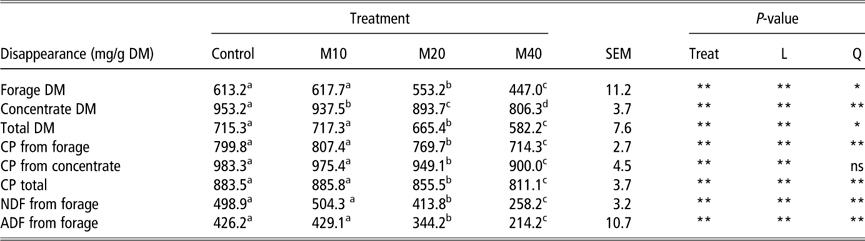
The effects of increasing concentrations of Moringa seeds in the diet on the disappearance of DM and nutrients after 48 h of incubation in the Rusitec are presented in Table 4. The disappearance of total DM, forage DM and concentrate DM was linearly decreased (P<0.01) with increasing supplementation of Moringa seeds into the diet. The disappearance of CP from the forage, concentrate and total diet as well as NDF and ADF disappearance from the forage was linearly decreased (P<0.01) with increasing Moringa seed inclusion, however, disappearance was only reduced from the control with M20 and M30 supplement levels.
Effect of inclusion of Moringa seeds in the diet on disappearance of dry matter (DM), CP, NDF and ADF from dietary components after 48 h of incubation in a Rusitec

Control=no Moringa seeds; M10=100 g/kg DM of concentrates inclusion of Moringa seeds; M20=200 g/kg DM of concentrates inclusion of Moringa seeds; M40=400 g/kg DM of concentrates inclusion of Moringa seeds; Treat=treatment effect; L=linear effect; Q=quadratic effect.
Values in the same row followed by different superscript letters are significantly different at P<0.05.
Level of significance indicated by *P<0.05, **P<0.01, ns=not significant.
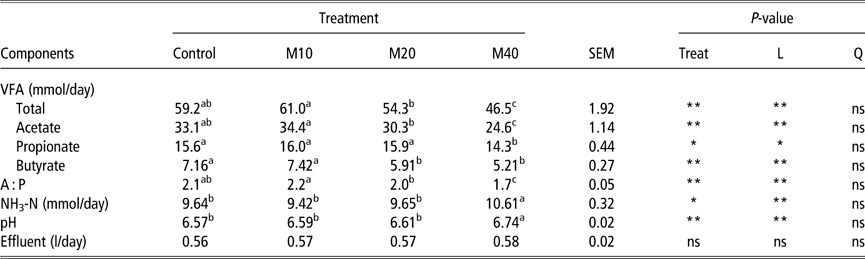
Increasing Moringa seeds in the diet caused a linear response (P<0.01) to total VFA and acetate production with a decrease in production when Moringa seeds were included at the M40 treatment (Table 5). Propionate production was linearly decreased (P=0.05) and was lower for M40 treatment compared with the control. Butyrate and A:P was linearly decreased (P<0.01) with increasing concentrations of Moringa seeds in the diet. The production of NH3-N and pH was linearly increased (P⩽0.05) with increasing addition of Moringa seeds into the diet, however, both were only different under the M40 treatment.
Effect of inclusion of Moringa seeds in the diet on fermentation characteristics measured using the Rusitec system

Control=no Moringa seeds; M10=100 g/kg dry matter (DM) of concentrates inclusion of Moringa seeds; M20=200 g/kg DM of concentrates inclusion of Moringa seeds; M40=400 g/kg DM of concentrates inclusion of Moringa seeds; Treat=treatment effect; L=linear effect; Q=quadratic effect; VFA=volatile fatty acids; A:P=ratio of acetate to propionate.
Values in the same row followed by different superscript letters are significantly different at P<0.05.
Level of significance indicated by *P<0.05, **P<0.01, ns=not significant.
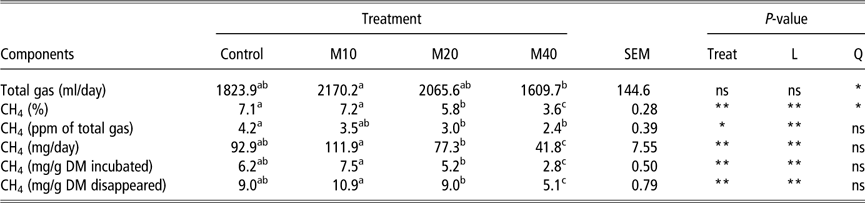
The inclusion of Moringa seeds in the diet had a quadratic effect (P=0.03) on total gas production (ml/day; Table 6) where gas production was increased in the M10 and M20 treatments and decreased for M40 treatment. CH4 production (% and ppm of total gas) was linearly decreased (P<0.03) with increasing concentrations of Moringa seeds in the diet. Methane production (mg/day) and CH4 production per DM incubated or DM disappeared was linearly decreased (P<0.01) with increasing inclusion of Moringa seeds into the diet. CH4 production per DM incubated or DM disappeared was only different from the control in the M40 treatment.
Effect of inclusion of Moringa seed in the diet on in vitro gas production using a Rusitec system

Control=no Moringa seeds; M10=100 g/kg dry matter (DM) of concentrates inclusion of Moringa seeds; M20=200 g/kg DM of concentrates inclusion of Moringa seeds; M40=400 g/kg DM of concentrates inclusion of Moringa seeds; Treat=treatment effect; L=linear effect; Q=quadratic effect; ppm=parts per million; CH4=methane.
Values in the same row followed by different superscript letters are significantly different at P<0.05.
Level of significance indicated by *P<0.05, **P<0.01, ns=not significant.
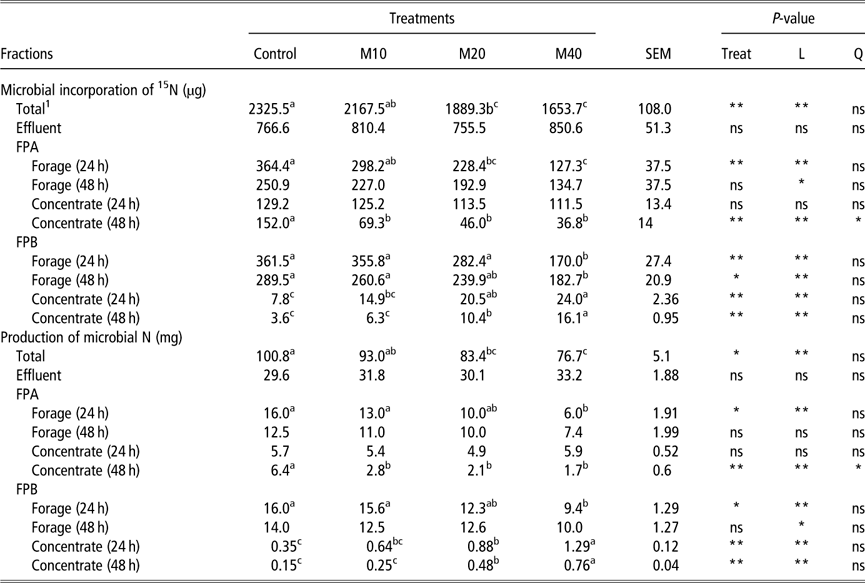
The microbial incorporation of 15N into the total diet, FPA forage (24 h), FPA concentrate (48 h) and FPB forage (24 and 48 h) linearly decreased (P<0.05) with increasing concentrations of Moringa seeds (Table 7). The incorporation of 15N into the FPB concentrate was linearly increased (P<0.05) after both 24 and 48 h of incubation. The incorporation of 15N into the total diet decreased (P<0.01) compared with the control when Moringa seeds were included at greater than 20% of concentrate. Production of MN (mg) from the total diet, FPA forage (24 h), FPA concentrate (48 h) and FPB forage (24 h) linearly decreased (P⩽0.05). Production of MN from FPB concentrate after both 24 and 48 h linearly increased (P<0.01), and production was greater in the M20 and M40 treatments than the control.
Effect of the inclusion of Moringa seed in the diet on the daily incorporation of 15N into microbial N in effluent, feed particle-associated (FPA) and feed particle-bound (FPB) fractions during 24- and 48-h incubations of forage and concentrate in a Rusitec

Control=no Moringa seeds; M10=100 g/kg dry matter (DM) of concentrates inclusion of Moringa seeds; M20=200 g/kg DM of concentrates inclusion of Moringa seeds; M40=400 g/kg DM of concentrates inclusion of Moringa seeds; Treat=treatment effect; L=linear effect; Q=quadratic effect.
1 Total incorporation is the sum of all incorporations in the effluent, FPA and FPB fractions obtained from both the silage and concentrate feed bags after both 24 and 48 h of incubation.
Values in the same row followed by different superscript letters are significantly different at P<0.05.
Level of significance indicated by *P<0.05, **P<0.01, ns=not significant.
Discussion
The inclusion of Moringa seeds decreased the overall diet fermentability after 48 h of incubation in the Rusitec as these replaced more fermentable carbohydrates. However, DMD from the total diet and forage was only significantly reduced when Moringa seeds were included at concentrations of the M20 and M40 treatments. The reduction in DMD was reflected in the decline of CP, NDF and ADF disappearance in the M20 and M40 diets as compared to the control diet. While CP disappearance was reduced (P<0.01) when Moringa seeds were included in the diet, NH3-N production was linearly increased (P<0.01). The greater concentration of ammonia could reflect a reduction in the efficiency of nitrogen utilisation by bacteria (Chaves et al., Reference Chaves, He, Yang, Hristov, McAllister and Benchaar2008) or indicate a reduction in the number of bacteria (Males and Purser, Reference Males and Purser1970). This possibility is supported by the observed reduction in total microbial protein synthesis in this study.
Consistent with a decrease in diet fermentability, total VFA and total gas production was decreased in the M40 treatment. It is well established that high concentrations of oils can inhibit DMD (Fraser et al., Reference Fraser, Chaves, Wang, McAllister, Beauchemin and Benchaar2007; Cobellis et al., Reference Cobellis, Trabalza-Marinucci, Marcotullio and Yu2016; Rodrigues et al., Reference Rodrigues, de Paula, Rennó, Fontes, Machado, de Valadares, Filho, Huhtanen and Marcondes2017). In the current study, total dietary fat content was increased from 19 g EE/kg DM in the control, to 68 g EE/kg DM with the M40 diet. Though only the M40 diet is greater than the 60 g EE/kg DM as recommended by Van Soest (1994) in which there is no inhibition of fibre digestion, other factors like the fatty acid profile and the processing of the seed can also influence diet digestibility. Moringa seeds have a high content of unsaturated fatty acids (82%), of which about 70% consists of oleic acid (Ogunsina et al., Reference Ogunsina, Indira, Bhatnagar, Radha, Debnath and Gopala Krishna2014). The hydrogenation process of unsaturated fatty acids from oil is suggested to cause reduced fibre digestibility in which the ability of microorganisms in the rumen to saturate fatty acids are exceeded. This causes unsaturated fatty acids to accumulate and interfere with microbial digestion (National Research Council, 2001). Specifically, medium- and long-chain fatty acids which are typically prevalent in plant oil extracts like Moringa can inhibit gram positive rumen bacteria, protozoa and archaea (Palmquist, Reference Palmquist1994; Martin et al., Reference Martin, Rouel, Jouany, Doreau and Chilliard2008) with both bacteria and protozoa participating directly in the ruminal degradation of fibre (Martin et al., Reference Martin, Rouel, Jouany, Doreau and Chilliard2008). Olivares-Palma et al. (Reference Olivares-Palma, Meale, Pereira, Machado, Carneiro, Lopes, Maurício and Chaves2013) found that in vitro DM digestibility was not affected when Moringa pressed seed cakes replaced U. brizantha at up to 400 g/kg DM. However, in that study the fat content of the Moringa press seed cakes was only 84.8 g of ether extract/kg DM, compared with 319 g of fat/kg DM in the current study.
Total VFA, acetate, propionate production (mmol/day) and the A:P ratio linearly decreased (P<0.03) with increasing concentrations of Moringa seeds in the diet. However, only the M40 treatment differed significantly from the control diet with a 21.3% decline in total VFA production. The VFA are the primary end products of carbohydrate fermentation within the rumen, and the reduction in the total VFA (propionate, acetate and butyrate) is a consequence of a decrease in DM and NDF degradability (Giraldo et al., Reference Giraldo, Ranilla, Tejido and Carro2007). Specifically, bacteria that degrade structural carbohydrates (cellulose and hemicellulose) and produce acetate are particularly sensitive to high-oil diets (Maia et al., Reference Maia, Chaudhary, Bestwick, Richardson, McKain, Larson, Graham and Wallace2010). Therefore, the reduction in acetate could also be attributed to a reduction in the presence of cellulolytic and hemicellulolytic bacteria (Carro et al., Reference Carro, Ranilla, Martín-García and Molina-Alcaide2009). In addition, Moringa seeds have secondary compounds such as cationic polyelectrolyte proteins, which at low concentrations can exhibit beneficial antibacterial responses (Makkar et al., Reference Makkar, Francis and Becker2007; Olivares-Palma et al., Reference Olivares-Palma, Meale, Pereira, Machado, Carneiro, Lopes, Maurício and Chaves2013). However, when present in great concentrations these substances can inhibit rumen fermentation and decrease the formation of fermentation end products (Makkar and Becker, Reference Makkar and Becker1998; Hoffmann et al., Reference Hoffmann, Muetzel and Becker2003).
The observed linear decrease (P<0.01) in the A:P ratio with increasing concentrations of Moringa seeds corresponded to a decrease in CH4 production. While there was a 55% reduction in CH4 (mg/day) from the M40 diet, this reduction is also associated with a decrease in diet digestibility (Brask et al., Reference Brask, Lund, Hellwing, Poulsen and Weisbjerg2013). However, there was still a decrease in CH4 production as a proportion of DM incubated and DM disappeared which shows that Moringa seed inclusion has inhibitory effects on methanogenic activity despite the reduction in nutrient digestibility. In contrast to these results, Olivares-Palma et al. (Reference Olivares-Palma, Meale, Pereira, Machado, Carneiro, Lopes, Maurício and Chaves2013) found that Moringa oilseed press cakes at 400 g/kg DM in vitro caused a decrease in CH4/g DM production with no decrease in in vitro DMD. Though as previously discussed, the fat content in these press cake was substantially lower than in the current study.
The total diet microbial incorporation and the production of MN linearly decreased (P<0.01) with increasing concentrations of Moringa seeds. This is consistent with the decrease in DMD, as well as the inhibitory effects that plant oil extracts can have on rumen microbial populations (Makkar et al., Reference Makkar, Francis and Becker2007). The decrease in microbial synthesis supports the notion that CH4 reduction was a consequence of decreased DMD, as microbial synthesis may be expected to increase if methanogenesis was inhibited due to its ability to serve as an alternative hydrogen sink.
Microbial incorporation of 15N and production of MN of the FPB fraction associated with the concentrates linearly increased (P<0.01). This may indicate that the primary colonising microbes associated with the concentrates were less inhibited by the inclusion of Moringa seeds. This is agreement in with other literature (Fraser et al., Reference Fraser, Chaves, Wang, McAllister, Beauchemin and Benchaar2007) in which secondary colonising bacteria are more susceptible to antimicrobial activity within the biofilm compared with primary colonisers (McAllister et al., Reference McAllister, Bae, Jones and Cheng1994). Furthermore, increased incorporation of 15N and production of MN with Moringa seeds in the FPB fraction associated with the concentrate indicates increased microbial colonisation (Wang et al., Reference Wang, McAllister, Rode, Beauchemin, Morgavi, Nsereko, Iwaasa and Yang2001). Reduced 15N incorporation into FPA and FPB fractions at 24 and 48 h on forage substrate with supplementation of Moringa seeds might be explained with the fact that these seeds contain abundance of phenolic acids and flavonoids that inhibit microbial activity (Al_husnan and Alkahtani, Reference Al_husnan and Alkahtani2016). Lürling and Beekman (Reference Lürling and Beekman2010) demonstrated that growth of cyanobacterium could be terminated using high concentrations (⩾80 mg/l) of Moringa seed extract. Many studies have suggested that Moringa seeds have antibacterial activities against both Gram-negative, Gram-positive bacteria and fungi (Wang et al., Reference Wang, Chen and Wu2016).
In conclusion, Moringa seeds included at 20% and 40% of concentrate DM resulted in a linear decrease in the production of CH4. This reduction was associated with a decrease in diet degradability which resulted in an undesirable decrease of total VFA and MN production. Therefore raw Moringa seeds do not present as a viable feed supplement to reduce CH4, however, they can be included in the diet DM at up to 100 g/kg as a protein-rich feed source with no effects on rumen fermentation or microbial synthesis.
Acknowledgements
This study was conducted with funding from the Feed Opportunities in the Biofuels Industry (FOBI) network of the AAFC Agricultural Bioproducts Innovation Program (AABIP), the Alberta Meat and Livestock Agency (ALMA) and the Norwegian–Canadian BILAT project. The authors would like to thank CAPES-PDSE (Programa de Doutorado Sanduíche no Exterior; Brazilian Funding Agency) for financial support during Túlio O. J. D’A. Lins’s PhD candidature. The authors acknowledge Embrapa, CAPES-PVE, CNPq and FAPEMIG that allow the execution of the PECUS RumenGases project, enabling the collaboration with Agriculture and Agri-Food Canada and The University of Sydney. The authors would also like to acknowledge the technical assistance of D. Vedres (chromatography), W. Smart (animal care and sampling) and B. Baker (animal care).
Declaration of interest
Authors declare that the research was conducted in the absence of any commercial or financial relationships that could be construed as a potential conflict of interest.
Ethics statement
Donor cows used in this experiment were cared for in accordance with the guidelines of the Canadian Council on Animal Care (2009).
Software and data repository resources
The data set is not available for public access.