Health care providers, being on the frontline of service delivery, depend on a multitude of practice guidelines, statements, position papers and ‘best practices’ in order to provide quality services. However, not all providers have consistently adhered to issued guidelines (Knebel et al., Reference Knebel, Lundahl, Edward-Raj, Abdallah, Ashton and Wilson2000). Recent research on family planning counselling suggests that guidelines alone are not sufficient to ensure high-quality services (Leon et al., Reference Leon, Lundgren and Jennings2008). In an effort to improve provider adherence to guidelines and protocols, many organizations promote useful tools such as checklists, posters, decision tables or flowcharts, known as job aids. Job aids have demonstrated their effectiveness in improving provider adherence (Edward-Rah & Phiri, Reference Edward-Raj and Phiri2002). One such job aid is a set of four family planning provider checklists developed by Family Health International (FHI) in 2008 (http://www.fhi.org/en/RH/Pubs/servdelivery/checklists/index.htm).
Despite substantial investment in the development of a variety of job aids, there are few data available on the actual use of job aids (Knebel et al., Reference Knebel, Lundahl, Edward-Raj, Abdallah, Ashton and Wilson2000). In a previous study to improve physician adherence to preventative health measures, provider checklists were only used by 39% of physicians (Cheney & Ramsdell, Reference Cheney and Ramsdell1987). A more recent study documented that checklists are an effective means of increasing adherence to medical guidelines; however, they tend to be used inconsistently (Hales et al., Reference Hales, Terblanche, Fowler and Sibbald2008).
A variety of reasons for non-use of job aids have been cited, including instances where providers are hesitant to appear in need of assistance in front of peers or clients (Knebel et al., Reference Knebel, Lundahl, Edward-Raj, Abdallah, Ashton and Wilson2000). In addition, providers may not be convinced that job aids present accurate and trustworthy information. For example, despite receiving information to the contrary, 64% of providers surveyed in a study in Madagascar reported that national standards require a woman to be menstruating in order to initiate a family planning method (Wesson et al., Reference Wesson, Nutley, Raharison, Green and Rabenja2010). Elsenheimer (Reference Elsenheimer1998) suggests that training workshops may serve as an effective means of convincing and motivating health care providers to use job aids in their daily work.
This report investigates the longer term effects of training workshops on utilization of provider job aids, specifically FHI's family planning checklists. Using data from follow-up surveys of participants in training workshops in Uganda (n=19) and the Dominican Republic (DR) (n=61), the study examined whether job aids distributed in these training workshop are used in regular practice 7–24 months later.
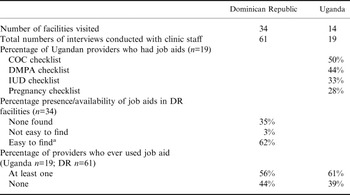
The Uganda evaluation was based on training workshops conducted in 2005–2006 by FHI, in collaboration with the Ugandan Ministry of Health (MOH). These workshops introduced several job aids to over 400 service providers and community representatives. In 2007, FHI conducted key informant interviews to investigate current availability and utilization of FHI's checklists among selected workshop participants. This study design was a one-time follow-up survey of workshop participants selected in a purposive sample of districts (Wesson & Katz, Reference Wesson and Katz2007). A total of nineteen service providers were interviewed between April 2007 and May 2007 (Table 1). The medical personnel who were interviewed were overall very experienced with a median of at least 10 years of experience.
Facilities visited and job aid availability and use in Uganda and the Dominican Republic

a In plain view or on the clinician's desk.
The DR evaluation followed a training by the National Council on Population and Family (CONAPOFA). In May 2006, over a 6-month period, CONAPOFA trained approximately 1700 Ministry of Health employees on a variety of topics, including FHI's checklists. Of the 78 facilities in the two districts that sent representatives to the trainings, FHI's local consultants chose a total of 34 facilities to be part of the evaluation (Hubacher, Reference Hubacher2007). They made successful contact with at least one service provider in a total of 34 facilities and interviewed 61 providers between January and May 2007 (Table 1).
The Uganda evaluation measured availability by the number of providers who reported they had a copy of the job aid; half or fewer providers had copies of the COC checklist (Table 1). The DMPA, pregnancy and IUD checklists were less available than the COC checklist. The checklists appeared to be more available in the DR evaluation, which measured availability by whether or not at least one job aid was found in each of the health clinics. The DR evaluation also measured availability by the ease of finding the available aids. Investigators found at least one job aid in 65% of the clinics and of these clinics where a job aid was found, 95% had at least one job aid in plain view or on the clinician's desk (Table 1).
In Uganda and the DR, 61% and 56% of providers, respectively, stated they had used the job aids at least once (Table 1). In Uganda, over 75% of those who reported not using the checklists said it was because they did not receive copies. For providers who reported they used the job aids in the Uganda evaluation, all but one said that each job aid was ‘very helpful’; just one provider said the DMPA checklist was ‘somewhat helpful’. The DR evaluation found similar results. Of the providers who reported use of the job aids nearly all found the job aids ‘very useful’.
If the introduction of job aids is intended to highlight new guidelines or improve adherence, more effort is needed to ensure high rates of utilization. The results of these evaluations in Uganda and the DR suggest that limited introduction of job aids during training workshops resulted in only about half the providers ever using the materials. This must have been influenced by the availability of the checklists as only between 50% and 65% of clinics had the checklists. However, the vast majority of providers who used the checklists reported that the material was very helpful to their work. Many organizations continue to commit resources to the creation of more job aids, yet little research is available on the most effective way to promote utilization of these tools (Knebel et al., Reference Knebel, Lundahl, Edward-Raj, Abdallah, Ashton and Wilson2000).
The findings from Uganda and the DR suggest that additional strategies are needed to increase use of job aids. Because providers can't use tools they don't have, the most critical strategy is to ensure availability. To this end, it may be helpful to institutionalize production and on-going dissemination from a central Ministry of Health office. Providers might also benefit from step-by-step training and the opportunity to practise using the job aids in a simulated environment (Elsenheimer, Reference Elsenheimer1998). Such trainings may also help providers draw clearer connections between job aids and important service delivery protocols. Until such strategies are developed and implemented, utilization of job aids and adherence to critical service delivery guidelines are likely to remain below optimal levels.