1. Introduction
The interaction of gamma rays with a pair plasma is a fundamental problem in astrophysics. For instance, it is present in the context of gamma-ray bursts (GRBs). The latter involve the explosion of a stellar mass object, where energy is expelled in the form of a relativistic ejecta. As this ejecta propagates, its interaction with the ambient medium generates a strong emission which is detected by satellites as well as ground-based observatories. Recent efforts demonstrated emission over a large range of frequencies including the radio, optical, X-ray and gamma-ray bands, up to TeV energies (Acciari et al. Reference Acciari, Ansoldi, Antonelli, Engels, Baack, Babić, Banerjee, Barres de Almeida, Barrio and González2019).
For most GRBs, the temporal evolution of the observations shows that their spectra consist of two parts, a prompt emission followed by an afterglow. The prompt emission of a GRB is defined as an initial emission phase in the keV–MeV band, which lasts for a few milliseconds to several minutes. The afterglow is a counterpart of the prompt emission extending in the optical and radio ranges and its duration can span from a few hours to several days. While it is acknowledged that a large part of the afterglow can be attributed to a forward external shock driven by the ejecta propagating in the ambient medium (Meszaros & Rees Reference Meszaros and Rees1997), the origin of the prompt emission is not fully understood yet. The main reason is that there remains unanswered questions related to the composition of the ejecta, how its energy is dissipated and how particles are accelerated.
All models agree that there is an ejecta formed by a compact object of radius  $\sim 10^{7} \ \textrm {cm}$. This ejecta is a relativistic plasma in expansion. Most of its energy comes from photons, but it also contains pairs, an unknown fraction of baryons that may even be magnetized. At this early stage of expansion the relativistic plasma is so dense that photons cannot escape. At the photospheric radius
 $\sim 10^{12} \ \textrm {cm}$, its density has decreased enough to enable a fraction of the gamma rays to propagate in the ambient medium (Cavallo & Rees Reference Cavallo and Rees1978). One of the pending questions related to GRBs is how does the ejecta dissipate its energy above such a large distance of
 $\sim 10^{12} \ \textrm {cm}$? This question has been addressed in two ways, as detailed in a recent review on GRBs (Kumar & Zhang Reference Kumar and Zhang2015).
First, researchers proposed models that describe the overall evolution of the ejecta. The most used is the hot fireball model which assumes that the energy of the ejecta is dissipated at the photosphere radius and in internal/external shocks (Narayan, Paczynski & Piran Reference Narayan, Paczynski and Piran1992; Rees & Meszaros Reference Rees and Meszaros1994; Piran Reference Piran2005). However, it should be mentioned that some GRB spectra are better explained with a model assuming a magnetized ejecta, where the energy is dissipated via current-driven instabilities (Lyutikov Reference Lyutikov2006; Zhang & Yan Reference Zhang and Yan2010). The gamma-ray emission processes are manifold and are widely discussed in these models. The processes are usually synchrotron (Meszaros & Rees Reference Meszaros and Rees1993; Rees & Meszaros Reference Rees and Meszaros1994), inverse Compton (Gruzinov & Mészáros Reference Gruzinov and Mészáros2000) or inverse Compton up-scattering of synchrotron photons by high-energy electrons (synchrotron–self-Compton). In the Klein–Nishina regime, the Compton process is also held responsible for a bulk plasma acceleration called Compton drag or radiative acceleration (Madau & Thompson Reference Madau and Thompson2000; Thompson & Madau Reference Thompson and Madau2000). Our work here goes beyond these, by assuming that collective plasma processes can be triggered as the energetic photons propagate through the plasma. On another hand, some hadronic processes (Bethe–Heitler and photopion) are discussed as possible sources of high-energy positrons, which then radiate gamma rays via synchrotron. Pair production processes are also proven to play a significant role in the development of key features of GRBs such as their high radiative efficiency (Stern Reference Stern2003) or their flat spectrum from the infrared to the ultraviolet (Beloborodov Reference Beloborodov2005).
Second, researchers also performed numerical simulations of basic plasma processes in the extreme conditions of GRBs using particle-in-cell (PIC) simulations. Employing this framework enables one to account for collective plasma dynamics, radiative processes and, more importantly, for any dynamical feedback between the two. The first example relevant in the context of GRBs (Medvedev & Loeb Reference Medvedev and Loeb1999) is the simulation of relativistic collisionless shock formation by the Weibel instability (Silva et al. Reference Silva, Fonseca, Tonge, Dawson, Mori and Medvedev2003) and the subsequent Fermi-type particle acceleration (Spitkovsky Reference Spitkovsky2008; Martins et al. Reference Martins, Fonseca, Silva and Mori2009). The second example is particle acceleration in magnetic reconnection regions (Mehlhaff et al. Reference Mehlhaff, Werner, Uzdensky and Begelman2020),which is known to be of interest for GRBs (Uzdensky Reference Uzdensky2011). The third example is electron acceleration in Compton-driven plasma wakefields during the GRB interaction with its circumburst medium (CBM) (Frederiksen Reference Frederiksen2008; Del Gaudio et al. Reference Del Gaudio, Fonseca, Silva and Grismayer2020a).
In his study, Frederiksen considers the interaction of a Planckian photon distribution with a tenuous plasma (Frederiksen Reference Frederiksen2008). The photon energy lies between  $30$ keV and
 $3$ MeV and he observes electron acceleration in a plasma wakefield. According to the author, this wakefield is excited by an electrostatic force acting to restore the charge separation induced by Compton deflections. In contrast to this work, our investigation focuses on a regime where the Compton cross-section is beamed above
 $10$ MeV. In addition, we consider a range where Compton scattering prevails over the Bethe–Heitler pair production (
 $\gamma e \rightarrow e^+e^- e$) for energies below
 $100$ MeV. Formulae for all these processes can be found in the paper by Lightman (Reference Lightman1982). For this gamma-ray range of
 $10\text{--}100$ MeV, one expects Compton scattering to deflect electrons mainly forward such that they form a relativistic beam (Del Gaudio et al. Reference Del Gaudio, Fonseca, Silva and Grismayer2020a).
In light of these previous results, we investigate the interaction of gamma rays (10–100 MeV) with a background pair plasma. In § 2, with the support of a one-dimensional (1-D) theoretical model and PIC simulations, we clarify how a gamma-ray beam (10–100 MeV) propagating in a pair plasma can drive the formation of a relativistic and dense electron positron beam via Compton scattering. In § 3, we specify under which conditions the pair beam can trigger a beam-plasma instability, thus generating a small-scale magnetic field whose extent is discussed. Section 4 confirms the robustness of this process for various photon sources. Finally, we argue in § 5 that these conditions can be met for radii  $r$ such that
 $r \geq r_\textrm {ph}$, with
 $r_\textrm {ph}$ the photospheric radius of a GRB.
2. Pair beam formation
We first discuss a simplified physical picture. Let us consider a semi-infinite gamma-ray beam of density  $n_{\omega 0}$ with a monoenergetic distribution. We denote the photon energy normalized by the electron rest mass as
 $\epsilon = \hbar \omega / {mc}^2$. The photon beam propagates along the
 $x$ direction in an infinite cold pair plasma at rest, with density
 $n_{p0}$ associated with an angular frequency
 $\omega _p$. In the frame of this work, we focus on the energy range
 $1 \ll \epsilon < 1/ \alpha _f = 137$, where
 $\alpha _f$ denotes the fine structure constant. In this range, Compton scattering prevails over the two-photon Breit–Wheeler process and pair creation in the Coulomb field of an electron or positron (Lightman Reference Lightman1982).
The formation process of the pair beam relies on the beaming of the Compton cross-section for high-energy photons. Let us consider an electron at rest experiencing Compton deflection from a gamma ray of energy  $\epsilon$, with
 $\textrm {d}\sigma _\textrm {kn}/\textrm {d}\varOmega$ and
 $\sigma _\textrm {kn}(\epsilon )$ the angular-differential and total Compton cross-sections (Klein & Nishina Reference Klein and Nishina1928), and
 $\theta$ the polar angle associated with
 $\varOmega$, the photon angle after one scattering. The Lorentz factor of the electron after the deflection
 $\gamma$ can be deduced from the energy and momentum balance as
 $\gamma / \epsilon = 1+1/\epsilon -1/[1+\epsilon (1-\cos \theta )]$. We introduce
 $\phi$ the angle between the deflected electron momentum and the incident photon direction and obtain
 $\mathrm {cotan} (\phi ) = (1+\epsilon ) \tan (\theta / 2)$. Averaging these quantities over the Compton angular cross-section, we obtain for
 $\epsilon \gg 1$,
 $\langle \gamma \rangle _{\varOmega } \simeq \epsilon$ and
 $\langle \sin ^2 \phi \rangle _{\varOmega } \simeq 4/\epsilon$ (Blumenthal & Gould Reference Blumenthal and Gould1970). This shows that there is a simultaneous beaming of photons, electrons and positrons centred on the direction of the incident gamma ray. We will discuss later the effects induced by a more realistic gamma-ray beam distribution.
We assume that the longitudinal momentum of the pair beam ( $p_x$) can be approximated by its average over the Compton cross-section
 $p_x \simeq \sqrt {\langle p_{x}^2 \rangle _{\varOmega }}$, and we define the transverse momentum spread induced by Compton scattering as
 ${\rm \Delta} p_{\perp } = \sqrt {\langle p_{\perp }^2 \rangle _{\varOmega }}$. For
 $\epsilon \gg 1$,
 \begin{equation} \frac{p_x}{{mc}} \simeq \epsilon \quad \text{and} \quad \frac{{\rm \Delta} p_{{\perp}}}{{mc}} \simeq \sqrt{\frac{7 \epsilon}{6 \ln \epsilon}}. \end{equation}
Equation (2.1a,b) shows that the deflected electron energy can be as high as the incoming photon energy and that the transverse momentum spread of the pair beam is typically a few percent of its longitudinal momentum  ${\rm \Delta} p_{\perp }/p_x \simeq 5\text {--}20\,\%$ for
 $1 \ll \epsilon < 1/\alpha _f$.
The density of the photons decreases as they are scattered at a frequency  $\tau _{\omega }^{-1} = 2 n_{p0} c \sigma _\textrm {kn}$. It thus follows that
 $\textrm {d}n_{\omega }/\textrm {d}t=-n_{\omega }/\tau _{\omega }$. The solution reads
 $n_{\omega } / n_{\omega 0} = \exp (-t/\tau _{\omega })$. In the high-energy limit
 $\epsilon \gg 1$, one has
 $\sigma _\textrm {kn}(\epsilon ) \simeq \pi r_e^2 \ln (\epsilon )/\epsilon$, where
 $r_e$ is the classical electron radius. As a result, the photon density can be approximated as constant
 $n_{\omega }/n_{\omega 0} \simeq 1$, where in fact
 $\omega _p \tau _{\omega } \propto r_e^{-3/2}n_{p0}^{-1/2} \epsilon / \ln (\epsilon ) \gtrsim 10^{11}$ for any plasma density
 $n_{p0} \leq 10^{18} \ \textrm {cm}^{-3}$, a conservative upper bound for astrophysical systems.
We now consider a more detailed model for the pair beam formation. Let us denote  $n_p(x,t)$ as the background plasma density. The electrons (and positrons) of the beam are those experiencing at least one Compton scattering. Their density is denoted as
 $n_b(x,t)$ and they have a velocity
 $v_b$. At the initial time
 $t=0$, we assume that the photons are located in the
 $x<0$ half-space and propagate toward the background plasma at rest in the other half-space
 $x>0$. The evolution of the background plasma density (beam density) is given by the continuity equation with a source term accounting for a depletion (loading) at the Compton frequency
 $\nu =\sigma _\textrm {kn} c n_{\omega }$
 \begin{equation} \left.\begin{array}{c@{}} \partial_t n_p + \boldsymbol{\nabla} \boldsymbol{\cdot} (n_p \boldsymbol{v}_p) ={-} \sigma_\textrm{kn} c n_\omega n_p \\ \partial_t n_b + \boldsymbol{\nabla} \boldsymbol{\cdot} (n_b \boldsymbol{v}_b) = \sigma_\textrm{kn} c n_\omega n_p \end{array} \right\}. \end{equation}
We introduce the Heaviside function  $H$, along with the variables
 $\xi ,\tau$ defined as
 $\xi =ct-x$ and
 $\tau =t$. The background plasma is assumed to be at rest during the interaction (
 $\boldsymbol {v}_p=0$), and the beam to have a constant velocity
 $\boldsymbol {v}_b=v_x \boldsymbol {x}=c\beta _x\boldsymbol {x}$. The evolution of the background plasma and beam densities simplifies to
 $$\begin{gather} [c\partial_{\xi}+\partial_{\tau}] n_p(\xi,\tau) ={-} \nu n_p(\xi,\tau) [H(\xi)-H(\xi - ct)], \end{gather}$$
 $$\begin{gather}{}[(c-v_x)\partial_{\xi}+\partial_{\tau}] n_b(\xi,\tau) = \nu n_p(\xi,\tau) [H(\xi)-H(\xi - ct)]. \end{gather}$$
We first solved (2.3) by assuming the solution is of the form  $f(\xi )g(\tau )$. As far as (2.4) is concerned, its solution was derived using the method of Laplace transform. The solutions are obtained for all
 $\xi \leq c\tau$ as
 \begin{align} n_p(\xi,\tau) &= n_{p0}\ \textrm{e}^{-{\nu \xi}/{c}} [H(\xi)-H(\xi - c\tau)], \end{align}
 \begin{align} n_b(\xi,\tau) &= \frac{n_{p0}}{1-\beta_x}[ ( 1 -\textrm{e}^{-{\nu \xi}/{c}} )H(\xi) \nonumber\\ & \quad + (\textrm{e}^{-({\nu}/{v_x})(\xi-c\tau(1-\beta_x))}-1)H(\xi- c\tau(1-\beta_x))]. \end{align}
The normalized beam velocity  $\beta _x$ can be estimated as
 $\beta _x \simeq \sqrt { \langle \beta _x^2 \rangle _{\varOmega }}$. In the high-energy limit
 $\epsilon \gg 1$,
 $\beta _x \simeq 1 - 1/ (2\epsilon \ln \epsilon )$. For large times
 $t \gg 1 / [\nu (1-\beta _x)]$, (2.6) implies that the beam cannot exceed the maximum density
 $n_{p0}/(1-\beta _x)\simeq 2 n_{p0} \epsilon \log \epsilon$. Because we expect collective processes for such time scales, we underline that this limit is unlikely to be reached and should be considered as an upper bound of the maximum achievable density. This maximum density could however be achieved in cases where collective effects are damped on large distances, for example, either with a high magnetic field oriented in the flow direction or a large background plasma temperature.
To clarify some of the properties of this solution, we recast it with  $(x,t)$ variables and in the limits
 $\nu t\ll 1$ and
 $\beta _x\simeq 1$ and therefore get, for all
 $0 \leq x \leq ct$,
 $$\begin{gather} n_p(x,t) = n_{p0} (1+\nu x/c - \nu t), \end{gather}$$
 $$\begin{gather}n_b(x,t) = n_{p0} \nu x / c. \end{gather}$$
The result in (2.7) illustrates that the background plasma density evolves linearly with the position  $x=0\rightarrow ct$, increasing from
 $n_{p0}(1-\nu t)$ to its maximum value
 $n_{p0}$. Equation (2.8) clarifies that the beam density is expected to grow linearly with the propagation distance, starting from
 $0$ and increasing to its maximum value
 $n_{p0}\nu t$ at the position of the photon front
 $x=ct$.
We stress this model is valid whatever the photon and plasma densities. It remains applicable as long as collective plasma effects do not play a significant role. In terms of photon energies, the model is strictly limited to the range  $1 \ll \epsilon < 1/\alpha _f = 137$. However, we will discuss in § 4 why it can be extended to a larger range of
 $20 \lesssim \epsilon \lesssim 200$. To account for photons in the energy range
 $1 \lesssim \epsilon \lesssim 20$, one would need to account for the much larger energy spread induced by the Compton cross-section and also to include the two-photon Breit–Wheeler pair creation.
We have reported how a pair beam can be created when gamma rays propagate in a background pair plasma via Compton scattering. This process is corroborated by theory and is now confronted to simulation results. We have run 2-D PIC simulations with Osiris (Fonseca et al. Reference Fonseca, Silva, Tsung, Decyk, Lu, Ren, Mori, Deng, Lee, Katsouleas and Adam2002). These simulations were recently enriched with a Compton scattering module (Del Gaudio et al. Reference Del Gaudio, Grismayer, Fonseca and Silva2020b), similar to earlier work (Haugbølle, Frederiksen & Nordlund Reference Haugbølle, Frederiksen and Nordlund2013). The simulation proceeds through two key steps: first a random pairing of macro particles at every time step and in every cell and second a Monte Carlo sampling of the angle-resolved Klein–Nishina cross-section (Klein & Nishina Reference Klein and Nishina1928). For every binary collisions treated, the cross-section is evaluated in the electron rest-frame, an energy and momentum balance is ensured, and a splitting technique is employed to handle the varying weight of macro particles. This implementation relies on macro particle pairing and therefore stands out from other works (Levinson & Cerutti Reference Levinson and Cerutti2018) where the Compton cross-section is evaluated from the intensity of the ambient radiation field.
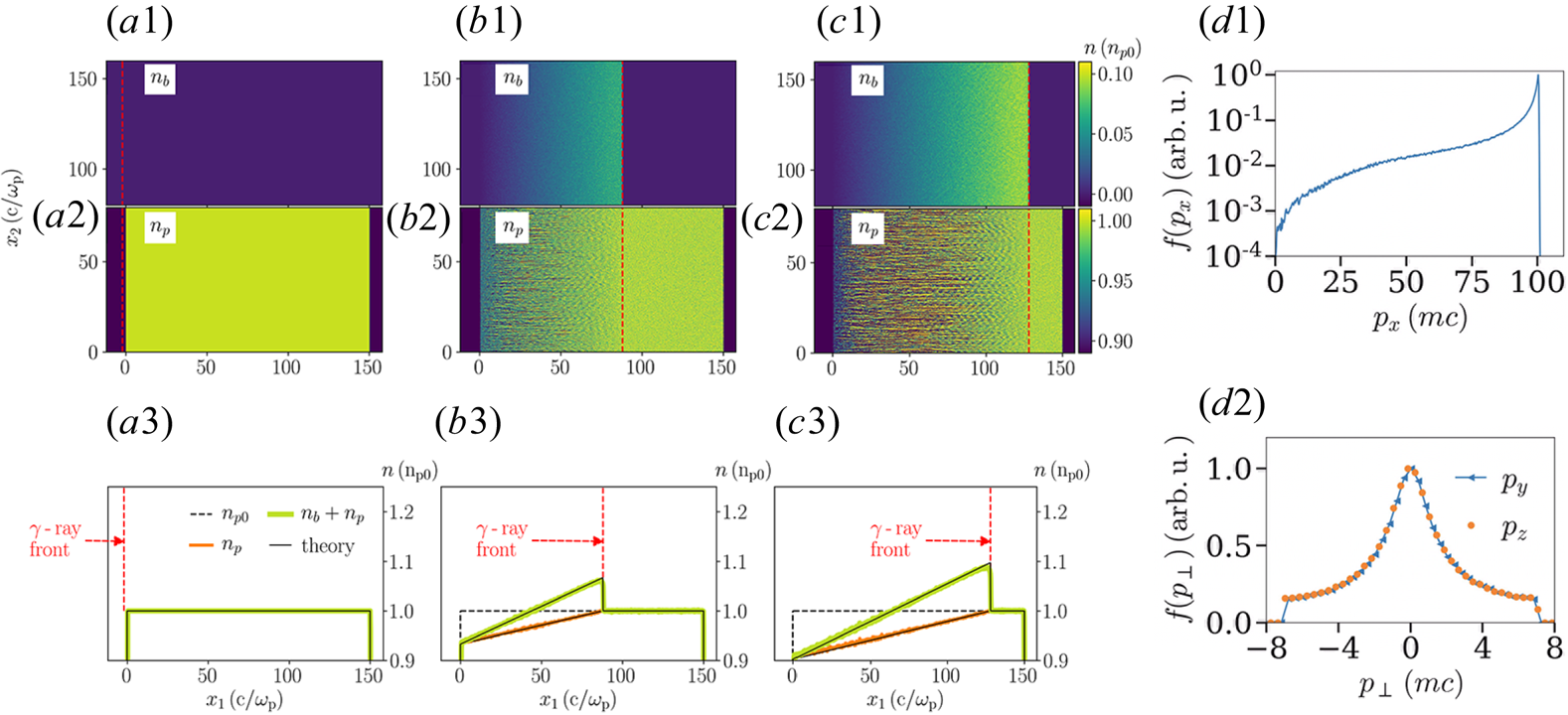
We detail the relativistic pair beam formation from an illustrative simulation in figure 1. We consider a cold pair plasma ( $1$ eV) with a uniform density
 $n_{p0}=1 \ \textrm {cm}^{-3}$, as displayed in figure 1(a1–a3). In this pair plasma, we propagate a monoenergetic (
 $\epsilon = 100$) gamma-ray beam along the
 $x$ direction from left to right. This presents a uniform density
 $n_{\omega 0} = 10^{17} \ \textrm {cm}^{-3}$ with a front indicated by the red dashed line in figure 1(a3,b3,c3). Periodic boundary conditions are assumed in the transverse direction
 $y$ for all species and fields, and open boundary conditions are employed in the longitudinal
 $x$ direction. The domain extends to
 $(160 c/\omega _p)^2$ with
 $2000^2$ cells. The cell dimensions are
 $\delta x = \delta y = 0.08 c/\omega _p$ and the time step is
 $\delta t = \delta x /2$. We initialize
 $80/80/160$ particles per cell for electrons, positrons and photons.
(a1,b1,c1) The two-dimensional (2-D) electron beam density profile at three instants: (a1)  $\omega _p t = 0$; (b1)
 $\omega _p t = 90$; and (c1)
 $\omega _p t = 130$. (a2,b2,c2) The 2-D electron background density profile for the same three instants. (a3,b3,c3) One-dimensional projections along propagation direction
 $x$ for the same instants. The orange curve is the background plasma density
 $n_p$, the green thick curve is the total density
 $n_p+n_b$ and the black curves are the theoretical estimates from (2.5) and (2.6). The gamma-ray beam propagates from left to right and its front is marked by the dashed red line. (d1,d2)
 $f(p_x)$ and
 $f(p_{\perp })$ Distributions of electrons scattered by Compton at the beam front for time
 $\omega _p t=130$. For the plasma density
 $n_{p0}=1 \ \textrm {cm}^{-3}$, one has
 $c/\omega _p = 5.3\times 10^5 \ \textrm {cm}$.

The process of pair beam formation is illustrated in figure 1. Figure 1(a1,b1,c1) exhibit 2-D profiles of the electron beam density  $n_b$ at three instants
 $\omega _p t = 0$,
 $90$ and
 $130$. The profiles correspond to electrons which experienced at least one Compton scattering. Figure 1(a2,b2,c2) represent 2-D profiles of the electron background density
 $n_p$ for the same three instants
 $\omega _p t = 0$,
 $90$ and
 $130$. Figure 1(a3,b3,c3) shows the averages of theses 2-D densities along
 $y$ the transverse direction. To clarify the plot, only the total density
 $n_b+n_p$ (green thick curve) and background density
 $n_p$ (orange thin curve) are represented. Based on these figures, we can observe the formation and propagation of an electron beam (positrons are superimposed by symmetry). We found excellent agreement of the simulations with the theoretical estimates (black lines) of (2.5) and (2.6). The simulation times considered here (
 $\omega _p t \leq 130$) lie within the limit
 $\nu t \ll 1$ where we derived (2.7) and (2.8). For such early times, the beam and background densities have profiles increasing linearly with the propagation distance, which explains the triangular shape of the total density profile in figure 1(b3,c3). The momenta distributions
 $f(p_x)$ and
 $f(p_{\perp })$ of deflected electrons are exemplified in figure 1(d1,d2) at time
 $\omega _p t = 130$. The distribution
 $f(p_x)$ exposes a peak at
 $p_x/{mc} \simeq 100 = \epsilon$, exactly as our theoretical estimate in (2.1a,b). The transverse momentum profile
 $f(p_{\perp })$ includes both directions
 $p_y$ and
 $p_z$. The two distributions are centred and characterized by a
 $\simeq 3 {mc}$ standard deviation, in agreement with (2.1a,b). This is conducted in the range of validity of the theoretical model with periodic conditions in the transverse direction, and does not provide evidence for collective plasma processes with a significant impact on the beam formation.
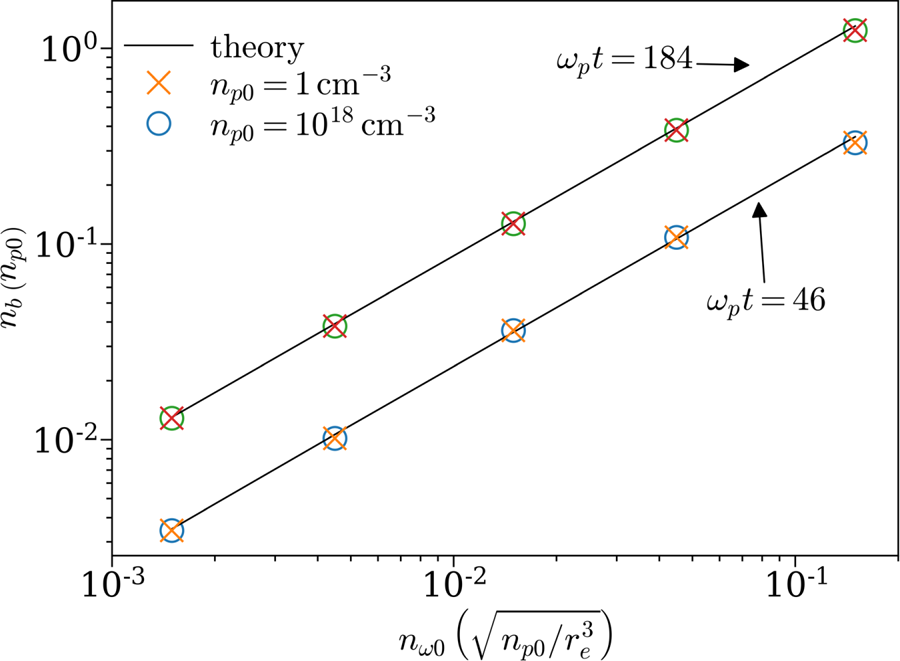
Another set of 2-D simulations was run to assert the relevance of this process of beam formation. Our goal is to check the range of validity of the scaling inferred for its peak density in (2.6). We consider two sets of simulations. The first set is characterized by a pair plasma of density  $n_{p0}=10^{18} \ \textrm {cm}^{-3}$, with photon densities
 $n_{\omega 0}= 10^{25}$–
 $10^{27}\ \textrm {cm}^{-3}$. The second presents a pair plasma density of
 $n_{p0}=1 \ \textrm {cm}^{-3}$, with photon densities
 $n_{\omega 0} = 10^{16}$–
 $10^{18}\ \textrm {cm}^{-3}$. Connections of these parameters to laboratory or astrophysical parameters will be discussed in § 5. Given the symmetry of our problem, we reduce the domain size to
 $(24 c/\omega _p)^2$ and follow the photon beam in a moving window with a velocity equal to
 $c$. The domain has
 $600^2$ cells with dimensions
 $\delta x = \delta y = 0.04 c/\omega _p$ and a time step
 $\delta t = \delta x /2$.
Figure 2 represents the pair beam density as a function of the incident photon density for two instants,  $\omega _p t = 46$ and
 $184$. The normalization by the quantity
 $(n_{p0}/r_e^3)^{1/2}$ comes from a factor
 $\nu /\omega _p$ in (2.8). This reveals a general scaling of the normalized pair beam density
 $n_b/n_{p0}$, independent of the initial plasma density
 $n_{p0}$. Despite such a wide gap of initial plasma densities considered in figure 2, simulations clarify that the normalized pair beam density at a given time
 $t$ remains exactly the same as long as
 $n_{\omega 0}(r_e^3/n_{p0})^{1/2}$ (or
 $\nu /\omega _p$) is constant. This scaling matches exactly with the prediction of (2.6), illustrated as a black line in figure 2.
Pair beam density  $n_b/n_{p0}$ versus the photon density
 $n_{\omega 0}$ in units of
 $\sqrt {n_{p0}/r_e^3}$ for plasma densities
 $n_{p0} = 1 \ \textrm {cm}^{-3}$ (X) and
 $n_{p0} = 10^{18} \ \textrm {cm}^{-3}$ (O) at two times in the simulations. The plasma angular frequency is
 $\omega _p$.

We have generalized the validity of the results obtained in figure 2 to account for baryon loading in the background plasma. First, we ran all the simulations presented before with a fraction  $f$ of proton density up to
 $f=0.1 n_{p0}$ in the pair plasma. As the initial electron and positron plasma densities are not equal, the beam driven by Compton now presents a non-uniform charge and current densities. This initiates the start of the two-stream instability. The growth rate of such instability is much lower than the oblique instability (Bret, Firpo & Deutsch Reference Bret, Firpo and Deutsch2005b) by a factor
 $\gamma _b^{2/3}$, with
 $\gamma _b$ as the Lorentz factor of the beam. As a consequence, the exponential growth of the oblique modes we report in the next section still takes place, but is initiated in a slightly perturbed plasma. Second, we ran one three-dimensional (3-D) simulation, which confirmed our previous findings. We performed the simulation for a plasma density of
 $n_{p0}=1 \ \textrm {cm}^{-3}$ and photon density of
 $n_{\omega 0} =10^{18}\ \textrm {cm}^{-3}$. The domain size was
 $(24 c/\omega _p)^3$ and the photon beam was followed in a moving window with a velocity equal to
 $c$. The domain had
 $600^3$ cells of dimensions
 $\delta x = \delta y = \delta z = 0.04 c/\omega _p$ and the time step was
 $\delta t = \delta x /2$. We initialized
 $2/2/4$ particles per cell for electrons, positrons and photons. The transverse boundary conditions for particles and fields were all periodic. For this 3-D simulation (not shown here), the evolution of the peak beam density was the same as for the 2-D simulation with the same parameters. While we will discuss this in detail in § 3, we add that the growth rate of the beam plasma instability in this 3-D simulation is also the same as in the corresponding 2-D simulation.
3. Onset of a beam-plasma instability
The normalized pair beam density  $n_b/n_{p0}$ increases with time and is expected to trigger an electromagnetic beam-plasma instability when
 $n_b/n_{p0} \lesssim 1$. Two types of modes can compete and lead to an exponential growth of magnetic fields (Bret, Firpo & Deutsch Reference Bret, Firpo and Deutsch2005a). The first type is the modes associated to the current filamentation instability (CFI), with growth rate
 $\omega _p^{-1}\varGamma _\textrm {CFI} = (n_b /n_{p0}\gamma _b)^{1/2}$. The second type is the modes corresponding to the oblique filamentation instability (OBI), with growth rate
 $\omega _p^{-1}\varGamma _\textrm {OBI} = \sqrt {3}(n_b /n_{p0}\gamma _b)^{1/3} /2^{4/3}$. We can predict that our prevailing modes will be oblique because we consider Lorentz factors
 $1 \ll \gamma _b \lesssim 1/ \alpha _f$ and densities
 $n_b /n_{p0} \leq 1$. Above some critical angle in
 $\boldsymbol {k}$ space, such modes are expected to be damped like CFI modes arising from thermal effects (Bret et al. Reference Bret, Firpo and Deutsch2005a). The physical reason is that a transverse thermal expansion of filaments competes with the magnetic pinching force maintaining them (Silva et al. Reference Silva, Fonseca, Tonge, Mori and Dawson2002). The latter theoretical work provides a density threshold above which the instability can still be set off despite this initial spread. It reads
 $\alpha _\textrm {th} = n_b/n_{p0} \simeq \gamma _b (p_{\perp }/{mc}\gamma _b)^2$. Using the estimates from (2.1a,b), we get
 $n_b/n_{p0} \simeq 7 / (6 \ln \epsilon )$ and
 \begin{equation} \omega_p^{{-}1}\varGamma \simeq (7 \sqrt{3}/16)^{1/3} [\epsilon \log(\epsilon)]^{{-}1/3}.\end{equation}
The minimum density required to trigger the instability is reached after a propagation time of  $1 / ( \nu \ln \epsilon )$. Using (2.6), this implies the photons should propagate through a plasma of length greater than
 $r_{\min } \geq c / ( \nu \ln \epsilon )$. This condition can be recasted as
 \begin{equation} r_{\min} [\mathrm{cm}] \geq 1.6\times 10^{25} n_{\omega}^{{-}1} [\mathrm{cm}^{{-}3}] . \end{equation}
The beam density threshold  $\alpha _\textrm {th}=6/(7\ln \epsilon )$ is independent from the initial plasma density, and so is the plasma length
 $r_{\min }$ given in (3.2). It is worthwhile to stress that provided the photon density and the background plasma length satisfy the condition in (3.2), the instability will take place. As far as the effect of the background plasma temperature is concerned, we can rely on previous investigations (Bret et al. Reference Bret, Firpo and Deutsch2005b). For the non-relativistic background plasma temperature considered here (
 $1$ eV), we do not expect any mitigation effect on the onset of CFI-like modes.
In addition, it seems meaningful to evaluate the energy conversion efficiency from the incident photons to magnetic fields. We define  $\eta = \mathcal {E}_{B_z}/\mathcal {E}_{\omega 0}$, the ratio between the magnetic energy
 $\mathcal {E}_{B_z} \simeq \int c^2 B_z^{2}/8\pi \, \textrm {d}\boldsymbol {x}$ and the incident photon energy. For a semi-infinite beam (and 1-D), the ratio
 $\eta$ is also the ratio of the energy densities. For the sake of simplicity, we estimate an upper bound for the magnetic field energy
 $\mathcal {E}_{B_z} \lesssim \int c^2 |B_z|^{2}/8\pi \,\textrm {d}\boldsymbol {x}$. Using Parseval theorem, this can be expressed as
 $\mathcal {E}_{B_z} \lesssim \int c^2 |B_z|^{2}/8\pi \,\textrm {d}\boldsymbol {k}$. The value of the saturated magnetic field can be approximated by equating the bounce frequency of trapped particles to the growth rate of the instability (Yang, Arons & Langdon Reference Yang, Arons and Langdon1994). This maximum is
 $eB_{z}(k)/m\omega _p \simeq (\gamma _b^2/p_x) (\omega _p^{-1} \varGamma )^2 \omega _p /kc$. The energy conversion efficiency is then deduced by introducing the incident photon energy density
 $\epsilon n_{\omega 0}$
 \begin{equation} \eta \lesssim \frac{1}{4 \pi} \left( \frac{7\sqrt{3}}{16} \right)^{4/3} \frac{n_{p0}}{n_{\omega 0}} \frac{1}{(\epsilon \ln^4 (\epsilon) )^{1/3}}. \end{equation}
It is important to underline that this inequality only expresses an upper bound for the conversion efficiency. For any given plasma of density  $n_{p0}$, (3.3) predicts that
 $\eta$ can be maximized for smaller incident photon densities
 $n_{\omega 0}$. However, decreasing the photon density limits the growth of the beam density through Compton scattering and therefore increases the propagation distance required to trigger the instability, as evidenced in (3.2). As a consequence of this low conversion efficiency
 $\eta$, the generation of magnetic fields can, in principle, take place over long distances. For a perfectly collimated photon source emerging from the photosphere (
 $\simeq 10^{12} \ \textrm {cm}$), this length can be as high as the Compton mean free path
 $L_{\omega }\ [\mathrm {cm}] =c\tau _{\omega } \simeq 10^{25} n_{p0}^{-1} \ [\textrm {cm}^{-3}]$. In fact, the typical opening angle of the GRB ejecta is in the range
 $\theta \leq 20^{\circ }$, as estimated by Racusin et al. (Reference Racusin, Liang, Burrows, Falcone, Sakamoto, Zhang, Zhang, Evans and Osborne2009). With this more realistic assumption, the photon density and the beam density are expected to decrease with the propagation distance as
 $1/r^2$ owing to this transverse dilution effect. We estimate under which condition this depletion of the beam may remain negligible compared with the loading via Compton scattering as
 \begin{equation} \frac{\nu}{c} (r-r_\textrm{ph}) \left(\frac{r_\textrm{ph}}{r}\right)^2 \geq 1 \rightarrow r \leq \sigma_\textrm{kn} n_{\omega 0} r_\textrm{ph}^2 = r_{\max}. \end{equation}
The inequality (3.4) states that the density increase owing to the Compton loading between  $r_\textrm {ph}$ and
 $r$ is
 $\nu (r-r_\textrm {ph})/c$ and remains larger than the density decrease between
 $r_\textrm {ph}$ and
 $r$ owing to the transverse dilution, which is
 $(r_\textrm {ph}/r)^2$. The inequality (3.4) provides a maximum distance, denoted as
 $r_\textrm {max}$, over which the instability can be sustained.
Given a gamma-ray density between  $10^{14}\ \textrm {cm}^{-3}$ and
 $10^{22}\ \textrm {cm}^{-3}$ that we inferred at the exit of the photosphere of GRBs (see § 5), the condition (3.4) is fulfilled for distances ranging from a few photospheric radii
 $\sim 10^{12} \ \textrm {cm}$ up to larger values of
 $10^{20} \ \textrm {cm}$. We did not verify this estimate in simulations owing to the computational cost for very long propagation lengths
 $L \ [\mathrm {cm}] \geq 10^{8} n_{p0}^{-1/2} \ [\textrm {cm}^{-3}]$.
4. Generalization for various photon distributions
In the previous section, we have considered idealized photon distributions. We now examine more realistic photon distribution functions.
We investigate a simulation with plasma density  $n_{p0}=10^{8} \ \textrm {cm}^{-3}$ and photon density
 $n_{\omega 0} = 10^{22} \ \textrm {cm}^{-3}$. We employ the
 $\delta$ notation for a Dirac delta function, and can write the momentum distribution of the photons as
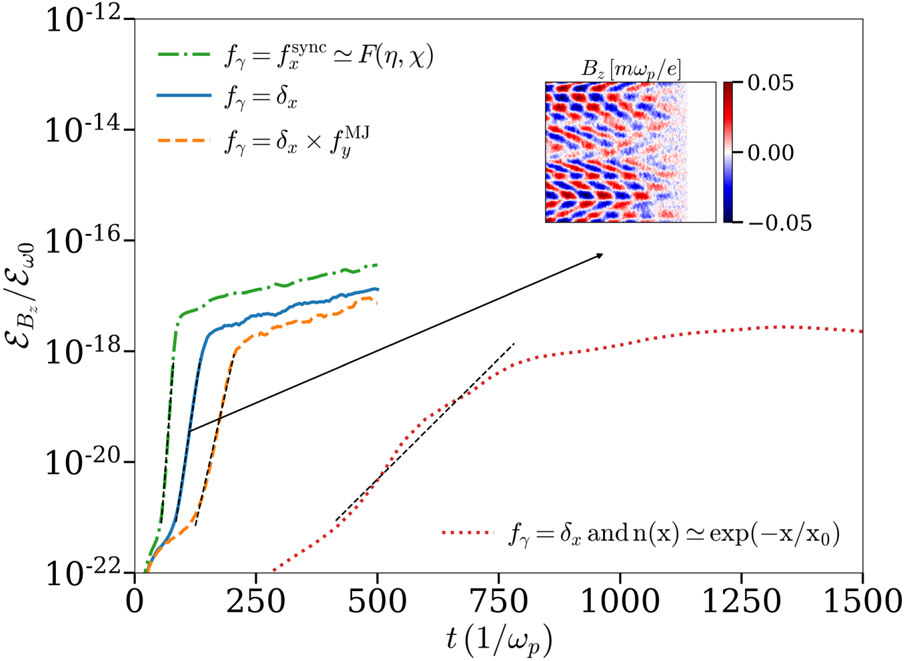
 $f=\,f_{x}=\delta (p_x-100 {mc})$. Figure 3 reports the energy of the
 $B_z$ field, denoted by
 $\mathcal {E}_{B_z}$ and normalized by the incident photon energy
 $\mathcal {E}_{\omega 0}$ (blue solid curve). We first focus on the monoenergetic photon distribution (blue solid curve). The growth rate for all modes
 $\boldsymbol {k}$ is
 $\omega _p^{-1} \varGamma = 7.4 \times 10^{-2}$. The
 $B_z$ field profile is displayed during the linear phase of the instability (see the inset) and shows that the dominant mode is oblique:
 $\boldsymbol {k} = (k_x,k_y) \simeq (1.8, 1.4) \omega _p/c$. Its growth rate is
 $\omega _p^{-1} \varGamma = 0.12$ close to
 $\omega _p^{-1} \varGamma \simeq 0.118$, which is the theoretical prediction from (3.1). The linear stage of the instability starts after a propagation distance
 $\simeq 90 c/\omega _p$, which is consistent with the minimum inferred theoretically of
 $34 c/\omega _p$ in (3.2). The theoretical upper bound of the energy conversion efficiency given by (3.3) is
 $\eta \lesssim 1.5\times 10^{-17}$, which is of the order of the simulation result
 $\eta = 5\times 10^{-18}$. We also checked that the pair beam density rises slowly (
 $+30\,\%$) on the instability time scale for
 $\omega _p t = 90\text {--}150$. This legitimates a posteriori the use of estimates from linear theory. However, during the saturation stage, for
 $\omega _p t = 150\text {--}500$, the front beam density increases from
 $n_{p0}$ up to
 $\sim 4 n_{p0}$, a value which is in agreement with that from (2.8). As a consequence, the beam keeps on filamenting and the magnetic field energy keeps increasing.
Magnetic field energy  $\mathcal {E}_{B_z}$, normalized by the incident photon energy
 $\mathcal {E}_{\omega 0}$. We denote
 $\eta =\mathcal {E}_{B_z}/\mathcal {E}_{\omega 0}$ and derive an upper bound in (3.3). Simulation for a monoenergetic photon distribution (blue solid curve), a Maxwell–Jüttner transverse profile (orange dashed curve), a front density gradient (red dotted curve) and a synchrotron distribution (green dash–dotted curve). The growth rate of the field is determined from the slope of the black dashed curves. Inset: typical
 $B_z$ field profile during the linear phase.

The aforementioned discussions are focused on a monoenergetic gamma-ray beam. We intend to extend these results for more complex distributions. First, we consider a photon distribution  $f=f_x f_y$ with
 $f_x=\delta (p_x-100 {mc})$ and
 $f_y$ a Maxwell–Jüttner distribution of temperature
 $T_{\gamma ,\perp }$. In the case where
 $T_{\gamma ,\perp }/{mc}^2 \ll {\rm \Delta} p_{\perp }/{mc}$, with
 ${\rm \Delta} p_{\perp }/{mc}=\sqrt {7 \epsilon /(6 \ln \epsilon )}$ given by (2.1a,b), the results we have discussed before are not changed because the transverse momentum spread of the beam only arises from the Compton scattering kinematics. In the other limit
 $T_{\gamma ,\perp }/{mc}^2 \gtrsim \sqrt {7 \epsilon /(6 \ln \epsilon )}$, the transverse momentum spread of the beam is determined by
 $T_{\gamma ,\perp }$. Because the Compton cross-section is beamed for gamma rays, the pair beam presents a similar transverse momentum spread as the photon beam, which is known to lower the growth rate of the OBI (Bret, Gremillet & Bénisti Reference Bret, Gremillet and Bénisti2010). The latter behaviour is confirmed in figure 3 where we choose
 $T_{\gamma ,\perp }=3{mc}^2$. This implies a transverse momentum spread of
 ${\rm \Delta} p_{\perp }/{mc} = 6$ for the photon source, while the Compton-induced spread is
 ${\rm \Delta} p_{\perp }/{mc}=\sqrt {7 \epsilon /(6 \ln \epsilon )}=5$. As expected, this leads to a reduction of the growth rate
 $\omega _p^{-1}\varGamma = 7.4\times 10^{-2} \rightarrow 4.5 \times 10^{-2}$, see the orange dashed curve. Second, we consider that the photons have a monoenergetic distribution
 $f=f_x$ with
 $f_x=\delta (p_x-100 {mc})$ but their density profile has an exponential shape
 $\propto \exp (-x/100)$ of scale length
 $100 c/ \omega _p$, followed by a flat profile of density
 $n_{\omega 0}$. Because the pair beam density is proportional to the photon density, its profile first presents a density gradient and then the triangular shape, as observed in figure 1(b3,c3). As a result, the growth of the OBI is delayed in time, and is slightly lower but noticeable (
 $\omega _p^{-1}\varGamma \simeq 1.0\times 10^{-2}$). This time delay is comparable to the gradient length, as can be seen by the red dotted curve in figure 3. Third, we model a synchrotron distribution for the incident photon beam. We set up this energy distribution as a longitudinal momentum distribution for the photons
 $f=f_x=F(\eta , \chi )$ (Klepikov Reference Klepikov1954). The function
 $F$ represents the synchrotron spectra of an electron with a quantum parameter
 $\eta$,
 $\chi$ being the photon quantum parameter. It has a peak at an energy of
 $\hbar \omega /{mc}^2 = 100$. Photons with an energy of
 $10$–
 $100$ MeV are Compton scattered and contribute to increase the pair beam density compared with the monoenergetic case. Indeed, the Klein–Nishina cross-section is a decreasing function of photon energy. As a result, the growth of the
 $B_z$ field energy is faster:
 $\omega _p^{-1}\varGamma = 7.4\times 10^{-2} \rightarrow 1.2 \times 10^{-1}$, as seen by the green dash–dotted curve in figure 3.
5. Relevance for astrophysics and laboratory environments
We now discuss under which conditions this process can be observed in astrophysics and in the laboratory.
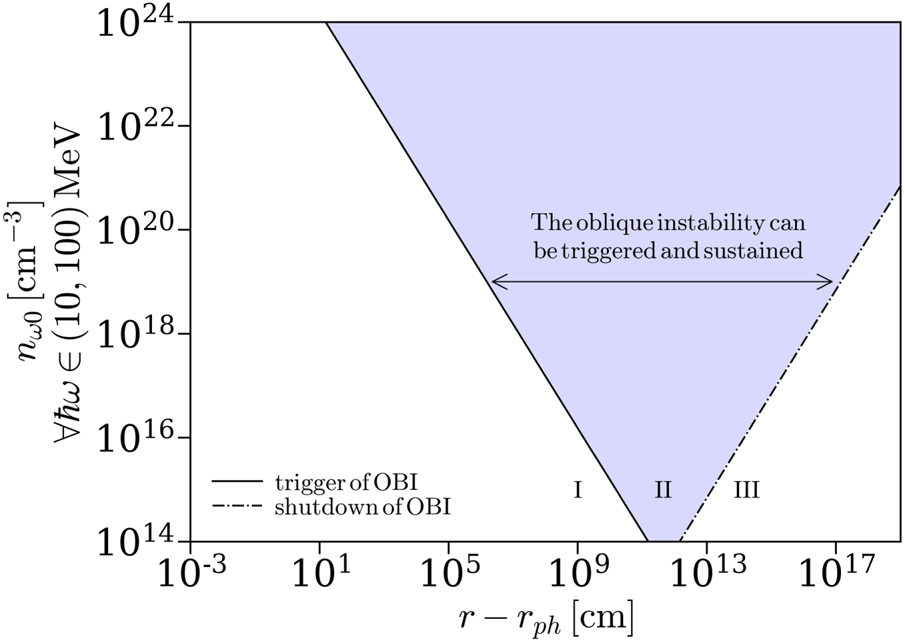
Figure 4 covers a large range of photon densities  $n_{\omega 0}$ and distances
 $r-r_\textrm {ph}$, with
 $r_\textrm {ph}$ the photospheric radius of a GRB. It reports whether the propagation distance is large enough to enable the instability to be triggered, see (3.2). The latter limit is plotted by the continuous line in figure 4 and enables the distinction of two regimes of interaction. The first interaction regime is represented by all the area on the left side of the continuous line and is denoted as I. In this case, the photons are expected to form a relativistic electron positron beam via Compton scattering. However, the pair beam density is too low and its transverse momentum spread is too high to enable the onset of the instability, as detailed in § 3. The second interaction regime is depicted by the area between the continuous and dash–dotted lines and is denoted as II. In this regime, the pair beam density grows high enough to allow the instability to develop. The dash–dotted line illustrates the maximum length of the filament, as estimated in (3.4). This corresponds to the radius above which the beam density is depleted by dilution effects faster than it is loaded via Compton scattering.
Relevance of the pair beam formation and magnetization in the frame of the GRB–CBM interaction at the photospheric radius  $r_\textrm {ph} \sim 10^{12} \ \textrm {cm}$. On the left side of the continuous line (area I): one expects only pair beam formation. Between the continuous and dash–dotted lines (area II), one also expects the beam-plasma instability. On the right side of the dash–dotted (area III), the instability is shutdown owing to the transverse dilution of the beam.

For the photospheric radius of a GRB, we evaluated a range of relevant gamma-ray densities. With estimates from the fireball model, this gamma-ray density (10–100 MeV) is determined to be  $n_{\omega }\in (10^{14},10^{22}) \ \textrm {cm}^{-3}$. From this order of magnitude, we observe in figure 4 that such conditions can trigger the instability and its development at large distances. To be more precise, the instability can be expected for GRBs whenever their gamma-ray density at the photosphere radius is above
 $10^{14} \ \textrm {cm}^{-3}$, which corresponds to a GRB with an isotropic equivalent luminosity above
 $3 \times 10^{50}$ erg s
 $^{-1}$. The second important result is that the beam density remains high enough to sustain the instability at large distances, despite its transverse dilution. For example, the instability can be maintained at distances
 $\geq 10^{17} \ \textrm {cm}$ for gamma-ray densities
 $\geq 10^{19} \ \textrm {cm}^{-3}$, and this corresponds to an isotropic equivalent luminosity
 $\geq 10^{52}$ erg s
 $^{-1}$.
We now detail the estimates to infer what is the gamma-ray density at the photosphere radius, following Kumar & Zhang (Reference Kumar and Zhang2015). Let us consider a compact object with a radius  $\sim 10^{7} \ \textrm {cm}$ and an isotropic equivalent luminosity
 $\mathcal {L}$ in erg s
 $^{-1}$. For simplicity we provide the estimate in the compact object frame, thus neglecting the red shift of its host galaxy. The fireball emerges from the compact object and experiences an adiabatic expansion. At the photospheric radius
 ${\sim }10^{12} \ \textrm {cm}$, the emergent thermal radiation from the photosphere has a luminosity which is equivalent to a blackbody temperature of
 $[1.3 \ \mathrm {MeV}] \times \mathcal {L}_{52}^{1/4}$. The notation
 $\mathcal {L}_{52}$ is defined as
 $\mathcal {L}_{52}=\mathcal {L}/(10^{52} \ \textrm {erg}\ \textrm {s})$. We assume typical GRBs have an isotropic equivalent luminosity in the range
 $\mathcal {L}\in (10^{47}\text {--}10^{54})$ erg s
 $^{-1}$, in line with data recently gathered (Abbott et al. Reference Abbott, Abbott, Abbott, Acernese, Ackley, Adams, Adams, Addesso, Adhikari and Adya2017). This leads to the conclusion that this blackbody equivalent temperature for the luminosity at the photospheric radius ranges from
 $70 \ \mathrm {keV}$ up to
 $4 \ \mathrm {MeV}$. However, the isotropic equivalent luminosity is defined for photons in the standard energy band
 $1 \ \mathrm {keV}$ up to
 $10 \ \mathrm {MeV}$. We then deduce the fraction of photons in the energy range
 $10$–
 $100$ MeV, where our results are valid, by assuming a black body energy distribution. For instance, this ratio of photons (10–100 MeV) becomes
 $\gtrsim 5\,\%$ if the GRB isotropic equivalent luminosity is
 $\gtrsim 10^{52}$ erg s
 $^{-1}$. The final step is to deduce a gamma-ray density from this total luminosity in gamma rays. To this purpose, we assumed the GRB ejecta is a spherically expanding shell and its thickness is the GRB duration, typically ranging between
 $0.1$ and
 $100 \ \textrm {s}$.
We now discuss the role of an external magnetic field that can be expected in an astrophysical scenario. It is expected that an external and strong enough magnetic field aligned with the flow will prevent the development of the current filamentation instability (Molvig Reference Molvig1975). It was however demonstrated that if the field is not strictly aligned with the flow, then the instability is ensured to take place with a reduced growth rate for a non-relativistic beam temperature (Bret & Alvaro Reference Bret and Alvaro2011). This growth rate is a fraction of the growth rate without any magnetic field. Its detailed value in the low- and high-magnetization limits can be found in (8) and (10) of the paper by Bret & Alvaro (Reference Bret and Alvaro2011).
It is worth questioning whether this Compton-driven beam formation and magnetization can take place in the laboratory. Despite the ongoing worldwide efforts, no large size and confined pair plasmas have been formed in a laboratory environment yet. One can still mention that pair jets of high density  $n_{p0}\sim 10^{16}\ \textrm {cm}^{-3}$ can be generated by fast electrons going through mm-sized high-Z targets. The fast electrons can be generated by an intense laser (Chen et al. Reference Chen, Link, Sentoku, Audebert, Fiuza, Hazi, Heeter, Hill, Hobbs, Kemp, Kemp, Kerr, Meyerhofer, Myatt, Nagel, Park, Tommasini and Williams2015; Liang et al. Reference Liang, Clarke, Henderson, Fu, Lo, Taylor, Chaguine, Zhou, Hua, Cen, Wang, Kao, Hasson, Dyer, Serratto, Riley, Donovan and Ditmire2015) or by a plasma wakefield accelerator (Sarri et al. Reference Sarri, Poder, Cole, Schumaker, Di Piazza, Reville, Doria, Dromey, Gizzi, Green, Grittani, Kar, Keitel, Krushelnick, Kushel, Mangles, Najmudin, Thomas, Vargas and Zepf2015; Xu et al. Reference Xu, Shen, Xu, Li, Yu, Li, Lu, Wang, Wang, Liang, Leng, Li and Xu2016). Recent numerical work has brought forward a new scheme to create dense pair jets
 $n_{p0}\sim 10^{13}\ \textrm {cm}^{-3}$ with size of several skin-depths in all directions from the interaction of relativistic protons (
 $400 \ \textrm {GeV}\ \textrm {c}^{-1}$) with a solid beryllium/lead target (Arrowsmith et al. Reference Arrowsmith, Shukla, Charitonidis, Boni, Chen, Davenne, Froula, Huffman, Kadi, Reville, Richardson, Sarkar, Shaw, Silva, Trines, Bingham and Gregori2020). Regarding gamma-ray sources (10–100 MeV), we estimated a density
 $n_{\omega 0}\sim 10^{17} \ \textrm {cm}^{-3}$ for the experimental photon source recently obtained by nonlinear inverse Compton scattering (Cole et al. Reference Cole2018; Poder et al. Reference Poder2018). For such a photon density, one would need a plasma length of
 $10^8 \ \textrm {cm}$ to witness the instability, which cannot be achieved in a laboratory environment. We also consider the results of a recent simulation from an extremely dense gamma-ray source obtained during the interaction of a dense electron beam with multiple micron-sized foils (Sampath et al. Reference Sampath2021). Although it remains a numerical result and its experimental realization may lie far in the future, it achieves a record gamma-ray density of
 $n_{\omega 0}\sim 10^{23} \ \textrm {cm}^{-3}$ with a distribution peaked at 100 MeV. One can see in figure 4 that even this high gamma-ray density might be enough to witness the onset of the Compton-driven instability in a laboratory frame. One would need a plasma length of
 $150 \ \textrm {cm}$ to observe it. Overall, our results indicate that exploration of the process of beam formation and magnetization in the laboratory is unlikely in the short term owing to the combined requirements of plasma length and gamma-ray densities.
6. Conclusions
To summarize, we reported a study of gamma-ray propagation in a background pair plasma. We showed that it can lead to the formation of a relativistic pair beam, thanks to the beaming of the Compton cross-section for photons above 10 MeV. A theoretical model to describe the formation of the beam driven by Compton scattering has been developed, and compared with PIC simulations. We showed the pair beam can achieve a relativistic Lorentz factor with a density comparable to the background plasma. In addition, we quantified the transverse momentum spread of the beam, which is induced by the Compton cross-section. We demonstrated that the pair beam, as it propagates, can convert its kinetic energy to magnetic energy via the oblique instability, although limited by its transverse momentum spread. The conversion efficiency of this process is low, but it can occur over long distances. We extrapolated from PIC simulations that it could lead to the generation of magnetic fields on distances larger than a parsec (up to  $\simeq 10^{25} \ \textrm {cm}$) for a perfectly collimated GRB ejecta. For a less collimated one (
 $\theta \leq 20^{\circ}$), we estimated the instability can be sustained over long distances
 $10^{12}\rightarrow 10^{17} \ \textrm {cm}$ for GRBs with an isotropic equivalent luminosity ranging from
 $3\times 10^{50} \text { to } 10^{52}$ erg s
 $^{-1}$. We showed that these results can be used to address the energy dissipation of gamma rays at the photospheric radius of GRBs. We checked the robustness of our results for various types of photon sources, with non-uniform density profiles and transverse and longitudinal spreads in their momentum distribution. The simulations done in the frame of this study are performed for the typical orders of magnitude for plasma and photon densities expected at the photospheric radius of a GRB, using estimates from the hot fireball model as well as data recently gathered on GRBs.
This work offers two directions to explore in the future. The first could be to consider photon distributions with energies below 10 MeV to connect with previous works on Compton-driven plasma wakes (Frederiksen Reference Frederiksen2008; Del Gaudio et al. Reference Del Gaudio, Fonseca, Silva and Grismayer2020a). The second is to understand the impact of the beam formation and magnetization on global GRB models.
Acknowledgements
The authors acknowledge fruitful discussions with Drs Del Gaudio and Schoeffler.
Editor Antoine C Bret thanks the referees for their advice in evaluating this article.
Funding
This work was supported by the European Research Council (ERC-2015-AdG Grant 695088). We also acknowledge PRACE for awarding access to MareNostrum based in Spain.
Declaration of interests
The authors report no conflict of interest.