Introduction
Home hospice uses a unique care model in which family caregivers assume primary responsibility for patients’ emotional and physical care, with the support of a hospice nurse leading an interdisciplinary team (National Hospice and Palliative Care Organization, 2015). Caregivers are explicitly included as a member of the care team (National Hospice and Palliative Care Organization, 2015), and a family-centered approach honors the caregiver's role, focusing on the medical and psychosocial health of the patient as well as the concerns and capability of family (Teno et al., Reference Teno2004). The family-centered approach is ideal given the transitions experienced by patient and family during end-of-life care. Although family caregivers are often involved at all stages of cancer care, home hospice is arguably when caregivers take a more active role in patient care and interactions with healthcare providers. Patients and families at end of life are faced with complex, multidimensional decision-making processes, from understanding prognosis, deciding to forego curative treatment, and managing ongoing palliative and hospice care (Chen et al., Reference Chen2003). Family members, especially those that take on caregiving responsibilities, are inextricably bound to these processes. Conflict and disagreement among family members occurs often and can present significant challenges (Kramer et al., Reference Kramer2010).
To achieve family-centered care, providers must use communication strategies that foster shared understanding, trust, and agreement with and among the family (Street, Reference Street2013; Street et al., Reference Street2009; Zolnierek & Dimatteo, Reference Zolnierek and Dimatteo2009). Communication can be especially difficult in complex and emotionally charged situations, such as at end of life (Bredart et al., Reference Bredart, Bouleuc and Dolbeault2005). There is a small but growing literature on patient-caregiver-provider communication. This literature, mainly focused on clinical encounters, suggests that caregivers serve more as observers or advisors than as active participants (Eggly et al., Reference Eggly2013; Laidsaar-Powell et al., Reference Laidsaar-Powell2016a, Reference Laidsaar-Powell2016b). There is less research describing the process of providers’ facilitation through the evolving and potentially conflicting patient-caregiver goals of care. Although family caregivers are often seen as proxies and advocates for the patient (Laidsaar-Powell et al., Reference Laidsaar-Powell2016a), caregiver and patient may not always agree on goals or how to achieve these goals.
Further, most hospice patients and caregivers experience role changes because of advancing patient illness and decline. Effective ongoing communication is required to manage these transitions (Duggleby et al., Reference Duggleby2016). The emotional nature of the patient's impending death can contribute to communication difficulties for many families with advanced stage disease (Zaider et al., Reference Zaider, Hichenberg, Latella, Kissane, Bultz and Butow2017; Zhang et al., Reference Zhang, Zyzanski and Siminoff2010). Even long-term spouses who report “sharing everything” with each other often do not disclose physical or psychosocial/emotional health information (Checton & Greene, Reference Checton and Greene2014). Instead of communicating with each other, some couples turn to third parties, due in part to a need to express emotions while “protecting” their spouse (Manne et al., Reference Manne2007). For patients and caregivers that do communicate, but disagree, conflict may spill over into communication with others. For example, individuals may try to enlist others’ support or request mediation, particularly if that individual has some expertise, such as hospice nurses. Although conflict can be detrimental, it can also be an important catalyst for change. By expressing fears and frustrations, family members can resolve differences, share in decision-making, and experience positive emotions and deeper connections. Previous research suggests that conflicts that contain positive emotions can shape more positive reactions and resolutions to conflict than wholly negative conflicts (Fredrickson, Reference Fredrickson2001; Halperin, Reference Halperin2013; Larsen et al., Reference Larsen2017). Failure to communicate or ongoing family conflicts can result in misunderstandings or disagreements about care goals and preferences, ultimately affecting care and quality of life, even affecting caregiver bereavement (Kissane et al., Reference Kissane1994; Kramer et al., Reference Kramer2010).
Often, the responsibility to resolve conflict between families at end of life falls to providers (Boelk & Kramer, Reference Boelk and Kramer2012); however, many healthcare providers find communicating with families in conflict to be challenging (Laidsaar-Powell et al., Reference Laidsaar-Powell2017) and there is a need to better understand what conflict looks like to help providers learn how to address it (Boelk & Kramer, Reference Boelk and Kramer2012). Despite this, most work on family conflict in home hospice is based on self-report or interview data (Boelk & Kramer, Reference Boelk and Kramer2012; Hamano et al., Reference Hamano2018; Hopeck & Harrison, Reference Hopeck and Harrison2017; Kramer et al., Reference Kramer2010); few studies have captured observations of conflict and its resolution at end of life.
Objective
This paper describes communication among patients, caregivers, and nurses during home hospice visits, with a focus on periods of role transition and emerging conflict. This study is an important contribution to current literature examining nurse intervention in patient-caregiver conflict. Although previous qualitative studies have captured patient and caregiver accounts of communication conflict and barriers, this study observes realtime interactions and exact communication, providing the specific feedback needed to design interventions for patients, caregivers, and nurses.
Methods
The present study is a secondary analysis of home hospice interactions captured within a larger multisite longitudinal study of family caregivers in home hospice, the Cancer Caregiver Study-I (P01CA138317) from August 2011 through December 2014. The study was approved by the institutional review board and home hospice agencies.
Participants
Nurse participants were recruited from seven hospice agencies in the Intermountain West (n = 5) and Northeastern (n = 2) United States. Caregiver-patient dyads were recruited from participating nurse caseloads. Eligibility criteria included spouse/partner caregivers of individuals with a cancer diagnosis newly enrolled in home hospice, >45 years of age, English speaking, cognitively able to participate, and had at least one audiotaped visit with their hospice nurse. All participants (or their legal representatives) provided written informed consent. The current analysis included 19 patient-caregiver dyads and 19 unique nurses.
Procedures
Upon study enrollment, nurse and caregiver participants completed demographic questionnaires. Nurse participants audiorecorded their hospice home visits from study enrollment until patient death using a small, unobtrusive digital recorder. Visit recordings were analyzed by trained coders in the parent study (Reblin et al., Reference Reblin2016, Reference Reblin2017) using the Roter Interaction Analysis System, which identifies content and process communication strategies for each utterance, including positive and negative emotion expression (Roter & Larson, Reference Roter and Larson2002).
Our goal in the current analysis was to identify potential conflict between patient and caregiver and its resolution. Based on the broaden and build theory (Fredrickson, Reference Fredrickson2001), which states that many people use positive emotions on the heels of negative emotion and/or conflict as a self-regulatory strategy, we selected recorded and coded home hospice nurse visits with a frequency of both positive and negative emotion Roter Interaction Analysis System codes 1 SD or higher for both patient or caregiver. Nineteen visits from unique dyads were selected and professionally transcribed for qualitative analysis.
Analysis
Because conflict and resolution in nurse-patient-caregiver communication research is largely unexplored, we used constant comparison methodology for analysis (Charmaz, Reference Charmaz2006; Corbin & Strauss, Reference Corbin and Strauss2008). Using hand coding methods, two authors (J.H., M.R.) with training and experience in analyzing clinic communication processes first reviewed unrelated transcripts to become sensitized to specific verbal communication behaviors. Coders discussed and gained consensus regarding criteria for identifying instances of conflict involving nurse intervention and refined this process by identifying eligible passages using unrelated transcripts. After establishing consensus over the criteria for nurse-caregiver-patient conflict, coders collaboratively created a codebook that included accepted rules for identifying the start and end of passages as well as identifying and classifying verbal behaviors. Coders deductively developed a preliminary code list of key concepts. Nurse communication in coded exchanges was labeled to identify the following functions: problem-solving, mediation, or facilitating discussion about conflict. Coders also indicated whether nurses’ responses provided validation and/or reassurance. Using the constant comparison method, coders identified new phenomena emerging from the text, while iteratively refining and updating the code list to reflect observed communication. After independently reviewing eight transcripts, coders met to collaboratively review and compare coding and reached consensus through mutual discussion together and with the authorship team. Final coding was entered into Atlas.ti (a qualitative software program; Scientific Software Development, 1999). Coders collaborated to refine existing categories, integrating and collapsing instances with similar or related properties (Corbin & Strauss, Reference Corbin and Strauss2008). Findings are presented thematically (Sandelowski & Leeman, Reference Sandelowski and Leeman2012).
Ethical approval
All procedures were conducted under approval by the University of Utah Institutional Review Board, protocol number 00033122.
Results
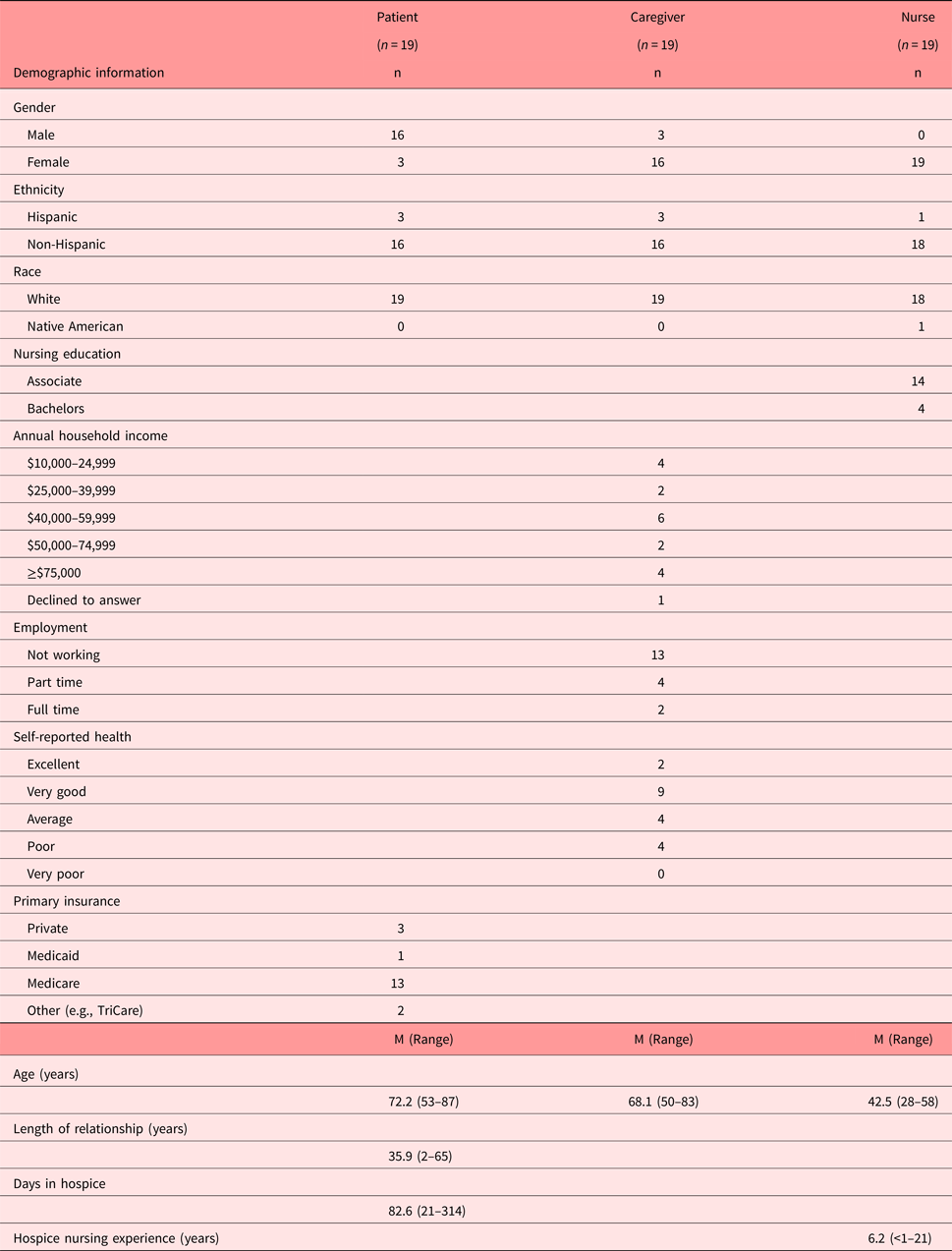
As shown in Table 1, average nurse age was 42.5 years, all 19 hospice nurses were female, and most were non-Hispanic white. Most held an associate's degree and had been practicing as a hospice nurse for an average of 6.2 years. Caregivers were spouses of patients (average years in relationship = 35.9) and dyads were primarily non-Hispanic white. Most caregivers were female and slightly younger on average than patients (68.1 vs. 72.2).
Study demographic information

Negotiating transitions in independence
Caregivers identified the patients’ decreasing mobility, endurance, or comfort as a pivotal transition in care. Caregivers and patients each initiated individual alliances with the hospice nurse, sharing their perspective or opinions regarding potential misconceptions and preferences for care, most often when the other was not present. In an effort to foster shared understanding, nurses frequently identified opportunities for caregivers to directly raise concerns with patients (and vice versa), without disclosing the prior discussion with the nurse. In other cases, nurses served as an intermediary to address patient-caregiver issues, acting as a neutral third party. In one example, a caregiver privately confides in the nurse, expressing frustration:
Caregiver: She sits on the steps. She thinks you can sit down the stairs and go down, easy. How do you do that getting up the stairs? You can't lift your bum up from one to the other. You can't do that going up the stairs, not with her strength. She had no strength to get on the stairs. So I said no.
The nurse in turn subsequently raises this issue with the patient:
Nurse: I was telling [caregiver], if you're feeling tired…use the transport chair instead of walking. Let him wheel you out…And one of the things I want you to do is, when you go to get up, ask [caregiver] for some help, okay? I want you to try to remain independent and do it on your own, but you might be a little wobbly, and I don't want you to fall. [Facilitating discussion about previous conflict]
In another instance, the nurse listened as a patient aired his grievance concerning his wife's decision to revoke his driving privileges:
CG: He's mad at me because I don't want him to drive.
Patient: That's my biggest concern.
CG: But when you see how slowly he moves and if a child ran out in front of the car–
Patient: I need a haircut. Now my grandson is going to take me so I can finally get a haircut. It's amazing how many things you can't do when your license is taken away from you.
Nurse: I know. That feels like all your independence is taken away. [Validation]
Patient: It really doesn't need to be.
Nurse: Yeah, I know.
Patient: But she says it does.
CG: [Patient], what if a child ran out in front of you?
Patient: Well, that doesn't happen.
Caregiver: …It's the response time. You may feel like you're okay to drive but it's the response time.
Patient: … I do what I'm told.
Nurse: Yeah.
CG: I might want to get that in writing.
Patient: Here's my witness. I do what I am told. Don't I?
While the nurse listens and provides the patient an opportunity to share his disappointment and anger, it is unclear if this approach is sufficient to help the couple resolve the issue of the patient's driving. Despite both patient and caregiver offering their perspectives, the use of humor and remaining tension suggest this couple may require additional negotiation before the issue is resolved.
During another interaction, a caregiver expressed frustration about a patient's immediate family members and their continued reliance on the patient's “handy man” skills, despite his increasing fatigue. In this instance, the patient attempted a plumbing job that left him severely fatigued. The nurse manages to reframe the issue for the caregiver, identifying the patient's need to feel useful and suggesting alternative activities that still allowed him to address that need. This delicate balancing act gently addresses the caregiver's concern and allows the patient to share his own perspective.
Caregiver: He likes being able to be helpful but sometimes it's more harm than good…
Nurse: It's more harm on him? Yeah. Well, I know he likes to help and he likes to - it makes you feel useful and I think you're probably not feeling a lot of that these days with everything that's going on, right? [Validation]
Patient: Right. Damn sure not.
Nurse: So you maybe you could find things that aren't too physical that you could help with. [Mediates conflict between patient and caregiver]
While patients expressed frustration over the loss of independence, caregivers similarly vented their sadness and sense of helplessness to the nurse about assuming more responsibility and/or control over the patient and his/her affairs. Caregivers were committed to guiding patients through the transitions inherent to hospice care, but were often confronted with patient frustration and noncompliance. Caregivers routinely turned to the nurse for assistance and emotional support in response to these challenges.
In one instance, a caregiver vents her frustration when a nurse conveys the importance of a patient taking his long-acting pain medication:
Caregiver: That's what I've been trying to get him to do. And I'll say, okay, you need to take these right now. “Okay, I will.” I put them right there. And when I come back from work they're still sitting there, when I come home. “Okay, you didn't take them. What have you taken today?” …And all of the things were still full, so I knew he hadn't taken anything since I gave him the morphine this morning. So I'm like, you gotta take the pain pills. You're in pain, take the pain pills.
In another instance, a caregiver discussed his attempts to arrange alternative sleeping arrangements for his wife once she was no longer able to climb the stairs to their bedroom. After moving the bed to the first floor and rearranging furniture to accommodate her, the caregiver reported that his wife was unhappy having to sleep on a different side of the bed than she was accustomed to:
Caregiver: I said, “It's my bed, too, honey. I've been sleeping there just as long as you have. I can go upstairs every night and go to sleep. I don't have to sleep down here. You have to sleep down here. I'm sleeping with you because I want to sleep with you. But I don't have to sleep here. I miss the bed, too. I'm sleeping on the wrong side.” I always sleep on this side, and she's on the other side. She said, “I'm on the wrong side.” I said, “You can't sleep on that side because you cannot - where are you going to go? Go over there, hit the table, come around here, slip in the chair, slip on this thing, fall here. You'll kill yourself getting up to get out. You have to get out here to go to the bathroom. This is why you're on that side.”
In yet another instance, a caregiver conveys helplessness when his wife's diminishing cognition resulted in a prolonged misunderstanding:
Caregiver: Last night I came in the living room and said “I want to make sure [the bag for her feeder is] ok for the night.” …But she was convinced this was underwear.
Nurse: Ok, yeah.
Caregiver: And it took me ten minutes… I showed her the bag, what went on it. It took me ten minutes to convince her she couldn't wear this.
Nurse: Right, that's hard. That's hard, isn't it? [Validation]
Caregiver: And that's new. …And I don't know if it was the stroke because she just couldn't find the words, but she was insisting, “Well, what am I going to use if I can't have this?” And I said, “You can use two of these but then I won't have a bag.” And that went on for 10 minutes…
Nurse: Oh, I'm sorry.
In a statement that appears to be balancing frustration with heartfelt caring, a caregiver confided to her husband's hospice nurse:
Caregiver: I can't imagine how those people do it that if they don't love their spouse.
Nurse: (murmuring in agreement) Oh gosh.
Caregiver: Now I understand how people can leave in the middle of an illness. Before I was always like, “What an a-hole, how could somebody do that?” But now I see the stress, I'm like…
Nurse: Yeah.
Caregiver: And when he was going through treatment I would say the same thing. I was like, “Honey, if I didn't love you so much I could f-ing kill you myself…” [Supportive listening]
These examples illustrate the complexity of patients’ gradual loss of independence and the increased responsibility caregivers assume. This process is often characterized by conflict, frustration, a sense of helplessness and underlying sadness, and inevitable shifts in the caregiver-patient relationship.
Navigating emotional/psychosocial transitions
Caregivers and patients consulted hospice nurses to share their discomfort concerning transitions in responsibility and household tasks, including instrumental planning of death. Patients were dismayed to find they could no longer complete certain tasks they had always completed or support their spouse as they had previously. Observing the start of a snowfall, one patient lamented to his nurse about not being able to shovel the walk: “This is going to be hard. This is the first one I'm not going to be able to do anything about.” Caregivers similarly were struck by the realization that they would need to assume new household tasks and responsibilities in the wake of the patient's death.
In addition to problem-solving anticipated household issues, nurses were also asked about legal and administrative issues, such as power of attorney and changing documentation of ownership.
Caregiver: Do you know anything about - like, the cars are in, the titles are in his name. Should I have him sign the titles?
Nurse: Well, you guys are married, right? [The social worker] would be a good person to ask that because she works a lot -
Caregiver: Okay, so when I see her, if I see her tomorrow… [Practical advice]
As an indirect conduit for communication, hospice nurses facilitated shared understanding surrounding issues that patients and caregivers might have been reticent to openly discuss together, such as the inevitability of the patient's death. In some cases, caregivers and patients were able to openly discuss the patient's approaching death. Many times, however, both patient and caregiver confided their concerns, questions, and anticipatory grief to the hospice nurse separately. The hospice nurse, in turn, provided comfort, reassurance, and insight about the issues facing the other person. In this way, the hospice nurse served an intermediary through which patients and caregivers communicated their emotional and instrumental needs in the face of impending death.
Given the sensitive nature of these conversations, the hospice nurse was a safe and ideal resource for facilitating understanding of these tensions and served as a safe conduit for spouses to share these emotions for each other. In the following example, the hospice nurse gently informed the caregiver of the patient's concerns about his caregiving needs and the possible burden on the caregiver:
Nurse: He was asking me if it got to a point where you couldn't care for him, if he could - if there was a way we could set up a nursing home.
Caregiver: Oh, is that the truth?
Nurse: That's what he asked, so I think he's worried about you too so -
Caregiver: Oh, that's so sad.
Below, the patient shares his observations about the caregiver's emotional acceptance of his death:
Patient: Oh, I hear her talking about all kinds of plans she made, for my funeral and everything. So, I think she's finally accepted it.
In another example, the hospice nurse relays the patient's preferences for transition to her spouse:
Nurse: I told her, I said, “I'll see you on Monday” and she said, “Dead or alive?” I said, “Yes but preferably alive; at least one last time.” But she did say I wanna go sooner rather than later.
Caregiver: She did?
Nurse: Yes. She does. [Emotional support]
During the course of hospice care, and especially as the patient approached death, some patients and caregivers were reluctant to voice difficult issues with each other. As an intermediary, the hospice nurse helped facilitate the transmission of information and sentiments that may have been too difficult for caregivers and patients to communicate directly.
Discussion
Our findings show that caregivers and patients struggle to process the loss of patient independence and greater caregiver control associated with end of life. Hospice care may largely focus on the symptom management of the patient, but it is clear that the psychosocial and practical needs of both patient and caregiver are inextricably linked (Dy et al., Reference Dy2015; Ellington et al., Reference Ellington2017). Outside assistance from hospice nurses may be needed to facilitate constructive transitions for families facing end of life; hospice nurses can provide this needed support (Clayton et al., Reference Clayton2017; Reblin et al., Reference Reblin2015). Previous literature has demonstrated the inevitability of patient-caregiver transitions and the potential for turmoil that may accompany those changes (Duggleby et al., Reference Duggleby2016). Our findings provide further insight into the topics and processes involved in these transitions and the role hospice nurse communication can play in mediating potential conflict.
Although hospice patients are aware of their life-limiting disease, they are often unprepared and saddened by progressively decreasing independence, such as losing the ability to drive or move freely throughout the house without assistance. These events attain great significance as both caregivers and patients struggle to grieve a multilayered loss of the patient's life, as well as the steady loss of the patient's ability to fulfill the traditional roles with the caregiver and others and participate in familiar activities. Hospice nurses who acknowledge these elements of personhood can build trust with the family and improve patient care (Chochinov et al., Reference Chochinov2015). Facilitating communication between patients and caregivers may also reduce anxiety, facilitate adaptation to new realities, enhance family-centered care, and improve quality of life (Bernacki et al., Reference Bernacki and Block2014; Wittenberg et al., Reference Wittenberg2017).
Nurses in our study were regularly consulted by families to address psychosocial and emotional needs that could also be addressed by a social worker. Caregivers and patients were invited to consult the social worker on the care team, but nurses ultimately mediated much of the conflict and distress reported by participants. In many cases, nurses were able to adequately address patient and caregiver psychosocial needs, but in other instances patients and caregivers seemed to require additional intervention. Although nurses may be perceived as more accessible and are perhaps more familiar with existing family communication patterns, patients may have benefitted from social workers’ specialized training in addressing conflict surround end-of-life care. Nurses can benefit from additional training to address the scenarios that we have discussed and may find it beneficial to round on hospice patients with a social present.
In this study, hospice nurses were powerful allies for caregivers who struggled to manage patients’ medical, emotional, and psychosocial issues in the midst of their own anticipatory grief. Caregivers regularly consulted hospice nurses, who were often seen as experts in end-of-life care, to address their fears and uncertainties. Consistent with previous research (Clayton et al., Reference Clayton2014; François et al., Reference François2017), nurses addressed concerns with emotional support, validation, and practical advice, such as suggestions for lawn care, banking, counseling, and seeking support from family and friends.
Limitations
Our study does not capture conflicts not directly raised verbally during nursing visits. Further, although nurses in our data were largely responsive to direct appeals for involvement, they did not address other potential areas of conflict. These interactions may happen with other members of the hospice team, but could also reflect nurses’ perceived difficulty in managing family conflict (Zaider et al., Reference Zaider, Hichenberg, Latella, Kissane, Bultz and Butow2017). Future research should assess the outcomes of these discussions, both in terms of whether they resolve conflict, but also in terms of patient and caregiver well-being.
Implications for end-of-life care
We provide examples of how nurses communicate in an attempt to mediate transitions patients and caregivers experience during home hospice care (i.e., negotiating transitions surrounding loss of independence). These examples of what types of communication occurs and may be demanded of nurses in home hospice care may be useful for developing communication skills training to address the management of family conflict, a skill often lacking in basic curricula and where some nurses lack confidence (Wittenberg et al., Reference Wittenberg, Goldsmith and Neiman2015). These findings can guide and inform communication interventions informed to improve facilitation of communication between nurses, caregivers, and patients during the hospice care continuum.
Conclusion
Hospice nurses assume multiple roles, including confidante and mediator in home hospice settings. The current study demonstrates that nurses are frequently asked to address emotionally laden and complex interactions that must be handled with skill to preserve the caregiver-patient relationship. These duties exist far beyond the provision of physical care, highlighting the need to provide hospice nurses with communication skills to support both patients and caregivers. Our work demonstrates the need for focused communication interventions in cancer home hospice care. Patients and caregivers each have their own unique perspective, but their experiences are linked in a way that requires communication to achieve mutually agreeable solutions. Helping dyads communicate more effectively with each other can help resolve differences, create intimacy through shared emotions, and deepen their caregiving experience (Cassidy, Reference Cassidy2013; Manne & Badr, Reference Manne and Badr2008; Manne et al., Reference Manne2010), ultimately affecting care, quality of life, and caregiver bereavement (Kissane et al., Reference Kissane1994; Kramer et al., Reference Kramer2010).
Acknowledgments
The authors thank the participants who make this research possible.
Research reported in this publication was supported by the National Cancer Institute of the National Institutes of Health under award number P01CA138317, the American Cancer Society under award number ACS MRSG 13-234-01-PCSM, and the National Cancer Institute under award 5R25 CA090314.
Conflicts of interest
The authors declare no conflict of interest with the research, authorship, and/or publication of this article. The content is solely the responsibility of the authors and does not necessarily represent the official views of the American Cancer Society or the National Institutes of Health.