

Weak states can neither guarantee fair enforcement of tax laws nor commit to providing public goods and services once taxes are collected. As a result, taxpayers are highly reluctant to pay taxes. When taxpayers withhold “quasi-voluntary” compliance (Levi Reference Levi1988), weak states become trapped in a vicious cycle of low revenue and poor services. These problems are acute in the developing world, and they have been exacerbated by recent trends toward decentralization that place greater fiscal responsibility in the hands of local governments that struggle to assess tax obligations and to enforce payment from unwilling citizens (Moore Reference Moore, Bräutigam, Fjeldstad and Moore2008). Yet, both political and economic development depend on a state's ability to overcome these problems and tax more robustly. Even at the local level, taxes finance spending at the margin, shape economic inequality, and affect economic efficiency (Bird Reference Bird2010).
In this article, I argue that certain types of businesses offer a pathway out of this vicious cycle for weak local governments. While many businesses lobby against taxation, businesses that are locally owned, nationally connected, and logistically complex build robust associations that support taxation. These types of businesses benefit from improvements in public infrastructure, so they empower their associations to monitor members’ tax compliance and to pressure officials to uphold their spending commitments. When successful, associations ensure that businesses capture the gains from increasing revenue. In doing so, they generate institutional capacity to levy taxes at levels that would otherwise be out of reach for weak local governments.
I demonstrate the necessity of business support for taxation in the absence of state capacity by means of a comparative analysis of two Philippine cities that differ in their ability to tax despite a number of similarities between them. These cities faced analogous infrastructure crises, yet only the city of Iloilo responded by increasing politically unpopular and administratively difficult property taxes. In contrast, the city of Batangas tried to raise property taxes, but failed. To explain this divergence, I trace the process by which tax ordinances were formulated, enacted, and implemented in each city. The case studies show that tax increases co-varied with business support, and that business support waxed and waned depending on over-time variation in the capability of business associations to discourage tax evasion and to enforce official commitments to spend on infrastructure.
My argument that business support is a crucial pre-condition for taxation in weak states contrasts with a number of classic approaches to taxation. For example, many scholars take it for granted that business power impedes taxation. When businesses control mobile capital, structural power pressures government officials to offer special tax breaks or refrain from imposing taxes they might otherwise consider (Bates and Lien Reference Bates and Lien1985; Winters Reference Winters1996). When businesses are well-organized, instrumental power can be wielded during the policy-making process to abort tax reforms (Fairfield Reference Fairfield2015; Frieden Reference Frieden1991). Plentiful natural resources are also thought to “curse” a state's ability to tax, at least in part by empowering business (Chaudhry Reference Chaudhry1997; Karl Reference Karl1997; Shafer Reference Shafer1994). Resources provide an easy source of revenue that both hollows out the state's administrative capacity to tax non-resource sectors and fosters harmfully co-dependent relationships between government and businesses in the resource sector.Footnote 1 Countervailing these variables, some authors theorize that elections compel the state to overcome tax resistance by generating pressure for accountability (Bird Reference Bird2010; Careaga and Weingast Reference Careaga, Weingast and Rodrik2003), redistribution (Meltzer and Richard Reference Meltzer and Richard1981; Boix Reference Boix2003), or clientelism (Scott Reference Scott1972). Others argue that a “fiscal contract” can co-opt resistance by offering useful public services in exchange for tax compliance (Einhorn Reference Einhorn, Martin, Mehrotra and Prasad2009; Prichard Reference Prichard2015; Ross Reference Ross2004; Timmons Reference Timmons2005). Such fiscal contracts can be sustained as long as shared norms of obligation motivate taxpayers (Feldman and Slemrod Reference Feldman, Slemrod, Martin, Mehrotra and Prasad2009; Lieberman Reference Lieberman, Martin, Mehrotra and Prasad2009; Scheve and Stasavage Reference Scheve and Stasavage2016), and representative institutions restrain predatory states (North and Weingast Reference North and Weingast1989; Timmons Reference Timmons2010; Weingast Reference Weingast1990).
These approaches all share an assumption that levels of taxation result from a conflict of interests between businesses and the state. In this conflict, businesses strive to evade taxation by means of their instrumental and structural power. However, states may prevail with higher taxes if elections empower pro-tax majorities, resource scarcity threatens the state's viability, or fiscal contracts induce business consent. These accounts are less useful, however, to explain taxation in cases of weak states. A state that cannot equitably enforce taxation or credibly commit to spending on public goods can neither compel nor induce compliance no matter how favorable other conditions. Therefore, in the account that follows, I argue that taxation succeeds in weak states not because the state prevails over business, but rather because businesses that support taxation capture the state. In doing so, businesses underwrite a one-sided fiscal contract. They themselves promote compliance among taxpayers while at the same time guaranteeing the credibility of local officials. As a result, they gain control over spending policy and guide public expenditures to serve their interests.
My findings add to the evidence that private interests are critical during early stages of state-building (Saylor Reference Saylor2014). In effect, weak local governments “borrow” institutional capacity from well-organized and politically entrenched businesses. Paradoxically, those economic elites who are most politically influential and therefore least subject to taxation are precisely the elites who are most capable of acting on behalf of the state to facilitate taxation.
THE ORGANIZATIONAL FOUNDATIONS OF GOVERNMENT-BUSINESS ALLIANCES
Taxation involves broad social debates about distributional fairness as well as questions about the trustworthiness of government, meaning that it poses both a collective action and a commitment problem. First, collective action often fails because individuals have an incentive to free-ride on the contributions of others (Olson Reference Olson1965). This problem is particularly fraught with respect to taxation, because each taxpayer would prefer to rely on others to pay taxes that fund government while personally evading their own obligation. To resolve the problem, some “fair” consensus about how to distribute the burden of taxation must be negotiated and enforced (Scheve and Stasavage Reference Scheve and Stasavage2016). Second, commitment problems undermine exchanges that unfold over time (Greif Reference Greif2000). When one party to a transaction pays before the other, the second party has an opportunity to “take the money and run.” In the case of taxation, it is taxpayers who must pay now and trust that they will benefit later from government spending. The solution to this problem requires a system of monitoring and sanctions that “tie the hands” of the government, ensuring that officials cannot repurpose public revenue for private or political gain.
These problems are acute in the developing world, and many local governments lack the capacity to overcome them on their own (Moore Reference Moore, Bräutigam, Fjeldstad and Moore2008). The heavy administrative burden of tax collection exacerbates free-riding, because taxpayers know that administrative obstacles undermine enforcement. Tax administration entails registration of taxpayers, assessment of liabilities, and collection of payment (Lieberman Reference Lieberman2003), three difficult tasks that are all but impossible in developing countries where cash economies rarely generate records of transactions and street-level bureaucrats have discretion to adjust tax assessments in exchange for bribes. Similarly, “political market imperfections” (Keefer and Khemani Reference Keefer and Khemani2005) preclude local officials from credibly tying their hands. Taxpayers know that they will have difficulty tracking the path of funds through the budgeting process, making it easy for officials to break their promises about spending. And even if taxpayers could monitor corruption, they possess limited recourse to sanction officials, especially when elections are clientelistic or simply not competitive (Hutchcroft and Rocamora Reference Hutchcroft, Rocamora and Robison2012). In sum, the twin challenges of collective action and commitment create strong incentives for taxpayers to evade payment and for officials to misuse public funds, producing a vicious cycle that leaves everyone worse off.
When governments cannot equitably enforce tax collection nor credibly commit to spending plans, by what means can taxes be collected? I propose that businesses can resolve collective action and commitment problems on behalf of weak local governments by means of cohesive and well-connected associations. However, only businesses of a certain type will build such associations and help low-capacity local governments raise taxes. Specifically, locally owned businesses with national political connections are capable of building associations that are sufficiently cohesive to monitor members’ tax compliance and sufficiently connected to sanction local officials’ opportunism. Meanwhile, businesses with logistically complex operations have the motivation to support taxation because they profit from public spending on physical infrastructure. Thus, businesses with all three characteristics are uniquely suited to capture the benefits of higher spending by local governments. Figure 1 illustrates the hypothesized relationship between businesses, associations, and tax revenues.
A hypothesized relationship between businesses, their associations, and tax

ASSOCIATIONS
At first glance, business associations might seem like unlikely candidates to help city governments collect taxes. The classic view of business associations, as interest groups devoted to rent-seeking, dates back to Adam Smith (Haggard, Maxfield, and Schneider Reference Haggard, Maxfield, Schneider, Maxfield and Schneider1997). Yet, more recent scholarship has highlighted the ways in which “developmental associations” contribute to economic growth and responsive government, by disciplining members to invest in economically productive activities (Schneider and Maxfield Reference Schneider, Maxfield, Maxfield and Schneider1997, 21) and by engaging in tax bargaining (Prichard Reference Prichard2015). I build on this literature to consider the effect of business associations on the capacity of local governments to tax.
Business associations are “long-term organizations with formal statutes regulating membership and internal decision-making in which the members are individual business people, firms, or other associations (that are not necessarily linked by ownership … or contractual ties)” (Doner and Schneider Reference Doner and Schneider2000, 280). This definition distinguishes associations from informal business networks, on the one hand, and business conglomerates, on the other, and it is broad enough to admit variation across associations in multiple dimensions, including membership, representation, organizational structure, and bureaucratic strength (Schneider Reference Schneider2004).
The differences among business associations have important implications for their behavior and effects. I focus on the qualities of “cohesion” (Fairfield Reference Fairfield2015, 38) and “access” (Schneider Reference Schneider2004, 13) as critical determinants of associational strength as it relates to tax revenue, because they empower associations to resolve the collective action and commitment problems associated with taxation.Footnote 2 A cohesive association is one that can discourage free-riding, thereby enforcing agreements about how the costs and benefits of taxation will be distributed. By definition, associations provide a forum for collective decision-making among businesses, but the ability to monitor compliance with collective decisions and sanction those who defect varies across associations. In general, an association's ability to allocate valued selective incentives, such as access to common pool resources, training programs, and credit, determines its ability to enforce collective agreements (Doner and Schneider Reference Doner and Schneider2000). In addition, the tasks of monitoring and sanctioning members are made easier when associations overlap with social or ethnic communities, because communal ties facilitate monitoring while social and familial approval provides a source of second-party enforcement of distributional bargains (Fabella Reference Fabella, Cook, Fabella and Lee2007).
If selective incentives contribute to the cohesiveness of an association, then privileged access makes associations influential by empowering them to enforce commitments. In low-tax environments with non-competitive elections, businesses have little recourse short of exit when officials break their commitments. They cannot withhold taxes that they do not pay, nor can they challenge incumbents who cannot lose. However, under decentralization, privileged access at higher levels of government provides a stick that businesses otherwise lack. When business associations have special access to superordinate officials, they can deny local officials benefits originating at higher levels of government and harass them with vertical oversight.
In sum, the right mix of selective incentives and privileged access can empower business associations to discourage free-riding by their members and to underwrite the credibility of public officials. However, it does not provide the motivation for associations to do so. I assume that the interests of business associations reflect the economic interests of their members, so I now turn to characteristics of the businesses themselves to elaborate the conditions under which business associations acquire these traits and put them to work on behalf of city governments.
BUSINESSES
First, businesses with logistically complex operations are most motivated to support new taxes, because they disproportionately rely on public, physical infrastructure. Businesses that are integrated into complex networks of suppliers, distributors, or customers depend on effective physical and telecommunications infrastructure to keep operations running smoothly and on-time (Kaplinsky Reference Kaplinsky2000). In general, commercial, manufacturing, and business services enterprises are most likely to value spending on new infrastructure for this reason, whereas resource-extractive enterprises with enclave operations often meet their more limited logistical needs with private solutions.
Second, thoroughly local business communities are more likely to construct cohesive business associations than communities comprising local, national, and multinational owners, for two reasons. First, local businesses are enmeshed in a shared social community that facilitates monitoring and enforcement, especially when social connections are reinforced by overlapping ethnic ties. In contrast, social pressure is diluted within groups of businesses that include national and multinational owners. Multinational businesses, in particular, “usually keep a low profile in business associations,” not least because they are typically managed by expatriates that “circulate rapidly in and out of the country and are not embedded in … the local elite” (Schneider and Maxfield Reference Schneider, Maxfield, Maxfield and Schneider1997, 24–25). State-owned enterprises likewise participate in associations only passively (Prichard Reference Prichard2015). Second, a homogenous local business elite is more likely to feel threatened by outside investors. Both communal ties as well as a shared sense of threat mitigate the collective action problem and enhance the capacity of local business associations to enforce agreements about how the tax burden will be distributed across the community.
Third, personal access to high-level officials underpins association influence in clientelist political systems. Local politicians depend on personal ties to central patrons for patronage appointments, pork-barrel projects, campaign finance, and candidate nominations (de Dios Reference De Dios, Balisacan and Hill2007; Rocamora Reference Rocamora1998).Footnote 3 They likewise benefit when institutions of vertical oversight overlook their transgressions. Businesses can insert themselves into such systems of patronage when they “vertically integrate” by capturing individual politicians (Fabella Reference Fabella, Cook, Fabella and Lee2007). In doing so, businesses acquire the ability to discourage opportunistic behavior by starving local officials of patronage and by harassing them with oversight. However, influence within patronage systems waxes and wanes over time as shifting electoral outcomes reconfigure personal alliances.Footnote 4
Well-placed connections within the national government have implications for the motivation and cohesiveness of associations, too. They enhance cohesiveness by generating selective incentives that originate in the state (Schneider Reference Schneider2004). Specifically, businesses will be reluctant to exit associations that allocate lucrative government contracts. And it is a source of motivation because the political allies of well-connected businesses benefit from the popularity of highly visible public works projects.
Importantly, these business characteristics are related to resource endowments in reinforcing ways. Specifically, all three characteristics are rare among resource-seeking enterprises. In the natural resource sector, private solutions often suffice to meet logistical needs; high barriers to entry favor large national and multinational firms over local enterprises; and, to the extent that the sector is dominated by MNCs, cultural and legal constraints hinder personal access.Footnote 5 In contrast, the manufacturing, commercial, and business services sectors are much more likely to be populated by locally owned businesses that are both economically integrated into complex logistical networks and personally integrated into political patronage networks (Kaplinsky Reference Kaplinsky2000).
In sum, groups of businesses that exhibit logistically complex operations, local ownership and national political access are not only motivated to increase public revenue, but they are also capable of capturing the value created by new taxes, and will therefore support new taxes as long as these conditions hold. In general, such businesses are most likely to be found in commercial, manufacturing, and businesses services but not natural resource sectors. If my argument is correct, then tax increases should be associated with cohesive, connected associations comprised of locally owned, logistically complex, and nationally connected businesses operating in resource-scarce environments.
TWO PHILIPPINE CITIES
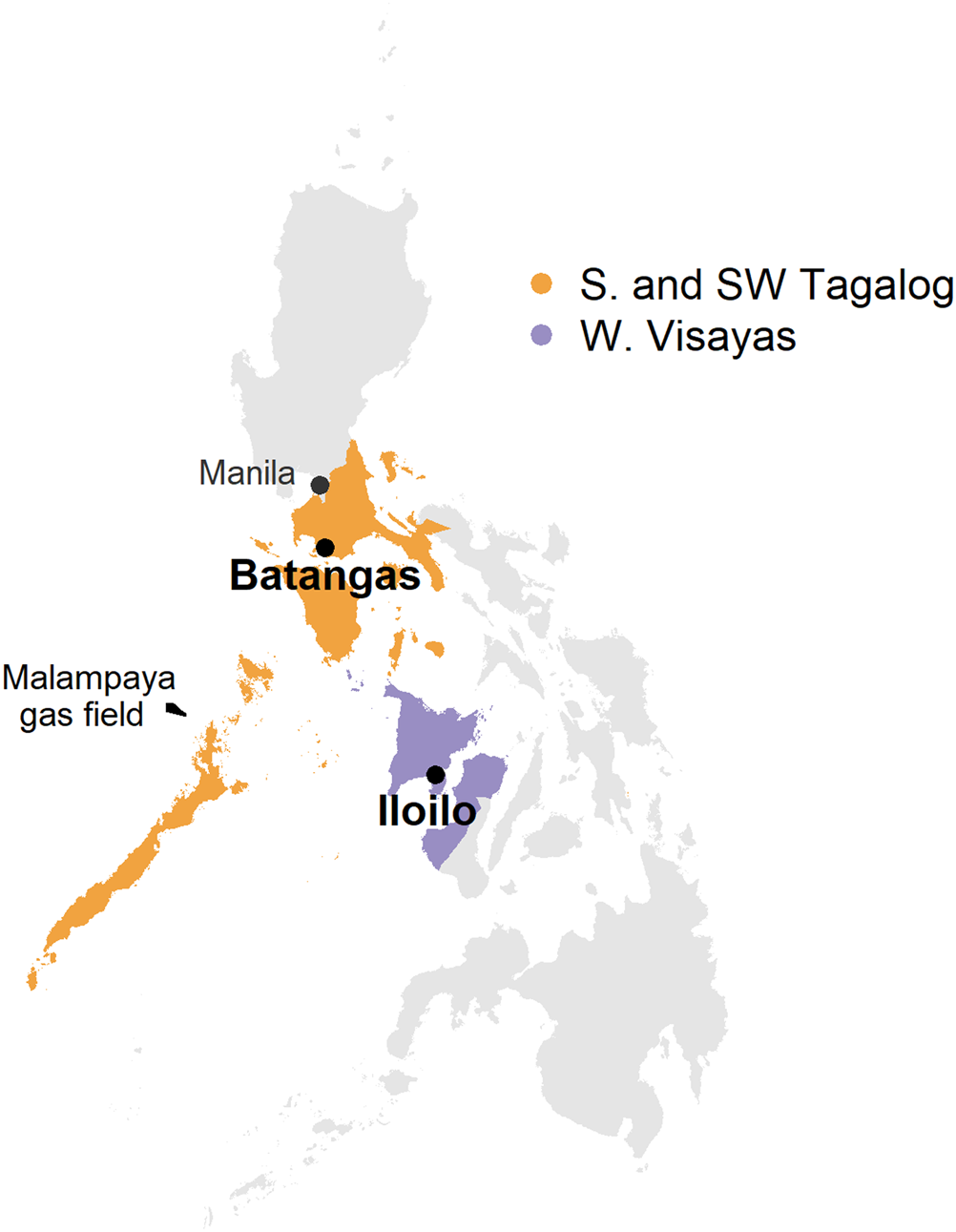
To support my argument that certain types of businesses help low-capacity local governments raise taxes, I present a controlled comparison of two Philippine cities, Iloilo and Batangas, that differ in terms of capacity to tax despite their similarities otherwise. While not identical, the cases are sufficiently similar “to control for existing rival hypotheses” (Slater and Ziblatt Reference Slater and Ziblatt2013, 1313, italics removed). In addition to the well-known advantages of subnational comparisons in controlling for national parameters (Snyder Reference Snyder2001), Iloilo and Batangas share several individual characteristics, described in the following section, that rule out alternative explanations. Nevertheless, the cities differ in two respects. The characteristics of local businesses and the associations that represent them differ, and so do resource endowments as a result of a natural gas pipeline that conveys gas from the Malampaya field to Batangas (Figure 2). Thus, these cases offer a useful opportunity to interrogate the relationship between natural resources, business power, and taxation. By tracing the causal process by which businesses affect taxation (Fairfield and Charman Reference Fairfield and Charman2017; Ricks and Liu Reference Ricks and Liu2018), I show that these cases do not hew to traditional expectations of business tax resistance amplified by state dependence on resource revenues.
Map of the Philippines

The Philippines is well-suited to research on local taxation. On the one hand, it is the most fiscally decentralized state in Southeast Asia, and among the most decentralized states in the developing world, when measured by the share of local government expenditures funded by own-source revenues (Bahl and Bird Reference Bahl and Bird2008). On the other hand, local governments struggle mightily to escape the pernicious cycle of low taxes and poor services (Capuno Reference Capuno, Balisacan and Hill2007). These countervailing forces have produced significant variation in the ability of cities to generate tax revenue, so much so that Philippine cities nearly mirror the range of variation across the developing world. This variation poses an especially intriguing puzzle because electoral, legislative, administrative, and cultural institutions, often cited as driving forces for taxation, are similar across cities.
Iloilo and Batangas exemplify this puzzle because they differ in their capacity to tax, even though they share identical formal powers, similar revenue potential, and analogous problems with inadequate infrastructure. In other words, both cities have authority, opportunity, and motivation to increase taxes, yet only Iloilo has done so.
First, Iloilo and Batangas share identical powers of taxation. The Local Government Code of 1991 grants Philippine cities authority to collect property taxes, business taxes, and a variety of minor taxes and non-tax revenues including user fees, regulatory fees, and income from publicly owned enterprises (Manasan Reference Manasan, Balisacan and Hill2007). While fiscal autonomy does have limits in the form of tax rate ceilings and provincial oversight,Footnote 6 local governments nonetheless control revenue at the margin. Among local revenue sources, the property tax constitutes a substantial source of untapped revenue (Bureau of Local Government Finance 2015), but it is demanding administratively and unpopular politically. Any city that seeks substantially to increase tax revenue must confront the challenges of property taxation.
Second, Iloilo and Batangas both possess considerable revenue potential by virtue of their large and diverse economies. Both are provincial capitals with major ports. Both are among the Philippines’ twenty largest cities outside of Metro Manila, with populations of 425,000 in Iloilo and 300,000 in Batangas. Both possess public and private universities, major hospitals, and large shopping centers, making them economic and cultural hubs—Iloilo for the Western Visayas region and Batangas for the Southern and Southwestern Tagalog regions (Figure 2). And both cities host national government agency field offices, although Batangas is not formally an administrative center.
Third, both cities have suffered notable infrastructure failures in recent years. In Iloilo during the 2000's, for example, debilitating floods inundated 80 percent of the city's neighborhoods (barangays) three to four times per year (Visayan Daily Star 2007) and increasingly frequent power shortages culminated in 40 hours of outages during November of 2010 (Drilon Reference Drilon2012). In Batangas, infrastructure slowly deteriorated despite years of high revenue. Most notably, the city's two most important bridges collapsed within five years of one another. The Bridge of Promise collapsed in 2009 during Typhoon Santi (international name Mirinae), severing the city's bypass road for one year. Then, Calumpang Bridge collapsed in 2014 during Typhoon Glenda (international name Rammasun), disconnecting the posh Pallocan district from Batangas City Proper for more than a year.
Yet, despite shared authority, potential, and need for revenue, actual tax revenues have diverged. In 2002, Iloilo generated revenues equal to 2 percent of GDP, while in Batangas the corresponding figure was 5 percent. By 2016 those numbers had reversed. Iloilo's revenues had climbed above 4 percent of GDP, while Batangas’ had slipped to 3 percent. Driving the trend in both cities were changes in property tax revenues (Figure 3), even though the property tax constituted a significant source of revenue in both cities.Footnote 7 Property tax revenues grew steadily as a share of GDP in Iloilo but fell sharply in Batangas and bottomed out in 2010. Subsequent spikes in Batangas’ property tax revenues do not indicate true recovery, but rather payments by major companies settling large delinquencies in response to new presidential decrees.Footnote 8
Property tax as a share of GDP

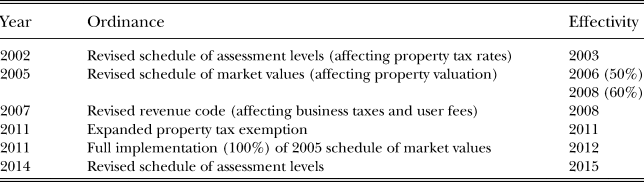
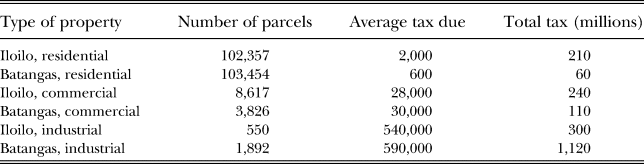
These contrasting trends reflect deeper differences between Iloilo and Batangas in the capacity to formulate policy, administer taxes, and generate compliance. First, the city assembly in Iloilo frequently revised its tax code, while its counterpart in Batangas rarely acted, especially with respect to the property tax, even as revenues declined (Tables 1 and 2). Second, Iloilo's property tax base was less top-heavy than Batangas,’ indicating a broader base across residents. In Iloilo, the average homeowner owed three times as much as her counterpart in Batangas (Table 3), while Batangas relied heavily on a few large taxpayers, namely Shell, First Gas Power, Korean Electric Power Corporation, and a few others.Footnote 9 Third and most importantly, Iloilo collected a much higher percentage of assessed property taxes than Batangas despite broadly similar assessments (Table 3), indicating better compliance on the part of taxpayers. In 2014, for example, Iloilo collected approximately 70 percent of taxes due; Batangas only 36 percent.
Major Iloilo City tax legislation, 2001–2016

Major Batangas City tax legislation, 2001–2016


COMPARING CASES
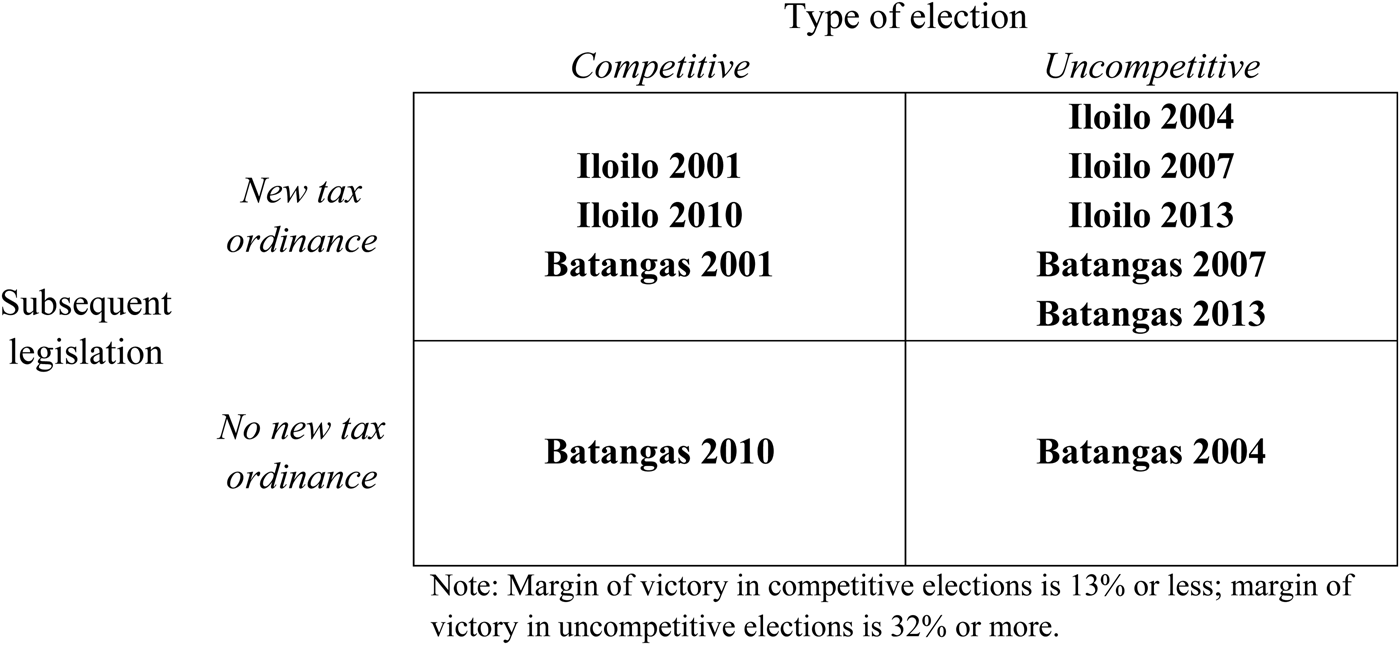
Why does the capacity to tax differ between Iloilo and Batangas? The selection of these particular cases allows me to rule out several existing explanations. (Table A1, available in the online appendix, summarizes these explanations.) Elections, whether they promote accountability, redistribution, or clientelism, cannot account for differences between Iloilo and Batangas because they are similarly uncompetitive in both cities. If the measure of electoral competitiveness is incumbent turnover, then both cities have been perfectly uncompetitive; that is, during the post-Marcos era neither city experienced turnover in mayoral elections until 2019.Footnote 10 While it is possible to identify more and less competitive elections in each city by comparing margin of victory, there is also no clear pattern of association between electoral margin and subsequent tax legislation (Figure 4).
Mayoral elections by competitiveness and subsequent tax legislation

Inequality, too, is similar between cities, so it is not the case that material conditions create demand for progressive taxation in Iloilo but not Batangas. Provincial inequality appears to have converged since the 1990s (Human Development Network 2013), while poverty has held steady at moderate levels in both cities (Philippine Statistics Authority Reference Authority2016).
Representative institutions, despite their theoretical importance in the literature on fiscal contracts, are broadly similar throughout the Philippines and offer little explanatory leverage over subnational variation. Iloilo and Batangas share with other major cities standard fourteen-member city assemblies (including twelve elected and two ex-officio members), weak bureaucratic agencies, volatile affiliations with national political parties, and ineffective labor unions (Hutchcroft and Rocamora Reference Hutchcroft, Rocamora and Robison2012).
Norms of fairness and trust are consistent between the cases and do not constitute a stronger foundation for taxation in Iloilo than in Batangas. The case studies highlight public statements by business leaders and other public figures to demonstrate that in both cases they evaluated proposed taxes according to their anticipated distributional fairness and the credibility of mayoral promises about future spending.
Finally, capital mobility, as a source of structural power, can be ruled out because it wrongly predicts greater capacity to tax in Batangas. Many large industrial plants located in Batangas cannot relocate because their investments are highly specific to Batangas’ deepwater port and natural gas from the nearby Malampaya field. Consequently, their structural power should be minimal, making them easy targets for taxation. Yet, Batangas has struggled to increase tax revenues while Iloilo has repeatedly increased taxes despite the greater mobility of its largely commercial enterprises.
While I can eliminate several explanations on the basis of case selection, two crucial differences remain. First, Iloilo and Batangas differ with regard to the cohesiveness and access of business associations. The Iloilo Economic Development Foundation and Iloilo Business Club have successfully coordinated collective action to various ends over many years. In addition, the case studies show that these associations benefited from highly personal access to the presidential administration of Benigno Aquino III. In contrast, rival associations have divided Batangas’ business community. While both the Metro Batangas Business Club and Batangas Province Chamber of Commerce aspire to represent all sectors of Batangas’ economy, conflict between them has limited their membership and circumscribed cohesiveness. Moreover, Batangas’ businesses, particularly the multinational corporations (MNCs), lacked personal links to the Aquino administration.
Second, the cities differ because Batangas has access to natural resources that Iloilo lacks. Batangas is the terminus of an underwater pipeline that conveys natural gas from the Malampaya off-shore field (Figure 2). Industrial development boomed after the gas discovery in the mid-1990s as major domestic manufacturers, the state-owned Philippine National Oil Company, and multinational corporations such as Shell, Chevron, and Holcim invested in Batangas. In contrast, Iloilo has neither natural resources nor a major presence of multinational corporations. Rather, the city functions as a commercial hub for Panay Island and the Western Visayas. As a result, the city developed a homogenous business community of domestic and local firms focused on local commerce.
In the case studies that follow, I provide evidence that taxation was more successful in Iloilo because of its stronger business associations, not in spite of them. While business leaders in both cities evaluated tax ordinances in terms of distributional fairness and the credibility of mayoral promises, only business associations in Iloilo were able to resolve the problems of collective action and credible commitments. Differences in associational capacity can in turn be traced back to business characteristics associated with contrasting resource endowments. Specifically, Batangas’ access to natural gas attracted multinational and national energy firms indifferent to local infrastructure, “deficient” in terms of local political engagement (Doner and Schneider Reference Doner and Schneider2016), and, in the case of MNCs, without personal connections to national politicians.
The case studies draw on press clippings, position papers, formal letters, legislative minutes, property valuation schedules, official data on revenues and spending, and other administrative documents that I collected in the Philippines over a period of eight months in 2014 and 2015. During that time, I interviewed 90 individuals throughout the country, including 25 in Iloilo and 17 in Batangas. Among others, my sources included elected officials, business leaders, tax bureaucrats, journalists, activists, and academics.
ILOILO
Iloilo City raised property taxes in 2005, 2011, and 2014 even though businesses worried about distributional fairness and residents feared that local government would misuse new tax revenues. How did Iloilo overcome these problems? I argue that Iloilo's business community, represented by Iloilo Economic Development Foundation and Iloilo Business Club, advanced a business-centered vision for city development that required extensive infrastructure improvements that exceeded the city's fiscal means. To realize its vision, the business community mobilized external resources, built consensus among local businesses, and held local officials to their promises to spend public money on infrastructure. Its political influence was sufficient to monitor public spending and to punish officials who diverted funds away from infrastructure spending, lending credibility to otherwise unconvincing official promises.
A BUSINESS-CENTERED INFRASTRUCTURE DRIVE
The Iloilo Economic Development Foundation (ILED) was founded in 2007 by a group of nationally prominent businesspeople with roots in Iloilo, including the brothers Rex and Franklin Drilon. The organization's stated goal was to attract investors to Iloilo City, largely by improving the city's inadequate infrastructure. ILED was a peak association with a small membership of business associations, individual “titans” of Iloilo's economy, and representatives of local government. Its sister organization, the Iloilo Business Club (IBC), had since 1990 represented a more encompassing local membership of approximately 80 of Iloilo's most prominent businesses.
Acting alone, the City of Iloilo could not have addressed all of the city's infrastructure challenges. Yet the condition of Iloilo's infrastructure improved dramatically between 2005 and 2015, thanks to a “massive public infrastructure development” effort (Drilon Reference Drilon2014). The drive included the construction of an international airport, a floodway five kilometers in length, an international convention center, a ferry terminal, a by-pass road, a 164 MW coal-fired power plant, the restoration of Iloilo River, and the development of greenbelts and walking trails along the river's banks. These projects were funded by benefactors ranging from national government agencies to the Japan International Cooperation Agency to private investors to the city itself. In the case of many of these projects, ILED worked behind the scenes to facilitate collaboration among the city, national government, and individual businesspeople.
The City of Iloilo played a supporting role during the infrastructure drive by funding smaller projects that complemented the enormous national ones. In particular, the city resettled communities displaced by the projects (Mateo Reference Mateo2014; Visayan Daily Star 2007). Residents complained not unreasonably that relocation sites were distant and lacked access to water and power, but in general the city sided with the business community and insisted upon resettlement. Mayor Mabilog ungraciously described the city's role by saying, “While the senator [Franklin Drilon] does what needs to be done, I'm the one who has to face complainants in court” (Jimenez-David Reference Jimenez-David2015). In addition, the City's Annual Investment Plans show many small projects to improve neighborhood roads, drainage, and parks, including Iloilo's famous plazas. Despite their small scale, these projects reduced traffic and flooding and created opportunities for recreation at the neighborhood level.
In sum, the city's need for tax revenue to address infrastructure problems was measured but real, at least from the perspective of the business community. While the major projects were funded externally, the city undertook smaller projects complementary to them.
BUILDING DISTRIBUTIONAL CONSENSUS
In addition to promoting certain infrastructure projects, ILED and IBC organized consensus within the business community favorable to its vision for Iloilo. The cleavage most threatening to their development agenda was competition between established, downtown businesses and newcomers gravitating toward the more suburban Mandurriao district, which most benefited from new development. Megaworld's business park, the Iloilo Convention Center, the Esplanade Park, and many other new developments were located in Mandurriao, and the district threatened to eclipse downtown Iloilo as the center of business, recreation, and shopping.
Many downtown businesses were small, family operations owned by Chinese-Filipinos who had been there for generations. If not somehow compensated, it is likely that they would have resisted ILED's leadership and opposed the entry of new developers into the city. Just such a conflict arose between the vendors’ association at the Iloilo Central Market and the city government when the city proposed to “revitalize” the central market by privatizing it. The rumored buyer was SM Prime Holdings, perhaps the most prominent property developer in the Philippines. Afraid of being displaced from their stalls, the vender's association resisted the proposal by filing a civil case against the city government (Angelo Reference Angelo2014a).
In general, such conflicts were rare, however, because business leaders mitigated potential tension in two ways. First, they proceeded cautiously, initially supporting causes that generated widespread support within the business community. The original ILED platform—to reduce the cost of electricity and water, improve the roads, upgrade the ports, and expand tourism—benefited both small businesses downtown and large developers in Mandurriao. Notably, ILED spent years building its credibility with less controversial river redevelopment projects, such as cleaning the river and building a new ferry terminal, before controversially proposing to redevelop the Iloilo River Wharf in 2014 (Angelo Reference Angelo2014c). The wharf has historically been the site of intense political contestation—its control once triggered a “war on the waterfront”—and thus its proposed redevelopment highlights ILED's growing assertiveness (McCoy Reference McCoy1977).
Second, ILED and IBC have attempted to compensate small, downtown businesses by attracting more visitors to City Proper. The annual Dinagyang Festival, funded by the city government, attracts tens of thousands of visitors to downtown Iloilo for several days every February. The Dinagyang Foundation organizes the festival, and its trustees include Felipe Uygongco, brother of ILED Chairman Alfonso Uy. In addition, the city government, with the full support of ILED and IBC, has been preserving heritage buildings downtown to attract more tourists. ILED and IBC have likewise been lobbying city officials to decorate “Chinatown” in the fashion of Singapore's Chinatown to make it more attractive and recognizable to visitors.
Ordinarily, such compensation would pose the same type of commitment problem as taxes, because larger businesses would rather not honor their promises of compensation. But in this case, two mitigating factors underpin trust between small Chinese businesses and Iloilo's business leaders. First, small businesses have ongoing leverage against larger businesses because their cooperation is needed to make taxation work and to spread the costs of development. If larger businesses renege on their promises, smaller businesses can simply stop paying taxes. Second, Iloilo has one of the largest and most tightly knit communities of Chinese business owners in all of the Philippines (Omohundro Reference Omohundro1981). Not only do Iloilo's Chinese have extensive experience as members of ethnically based business associations, but prominent members of the community, the Uy family most notably, were represented in leadership positions of ILED and IBC. Thus, promises of compensation were buttressed by ethnic obligations and social relationships between leadership and rank-and-file members.
EXERTING POLITICAL INFLUENCE AT CITY HALL
Iloilo's business community was willing to contribute financially to the city's infrastructure drive, such as when the developer Andrew Tan donated land for the Iloilo Convention Center and the tycoon Federico Lopez donated passport scanners to the new international airport (Pendon Reference Pendon2012). Yet, the willingness to donate individually to specific causes does not necessarily imply a willingness to pay higher taxes. Unlike donations, taxes are obligatory and ongoing, and unlike donors, taxpayers do not decide how their money will be spent. Given Iloilo's long history of politicizing government spending (Leichter Reference Leichter1976), the business community wanted assurance that the city government would spend new tax revenues on infrastructure.
To this end, ILED exerted political influence through close personal connections with Mayor Jerry Treñas (2001–2010) and Mayor Jed Mabilog (2010–2017), active involvement in the deliberations of the city council's committee on ways and means, and after 2010, national-level influence within the ruling Liberal Party. In theoretical terms, the ways and means committee provided the means to monitor public spending, while the Liberal Party provided the threat of punishment.
Members of ILED had personal relationships with Iloilo City's mayors. Jed Mabilog was second cousin to Senator Franklin Drilon, and Jerry Treñas worked early in his career in the law office where Franklin Drilon was a partner. Moreover, personal and family ties were reinforced by institutional connections, because both the mayor and the governor are ex officio members of ILED. In this respect, ILED functioned as a “home-grown” forum for public–private consultation, which Doner (Reference Doner2009, 86) argues is essential to underpin credible commitments. Yet, relationships alone were not enough to guarantee the credibility of city officials.
The controversy surrounding the city's 2014 proposal to increase property taxes exemplified how the business community wanted tangible assurance that tax dollars would be spent on infrastructure. The City Treasurer's Office initially justified the proposal by admitting that the city was experiencing fiscal distress, and the business community responded with outrage (Tingson Reference Tingson2014). The chairman of the Ways and Means Committee, Councilor Plaridel Nava, complained that the executive office “should have presented the benefits that the business sector and the public would get from paying higher taxes” (Sorsano Reference Sorsano2014). In response, Mayor Mabilog issued a list of infrastructure and services that the new revenue would fund, and presented the new justification at a crowded public hearing on July 18 (Mabilog Reference Mabilog2014).
Businesses remained skeptical and demanded more detail about how exactly the money would be spent. Joeboy Agriam, governor of Philippine Chamber of Commerce and Industry—Iloilo, demanded, “If you want a compromise, open your books, present your financial statement and we will see what areas in your expenditures are weak … if it is really needed, then we might help” (De los Santos and Mateo Reference De los Santos and Mateo2014a). Mayor Mabilog took Mr. Agriam at his word, and presented the city's finances to the business community despite the strenuous objections of Councilor Nava (Angelo Reference Angelo2014b). Yet, not even this concession satisfied local businesses, and they countered with a proposal that the mayor's executive assistant for finance dismissed as “paltry” (Angelo and Mateo Reference Angelo and Mateo2014b).
A compromise was unattainable until senior ILED leaders arrived to negotiate in person with Mayor Mabilog. First, ILED President Narzalina Lim met Mayor Mabilog early on a Sunday morning to discuss the bill (Angelo and Mateo Reference Angelo and Mateo2014a). A few days later, former mayor and sitting congressman Jerry Treñas flew in from Manila. As The Daily Guardian colorfully put it, “Mabilog and Treñas literally burned their phone lines as they negotiated with the businessmen” (De los Santos and Mateo Reference De los Santos and Mateo2014b). In this episode, personal relationships among the city's top leaders were crucial to resolving the standoff, because they facilitated face-to-face negotiations amid growing animosity among city council, mayor, and the business community. Yet it is equally clear that business leaders expected more than mere personal assurances from Mayor Mabilog.
What businesses demanded was a credible commitment that their tax dollars would be spent on infrastructure, upheld by the ability to monitor public spending and punish wayward officials. In this respect, the city council process for deliberating tax measures, and budgeting more generally, was sufficiently transparent to enable monitoring. Despite the animosity, business leaders received many opportunities to state their position during the ways and means committee's public hearings. As a result of the process, they gained access to the city's financial records and substantively influenced the form of the new ordinance. Councilor Nava and Mayor Mabilog proved that they were willing not only to share information with business but also to hear its concerns. The attitude of city leaders combined with the procedural requirement to hold public hearings on issues related to finance created a reasonable expectation that businesses would continue to be able to monitor public spending in the future.
If committee hearings provided the means to monitor spending, what provided the threat of punishment? The evidence is suggestive, but I submit that ILED had special influence within the nationally ruling Liberal Party, in the person of Franklin Drilon, that substantiated a credible threat against Mayor Mabilog's political career. To be clear, the Liberal Party's influence over Mabilog would not have originated in conventional expectations of party discipline. Rather, Mabilog would have been particularly dependent on support from Manila as a first-term mayor who lacked an independent base of patronage. And during the Liberal administration of president Benigno Aquino III, that support would have had to go through Franklin Drilon: President of the Senate, Liberal Party stalwart and brother of ILED vice chairman Rex.
In contrast, ILED should have been less able to punish Mabilog's predecessor, Jerry Treñas. Prior to 2010, Franklin Drilon, the Liberal Party, and, by extension, ILED were in the national opposition. Secretary of Justice Raul Gonzalez, whom Rex Drilon openly distrusted, still dominated Iloilo politics (Drilon Reference Drilon2012). And Treñas was reportedly close to President Gloria Macapagal Arroyo. As a result, ILED should not have had the same leverage over Jerry Treñas that they exercised over Jed Mabilog.
Accordingly, the Iloilo business community was cautious with Jerry Treñas regarding fiscal policy, even though he was a big proponent of infrastructure projects. Treñas’ signature tax ordinance, re-appraising property values, was passed in 2005 but never fully implemented during his time in office.Footnote 11 The city council had to pass a second law to activate the first one, which it did not do until 2011. The business community likely insisted upon this precaution because it did not fully trust Mayor Treñas without a credible means of punishing him should he divert funds away from infrastructure spending.
BATANGAS
During the 1990s, Batangas City benefited from very high revenues that were generated by property taxes levied on a few large industrial facilities, especially Shell's Tabangao oil refinery. In the 2000s, however, Batangas’ revenues declined as a share of GDP (Figure 3) and its transportation infrastructure began to show signs of strain. Nevertheless, many local businesses resisted when the city proposed legislation to shore up revenues in 2013. They did not trust the city government to spend the money well and they objected that the tax burden was not fairly distributed. Why could Batangas not overcome the problems that Iloilo solved, despite a clear need for new revenue? Its business community was too divided by ownership and political affiliation to reach a distributional consensus or to monitor public spending.
COLLAPSING REVENUES, COLLAPSING INFRASTRUCTURE
Batangas’ revenue as a share of GDP bottomed out one year after the Bridge of Promise collapsed. The city had not updated property valuations since 1994, so property tax revenue remained stagnant even as property values appreciated over time. In response, the city government passed an ordinance in 2013 intended to increase property tax revenues. The ordinance enacted an updated schedule of property valuations, based on the first “general revision” of property values conducted by the city assessor's office in 19 years. The measure increased individual property tax obligations tenfold in some cases, albeit from a very low starting point. In the aggregate, the measure was expected to increase property tax revenues by PhP 2.5 billion (USD 60 million), or 600 percent (Committee on Ways and Means 2013).
The text of the ordinance itself referred to new infrastructure projects as justification for the tax increase, and the city planned to use the new revenue to fund a wide variety of projects, including transportation infrastructure. Victor Reginald Dimacuha, Secretary to (and son of) the mayor, claimed that the measure was necessary to achieve the “dream of a more developed Batangas City,” and would fund, among other things, projects to build 100 new high school classrooms, to renovate two public markets, to construct roads, canals and seawalls, to develop new industrial and commercial districts, and to maintain current healthcare and scholarship programs (Dimacuha Reference Dimacuha2013).
When the tax ordinance passed in November 2013, city officials could not have known that in just eight months it would take on new urgency after the collapse of the second bridge. City officials would soon propose plans to add a third bridge to span the river, this time a suspension bridge to mitigate the threat posed by river debris. Initial estimates put the cost of the proposed bridge at 350 million pesos, or about USD 8 million (Batangas City Reference City2015).
DISSENSION AMONG BUSINESSES
Unlike in Iloilo, however, the business community in Batangas City organized vociferous resistance against the new tax measure despite the poor condition of city infrastructure. Batangas’ businesses were divided among three distinct groups with diverging agendas, and their internal conflicts precluded the possibility of formulating a unified response to the tax increase. The first group comprised huge MNCs, specifically Shell and the Korean Electric Power Corporation (Kepco), which appeared to rise above the fray of local politics only because they chose to lobby at the presidential palace instead of City Hall. The second group comprised local businesses supportive of the Dimacuha regime, and the third group comprised the regime's opponents.
Kepco, owner of the natural gas power plant at Ilijan, resisted property taxation by “lawyering up” and seeking the aid of the national government. For the first eleven years of its operating life, the Kepco plant was delinquent in its property taxes. During that time, it accumulated an astonishing 9.9 billion pesos (USD 500 million) in unpaid taxes. Kepco insisted that under the terms of its Build-Operate-Transfer contract, the Philippine National Power Corporation was responsible for its tax obligations. Batangas City appealed in the Court of Tax Appeals, but in 2011 President Benigno Aquino III issued Executive Order 27 forgiving part of the tax owed by a similar “independent power producer” in neighboring Quezon province. Even though the order was only binding for Quezon province, Batangas and Kepco ultimately reached a settlement based upon it: Kepco agreed to pay approximately 900 million pesos (USD 50 million) to the city (Mauricio Reference Mauricio2014).Footnote 12
In 2014, President Aquino issued a second executive order which expanded Executive Order 27 to apply to all provinces. Thus, for all property taxes due through 2014, independent power producers were assessed the tax based on 15 percent of the fair market value of their facilities, rather than the standard 80 percent. The president's order also condoned all penalties for late payment of tax. Both executive orders applied only retroactively, so they did not resolve the question of how independent power producers would be taxed in the future. Nevertheless, they demonstrated the president's support for independent power producers, and established a benchmark value of what independent power producers were willing to pay in property taxes. In the case of Kepco, property tax obligations fell from approximately 900 million pesos per year in the original assessment to 75 million pesos in 2014. Ironically, the executive orders increased Batangas City's actual revenues, because Kepco had not previously paid property taxes, but they nevertheless demonstrated the power of Kepco and the other independent power producers to overrule local governments and to choose their own tax rates.
By lobbying nationally, MNCs in Batangas distanced themselves from local politics and businesses. Meanwhile, local businesses negotiated directly with the local government over tax policy, but internal conflicts hamstrung their efforts. Two competing business associations, the Metro Batangas Business Club and the Batangas Province Chamber of Commerce, both claimed to represent the business community. The former was friendly with the Dimacuha regime, while the latter was opposed. Yet, neither influenced city tax policy.
The Metro Batangas Business Club emerged as an outgrowth of the USAID INVEST program, which promoted an open business climate in three Philippine cities including Batangas (USAID 2014).Footnote 13 In September 2013, the INVEST program, the Batangas Province Chamber of Commerce, and the provincial chapter of the Filipino-Chinese Chamber of Commerce organized the first of many meetings among a core group of local businesses that would go on to found the Metro Batangas Business Club. Although the INVEST program initially worked through Batangas Province Chamber of Commerce, USAID officials and the city government pushed for a new, city-specific business organization. Then, as the new business club developed, the mayor and his allies in the business community sidelined the Batangas Province Chamber of Commerce and its outspoken president, Faustino “Ting” Caedo. Ting Caedo publicly opposed the proposed property tax increase, which was being debated at the same time that the Metro Batangas Business Club was being formed.
Ting Caedo and the Batangas Province Chamber of Commerce went on to lead the opposition against Mayor Dimacuha, while the Metro Batangas Business Club remained loyal. More importantly, this episode demonstrated the Dimacuha family's ability to meddle in the affairs of local businesses. They took advantage of the INVEST program to establish a new business association in Batangas City friendly to them. In doing so, they not only neutralized Batangas Province Chamber of Commerce, but they also sidelined Ting Caedo personally from participation in the Metro Batangas Business Club. Instead, they ensured that one of their allies would be elected chairwoman of the new organization in his place.
As a result, City Hall had little reason to negotiate the new tax ordinance with local businesses. Not only the Batangas Province Chamber of Commerce, but also the Metro Batangas Business Club requested relief from the tax increase in the form of reduced rates and gradual implementation, but the city government was unmoved (Batangas City Stakeholders 2013).Footnote 14 The city council pushed forward with the ordinance as proposed, and passed it on November 25, 2013.
“REJECT RPT 20 MOVEMENT”
By refusing to involve local businesses in the formulation of the new tax ordinance, the city government in effect challenged businesses to take it or leave it. Opponents organized a “movement” to communicate their dissatisfaction with both the tax and the Dimacuha administration. They called their organization “Reject RPT 20 Movement” in reference to the law's formal name, Real Property Tax Ordinance No. 20. Joining Ting Caedo were prominent former officials who had fallen out of favor with the Dimacuha family, including former vice-mayor Jose Tolentino, Dimacuha's own daughter-in-law Kristine Balmes, and former Secretary of Justice Hernando Perez.
They encouraged Batangas residents to engage in civil disobedience by not paying their property taxes, and they energetically attacked the law with litigation. The group petitioned both the Batangas Provincial Council and the Department of Justice to strike down the law, arguing that the law was “excessive, inequitable, and confiscatory” (Ganzon Reference Ganzon2014). It complained that the tax increases were so large—in some cases 2,000 percent because the previous valuations were so far out-of-date—that they were “unconscionable,” and that tax increases were largest on land owned by the mayor's political opponents (Perez Reference Perez2014).
The litigation did not strike down the law, but it may have sown enough doubt among Batangueños to embolden civil disobedience. In a personal interview, Victor Reginald Dimacuha, Secretary to the Mayor, expressed disappointment with the revenue generated by the tax increase, which represented only a tiny fraction of the initial estimate of PhP 2.5 billion in new revenues. In the year the law took effect, property tax revenues increased by only PhP 30 million (USD 700,000), or 7 percent. As a result, in March 2015 the city entered into a loan agreement with Land Bank of the Philippines to borrow 1 billion pesos (USD 22 million) for various infrastructure projects, including the new bridge (Florendo Reference Florendo2015).
Meanwhile, the “Reject RPT 20 Movement” became the focal point of political opposition in Batangas. The group held a rally in the Batangas plaza every Saturday for at least two years, attracting a few dozen people wearing red on a regular basis. Although the tax increase was the original impetus behind the movement, the group soon began to oppose other city development proposals, too. They rejected a proposal for a new coal power plant, and, of course, the proposal to borrow PhP 350 million to build the third bridge.
THE RESOURCE CURSE?
The case of Batangas City resembles, in key ways, a local version of the resource curse. Easy revenues from a few large industrial facilities enabled the Dimacuha family to dominate city government while keeping taxes low on the majority of citizens. Moreover, years of easy money robbed the city of its ability to adjust to diminishing revenues. The city's attempt to increase tax revenue fell short of expectations by the difference between PhP 2.5 billion and PhP 30 million! However, the process that links natural resources to taxation in Batangas is inconsistent with the mechanisms specified in the literature on the resource curse.
According to that literature, natural resources enervate taxation in two ways. First, “extractive capabilities wither” as states shift resources away from the agencies that administer direct taxes on non-resource sectors (Karl Reference Karl1997, 16). Second, they foster harmfully close relationships between the state and a well-organized, highly demanding, and narrowly interested resource sector. Yet, upon closer examination, neither of those mechanisms accurately characterize tax politics in Batangas.
Administratively, Batangas never stopped collecting property taxes. On the contrary, the property tax is the primary means by which the city extracts revenue from energy firms. The city assessor's office, when called upon in 2013, produced a “general revision” that updated property valuations for agricultural, commercial, and residential as well as industrial properties. In other words, Batangas retained sufficient administrative capability to levy a direct tax across economic sectors, despite the presence of natural resources.
Politically, Batangas’ natural resources did not empower businesses to undermine state autonomy, but rather the opposite. Batangas’ energy firms directed their political activities toward the national government, thereby undercutting local businesses’ ability to negotiate with the local government. As a result, the mayor's office all but dictated tax policy in highly autonomous fashion. In a second twist, state autonomy enfeebled rather than facilitated new taxes. Batangas’ tax ordinance failed meaningfully to increase revenues, while Iloilo's ordinances succeeded despite significant business influence over tax policy.
Instead, Batangas’ resource wealth undermined its capacity to tax by disorganizing the city's business community. The giant domestic and multinational corporations that were attracted to Batangas’ energy industry eschewed local political engagement. Not only did they prefer to lobby for their interests at the presidential palace, but they were also indifferent to the condition of local infrastructure, because they manufactured products for export, not for local markets.Footnote 15 Disinterest on the part of the city's largest businesses weakened local business organization. As a result, the city lacked a suitable interlocuter to help it resolve the collective action and commitment problems associated with taxation. Ultimately, Batangas failed to secure the consent of its taxpayers, many of whom resisted the new tax through litigation, civil disobedience, and gossip.
CONCLUSION
In this article, I have argued that Iloilo increased property tax revenues more successfully than Batangas because of the contrasting character of their business communities. A majority of Iloilo's businesses were locally owned enterprises engaged in infrastructure-intensive commercial activities. In addition, prominent members of the community were personally connected to top national leaders. As a result, Iloilo's business community shared a collective interest in good public infrastructure, a high degree of social and ethnic homogeneity, and significant leverage over local officials. In contrast, Batangas's access to natural gas attracted multinational corporations and resource-seeking enterprises that, as a result of foreign ownership and enclave operations, were indifferent to local policy. These businesses diluted collective dependence on public infrastructure, fragmented social and ethnic ties within the business community, and lacked personal access to national politicians. While these characteristics were related to natural resource endowments, resource wealth disempowered business in ways not expected in the literature on the resource curse. Instead of heightening business influence over resource-dependent local governments, Batangas’ natural gas pipeline disorganized business by introducing cleavages between resource-seeking multinational enclaves and infrastructure-intensive local commercial enterprises.
These business characteristics, in turn, produced associations that supported taxation in Iloilo but not in Batangas. In Iloilo, the associations ILED and IBC supported new tax ordinances in return for government participation in a business-centered vision of city development. They buttressed cohesiveness by compensating downtown businesses, monitored public spending by participating vigorously in public hearings, and wielded access within the Liberal Party administration of President Aquino to enforce official commitments. In contrast, Batangas’ fragmented associations were too divided even to influence a new tax ordinance, much less endorse it to property owners. Businesses so lacked consensus that they could not even agree on the need for a new bridge after both of the city's major bridges collapsed. These associations likewise lacked access to local or national officials. Instead, multinational corporations defended their interests in court, while local businesses were simply locked out of the policy-making process with no means to monitor or sanction local officials. As a result, Iloilo enacted multiple tax increases with much higher levels of compliance than in the case of Batangas’ single property tax ordinance.
My argument might strike some readers as naïve with respect to the intentions of Philippine businesses better known for their rent-seeking prowess than their corporate citizenship. Yet, it does not imply that businesses act against their self-interest. It requires only that some businesses rely on public infrastructure, and that those businesses act collectively to procure that infrastructure in the same way that they would organize to procure any other club good. In other words, certain types of businesses form “distributional coalitions” in order to influence government policy in a process highly reminiscent of rent-seeking (Olson Reference Olson1982), except that the sought-after policy is not a subsidy but public infrastructure. As Davidson (Reference Davidson2015) underscores, rent-seeking occurs everywhere, but with varied effects.
In this sense, my findings are consistent with previous work that demonstrates the enduring power of national oligarchs and local bosses in the Philippines (Anderson Reference Anderson1988; Billig Reference Billig2003; Hutchcroft Reference Hutchcroft1998; Kang Reference Kang2002; McCoy Reference McCoy2009; Sidel Reference Sidel1999), but they further elaborate the variety of ends to which that power is directed. As Philippine businesses expand their entrepreneurial activities (McVey Reference McVey and McVey1992; Haggard Reference Haggard and Rowen1998), they increasingly combine entrepreneurial and rent-seeking strategies (Khan and Jomo Reference Khan and Jomo2000). My account is a case in point: it is precisely those elites with particularistic connections in Manila that have the ability to lean on local governments to foster entrepreneurial enterprises.
That is not to say, however, that business support for taxation has clearly positive implications for development. In return for collaboration, local governments surrender fiscal policy to business interests, with uncertain long-term consequences. In the short-term, local governments increase revenue, improve infrastructure, and promote economic growth, but in the long-term, powerful business interests might block additional reforms and hinder development, as they have done elsewhere (Fairfield Reference Fairfield2015). Alternatively, it may be that, by empowering the state to levy taxes or strengthening civil society through economic growth, organized business ultimately dilutes its political power.
To what extent will findings from Iloilo and Batangas generalize beyond these specific cases? Findings from controlled comparisons can travel to the extent that they refer to general variables, control for alternative explanations, and capture the range of variation characteristic of a broader population (Slater and Ziblatt Reference Slater and Ziblatt2013). By these criteria, my findings are potentially portable. The problems of free-riding and commitment are general, applying not only to taxation, but also to other policy sectors, and my explanation is expressed in terms of generalizable characteristics of businesses and their associations. I have ruled out multiple alternative explanations through case selection and process-tracing. And Iloilo and Batangas resemble a broad population of weak yet fiscally autonomous cities in the developing world.
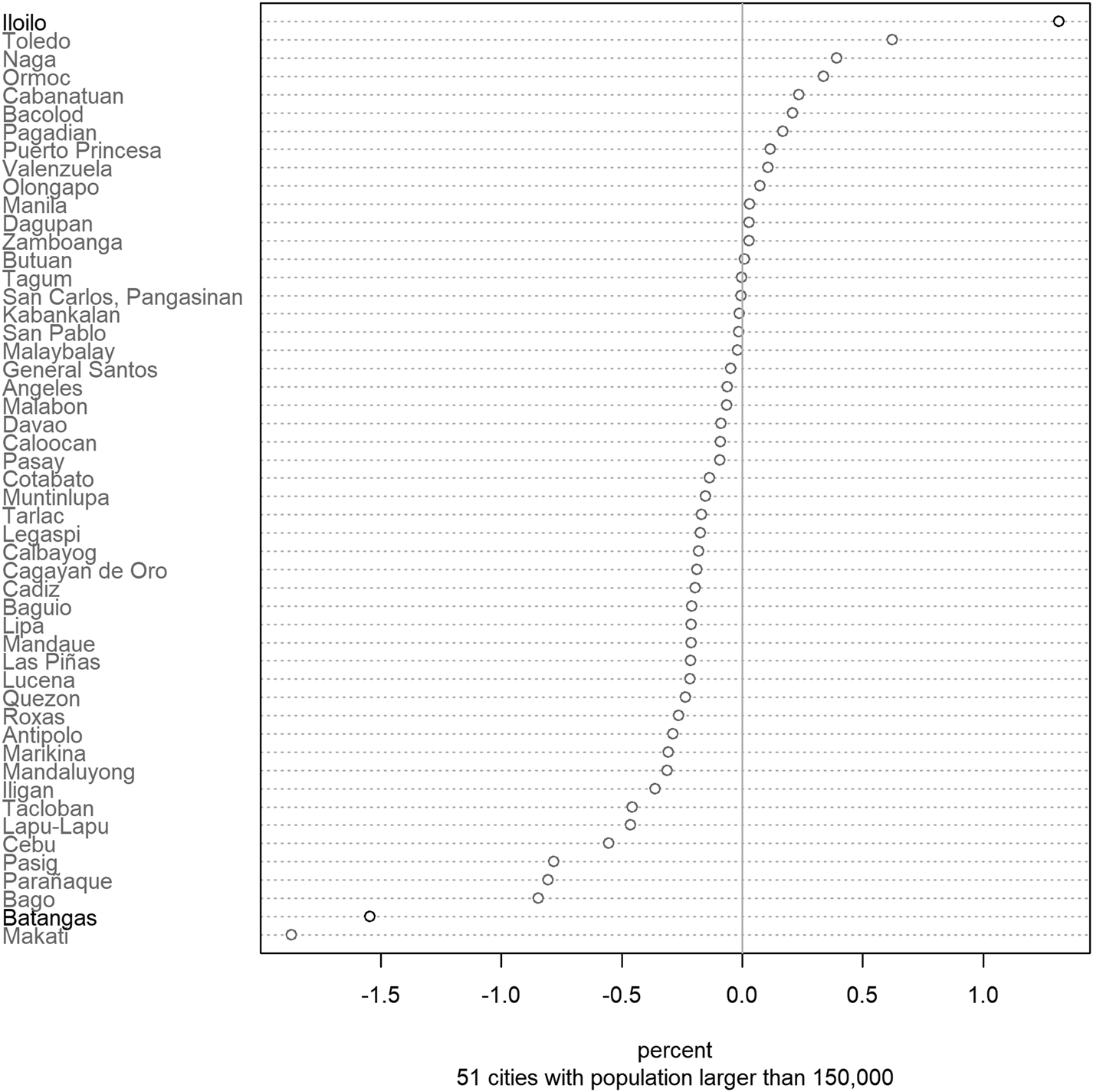
However, this population of cities is limited in several ways. First, the argument is more likely to generalize “down” to smaller cities, where the challenges of taxation are easier to solve, than “up” to larger metropolitan areas with highly fragmented interests and more severe collective action and commitment problems. Second, the argument should not travel to cities grappling with policy challenges that are difficult to monitor and unimportant to businesses. Different institutional solutions are probably necessary to accomplish complex and unprofitable developmental tasks such as improving health and education. Third, this argument explains change over time, so it is appropriate that Iloilo and Batangas have experienced more dramatic changes over the past decade than nearly all other similar cities in the Philippines (Figure 5). Even so, the extreme degree of change in these cases means that the argument might be less useful to explain cases in which revenues remain steady over time. Fourth and finally, it bears emphasis that the problems facing Iloilo and Batangas were distinctive to weak states, while the solutions that businesses offered were distinctive to decentralized states. More adversarial business–government relationships often prevail when strong, central bureaucracies have at their disposal a wider variety of means to increase taxes (Fairfield Reference Fairfield2015; Prichard Reference Prichard2015).
Change in property tax revenue as a share of GDP 2002–2016

A consideration of the peculiarities of taxation in weak states yields several insights. First, this article highlights a novel pathway out of the vicious cycle of low taxes and poor services by elaborating a set of conditions under which businesses consent to taxation despite the inability of the state to prevent free-riding or to commit to spending policies. Second, fiscal contracts achieved under such conditions are much more one-sided than previously recognized, to the extent that businesses underwrite both parties to the agreement. Third, the willingness of business to engage in such pacts suggests that it applies its political power to a wider variety of ends than is commonly acknowledged. Among certain businesses, the same political influence that enables tax evasion and rent-seeking can also facilitate tax collection.
ACKNOWLEDGEMENTS
I am grateful to Rick Doner, Jennifer Gandhi, Douglas Kammen, and Eric Reinhardt for their guidance. Aries Arugay, Dockoy Capuno, Jamie Davidson, Don Emmerson, Frank Fukuyama, Stephan Haggard, Paul Hutchcroft, Tom Lancaster, Naomi Levy, Amy Liu, Eddy Malesky, Mick Moore, Mai Nguyen, Tom Pepinsky, Tom Remington, John Sidel, Dan Slater, Meredith Weiss, Matt Winters, members of the postdoc working group at Freeman Spogli Institute, and two anonymous reviewers thoughtfully commented on earlier versions of this article. In the Philippines, Niño Alvino and Bebot Paredes generously shared data and expertise. Financial and institutional support were provided by Fulbright, Philippine-American Education Foundation, Third World Studies Center, and the Center on Democracy, Development, and the Rule of Law.
SUPPLEMENTARY MATERIAL
The supplementary material for this article can be found at https://doi.org/10.1017/jea.2020.15.
CONFLICTS OF INTEREST
The author declares none.