

Introduction
Audiovisual media, often described as a double-edged weapon with undeniable public influence, play a crucial role in both fostering empathy among viewers and shaping social behaviour. In testimonial contexts, formats such as photojournalism broadcasts, testimonial documentaries, feature films, and short films do more than simply record events.Footnote 1 Instead, as practices that always stem from choices of subject and framing, they actively engage in memory, transforming individual testimony into collective cultural representations and turning them into memory texts (Kuhn Reference Kuhn2010).Footnote 2 This performative dimension is particularly significant in the aftermath of war and genocide, where denial and deliberate erasure of memory remain key strategies for the perpetuation of violence (Lemkin Reference Lemkin2005).
The Bosnian War (1992–1995) is no exception. Journalistic media, through the work of British journalist Ed Vulliamy and North American photographer Ron Haviv, exposed the existence of concentration camps in Omarska and Trnopolje, denouncing the starvation and abuses that non-Serb – mostly Bosniak – civilians withstood. These images, which soon circulated worldwide, sharply contrasted with official paramilitary and military documentation produced by Bosnian Serb forces, which sought to deny international journalistic narratives, humiliate civilians, and distort perpetrators’ responsibility.Footnote 3 The presence of denialism in some of the most conservative sectors of Bosnia and Herzegovina (BiH)’s tripartite government further illustrates how memory remains a contested ground more than thirty years after the end of the war. When material and institutionalised cultural memory prove insufficient to restore a community’s sense of identity, recognition initiatives fostered by survivors become attempts to make civil perspectives, testimonies, and suffering visible.
Although denial is particularly common in certain parts of the country, this situation is far from homogeneous. The Federation of BiH, currently under the government of Nermin Nikšić, along with its allies, recognises and commemorates Srebrenica. Moreover, the United Nations (UN) establishment of 11 July as the International Day of Reflection and Commemoration of the Genocide in Srebrenica represents one of the most significant expressions of international support for BiH.
Against such polarisation of memory, where deep and parallel contested narratives by different ethnic groups keep on influencing everything from how history is taught in schools to public monuments erected or restricted, cinema becomes an effective medium to challenge denialist claims and to foreground a shattered cultural memory (Milišić Reference Milišić2021). In the case of the Bosnian War, different kinds of fictional audiovisual accounts evoke the most human aspects of conflict in order to denounce the lack of justice and recognition owed to survivors. Yugoslav and post-Yugoslav war cinema, for instance, depicts the conflict through local directors, actors, and the Bosnian language,Footnote 4 seeking to reclaim a threatened identity by making it visual and audible (García and José Reference García and José2021). At the same time, cinema – and art more broadly – has served as an instrument of propaganda before, during, and after the war in the former Yugoslavia, as well as a means of resistance and counter-narration. This ambivalence underlines the need to scrutinise how specific works position themselves within these political and aesthetic struggles.
Cinema thus emerges as an unofficial means of remembering, capable of addressing the aftermath of war from within particular communities and offering alternative commemorative practices that can be more effective in providing an insider perspective than official memorials.Footnote 5 This article argues that Jasmila Žbanić’s Quo Vadis, Aida? (2020) is a paradigmatic example of such practices. Through the perspective of Aida Selmanagić, an insider simultaneously cast as a civilian, a survivor, a participant, and a mediator, the film explores the ambiguities of survival while resisting both victimisation and denialism. Building on recent work that connects cinema, memory, and transitional justice in post-conflict societies, the article examines Quo Vadis, Aida? as an alternative commemorative practice that intervenes in ongoing struggles over the memory of the Srebrenica genocide.
Four central research questions guide this study. On the one hand, it asks how Quo Vadis, Aida? contributes to the reworking of cultural memory for Srebrenica survivors and their communities. Secondly, it investigates in what ways it engages with social justice, memory construction, trauma frameworks, and counter-denialism. Thirdly, it asks how the film’s cinematic language mediates between individual and collective memory, and between local and international audiences. Lastly, it considers whether it may prompt forms of witness activism that extend beyond the screen. To address these questions, I draw on Assmann’s contributions to cultural memory studies (Reference Assmann, Meusburger, Heffernan and Wunder2011), Misztal’s work on remembrance (Reference Misztal2003), Kuhn’s exploration of trauma and representation in visual media (Reference Kuhn2010), and transitional justice frameworks as articulated by Kerr and Mobekk (Reference Kerr and Mobekk2010), among others. Bringing these perspectives together, I conceptualise the film as a memory text that negotiates between communicative and cultural memory, and as a critical cinematic intervention that exposes the limits of judicial mechanisms alone to secure recognition and justice.
The article proceeds in four steps. First, I outline the historical and cultural context of Srebrenica and the politics of denial and memorialisation in BiH. Second, I situate Quo Vadis, Aida? within debates in memory studies and transitional justice, clarifying how the film’s narrative and paratextual choices can be read through Assmann, Misztal, Kuhn, and Kerr and Mobekk. Third, I offer a close reading of key scenes in the film to show how Aida’s story mediates between personal loss, collective memory, and demands for responsibility addressed to local and international actors. Finally, I consider the film’s circulation and reception as part of broader unofficial commemorative practices, including forms of digital mourning and transnational witnessing, and reflect on the implications of reading Aida’s narrative as both deeply situated and potentially universal.
Historical and cultural context
Set in Srebrenica, a municipality in the eastern part of the Republika Srpska, Quo Vadis, Aida? (2020) portrays the tragedy of the Bosniak people of Srebrenica and those who sought refuge there, subjected to a three-year siege by Bosnian Serb forces. To understand the events that the viewer perceives through Aida’s eyes, and how focusing on this locality helps counter denial discourses, it is necessary to outline how Srebrenica came to be transformed from a UN-designated ‘safe area’ into the site of a recognised genocide.
Srebrenica is now widely recognised as a genocide, both by international courts and by survivors themselves.Footnote 6 The International Criminal Tribunal for the Former Yugoslavia (ICTY) defined the events in Srebrenica as the ‘killing of military-aged men’ aimed at destroying the Bosniak community of Srebrenica as such and eliminating the likelihood of its reconstitution on that territory (ICTY 2024). This characterisation meets the legal criteria of the UN Convention on the Prevention and Punishment of the Crime of Genocide, and subsequent institutions have affirmed that the Bosniaks of Srebrenica were targeted on the basis of national, religious, and ethnic identity.
By 1995, the atrocities in BiH were well known internationally, yet effective aid remained scarce. The UN declared Srebrenica a ‘safe area’ in 1993, but in practice civilians were disarmed while Bosnian Serb forces retained their military capacity. This imbalance left the enclave highly vulnerable when Bosnian Serb forces intensified their offensive. In July 1995, tens of thousands of Bosniaks sought refuge in Potočari, where Dutch peacekeepers were stationed – a space that becomes the focal point of much of Quo Vadis, Aida?
There, Bosnian Serb forces used UN vehicles and equipment to transport captured men and boys to execution sites north of Srebrenica, while women, children, and the elderly were transported by bus to Bosniak-held territory. Forensic investigations later confirmed mass executions, mutilation, and sexual violence, with many victims found bound at the wrists and ankles (Cleverly Reference Cleverly2021b). Survivors’ associations and international observers have since accused the UN and the Dutch peacekeepers of failing to protect the enclave and of destroying or failing to preserve evidence, accusations that continue to haunt the politics of memory and accountability.
Despite overwhelming evidence, denial remains widespread, particularly in the Republika Srpska, Serbia, and parts of Croatia. After the recent recognition of 11 July as the International Day of Reflection and Commemoration of the 1995 Srebrenica Genocide, political actors in the Republika Srpska renewed threats of secession. Other practices – such as prohibitions on using the word ‘genocide’ during Prijedor’s White Armband Day,Footnote 7 the failure to rebuild destroyed mosques, or the glorification of convicted perpetrators through plaques and monumentsFootnote 8 – illustrate what Pettigrew (Reference Pettigrew, Lindert and Marsoobian2018) calls an obstruction of memorialisation. This obstruction is not limited to the suppression of remembrance but also materialises through its distortion. In BiH, the politicisation and instrumentalisation of memory have led to an uncontrolled multiplication of memorials that commemorate one’s ‘own’ victims while systematically forgetting others. Such selective strategies, thus, perpetuate a single ideologically driven narrative that disenfranchises minoritised communities. Lemkin described such post-conflict politics of erasure as the ‘second phase’ of genocide (Reference Lemkin2005, 79), an ongoing attack on a community in the aftermath of mass violence (Luck Reference Luck2020). By enforcing silence and preventing a meaningful restoration of memory, the genocide persists in the present, shaping the conditions under which films like Quo Vadis, Aida? Take on particular political and ethical weight.
In a climate of political erasure, the need for responses that dignify the memory of victims and survivors alike becomes urgent. It is precisely at this juncture that grassroots initiatives intervene.Footnote 9 Grassroots initiatives such as the Mothers of Srebrenica and Žepa Enclaves – a non-governmental and non-profit association aiming at connecting survivors and family members of these enclaves – can be understood as citizen-driven efforts to preserve and honour the memory of both the dead and the survivors. These initiatives are often shaped by what Fuchs (Reference Fuchs2014) describes as impact events, including Srebrenica, the two Markale bombings in Sarajevo, or the destruction of cultural emblems like the Stari Most in Mostar. Through the engagement with these events, grassroots actors help produce what Assmann (Reference Assmann, Meusburger, Heffernan and Wunder2011) calls figures of memory, that is, ‘fixed points made of fateful events of the past, whose memory is maintained through cultural formation (texts, rites, monuments) and institutional communication (recitation, practice, observance)’ (129). The social impact of these initiatives, in turn, fosters an empathy mode (Assmann Reference Assmann, Meusburger, Heffernan and Wunder2011), encouraging active engagement in memorialisation practices without making the distance between participants and survivors collapse. In addition to physical commemorative practices, these efforts increasingly take digital forms. For instance, online ‘virtual villages’, composed of maps, pre- and post-war photographs of destroyed sites, and recorded testimonies, seek to counter denial by reinscribing geographical, architectural, and social absences into digital presence.Footnote 10
It is within this landscape of contested memory, denial, and grassroots commemoration that Quo Vadis, Aida? intervenes. As I will show, the film participates in unofficial memory practices by reconstructing the silences and erasures that culminated in genocide, translating and universalising a personal narrative into a collective plight, and subjecting its main characters – local civilians, Bosnian Serb forces, and international peacekeepers – to the moral scrutiny of diverse audiences. In positioning Aida as both a survivor and a mediator in the war and in its long aftermath, the film performs a counter-hegemonic memory practice that gathers silence, oblivion, and abuse and reworks them into a narrative that demands a more defined space for socially and institutionally silenced voices – voices whose memories, far from being forgotten or confined to Bosniak circles, continue to grow more vivid and present with each passing day.
Case study: Quo Vadis, Aida? (2020) in the context of memory studies
Analysing Quo Vadis, Aida? (2020) as an instance of unofficial memory practices through which a community’s memory may be restored and affirmed while counteracting denial requires situating it within the field of memory studies. Remembering and memory recovery are not neutral processes. Instead, they always involve selection, framing, and reconstruction of events in line with particular ideological and affective horizons (Kuhn Reference Kuhn2010). In Žbanić’s film, the tension between opposed forces – testimony and historical documentation, institutions and survivors, local and international audiences – pervades every level of the narrative. Reading the film as an alternative audiovisual commemorative practice, therefore, calls for theoretical frameworks that draw out the links between memory, identity, and justice in grassroots cultural productions.
Two interconnected debates structure the analysis that follows. First, I focus on Aida’s characterisation as a kind of everywoman, whose story mediates between personal and collective memory without losing its situated Bosniak specificity. To develop this point, I turn to Assmann’s distinction between communicative and cultural memory (Reference Assmann, Meusburger, Heffernan and Wunder2011) and his notion of figures of memory. Second, I offer a critical examination of how recognition, denial, and justice are staged in the film, drawing on transitional justice debates (Kerr and Mobekk Reference Kerr and Mobekk2010; Phillips Reference Phillips2013; Skaar Reference Skaar2013) and on criminological work on atrocity films that distinguishes between mainstream works that ‘act out’ and critical films that ‘work through’ violence (Brown and Rafter Reference Brown and Rafter2013). Taken together, these perspectives allow one to argue that fiction films such as Quo Vadis, Aida?, when read through transitional justice and memory frameworks, can foster a moral and ethical stance in viewers by offering a subjective reconstruction of genocide that is both mediated by the filmmaker and grounded in survivor testimony.
By subjecting its characters – survivors, perpetrators, and international officials – to the audience’s gaze and judgement, the film illustrates cinema’s capacity to catalyse intercultural dialogues that can contribute to reviving Bosniak collective memory and to questioning global complicity.
Žbanić, digital mourning, and retrospective justice: Paratextual choices in Quo Vadis, Aida?
In 1995, when the Srebrenica genocide occurred, Jasmila Žbanić – born in Sarajevo, the city subjected to a 1,425-day siege – was 21 and living in the United States. She has since described the international community’s failure as ‘a betrayal of the United Nations, a betrayal of Europe, a betrayal of the world’ (Rodicio Reference Rodicio2025). After returning to Bosnia and co-founding the Deblokada association (1997), a space for artists to confront the collective devastation of the conflict, Žbanić has consistently explored the lives of women in and after war from different angles. Her first feature, Grbavica: Esma’s Secret (2006), which won the Golden Bear at the 56th Berlinale, follows a mother–daughter relationship in the Grbavica neighbourhood of the Novo Sarajevo municipality and addresses the taboo of motherhood resulting from wartime sexual violence, drawing on extensive interviews with survivors.
Partially inspired by former UN interpreter Hasan Nuhanović’s memoir Under the UN Flag: The International Community and the Srebrenica Genocide (2007), Quo Vadis, Aida? (2020) follows Aida – played by multi-award-winning Serbian actress Jasna Đuričić – an English teacher working as a translator for Dutchbat III at the cusp of the Srebrenica genocide. Through her interactions with close relatives, such as her husband and sons, acquaintances, and bureaucratic figures such as Thomas Karremans, the audience confronts the complexities faced by someone forced into a triple position: civilian, survivor, and institutional intermediary responsible for translating between local Bosniaks and UN officials.
Aida’s dual position as both witness and participant foregrounds the film’s preoccupation with choice: whose story is told, how it is told, and whose responsibility it is to tell it. One of Žbanić’s most deliberate choices concerns casting and language. Key roles are played by actors who are Bosniak, Bosnian Serb, or Serbian, with the exception of Johan Heldenbergh, a Belgian actor portraying Karremans, while several Dutchbat characters are also played by non-Bosnian actors, including Raymond Thiry as Franken. The film is predominantly spoken in Bosnian, with English used in conversations among Dutch soldiers and in some exchanges between Aida and Dutchbat members, and is distributed internationally with subtitles. This linguistic and casting strategy enhances the film’s mimetic proximity to the region while simultaneously inviting external spectators into a world whose codes they only partially share.
Within this broader strategy, Žbanić occasionally deploys role reversals across ethnic lines. A Bosniak character such as Aida is played by a Serbian actress, while Joka – a Bosnian Serb paramilitary who repeatedly threatens and humiliates civilians within the UN base – is portrayed by Emir Hadžihafizbegović, an actor of Bosniak background and an activist associated with the Party of Democratic Action (SDA), founded by Alija Izetbegović. Read through Phillips (Reference Phillips2013), such choices may be perceived as memorial practices in themselves, placing actors on the other side, and staging a performative confrontation with roles they might otherwise be assigned in national narratives. Against a polarised and denial-laden memory landscape, this decision may also be interpreted as a counter-hegemonic gesture that unsettles the rigid ‘us vs. them’ logic and underscores a shared responsibility to keep memory alive rather than fixing guilt or innocence along ethnic lines alone.
Žbanić’s insistence on creating a representation that remains close to Bosniak experiences serves the film’s dual objective, that is, generating empathy and enacting a form of retrospective justice through recognition. This is pursued not only through narrative and formal choices but also through the film’s paratextual life, with its circulation at major international festivals and awards, its screenings organised by embassies and cultural institutions on key commemorative dates, and its mobilisation by activist and educational initiatives.Footnote 11 In BiH, for instance, the country’s particular political context played a fundamental role in the promotion of – or lack thereof – the film. Bosnian politicians supported and promoted the film itself for the Oscar campaign, including Bakir Izetbegović, president of the SDA, and Šefik Džaferović, Bosniak member of the BiH presidency. At the same time, it was partly funded by BiH public funds, as the production and financing logos at the beginning of the film demonstrate. Through these channels, audiences are encouraged to engage with the community’s plight and to reflect on their own positions in relation to global responsibility (Figure 1).
Institutions partaking in the funding and promotion of Quo Vadis, Aida?

In this context, the film participates in what Jaugaitė (Reference Jaugaitė2024) terms digital mourning or digital grief, a form of public remembering that has expanded with the rise of social media. Digital mourning exposes the vulnerability of survivors and bereaved families, turning private experiences into publicly shared narratives and images. Scholars have raised concerns about the ethical and psychological implications of such constant exposure to grief (Beaunoyer and Guitton Reference Beaunoyer and Guitton2021), suggesting that it may complicate processes of working through trauma. Yet for the Bosniak community, online forms of mourning may also function as counter-denial strategies, making persistent trauma visible and reclaiming justice in the face of official silence.
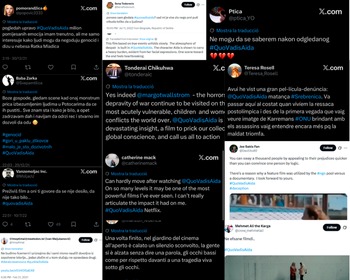
The film’s digital circulation facilitates this process by enabling spectators to become active participants in remembrance practices. On platforms such as X (formerly Twitter), users comment in real time as they watch Quo Vadis, Aida?, posting under hashtags that include the film’s title and sharing their emotional responses to scenes they may be encountering for the first time (Figure 2).
Compilation of posts on X reflecting users’ opinions after watching Quo Vadis, Aida?

This dynamic resonates with initiatives such as #ŠtoTeNema, a participatory art and social media project devoted to Srebrenica victims that has, since 2012, generated thousands of posts, replies, and photographs that are periodically transformed into material memorial forms (Jaugaitė Reference Jaugaitė2024).Footnote 12 In both cases, the articulation of grief online becomes a form of digital witnessing that crosses national borders and generational divides, making the memory of Srebrenica survivors – and the demand for accountability – more accessible across time and space.
Having framed the paratextual environment of Quo Vadis, Aida? as part of an emerging digital and transnational memory ecology, I now turn to the film’s narrative and audiovisual strategies to show how it (1) casts and collectivises individual experiences, and (2) enacts a form of justice for the Srebrenica population by highlighting the failures and limits of institutional responses.
From communicative to cultural memory: Aida’s testimony as a bridge
In Quo Vadis, Aida?, Aida emerges not only as the protagonist of a personal tragedy but also as a symbolic everywoman figure who stands at the intersection of intimate suffering and collective memory. Drawing on Assmann’s distinction between communicative and cultural memory (Reference Assmann, Meusburger, Heffernan and Wunder2011), the film may be read as staging a passage from the immediacy of personal, intergenerational remembrance to the externalisation of that remembrance in durable cultural forms. Communicative memory – built through everyday interactions among contemporaries and usually confined to a span of three or four generations – depends on interpersonal transmission within families and small communities, and is not necessarily preserved by institutions. Cultural memory, by contrast, is
itself premised on the idea that memory can only become collective as part of a continuous process whereby memories are shared with the help of both symbolic artefacts that mediate between individuals and, in the process, create communality across both space and time (Erll and Rigney Reference Erll and Rigney2009).
For many Srebrenica survivors, the right to have their experiences acknowledged within cultural memory remains precarious and unevenly granted.
Once dramatised through the camera lens, Aida’s story becomes what Kuhn calls a memory text (Reference Kuhn2010), that is, a performance of memory that draws on interviews, documents, photographs, and cinematic sequences, assembled into a structure that invites interpretation rather than offering a transparent window onto the past. This multidimensional approach is further reflected in the film’s composite nature. For instance, the work constitutes an assemblage of diverse sources, such as Nuhanović’s book, testimonies, interviews with survivors, footage recorded during the war, and documentaries, as well as interwoven narratives of a personal, interpersonal, and institutional nature.
This dynamic is particularly evident in sequences where Aida moves frantically through the UN base in Potočari, pleading with Karremans – who soon disappears from the narrative – to admit her husband and sons to the compound (Figure 1). As both a translator and an indirect witness to atrocities elsewhere in BiH, Aida implicitly understands that her male relatives are especially vulnerable. Yet her appeals are mediated by lists, bureaucratic procedures, and the discretionary power of Dutch officers.
The film uses this moment to dramatise the hierarchical geography of the ‘safe area’: Aida only gains a fragile privilege through performance – through her capacity to negotiate with Franken and Karremans – , while her family remains outside the institutional frame that promises protection. Rather than presenting her as a stable mediator, the film marks her as a site where the gap between formal inclusion and material survival becomes visible. In light of Kepkay’s (Reference Kepkay2011) account of gendercide in the Bosnian War, Aida’s implied knowledge that Bosnian Serb forces target military-aged Bosniak men deepens the ethical weight of this exclusion because the film suggests that the men on ‘the list’ may be precisely those who are most at risk.
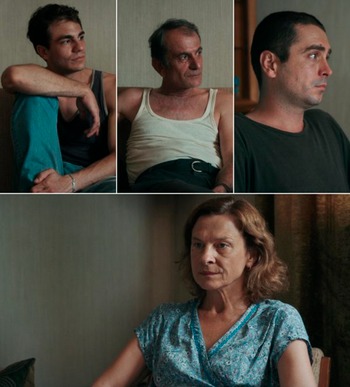
The film repeatedly stages the growing separation between Aida and her family. In the opening scene, the camera captures her husband and sons looking in her direction, frozen in a moment of anticipatory tension (Figure 3). This framing may be read as a mnemonic contract, where Žbanić suggests that their survival – before, during, and after the genocide – depends on her, emphasising her responsibility both as a mother and as the eventual carrier of their memory. The stillness of this early image contrasts sharply with later kinetic sequences, underscoring the fragility of the bond. In terms of Hirsch’s postmemory, this moment crystallises how survivor memory is structured less by individual recall than by the burden of transmission, and how that transmission is already endangered before the genocide fully unfolds.
Aida’s sons and husband during the opening scene.

Figure 3. Long description
The shot presents four characters: three close shots of men in the upper row, standing respectively for Aida’s sons, one in each corner, and her husband in the middle, and a woman, Aida, in the lower row. Her sons are each wearing dark clothes, while their father sports a white t-shirt. Aida, staring at them in a serious way, wears a light blue dress.
Within this framework, Žbanić stages Aida’s agency as strongly constrained, dramatising the collision between individual survival choices and collective responsibilities. When Major Franken calls for a volunteer to accompany him to negotiate with Mladić, the camera isolates Aida, highlighting her individuality and implicating her in a rapidly escalating moral dilemma (Milišić Reference Milišić2021). In the charged silence, she offers her husband for the mission in the hope of securing protection for him and their sons (00:22:06). This ethically ambiguous decision privileges her immediate family’s survival over solidarity with neighbours, despite her awareness of the risks. Later, as she crosses the barbed-wire fence separating those inside the UN compound from those still outside, she refuses a neighbour’s plea to take her son with her, fearing for her own children’s safety. These scenes underscore the limits of Aida’s agency. The character appears neither indifferent, like some UN officers, nor driven by hatred, like the Bosnian Serb military and paramilitary units, but as a mediator whose choices are shaped by an impossible calculus of self-preservation, familial loyalty, and communal responsibility. In this sense, the film retrieves Milišić’s critique of works that moralise victims rather than attend to the structural conditions that produce their so-called complicity. Aida’s compromises, from this perspective, are presented not as exceptions but as symptoms of a system designed to render solidarity practically impossible.
Her constrained complicity resurfaces when she translates Franken’s reassurances that refugees boarding the UN-controlled buses will be taken ‘to safety’, even as she strongly suspects the opposite (01:02:15). At one point, she even protests, insisting that it is not safe and asking who will accompany the buses, only to be overruled. Spoken by a fellow Bosniak and community member, Aida’s words acquire a particular weight, becoming part of a misleading discourse that people trust, presenting her as complicit in the destruction of her own community. Yet, from the perspective of memory studies, the film uses this moment less to condemn Aida than to expose the limits of agency under occupation and institutional failure. Her position as a mediator between the UN, Bosniak civilians, and Bosnian Serb forces reveals how memory itself is produced through asymmetrical speech acts: some utterances enable survival, others foreclose it, and others sustain denial, and her words remain collectively consequential.Footnote 13
Despite her relative privilege, Aida is thus positioned less as an empowered agent than as a liminal figure whose access to Dutch officers offers only limited protection. Žbanić resists casting her as a saint or as a conventional heroine, emphasising instead ‘a human being in a hard situation’ whose ‘humanity is shrinking’ under pressure (Chen Reference Chen2021; García and José Reference García and José2021). Through intimate close-ups that capture her accusatory gaze towards UN officers and long shots that situate her among the mass of displaced civilians, the film renders her simultaneously singular and emblematic, complicating the categories of victim, perpetrator, and saviour. In this way, Aida becomes an everywoman mediator; a figure who embodies the generic experience of Bosniak women – those who bear the triple burden of material survival, moral negotiation, and the preservation of memory – while remaining recognisable as a concrete individual.
The film also uses flashbacks to expand the scope of remembrance beyond Aida’s subjective perspective. The ‘Best Hairstyle of Eastern Bosnia 1991–1992’ competition – an exuberant, pre-war cultural event – interrupts the otherwise linear, siege-time narrative (Figure 4). Unlike most of the film, this scene is not focalised strictly through Aida’s eyes but lingers on multiple women and men in slow motion and close-ups. Placed mid-film in a darker setting, the flashback marks the rupture between pre-war life and the genocide’s aftermath, showing that the community is not only remembered as victims but also as people who, as Žbanić contends, were ‘human beings … capable of being silly and happy’ (Chen Reference Chen2021) and whose ordinary lives were violently interrupted. Thereby, the film counters the tendency to essentialise the victims as perpetual sufferers, affirming Rutland’s claim that such scenes help audiences remember the community as playful, diverse, and ethnically mixed before the genocide (Reference Rutland2021).
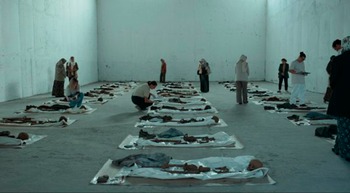
Victim identification in Srebrenica.

Moreover, by showing characters whom viewers recognise from the camp scenes – later as perpetrators, bystanders, or victims – the flashback establishes what Assmann calls figures of memory, that is, condensed images or events that crystallise a community’s sense of loss and rupture (Assmann Reference Assmann, Meusburger, Heffernan and Wunder2011). The fragmentation of the film’s chronology mirrors the fractured state of the post-genocide community, while also suggesting that cultural memory is built from discontinuous, reassembled images rather than from a seamless narrative. Aida’s everywoman position allows the film to move between these scales – from her individual gaze to the wider crowd, from the intimate family to the collective community, and from the immediacy of communicative memory to the persistence of cultural memory.
The epilogue crystallises such movement from communicative to cultural memory. After the scenes of separation, evacuation, and implied executions, the film cuts to a stark, wintry interior where human remains are laid out on the floor for identification (Figure 4). The presence of a reconstructed minaret in earlier shots indicates a post-war setting (2002 or later), yet the sequence itself is marked as atemporal, emphasising that forensic identification and mourning persist long after violence has ostensibly ceased. The camera initially offers a panoramic view, then tracks Aida as she moves among the bodies. When she kneels before a set of remains, the shot tightens, yet the camera maintains a respectful distance, inviting viewers to witness without appropriating her grief – an aesthetic choice that dramatises the limits of empathy itself.
This formal restraint aligns with Landsberg’s notion of prosthetic memory (Reference Landsberg and Grainge2003), that is, the idea that mass-mediated forms of empathy allow viewers to connect with others’ traumatic histories without collapsing the difference between viewer and survivor. The presence of multiple women in the identification hall, some leaving without closure, situates Aida within a broader community of Bosniak women whose losses reverberate across BiH and its diaspora.Footnote 14 Yet, at the same time, the scene implicitly acknowledges the limits of representation. Even as it invites affiliative engagement, it marks certain dimensions of suffering as inaccessible to outsiders, echoing debates about the ethics of vicarious witnessing and the risks of overidentification.
In this sense, Quo Vadis, Aida? operates as an archive of figures of memory (Bahun Reference Bahun2020). Visual motifs such as green coffins and lines of grieving women have become emblematic of Srebrenica, circulating beyond the film in news reports, exhibitions, and other films. Yet the repetition of such images risks generalising the conflict and obscuring the particularities of different victim groups. Nuhanović’s critical response to the film, stating that he does not feel personally represented, despite recognising its importance, illustrates the paradox of cultural memory: any collectively legible narrative necessarily prioritises certain stories and forms of suffering while marginalising others, depending on intended audience, national frames, and political contexts (Izzo Reference Izzo2022). This way, even well-intentioned memorialisation is perceived as a form of selection, not full restoration.
The film also gestures towards the collapse of conventional intergenerational transmission. For many families, the death of male relatives means that trauma cannot be passed on through the usual channels of communicative memory, described by Hirsch (Reference Hirsch2012) as the dialogic, everyday transmission of stories, photos, and behaviours within the family. Another common phenomenon is the survivors’ inability to pass such trauma down due to the pain it still causes them, which sometimes manifests as a greater distance with the second generation. In this formulation, the film is not simply a record of loss but a material intervention into the politics of intergenerational memory, attempting to sustain what Hirsch calls postmemory even where familial transmission has structurally broken down. In the specific case of Srebrenica, those who were children during the genocide and the children of survivors, however, are very active in preserving its memory. The existence of the generation of postmemory, thus, intensifies the importance of public and cultural forms of remembrance, including cinema, as sites where memory can be externalised, circulated, and contested.
The symbolic role of cinema as a physical space is underscored when one of the massacre sites is revealed to be a theatre-like hall used for screenings and performances, rather than a conventional town movie theatre. When a Bosnian Serb officer orders the men inside with the chilling line ‘Now you’ll watch the real movie’ (01:25:00), an everyday entertainment venue becomes a stage for mass murder, and spectatorship is violently transformed into enforced vulnerability. The exact nature of the building – factory hall, cultural centre, or school gym – is left somewhat ambiguous, which prevents it from being reduced to a single, fixed icon and instead allows it to stand in for a broader typology of spaces turned into sites of violence.
Significantly, the reappearance of a similar kind of hall in the epilogue – as a space for children’s performance – highlights the film’s concern with how sites of atrocity may be re-used, re-memorised, and re-ritualised in post-war life, even if the exact spatial identity is left ambiguous. The final scene returns to a large, hall-like interior, now transformed into a stage for children’s choreography. Such space becomes a site where a new generation performs before an audience that includes Aida. Through close-ups, nine children cover and uncover their eyes, some looking directly into the camera, others towards the diegetic audience (01:37:19). This gesture encapsulates the act of witnessing and hints at a threefold responsibility for preserving memory: that of children, who embody the post-war generation; that of parents and survivors, who must transmit truthful accounts; and that of viewers, who become secondary witnesses invited to sustain remembrance beyond the film. The composition implies that collective memory does not reside in a single figure like Aida but is distributed across institutions, rituals, education, and everyday acts of commemoration.
This scene resonates with Hirsch’s concept of affiliative postmemory (2012), which highlights how individuals and communities without direct biological ties to survivors may nonetheless engage ethically with their histories. By assigning this triple responsibility through visual composition and narrative emphasis, Quo Vadis, Aida? completes its trajectory from intimate, communicative memories to a shared cultural and political obligation to remember. The film, thus, positions cinema not only as a medium of aesthetic representation but also as a material and institutional practice of memory, where the act of watching becomes a form of participation in the ongoing project of remembrance, testimony, and resistance to denial.
Transitional justice beyond the courtroom
Survivors of mass atrocity frequently perceive judicial processes as partial and incomplete, unable to address the full spectrum of harms – particularly public acknowledgement, restoration of dignity, and everyday security (Kritz Reference Kritz1995; Teitel Reference Teitel2000). Orentlicher’s Some Kind of Justice (Reference Orentlicher2018) documents this gap in the ICTY’s Srebrenica prosecutions, highlighting that, while securing convictions against Mladić and others, the Tribunal largely left the survivors’ needs for moral recognition unmet.Footnote 15
Kerr and Mobekk define transitional justice precisely as a broader field composed of ‘non-judicial mechanisms aimed at dealing with a legacy of large-scale abuses of human rights and/or violations of international humanitarian law’ (Reference Kerr and Mobekk2010, 1). In this framing, transitional justice is not only about verdicts and sentences but also about public acknowledgement, memorialisation, and the redistribution of symbolic power. Quo Vadis, Aida? enters this expanded transitional justice landscape not by retelling ICTY trials, which are kept implicit throughout, but by staging what courts structurally excluded, that is, public moral reckoning with Dutchbat’s passivity, Bosnian Serb perpetration, and the survivors’ constrained agency before heterogeneous global audiences (Rutland Reference Rutland2021).
Such cinematic justice aligns with Brown and Rafter’s (Reference Brown and Rafter2013) distinction between atrocity films that ‘act out’ violence, replaying spectacular killing scenes that risk aestheticising suffering and desensitising viewers, and those that ‘work through’ it ethically, fostering reflection on structures of complicity and collective memory rather than cathartic display. Žbanić positions the film in the latter category, deploying deliberate formal restraint to redirect attention from the victims’ bodies to the structures of responsibility that surround them. This is most evident when Bosnian Serb paramilitaries enter Potočari (00:47:40), a sequence that becomes a key site where the film stages its double critique of the UN and the Dutchbat.
Franken’s fragile authority reveals Karremans’s weakness as a senior commander. Initially refusing Joka entry (‘it’s not allowed’), Franken reverses only after Karremans orders it remotely from Hotel Fontana, to which Franken objects firmly and is overruled, and when Karremans visibly defers to Mladić for final confirmation. This deference chain directly mitigates Nuhanović’s critique that Žbanić softens her portrayal of Karremans (Izzo Reference Izzo2022). Rather than individual failure, the film constructs structural abdication. Dutch soldiers stand armed but passive behind paramilitaries blended among refugees, refusing intervention as Joka’s men harass civilians under ‘war criminal’ accusations. Wide-angle static shots expose this complicity geographically and morally, aligning the viewer not with individual guilt but with the institutional and situational conditions that make complicity possible.
Such critique extends to post-war dynamics. Former Dutchbat soldiers have sought psychological trauma compensation while survivors’ demands for a full investigation face institutional resistance (Mulaj Reference Mulaj2017; Fajić Reference Fajić2024). Nuhanović himself was pathologised as ‘too emotional, too loud’ (Nuhanović Reference Nuhanović2018), a classic example of the ways survivor voices are disqualified when they threaten dominant political narratives. Žbanić acknowledges the Dutchbat’s precarity, being outnumbered, underarmed, and inexperienced, which she represents through a young casting, without exoneration. Yet she insists that moral passivity constitutes enabling complicity that legal mechanisms never fully adjudicate (Misztal Reference Misztal2003; Tromp Reference Tromp2020). In this way, the film positions the Dutchbat not as neutral witnesses but as complicit facilitators whose inaction allowed the genocide to unfold, using cinematic forms to indict what the law only partially addressed.
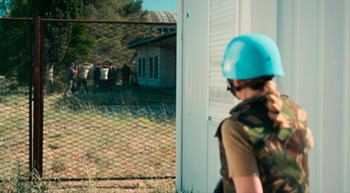
A female Dutch soldier crystallises this moral failure (01:21:35). Earlier mocked by Serbs, she now watches Bosniak men being marched not towards promised safety but towards the massacre hall. Gunfire erupts off-screen; she turns away silently. Mulaj’s (Reference Mulaj2017) notion of ‘cracks in humanitarian endeavor’ becomes visible here. The choice to remain passive, to let the camera record the atrocity without intervening, amounts to a form of participatory violence. Thus, the film highlights this split between humanitarian rhetoric and humanitarian practice, exposing how silence and non-intervention are not neutral absences but active forms of complicity within the logic of the ‘humanitarian’ mission (Figure 5).
Female soldier witnessing the massacre.

Figure 5. Long description
The shot portrays a young female, presumably a soldier from the UN Dutch bat, as she is wearing a blue helmet and a military vest. She is looking behind a fence, as if hiding, as a group of men are led, with their hands behind their heads, toward a white building by soldiers sporting the Bosnian-Serb Army’s uniform.
Žbanić’s real-time dramatisation counters this silence through ‘working through’ restraint modelled after Brown and Rafter’s critical mode. The massacre unfolds audibly – gunfire, screams from off-screen – but never visually: no bodies are shot on camera, no blood is shown. This deliberate absence intensifies horror while avoiding Sontag’s (Reference Sontag2025) spectacle of suffering, where atrocity images risk becoming consumable aesthetic objects that shock but ultimately displace responsibility onto the victims. However, one calculated exception tests this boundary. At 00:09:10, a soldier casually steps over a woman’s corpse in town, framing victim exposure as a gesture of perpetrator sovereignty rather than as an ethical position for the film’s gaze. This moment marks the limits of the film’s refusal of spectacle, exhibiting that the perpetrator’s perspective, not the victim’s body, is the one that the film sometimes exposes.
The strategy activates overlapping modes of remembrance, aligning with Assmann’s empathy mode (Reference Assmann, Meusburger, Heffernan and Wunder2011), which invites viewers to feel with survivors without occupying their position, and with Žbanić’s stated ‘right to dignified death’ (García and José Reference García and José2021; Barrenetxea-Maranon Reference Barrenetxea-Maranon2021). Brown and Rafter’s (Reference Brown and Rafter2013) ‘working through’ becomes literal here. Viewers must imagine the unseen, reconstructing the killings through sound, gesture, and the visible inaction of those who could have intervened. Cinema, thus, performs transitional justice, not by reproducing the violence of the crime but by publicising the impunity and structural complicity that enabled it, in a space where courts, in practice, remained silent.
This critique extends into the epilogue’s post-war present. The mass grave exhumation appears not through sensationalist close-ups but as a cordoned site, where police tape, forensic workers, and the survivors’ accusing gazes predominate (01:33:10). The viewers may infer remains from shovels and body bags, and the posture of the workers, while faces like Ahmed’s mother, who was earlier refused entry to the facilities, guide the ethical reading of the scene. This indirect visualisation counters what Lemkin (Reference Lemkin2005) describes as the ‘second phase’ of genocide, that is, the post-conflict attempt to erase or relativise the memory of the victims, and resonates with Luck’s (Reference Luck2020) account of denial as a continuous political project. The film thereby constitutes a visual act of resistance to the erasure of Srebrenica, even as Republika Srpska political actors refuse to acknowledge the genocide (Labonté Reference Labonté2025).
Everyday dispossession unfolds through the dual apartment visits, clarifying its progression from partial to total. First (01:28:25), Aida finds her pre-war apartment occupied but still intact – her wall clock, šekerlik, and TV remain alongside Joka’s family additions, marking dual possession. The domestic traces of her former family life coexist uneasily with the presence of the perpetrator, producing a visual grammar of displacement that is not complete. Then, on the stairwell encounter (01:32:20), Joka avoids her gaze, passing as a stranger despite Potočari confrontations, embodying what Odak (Reference Odak2020) calls intimate denial. This process entails a forced coexistence with unrepentant perpetrators who refuse acknowledgement or apology, which obstructs healing and memory reconstruction (Skaar Reference Skaar2013). In the second visit (01:36:30), the space stands emptied, with the opening scene items vanished, and total dispossession being complete. The apartment is no longer a site of memory but of erasure, confirming that the genocide persists in the present through the occupation of survivors’ homes and the normalisation of impunity.
This everyday dimension of the film’s critique reinforces the idea that transitional justice is not only a legal or institutional process but a spatial and psychological struggle – an ongoing moral struggle that continues long after the trials are finished. Local survivors witness the persistence of dispossession, regional viewers recognise the normalisation of perpetrator impunity, and global audiences encounter the structural aftermath of genocide, shaped by neglect, silence, and institutional complicity.
Thus, Quo Vadis, Aida? offers double critique – of international indifference, where peacekeeping without enforcement predominates; and of the way memory itself becomes a form of justice in the absence of institutional accountability. By staging complicity, refusing spectacle, and emphasising the survivors’ continued erasure, Žbanić positions cinema within the widest sense of transitional justice, that is, as a non-judicial reckoning that cultivates recognition across divided publics and insists that remembrance is an ongoing ethical and political obligation.
Conclusion
As part of visual art bringing Bosnia’s conflict into the present, Jasmila Žbanić’s Quo Vadis, Aida? (2020) concludes by posing its titular question – ‘Where are you going?’ – to characters and audience alike. What begins as an interrogation of individual survival choices under genocidal pressure becomes an ethical demand: what moral direction do we choose after witnessing institutional betrayal, survivor constraint, and post-war denial’s persistence? This closing gesture positions the film not only as a record of past violence but as an ongoing invitation to reflection and responsibility, underscoring that remembrance is not a settled act but a continuous negotiation.
This article has demonstrated cinema’s capacity as an unofficial memory practice, preserving silences that obstruct justice in BiH thirty years after the Dayton Accords. By stepping into the representational gaps left by law and the state, Žbanić’s film performs a form of memory-making that is simultaneously intimate and public, local and transitional. In this sense, it aligns with broader literature on non-state transitional justice, where cultural producers take on tasks that formal institutions either cannot or will not complete. The film’s force, thus, lies less in its fidelity to historical detail than in its ability to re-stage the moral and political questions that continue to structure the Bosnian present.
Three arguments emerge from this analysis. First, Žbanić fosters interethnic and transnational dialogue through paratextual strategies. Cross-ethnic casting, with Serbian actress Jasna Đuričić as Bosniak Aida, or Bosniak actor Emir Hadžihafizbegović as the perpetrator Joka, and the use of Bosnian with strategic English subtitles addresses heterogeneous audiences in distinct ways: local Bosniaks recognise intimate domestic and linguistic details; ex-Yugoslav viewers decode role reversals that unsettle the ‘us vs them’ binaries; and global audiences learn UN protocols and legal conventions through the mediation of dialogue and the subtitle. Moreover, digital mourning practices, such as film-related hashtags paralleling #ŠtoTeNema’s coffee-cup installations, transform private grief into public witnessing across generations, illustrating how cinema may catalyse forms of networked memory that extend beyond the screen (Jaugaitė Reference Jaugaitė2024). In this way, Žbanić’s work resonates with theorists who emphasise that memory now circulates through multi-platform publics, where art, social media, and commemorative art join in collective sense-making.
Second, cinematic dramatisation transforms communicative into cultural memory. With an entire generation of Bosniak men erased in the particular region of Srebrenica, Aida’s ‘everywoman’ figure mediates this transition, turning her familial interactions – calls, negotiations, everyday gestures – into what Assmann (Reference Assmann, Meusburger, Heffernan and Wunder2011) calls institutionalised practices of remembrance. These intimate scenes become, in Kuhn’s (Reference Kuhn2010) terms, memory texts, which represent constructed assemblages that viewers must interpret rather than transparently receive. Simić and Volčić’s (Reference Simić and Volčić2014) critique of ethnic-centred narratives finds partial counterweight in Isanović’s defence of the film’s universal resonance. Through this perspective, the grounding in Bosniak particularity ensures that testimony is not diluted into abstract ‘humanity’, while the translator-and-mother dilemmas allow the film’s ethical questions to travel globally. Formal choices, such as the off-screen massacre audio, the dual apartment dispossession sequence, and the children’s eye-opening gesture, position viewers as affiliative secondary witnesses (Hirsch Reference Hirsch2012), called upon to bear the responsibility of intergenerational transmission. The film, thus, insists that cultural memory is not only about representation but also about the ethical burden of spectatorship.
Third, the film constitutes an instance of non-judicial transitional justice. Hodžić (Reference Hodžić2010) and Orentlicher (Reference Orentlicher2018) document the judicial limits of what ICTY convictions could achieve, that is, while the Tribunal delivered verdicts, it often failed to provide the full moral recognition and material reparation that survivors sought. Kerr and Mobekk (Reference Kerr and Mobekk2010), on the other hand, define the mechanisms, such as truth-telling initiatives, memorial projects, and artistic interventions, that attempt to fill these gaps. In this expanded frame, Žbanić stages the reckonings that courts structurally excluded, which include the Dutchbat’s structural abdication, with Franken’s objections being overruled by Karremans, who in turn defers to Mladić; the female soldier’s silent witnessing; and the everyday denial embodied in Joka’s averted gaze and the erasure of Bosniak property. In line with Brown and Rafter’s (Reference Brown and Rafter2013) distinction between atrocity films that ‘act out’ violence and those that ‘work through’ its ethical and political dimensions, the film positions cinema within transitional justice’s widest scope, cultivating recognition across divided publics where courts fell silent. The film’s refusal of spectacle and its emphasis on complicity and silence signal that the real injustice to be addressed is not only the killings themselves but the institutional and moral failures that made them possible.
Today’s ethnic conflicts echo Bosnia’s patterns of violence, displacement, and denial, making Žbanić’s work a crucial reference point for debates about memory, responsibility, and the role of culture in the aftermath of atrocity. By addressing both individual and collective aftermaths, the film demands responsibility not only from local survivors but also from regional neighbours and global bystanders. Framing the film as an unofficial memory practice, Quo Vadis, Aida? underscores the necessity of preserving contested pasts to prevent the denial-and-violence cycles. Its final question, thus, lingers. Faced with the silences of genocide, where do we, as viewers and citizens, go?
Data availability statement
The data that support the findings of this study are openly available in Quo Vadis, Aida? (2020) by Jasmila Žbanić.
Funding statement
The work received no specific grant from any funding agency, commercial, or not-for-profit sectors.
Competing interests
The author declares none.
Anesa Muslimovic Ortega is a third-year predoctoral researcher at the Department of English and German at the Universitat de València. Graduating with Honours from both her BA in English Studies and MA in Creative and Humanistic Translation, her main research interests include the representation of trauma and fragmented identities in North American diasporic fiction, gender studies, and queer theory.


 Open access

