Introduction
An unstable, chronically discharging, open tympanomastoid cavity can be a major source of discomfort and frustration for the patient and doctor.Reference Dornhoffer, Smith, Richter and Boeckmann1, Reference Males and Gray2 The worst open cavities can render patients more severely symptomatic than the cholesteatoma that originally prompted their creation.
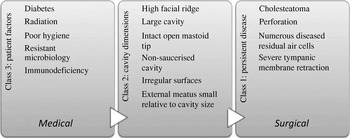
In the authors' practice, factors contributing to chronic open tympanomastoid cavity instability are classified into three broad categories (Figure 1),Reference Gluth, Metrailer, Dornhoffer and Moore3 and many of these are often present at once. The first class of factors concerns cases in which antecedents to tympanomastoid pathology were not eliminated, such as cholesteatoma or tympanic membrane perforation. These factors often act as stand-alone indicators for revision surgery. The second class pertains to unfavourable cavity shape and size due to traditionally cited factors such as a high facial ridge, an inadequate meatoplasty or a voluminous gravity-dependent open mastoid tip.Reference Sade, Weinberg, Berco, Brown and Halevy4 Multiple class two factors acting together may prompt revision surgery. The third class involves factors that negatively affect the biological environment within the cavity itself, such as antimicrobial-resistant pathogens, chronic moisture, immunodeficiency, diabetes and neglect of aural toilet. These factors are usually managed in the clinic.
Classification of factors leading to mastoidectomy revision (as described in the Introduction; see also Gluth et al. Reference Gluth, Metrailer, Dornhoffer and Moore3).

Of the factors in the third class, microbiology can be particularly consequential; it will affect clinical decision making in terms of the type and route of antimicrobial medication administration. Although several reports have been published over the years concerning the microbiology of chronic suppurative otitis media (CSOM),Reference Choi, Park, Park, Jun, Lee and Yeo5–Reference Yeo, Park, Hong, Cha and Kim12 questions still linger as to how these reports apply to the unique open cavity tympanomastoid environment. It is unclear if treatment of the most severely unstable cavities fails at least in part because pathogenic microbes are never completely eliminated, or whether antibiotic-resistant pathogens play a significant role in prompting revision surgery. Is an unfavourable microbiology profile such a prominent occurrence in canal wall down tympanomastoidectomy failure that it should be considered a stand-alone indication for revision surgery, or is the authors' classification as a class three factor most appropriate? Accordingly, the aim of this study was to review and analyse the microbiology of open mastoid cavities that were so unstable they required surgical revision. The study comprised a select group of the most difficult cases (grade 3) according to the rating scale proposed by Merchant et al. Reference Merchant, Wang, Jang, Glynn, Rauch and McKenna13
Materials and methods
The hospital ethics committee granted a waiver of oversight due to minimal risk according to the 2007 Australian National Statement on Ethical Conduct in Human Research. A retrospective chart review was undertaken of all patients who underwent surgical revision of an unstable canal wall down tympanomastoid cavity performed by the senior author (MDA) between 2000 and 2010 at St. John of God Hospital Subiaco in Perth, Western Australia. An unstable tympanomastoid cavity was characterised by symptoms that were not satisfactorily controlled by therapy delivered in the clinic, or in which primary otological disease (cholesteatoma, perforation) was not eliminated with initial canal wall down tympanomastoid surgery.
If a culture specimen had been obtained within the three months preceding surgery or intra-operatively, the culture results were noted, including organism and antimicrobial sensitivity. The decision to acquire a specimen was made based on whether there was evidence of acute infection characterised by an active purulent-appearing discharge. In addition, the presence or absence of cholesteatoma was noted for each case.
Statistical analysis was performed using the chi-square test. Specifically, we evaluated potential differences in the frequency of positive or polymicrobial results between culture specimens from cases that involved cholesteatoma and those that did not.
Results
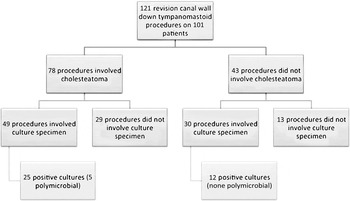
The results revealed that 121 revision procedures for unstable open cavities were performed on a total of 101 patients (Figure 2). The average age of these patients at the time of surgery was 38.6 years (range 5–77 years). Of these, 79 procedures included culture specimen acquisition and processing, either during the operation or during the immediate pre-operative period. A standardised microbiology protocol was utilised for the preparation and processing of all specimens, which included aerobic, anaerobic and fungal cultures.
Culture specimens from 121 revision canal wall down tympanomastoid procedures.

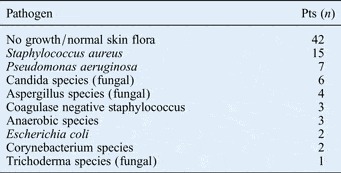
Of the 79 culture specimens, 42 had no growth or only growth of normal skin flora; 37 returned a positive result, 5 of which were polymicrobial. The most commonly cultured organisms were Staphylococcus aureus (n = 15), Pseudomonas aeruginosa (n = 7) and candida species (n = 6). A breakdown of culture results is portrayed in Table I.
Patients' microbiology profile*

* Profile of those who underwent surgical revision of an unstable open tympanomastoid cavity (total n = 79). Pts = patients
An antimicrobial resistance profile was generated for cultures that tested positive for organisms associated with antimicrobial resistance (staphylococcus species, P aeruginosa, Escherichia coli). Of the 15 cultures positive for S aureus, 6 were resistant to penicillin; however, all were sensitive to cephalexin and flucloxacillin. Of the seven cultures positive for P aeruginosa, two were resistant to gentamicin, but all were sensitive to ciprofloxacin. The only culture associated with significant antibiotic resistance was a single specimen positive for E coli that was resistant to all oral antibiotics tested (penicillin, cephalosporin and fluoroquinolone); however, it was sensitive to intravenous agent meropenem and amikacin.
Analysis using the chi-square test, which was utilised to determine whether cases involving cholesteatoma were more or less likely to yield either a positive culture or a polymicrobial culture result than cases not involving cholesteatoma, revealed no statistically significant differences (p > 0.05 for all). In addition, there were no significant differences found in terms of the likelihood of encountering a positive culture for either S aureus or P aeruginosa based on the presence or absence of cholesteatoma (p > 0.05 for all).
Discussion
The microbiology of CSOM is an established topic in the medical literature. A thorough review by Verhoeff et al. indicated that P aeruginosa is generally cited as the most common culture isolate (18–67 per cent of cases), followed by S aureus (14–33 per cent of cases).Reference Verhoeff, van der Veen, Rovers, Sanders and Schilder14 Both of these pathogens are hypothesised to be secondarily opportunistic, resulting from the failure of barrier separation between the moist mucosalised middle ear and the epithelialised lateral ear canal and mastoid cavity. It has also been suggested that polymicrobial infection may be much more common when cholesteatoma is present.Reference Papastavros, Giamarellou and Varlejides11 However, this point is controversial. In the current study, the presence of cholesteatoma was not found to have any statistically significant impact on culture outcomes, polymicrobial or otherwise.
Despite the plethora of data already published on the microbiology of CSOM, this report is unique in that it focuses on a specific subset of patients who represent some of the most difficult and chronic cases. Furthermore, this is a somewhat novel study as it deals with the microbiology of the open tympanomastoid cavity, a topic that is surprisingly neglected in the medical literature. Given these unique aspects, it is perhaps not surprising that our findings differ somewhat from most other more generalised reports on CSOM.Reference Verhoeff, van der Veen, Rovers, Sanders and Schilder14 In particular, S aureus was more than twice as common as P aeruginosa. One may speculate that S aureus, which frequently colonises skin, is more common in an open tympanomastoid cavity because skin-lined surfaces are widespread. In addition, the proteus species, which is a common finding in other more generalised reports on CSOM, were not cultured in this series.
Some reports addressing CSOM have noted frequently positive anaerobic cultures,Reference Papastavros, Giamarellou and Varlejides11, Reference Brook and Yocum15, Reference Jonsson, Schwan, Thomander and Fabian16 although one might expect anaerobes to be uncommon in an open cavity environment. We were only able to confirm anaerobic pathogens in three cases. Albert et al. similarly found positive anaerobic culture in only 2 of 79 patients enrolled in a prospective study that involved culture of mastoid granulations obtained during primary intact canal wall mastoidectomy.Reference Albert, Job, Kuruvilla, Joseph, Brahmadathan and John17 Furthermore, fungal growth was not particularly common among our patients, with only 14 per cent of all culture specimens testing positive for fungus.
Although antimicrobial resistance is an increasing problem in the modern era of medicine, we found it to be highly uncommon in this series. The 79 culture specimens processed in this series yielded only one case of bacterial growth that was not sensitive to common oral antibiotics, and we did not encounter a single case of multidrug-resistant S aureus or P aeruginosa. Although patterns of antimicrobial resistance have pronounced regional variability, the current findings appear to marginalise the theoretic role that antimicrobial resistance plays as a necessary factor in the pathogenesis of long-term open tympanomastoid cavity instability.
There are many likely causes for a chronically unstable open tympanomastoid cavity. However, our findings suggest that a chronic inability to definitively clear severe pervasive infection is less likely to be the major overriding factor leading to surgical revision. Indeed, culture specimen acquisition was only considered necessary in 65 per cent of patients in this series. Admittedly, this statistic is dependent on the biases and individual practice patterns of particular surgeons; however, less than half of the patients that did require a tympanomastoid culture yielded a positive result, and these positive results only accounted for 31 per cent of the total cases in this series.
Although it may not always be possible to definitively clear infection from an open tympanomastoid cavity, a more common pattern of open mastoid cavity instability seems to be the frequent relapse of symptoms, with variable periods of relative stability associated with treatment measures that are temporarily successful in generating an infection-free environment. Such a recurrent pattern of disease symptoms may be dependent on the size and contour of the cavity, which can greatly influence the ability to clear cerumen, moisture and keratin debris.Reference Sade, Weinberg, Berco, Brown and Halevy4, Reference Wormald and Nilssen18, Reference Wormald and van Hasselt19 The role of biofilms in recurrent open mastoid cavity instability is another topic worthy of investigation.Reference Bakaletz20, Reference Lee, Pawlowski, Luong, Furze and Roland21
• Positive culture was not overwhelmingly common in surgically revised unstable canal wall down mastoid cavities
• Staphylococcus aureus was the most common pathogen in the worst open mastoid cavities
• Culture results were not affected by the presence of cholesteatoma
• Antimicrobial resistance was rare and did not seem to be a requisite factor for surgical revision
Youngs studied the histopathology of specimens acquired from revision canal wall down tympanomastoid procedures.Reference Youngs22, Reference Youngs23 Interestingly, the author reported finding squamous epithelium with a prominence of both acute and chronic inflammatory changes, including foreign body granuloma and aural polyp. Of note, he reported that persistently secreting respiratory mucosa was a relatively rare finding, thereby contradicting the hypothesis that residual discharging mastoid air cells are primarily to blame for most cases of open mastoid cavity instability.
One factor that impacts the overall clinical decision-making outlook with patients who have an unstable open tympanomastoid cavity is the high success rate of revision surgery in achieving a dry, stable ear.Reference Dornhoffer24–Reference Hung, Leung, van Hasselt, Liu and Tong27 In the authors' experience, successful revision of these cavities is optimised by meticulously eliminating all pathology and skilfully creating a favourably ‘saucerised’ cavity. This latter point involves such manoeuvres as the complete lowering of the facial ridge, contouring of the tympanic bone inferiorly where it interfaces the mastoid cavity and amputating the mastoid tip. In addition, innovative surgical techniques, such as mastoid obliteration with distinctly vascularised soft tissue flaps, may be particularly beneficial in combating infection, promoting healing and resisting fibrotic shrinkage. The authors' favoured technique involves a dual combination of a superiorly pedicled fascio-periosteal flap with the axial blood supply of the middle temporal artery and an inferiorly based musculo-periosteal flap with a somewhat random blood supply. This has been shown to result in a small, dry, maintenance-free ear in the vast majority of cases.Reference Singh and Atlas26
Conclusion
A positive culture does not appear to be an overwhelmingly common characteristic of unstable open tympanomastoid cavities that require surgical revision. When microbial growth is present in this patient population, S aureus appears to be the most common isolate. Antimicrobial resistance was extremely rare and did not appear to be a major factor for revision open mastoid surgery in this series.
Acknowledgment
We would like to thank Dr Rob Eikelboom (Ear Science Institute Australia and Ear Sciences Centre, University of Western Australia), who helped to perform the statistical analyses.