1 Introduction
Spatial distribution, particularly that of coherence and aerodynamic admittance, is of great importance for understanding the unsteady behaviour of the lift on structures in turbulent flow. The structures concerned in this respect include the aerofoil as well as a number of bluff bodies, such as bridge decks, turbine blades, and tall buildings. A key point of study is the description of the three-dimensional spectral tensor of the lift in Fourier space and the derivation of analytical solutions for coherence and admittances that retain most of the structural information regarding the three-dimensional effects of turbulence. The usual starting point for the above-mentioned three-dimensional effects is to study the spanwise correlation of the lift. In practical gust-loading problems, a strip-theory assumption (Fung Reference Fung and Fung1969) is usually adopted wherein the spatial correlation of the turbulence is used to describe the three-dimensional properties of the lift force. It is well known that the strip-theory assumption becomes more accurate as the length scale of the turbulence increases. However, published experimental studies (Etkin Reference Etkin and Etkin1971; Hjorth-Hansen, Jakobsen & Strømmen Reference Hjorth-Hansen, Jakobsen and Strømmen1992; Sankaran & Jancauskas Reference Sankaran and Jancauskas1993; Jakobsen Reference Jakobsen1997; Kimura et al. Reference Kimura, Fujino, Nakato and Tamura1997; Larose Reference Larose1997; Larose & Mann Reference Larose and Mann1998; Ma Reference Ma2007; Ito, Shirato & Matsumoto Reference Ito, Shirato and Matsumoto2014; Li Reference Li2015; Li, Li & Liao Reference Li, Li and Liao2015; Hann, Wu & Kareem Reference Hann, Wu and Kareem2016; Yan, Zhu & Flay Reference Yan, Zhu and Flay2016) show that the spanwise correlation of the lift force is greater than that of the turbulence when the length scale of the oncoming flow is not large compared with the characteristic length of the body (Taylor Reference Taylor and Taylor1965). In fact, the three-dimensional effects of the turbulence rely on the exact description of the aerodynamic admittance in the spectral tensor of the lift, as the aerodynamic admittance is generally regarded as the aerodynamic transfer function of a linear time-invariant system.
Early relevant studies primarily focused on the lift behaviour on an aerofoil. Using the strip assumption, Sears’ linearized spectral model of lift on a thin strip was expressed in terms of two-dimensional aerodynamic admittance (2D AAF), the Sears’ function. Liepmann (Reference Liepmann1955) extended this two-dimensional spectral model to a three-dimensional one by introducing the 3D AAF,
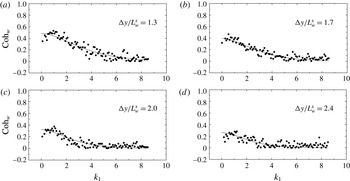
 $\unicode[STIX]{x1D712}_{L}(k_{1},k_{2})$
, which was defined as the two-dimensional Fourier transform of the indicial admittance
 $h(t,y)$
. Such a 3D spectral model can better account for the three-dimensional nature of turbulence with respect to the spanwise direction of a finite aerofoil. A more general admittance model was proposed by Ribner (Reference Ribner1956) using the three-wavenumber spectral tensor. Based on lifting-surface theory, a 3D AAF described by two wavenumbers, chordwise and spanwise, was developed to theoretically study the unsteady lift on a thin aerofoil in a two-dimensional sinusoidal flow field (Filotas Reference Filotas1969a
,Reference Filotas
b
; Graham Reference Graham1970, Reference Graham1971). Graham’s 3D AAF was experimentally validated by Jackson, Graham & Maull (Reference Jackson, Graham and Maull1973) indirectly. In a previous paper (Li et al.
Reference Li, Li and Liao2015), we developed a general approach numerically determining the two-wavenumber spectrum and admittance of the lift on a thin aerofoil in grid-generated turbulence, which is highly accurate compared with Sears’ and Graham’s theoretical results. It should be noted that the above-mentioned approach can be applied to bluff bodies with complex cross-sectional shapes. In the present paper, we extend this work from a numerical solution to an analytical solution, following Ribner’s three-dimensional theory.
Because of the complex separation of flow, it is known that potential theory certainly fails to account for the spatial characteristics of lift on bluff bodies, such as rectangular cylinders and streamlined bridge decks. This problem is a classic one that has attracted considerable attention. In previous studies, empirical spectral models of the lift were proposed in terms of the generalized one-wavenumber admittance and the coherence of the lift based on experimental investigations. In contrast with the 3D AAF, the generalized one-wavenumber admittance is unable to describe the effects of spanwise variations of turbulence on the spatial lift distribution on bluff bodies. In addition, while a series of empirical coherence models were obtained, the nature of the coherent structure of the lift remained unclear as these models were developed simply by modifying the turbulence models proposed by Davenport (Reference Davenport1962) in a simple exponential form or those proposed by Roberts & Surry (Reference Roberts and Surry1973) and Irwin (Reference Irwin1977) in terms of Bessel functions. Therefore, it is necessary to present an approximate closed solution for the spatial lift distribution, including coherence and admittances, to explicitly interpret the three-dimensional effects of the turbulence. Generally, we know that body-induced vortex shedding may affect the flow separation and coherence of lift within a certain frequency band (frequency of Kármán vortex street). Moreover, the spectral and coherence proposed herein do not take this effect into consideration. This simplification is acceptable from the viewpoint of calculating the buffeting response, because the frequency of the vortex shedding is usually much higher than the natural frequency of the line-like structures encountered in practical engineering.
The aim of the present work is to propose a generalized approach based on Ribner’s three-dimensional theory, yielding closed-form expressions for the coherence and admittances of lift on rectangular cylinders in turbulent flow. Three steps are required in such an approach. In the first step, a more tractable coherence model must be derived in Fourier space by parametrizing the coherence of the lift in terms of the coherence of the 3D AAF and vertical velocity fluctuations. The second step is to present closed-form expressions of lift admittances using the proposed coherence model, after which the three-dimensional effects of the turbulent flow can be studied by means of a second-order spectral tensor method. The third step is to mathematically quantify the effects of the decay parameters of the 3D AAF and vertical velocity fluctuations on the spanwise correlation of lift. The model developed in the present paper can be used to describe the spatial distribution of lift on line-like structures with bluff cross-section shapes in turbulent flow. Using a series of wind tunnel tests, these models have been validated and thus allow us to investigate the spatial correlation of lift on bodies in turbulent flow from an energy-transition point of view.
2 Mathematical model
In this section, the model that describes the lift coherence on an aerofoil is derived theoretically using Ribner’s three-dimensional theory outlined in § 2.1. The model can be extended to rectangular cylinders by defining three constant coefficients in the decay parameter of the 3D AAF, as described in § 2.2.1. In § 2.2.2, a closure method for obtaining approximate expressions of the admittances is proposed using the proposed coherence model. In § 2.3, the effects of the decay parameters (corresponding to vertical velocity fluctuations and 3D AAF) on the spanwise correlation of the lift force are studied in detail.
2.1 Theoretical coherence model of the lift force on a thin aerofoil
The coordinate system features an
 $x$
-axis in the direction of the mean wind
 $U$
, a
 $y$
-axis along the span of the body, and a
 $z$
-axis perpendicular to the other two axes.

The three-dimensional spectral tensor model proposed by Ribner (Reference Ribner1956) is reviewed for the sake of clarity, which is defined as
 $$\begin{eqnarray}\displaystyle S_{L}(\boldsymbol{k})=(\unicode[STIX]{x1D70C}UbC_{L}^{\prime })^{2}|\unicode[STIX]{x1D712}_{L}(\boldsymbol{k})|^{2}S_{w}(\boldsymbol{k}), & & \displaystyle\end{eqnarray}$$
where
 $\unicode[STIX]{x1D70C}$
,
 $U$
,
 $b$
and
 $C_{L}^{\prime }$
are, respectively, the air density, mean wind velocity, the semi-chord length of aerofoil and the lift slope,
 $\boldsymbol{k}$
is a wavevector with three components
 $k_{1}$
,
 $k_{2}$
and
 $k_{3}$
as the wavenumbers in the
 $x$
,
 $y$
and
 $z$
directions, respectively (see figure 1),
 $k_{i}=n_{i}/U$
(
 $n_{i}$
is frequency),
 $|\unicode[STIX]{x1D712}_{L}(\boldsymbol{k})|^{2}$
is the three-wavenumber aerodynamic admittance, and
 $S_{w}(\boldsymbol{k})$
is the three-wavenumber spectrum of vertical velocity fluctuations (see § A.1).
The present study focuses on investigating the lift coherence on bodies whose geometrical dimensions in the
 $z$
direction are far smaller than those in the other two directions, such as aerofoils, flat plates and long span bridge decks. In this case, the lift force on the body is sensitive only to the turbulence pattern in the (
 $x,y$
) plane (Jackson et al.
Reference Jackson, Graham and Maull1973). Hence,
 $k_{3}$
can be integrated out in (2.1), resulting in a reduction to two dimensions: the (
 $x,y$
) plane (Ribner Reference Ribner1956). The method for obtaining the cross-spectrum of the lift on an aerofoil is described in detail in § A.2, which is given by
 $$\begin{eqnarray}\displaystyle S_{L}(k_{1},\unicode[STIX]{x0394}y)=(\unicode[STIX]{x1D70C}UbC_{L}^{\prime })^{2}[|\unicode[STIX]{x1D712}_{L}(k_{1},\unicode[STIX]{x0394}y)|^{2}\otimes \text{Coh}_{w}(k_{1},\unicode[STIX]{x0394}y)]S_{w}(k_{1}), & & \displaystyle\end{eqnarray}$$
where
 $|\unicode[STIX]{x1D712}_{L}(k_{1},\unicode[STIX]{x0394}y)|^{2}$
is defined as the cross-3D admittance, and
 $\text{Coh}_{w}(k_{1},\unicode[STIX]{x0394}y)$
and
 $S_{w}(k_{1})$
correspond to the coherence and one-point spectrum of the vertical velocity fluctuations, respectively. The cross-3D admittance
 $|\unicode[STIX]{x1D712}_{L}(k_{1},\unicode[STIX]{x0394}y)|^{2}$
can be obtained by using the inverse Fourier transform of Graham’s two-wavenumber aerodynamic admittance (Graham Reference Graham1970, Reference Graham1971). However, Graham’s function is a numerical solution. Therefore, it is difficult to apply to derive the closed solution for
 $|\unicode[STIX]{x1D712}_{L}(k_{1},\unicode[STIX]{x0394}y)|^{2}$
. Instead, the approximate formulae for the 3D AAF of lift on a thin aerofoil are presented as correction factors to Sears’ function (Mugridge Reference Mugridge1970, Reference Mugridge1971; Blake Reference Blake, Frenkiel and Temple1986) in §§ B.1 and B.2. By defining the coherence of 3D AAF
 $\text{Coh}_{\unicode[STIX]{x1D712}_{L}}(k_{1},\unicode[STIX]{x0394}y)$
, the approximate expression for
 $|\unicode[STIX]{x1D712}_{L}(k_{1},\unicode[STIX]{x0394}y)|^{2}$
is as indicated in § B.3.
With respect to
 $\text{Coh}_{w}(k_{1},\unicode[STIX]{x0394}y)$
, Irwin (Reference Irwin1977) proposed a theoretical model for homogeneous isotropic turbulence based on the von Kármán spectrum. However, Irwin’s coherence model is represented in terms of Bessel functions, which can hardly be applied to derive the closed-form expression of
 $S_{L}(k_{1},\unicode[STIX]{x0394}y)$
in (2.2). The modified exponential coherence model proposed by Jakobsen (Reference Jakobsen1997) is more feasible. However, because of its dimension-dependent feature, Jakobsen’s empirical model is also limiting. By non-dimensionalizing this expression, the improved formula is as presented in appendix C.
Substituting (B 5)–(B 6) and (C 1)–(C 2) into (2.2), the closed-form expression of
 $S_{L}(k_{1},\unicode[STIX]{x0394}y)$
, considering the three-dimensionality of the turbulence, can be derived mathematically via a convolution operation:
 $$\begin{eqnarray}\displaystyle S_{L}(k_{1},\unicode[STIX]{x0394}y) & = & \displaystyle (\unicode[STIX]{x1D70C}UbC_{L}^{\prime })^{2}\left[\int _{-\infty }^{\infty }|\unicode[STIX]{x1D712}_{L}(k_{1},\unicode[STIX]{x1D70F})|^{2}\,\text{Coh}_{w}(k_{1},\unicode[STIX]{x0394}y-\unicode[STIX]{x1D70F})\,\text{d}\unicode[STIX]{x1D70F}\right]S_{w}(k_{1})\nonumber\\ \displaystyle & = & \displaystyle (\unicode[STIX]{x1D70C}UbC_{L}^{\prime })^{2}\unicode[STIX]{x1D6F9}_{L}(k_{1},\unicode[STIX]{x0394}y)S_{w}(k_{1}),\end{eqnarray}$$
where
 $$\begin{eqnarray}\displaystyle \unicode[STIX]{x1D6F9}_{L}(k_{1},\unicode[STIX]{x0394}y)=\frac{1}{1+2\unicode[STIX]{x03C0}\tilde{k}_{1}}\left[\frac{\unicode[STIX]{x1D706}_{L}^{2}\exp (-2\unicode[STIX]{x03C0}A_{w}\unicode[STIX]{x0394}y)-\unicode[STIX]{x1D706}_{L}A_{w}\exp (-2\unicode[STIX]{x03C0}\unicode[STIX]{x1D706}_{L}\unicode[STIX]{x0394}y)}{\unicode[STIX]{x1D706}_{L}^{2}-A_{w}^{2}}\right] & & \displaystyle\end{eqnarray}$$
and
 $\unicode[STIX]{x1D6F9}_{L}(k_{1},\unicode[STIX]{x0394}y)$
is defined as the equivalent coherence of the lift force, which can be used to describe the effects of three-dimensional turbulence and 3D AAF on the spatial distribution of the lift force on a thin aerofoil,
 $\unicode[STIX]{x1D706}_{L}$
and
 $A_{w}$
are the decay parameters corresponding to the coherence of the 3D AAF and vertical velocity fluctuations, respectively. If we set
 $\unicode[STIX]{x0394}y=0$
, the one-point spectrum of the lift can be derived from (2.3)–(2.4) as
 $$\begin{eqnarray}\displaystyle S_{L}(k_{1})=(\unicode[STIX]{x1D70C}UbC_{L}^{\prime })^{2}|\unicode[STIX]{x1D712}_{L}(k_{1})|^{2}S_{w}(k_{1}), & & \displaystyle\end{eqnarray}$$
where
 $|\unicode[STIX]{x1D712}_{L}(k_{1})|^{2}$
is the generalized one-wavenumber admittance in terms of the two-dimensional aerodynamic admittance and the spanwise correction factor in (B 1), defined by
 $$\begin{eqnarray}\displaystyle |\unicode[STIX]{x1D712}_{L}(k_{1})|^{2}=\underbrace{\frac{1}{1+2\unicode[STIX]{x03C0}\tilde{k}_{1}}}_{Sears^{\prime }\;fun.}\underbrace{|F_{L}(k_{1})|^{2}}_{correction\;fac.}, & & \displaystyle\end{eqnarray}$$
with
 $$\begin{eqnarray}\displaystyle |F_{L}(k_{1})|^{2}=\frac{\unicode[STIX]{x1D706}_{L}}{\unicode[STIX]{x1D706}_{L}+A_{w}} & & \displaystyle\end{eqnarray}$$
is the one-dimensional correction factor of
 $|\unicode[STIX]{x1D712}_{L}(k_{1})|^{2}$
. The validation of the proposed closed-form expression of the cross-spectrum of the lift is presented in detail in appendix D.
The coherence of the lift force on a thin aerofoil is defined as
 $$\begin{eqnarray}\displaystyle \text{Coh}_{L}(k_{1},\unicode[STIX]{x0394}y)=\frac{S_{L}(k_{1},\unicode[STIX]{x0394}y)}{S_{L}(k_{1})}. & & \displaystyle\end{eqnarray}$$
Substituting (2.3)–(2.7) into (2.8), the closed-form expression of the lift coherence is given by
 $$\begin{eqnarray}\displaystyle \text{Coh}_{L}(k_{1},\unicode[STIX]{x0394}y)=\frac{\unicode[STIX]{x1D706}_{L}\exp (-2\unicode[STIX]{x03C0}A_{w}\unicode[STIX]{x0394}y)-A_{w}\exp (-2\unicode[STIX]{x03C0}\unicode[STIX]{x1D706}_{L}\unicode[STIX]{x0394}y)}{\unicode[STIX]{x1D706}_{L}-A_{w}}. & & \displaystyle\end{eqnarray}$$
Compared with previous coherence models (Hjorth-Hansen et al.
Reference Hjorth-Hansen, Jakobsen and Strømmen1992; Jakobsen Reference Jakobsen1997; Kimura et al.
Reference Kimura, Fujino, Nakato and Tamura1997; Larose & Mann Reference Larose and Mann1998), the proposed expression is of physical significance and can describe the coherent structure of the lift along the
 $y$
direction. Interestingly, equation (2.9) indicates that the spanwise correlation of the lift on a thin aerofoil is closely associated with that of the vertical velocity fluctuations and 3D AAF together. We can therefore quantitatively analyse the effects of the cross-sectional shapes of bodies and the three-dimensionality of turbulence on the spanwise correlation of the lift force (see § 2.3). The two-wavenumber coherence of the lift force can be obtained by taking the Fourier transform of (2.9), which yields
 $$\begin{eqnarray}\displaystyle \unicode[STIX]{x1D6F7}_{L}(k_{1},k_{2})=\frac{1}{\unicode[STIX]{x03C0}}\frac{\unicode[STIX]{x1D706}_{L}A_{w}(\unicode[STIX]{x1D706}_{L}+A_{w})}{(\unicode[STIX]{x1D706}_{L}^{2}+k_{2}^{2})(A_{w}^{2}+k_{2}^{2})}. & & \displaystyle\end{eqnarray}$$
Substituting (2.5)–(2.7) into (2.8), the cross-spectrum of the lift force can be expressed as
 $$\begin{eqnarray}\displaystyle S_{L}(k_{1},\unicode[STIX]{x0394}y)=(\unicode[STIX]{x1D70C}UbC_{L}^{\prime })^{2}|\unicode[STIX]{x1D712}_{L}(k_{1})|^{2}S_{w}(k_{1})\,\text{Coh}_{L}(k_{1},\unicode[STIX]{x0394}y). & & \displaystyle\end{eqnarray}$$
It should be noted that (2.11) is consistent with the gust-loading model proposed by Larose & Mann (Reference Larose and Mann1998). By comparing (2.3) with (2.11), the following relation can be obtained:
 $$\begin{eqnarray}\displaystyle \unicode[STIX]{x1D6F9}_{L}(k_{1},\unicode[STIX]{x0394}y)=|\unicode[STIX]{x1D712}_{L}(k_{1})|^{2}\,\text{Coh}_{L}(k_{1},\unicode[STIX]{x0394}y). & & \displaystyle\end{eqnarray}$$
As shown in (2.12), it is clear that the equivalent coherence of the lift can be expressed in terms of the generalized one-wavenumber admittance and the coherence of the lift force.
2.2 Closed solution for the 3D AAF of a rectangular cylinder
In this section, extensions of the presented lift coherence model to bluff bodies are made to quantitatively study the effects of three-dimensional flow (see § 2.3). We propose a general approach for obtaining the closed solution of the 3D AAF based on Ribner’s three-dimensional theory.
2.2.1 Extension of the proposed coherence model to a rectangular cylinder
Despite its simple geometry, the three-dimensional flow over an elongated rectangular cylinder is highly complex because of the unsteady flow separation and reattachment that result in the three-dimensional spatial distribution of the unsteady lift force. Moreover, the structures with a rectangular cross-section are widely used in engineering. Thus, a rectangular cylinder is taken as the typical representation of a bluff body in the present paper. In this case, Graham’s 3D AAF is certainly invalid because of the effects of flow separation and reattachment. Hence, the proposed coherence model cannot be applied directly. However, equation (2.9) is still of interest in investigating the coherent structure of the lift along the span, noting that the spanwise correlation of lift is mainly determined by the decay parameters of the 3D AAF and vertical velocity fluctuations. In fact, similarly to the spanwise distribution of the lift on a thin aerofoil, that of the lift on a slender body depends on the cross-sectional shape (associated with 3D AAF) and the spatial variations of the vertical velocity fluctuations. Therefore, for a given turbulent flow field, it is reasonable to assume that the double-exponential function (2.9) can be applied to describe the spanwise correlation of lift on a rectangular cylinder by appropriately modifying the decay parameter of the 3D AAF,
 $\unicode[STIX]{x1D706}_{L}^{r}$
. Thus, according to Mugridge’s or Blake’s expression, the present coherence model can be adjusted by defining
 $\unicode[STIX]{x1D706}_{L}^{r}$
as a function of three floating parameters as follows:
 $$\begin{eqnarray}\displaystyle \text{Coh}_{L}^{r}(k_{1},\unicode[STIX]{x0394}y)=\frac{\unicode[STIX]{x1D706}_{L}^{r}\exp (-2\unicode[STIX]{x03C0}A_{w}\unicode[STIX]{x0394}y)-A_{w}\exp (-2\unicode[STIX]{x03C0}\unicode[STIX]{x1D706}_{L}^{r}\unicode[STIX]{x0394}y)}{\unicode[STIX]{x1D706}_{L}^{r}-A_{w}}, & & \displaystyle\end{eqnarray}$$
with
 $$\begin{eqnarray}\displaystyle \unicode[STIX]{x1D706}_{L}^{r}=\sqrt{a_{1}(2\unicode[STIX]{x03C0}bk_{1})^{a_{2}}+a_{3}}/(2\unicode[STIX]{x03C0}b), & & \displaystyle\end{eqnarray}$$
where
 $a_{1}$
,
 $a_{2}$
and
 $a_{3}$
are floating parameters that must be determined by wind tunnel tests. It should be noted that the coherence of the vertical velocity fluctuations is still described by Jakobsen’s empirical model. In addition, the Fourier transform of (2.13) is simply a modified version of (2.9), replacing
 $\unicode[STIX]{x1D706}_{L}$
with
 $\unicode[STIX]{x1D706}_{L}^{r}$
.
2.2.2 Closed-form expressions of admittances
To obtain a closed-form expression for the three-dimensional aerodynamic admittance of lift on a rectangular cylinder, Ribner’s theory can be applied. The derivation procedure involves the following four steps:
(i) Definition of the spectral model of the lift. The three-dimensional spectrum of the lift acting on a rectangular cylinder should be defined first. This study adopts the following two-wavenumber spectral model proposed by Li et al. (Reference Li, Li and Liao2015):
 $$\begin{eqnarray}\displaystyle S_{L}(k_{1},k_{2})=(\unicode[STIX]{x1D70C}Ub)^{2}|\unicode[STIX]{x1D712}_{L}^{r}(k_{1},k_{2})|^{2}[4C_{L}^{2}S_{u}(k_{1},k_{2})+(C_{L}^{\prime }+C_{D})^{2}S_{w}(k_{1},k_{2})], & & \displaystyle\end{eqnarray}$$
where
 $C_{L}$
and
 $C_{D}$
are the lift and drag coefficients respectively,
 $S_{u}(k_{1},k_{2})$
is the two-wavenumber spectrum of longitudinal velocity fluctuations, and
 $|\unicode[STIX]{x1D712}_{L}^{r}(k_{1},k_{2})|^{2}$
is the 3D AAF. For simplicity, the contribution of the longitudinal velocity fluctuations to the lift on a rectangular cylinder can be neglected when the angle of attack of the incoming flow is zero. The equation (2.15) can thus be reduced to
 $$\begin{eqnarray}\displaystyle S_{L}(k_{1},k_{2})=(\unicode[STIX]{x1D70C}Ub)^{2}(C_{L}^{\prime }+C_{D})^{2}|\unicode[STIX]{x1D712}_{L}^{r}(k_{1},k_{2})|^{2}\unicode[STIX]{x1D6F7}_{w}(k_{1},k_{2})S_{w}(k_{1}). & & \displaystyle\end{eqnarray}$$
Therefore, the one-point spectrum of the lift can be obtained by integrating (2.16) over
 $k_{2}$
(see (D 1)). We thus have
 $$\begin{eqnarray}\displaystyle S_{L}(k_{1})=(\unicode[STIX]{x1D70C}Ub)^{2}(C_{L}^{\prime }+C_{D})^{2}|\unicode[STIX]{x1D712}_{L}^{r}(k_{1})|^{2}S_{w}(k_{1}), & & \displaystyle\end{eqnarray}$$
where
 $$\begin{eqnarray}\displaystyle |\unicode[STIX]{x1D712}_{L}^{r}(k_{1})|^{2}=\int _{-\infty }^{\infty }|\unicode[STIX]{x1D712}_{L}^{r}(k_{1},k_{2})|^{2}\unicode[STIX]{x1D6F7}_{w}(k_{1},k_{2})\,\text{d}k_{2}. & & \displaystyle\end{eqnarray}$$
Taking the Fourier transform of (2.8) and combining it with (2.17), the two-wavenumber spectrum of the lift can be rewritten as
 $$\begin{eqnarray}\displaystyle S_{L}(k_{1},k_{2})=(\unicode[STIX]{x1D70C}Ub)^{2}(C_{L}^{\prime }+C_{D})^{2}|\unicode[STIX]{x1D712}_{L}^{r}(k_{1})|^{2}\unicode[STIX]{x1D6F7}_{L}(k_{1},k_{2})S_{w}(k_{1}). & & \displaystyle\end{eqnarray}$$
By comparing (2.16) with (2.19), the following relation can be obtained
 $$\begin{eqnarray}\displaystyle \frac{|\unicode[STIX]{x1D712}_{L}^{r}(k_{1},k_{2})|^{2}}{|\unicode[STIX]{x1D712}_{L}^{r}(k_{1})|^{2}}=\frac{\unicode[STIX]{x1D6F7}_{L}(k_{1},k_{2})}{\unicode[STIX]{x1D6F7}_{w}(k_{1},k_{2})}. & & \displaystyle\end{eqnarray}$$
The relation described by (2.20) demonstrates the dependence of the admittances, including
 $|\unicode[STIX]{x1D712}_{L}^{r}(k_{1},k_{2})|^{2}$
and
 $|\unicode[STIX]{x1D712}_{L}^{r}(k_{1})|^{2}$
, on the spatial correlation of the lift and vertical velocity fluctuations. This relation will play an important role in the following derivation processes.
(ii) Definition of 3D AAD and generalized one-wavenumber admittance. Similarly to the thin aerofoil case, Li (Reference Li2015) found that the admittance of the lift on a bluff body in two-dimensional flow (2D AAF),
 $|\unicode[STIX]{x1D712}_{L}^{r}(k_{1},0)|^{2}$
, is a function of the reduced frequency
 $\tilde{k}_{1}(=2\unicode[STIX]{x03C0}k_{1}b)$
, known as Sears’ function, and depends only on the cross-sectional shape. In analogy with (B 1), we therefore propose an approximate expression for formulating the 3D AAF of lift on a rectangular cylinder as follows:
 $$\begin{eqnarray}\displaystyle |\unicode[STIX]{x1D712}_{L}^{r}(k_{1},k_{2})|^{2}=|\unicode[STIX]{x1D712}_{L}^{r}(k_{1},0)|^{2}|F_{L}^{r}(k_{1},k_{2})|^{2}, & & \displaystyle\end{eqnarray}$$
where
 $|F_{L}^{r}(k_{1},k_{2})|^{2}$
is the correction factor to the two-dimensional admittance
 $|\unicode[STIX]{x1D712}_{L}^{r}(k_{1},0)|^{2}$
. It should be noted that (2.21) will be reduced to 2D AAF for transversely fully correlated gusts (when
 $k_{2}=0$
). In this case, the correction factor
 $|F_{L}^{r}(k_{1},k_{2})|^{2}$
at
 $k_{2}=0$
satisfies
 $$\begin{eqnarray}\displaystyle |F_{L}^{r}(k_{1},0)|^{2}\equiv 1. & & \displaystyle\end{eqnarray}$$
Substituting (2.21) into (2.18) results in the following generalized one-wavenumber admittance
 $$\begin{eqnarray}\displaystyle |\unicode[STIX]{x1D712}_{L}^{r}(k_{1})|^{2}=|\unicode[STIX]{x1D712}_{L}^{r}(k_{1},0)|^{2}|F_{L}^{r}(k_{1})|^{2}, & & \displaystyle\end{eqnarray}$$
where
 $|F_{L}^{r}(k_{1})|^{2}$
represents the correction factor defined by
 $$\begin{eqnarray}\displaystyle |F_{L}^{r}(k_{1})|^{2}=\int _{-\infty }^{\infty }|F_{L}^{r}(k_{1},k_{2})|^{2}\unicode[STIX]{x1D6F7}_{w}(k_{1},k_{2})\,\text{d}k_{2}. & & \displaystyle\end{eqnarray}$$
Similarly, the generalized one-wavenumber admittance can also be represented as a correction factor to the 2D AAF as shown in (2.21).
(iii) Theoretical derivation of
 $|F_{L}^{r}(k_{1})|^{2}$
. Substituting (2.21) and (2.23) into (2.20), the following relation can be obtained:
 $$\begin{eqnarray}\displaystyle |F_{L}^{r}(k_{1},k_{2})|^{2}\unicode[STIX]{x1D6F7}_{w}(k_{1},k_{2})=|F_{L}^{r}(k_{1})|^{2}\unicode[STIX]{x1D6F7}_{L}(k_{1},k_{2}). & & \displaystyle\end{eqnarray}$$
Given that
 $k_{2}=0$
and using (2.22), the correction factor of the generalized one-wavenumber admittance is given by
 $$\begin{eqnarray}\displaystyle |F_{L}^{r}(k_{1})|^{2}=\frac{\unicode[STIX]{x1D6F7}_{w}(k_{1},0)}{\unicode[STIX]{x1D6F7}_{L}(k_{1},0)}. & & \displaystyle\end{eqnarray}$$
Substituting (C 3) and (2.10) into (2.26), the closed-form expression of
 $|F_{L}^{r}(k_{1})|^{2}$
is
 $$\begin{eqnarray}\displaystyle |F_{L}^{r}(k_{1})|^{2}=\frac{\unicode[STIX]{x1D706}_{L}^{r}}{\unicode[STIX]{x1D706}_{L}^{r}+A_{w}}. & & \displaystyle\end{eqnarray}$$
(iv) Theoretical derivation of
 $|F_{L}^{r}(k_{1},k_{2})|^{2}$
. Substituting (C 3), (2.10) and (2.27) into (2.25), the closed-form expression of
 $|F_{L}^{r}(k_{1},k_{2})|^{2}$
is given by
 $$\begin{eqnarray}\displaystyle |F_{L}^{r}(k_{1},k_{2})|^{2}=\frac{(\unicode[STIX]{x1D706}_{L}^{r})^{2}}{(\unicode[STIX]{x1D706}_{L}^{r})^{2}+k_{2}^{2}}. & & \displaystyle\end{eqnarray}$$
By contrast, equation (2.28) has the same mathematical form as (B 2). Given
 $k_{2}=0$
, equation (2.28) also satisfies the relation (2.22). This result validates the presented closed-form solution for admittances. Therefore, provided that the empirical coherence model of the lift is determined, the generalized one-wavenumber admittance and 3D AAF can be conveniently derived using the proposed procedure. It should be noted that the accuracy of the proposed approach mainly depends on the empirical coherence model. The approach proposed herein is still valid when the coherence model is replaced by others, e.g. Kimura’s model.
2.3 Effects of the decay parameters on the spanwise correlation of lift
The spatial correlation of the lift on two different spanwise strips can be explored using the cross-correlation coefficient, which is given by
 $$\begin{eqnarray}\displaystyle R_{L}(\unicode[STIX]{x0394}x,\unicode[STIX]{x0394}y)=\frac{\overline{L_{1}(x,y)L_{2}(x+\unicode[STIX]{x0394}x,y+\unicode[STIX]{x0394}y)}}{\tilde{L}_{1}\tilde{L}_{2}}, & & \displaystyle\end{eqnarray}$$
where
 $L_{1}$
and
 $L_{2}$
represent the lift at strips 1 and 2 respectively, the overbar denotes an ensemble average,
 $\unicode[STIX]{x0394}x=U\unicode[STIX]{x0394}t$
using Taylor’s hypothesis, and
 $\unicode[STIX]{x0394}y$
is the spanwise separation between two strips defined in figure 1. The quantities
 $\tilde{L}_{1}$
and
 $\tilde{L}_{2}$
are the standard deviations of
 $L_{1}(x,y)$
and
 $L_{2}(x+\unicode[STIX]{x0394}x,y+\unicode[STIX]{x0394}y)$
, respectively. Generally, the size of the separation bubble plays an important role in determining the spatial correlation of the lift when the spanwise separation between two strips is not excessively large (Cherry, Hiller & Latour Reference Cherry, Hiller and Latour1984; Kiya & Sasaki Reference Kiya and Sasaki1985). On the other hand, the effect of vortex shedding in separated flow should be emphasized instead of the large-scale vortices in the separation bubble when the separation is beyond the mean reattachment length, as the spatial correlation of the resulting smaller-scale vortices decreases rapidly as the spanwise separation increases. However, equation (2.29) can hardly account for this physical property, clearly because of the missing wavelength information of the vortices in the correlation coefficient due to the integration operation. By contrast, the spatial correlation defined by coherence allows us to clearly study the contribution of the vortices with different wavelengths.
In this section, the spanwise correlation of the lift is compared with that of the vertical velocity fluctuations to mathematically study the three-dimensional effects of turbulent flow, i.e. using the difference between the proposed coherence model for lift (2.13) and Jakobsen’s model for the
 $w$
component (see appendix C). In the following section, we take a two-step quantitative approach to this issue:
(i) The sign of
 $\unicode[STIX]{x1D6E5}_{Coh}$
. Assuming that
 $A_{w}\neq \unicode[STIX]{x1D706}_{L}$
, the difference between the coherence of the lift force and
 $w$
component, is defined as
 $$\begin{eqnarray}\displaystyle \unicode[STIX]{x1D6E5}_{Coh}=\text{Coh}_{L}-\text{Coh}_{w}. & & \displaystyle\end{eqnarray}$$
By subtracting (C 1) from (2.9) (or (2.13)), we obtain
 $$\begin{eqnarray}\displaystyle \unicode[STIX]{x1D6E5}_{Coh}=\frac{A_{w}[\exp (-2\unicode[STIX]{x03C0}A_{w}\unicode[STIX]{x0394}y)-\exp (-2\unicode[STIX]{x03C0}\unicode[STIX]{x1D706}_{L}\unicode[STIX]{x0394}y)]}{\unicode[STIX]{x1D706}_{L}-A_{w}}. & & \displaystyle\end{eqnarray}$$
The special case is to let
 $A_{w}\rightarrow \unicode[STIX]{x1D706}_{L}$
, whereby the limitation of (2.31) can be obtained by using L’Hopital’s rule
 $$\begin{eqnarray}\displaystyle \unicode[STIX]{x1D6E5}_{Coh}|_{A_{w}\rightarrow \unicode[STIX]{x1D706}_{L}}=2\unicode[STIX]{x03C0}\unicode[STIX]{x1D706}_{L}\unicode[STIX]{x0394}y\exp (-2\unicode[STIX]{x03C0}\unicode[STIX]{x1D706}_{L}\unicode[STIX]{x0394}y). & & \displaystyle\end{eqnarray}$$
The effects of three-dimensional turbulence depend on the sign of
 $\unicode[STIX]{x1D6E5}_{Coh}$
, which is analysed based on the following three cases:
-
(1) Case 1:
 $0<\unicode[STIX]{x0394}y<\infty$
. Case 1 represents an aerofoil or rectangular cylinder with a finite span. In this case, the difference
$\unicode[STIX]{x1D6E5}_{Coh}$
in both (2.31) and (2.32) remains positive. This result indicates that the lift on line-like structures with a finite span is more strongly correlated than the vertical velocity fluctuations, due to the three-dimensional effects of turbulence. Thus, we mathematically interpret the phenomenon observed in previous wind tunnel tests, which may be an intrinsic property of the coherence of lift on an elongated body.
-
(2) Case 2:
$\unicode[STIX]{x0394}y=0$
. Case 2 represents an aerofoil or rectangular cylinder with an infinitesimal span, which can be regarded as the two-dimensional cross-section of a body passing through transversely fully correlated turbulence (Fung Reference Fung and Fung1969). In this case, the difference
$\unicode[STIX]{x1D6E5}_{Coh}$
becomes zero regardless of the decay parameters. This result implies that the spatial correlation of the gusts can be considered representative of that of the lift, which is essentially the strip assumption (Fung Reference Fung and Fung1969). -
(3) Case 3:
$\unicode[STIX]{x0394}y=\infty$
. Case 3 represents an aerofoil or rectangular cylinder with an infinite span. Thus, the solution to (2.31) can be easily obtained by calculating the limitation of
$\unicode[STIX]{x1D6E5}_{Coh}$
using L’Hopital’s rule, which yields (2.33)When
$$\begin{eqnarray}\displaystyle \underset{\unicode[STIX]{x0394}y\rightarrow \infty }{\text{Lim}}\unicode[STIX]{x1D6E5}_{Coh}|_{A_{w}\rightarrow \unicode[STIX]{x1D706}_{L}}=\underset{\unicode[STIX]{x0394}y\rightarrow \infty }{\text{Lim}}\frac{1}{\exp (2\unicode[STIX]{x03C0}\unicode[STIX]{x1D706}_{L}\unicode[STIX]{x0394}y)}. & & \displaystyle\end{eqnarray}$$
$\unicode[STIX]{x0394}y\rightarrow \infty$
, both (2.32) and (2.33) become zero. This solution is reasonable, because the correlation of the lift or vertical velocity fluctuations vanishes when the spanwise separation is sufficiently large.


Similarly, it can be proved that the lift on an aerofoil or rectangular cylinder is more strongly correlated than the 3D AAF defined by (B 6) based on the above-mentioned procedure. Massaro & Graham (Reference Massaro and Graham2015) studied the spanwise correlation of lift numerically by defining of the correlation length scale, and similar results were obtained. In contrast, it should be noted that a larger correlation length scale does not suggest that the spanwise correlation is also larger for arbitrary wavenumber
 $k$
according to Bracewell’s approach (Bracewell Reference Bracewell and Bracewell1978). This issue is further discussed from the experimental perspective in § 3.2.
(ii) The monotonic behaviour of
 $\unicode[STIX]{x1D6E5}_{Coh}$
. In step (i), the sign of
 $\unicode[STIX]{x1D6E5}_{Coh}$
is analysed, and the effects of the decay parameters must be further studied with respect to case 1, i.e. the finite span section (
 $0<\unicode[STIX]{x0394}y<\infty$
). According to the proposed coherence model (2.9) or (2.13), it should be noted that the decay parameters
 $\unicode[STIX]{x1D706}_{L}$
and
 $A_{w}$
, associated with the 3D AAF and
 $w$
component, respectively, primarily determine the coherence of the lift. Thus, the difference
 $\unicode[STIX]{x1D6E5}_{Coh}$
defined by (2.31) is applied to analyse the effects of the decay parameters on the spanwise correlation of the lift force. By defining
 $\unicode[STIX]{x1D706}_{L}=A_{w}+\unicode[STIX]{x1D6FF}$
(
 $\unicode[STIX]{x1D6FF}\in [-\infty ,\infty ]$
), equation (2.31) can be rewritten as
 $$\begin{eqnarray}\displaystyle \unicode[STIX]{x1D6E5}_{Coh}=\text{Coh}_{L}-\text{Coh}_{w}=\frac{\unicode[STIX]{x1D700}[1-\exp (-2\unicode[STIX]{x03C0}\unicode[STIX]{x1D6FF}\unicode[STIX]{x0394}y)]}{\unicode[STIX]{x1D6FF}}, & & \displaystyle\end{eqnarray}$$
with
 $$\begin{eqnarray}\displaystyle \unicode[STIX]{x1D700}=A_{w}\exp (-2\unicode[STIX]{x03C0}A_{w}\unicode[STIX]{x0394}y), & & \displaystyle\end{eqnarray}$$
where
 $\unicode[STIX]{x1D700}$
is a positive function associated with
 $A_{w}$
and
 $\unicode[STIX]{x0394}y$
. Therefore, the effects of the decay parameters are simply attributed to the monotonicity of
 $\unicode[STIX]{x1D6E5}_{Coh}(\unicode[STIX]{x1D6FF})$
. By using the derivation method, we have
 $$\begin{eqnarray}\displaystyle \frac{\text{d}\unicode[STIX]{x1D6E5}_{Coh}}{\text{d}\unicode[STIX]{x1D6FF}}=\frac{\unicode[STIX]{x1D700}[1-\exp (-2\unicode[STIX]{x03C0}\unicode[STIX]{x1D6FF}\unicode[STIX]{x0394}y)(1+2\unicode[STIX]{x03C0}\unicode[STIX]{x1D6FF}\unicode[STIX]{x0394}y)]}{-\unicode[STIX]{x1D6FF}^{2}}. & & \displaystyle\end{eqnarray}$$
When
 $\unicode[STIX]{x1D6FF}\rightarrow 0$
, the solution of (2.36) can be obtained by determining its limit according to L’Hopital’s rule, giving
 $$\begin{eqnarray}\displaystyle \underset{\unicode[STIX]{x1D6FF}\rightarrow 0}{\text{Lim}}\frac{\text{d}\unicode[STIX]{x1D6E5}_{Coh}}{\text{d}\unicode[STIX]{x1D6FF}} & = & \displaystyle \underset{\unicode[STIX]{x1D6FF}\rightarrow 0}{\text{Lim}}\frac{\unicode[STIX]{x1D700}(2\unicode[STIX]{x03C0}\unicode[STIX]{x0394}y)^{2}\unicode[STIX]{x1D6FF}\exp (-2\unicode[STIX]{x03C0}\unicode[STIX]{x1D6FF}\unicode[STIX]{x0394}y)}{-2\unicode[STIX]{x1D6FF}}\nonumber\\ \displaystyle & = & \displaystyle \underset{\unicode[STIX]{x1D6FF}\rightarrow 0}{\text{Lim}}\frac{\unicode[STIX]{x1D700}(2\unicode[STIX]{x03C0}\unicode[STIX]{x0394}y)^{2}[(1-2\unicode[STIX]{x03C0}\unicode[STIX]{x1D6FF}\unicode[STIX]{x0394}y)\exp (-2\unicode[STIX]{x03C0}\unicode[STIX]{x1D6FF}\unicode[STIX]{x0394}y)]}{-2}\nonumber\\ \displaystyle & = & \displaystyle \frac{\unicode[STIX]{x1D700}(2\unicode[STIX]{x03C0}\unicode[STIX]{x0394}y)^{2}}{-2}.\end{eqnarray}$$
In this case, the above-mentioned limit remains negative, which means that
 $\unicode[STIX]{x1D6E5}_{Coh}(\unicode[STIX]{x1D6FF})$
is monotonically decreasing, i.e. the smaller
 $\unicode[STIX]{x1D6FF}$
is, the larger the spanwise correlation of the lift becomes relative to that of
 $w$
.
When
 $\unicode[STIX]{x1D6FF}\neq 0$
, the monotonic behaviour of
 $\unicode[STIX]{x1D6E5}_{Coh}(\unicode[STIX]{x1D6FF})$
depends on the sign of the numerator in (2.36), defined by
 $$\begin{eqnarray}\displaystyle \unicode[STIX]{x1D719}=\unicode[STIX]{x1D700}[1-\exp (-2\unicode[STIX]{x03C0}\unicode[STIX]{x1D6FF}\unicode[STIX]{x0394}y)(1+2\unicode[STIX]{x03C0}\unicode[STIX]{x1D6FF}\unicode[STIX]{x0394}y)]. & & \displaystyle\end{eqnarray}$$
Thus, the derivative of
 $\unicode[STIX]{x1D719}$
is given by
 $$\begin{eqnarray}\displaystyle \frac{\text{d}\unicode[STIX]{x1D719}}{\text{d}\unicode[STIX]{x1D6FF}}=\unicode[STIX]{x1D700}(2\unicode[STIX]{x03C0}\unicode[STIX]{x0394}y)^{2}\unicode[STIX]{x1D6FF}\exp (-2\unicode[STIX]{x03C0}\unicode[STIX]{x1D6FF}\unicode[STIX]{x0394}y), & & \displaystyle\end{eqnarray}$$
which approaches zero when
 $\unicode[STIX]{x1D6FF}\rightarrow 0$
. It is clear that the sign of (2.39) depends only on
 $\unicode[STIX]{x1D6FF}$
. When
 $\unicode[STIX]{x1D6FF}<0$
, equation (2.39) is negative, and thus (2.36) is monotonically increasing, and
 $vice$
 $versa$
. This result implies that the three-dimensional effects of turbulence become more prominent as
 $\unicode[STIX]{x1D6FF}$
decreases over the entire frequency domain. Hence, using mathematical treatment, the effects of cross-sectional shape and three-dimensional flow on the spanwise correlation of the lift can be interpreted quantitatively in a clearer manner.
With respect to a given gust field, the above-mentioned analysis provides explicit insight into the physical phenomenon in which the lift on an aerofoil or other line-like structure becomes more strongly correlated with the increasing correlation of the 3D AAF. In addition, this enhancement depends on the difference
 $\unicode[STIX]{x1D6FF}$
between
 $\unicode[STIX]{x1D706}_{L}$
and
 $A_{w}$
. This theoretical derivation can be verified by the experimental investigation in the next section using three sectional models with different cross-sectional shapes.
3 Experimental investigation
Experiments were conducted in a wind tunnel with a 2.4 m (width)
 $\times$
2 m (height) working section (XNJD-1 wind tunnel). The tunnel is of the closed-circuit type and has a free-stream turbulence level of approximately 0.3 % and a top speed of
 $45~\text{m}~\text{s}^{-1}$
. A highly turbulent flow was generated by the installation of a uniform grid 4.2 m upstream of the model in the streamwise direction. The grid was constructed of bars of rectangular cross-section with a mesh size of 0.33 m
 $\times$
0.33 m and a bar size of 0.07 m. The turbulence parameters in three directions, shown in table 1, were measured simultaneously using Series 100 Cobra Probe, and the angle of attack of the incoming flow was zero in the experimental investigation.
Characteristics of grid-generated turbulence based on least-squares fit of the von Kármán spectrum.

To validate the presented spectral and coherence model, three sectional models were used. The model, with a NACA 0015 cross-section, was mounted normal to the flow to assess the validity of the double-exponent coherence model (2.9). The model was made of fibreglass, with several ribs to increase its stiffness and a chord length is 0.5 m. The 0.7 m long centre portion (action model) of the model was instrumented to measure the unsteady surface pressures on six strips along the span. Two 0.4 m long pseudomodels and end plates were installed at each end of the action model to ensure the two-dimensionality of the flow and to reduce end effects. Similarly, the other two models, with rectangular cross-sections of 0.2 m
 $\times$
0.1 m (aspect ratio:
 $B/D=2:1$
) and 0.4 m
 $\times$
0.1 m (aspect ratio:
 $B/D=4:1$
), were mainly used to investigate the effects of the decay parameters,
 $\unicode[STIX]{x1D706}_{L}^{r}$
and
 $A_{w}$
, on the spatial distribution of the lift force and the distortion of the free stream when turbulent flow passed through the models. It should be noted that the lengths of the two rectangular models, including the centre portions and pseudomodels, were consistent with those of the NACA 0015 model.
The dynamic force measurements were based on simultaneous measurements of surface pressures around six chordwise strips in the centre portion of the three models. The pressure distribution of each strip was measured using 50 pressure taps for the
 $B/D=2:1$
model and 60 pressure taps for the other two models. Six DMS 3400 pressure transducers were used to synchronously measure surface pressure fluctuations on those models. The transducers were mounted directly inside the models and connected to pressure tapings with PVC tubing with an internal diameter of 1.5 mm. Thus, the tube length could be kept to a minimum (0.2 m), ensuring a good frequency response up to 256 Hz. By integrating the surface pressures, the time-varying lift on each strip could be obtained for later spectral and coherence analyses. The contribution of skin-friction to the lift on the motionless models was not taken into account, because the angle of attack was zero and the surface was well polished to keep the roughness of those models low.
To facilitate the calculation of the 3D AAF, the sampling frequency of the Cobra Probe and pressure scanners was set to 256 Hz. The low-frequency eddies that carry most of the energy in turbulence were of primary interest (see figure 2). Therefore, the sampling rate used herein was sufficient to capture the major turbulence spectrum. Wind tunnel tests were typically conducted at a mean wind speed of
 $11.5~\text{m}~\text{s}^{-1}$
with the Reynolds number
 $Re$
ranging from
 $5.7\times 10^{4}$
to
 $7.7\times 10^{4}$
, where
 $Re=UD/\unicode[STIX]{x1D710}$
,
 $D$
is the height of the model, and
 $\unicode[STIX]{x1D710}$
is the kinematic viscosity.
3.1 The characteristics of grid-generated turbulence
Spectrum of the vertical wind fluctuations for grid turbulence (●). Solid line: fit of von Kármán spectrum using (3.1) with
 $\unicode[STIX]{x1D6FD}=1/3$
.

In wind tunnels, homogeneous turbulence can be approximately simulated by a square-mesh grid (Batchelor Reference Batchelor1959). Models based on the von Kármán spectrum can be applied in the present work, because they can describe grid-generated turbulence well (Roberts & Surry Reference Roberts and Surry1973; Larose & Mann Reference Larose and Mann1998; Li et al. Reference Li, Li and Liao2015). The one- and two-wavenumber spectra of the vertical velocity fluctuations proposed by Taylor (Reference Taylor and Taylor1965) are described by
 $$\begin{eqnarray}\displaystyle & \displaystyle S_{w}(k_{1})=\frac{2\unicode[STIX]{x1D70E}_{w}^{2}L_{u}^{x}[1+(8/3)(2\unicode[STIX]{x03C0}ak_{1})^{2}]}{[1+(2\unicode[STIX]{x03C0}ak_{1})]^{11/6}}, & \displaystyle\end{eqnarray}$$
 $$\begin{eqnarray}\displaystyle & \displaystyle S_{w}(k_{1},k_{2})=\frac{(128/9)\unicode[STIX]{x1D70E}_{w}^{2}\unicode[STIX]{x03C0}^{3}a^{4}(k_{1}^{2}+k_{2}^{2})}{[1+4\unicode[STIX]{x03C0}^{2}a^{2}(k_{1}^{2}+k_{2}^{2})]^{7/3}}, & \displaystyle\end{eqnarray}$$
with the parameter
 $a$
given by
 $$\begin{eqnarray}\displaystyle a=L_{u}^{x}[\sqrt{\unicode[STIX]{x03C0}}\unicode[STIX]{x0393}(\unicode[STIX]{x1D6FD}+{\textstyle \frac{1}{2}})/\unicode[STIX]{x0393}(\unicode[STIX]{x1D6FD})]^{-1}, & & \displaystyle\end{eqnarray}$$
where
 $\unicode[STIX]{x1D6FD}=1/3$
,
 $L_{u}^{x}$
is the longitudinal integral length scale of turbulence with
 $L_{u}^{x}=2L_{w}^{x}=2L_{v}^{x}$
for homogeneous isotropic turbulence,
 $\unicode[STIX]{x0393}(\unicode[STIX]{x1D6FD})$
is the Gamma function, and
 $\unicode[STIX]{x1D70E}_{w}$
is the root mean square (r.m.s.) of vertical velocity fluctuations.
To characterize the flow condition in the section model position, the one-wavenumber spectrum of the
 $w$
component is compared with the theoretical result (3.1) in figure 2. It is observed that the measured result corresponds particularly well with (3.1) as
 $\unicode[STIX]{x1D6FD}=1/3$
, as proposed by Taylor (Reference Taylor and Taylor1965), suggesting that the grid-generated flow field satisfies the assumption of homogeneity and isotropy. Moreover, the measured results confirm that the indirectly measured two-wavenumber spectrum of
 $w$
(3.2) is of high accuracy (Li et al.
Reference Li, Li and Liao2015). Table 1 presents the fitted results and summarizes the characteristics of the turbulence. Specifically, the integral length scales are obtained by fitting with the experimental spectrum using the von Kármán model (3.1). The result shows that
 $L_{u}^{x}$
is nearly double
 $L_{w}^{x}$
, which is consistent with the property of homogeneous isotropic turbulence. However, the property of isotropic turbulence that suggests that the variances
 $\unicode[STIX]{x1D70E}_{u}^{2}$
and
 $\unicode[STIX]{x1D70E}_{w}^{2}$
must be equal is not supported by data (Mann Reference Mann1994), including those obtained from the present experiments, which depend on the averaging time (usually approximately
 $10~\text{min}$
for meteorological measurements) and the effects of anisotropic component in the flow (Mann Reference Mann1994; Larose Reference Larose1997).
The coherence of homogeneous isotropic turbulence can be calculated analytically in terms of Bessel functions for the von Kármán spectrum (Irwin Reference Irwin1977). However, such a model is somewhat complex when used to analyse the effect of three-dimensional turbulence on the buffeting lift force. Instead, Jakobsen’s empirical model is adopted to provide the decay parameter
 $A_{w}$
for the proposed coherence models (2.9) and (2.13). Thus, the accuracy of Jakobsen’s model is assessed in figure 3 by comparison with the experimental results. The three parameters in
 $A_{w}$
can be determined using the nonlinear least-squares fit method and are presented in table 2.
It is clear that Jakobsen’s empirical coherence model generally agrees with the measured results, thus providing an accurate estimate of the decay parameter
 $A_{w}$
for the proposed coherence model.
3.2 The spatial distribution of lift force on rectangular cylinders
3.2.1 Validation of the proposed coherence model
To validate the proposed coherence model in § 2, an experimental investigation of the NACA 0015 model is performed. The lift forces on the chordwise strips were obtained based on simultaneous measurements of surface pressures. The proposed coherence model is compared with the measured results in figure 4, and the parameters in
 $\unicode[STIX]{x1D706}_{L}$
are presented in table 2, obtained using the least-squares fit method. The results of the proposed coherence model agree well with the measurements when
 $\unicode[STIX]{x0394}y/L_{w}^{x}<6$
, although the model’s accuracy decreases slightly at very low frequency when the dimensionless separation
 $\unicode[STIX]{x0394}y/L_{w}^{x}$
increases. The experimental results thereby confirm that the proposed coherence model is of sufficiently high accuracy, which ensures the reliability of the following parameter analysis.

Comparisons of the coherence of lift on NACA 0015 between the proposed coherence model (solid line) and experimental results (●).

Parameters of the double-exponent coherence models fitted by the measured results.

The proposed coherence model can be further validated by comparison with Mugridge’s and Blake’s theoretical results. In our previous paper (Li et al.
Reference Li, Li and Liao2015), we confirmed that Mugridge’s 3D AAF is only of high accuracy at low frequency (
 $k_{1}<1/\unicode[STIX]{x03C0}$
) and that Blake’s approximate expression is more accurate when the reduced frequency is not particularly low. For verification, this conclusion is further investigated in this study by comparing the predicted correlation coefficients of lift with the experimental results. Using the proposed coherence model, the correlation coefficient can be numerically calculated as follows:
 $$\begin{eqnarray}\displaystyle R_{L}(\unicode[STIX]{x0394}y)=\frac{\displaystyle \int _{0}^{\infty }S_{L}(k_{1},\unicode[STIX]{x0394}y)\,\text{d}k_{1}}{\sqrt{\displaystyle \int _{0}^{\infty }S_{L}(k_{1},y_{1})\,\text{d}k_{1}\int _{0}^{\infty }S_{L}(k_{1},y_{2})\,\text{d}k_{1}}}. & & \displaystyle\end{eqnarray}$$
Then, by substituting (2.3)–(2.7) into (3.4) and using the parameters provided in table 2, the correlation coefficients of the lift on aerofoil can be determined as shown in figure 5.
Comparisons between the experimentally measured correlation coefficient of the lift force on NACA 0015 (solid line) and the theoretical calculations based on the double-exponent coherence model: (▫), Mugridge’s decay parameter (B 3); (○), Blake’s decay parameter (B 4); (
 $+$
), empirical decay parameter (2.14).

The calculated results using Mugridge’s parameters can hardly describe the spanwise correlation of the lift force on a thin aerofoil relative to the laboratory measurements, particularly for the cases with a large spanwise separation. In contrast, Blake’s results, as well as those obtained using the proposed coherence model, are in agreement with the experimental measurements. Similar results were obtained in our preceding studies (Li et al. Reference Li, Li and Liao2015). Therefore, it is worth mentioning that the proposed coherence model, based on Ribner’s three-dimensional theory, is valid for the lift on a thin aerofoil.
3.2.2 The application of the proposed coherence model to rectangular cylinders
Comparisons between direct measurements of the spanwise coherence of the lift force on a rectangular cylinder with an aspect ratio of
 $B/D=2$
(●) and the proposed coherence model (solid line).

Comparisons between direct measurements of the spanwise coherence of the lift force on a rectangular cylinder with an aspect ratio of
 $B/D=4$
(●) and the proposed coherence model (solid line).

In this section, the application of the proposed coherence model (2.13) to rectangular cylinders is investigated. The proposed coherence model is compared in figures 6 and 7 with the results measured for rectangular cylinders with aspect ratio
 $B/D=2$
and
 $B/D=4$
, respectively. Using least-squares fit method, the three floating parameters in
 $\unicode[STIX]{x1D706}_{L}^{r}$
were obtained as shown in table 2.
As shown in figure 6, the proposed coherence model agrees well with the experimental measurements, except at rather low frequency or in the vortex-shedding range. In addition, it is noted that the peak in the vortex-shedding range can increase to up to 0.58, which may be related to the Strouhal number, aspect ratio and flow characteristics, such as turbulence intensity, the integral length scale and the fluid viscosity. Similar results are shown in figure 7 with respect to the rectangular cylinder with
 $B/D=4$
. However, the effects of the deviation between the proposed coherence model and the experimental results in the low-frequency domain and vortex-shedding frequency range on the one-point spectrum of lift on the sectional strip are negligible. Therefore, the proposed coherence model is of acceptable accuracy for rectangular cylinders, although it is apparently not the most optimized option; that option would provide better insight into the coherence of lift and the effects of parameters
 $\unicode[STIX]{x1D706}_{L}$
and
 $A_{w}$
.
3.2.3 The optimum option for describing the spanwise correlation of lift
Correlation coefficients of lift forces and vertical velocity fluctuations behind the uniform grid.

It is clear that the lift fluctuations on a thin aerofoil are directly related to the vertical velocity fluctuations in the free stream when the flow remains attached. In contrast, the lift fluctuations on a bluff body are mainly determined by the characteristics of flow separation and reattachment. Hence, it is expected that the size of the separation bubble has an important effect on the spanwise correlation of the lift fluctuations (Cherry et al. Reference Cherry, Hiller and Latour1984; Sankaran & Jancauskas Reference Sankaran and Jancauskas1993). It should be noted that (2.13)–(2.14) provide a simplified model accounting for the effects of three-dimensional turbulence on the spanwise correlation of lift on bluff bodies. The correlation coefficient, correlation length scales and correlation width are also usually applied to describe the spanwise correlation of the lift force. The first two are defined by (2.8) and (3.4), respectively, and the correlation length scale defined by Massaro & Graham (Reference Massaro and Graham2015) is a function of the wavenumber obtained by integrating the coherence of turbulence and lift as follows:
 $$\begin{eqnarray}\displaystyle L^{y}(k_{1})=\int _{0}^{\infty }\text{Coh}_{12}(k_{1},\unicode[STIX]{x0394}y)\,\text{d}\unicode[STIX]{x0394}y, & & \displaystyle\end{eqnarray}$$
where
 $\text{Coh}_{12}(k_{1},\unicode[STIX]{x0394}y)$
is the coherence defined by (2.8). The correlation width defined by Larose & Mann (Reference Larose and Mann1998) is expressed by integrating the correlation coefficients, which yields
 $$\begin{eqnarray}\displaystyle L^{y}=\int _{0}^{\infty }R_{12}(\unicode[STIX]{x0394}y)\,\text{d}\unicode[STIX]{x0394}y, & & \displaystyle\end{eqnarray}$$
where
 $R_{12}(\unicode[STIX]{x0394}y)$
is the correlation coefficient.
In figure 8, the spanwise correlation coefficients of vertical velocity fluctuations behind a uniform grid are compared with those of the lift forces on three sectional models. The results show that the spanwise correlation of lift forces is greater than that of the
 $w$
component, which is well consistent with the results reported in previous studies. Interestingly, the spanwise correlation of lift on a thin aerofoil is greater than that on rectangular cylinders, which should be attributed to the attachment of the flow. With respect to the rectangular cylinders, the spanwise correlation of the lift force on the
 $B/D=2$
section is greater than that on the
 $B/D=4$
section when
 $\unicode[STIX]{x0394}y/L_{w}^{x}$
is less than 4.8 (
 ${\approx}$
 $x_{R4}/L_{w}^{x}$
or 1.6
 $x_{R2}/L_{w}^{x}$
, where
 $x_{R4}$
and
 $x_{R2}$
are the mean reattachment lengths of the rectangular models with
 $B/D=4$
and 2, respectively), and vice versa. The experimental results verify that the spanwise correlation of lift is related to the aspect ratio and separation between two strips (Larose & Mann Reference Larose and Mann1998; Ito et al.
Reference Ito, Shirato and Matsumoto2014). The phenomenon illustrated in figure 8 can be interpreted by the physical characteristics of flow separation and reattachment. As the aspect ratio decreases, the size of the separation bubble is reduced in length and height (i.e.
 $B/D=2$
), which, in turn, reduces the pressure fluctuations within the separation bubble. Consequently, the vortices of the rectangular section become more two dimensional, resulting in a larger spanwise correlation of lift on the model with
 $B/D=4$
, while the spanwise separation
 $\unicode[STIX]{x0394}y$
is smaller than
 $x_{R4}$
. When
 $\unicode[STIX]{x0394}y>x_{R4}$
, the opposite tendency of the spanwise correlation of lift is likely caused by the preceding vortex shedding from the reattachment point of the
 $B/D=2$
section (
 $x_{R2}\approx 0.6x_{R4}$
) and the resulting small-vortex structures (more 3D). However, the correlation coefficient clearly fails to demonstrate the spanwise correlation of vortices of various wavelengths.
The correlation length scales of lift forces and vertical velocity fluctuations defined by (3.5) using experimental measurements of coherence in wind tunnel tests.

Using (3.5) and the experimental measurements of coherence presented in figures 3, 4, 6 and 7, the correlation length scales of the lift and the
 $w$
component can be obtained as shown in figure 9. It should be noted that the correlation length scales of lift are greater than those of the
 $w$
component. Compared with the correlation coefficient, this representation can clearly reflect the effects of vortex shedding on the spanwise correlation of the lift on rectangular cylinders as shown in figure 8. However, the model masks information regarding the variations of the spanwise correlation of the lift with the separation between two strips along the span of the rectangular cylinders.
Using (3.6), the correlation widths of the lift and the
 $w$
component can be obtained from figure 8, and the results are presented in table 3. Apparently, the correlation widths of the lift force on elongated bodies, including the aerofoil and rectangular cylinders examined herein, are much larger than those of the
 $w$
component. The results are in agreement with the above-mentioned studies. However, it is observed that the correlation width of lift on the aerofoil is similar to the correlation widths on the rectangular cylinders. Compared with the results obtained using the three evaluation methodologies, the correlation width contains much less information regarding the effects of spanwise separation, aspect ratio and cross-sectional shape because of the integration over wavenumber and spanwise separation.
Correlation widths of vertical velocity fluctuations and lift forces.

Consequently, it can be concluded that the correlation coefficient, correlation width and correlation length scales are not the optimal option for describing the spatial correlation of two random variables compared with coherence, as they are not mathematically rigorous in describing the spatial correlation of lift varying with wavenumber and separation as discussed in § 2.3. In the next section, coherence is applied to study the effects of the decay parameters on the spanwise correlation of the lift on elongated bodies by wind tunnel tests.
3.2.4 The effects of decay parameters
It should be noted that the fitted results in table 2 are obtained using the total nonlinear least-squares method, which would partially mask the information regarding the variations of the spanwise correlation of lift with dimensionless separations. Therefore, taking three specific separations for instance, i.e.
 $\unicode[STIX]{x0394}y/L_{w}^{x}=3.3$
, 4.8 (mean reattachment length
 $x_{R4}$
, see figure 8) and 7.6, the decay parameters in the proposed coherence model are fitted by the nonlinear least-squares approach separately to further study the phenomenon illustrated in figure 8. For the sake of readability, we use the names in the legend of figure 10 to represent the corresponding decay parameters and coherence hereafter.
When
 $\unicode[STIX]{x0394}y/L_{w}^{x}=3.3$
, figure 10(a) shows that the decay parameters
 $\unicode[STIX]{x1D706}_{L}$
are smaller than
 $A_{w}$
when
 $k_{1}$
is within 0.5 (defined as critical point of wavenumber), i.e.
 $(B/D\,=\,2\,:\,1)<(\text{NACA 0015})<(B/D\,=\,4\,:\,1)<(w)$
. As discussed in § 2.3, the three-dimensional effects of the turbulence become more prominent as the difference between
 $\unicode[STIX]{x1D706}_{L}$
and
 $A_{w}$
decreases. In other word, the coherence of the lift forces on bodies should have the opposite tendency of the decay parameters, i.e.
 $(w)<(B/D=4:1)<(\text{NACA 0015})<(B/D=2:1)$
, which is consistent with the results shown in figure 10(b). With respect to the other two separations, figure 10(c–f) can further validate the theoretical analysis conducted in § 2.3.
The relationship between the decay parameters (
 $\unicode[STIX]{x1D706}_{L}$
and
 $A_{w}$
) and the coherence of the lift on experimental models with different cross-sectional shapes.

Interestingly, it appears that the critical wavenumber is kept approximately constant regardless of the cross-sectional shape and spanwise separation, dependent only on the turbulent flow field. Moreover, the results suggest that the smaller-scale vortices (
 $k_{1}>0.5$
) stretch more greatly along the span of the aerofoil than those passing through the rectangular cylinders. This finding may be attributed to the attached flow mentioned previously.
Compared with that of the
 $B/D=4$
section, figure 10(a,b) suggests that the contribution of the larger-scale vortices to the spanwise correlation of the lift on the model with a smaller aspect ratio is more distinct because the separation bubble decreases in length but becomes more elongated in the spanwise direction (more 2D). In particular, when
 $\unicode[STIX]{x0394}y/L_{w}^{x}=4.8$
, as shown in 10(c,d), the vortices around two strips on the rectangular cylinders with different aspect ratios may have similar spatial characteristics, including their length scale and phase, which are highly complex and should be further studied using the flow field visualization method. When
 $\unicode[STIX]{x0394}y/L_{w}^{x}>4.8$
, the spatial correlation of the lift forces on rectangular cylinders is primarily dominated by the resulting small eddies in the body-induced vortices. In this case, these small-scale vortices stretch more rapidly spanwise than they do chordwise during eddy formation and shedding. Consequently, the three-dimensionality of the vortex shedding and the 2D character of the separation bubbles can partly explain the larger contribution of high-frequency vortices, as shown in figure 10(e,f). Therefore, the effect of the aspect ratio on the spanwise correlation of the lift on rectangular cylinders is significant and should be more closely examined (Bearman Reference Bearman1971, Reference Bearman1972; Kiya & Sasaki Reference Kiya and Sasaki1983, Reference Kiya and Sasaki1985; Cherry et al.
Reference Cherry, Hiller and Latour1984; Nakamura & Ozono Reference Nakamura and Ozono1987).
3.2.5 The energy transition
Contours of two-wavenumber spectra of lift forces and vertical velocity fluctuations. (a) Lift force on NACA 0015 model. (b) Lift force on rectangular cylinder with
 $B/D=2:1$
. (c) Lift force on rectangular cylinder with
 $B/D=4:1$
. (d) Vertical velocity fluctuations.

In this section, the energy transition is discussed using the proposed 3D AAF model in the two-wavenumber domain, which allows us to understand the phenomenon by which the lift on a rectangular cylinder is more strongly correlated than the vertical velocity fluctuations in the free stream.
Previous studies (Bearman Reference Bearman1971, Reference Bearman1972) have indicated that the vortex line filaments would be stretched and rotated when turbulence approaches a body, which is of interest in studying the spanwise correlation of the lift on bluff bodies. With respect to the aerofoils, Li et al. (Reference Li, Li and Liao2015) investigated this distortion problem from the perspective of the energy transition, conducting two-wavenumber spectral analyses of velocity and lift as well as of aerodynamic admittance and coherence. Similarly, this approach is implemented with respect to the rectangular cylinder examined in the present work. The two-wavenumber spectra of the lift forces can be obtained by substituting (2.28) and (3.2) into (2.19). The results are shown in figure 11.
Contours of 3D AAF on an aerofoil and rectangular cylinders. (a) NACA 0015 model. (b) Rectangular cylinder with
 $B/D=2:1$
. (c) Rectangular cylinder with
 $B/D=4:1$
.

Contours of two-wavenumber coherence of lift forces and vertical velocity fluctuations. (a)
 $\unicode[STIX]{x1D6F7}_{L}(k_{1},k_{2})$
of NACA 0015 model. (b)
 $\unicode[STIX]{x1D6F7}_{L}(k_{1},k_{2})$
of rectangular cylinder with
 $B/D=2:1$
. (c)
 $\unicode[STIX]{x1D6F7}_{L}(k_{1},k_{2})$
of rectangular cylinder with
 $B/D=4:1$
. (d)
 $\unicode[STIX]{x1D6F7}_{w}(k_{1},k_{2})$
of vertical velocity fluctuations.

The wavenumber associated with the peak of
 $S_{L}(k_{1},k_{2})$
in the spanwise direction is lower than that of the vertical velocity fluctuations. It is clear that the energy of the lift forces on the bodies is transferred to larger-scale vortices in both the chordwise and spanwise directions. This phenomenon indicates that the vortex stretching in the spanwise direction results in a larger correlation of lift on bodies from an energetic perspective. Compared with that on the rectangular cylinders, the stronger spanwise correlation of the lift on the aerofoil may be induced by a larger proportion of vortex energy in the spanwise direction. With respect to the chordwise direction, the wavenumber of the rectangular cylinder related to the peak of
 $S_{L}(k_{1},k_{2})$
is lower than that of NACA 0015 and decreases as the aspect ratio increases. In addition, the higher the aspect ratio of the rectangular cylinder is, the more remarkable the effects of the vortex shedding on the spatial correlation of the lift force become.
Using (2.28), the 3D AAF of the three models can be obtained as shown in figure 12. Generally, the admittance can be regarded as a low-pass filter that transfers energy from high to low frequency (Li et al.
Reference Li, Li and Liao2015). In the low-frequency range, the filtered bandwidths have the following relations:
 $\text{(NACA 0015)}<(B/D=2:1)<(B/D=4:1)$
. The results suggest that larger-scale vortices are contaminated by smaller eddies such that the entrainment rate is increased. Consequently, the spanwise correlation of the lift should have the opposite tendency, which can be confirmed by the coherence results presented in figure 10, where
 $k_{1}$
is within the range of critical wavenumbers. Regarding the high-frequency range, the contributions of small-scale vortices on the rectangular cylinder with
 $B/D=2:1$
are clearly greater than those on the other two models. Thus, the results provide insight, from an energetic perspective, into the smaller correlation of lift shown in figure 10(f).
To further investigate the spanwise correlation of the lift from an energy point of view, the two-wavenumber coherence of the lift forces and vertical velocity fluctuations are obtained as shown in figure 13. In contrast with the two-wavenumber spectra demonstrated in figure 11, the two-wavenumber coherence can more directly describe the relationship between the spatial correlation of the lift and the energy-transition process. In the spanwise direction, the results coincide strongly with those obtained from the two-wavenumber spectra (see figure 11), providing the evidence of extended spanwise structures of vortices with spanwise coalescence (Cherry et al.
Reference Cherry, Hiller and Latour1984). Regarding the chordwise direction, it is observed that the peak energy is transferred to a lower frequency from the NACA 0015 model to the
 $B/D=4$
one, which indicates that vortex stretching occurs in the streamwise direction when the turbulent flow passes through the bodies. Nevertheless, it should be noted that the effect of vortex shedding on the spanwise correlation of the lift on the rectangular cylinders can hardly be described by using the proposed coherence model. Further improvement is required for the proposed model to quantitatively explain this effect.
4 Conclusion
Using Ribner’s three-dimensional spectral tensor theory and the inverse Fourier transform, a double-exponential coherence model is proposed to study the effects of three-dimensional turbulence and 3D AAF on the spanwise correlation of the lift force on aerofoils and rectangular cylinders. Based on this model, we find that the spanwise correlation of lift on line-like structures is intrinsically greater than that of the oncoming flow and 3D AAF. The presented model can be implemented in line-like structures of complex cross-sections because of the definitions of floating parameters. However, it is difficult to obtain the analytical solutions of these parameters, which must be determined by wind tunnel tests. Moreover, a generalized approach is proposed to derive the closed-form expression of the 3D AAF according to the coherence model of the lift. Hence, the problem of 3D AAF becomes an issue of experimentally determining a more accurate coherence model of lift.
According to the experimental investigation, it is observed that the proposed coherence model becomes more accurate as the shape of the cross-section approaches that of a thin flat plate. The discrepancy observed for the proposed coherence model in the vortex-shedding range can be neglected from the viewpoint of analysing the buffeting response analysis, because the frequency of vortex shedding is much higher than the natural frequency of the structures. Using this model, the effects of the decay parameters associated with the 3D AAF and
 $w$
component can be studied mathematically. The three-dimensional effect of turbulence becomes more prominent as the difference between
 $\unicode[STIX]{x1D706}_{L}$
and
 $A_{w}$
decreases, which is also experimentally validated herein. Furthermore, the experimental investigation suggests that the spanwise correlation of the lift on bodies is related not only to the scale of eddies but also to the spanwise separation between two strips. Therefore, coherence is the most appropriate means of describing the spatial correlation of the lift. The experimental results also demonstrate that the spanwise correlation of the lift on the aerofoil is more strongly correlated than that on the rectangular cylinders because of the attachment of flow. It is worth noting that the effect of the aspect ratio on the spanwise correlation of the lift forces on the rectangular cylinders is primarily attributed to the size of the separation bubble and smaller eddies in the vortex-shedding range.
Based on two-wavenumber spectral analysis, the spatial correlation of the lift on rectangular cylinders is investigated from an energy-transition perspective. It can be observed that the energy is transferred from high frequency to low frequency in a similar manner to that of the aerofoil. In addition, if the effect of vortex shedding on the spatial distribution of the lift force on a rectangular cylinder is more closely examined, the proposed coherence model should be further improved.
Acknowledgements
This work is supported by the National Natural Science Foundation under grant nos 51608074, 51478402, 51578098 and the Fundamental Research Funds for the Central Universities with project no. 106112017CDJQJ208849. We are indebted to Professor Tamura (Tokyo Polytechnic University, Japan), Dr N. Yeung (ARUP, HongKong) and Ms Smarika (Goldwind Science & Technology, Beijing) for their valuable comments and suggestions, which greatly enhanced the quality of this article.
Appendix A
A.1 Spectral model of homogeneous turbulence
In this section, we discuss the statistical and spectral characteristics of homogeneous turbulence. Suppose we measure turbulent velocity fluctuations at two points in space,
 $\boldsymbol{x}_{1}=(x_{1},y_{1},z_{1})$
and
 $\boldsymbol{x}_{2}=(x_{2},y_{2},z_{2})$
, with the coordinate system defined as in figure 1. Thus, the three-dimensional correlation function for the vertical turbulent component is defined as
 $$\begin{eqnarray}\displaystyle R_{w}(\boldsymbol{x}_{1},\boldsymbol{x}_{2})=\langle w(\boldsymbol{x}_{1})w(\boldsymbol{x}_{2})\rangle , & & \displaystyle\end{eqnarray}$$
where
 $w(\boldsymbol{x}_{1})$
and
 $w(\boldsymbol{x}_{2})$
are the vertical turbulent fluctuations at the two points, and the angle brackets indicate ensemble average. By definition, in homogeneous turbulence, the correlation function depends only on the spatial separation between
 $\boldsymbol{x}_{1}$
and
 $\boldsymbol{x}_{2}$
. Hence, we may write
 $$\begin{eqnarray}\displaystyle R_{w}(\boldsymbol{r})=\langle w(\boldsymbol{x}_{1})w(\boldsymbol{x}_{2})\rangle , & & \displaystyle\end{eqnarray}$$
where
 $\boldsymbol{r}=(\unicode[STIX]{x0394}x,\unicode[STIX]{x0394}y,\unicode[STIX]{x0394}z)=\boldsymbol{x}_{1}-\boldsymbol{x}_{2}$
, with
 $\unicode[STIX]{x0394}x,\unicode[STIX]{x0394}y,\unicode[STIX]{x0394}z$
in the
 $x$
,
 $y$
and
 $z$
directions, respectively.
The spectra are Fourier transforms of the correlation function. For example, the one-wavenumber cross-spectrum is
 $$\begin{eqnarray}\displaystyle S_{w}(k_{1},\unicode[STIX]{x0394}y,\unicode[STIX]{x0394}z)=2\unicode[STIX]{x1D70E}_{w}^{2}\int _{-\infty }^{\infty }R_{w}(\unicode[STIX]{x0394}x,\unicode[STIX]{x0394}y,\unicode[STIX]{x0394}z)\exp (-\text{i}2\unicode[STIX]{x03C0}k_{1}\unicode[STIX]{x0394}x)\,\text{d}\unicode[STIX]{x0394}x, & & \displaystyle\end{eqnarray}$$
where
 $\unicode[STIX]{x1D70E}_{w}$
is defined as in (3.1). The ordinary, one-point, spectrum would be
 $S_{w}(k_{1},0,0)$
. A cross-spectrum can be considered a mixed spatial correlation/spectral function.
In addition to the one-wavenumber spectrum, the two- and three-wavenumber spectra can be defined similarly as follows:
 $$\begin{eqnarray}\displaystyle S_{w}(k_{1},k_{2},\unicode[STIX]{x0394}z) & = & \displaystyle 2\unicode[STIX]{x1D70E}_{w}^{2}\int _{-\infty }^{\infty }R_{w}(\unicode[STIX]{x0394}x,\unicode[STIX]{x0394}y,\unicode[STIX]{x0394}z)\exp [-\text{i}(2\unicode[STIX]{x03C0}k_{1}\unicode[STIX]{x0394}x+2\unicode[STIX]{x03C0}k_{2}\unicode[STIX]{x0394}y)]\,\text{d}\unicode[STIX]{x0394}x\,\text{d}\unicode[STIX]{x0394}y\nonumber\\ \displaystyle & = & \displaystyle \int _{-\infty }^{\infty }S_{w}(k_{1},\unicode[STIX]{x0394}y,\unicode[STIX]{x0394}z)\exp (-\text{i}2\unicode[STIX]{x03C0}k_{2}\unicode[STIX]{x0394}y)\,\text{d}\unicode[STIX]{x0394}y,\end{eqnarray}$$
 $$\begin{eqnarray}\displaystyle S_{w}(k_{1},k_{2},k_{3}) & = & \displaystyle 2\unicode[STIX]{x1D70E}_{w}^{2}\int _{-\infty }^{\infty }R_{w}(\unicode[STIX]{x0394}x,\unicode[STIX]{x0394}y,\unicode[STIX]{x0394}z)\nonumber\\ \displaystyle & & \displaystyle \times \exp [-\text{i}(2\unicode[STIX]{x03C0}k_{1}\unicode[STIX]{x0394}x+2\unicode[STIX]{x03C0}k_{2}\unicode[STIX]{x0394}y+2\unicode[STIX]{x03C0}k_{3}\unicode[STIX]{x0394}z)]\,\text{d}\unicode[STIX]{x0394}x\,\text{d}\unicode[STIX]{x0394}y\,\text{d}\unicode[STIX]{x0394}z\nonumber\\ \displaystyle & = & \displaystyle \int _{-\infty }^{\infty }S_{w}(k_{1},\unicode[STIX]{x0394}y,\unicode[STIX]{x0394}z)\exp [-\text{i}(2\unicode[STIX]{x03C0}k_{2}\unicode[STIX]{x0394}y+2\unicode[STIX]{x03C0}k_{3}\unicode[STIX]{x0394}z)]\,\text{d}\unicode[STIX]{x0394}y\,\text{d}\unicode[STIX]{x0394}z\nonumber\\ \displaystyle & = & \displaystyle \int _{-\infty }^{\infty }S_{w}(k_{1},k_{2},\unicode[STIX]{x0394}z)\exp (-\text{i}2\unicode[STIX]{x03C0}k_{3}\unicode[STIX]{x0394}z)\,\text{d}\unicode[STIX]{x0394}z.\end{eqnarray}$$
It should be noted that these spectra can be expressed in terms of one-point spectra and a corresponding coherence function as in (2.8). Using the inverse Fourier transform, the correlation function can be obtained from the turbulence spectra. Hence, only one of these functions is independent because of the Fourier transform interrelationships (Etkin Reference Etkin and Etkin1971).
A.2 Cross-spectrum of lift on a thin aerofoil
Based on Ribner’s three-wavenumber spectral model, the cross-spectrum of the lift on thin aerofoil can be derived using the two-dimensional inverse Fourier transform of (2.1), which is given by
 $$\begin{eqnarray}\displaystyle S_{L}(k_{1},\unicode[STIX]{x0394}y,\unicode[STIX]{x0394}z) & = & \displaystyle (\unicode[STIX]{x1D70C}UbC_{L}^{\prime })^{2}\int \int _{-\infty }^{\infty }|\unicode[STIX]{x1D712}_{L}(k_{1},k_{2},k_{3})|^{2}S_{w}(k_{1},k_{2},k_{3})\nonumber\\ \displaystyle & & \displaystyle \times \exp [2\unicode[STIX]{x03C0}\text{i}(k_{2}\unicode[STIX]{x0394}y+k_{3}\unicode[STIX]{x0394}z)]\,\text{d}k_{2}\,\text{d}k_{3},\end{eqnarray}$$
where
 $S_{L}(k_{1},\unicode[STIX]{x0394}y,\unicode[STIX]{x0394}z)$
is the cross-spectrum of the lift force between two spatial locations separated by
 $\unicode[STIX]{x0394}y$
in the spanwise direction and by
 $\unicode[STIX]{x0394}z$
in the vertical direction.
The Fourier transform of the product of the two functions is given by (Bracewell Reference Bracewell and Bracewell1978)
 $$\begin{eqnarray}\displaystyle {\mathcal{F}}[f(t)g(t)]=\frac{1}{2\unicode[STIX]{x03C0}}F(\unicode[STIX]{x1D714})\otimes G(\unicode[STIX]{x1D714}), & & \displaystyle\end{eqnarray}$$
where ‘
 ${\mathcal{F}}$
’ is the Fourier transform operator,
 ${\mathcal{F}}[f(t)]=F(\unicode[STIX]{x1D714})$
,
 ${\mathcal{F}}[g(t)]=G(\unicode[STIX]{x1D714})$
, and ‘
 $\otimes$
’ is the one-dimensional convolution operator. By introducing the two-dimensional convolution as in (A 7), (A 6) can be rewritten as follows:
 $$\begin{eqnarray}\displaystyle S_{L}(k_{1},\unicode[STIX]{x0394}y,\unicode[STIX]{x0394}z)=(\unicode[STIX]{x1D70C}UbC_{L}^{\prime })^{2}|\unicode[STIX]{x1D712}_{L}(k_{1},\unicode[STIX]{x0394}y,\unicode[STIX]{x0394}z)|^{2}\otimes \otimes S_{w}(k_{1},\unicode[STIX]{x0394}y,\unicode[STIX]{x0394}z), & & \displaystyle\end{eqnarray}$$
where ‘
 $\otimes \otimes$
’ denotes the two-dimensional convolution operation,
 $|\unicode[STIX]{x1D712}_{L}(k_{1},\unicode[STIX]{x0394}y,\unicode[STIX]{x0394}z)|^{2}$
and
 $S_{w}(k_{1},\unicode[STIX]{x0394}y,\unicode[STIX]{x0394}z)$
are the two-dimensional inverse Fourier transforms of
 $|\unicode[STIX]{x1D712}_{L}(k_{1},k_{2},k_{3})|^{2}$
and
 $S_{w}(k_{1},k_{2},k_{3})$
, respectively. Similarly to the cross-spectrum of the vertical velocity fluctuations,
 $|\unicode[STIX]{x1D712}_{L}(k_{1},\unicode[STIX]{x0394}y,\unicode[STIX]{x0394}z)|^{2}$
is defined as the cross-3D admittance, which can describe the variations of the 3D AAF between two spatial locations.
Equation (A 8) indicates that the cross-spectrum of the lift force should be represented as the convolution between the cross-3D admittance and the cross-spectrum of the
 $w$
component instead of the product of
 $|\unicode[STIX]{x1D712}_{L}(k_{1},\unicode[STIX]{x0394}y,\unicode[STIX]{x0394}z)|^{2}$
and
 $S_{w}(k_{1},\unicode[STIX]{x0394}y,\unicode[STIX]{x0394}z)$
directly. If the spatial correlation of the lift in the vertical direction is negligible, then (A 8) is simplified to
 $$\begin{eqnarray}\displaystyle S_{L}(k_{1},\unicode[STIX]{x0394}y)=(\unicode[STIX]{x1D70C}UbC_{L}^{\prime })^{2}|\unicode[STIX]{x1D712}_{L}(k_{1},\unicode[STIX]{x0394}y)|^{2}\otimes S_{w}(k_{1},\unicode[STIX]{x0394}y), & & \displaystyle\end{eqnarray}$$
where the cross-3D admittance
 $|\unicode[STIX]{x1D712}_{L}(k_{1},\unicode[STIX]{x0394}y)|^{2}$
is
 $$\begin{eqnarray}\displaystyle |\unicode[STIX]{x1D712}_{L}(k_{1},\unicode[STIX]{x0394}y)|^{2}=\int _{-\infty }^{\infty }|\unicode[STIX]{x1D712}_{L}(k_{1},k_{2})|^{2}\exp (\text{i}k_{2}\unicode[STIX]{x0394}y)\,\text{d}k_{2}. & & \displaystyle\end{eqnarray}$$
Moreover,
 $S_{w}(k_{1},\unicode[STIX]{x0394}y)$
can be expressed as the product of the coherence and the one-point spectrum, which gives
 $$\begin{eqnarray}\displaystyle S_{w}(k_{1},\unicode[STIX]{x0394}y)=\text{Coh}_{w}(k_{1},\unicode[STIX]{x0394}y)S_{w}(k_{1}), & & \displaystyle\end{eqnarray}$$
where
 $\text{Coh}_{w}(k_{1},\unicode[STIX]{x0394}y)$
is the coherence of the vertical velocity fluctuations in the spanwise direction. By substituting (A 11) into (A 9),
 $S_{L}(k_{1},\unicode[STIX]{x0394}y)$
can be defined by a one-dimensional convolution
 $$\begin{eqnarray}\displaystyle S_{L}(k_{1},\unicode[STIX]{x0394}y)=(\unicode[STIX]{x1D70C}UbC_{L}^{\prime })^{2}[|\unicode[STIX]{x1D712}_{L}(k_{1},\unicode[STIX]{x0394}y)|^{2}\otimes \text{Coh}_{w}(k_{1},\unicode[STIX]{x0394}y)]S_{w}(k_{1}). & & \displaystyle\end{eqnarray}$$
Appendix B
B.1 Mugridge’s 3D AAF model
Compared with Graham’s exact function, Mugridge’s 3D AAF is of high accuracy with respect to
 $k_{1}<1/\unicode[STIX]{x03C0}$
and can be written as
 $$\begin{eqnarray}\displaystyle |\unicode[STIX]{x1D712}_{L}(k_{1},k_{2})|^{2}=\underbrace{\frac{1}{1+2\unicode[STIX]{x03C0}\tilde{k}_{1}}}_{Sears^{\prime }\;fun.}\underbrace{|F_{L}(k_{1},k_{2})|^{2}}_{correction\;fac.}, & & \displaystyle\end{eqnarray}$$
where
 $|F_{L}(k_{1},k_{2})|^{2}$
is the correction factor for describing the spanwise variations of the lift force, which is given by
 $$\begin{eqnarray}\displaystyle |F_{L}(k_{1},k_{2})|^{2}=\frac{\unicode[STIX]{x1D706}_{L}^{2}}{\unicode[STIX]{x1D706}_{L}^{2}+k_{2}^{2}}, & & \displaystyle\end{eqnarray}$$
with
 $$\begin{eqnarray}\displaystyle \unicode[STIX]{x1D706}_{L}=\sqrt{\tilde{k}_{1}^{2}+2/\unicode[STIX]{x03C0}^{2}}/(2\unicode[STIX]{x03C0}b), & & \displaystyle\end{eqnarray}$$
where
 $\tilde{k}_{1}=2\unicode[STIX]{x03C0}k_{1}b$
.
B.2 Blake’s 3D AAF model
Blake’s approximation has the same form as (B 1) and (B 2) but with the parameter
 $\unicode[STIX]{x1D706}_{L}$
replaced by
 $$\begin{eqnarray}\displaystyle \unicode[STIX]{x1D706}_{L}=\frac{\sqrt{[1+3.2(2\tilde{k}_{1})^{1/2}]/9.6}}{(2\unicode[STIX]{x03C0}b)}. & & \displaystyle\end{eqnarray}$$
B.3 The cross-3D admittance
Based on Mugridge’s or Blake’s approximations, the cross-3D admittance can be obtained by substituting (B 1) and (B 2) into (A 10), which yields
 $$\begin{eqnarray}\displaystyle |\unicode[STIX]{x1D712}_{L}(k_{1},\unicode[STIX]{x0394}y)|^{2}=\frac{\unicode[STIX]{x03C0}\unicode[STIX]{x1D706}_{L}}{1+2\unicode[STIX]{x03C0}\tilde{k}_{1}}\,\text{Coh}_{\unicode[STIX]{x1D712}_{L}}(k_{1},\unicode[STIX]{x0394}y) & & \displaystyle\end{eqnarray}$$
and the coherence of 3D AAF is given by
 $$\begin{eqnarray}\displaystyle \text{Coh}_{\unicode[STIX]{x1D712}_{L}}(k_{1},\unicode[STIX]{x0394}y)=\exp (-2\unicode[STIX]{x03C0}\unicode[STIX]{x1D706}_{L}\unicode[STIX]{x0394}y), & & \displaystyle\end{eqnarray}$$
where
 $\unicode[STIX]{x1D706}_{L}$
is defined by (B 3) or (B 4).
Appendix C
The improved Jakobsen’s empirical coherence model is given by
 $$\begin{eqnarray}\displaystyle \text{Coh}_{w}(k_{1},\unicode[STIX]{x0394}y)=\exp (-2\unicode[STIX]{x03C0}A_{w}\unicode[STIX]{x0394}y), & & \displaystyle\end{eqnarray}$$
where
 $$\begin{eqnarray}\displaystyle A_{w}=\left[\sqrt{c_{2}^{2}+(c_{3}k_{1}L_{w}^{x})^{2}}\right]^{c_{1}}/(2\unicode[STIX]{x03C0}L_{w}^{x}); & & \displaystyle\end{eqnarray}$$
 $c_{1}$
,
 $c_{2}$
,
 $c_{3}$
are kept as floating parameters for the least-squares fits, and
 $L_{w}^{x}$
is the integral length scale of vertical velocity fluctuations. The two-wavenumber coherence of (C 1) is obtained by using the inverse Fourier transform
 $$\begin{eqnarray}\displaystyle \unicode[STIX]{x1D6F7}_{w}(k_{1},k_{2}) & = & \displaystyle \int _{-\infty }^{\infty }\text{Coh}_{w}(k_{1},\unicode[STIX]{x0394}y)\exp (\text{i}k_{2}\unicode[STIX]{x0394}y)\,\text{d}\unicode[STIX]{x0394}y\nonumber\\ \displaystyle & = & \displaystyle \frac{1}{\unicode[STIX]{x03C0}}\frac{A_{w}}{(A_{w}^{2}+k_{2}^{2})}.\end{eqnarray}$$
Appendix D
To validate the closed-form expression of the lift cross-spectrum in (2.3)–(2.7), the relationship between the one- and two-wavenumber spectra of the lift force is applied, which is defined as
 $$\begin{eqnarray}\displaystyle S_{L}(k_{1})=\int _{-\infty }^{\infty }S_{L}(k_{1},k_{2})\,\text{d}k_{2}. & & \displaystyle\end{eqnarray}$$
If the thin aerofoil is regarded as a lift-surface,
 $S_{L}(\boldsymbol{k})$
is a function of only two wavenumbers. Hence, equation (2.1) becomes
 $$\begin{eqnarray}\displaystyle S_{L}(k_{1},k_{2})=(\unicode[STIX]{x1D70C}UbC_{L}^{\prime })^{2}|\unicode[STIX]{x1D712}_{L}(k_{1},k_{2})|^{2}S_{w}(k_{1},k_{2}), & & \displaystyle\end{eqnarray}$$
where
 $$\begin{eqnarray}\displaystyle S_{w}(k_{1},k_{2})=\unicode[STIX]{x1D6F7}_{w}(k_{1},k_{2})S_{w}(k_{1}). & & \displaystyle\end{eqnarray}$$
Substituting (B 1), (B 2) and (C 3) into (D 3), the two-wavenumber lift spectrum is given by
 $$\begin{eqnarray}\displaystyle S_{L}(k_{1},k_{2})=(\unicode[STIX]{x1D70C}UbC_{L}^{\prime })^{2}\left(\frac{1}{1+2\unicode[STIX]{x03C0}\tilde{k}_{1}}\frac{\unicode[STIX]{x1D706}_{L}^{2}}{\unicode[STIX]{x1D706}_{L}^{2}+k_{2}^{2}}\right)\left[\frac{1}{\unicode[STIX]{x03C0}}\frac{A_{w}}{A_{w}^{2}+k_{2}^{2}}S_{w}(k_{1})\right]. & & \displaystyle\end{eqnarray}$$
Substituting (D 4) into (D 1), the generalized one-wavenumber lift spectrum can be obtained by using the following infinite integral relation
 $$\begin{eqnarray}\displaystyle \int _{0}^{\infty }\frac{\text{d}x}{(\unicode[STIX]{x1D6FD}+x^{2})(\unicode[STIX]{x1D6FE}+x^{2})}=\frac{\unicode[STIX]{x03C0}}{2(\unicode[STIX]{x1D6FE}-\unicode[STIX]{x1D6FD})}\left(\frac{1}{\sqrt{\unicode[STIX]{x1D6FD}}}-\frac{1}{\sqrt{\unicode[STIX]{x1D6FE}}}\right). & & \displaystyle\end{eqnarray}$$
The result is in accord with those presented in (2.5)–(2.7), which suggests that the closed-form formulation of the lift cross-spectrum in (2.3)–(2.4) is valid.
Nomenclature
-
$a_{1},a_{2},a_{3}$
-
Floating parameters in
$\unicode[STIX]{x1D706}_{L}$
-
$A_{w}$
-
Decay parameter in Jakobsen’s coherence model
-
$b$
-
Semi-chord length
-
$C_{D}$
-
Static coefficient of drag
-
$C_{L}$
-
Static coefficient of lift
-
$C_{L}^{\prime }$
-
Lift slope
-
$\text{Coh}_{L}(k_{1},\unicode[STIX]{x0394}y)$
-
Coherence of lift force
-
$\text{Coh}_{w}(k_{1},\unicode[STIX]{x0394}y)$
-
Coherence of vertical velocity fluctuations
-
$\text{Coh}_{\unicode[STIX]{x1D712}_{L}}(k_{1},\unicode[STIX]{x0394}y)$
-
Coherence of three-dimensional aerodynamic admittance
-
$|F_{L}(k_{1},k_{2})|^{2}$
-
Correction factor of three-dimensional aerodynamic admittance
-
$|F_{L}(k_{1})|^{2}$
-
Correction factor of generalized one-wavenumber admittance
-
$\boldsymbol{k}$
-
Three-dimensional wavevector
-
$\tilde{k}_{1}$
-
Non-dimensional chordwise wavenumber (
$\tilde{k}_{1}=2\unicode[STIX]{x03C0}nb/U$
), reduced frequency -
$k_{1},k_{2},k_{3}$
-
Wavenumber in
$x,y,z$
directions respectively -
$L^{y}(k_{1})$
-
Correlation length scales
-
$L^{y}$
-
Correlation width
-
$L_{1},L_{2}$
-
The lift on strip 1 and 2 along the span of the body
-
$L_{u}^{x},L_{w}^{x},L_{v}^{x}$
-
Integral length scales of
$u,v,w$
with respect to streamwise direction -
$n_{1}$
-
Spanwise frequency
-
$R_{L,w}$
-
Correlation coefficients
-
$S_{L}(k_{1})$
-
One-point spectrum of lift
-
$S_{L}(k_{1},k_{2})$
-
Two-wavenumber spectrum of lift
-
$S_{L}(k_{1},\unicode[STIX]{x0394}y)$
-
Cross-spectrum of lift
-
$S_{w}(k_{1})$
-
One-point spectrum of vertical velocity fluctuations
-
$S_{w}(k_{1},k_{2})$
-
Two-wavenumber spectrum of vertical velocity fluctuations
-
$S_{w}(k_{1},\unicode[STIX]{x0394}y)$
-
Cross-spectrum of vertical velocity fluctuations
-
$U$
-
Mean wind velocity
-
$w$
-
Vertical velocity fluctuations
-
$x,y,z$
-
Chordwise, spanwise and vertical coordinates
-
$\unicode[STIX]{x0393}$
-
Gamma function
-
$\unicode[STIX]{x1D6E5}_{Coh}$
-
Difference between coherence of lift and
$w(=\text{Coh}_{L}-\text{Coh}_{w})$
-
$\unicode[STIX]{x1D706}_{L}$
-
Decay parameter in coherence of 3D aerodynamic admittance
-
$\unicode[STIX]{x1D70C}$
-
Air density
-
$\unicode[STIX]{x1D70E}_{w}$
-
RMS of vertical velocity fluctuations
-
$\unicode[STIX]{x1D6F7}_{w}(k_{1},k_{2})$
-
Two-wavenumber coherence of vertical velocity fluctuations
-
$\unicode[STIX]{x1D6F7}_{L}(k_{1},k_{2})$
-
Two-wavenumber coherence of lift
-
$|\unicode[STIX]{x1D712}_{L}(k_{1})|^{2}$
-
Generalized one-wavenumber admittance
-
$|\unicode[STIX]{x1D712}_{L}(k_{1},k_{2})|^{2}$
-
Three-dimensional aerodynamic admittance (two-wavenumber)
-
$|\unicode[STIX]{x1D712}_{L}(k_{1},\unicode[STIX]{x0394}y)|^{2}$
-
Cross-3D admittance
-
$|\unicode[STIX]{x1D712}_{L}(k_{1},0)|^{2}$
-
Two-dimensional aerodynamic admittance in two-dimensional flow
-
$\unicode[STIX]{x1D6F9}_{L}(k_{1},\unicode[STIX]{x0394}y)$
-
Equivalent coherence of lift force