Introduction
The round goby Apollonia melanostoma (Pallas 1814) (syn. Neogobius melanostomus; see Stepien & Tumeo, Reference Stepien and Tumeo2006) is an original Ponto-Caspian gobiid fish species that has spread with high velocity and has invaded the big river systems of Europe during the past decades. It even made its way to the Great Lakes of North America. The successful spread of this benthivorous fish is believed to be closely related to human activities such as river regulation, the connection of contiguous basins by canals and ballast water transport by ships (Copp et al., Reference Copp, Bianco, Bogutskaya, Erös, Falka, Ferreira, Fox, Freyhof, Gozlan, Grabowska, Kováč, Moreno-Amich, Naseka, Peňáz, Povž, Przybylski, Robillard, Russell, Stakènas, Šumer, Vila-Gispert and Wiesner2005). It was recorded for the first time in Austria in the year 2000 (Wiesner et al., Reference Wiesner, Spolwind, Waidbacher, Guttmann and Doblinger2000). In addition, two other non-indigenous Ponto-Caspian goby species had arrived in Austrian waters only a few years earlier: the bighead goby Neogobius kessleri (Günther 1861) was recorded in 1994 (Zweimüller et al., Reference Zweimüller, Moidl and Nimmervoll1996) and the racer goby Neogobius gymnotrachelus (Kessler 1857) in 1999 (Zweimüller et al., Reference Zweimüller, Guttmann, Singer, Schober and Weissenbacher2000, revised by Ahnelt et al., Reference Ahnelt, Duchkowitsch, Scattolin, Zweimüller and Weissenbacher2001).
As described for other neobiota, the invading gobies seem to have a major effect on the population development of native fish species: Jude et al. (Reference Jude, Janssen, Crawford, Munawar, Edsall and Leach1995) showed a decrease of native fish populations in the St. Clair River (Great Lakes Area, North America) due to enhanced aggression, habitat occupation and preying on their spawn by the round goby (Charlebois et al., Reference Charlebois, Marsden, Goettel, Wolfe, Jude and Rudnicka1997). Futhermore, invasive species have been reported to have an indirect influence on native populations by introducing new parasite species. The most impressive examples are the nematode Anguillicola crassus and its impact on the European eel Anguilla anguilla (Kennedy & Fitch, Reference Kennedy and Fitch1990), and the monogenean Dactylogyrus vastator which has caused severe damage to European cyprinid fish (Schäperclaus, Reference Schäperclaus1990). In both cases parasites were introduced anthropogenically into Europe together with their hosts during the past decades.
The parasite fauna of Ponto-Caspian gobies, especially of A. melanostoma, has been well examined in their native habitat, the Black Sea, by Kvach (Reference Kvach2001, Reference Kvach2004, Reference Kvach2005) and Özer (Reference Özer2007). From their newly invaded regions, studies have been done in North America (Camp et al., Reference Camp, Blaney and Barnes1999; Kvach & Stepien, Reference Kvach and Stepien2008) and the Baltic Sea (Rolbiecki, Reference Rolbiecki2006; Kvach & Skóra, Reference Kvach and Skóra2007). Concerning the Danube, parasitological examinations have been published for Hungary by Molnár (Reference Molnár2006) and for Slovakia by Ondračková et al. (Reference Ondračková, Dávidová, Pečínková, Blažek, Gelnar, Valová, Černý and Jurajda2005), but there are no reports from Austria yet.
The aim of the present study was to examine the proto- and metazoan parasites of the Ponto-Caspian gobies from the Danube in Austria, in order to match the results with existing reports from other regions, and to compare the parasite composition of gobies with parasites of indigenous fish species.
Materials and methods
Sampling sites
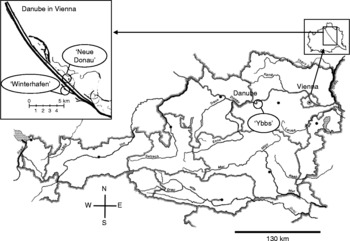
Fish were sampled between May and October 2007 from three different sites on the River Danube, which is the most important river in Austria. The geographical location of the sampling sites is given in fig. 1. Two sampling sites were located within the municipality of Vienna: one was the basin of a river port in Vienna, the ‘Winterhafen’, and the other, ‘Neue Donau’, was an artificial anabranch of the Danube. The third sampling site, ‘Ybbs’, was the estuary of the Ybbs River in Lower Austria, approximately 90 km upstream of Vienna.
Sampling sites on the Danube River in Austria.

Fish sampling
Fish were collected using longlines from the Neue Donau and the Winterhafen site and by electrofishing from the Ybbs site. A total of 79 specimens (25 female, 49 male and 5 not detected) of A. melanostoma and 12 specimens (2 female, 10 male) of N. kessleri were caught. In addition, one male specimen of the racer goby N. gymnotrachelus from the Winterhafen site was recovered. Fish were transported to the laboratory, kept in aerated tanks for up to 36 h, killed by cervical dislocation and then examined for parasites using conventional techniques described by Schäperclaus (Reference Schäperclaus1990) and Amlacher (Reference Amlacher1992). Parasites were identified to the lowest possible taxonomic level using Schäperclaus (Reference Schäperclaus1990), Bykhovskaya-Pavlovskaya et al. (Reference Bykhovskaya-Pavlovskaya, Gusev, Dubinina, Izyumova, Smirnova, Sokolovskaya, Shtein, Shulman and Epshtein1964) and Moravec (Reference Moravec2001). The total length (cm), weight (g) and sex were recorded for each fish. Parasitological terms were used according to Bush et al. (Reference Bush, Lafferty, Lotz and Shostak1997). The two single specimens of monogeneans recovered were damaged during preparation and therefore not identified to species level. Being well aware of the present discussion on species differentiation of digeneans identified as Diplostomum spathaceum in different fish species and awaiting the clarification of this discussion, all eye flukes recovered from the lens were classified as Diplostomum sp. and the single specimen from the vitreous humour was identified as Tylodelphys clavata following Bykhovskaya-Pavlovskaya et al. (Reference Bykhovskaya-Pavlovskaya, Gusev, Dubinina, Izyumova, Smirnova, Sokolovskaya, Shtein, Shulman and Epshtein1964). Reference material for Bucephalus polymorphus has been deposited at the Natural History Museum in Vienna.
Results
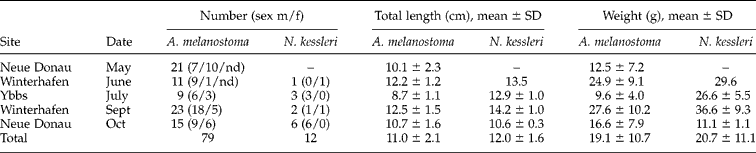
Statistical data of total length, weight and sex for both fish species are given in table 1. Twelve parasite taxa were found, including two protozoans (Trichodina sp., Ichthyophthirius multifiliis), two crustaceans (Paraergasilus brevidigitus, Ergasilus sieboldi), two monogeneans (Gyrodactylus sp., Dactylogyrus sp.), three metacercariae of digeneans (Diplostomum sp., T. clavata, B. polymorphus), two adult digeneans (Nicolla skrjabini and Bunodera nodulosa) and one acanthocephalan (Acanthocephalus lucii). In the round goby, all parasite taxa except Trichodina sp. could be detected.
Statistical data of fish sampled between May and October 2007.
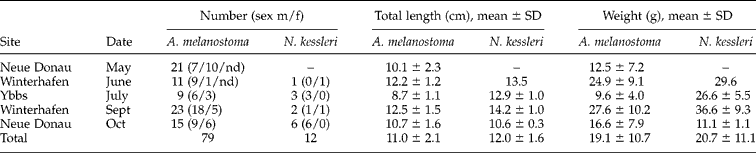
m/f, Male/female; nd, not determined; SD, standard deviation.
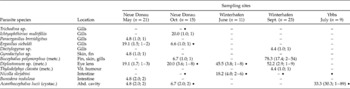
The parasitological indices were only calculated for A. melanostoma and are given in table 2. Due to the small sample size of N. kessleri it did not seem appropriate to calculate statistics; the occurrence is marked in table 2.
Parasites of A. melanostoma and N. kessleri from different sampling sites of the river Danube. Statistics calculated for A. melanostoma: prevalence (%) (mean intensity; range of intensity, minimum–maximum).

–, Not detected; ●, detected in N. kessleri.
metc., Metacercariae; cystac., cystacanth; vit. humour, vitreous humour; abd. cavity, abdominal cavity.
Discussion
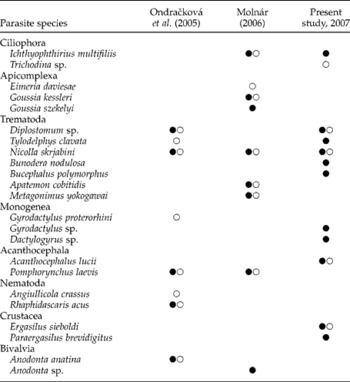
Comparing the studies by Molnár (Reference Molnár2006) of the Hungarian, and Ondračková et al. (Reference Ondračková, Dávidová, Pečínková, Blažek, Gelnar, Valová, Černý and Jurajda2005) of the Slovak section of the Danube, corresponding results for the parasite fauna could be described in this survey, although some differences in the composition on a species level were discovered. In the round goby and the bighead goby, eight parasite taxa were found in Slovakia, 12 in Austria and nine in Hungary (table 3). In total of 21 different species and an additional five genera have been detected in A. melanostoma and N. kessleri in the Danube so far.
Parasites of A. melanostoma and N. kessleri from the Slovak (Ondračková et al., Reference Ondračková, Dávidová, Pečínková, Blažek, Gelnar, Valová, Černý and Jurajda2005), the Hungarian (Molnár, Reference Molnár2006) and the Austrian (present study) part of the River Danube.

●, A. melanostoma; ○, N. kessleri.
The absence of the acanthocephalan Pomphorhynchus laevis from all sites in the present study is surprising. This is one of the most abundant helminth parasites reported from the Danube River, as shown amongst others for the barbel Barbus barbus (Laimgruber et al., Reference Laimgruber, Schludermann, Konecny and Chovanec2005) and for chub Leuciscus cephalus (Jirsa, Reference Jirsa2004). It was reported with prevalences up to 100% for these fish hosts, and has been reported previously from the round goby in the Danube (Ondračková et al., Reference Ondračková, Dávidová, Pečínková, Blažek, Gelnar, Valová, Černý and Jurajda2005; Molnár, Reference Molnár2006). Since there are no available reports of the benthic fauna for the sampling sites, it is unclear whether the absence of P. laevis is connected to the absence of its intermediate host Gammarus pulex, or whether other reasons account for it.
The occurrence of A. lucii, which uses the asellid Asellus aquaticus as intermediate host (Bykhovskaya-Pavlovskaya et al., Reference Bykhovskaya-Pavlovskaya, Gusev, Dubinina, Izyumova, Smirnova, Sokolovskaya, Shtein, Shulman and Epshtein1964), undoubtledly indicates poor water quality. Galli et al. (Reference Galli, Crosa, Mariniello, Ortis and D'Amelio2001) showed positive correlations between high prevalences of Acanthocephalus anguillae, an acanthocephalan which also uses A. aquaticus as intermediate host, and water pollution. The latest water quality report from the Austrian Government classified the Ybbs River in this region with water quality II in a five class ranking, and the Danube River II–III, indicating good condition (Philippitsch & Grath, Reference Philippitsch and Grath2006), which is contradicted by our findings. The complete absence of ectoparasites and eye flukes at the Ybbs site could be a motive for further investigations.
The most striking result of this survey seems to be the first appearance of B. polymorphus in Austrian waters, from A. melanostoma. This parasite has a life-cycle including two intermediate hosts and piscivorous fish as final hosts. The first intermediate host is the mollusc Dreissena polymorpha, with greatest emergence of cercariae of B. polymorphus between June and September (Baturo, Reference Baturo1977). As second intermediate host a large variety of fish species have been described; here metacercariae develop in epidermal cysts, with no specific location on the fish body. The final hosts are also diverse piscivorous fish (Moravec, Reference Moravec2001). Highest pathogenicity is described for the cercariae penetrating the fish body, and the death of fish and fry has been reported due to the mechanical damage caused (Baturo, Reference Baturo1978). Hyperaemia and haemorrhage are also frequent pathological symptoms (Baturo, Reference Baturo1980). The future investigation of possible final hosts and D. polymorpha will show whether the parasite can establish a firm population in the Danube River and whether this intrusion puts additional pressure on the fish populations.
Altogether it could be shown that the newly invading goby species, A. melanostoma and N. kessleri, seem to follow the pattern described by Torchin et al. (Reference Torchin, Lafferty, Dobson, McKenzie and Kuris2003), adopting indigenous parasite species as well as importing new ones with them at the same time. It is quite likely that B. polymorphus has been introduced by the gobies following the invasion of the first intermediate host D. polymorpha into mid-European waters. Future investigations will show the possible impact of this newly established parasite as well as the impact of the invaded fish species on the Danube ecosystems.
Acknowledgements
The authors sincerely thank the ‘Fischereiverein Freudenau’, especially Wolfgang Petrouscheck, and Dr Christian Wiesner from the University of Natural Resources and Applied Life Sciences, Vienna for providing the fish samples from Neue Donau and Winterhafen and from Ybbs, respectively. Furthermore, we wish to thank Dr Helmut Sattmann from the Museum of Natural History in Vienna for the identification of B. polymorphus.