Introduction
Infertility in mammalian females has long been a source of concern in reproductive medicine. Anovulation, malformed oocytes, aberrant fertilization, insufficient support of embryonic growth by the corpus luteum, and early implantation are all causes of female infertility (Adkins-Regan, Reference Adkins-Regan2015; García-Vázquez et al., Reference García-Vázquez, Gadea, Matás and Holt2016; Pitnick et al., Reference Pitnick, Wolfner and Dorus2020; Kanteraki et al., Reference Kanteraki, Isari, Svarnas and Kalavrouziotis2022). Many couples suffer from infertility, which is a huge challenge not only for their lives but also for their families (Niringiyumukiza et al., Reference Niringiyumukiza, Cai and Xiang2018). Although several assisted reproductive technologies may help people become fertile, infertility therapy is still difficult and has a poor success rate, despite technological breakthroughs (Borg et al., Reference Borg, Wolski, Gibbs and O’Bryan2010). Additionally, it is typical to observe additional negative consequences in these transgenic animals outside the anticipated phenotype when the production of many transgenic mice increases, which may be caused by modifications in positional effects (De Angioletti et al., Reference De Angioletti, Rovira, Notaro, Camacho Vanegas, Sadelain and Luzzatto2001). The use of transgenic animal models may be linked to decreased fertility and infertility. Additionally, transgenic mouse strains had low sperm production, according to earlier studies. Although superovulation increases the quantity of oocytes produced in females, only a small portion of them is viable, which results in fertilization failure (Töpfer-Petersen et al., Reference Töpfer-Petersen, Petrounkina and Ekhlasi-Hundrieser2000; Jiang et al., Reference Jiang, Zhang, Zou, Ma, Qu, Gu and Shen2021; Zhang et al., Reference Zhang, Xiao, Bol, Wang, Zhuge, Wu, Li and Meng2021; Wang et al., Reference Wang, Ma, Feng, Yan, Song, Wang, Zheng, Hao, Zhang, Yao and Wang2022; Husted et al., Reference Husted, Minutello, Pinna, Tougaard, Møs and Kopittke2023).
Obeticholic acid (OCA) is a 6α-ethyl chenodeoxycholic acid (CDCA) derivative used as a farnesoid X receptor (FXR) agonist (Ali et al., Reference Ali, Carey and Lindor2015). OCA is a selective FXR agonist produced from an endogenous FXR ligand, bile acid chenodeoxycholic acid. Obeticholic acid is roughly 100-fold more effective than chenodeoxycholic acid in activating FXR (Nevens et al., Reference Nevens, Andreone, Mazzella, Strasser, Bowlus, Invernizzi, Drenth, Pockros, Regula, Beuers, Trauner, Jones, Floreani, Hohenester, Luketic, Shiffman, van Erpecum, Vargas and Vincent2016). OCA has shown good results in improving primary biliary cirrhosis and nonalcoholic steatohepatitis (Xiong et al., Reference Xiong, Ren, Cui, Li, Wang and Zhang2017). Furthermore, OCA inhibits NLRP3 inflammasome activation in macrophages and suppresses inflammasome activation-induced hepatic lipid accumulation (Huang et al., Reference Huang, Wu, Zhao, Wu, Sun, Wang, Qin, Bai, Leng and Tang2021).
OCA may boost fertility and reproduction by improving the fetal bile acid profile. It is especially protective in mice with impaired bile acid metabolism during late gestation when treated with lipopolysaccharide (LPS; Pataia et al., Reference Pataia, McIlvride, Papacleovoulou, Ovadia, McDonald, Wahlström, Jansen, Adorini, Shapiro, Marchesi, Marschall and Williamson2020; Zhang et al., Reference Zhang, Gan, Lv, Qin, Hu, Liu, Ma, Song, Li, Jiang, Wang, Wang and Xu2020). In addition, OCA can inhibit the level of oxidative stress and therefore prevent intrauterine growth restriction in pregnant mouse fetuses (Chen et al., Reference Chen, Gao, Ma, Liu, Li, Wang, Gao, Xu and Chen2019).
Although research had been undertaken to investigate the function of OCA during fetal development, no comprehensive preclinical investigations on reproductive and developmental toxicity have been conducted to date, which precludes the use of OCA in pregnant and lactating women. As a result, the purpose of this study was to investigate the effects of various concentrations of OCA on reproductive and developmental damage in mice.
Materials and methods
This study was approved by the ethics committee of our hospital and the institutional review board (IRB; SADS2011451). All animal experiments should comply with the ARRIVE Guidelines and should be carried out in accordance with the UK Animals (Scientific Procedures) Act, 1986 and associated guidelines, EU Directive 2010/63/EU for animal experiments, or the National Research Council’s Guide for the Care and Use of Laboratory Animals. The authors assert that all procedures contributing to this work complied with the ethical standards of the relevant national and institutional guides on the care and use of laboratory animals.
The fertility toxicity study, prenatal developmental toxicity study, and reproductive toxicity study were conducted in accordance with the ICH Harmonized Guidelines (2017): Detection of Toxicity to Reproduction for Human Pharmaceuticals S5 (R3) (Andrews et al., Reference Andrews, Blanset, Costa, Green, Green, Jacobs, Kadaba, Lebron, Mattson, McNerney, Minck, Oliveira, Theunissen and DeGeorge2019).
Female fertility toxicity study
The aim of this study was to assess the interference of OCA on maternal reproductive function, mating behaviour, fertilization, and embryo implantation from pre-mating to implantation (14 days before mating).
Animal experiment
Obeticholic acid was purchased from Sigma Chemical Co. (St. Louis, MO, USA, CAS no. 474-25-9). Prior to the experiments, animals were kept ad libitum on standard food and water and under a 12 h light/12 h dark cycle in temperature-controlled (20–25°C) and humidity-controlled (50 ± 5%) chambers. Female mice were assigned to a standard maintenance or reproduction diet (CRM), referred to as the normal food diet control (NC), OCA-supplemented (5 mg/kg) CRM diet, OCA-supplemented (10 mg/kg) CRM diet, or OCA-supplemented (20 mg/kg) CRM diet and maintained their assigned diet for the duration of the experimental procedure (30 female rats per group). Pregnant mice were orally administered OCA daily from GD12 to GD17 and the dose of OCA was chosen according to previously published literature (Baghdasaryan et al., Reference Baghdasaryan, Claudel, Gumhold, Silbert, Adorini, Roda, Vecchiotti, Gonzalez, Schoonjans, Strazzabosco, Fickert and Trauner2011; Chen et al., Reference Chen, Gao, Ma, Liu, Li, Wang, Gao, Xu and Chen2019; Pataia et al., Reference Pataia, McIlvride, Papacleovoulou, Ovadia, McDonald, Wahlström, Jansen, Adorini, Shapiro, Marchesi, Marschall and Williamson2020). Body weight was measured every 3 days. The administration began 14 days before mating-gestation day t (G5). No drug was administered to male mice (10 mice per group).
Mating
In this study, one male and one female mice were selected at random and placed together in a cage for a 2-week mating period. Vaginal smears were taken daily at 8:00 a.m. to check for the presence of sperm. (The presence of sperm in the vaginal smear and/or a mating plug were considered evidence of successful mating, and the day was recorded as G0) The mating index, calculated as the number of mated pairs divided by the total number of female–male pairs and multiplied by 100%, was used to measure the success of the mating period.
Mother observation
During OCA treatment, female mice were observed at least once a day for activity, gait, behaviour, and other clinical signs (changes in skin, fur, eyes, and mucous membranes, the occurrence of secretions and excretions) to assess health status (Burkholder et al., Reference Burkholder, Foltz, Karlsson, Linton and Smith2012; Falk et al., Reference Falk, Zheng, Chen, Jiang, Liu and Lewis2017). If any mouse exhibited extreme pain or distress it would be sacrificed and its organs and tissues subjected to thorough pathological examination and histopathological analysis.
Necropsy of F0 female mice
Female mice were terminated with chloral hydrate by gavage on G18 by tube feeding with chloral hydrate and then dissected within 30 min for gross autopsy. The morphology, colour, borders, size, texture, and sections of vital organs such as the heart, liver, spleen, kidney, and reproductive organs were examined. Body weight without a uterus was recorded. Histopathological evaluation of haematoxylin–eosin-stained tissue sections for any abnormal organs was performed. The number of corpus luteum, the number of implantations, the number of live fetuses, and the number of absorbed fetuses were recorded to determine the sex. Conception and miscarriage were recorded. The fertility index was calculated (number of pregnant/number of female mating × 100%).
Western blot
A rotor-stator homogenizer was used to homogenize the fresh ventricular tissue in ice-cold lysis buffer (Beyotime, Shanghai, China). Nonfat milk was used to block the membrane before primary antibodies for FXR, TGR5 (Santa Cruz) were incubated at 4°C overnight. Lamin A/C (1:2000 dilution) was used as nuclear protein load control. The membrane was incubated for an additional 1 h the next day using Cell Signaling’s horseradish peroxidase (HRP)-conjugated secondary antibody. The band detected by the FluorChem Image System was developed on a membrane using an Immobilon solution (Millipore, Billerica, MA, USA). All experiments were repeated three times.
Biochemical analysis
Placental and testis glutathione (GSH) levels were measured using the Griffith method (Griffith, Reference Griffith1980). the level of GSH was expressed as μmol/g tissue. Placental lipid peroxidation was quantified by measuring the malondialdehyde (MDA) level (Ohkawa et al., Reference Ohkawa, Ohishi and Yagi1979). MDA levels were expressed as nmol/mg tissue. All experiments were repeated three times.
Total RNA isolation and quantitative RT-PCR (qRT-PCR) assay
Mouse placental tissue was homogenized in 1.2 ml of TRIzol reagent (Ambion, USA). The RNA concentration, purity, and quality were measured using a NanoDrop 2000 spectrophotometer (Thermo Fisher Scientific, Rockford, IL, USA) from aliquots (2 μl) of each sample. When the OD260/OD280 was 2.5 ± 0.2, the total RNA sample was eligible for further analysis. Total RNA (1.0 μg) was treated with RNase-free DNase and reverse transcribed with AMV reverse transcriptase (Pregmega). PCR reactions were amplified for 50 cycles in a three-step process of denaturation (95°C for 15 s), annealing (60°C for 15 s) and extension (72°C for 30 s). The relative proportions of target genes were calculated using the LightCycler 480 SYBR GreenIkit software (Roche Diagnostics). All experiments were repeated three times.
Evaluation of the sperm
The OCA-treated and control C57BL/10 and BALB/c males (n = 6) that had not been mated were used one day after the last OCA injection. Upon sacrifice, the epididymis was prepared and transferred to a 1 ml reaction tube (Eppendorf) containing 500 ml HTF medium (Chemicon MR-070-D; Hofheim, Germany). The supernatant was used for sperm counting.
Statistical analysis
All measured parameters were calculated and expressed as mean ± standard deviation or percentage. For all values, the homogeneity of variance was tested using the Bartlett test. Homogeneous data were analyzed using a one-way ANOVA followed by Dunnett’s multiple comparison tests to compare the test group with the control group. For variance heterogeneity, groups were compared using the Kruskal–Wallis nonparametric ANOVA followed by a Newman-Keuls multiple comparison test. To compare measurements, Fisher’s exact test (n < 100) or the chi-squared test with Yates’ continuity correction (n ≥ 100) was used. A probability of less than 0.05 (P < 0.05) was used as a criterion of significance.
Results
Female fertility toxicity study
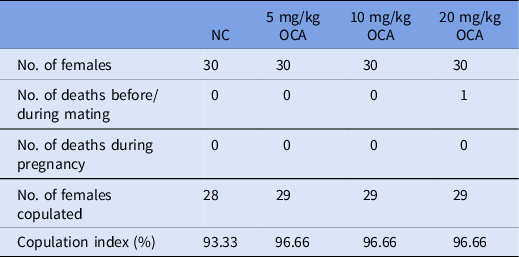
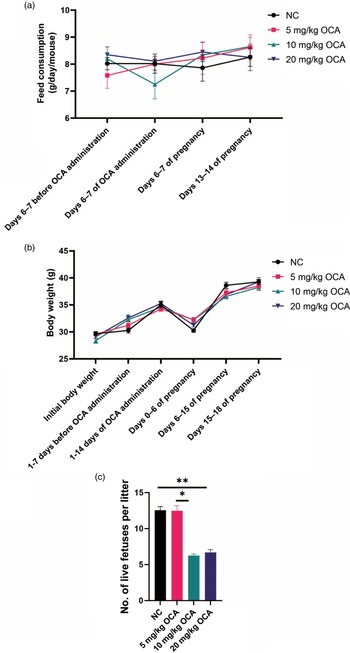
In our study, we first observed the effects of OCA on mothers and found no significant abnormalities in the appearance, behaviour, and clinical signs of F0 female mice in all experimental groups. There was no statistically significant difference in feed consumption between groups. The body weight of F0 females increased steadily with increasing OCA content. In addition, one female mouse was found dead 3 days before mating in the 20 mg/kg OCA intervention group, and autopsy findings showed partial damage to the oesophagus, which may be related to an improper feeding method of strong feeding and not significantly related to OCA (Table 1; Figure 1).
General examination of F0 females in fertility toxicity study.

NC, control; OCA, obeticholic acid.
General data of F0 females in prenatal development toxicity study. (a) Food consumption. (b) Body weight. (c) Number of live fetuses per litter. *P < 0.05; **P < 0.01. NC, control; OCA, obeticholic acid.

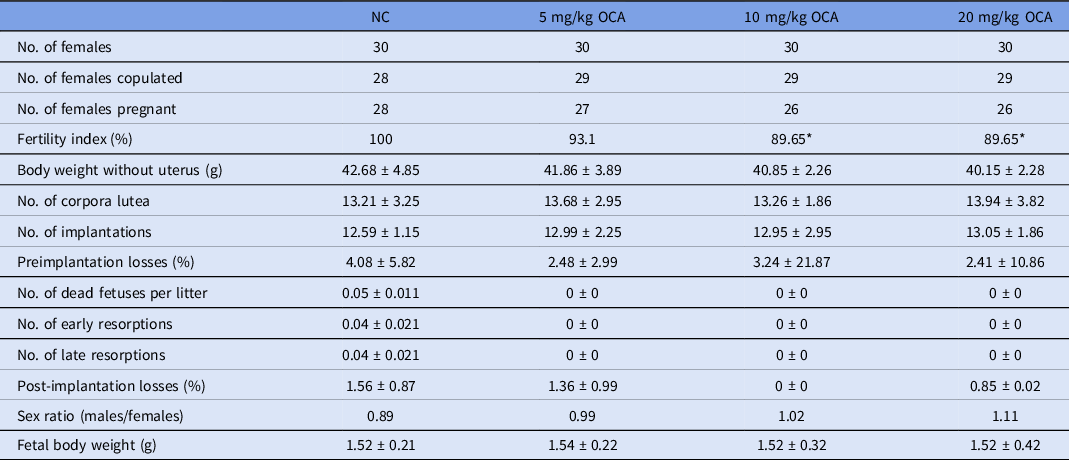
We also further performed an anatomical assessment of reproductive function in F0 female mice and no significant lesions were found. There were no statistically significant differences in uterine weight, fetal sex ratio, and fetal weight between the OCA group and the control group. The fertility index was significantly lower in the 10 mg/kg and 20 mg/kg OCA intervention groups than in the control group. In addition, the number of implantations was lower in the OCA-treated group than in the control group, and preimplantation losses were significantly higher than in the control group. There was a decrease in the number of implantations and an increase in losses in the OCA group compared with in the control group, while there was no difference in the number of corpora lutea. Our results demonstrated no significant relationship between post-implantation loss, and aspects of stillbirth (Table 2). Through this part of the study, we found that OCA increased the body weight of F0 female mice while reducing the incidence of placental implantation.
Maternal reproductive evaluation by necropsy of F0 females on G18 in fertility toxicity study

NC, control; OCA, obeticholic acid.
Post-implantation loss per litter = [(implantation sites − viable fetuses)/implantation sites] × 100%. Preimplantation loss per litter = [(corpora lutea − implantation sites)/corpora lutea] × 100%. *P < 0.05.
Prenatal developmental assessment
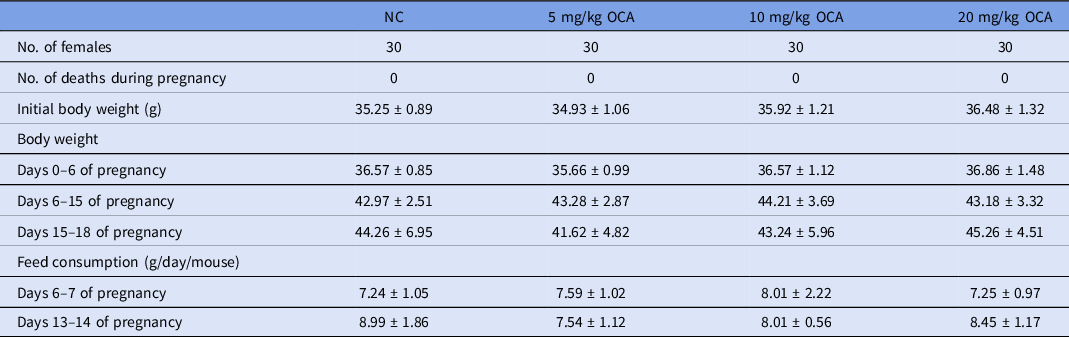
No signs of toxicity were observed in our study. In all experimental groups, no significant abnormalities were observed in the appearance and behaviour of F0 female mice. Body weight gain and feed consumption did not differ significantly between groups (Table 3).
General examination of F0 females in prenatal development toxicity study

NC, control; OCA, obeticholic acid.
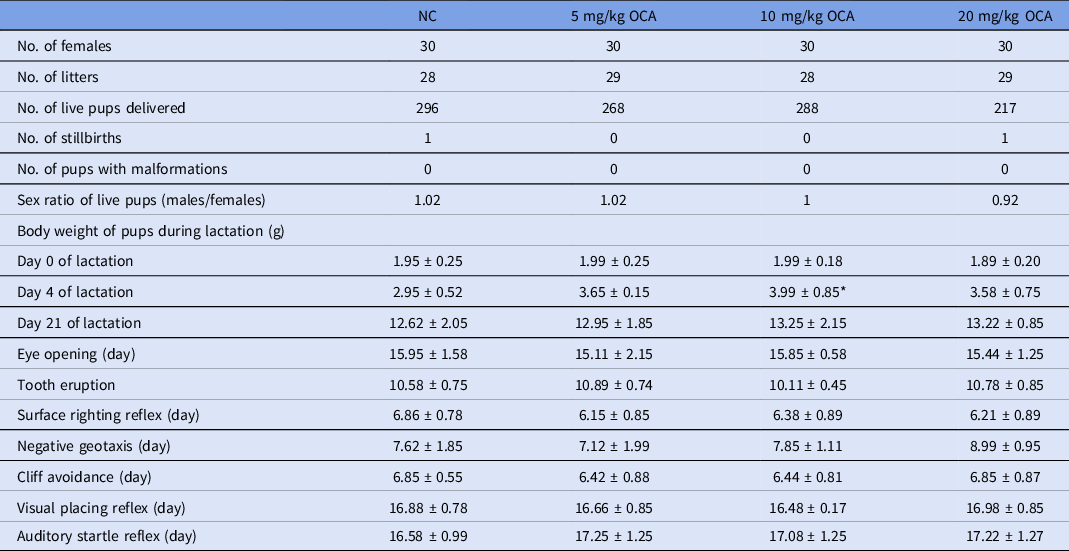
In addition, there are no significantly different among the number of litters, live fetuses, stillbirths, and sex ratio of live pups in the OCA-treated group and the control group. What is more, the body weight on day 4 of lactation was increased significantly in 10 mg/kg OCA compared with in the control group (Table 4).
Development of F0 females on G18 in reproductive toxicity study

NC, control; OCA, obeticholic acid. *P < 0.05.
OCA increases FXR and TGR5 expression in placental tissue
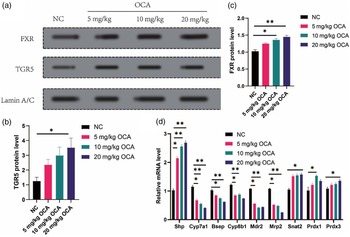
To further clarify the effect of OCA on the placenta, we examined the protein levels of the OCA-associated bile acid receptors TGR5 and FXR and showed that the protein levels of FXR (P = 0.0012) and TGR5 (P = 0.042) in the placenta increased significantly with 20 mg/kg OCA concentrations (Figure 2a–c). The mRNA levels of Shp, snat2, prdx1, and Prdx3 increased significantly with increasing OCA dose, but the levels of cyp7a1, Bsep, cyp8b1, Mdr2, and mrp2 were significantly downregulated (Figure 2d).
Obeticholic acid (OCA) protects against farnesoid X receptor/G-protein-coupled bile acid receptor (FXR/TGR5) protein levels and mRNA levels. (a) Western blot. (b) TGR5 protein level. (c) FXR protein level. (d) Relative mRNA level in placenta. *P < 0.05; **P < 0.01. Cyp7a1, Cytochrome P450 Family 7 Subfamily A Member 1; NC, control; Shp, Nuclear Receptor. All experiments were performed three times.

OCA inhibits oxidative stress levels in the placenta and testis and mitochondrial activity
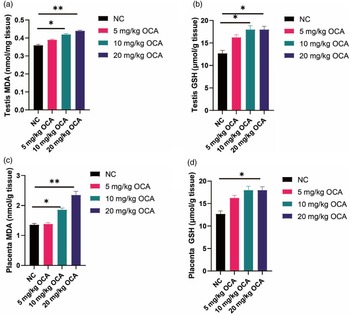
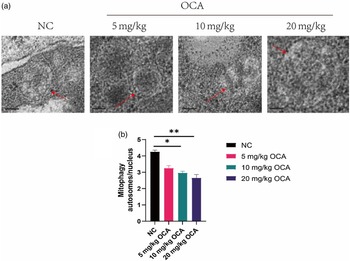
Compared with the control group, 10 mg/kg and 20 mg/kg OCA also increased MDA and GSH levels in the testis. Further analysis of MDA and GSH levels in the placenta showed that 10 mg/kg and 20 mg/kg OCA doses also increased MDA in the testis, but for GSH levels in the placenta, only 20 mg/kg OCA significantly increased the levels (Figure 3). Mitochondrial function plays a very important role in oxidative stress, so we further observed the mitochondrial activity and found that 10 mg/kg and 20 mg/kg of OCA significantly reduced the mitophagy autosomes/nucleus compared with in the normal control group (Figure 4).
Obeticholic acid (OCA) increases malondialdehyde (MDA) and glutathione (GSH) levels in placenta and testis. (a) Testis MDA. (b) Testis GSH. (c) Placenta MDA. (d) Placenta GSH. *P < 0.05; **P < 0.01. FXR, farnesoid X receptor; NC, control; TGR5, G-protein-coupled bile acid receptor. All experiments were performed three times.

Obeticholic acid (OCA) changes mitochondrial activity (a, b). The red arrows indicate the location of the mitochondria. *P < 0.05; **P < 0.01. FXR, farnesoid X receptor; NC, control; TGR5, G-protein-coupled bile acid receptor. All experiments were performed three times.

Sperm count and motility
In unmated mice, we further analyzed the sperm outcome of OCA-intervened males. It was found that there was no significant difference in sperm count for mice after OCA intervention in either C57BL/6 or BALB/c male mice. In sperm motility, OCA treatment in C57Bl/6N mice led to a decrease in motile sperm (Table 5).
Sperm count and motility after obeticholic acid (OCA) treatment

*P < 0.05.
Discussion
In the present study, we investigated the toxicity and possible mechanisms of OCA in mouse reproduction and development. The results showed that 10 mg/kg and 20 mg/kg OCA significantly reduced the rate of placental implantation. Also, OCA increased maternal body weight. Further analysis of the mechanisms revealed that increased levels of FXR and TGR5 and changes in oxidative stress levels may be the main causes of this phenomenon.
The bile acid derivative 6-ethylchenodeoxycholic acid, OCA, is a potent activator of FXR that reduces liver fat and fibrosis in animal models of fatty liver disease (Neuschwander-Tetri et al., Reference Neuschwander-Tetri, Loomba, Sanyal, Lavine, Van Natta, Abdelmalek, Chalasani, Dasarathy, Diehl, Hameed, Kowdley, McCullough, Terrault, Clark, Tonascia, Brunt, Kleiner and Doo2015). OCA, an FXR agonist, has also been shown to improve the histological features of nonalcoholic steatohepatitis. Younossi et al. (Reference Younossi, Ratziu, Loomba, Rinella, Anstee, Goodman, Bedossa, Geier, Beckebaum, Newsome, Sheridan, Sheikh, Trotter, Knapple, Lawitz, Abdelmalek, Kowdley, Montano-Loza and Boursier2019) found that obeticholic acid 25 mg significantly improved fibrosis and key components of nonalcoholic steatohepatitis disease activity among patients with nonalcoholic steatohepatitis. Oral OCA pretreatment protected mice from LPS-induced liver injury, which may be due to improved bile acid homeostasis and reduced inflammatory factors, and ATF4-mediated autophagic activity in hepatocytes (Xiong et al., Reference Xiong, Ren, Cui, Li, Wang and Zhang2017). However, pruritus and adverse effects on LDL-C should be considered concerning OCA treatment (Polyzos et al., Reference Polyzos, Kountouras and Mantzoros2020). More rare side effects and/or ones that may develop over a longer period will need to be studied in the context of ongoing studies. The anatomical results found that OCA did not increase body weight and food consumption in mice, which explains in part that the effect of OCA on the organism did not increase body weight.
OCA also plays an important role in reproduction. In intrahepatic cholestasis of pregnancy, the administration of an OCA-supplemented diet alters the fetal bile acid profile and therefore improves cholestasis. There were also no significant adverse effects on maternal or fetal morphology (Pataia et al., Reference Pataia, McIlvride, Papacleovoulou, Ovadia, McDonald, Wahlström, Jansen, Adorini, Shapiro, Marchesi, Marschall and Williamson2020). In addition, OCA also altered the maternal bile acid profile due to LPS, significantly increasing the protein levels of nuclear FXR and regulating its target genes involved in bile acid metabolism, characterized by lower expression of the bile acid synthase CYP7A1, higher expression of CYP3A and higher mRNA levels of the transporter protein Mdr1a/b (Zhang et al., Reference Zhang, Gan, Lv, Qin, Hu, Liu, Ma, Song, Li, Jiang, Wang, Wang and Xu2020). OCA also showed significant improvement in intrauterine growth restriction of mouse fetuses caused by cholestasis (Gulamhusein and Hirschfield, Reference Gulamhusein and Hirschfield2020). In conclusion, the above-mentioned literature found that OCA had an ameliorative effect on reproduction associated with bile acid stasis. However, there is a lack of results on the toxicity and reproduction of OCA in mice (Javitt, Reference Javitt2021; Mayo, Reference Mayo2022), so our study adds further data on OCA in this regard (Abenavoli et al., Reference Abenavoli, Falalyeyeva, Boccuto, Tsyryuk and Kobyliak2018).
In our results, OCA was found to produce a significant improvement in fetal implantation, while increasing the body weight of mice. In addition, our results also found a significant increase in TGR5 and FXR protein levels after OCA intervention. Chen et al. (Reference Chen, Gao, Ma, Liu, Li, Wang, Gao, Xu and Chen2019) found that OCA activated placental, maternal, and fetal hepatic FXR signalling. OCA also suppresses levels of oxidative stress, and previous studies have also found that OCA inhibited the upregulation of placental NADPH oxidase-4 and antioxidant genes during cholestasis (Chen et al., Reference Chen, Gao, Ma, Liu, Li, Wang, Gao, Xu and Chen2019). OCA significantly attenuated LPS-induced upregulation of placental proinflammatory genes, including TNF-α, IL-1β, IL-6, IL-12, Mip-2, Kc, and Mcp-1 compared with OCA, which elevated the anti-inflammatory cytokine IL-10 in maternal serum, amniotic fluid, and placenta (Chen et al., Reference Chen, Hu, Zhou, Yu, Fu, Zhang, Bo, Wang, Zhang and Xu2016).
The selective FXR agonist OCA has anti-inflammatory and antioxidant activities (Markham and Keam, Reference Markham and Keam2016). An experimental report found that OCA protects against obesity-induced kidney injury by suppressing free fatty acid-induced renal oxidative stress and endoplasmic reticulum stress (Adkins-Regan, Reference Adkins-Regan2015). A recent report from our laboratory showed that pretreatment with OCA protected mice from LPS-induced fetal demise and intrauterine growth restriction through its anti-inflammatory activity (García-Vázquez et al., Reference García-Vázquez, Gadea, Matás and Holt2016). Huang et al. (Reference Huang, Wu, Zhao, Wu, Sun, Wang, Qin, Bai, Leng and Tang2021) also found that OCA pretreatment protects against sepsis-induced acute kidney injury by inhibiting renal inflammation and oxidative stress (Kanteraki et al., Reference Kanteraki, Isari, Svarnas and Kalavrouziotis2022). In addition, obeticholic acid ameliorates valproic acid-induced hepatic steatosis and oxidative stress (Pitnick et al., Reference Pitnick, Wolfner and Dorus2020). For hepatorenal syndrome, Tsai et al. investigated that chronic OCA treatment can ameliorate the hepatorenal syndrome (HRS) in ascitic cirrhotic rats. OCA is an agent with antioxidative stress, antivasoconstrictive, and antiapoptotic properties that benefits ascitic, cirrhotic rats with systemic, hepatic, and renal abnormalities (Tsai et al., Reference Tsai, Liu, Hsu, Huang, Lin, Huang, Li, Lee, Hsieh, Yang, Lee, Liu, Huang, Hou and Lin2020). In summary, there is a clear association between OCA and oxidative stress, but the relationship between OCA and oxidative stress in terms of reproduction is unclear. The role of OCA on oxidative stress in reproduction was analyzed in our study and it was found that OCA altered the level of oxidative stress during reproduction in both male and female mice (Borrelli et al., Reference Borrelli, Bonelli, Tuccillo, Goldfine, Evans, Buonaguro and Mancini2018; Gai et al., Reference Gai, Krajnc, Samodelov, Visentin and Kullak-Ublick2020; Lee et al., Reference Lee, Wu and Lin2023). This also suggests that reproductive function may be significantly improved by intervening in oxidative stress.
An OCA 25 mg dose significantly improved fibrosis and key components of nonalcoholic steatohepatitis (NASH) disease activity among patients with NASH (Younossi et al., Reference Younossi, Ratziu, Loomba, Rinella, Anstee, Goodman, Bedossa, Geier, Beckebaum, Newsome, Sheridan, Sheikh, Trotter, Knapple, Lawitz, Abdelmalek, Kowdley, Montano-Loza and Boursier2019). OCA inhibits hepatic stellate cell activation/proliferation partially by regulating bile acid (BA) homeostasis and thereby inhibiting the activation of hepatic stellate cells (Zhou et al., Reference Zhou, Huang, Guo, Cui, Ge, He, Pan, Wang, Wang and Hao2019). What is more, OCA reversed BA taurocholate-linked disordered serum lipid metabolites and indole derivatives to anxiety as assessed by network analysis. Additionally, microbial depletion with antibiotics also improved anxiety, microgliosis, and BA enrichment in experimental metabolic disorders mice (Wu et al., Reference Wu, Han, Zheng, Zhu, Chen, Yao, Yue, Teufel, Weng, Li and Wang2021). FXR/Nrf2 signalling was involved in OCA-induced amelioration of metabolic disorder, oxidative stress, inflammation, fibrosis, and myocardial dysfunction (Wu et al., Reference Wu, Liu, He, Da and Xie2019). OCA improved adipose indices, glucose tolerance, and steatosis in a milder metabolic phenotype but failed to improve these factors in morbidly obese diabetic mice. These results help to explain OCA’s limited efficacy in reversing human NASH (Haczeyni et al., Reference Haczeyni, Poekes, Wang, Mridha, Barn, Geoffrey Haigh, Ioannou, Yeh, Leclercq, Teoh and Farrell2017). What is more, OCA inhibited both liver sinusoidal endothelial cells (LSEC) and Kupffer cell activation, while hepatic stellate cells (HSC) remained unaffected. This action is related to NF-κB inhibition via upregulated IκBα. In conclusion, OCA inhibits hepatic inflammation in toxic cirrhotic rats, resulting in decreased HSC activation and fibrosis (Verbeke et al., Reference Verbeke, Mannaerts, Schierwagen, Govaere, Klein, Vander Elst, Windmolders, Farre, Wenes, Mazzone, Nevens, van Grunsven, Trebicka and Laleman2016).
In our study, we also found that OCA also affected the functional state of mitochondria. OCA inhibited cholangiocarcinoma cell proliferation and migration that was associated with decreased mitochondrial energy metabolism (Erice et al., Reference Erice, Labiano, Arbelaiz, Santos-Laso, Munoz-Garrido, Jimenez-Agüero, Olaizola, Caro-Maldonado, Martín-Martín, Carracedo, Lozano, Marin, O’Rourke, Andersen, Llop, Gómez-Vallejo, Padro, Martin, Marzioni and Banales2018). OCA also improved mitochondrial turnover and function was directly mediated through GCG signalling that exerted multifactorial improvement in liver function and was a promising therapeutic option (Boland et al., Reference Boland, Laker, Mather, Nawrocki, Oldham, Boland, Lewis, Conway, Naylor, Guionaud, Feigh, Veidal, Lantier, McGuinness, Grimsby, Rondinone, Jermutus, Larsen, Trevaskis and Rhodes2020). OCA interventions are also widely used in clinical practice as a treatment method to inhibit oxidative stress mechanisms (Borrelli et al., Reference Borrelli, Bonelli, Tuccillo, Goldfine, Evans, Buonaguro and Mancini2018). Therefore, second-line therapy should be considered for patients with high-risk disease who cannot tolerate ursodeoxycholic acid (UDCA) treatment failure as evidence (often reflected in trials and clinical practice as alkaline phosphatase > normal and/or elevated bilirubin up to 1.67-fold) of which OCA is currently the only recommended drug licensed by the National Institute for Health and Clinical Excellence (Hirschfield et al., Reference Hirschfield, Dyson, Alexander, Chapman, Collier, Hübscher, Patanwala, Pereira, Thain, Thorburn, Tiniakos, Walmsley, Webster and Jones2018).
In conclusion, OCA intervention reduces the risk of placental implantation and the body weight of mice. Possible mechanisms are related to increased FXR and TGR5 expression and inhibition of oxidative stress.
Data availability
The data used to support the findings of this study are included in the article.
Acknowledgements
We would like to thank all participants and our hospital.
Author contributions
Conceptualization: ML, HLY, LYX, LQC. Data curation: HLY, LYX, LQC. Formal analysis: HLY, LYX, LQC. Funding acquisition: HLY, LYX, LQC. Investigation: HLY, LYX, LQC. Methodology: HLY, LYX, LQC. Project administration: HLY, LYX, LQC. Resources: ML, HLY, LYX, LQC. Software: ML, HLY, LYX, LQC. Supervision: ML, HLY, LYX, LQC. Validation: ML, HLY, LYX, LQC. Visualization: HLY, LYX. Writing – original draft: HLY, LYX. Writing – review and editing: ML, HLY, LYX, LQC.
Funding
This research was not funded.
Competing interests
The authors declare no conflict of interest.
Ethics approval and consent to participate
This study was approved and approved by the ethics committee of our hospital and the institutional review board (IRB; SADS2011451).