Introduction
Suicide is becoming an increasing worldwide public health problem, with nearly 1 million people dying from suicide annually (Word Health Organization, 2008). Recently, South Korea has shown alarmingly increased suicide rates, with 31.2 suicide deaths per 100 000 people in 2011, ranking the highest rate among Organisation for Economic Co-operation and Development (OECD) nations and approximately three times the average of advanced industrialised nations (Hvistendahl, Reference Hvistendahl2013).
While suicide is a complex phenomenon, recent evidence has found an increase in suicide rates following a celebrity suicide. Frequently called the Werther effect, copycat suicide is characterised by the desire to imitate suicide after exposure to another individual's suicide, which is often a well-known figure whose death is widely publicised. Studies have shown that national suicide rates spur an increase in mass copycat suicides immediately following the suicides of entertainment celebrities, and to a lesser extent political figures (Phillips, Reference Phillips1974; Stack, Reference Stack1987, Reference Stack2000; Niederkrotenthaler et al. Reference Niederkrotenthaler, Fu, Yip, Fong, Stack, Cheng and Pirkis2012). One study by Jeong et al. (Reference Jeong, Shin, Kim, Hong, Hwang and Lee2012) investigated the effect of five celebrity suicides on copycat suicides, indexed by suicide attempt visits to the emergency department in South Korea. Their study found that emergency department visits for suicide attempts or self-injury increased significantly following the announcements of celebrity suicides. Fu & Chan (Reference Fu and Chan2013) pooled ten studies with a total of 98 suicides by celebrities and found a pooled estimate of change in suicide rates (suicides per 100 000 population) of 0.26 in the month following a celebrity suicide. One recent study by Fu & Chan (Reference Fu and Chan2013) utilised a time-series analysis using ARIMA transfer function models to investigate the impact of 13 celebrity suicides on subsequent suicide rates in South Korea. In their study, 3 out of 11 cases found a significant increase in subsequent suicide rates, after adjusting for seasonality, secular trends and unemployment rates. The authors conclude that non-significance cases may largely be due to contextual factors, such as media coverage of celebrity suicides.
Researchers have long speculated mass media coverage as a driver in the increase of mass suicide following a celebrity suicide, with suicide-related information assumed to be disseminated by newspapers, magazines, television (TV) and radio. Previous studies have found that the increase in suicides is proportional to the amount of media coverage of the suicide. Stack (Reference Stack2003) conducted a meta-analysis of 293 findings from 42 studies on the impact of highly publicised celebrity suicides in the media on the number of copycat suicides. He found that studies measuring the effect of either an entertainment or political celebrity suicide story were 14.3 times more likely to find a copycat effect compared with other studies. Similar increases in suicide rates following a highly publicised suicide of a celebrity have been observed worldwide, including Korea (Fu & Yip, Reference Fu and Yip2009).
Despite the evidence of the copycat suicide phenomenon, there is limited information on the actual amount and length of impact on actual suicides following a celebrity suicide. Additionally, there is also limited knowledge on the quantitative impact of mass media coverage on the amount and length of impact on actual suicides following a celebrity suicide. Recently, Yang et al. (Reference Yang, Tsai, Yang, Shia, Fuh, Wang, Peng and Huang2013) investigated the association of suicide deaths with suicide news using longitudinal and spatial analysis. Their results indicated that media reporting of suicides was strongly associated with increased suicide deaths following a celebrity suicide, and slightly lagged behind the suicide deaths for approximately 1 month in the absence of other celebrity deaths. Another study by Fu & Yip (Reference Fu and Yip2009) estimated the risk for suicide deaths in three Asian celebrities in Hong Kong, Taiwan and South Korea using a meta-analytic approach. Their results found the highest risk in the first week following celebrity suicides after adjusting for secular trends (calendar year), seasonality, economic situation and temporal autocorrelation. However, there are no studies which have attempted to fit the copycat suicide phenomenon using exponential modelling that predicts the actual amount and length of impact on actual suicides following a celebrity suicide, and the extent to which mass media influences the increase and subsequent decline of copycat suicides following a celebrity suicide.
The present study has three aims: (a) to examine suicide modelling with exponential curve that predicts the copycat suicide effect of each celebrity suicide; (b) to investigate the association between media effect (both newspaper and TV) and subsequent suicides following celebrity deaths; and (c) to investigate the extent to which mass media influences the increase (amplitude or A) and the rate of decline (K) in the model for copycat suicides following a celebrity suicide by correlation analysis.
Methods
Suicide data
The present study utilised nationwide data from Korean Statistical Information Service (KOSIS, http://kosis.kr) in South Korea from 1991 to 2010 on all suicide deaths in South Korea (KOSIS). This database contains sociodemographic information, and dates and method of suicide classified according to the International Classification of Disease (ICD) ninth version (suicide ICD: X60–X84). Computerised searches for suicidal death with in-house software, developed by Matlab (MathWorks Inc, Natick, MA, USA), were performed.
Celebrity data
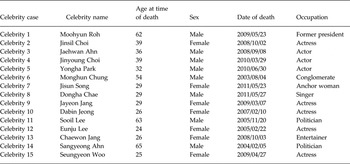
First, incidents of death by suicide of Korean celebrities were identified. These figures included entertainment, political or economical celebrity figures. Based on the most widely used search engine in Korea (Naver, http://www.naver.com), all celebrities that had committed suicide between 1990 and 2010 were retrieved by keyword searches for ‘celebrity suicide, actor/actress suicide, politician suicide, singer's suicide or star suicide’. A total of 30 celebrities were identified. Among these 30 celebrities, we did additional searches of the number of articles that were published by the top three newspapers in Korea (Chosun Ilbo, Chungang Ilbo and Donga Ilbo), which were selected based on the highest circulation rates determined by the Korea Press Foundation, during the first 7 days after the celebrity had committed suicide. Among these 30 celebrities, the top 15 celebrities with highest number of media reports were selected for the study. The selected celebrities for analysis included three politicians, 11 entertainment celebrities and one economic figure (see Table 1). Their names were ordered by the number of media search results and for simplicity denoted as ‘Celebrity 1, Celebrity 2, etc.’ as follows: Moo-hyun Roh (Celebrity 1), Jinshil Choi (Celebrity 2), Jaehwan Ahn (Celebrity 3), Jinyoung Choi (Celebrity 4), Yongha Park (Celebrity 5), Mong-heon Jeong (Celebrity 6), Jisun Song (Celebrity 7), Dongha Chae (Celebrity 8), Jayeon Jang (Celebrity 9), Dabin Jung (Celebrity 10), Sooil Lee (Celebrity 11), Eunju Lee (Celebrity 12), Chaewon Jang (Celebrity 13), Sangyeong Ahn (Celebrity 14) and Seungyeon Woo (Celebrity 15). For these celebrities, age at the time of death ranged from 24 to 65 years and 53% were male. Demographic information of the celebrities can be found in Table 1.
Name, demographics and date of death of selected celebrities

Media effect
The number of media reports following each celebrity's suicide was retrieved from a media portal, namely the Korean Integrated Newspaper Database System (KINDS, www.kinds.or.kr), which was developed by the Korea Press Foundation. This comprehensive full-text Korean news database has included articles in national and local newspapers, Internet articles and magazines, as well as TV reports since 1990. The name of each celebrity was entered into the portal, along with each individual date following the celebrity's suicide. The number of media reports for newspapers and TV were retrieved separately for analysis.
Model fit and statistical analyses
To model the copycat suicide of celebrities in South Korea, we adopted an exponential curve for the number of copycat suicides following a celebrity suicide as in (1).
 $$\,f\lpar x\rpar = A \cdot \exp \left({ - K \cdot x} \right)\comma$$
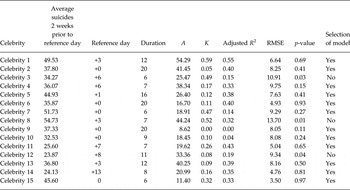
where A and K are model parameters, x is the observed day from a starting day, and f(x) is the number of suicides. The resulting parameter estimates are summarised in Table 2.
Exponential modelling of copycat suicides following 14 celebrity suicides in South Korea

Celebrity 1, Moohyun Roh; Celebrity 2, Jinsil Choi; Celebrity 3, Jaehwan Ahn; Celebrity 4, Jinyoung Choi; Celebrity 5, Yongha Park; Celebrity 6, Monghun Chung; Celebrity 7, Jisun Song; Celebrity 8, Dongha Chae; Celebrity 9, Jayeon Jang; Celebrity 10, Dabin Jeong; Celebrity 11, Sooil Lee; Celebrity 12, Eunju Lee; Celebrity 13, Chaewon Jang; Celebrity 14, Sangyeong Ahn; Celebrity 15, Seungyeon Woo.
In the model fitting, we assumed that the number of copycat suicides following each celebrity suicide takes an exponential shape with a specific starting day and duration, which are unique for each celebrity. The decision to consider different starting days and durations in modelling copycat suicides was mainly because each celebrity suicide has a different property until the death becomes made public. For example, in some cases people did not know whether the deaths of celebrities were suicides until wills or police reports were publicised, whereas in other cases they were concluded as suicides instantly due to apparent evidence. We observed the pattern of the number of suicides following a celebrity suicide, and then determined the reference day (shown in Table 2), as the starting day of model fitting to copycat suicides within 2 weeks from the celebrity suicide. In a similar way, the duration considered in a model fit was determined by closely observing the movement of the number of suicides following a celebrity suicide. Thus, we set the duration for the model fit as the period between the aforementioned starting day, and the day when the number of copycat suicides no longer seems to follow a single exponential curve, which we labelled as the duration in which the exponential model was valid (Table 2). The maximum duration was limited to 20 days. Additionally, we also subtracted the average number of suicides for 2 weeks prior to the celebrity suicide from the number of total suicides following the celebrity suicide, and considered this normalised data in order to minimise the influence by seasonal effect. The start days of modelling from the suicide day and the average numbers of suicides for 2 weeks before the celebrity deaths appear in Table 2.
To validate exponential curve modelling of copycat suicide, χ2 tests were performed on each celebrity suicide based on the following statistic χ2:
 $$\chi ^2 = \sum\limits_{i = 1}^n {\displaystyle{{\left({x_i - e_i } \right)^2 } \over {e_i }}}\comma$$
where x i and e i are the observed value and estimated value on the ith day (i = 1, 2, …, n) from a starting day for each celebrity based on an exponential model. From the statistics in (2), the corresponding p-values were computed with a degree of freedom set to n − 1. The resulting p-values were summarised in Table 2.
To examine the media effect on copycat suicide, two separate correlational analyses were conducted for each celebrity. The first analysis examined the association between the number of newspaper reports following the celebrity suicide and number of suicide incidences. The second analysis examined the association between the number of TV reports 30 days following the celebrity suicide and number of suicide incidences. All correlational analyses used Pearson's correlation coefficient. In the statistical analysis, all tests were based on significance level set at 0.05 and two-sided tests.
Results
Exponential modelling curve
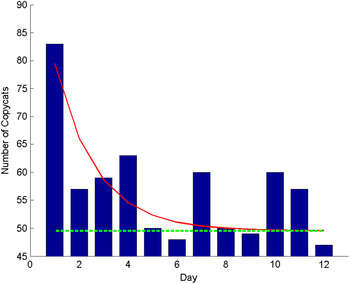
From the model validation with χ2 tests, exponential model fits were statistically accepted in all cases except Celebrities 3, 8 and 12, as seen in Table 2. Among the cases where exponential curves were statistically acceptable, the adjusted coefficients of determination (R 2) ranged from 4 to 55%, except for Celebrity 9. According to Table 2, Celebrity 1 showed the highest R 2. The actual copycat suicides and the exponentially fitted model for Celebrity 1 appear in Fig. 1.
Exponential model of Celebrity 1. *The red line is the fit curve, green dotted line indicates 49.53, which is the average suicides 2 weeks prior to reference day).

Correlation between media effect and suicide incidence
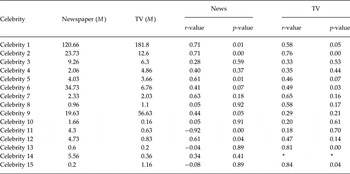
Correlational analysis between the number of media (newspaper, TV) and that of suicide incidents 30 days after each celebrity's suicide was conducted (see Table 3). There was a significant correlation between the number of newspaper reports and that of suicide incidents for Celebrity 1 (r = 0.71, p = 0.01), Celebrity 2 (r = 0.71, p < 0.01), Celebrity 5 (r = 0.61, p = 0.01), Celebrity 9 (r = 0.44, p = 0.05), Celebrity 11 (r = −0.92, p < 0.01) and Celebrity 12 (r = 0.61, p = 0.04), where all the correlations are positive except for Celebrity 11. There was also a significant correlation between the number of TV reports and suicide incidents for Celebrity 1 (r = 0.58, p = 0.05), Celebrity 2 (r = 0.76, p < 0.01), Celebrity 6 (r = 0.49, p = 0.03), Celebrity 13 (r = 0.81, p < 0.01) and Celebrity 15 (r = 0.84, p = 0.04).
Correlation between media effect (newspaper, TV) and copycat suicides (number of newspaper and TV reports submitted within 30 days following each celebrity's suicide)

*No TV reports were submitted.
Celebrity 1, Moohyun Roh; Celebrity 2, Jinsil Choi; Celebrity 3, Jaehwan Ahn; Celebrity 4, Jinyoung Choi; Celebrity 5, Yongha Park; Celebrity 6, Monghun Chung; Celebrity 7, Jisun Song; Celebrity 8, Dongha Chae; Celebrity 9, Jayeon Jang; Celebrity 10, Dabin Jeong; Celebrity 11, Sooil Lee; Celebrity 12, Eunju Lee; Celebrity 13, Chaewon Jang; Celebrity 14, Sangyeong Ahn; Celebrity 15, Seungyeon Woo.
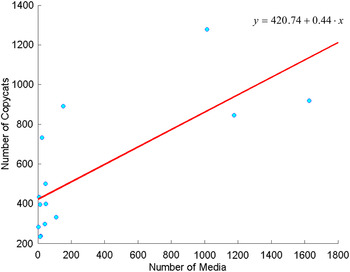
In an overall analysis, the number of copycat suicides during the unique duration of each celebrity based on the exponential fitting analysis were pooled together and correlated with the total number of media. There was a significant correlation between the total number of copycat suicides and the total number of media (r = 0.74, p < 0.01) for 14 celebrities (Celebrities 2–15). The data for Celebrity 1, the former President Roh, was excluded in the analysis because of a high number of political articles produced unrelated to his suicide following his death, which we determined could result in a biased correlation. This result is depicted in Fig. 2.
Scatter plot of the number of total media and the number of copycat suicides with the least squares line in red (correlation: r = 0.74, p < 0.01).

Correlation between media effect and A, K of copycat suicides
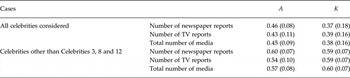
The average amplitude (A) of all the celebrities combined was 29.90 (±13.37), and the average rate of decline (K) was 0.23 (±0.20). There was a weak positive correlation between the average amplitude of increase in copycat suicides (A; r = 0.38, p = 0.16) and rate of decline (K; r = 0.45, p = 0.09) of copycat suicides with the total number of media. Similar patterns were observed when newspaper reports and TV were analysed separately with copycat suicides (see Table 4).
Correlations of amplitude and rate of decline with media effect (p-value)

As a subsequent post hoc analyses, we excluded the data of Celebrities 3, 8 and 12, for which exponential models rejected according to χ2 tests. After exclusion of these three celebrities, the correlations with A or K improved, regardless of media types. All the p-values of the correlation values for the excluded data were equal to or less than 0.1 (see Table 4).
Discussion
Exponential modelling of copycat suicides
The present study implemented a quantitative approach utilising exponential modelling to investigate the actual amount and length of impact on actual suicides following a celebrity suicide. The strengths of our study include using a systematic method to select celebrity cases, compared with previous studies where single celebrity cases or self-selected cases were used. Additionally, we also utilised quantitative methods to explore an exponential model of copycat suicides. Our main findings of the study indicate that the majority of copycat suicides subsequent to celebrity deaths followed an exponential model, which make it possible to quantify the pattern of the phenomenon of copycat suicides and predict the actual amount and length of impact on actual suicides after a celebrity suicide. There were three Celebrities (3, 8 and 12) for whom the exponential model was inadequate; in speculation of these three exclusions, the death of Celebrity 3 was involved with sharp controversy whether or not his death was a suicide or murder, whereas both Celebrities 8 and 12 suffered from depression, and their motivation for suicide was argued publicly and an autopsy for Celebrity 8 was conducted by request of his family. Thus, it is possible that public controversy surrounding the deaths of celebrities may have a substantial impact on copycat suicides and might delay the influence on copycat suicides and affect the model accuracies.
Media effects of copycat suicides
In our study, several individual significant associations between the number of media reports and copycat suicides were found, for both TV and newspaper reports. A majority of those significant associations was especially observed for those with higher number of media reports, indicating differential media effects based on the popularity of the celebrity. Additionally, when all 15 celebrities were pooled together, there were weak-to-moderate correlations between the amplitude and the rate of decline of the exponential models with the number of media coverage, showing more apparent associations for the data appropriate for exponential model fits.
The consistent pattern of a significant media association on the increase of copycat suicides following a celebrity suicide provides further evidence of the media effect, which has been reported in previous studies. The impact of media as a significant risk factor for copycat suicides following a celebrity suicide has been established through systematic reviews (Pirkis et al. Reference Pirkis and Blood2001a , Reference Pirkis and Blood b ; Stack, Reference Stack2003, Reference Stack2005). The recent study by Fu & Chan (Reference Fu and Chan2013) using South Korean data found only 3 out of 11 cases that were found to be followed by a significant increase in copycat suicides, and the authors speculated that this may be due to relatively smaller coverage of the death of their selected celebrities. Of the 11 celebrities Fu and Chan selected, only seven overlapped with the celebrities selected for our study. Among the seven celebrities that overlapped with our study, our findings are consistent Fu and Chan's results for two celebrities (Celebrities 10 and 5) following a significant increase of copycat suicides following the celebrity death, and one celebrity (Celebrity 3) not following a significant increase of copycat suicides. The discrepancies for the remaining celebrities in our study compared with Fu and Chan's study may be associated with different methodological designs. Another study conducted in South Korea by Jeong et al. (Reference Jeong, Shin, Kim, Hong, Hwang and Lee2012) selected five celebrities to investigate the increase in suicide attempt visits to the emergency department following a celebrity death, and found an additional 0.4–0.6 increase in suicide attempt visits per week to an emergency department following a celebrity death. Among their five selected celebrities, four overlapped with our study, and their findings were largely consistent with our findings.
In order to prevent the increase of copycat suicides following a celebrity death, the World Health Organization (WHO) provides guidelines in which media reporting should be conducted to minimise the impact of celebrity suicides on people who are vulnerable to imitating a major suicide (World Health Organization, 2008). For example, WHO recommends that language which sensationalises or normalises suicide or presents it as a solution to problems should be avoided. Specifically, terms like ‘unsuccessful suicide’ imply that death is a desirable outcome and thus should be avoided, and replaced with alternative phrases such as ‘non-fatal attempt’, which are more accurate and less open to misinterpretation. Other additional guidelines include avoiding the following: language which sensationalises or normalises suicide or presents it as a solution to problems, prominent placement and undue repetition of stories about suicide, explicit description of the exact method used in a completed or attempted suicide, and provision of detailed information about the site of a completed or attempted suicide. While we did not investigate methods of suicide in our study, it is well-known that copycat suicides have a tendency to imitate the same method of suicide the celebrity used (Yip et al. Reference Yip, Fu, Yang, Ip, Chan, Chen, Lee, Law and Hawton2006; Cheng et al. Reference Cheng, Hawton, Lee and Chen2007; Fu & Yip, Reference Fu and Yip2007, Reference Fu and Yip2009).
Potential mechanisms and future directions
The copycat suicide phenomenon has been based on social cognitive theory, and thought to be caused partially by being exposed to another person's suicide that subsequently leads to the imitation of suicidal behaviour (Mesoudi, Reference Mesoudi2009). Researchers have speculated that mass suicide increase following celebrity suicides result from prestige bias, where individuals prefer to copy the behaviour of individuals of high status or prestige (Henrich & Gil-White, Reference Henrich and Gil-White2001). From an evolutionary standpoint, this prestige can be seen as an adaptive mean of acquiring appropriate behaviour, as individuals of high status usually have reached their high status because of their adaptive behaviour in the first place. However, the prestige bias is also vulnerable to acquisition of maladaptive behaviour such as suicidal behaviour when such behaviour is displayed by prestigious individuals. Thus, copycat suicide may be a maladaptive by-product of what originally serves as an adaptive social learning rule (Mesoudi, Reference Mesoudi2009).
The results of this study are consistent with research from other countries that media reporting and celebrity suicide may have a contagious effect on copycat suicides. On a national level, improving media reporting and being careful about the portrayal of describing a celebrity suicide will be important. On a clinical level, identifying vulnerable populations in future studies will be important and providing preventative interventions should be established. A previous study suggested that prevention should start with suicide attempters who visit the emergency room, and a specific action plan should be set in place, as there was a high rate of discharge against advice (59.6%) and low follow-up compliance at the outpatient level (>50%) (Kim et al. Reference Kim, Namkoong, Kim, Yoon and Lee2013). Based on the results of our quantitative modelling of copycat suicides, future studies will be able to provide a quantitative framework to assess the effectiveness of future prevention strategies on copycat suicides.
Limitations
Despite the strengths of this study, such as the use of national database and investigating multiple celebrities, there are some limitations which must be noted. First, the present study only investigated celebrities in one nation, and thus generalisation to other countries may be limited. Second, our study did not examine vulnerability factors of copycat suicide that have been noted in previous studies (Cheng et al. Reference Cheng, Hawton, Lee and Chen2007). Based on exponential modelling to quantify the exact impact of celebrity suicides used in this study, future studies should focus on vulnerable populations that are susceptible to the impact of celebrity suicides and media effects.
Conclusions
Our study found a consistent pattern of exponential models on the increase of copycat suicides following a celebrity suicide. The number of copycat suicides was highly associated with media coverage and duration, which was also moderately associated with the amplitude and rate of decline of copycat suicides. This study provides a quantitative framework of the actual amount and length of impact of a celebrity suicide, and can guide future prevention studies in assessing the effectiveness of intervention strategies.
Acknowledgement
We would like to thank Goeun Lee for helping us search for the media effects used in this study.
Financial Support
This research was supported by the Basic Science Research Programme through the National Research Foundation of Korea (NRF) funded by the Ministry of Education, Science and Technology (grant no. 2010-0023051).
Conflicts of Interest
None.
Ethical Standards
The authors assert that all procedures contributing to this work comply with the ethical standards of the relevant national and institutional committees on human experimentation and with the Helsinki Declaration of 1975, as revised in 2008.