Introduction
At the time of the Great East Japan Earthquakes of 2011, and the ensuing the nuclear plant disaster in Fukushima Prefecture, approximately 5,800 dogs were affected. The area within a 20km radius of the nuclear plant was established as a restricted access zone, and all residents were forced to immediately evacuate following the earthquakes. As many as 26% of the dogs were swept away by the tsunami, and 2,000 dogs were illegally stolen from the restricted area and sold over the internet without owner permission.Reference Ito, Natsuhori and Kawamata 1 Three-hundred and four dogs were evacuated with their owners.Reference Ito, Natsuhori and Kawamata 1 Approximately 80% of the dogs left behind died of starvation by the time an animal rescue operation was launched by the local government and veterinary medical association in April 2011, one month after the earthquake.Reference Ito, Natsuhori and Kawamata 1 Dogs left behind in the restricted area caused public nuisances, especially immediately after the disasters, by roaming and barking in packs, scaring temporarily returned evacuees, and occasionally biting evacuees and first responders. Dog bites are common in disasters because dogs are distressed and display more aggression towards people.Reference Heath and Chomel 2 , Reference Scott Warner 3
Rescued dogs were initially housed at a temporary shelter in Ihno, Fukushima Prefecture. This first shelter operated under chaotic conditions: dogs were kept in individual cages proximate to each other, poor husbandry was maintained by unfamiliar/untrained staff, and lack of exercise was associated with deterioration of the mental and physical health of the impounded dogs. Confinement in shelters is extremely stressful for dogs: they are separated from familiar environments and social interactions; they experience novel noise, routines, food, constant exposure to other dogs, and unexpected handling; and elevated cortisol levels are common.Reference Hennessy, Davis, Williams, Mellott and Douglas 4 – Reference Coppola, Grandin and Enns 7 Shelter-related stress leads to physiological and behavioral homeostasis,Reference Bergamasco, Osella and Savarino 8 and at the Ihno shelter, prominent loss of muscle mass, continuous barking, and health problems such as diarrhea were noted in the dogs.
Most of the abandoned dogs were rescued by 2013 and kept at shelters until their owners reclaimed them or they were adopted by new owners. Remaining dogs in Ihno were subsequently transferred to a second shelter in Miharu, Fukushima Prefecture that was built after the earthquakes and designed to reduce stress; it also employed trained staff and accepted many volunteers to increase human interactions, which are known to be beneficial for dogs in shelters to reduce stress and enhance welfare.Reference Hennessy, Williams, Miller, Douglas and Voith 6 , Reference Coppola, Grandin and Enns 7
The objectives of this study were to report characteristics, disposition (adopted, reclaimed by owners, or died in shelter), and health status of dogs rescued in the Fukushima Prefecture, and perform epidemiological evaluation of factors associated with these dispositions and disease incidence.
Material and Methods
Study Population
All dogs rescued from the Fukushima Prefecture from March 2011 through July 2015 were included. Euthanasia was not performed unless animals suffered from severe illness. Volunteer veterinarians were engaged in medical care for animals in 2011, and beginning in 2012, a full-time veterinarian examined all animals at the shelter. Dogs were held in a wire cage in Ihno, and single-housed in a kennel in Miharu.
Data Collection
Sex, intake date, disposition (adopted, reclaimed, transferred to another shelter, or died) date, ownership status (verified owner or not), age, breed, and vaccination date were recorded electronically. The shelter’s medical records written by veterinarians were retrieved and information was collected by one of the authors, including any clinical signs and medical treatments.
Statistical Analysis
Kaplan-Meier time-to-event analysis was performed to estimate the median time (in days) to outcomes; results are presented as medians, 95% Confidence Intervals (CI) of the median, and ranges. Outcomes included how long people retained ownership of their dogs until they signed an agreement to relinquish them, time from shelter entry to onset of diarrhea, and the duration of shelter stay. A chi-square test of homogeneity was used to determine whether ownership status was associated with breed. Cox proportional hazards regression models were used to assess the association between time-to-adoption with ownership status, age, sex, and breed; dogs transferred or died before adoption were censored; and the association between time to owner reclamation with age, sex, breed, and diarrhea. Dogs transferred, died, or adopted before reclamation were censored.
Cox proportional hazards regression models were also used to examine the association between time to onset of diarrhea with age and breed, and between duration of diarrheic symptoms with the number of antibiotics and the number of medications; dogs adopted, reclaimed, transferred, or that died before diarrhea onset were censored.
Stata/IC 13.1 (StataCorp LP; College Station, Texas USA) was used for all analyses. Results are reported as Odds Ratios (ORs), Incident Rate Ratios (IRRs), and 95% CI. For statistical estimation and inferences, two-sided hypotheses and tests were used with a five percent significance level.
Results
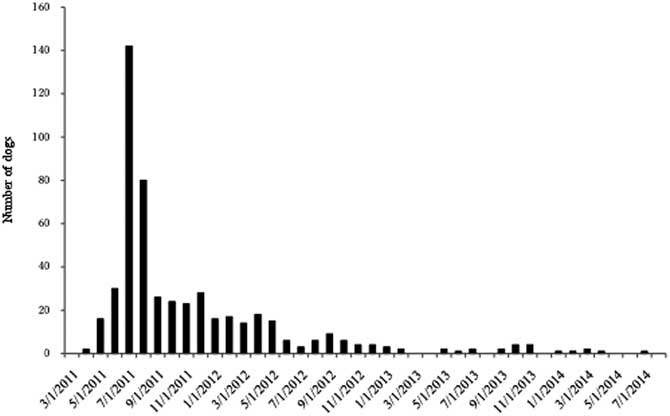
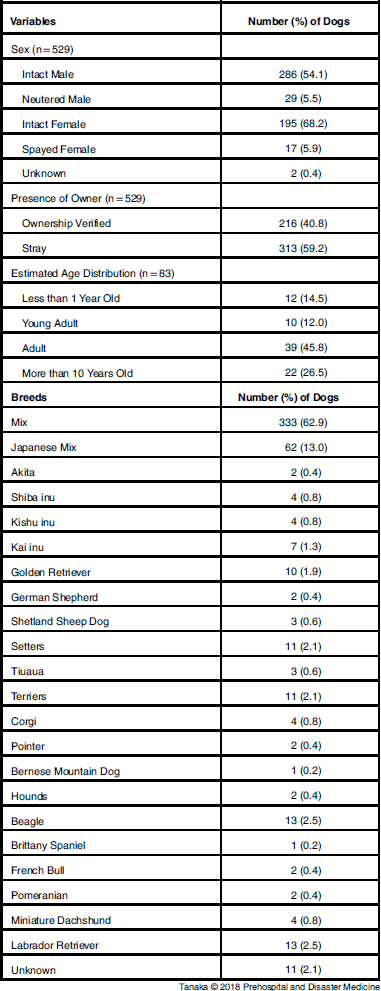
Five-hundred and twenty-nine dogs were rescued from March 31st, 2011 through July 4th, 2014 (Figure 1). Table 1 shows their sex, ownership status, estimated age distribution, breed, and disposition. Vaccination dates were recorded for 50 dogs that received rabies vaccine (Matsuken Pharmaceutical Industry Co., LTD; Japan) and inactivated vaccine against canine distemper virus, canine adenovirus type II, infectious canine hepatitis virus, canine parainfluenza virus, canine parvovirus, canine coronavirus, and canine leptospirosis (Kyoritsu Seiyaku Corporation; Japan), with a median time from intake to vaccination of four (95% CI, 2-9; range 0-31) days.
The Number of Dogs Rescued in Fukushima Prefecture and Admitted to the Ihno and Miharu Shelters from 2011-2014.

Characteristics of Dogs Admitted to the Ihno and Miharu Shelter in Fukushima from 2011-2014

Seventy-six percent of the dogs were mixed breeds. There was no significant association between breed and ownership status (P=.407). Three-hundred thirty-eight (63%) dogs were adopted, with a median time to adoption of 175 (95% CI, 159-190; range 0-1,208) days; 84 (16%) dogs were returned to the owner, with a median time to return of 285 (95% CI, 217-367; range 2-1,059) days; 55 dogs were transferred to other prefectures (range 9-1,195) days, 25 dogs died at the shelter (range 0-1,166) days, and 27 (5%) dogs were still at the shelter at the time of data collection (June 2014).
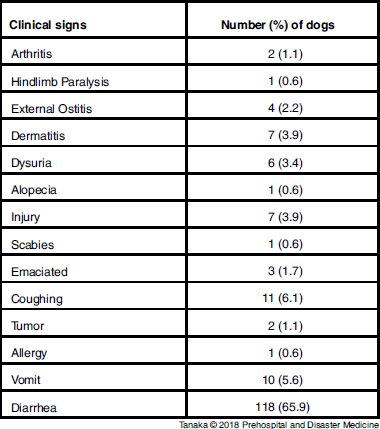
Medical records were retrieved for 179 dogs transferred to the shelter in Miharu from the Ihno shelter. Clinical signs observed among these dogs are listed in Table 2. Gastrointestinal signs including diarrhea and vomiting were the most commonly observed, and respiratory signs such as coughing were the second most commonly observed after entering the shelter. Parturition was observed following shelter admission in 11 dogs.
Clinical Signs Observed in 179 Dogs at the Ihno and Miharu Shelters in Fukushima, 2011-2015

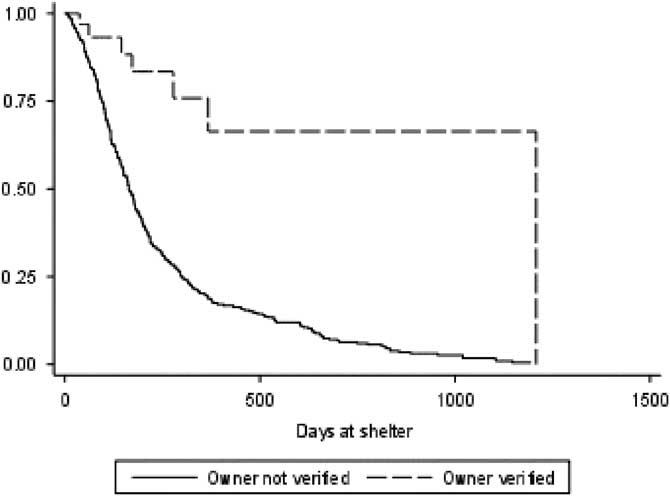
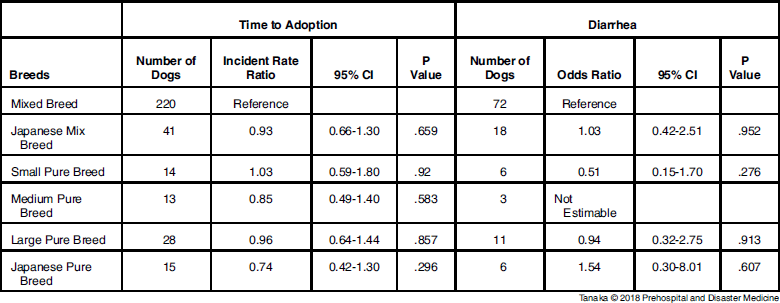
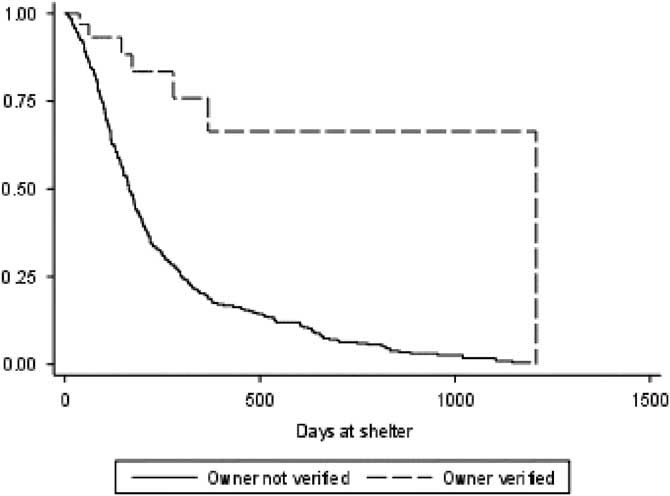
Ownership status, age, and breed: 26% (137/529) of the dogs had verified ownership, and the median time for the owners to transfer their ownership of the dogs to the shelter was 162 (95% CI, 129-213; range 0-1,106) days. Approximately 75% of dogs were medium or large mixed breeds. The purebred dogs were predominantly medium to large breeds, and small breeds only accounted for 16% of purebreds. Dogs with verified ownership took longer for adoption than those without verified ownership (IRR=0.16; 95% CI, 0.07-0.37; P<.001; Figure 2). Breed (Table 3) and sex (IRR=0.97; 95% CI, 0.90-1.04; P=.362) were not significantly associated with time to adoption. Age was associated with prolonged time to adoption (IRR=0.91; 95% CI, 0.85-0.98; P=.009). Japanese purebreds such as Akita, Shibainu, Kishu inu, and Kai inu were reclaimed faster than mixed breeds (IRR=3.31; 95% CI, 1.74-6.33; P<.001). Age (IRR=1.04; 95% CI, 0.85-1.26; P=.721) and sex (IRR=0.90; 95% CI, 0.73-1.12; P=.338) were not significantly associated with time to reclamation.
Kaplan-Meier Plot Showing Time to Adoption for Dogs With (n=53) or Without (n=392) Owner Verification in the Ihno and Miharu Shelters, Fukushima Prefecture, 2011-2015.
Cox Regression Analysis of the Association Between the Time to Adoption and Breeds, and Logistic Regression Analysis of the Association Between Development of Diarrhea and Breeds for the Dogs at the Ihno and Miharu Shelters in Fukushima Prefecture, 2011-2015

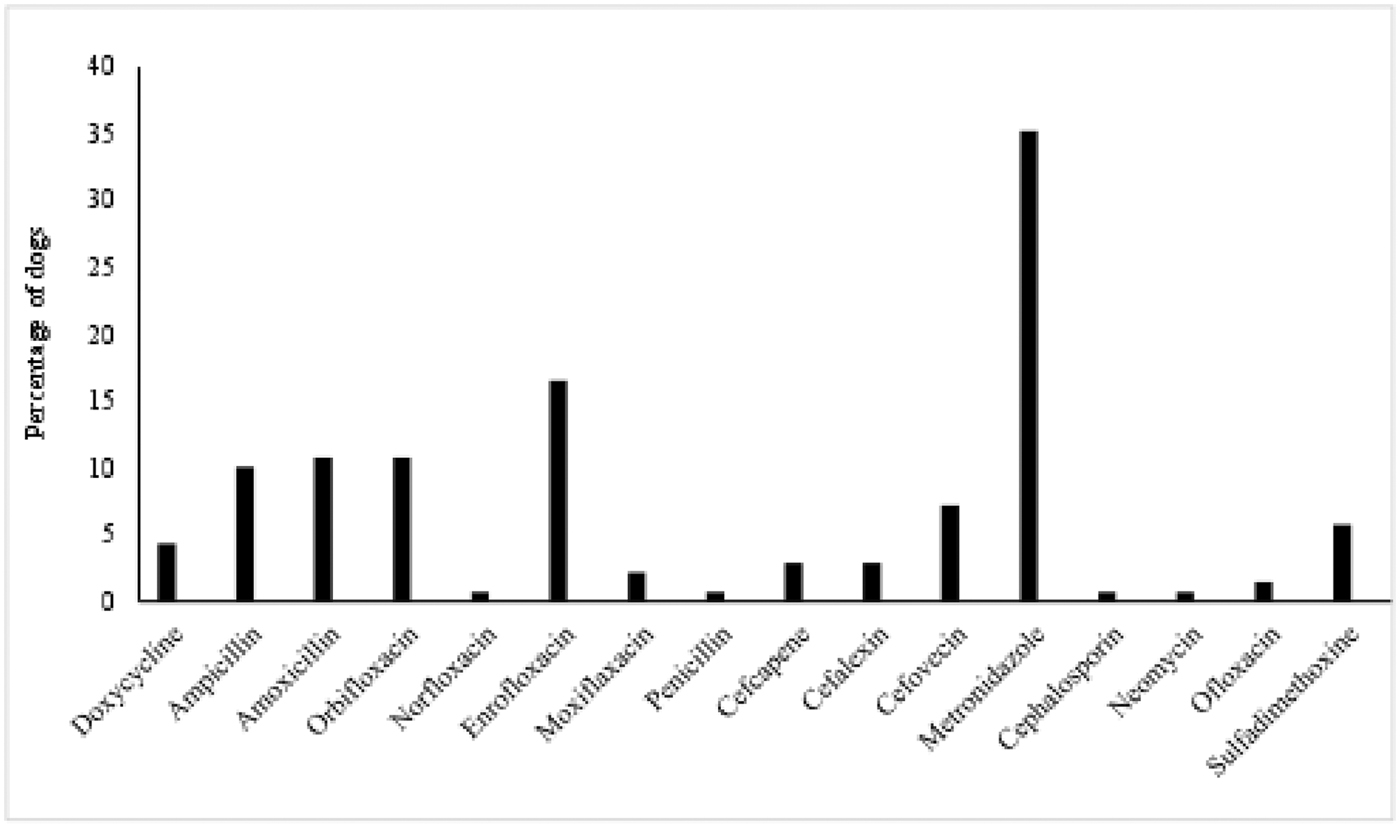
Diarrhea was observed in 66% of the dogs, and the median time from intake to the onset of the signs was 67 (95% CI, 55-80; range 1-177) days. Breed (Table 3), age (OR=1.06; 95% CI, 0.87-1.29; P=.545), and ownership status (OR=0.86; 95% CI, 0.46-1.62; P=.645) were not associated with the development of clinical signs. The median duration of the signs was three (95% CI, 3-4; range 1-40) days. Seventeen different antibiotics were used to treat diarrhea (Figure 3). Using three or more different antibiotics for diarrhea was associated with prolonged duration of the signs (IRR=0.47; 95% CI, 0.23-0.93; P=.031) compared to not using antibiotics. The number of different classes of medications administered besides antibiotics was not significantly associated with the duration of the signs (IRR=0.78; 95% CI, 0.53-1.15; P=.210). Diarrhea was not significantly associated with time to adoption (IRR=0.80; 95% CI, 0.50-1.29; P=.365) or reclamation (IRR=0.72; 95% CI, 0.41-1.26; P=.252).
Antibiotics Administered to Dogs to Treat Diarrhea at the Ihno and Miharu Shelters in Fukushima Prefecture (n=118).

Discussion
Most of the 2,000 dogs stolen from the restricted area in Fukushima Prefecture were small purebreds, and 304 dogs evacuated with the owners were also mostly small purebreds, which may be the reason why most of the dogs impounded at the shelter were mixed breeds, and small purebreds accounted for only 16%. Only 16% of dogs were reclaimed by the owner. A critical reason for low reclamation is that most temporary housing for evacuees in Fukushima Prefecture did not allow dogs, and it is generally difficult to find pet-friendly housing in Japan, especially for medium to large dogs. A high percentage of mixed breed dogs was common in other shelters,Reference Mondelli, Prato Previde, Verga, Levi, Magistrelli and Valsecchi 9 – Reference New, Salman, King, Scarlett, Kass and Hutchison 11 and the tendency of small breed dogs to be preferentially reclaimed by owners was observed in one study,Reference Patronek, Glickman and Moyer 12 although breeds were not associated with adoption nor reclamation in the shelter in Fukushima Prefecture. The most common purebred dogs were Labrador Retrievers, Beagles, Terriers, Setters, Golden Retrievers, and Japanese breeds such as Shibainus, Kishu inus, Kai inus, and Akitas; one report from the US also indicated Labrador Retrievers, Golden Retrievers, and Beagles as common breeds relinquished at shelters.Reference Patronek, Glickman and Moyer 12
One possible reason for high evacuation failure for dogs in this disaster is that approximately 84% of the dogs were mixed and large breed dogs, and most were kept outdoors. A key risk factor for pet evacuation failure is living outside, as well as low commitment and low attachment to pets.Reference Heath, Beck, Kass and Glickman 13 The area affected by the nuclear disaster is rural, and peoples’ perspectives towards pets and ownership are different from those in the urban areas of Japan. Many people keep dogs as outdoor watch dogs rather than companions; therefore, the commitment or attachment might have been low for those who did not evacuate with their dogs. At regular shelters not designed to temporarily impound animals during disasters, behavior problems,Reference Salman, New, John, Scarlett, Kass, Ruch-Gallie and Hetts 10 receiving little veterinary care, and being sexually intact were also risk factors for owner relinquishment.Reference Patronek, Glickman, Beck, McCabe and Ecker 14
Diarrhea was observed in 66% of the dogs. Diarrhea in dogs is extremely common in shelters; various etiologies include change of diet,Reference Simpson 15 stress,Reference Bhatia and Tandon 16 bacterial and viral pathogens, and predisposing diseases.Reference Greene 17 Multiple enteropathogens have been reported in dogs at shelters, such as Cryptosporidium spp, Cyroisospora spp, Giardia spp, Salmonella spp, Campylobacter spp, Clostoridium spp, and Escherichia coli; however, all have been identified in both normal and diarrheic dogs.Reference Tupler, Levy, Sabshin, Tucker, Greiner and Leutenegger 18 , Reference Sokolow, Rand, Marks, Drazenovich, Kather and Foley 19 Metronidazole was used in 35% of dogs, which is the drug of choice for Giardia sppReference Barlough 20 and Clostridium difficile infection, while many other diarrheal diseases including Salmonella, Clostridium, and Campylobacter infections are uncomplicated, self-limiting, and antimicrobial therapy is unwarranted.Reference Marks, Rankin, Byrne and Weese 21 , Reference Weese 22 In this shelter, 17 kinds of antibiotics were used to treat diarrhea, and enrofloxacin was used in 20% of the diarrheic dogs. Increased use of fluoroquinolones in dogs and cats has contributed to the development of antibiotic resistance in Salmonella spp, and multi-drug-resistant Salmonella infection in humans from animals at shelters has been reported.Reference Wright, Tengelsen and Smith 23 Antibiotic treatment of diarrhea in shelters should be performed with caution due to concerns about development of antibiotic resistance,Reference Wright, Tengelsen and Smith 23 , Reference Foley, Rand, Bannasch, Norris and Milan 24 and preventative measures to reduce stress such as environmental enrichment should be considered at the same time.
Coughing was the second most common clinical sign observed in this shelter. Another report indicated that coughing and diarrhea were the most common diseases in dogs from shelters.Reference Wells and Hepper 25
Confinement in cages in shelters causes stress in dogs separated from their familiar environments and social interactions, and are spatially restricted. All the dogs in the Ihno shelter were housed in individual cages with minimum care, human interaction, and exercise. Loss of muscle mass, aggression, and barking were common. Chronic stress caused by social and spatial restriction induces changes in behavior such as vocalization, aggression, excitement, and uncertainty,Reference Beerda, Schilder, Van Hooff, De Vries and Mol 26 and physiological changes such as elevated cortisol levels.Reference Beerda, Schilder, Bernadina, Van Hooff, De Vries and Mol 27 – Reference Stephen and Ledger 29
The ownership status of pets at the shelter in this disaster event was unclear, and adoption was delayed because of waiting for owners to turn in an agreement to relinquish, creating needless stays at the shelter for many dogs. The ownership of abandoned animals should, in the future, be transferred to the shelter at the time of intake, promptly making the animals available for adoption under certain conditions (ie, the new adopters would cede ownership if the previous owner wanted to reclaim their pets) to minimize the duration of shelter stay.
Well-organized volunteer training for care of shelter animals could be implemented with a registration system, and in case of a disaster, those registered volunteers could be dispatched to the affected area to avoid confusion and disruption. Immediately after the disaster in Fukushima, many enthusiastic but untrained people interjected themselves into the affected area and impeded care by causing confusion. This negative experience with volunteers led the local government and veterinary medical association to refuse to accept any volunteers at the Ihno shelter, which deleteriously affected animal welfare.
Human interaction with shelter dogs has been proven to reduce stress and facilitate compatible adoption,Reference Hennessy, Williams, Miller, Douglas and Voith 6 – Reference Bergamasco, Osella and Savarino 8 and one study suggested that a high-quality diet would also improve adverse behavior.Reference Hennessy, Voith and Young 30 Trained volunteers capable of handling shelter dogs and providing such diets can play an important role in improving mental and physical wellness by reducing stress and diarrhea. The Miharu shelter was better organized, and the damage from the disaster had gradually abated compared to when the Ihno shelter was operational, and trained volunteer staff were engaged in the care of dogs.
Limitations
Limitation of the study was that most of the small purebred dogs were either stolen or evacuated with owners before the rescue started and not all the dog populations in the evacuated area were included in the study population, which made it difficult to illustrate entire picture of the effect of the disaster in dog population.
Conclusion
To avoid evacuation failure, owner education is essential, especially in rural areas in Japan where owner commitment and attachment may be lower. In order to improve the welfare of dogs and avoid confusion in disasters, it is important to establish a registered volunteer training program to allow proper care for animals at shelters, development of disease management protocols, and enrichment strategies to prevent stress and disease. In addition, incorporating animals in disaster preparedness planning, and cooperating with first responders before the disaster, are essential to save both animals and people during the disaster.