Introduction
The last two decades of the twentieth century saw unprecedented levels of structural reform in health care in the United Kingdom. More recently, however, greater emphasis has been placed on the need to change organizations culturally alongside structural reforms, with the aim of achieving effective improvement in health care performance.Reference Davies, Nutley and Mannion1–Reference Scott, Mannion, Davies and Marshall3 The precise nature of organizational culture in health care policy is unspecified and the desirability and feasibility of strategies to be adopted has been questioned.Reference Ormrod4
Much of the early literature linking organizational culture to performance came from industry. This literature takes as its focus, new forms of ‘participative’ work systems pioneered by leading Japanese firms during the 1970s and 1980s that transformed workplaces, offering a more humane working environment. This focus has shifted recently from the private to the public sector and has formed key strands of health care policy.
The notion that organizational culture can affect performance in health care rests on a number of assumptions: that health care organizations have cultures that are identifiable, that culture is related to performance, that culture can be altered to impact on performance and that intervention will provide a worthwhile return on investment, with the positives outweighing any dysfunctional consequences.
Over the past half a century, ensuring high quality, dignified care for vulnerable groups of service users, such as frail older people, has been a continuing challenge.Reference Townsend5 In 2001, the then Labour Government in England, following widespread concerns about the poor standards of acute care for older people,6 introduced the National Service Framework (NSF) for Older People.7 This was a 10-year programme of reform intended to enhance independence and good health for older people by promoting ‘culture change so that all older people and their carers are always treated with respect, dignity and fairness’. A recent report, however, has found that many acute hospital wards still fail to adequately meet the need for dignified care of older people.Reference Tadd, Hillman, Calnan, Calnan, Bayer and Read8
The aim of this review is to explore the literature to ascertain whether any reliable evidence could be found that supports the assertion that organizational culture in health care organizations is related to their performance in terms of activity and outcomes.
The rise of culture in health care reform
Despite the emphasis historically on structural change, the notion of culture has not been ignored in health system reforms. Since the late 1990s, the management of organizational culture has been increasingly viewed as a necessary part of health system reform, and the need for changes in culture have been highlighted in official policy documents such as A First Class Service9 and the implementation proposals following The NHS Plan.10 These documents talk of cultures of excellence, no-blame cultures, high trust and learning cultures as desirable for a reformed National Health Service (NHS). Moreover, various forms of ‘bad’ cultures (blame culture, macho culture, culture of secrecy and so forth) are perpetually portrayed as the villains when enquiries speak of organizational failures. Perhaps the most notorious of these villains was the ‘club culture’ highlighted in the Kennedy Report on paediatric care and surgery in Bristol.Reference Kennedy2
In 2008, a survey conducted in 325 English NHS primary and acute trusts revealed that 98% of clinical governance managers interviewed saw the need to measure local culture in order to foster change and improve performance; nearly all of them (99%) acknowledged the importance of understanding and shaping local cultures, but the majority (88%) were also conscious that there are many challenges to overcome in implementing and sustaining beneficial culture change.Reference Konteh, Mannion and Davies11 It is therefore timely and important to review the evidence linking organizational culture with health care performance.
In their study, Mannion et al.Reference Mannion, Davies and Marshall12 found that acute trusts are utilizing a wide variety of strategies, tactics and specific initiatives to drive cultural change. These strategies include:
• Training and educational initiatives – perhaps supported by external agencies (i.e. Clinical Governance Support Team).
• External assessments (star ratings and Commission for Health Improvement (CHI) inspections).
• Leadership – and in particular, consistency between rhetoric and actions.
• Emphasis on practical demonstrations of the value placed on health professional groups (particularly nurses and allied professional groups) as a means of strengthening a safety culture.
• Partnership and collaborative working with local agencies to improve co-ordinated care.
Defining organizational culture
Notions of ‘culture’ have deep roots in the anthropological literature stretching back many decades.Reference Malinowski13 The application of these ideas to organizations rather than indigenous peoples began in the United States during the immediate post-war period,Reference Whyte14, Reference Blau15 but came to popular attention in the 1980s. During this period, a number of management texts became particularly influential in promoting the notion that ‘organizational culture’ was crucial in the management of organizational performance’.Reference Peters and Waterman16–Reference Deal and Kennedy18 Over the last two decades, interest in organizational culture has grown apace and has received extensive study across many workplace settings, including health care organizations.Reference Mannion, Davies and Marshall12, Reference Harrison, Marnoch, Hunter and Pollitt19–Reference Gerowitz, Lemieux-Charles, Heginbothan and Johnson21
In studies of organizational culture, the primary methodological principle is to investigate organizations as mini-societies,Reference Allaire and Firsirotu22, Reference Ashkanasy, Jackson, Anderson, Ones, Sinangil and Viswesvaran23 to illuminate the interpretations and understandings participants have of their role in the technical, social and political life of an organization. Among scholars, however, there is little consensus concerning the precise meaning of organizational culture and a plethora of definitions can be found in the literature.Reference Alvesson24–Reference Brown26 Most definitions recognize implicitly the socially constructed nature of the phenomenon, locate its generation in pervasive, normative beliefs and values, and view its expression in terms of patterns of behaviour. For these reasons, in particular, Mannion et al.Reference Mannion, Davies and Marshall12 drew on the work of Schein,Reference Schein27 who defined organizational culture as:
The pattern of shared basic assumptions – invented, discovered or developed by a given group as it learns to cope with its problems of external adaptation and internal integration – that has worked well enough to be valid and, therefore, to be taught to new members as the correct way to perceive, think, and feel in relation to those problems.
Thus what essentially distinguishes one culture from another is their varying and vast pools of tacit knowledge – which natives understand but are not necessarily conscious of knowing.Reference Mannion, Davies and Marshall12 Culture is thus not merely observable in social life, it is moreover the shared cognitive and symbolic context within which a society or institution can be understood.
Shared cultural values
While there may be values and beliefs that are wide, deep and shared across an organization, at the same time there will be stronger sets of more coherent cultures that are more readily observable in subgroups of the organization. Most clear among these are the subgroups of the different medical subspecialities, nursing and therapeutic professions. Each subgroup will have developed through education and training and maintained by influences outside the employing organization (for example, by professional bodies such as the Royal Colleges). In addition, working patterns may be heavily influenced by coherent cultures within specific teams.
Any analysis of organizational culture thus needs to identify and assess the dominant subcultures, their influences and their interactions. These subcultures may enhance the dominant culture in ways that are viewed as being positive (i.e. successful multidisciplinary teams, centres of excellence), while others may simply tolerate the organizational culture but draw their values and beliefs primarily from outside (i.e. medical subspecialities). In times of change, countercultures may also rise, overtly or covertly, to challenge the dominant organizational culture. Such patterns of resistance were evident during the structural reforms to the NHS in the 1980s and early 1990s.
Levels of culture
While the precise definition of ‘organizational culture’ remains contested, many commentators agree that the notion is layered in nature. Schein'sReference Schein27 identification of three levels of ascending importance offers one of the most widely acknowledged frameworks for analysis:
Level 1: Artefacts – the most visible manifestations of culture, including rituals, rewards and ceremonies. Artefacts are especially concerned with the observable patterns of behaviour within organizations.
Level 2: Beliefs and values – espoused beliefs and values which may be drawn on in justifying particular patterns of behaviour and which form the basis in choosing between alternative courses of action; for example, a belief in evidence or assertions concerning patient autonomy.
Level 3: Assumptions – the real, unspoken, largely unconscious beliefs, values and expectations held and shared by individuals; these may be signalled by artefacts that belie the espoused beliefs and values; for example, biomedical (compared with psychosocial) understanding of health and illness may exert significant (perhaps unnoticed) influence.
For all that these varying levels of culture have been identified and conceptualzed, relatively little work to date has succeeded in exploring the deeper levels of culture.Reference Scott, Mannion, Davies and Marshall3, Reference Mannion, Davies and Marshall12, Reference Scott, Mannion, Davies and Marshall28, Reference Scott, Mannion, Marshall and Davies29
Defining performance
The notion of performance presents additional problems as in any organization, a number of possible measures exist. This is particularly so in the field of health care, with measures of clinical process, health outcomes, access, efficiency, productivity and employee variables all offering some potential. In addition, different channels of communication may convey different information relating to performance. For example, ‘hard’ information contained in league tables may differ from ‘softer’ intelligence circulating around informal social networks.Reference Goddard, Mannion and Smith30
According to Scott et al.,Reference Scott, Mannion, Marshall and Davies29 the essential ambiguity surrounding ‘performance’ arises from three primary senses of the nature of performance: performance as enacted behaviour – relating to socio-technical processes of care; performance measured in terms of end-points or outcomes; performance as a dramatic event. There is a tendency in each of these meanings to invoke the others. Thus a surgical procedure implies both technical performance and a desired outcome, as well as entailing aspects of dramatic production. A consultant's ward round is an event as well as a ceremonial vehicle for demonstrating important social and technical competencies, including diagnostic skills, communication, therapeutic knowledge and learning. Finally, Scott et al.Reference Scott, Mannion, Marshall and Davies29 note that performance data (whether relating to waiting times, medical errors or comparative data on mortality) of necessity imply a series of socio-technical processes behind the statistics.
Relating culture and performance in non-health care settings
Since the early 1980s, there has been a significant growth in literature outside of health care examining the relationship between organizational/corporatist culture and performance. Much of this literature focuses on new forms of work organization and skills pioneered by leading Japanese firms. A past characterized by Fordist mass production has been compared with the current progressive manufacturing paradigm. This ‘new orthodoxy’ proposes that ‘old’ forms of work organization and production based on ‘Taylorist’ forms of control are increasingly counterposed to ‘new flexible’ work patterns, characterized by loosened (or even abandoned) central managerial control of the labour process. These new forms of work and organization are ascribed powers of liberation for labour and are coupled to processes of transformation in wider society.
This transition from Fordism to post-Fordism and the rise of ‘participative work systems’ was associated with a significant transformation in the nature of the industrial economy and society. Piore and SabelReference Piore and Sabel31 identified this as ‘the second industrial divide’. They argued that as a consequence of a series of ‘external shocks’ (e.g. increases in the price of oil), advanced industrial societies were witnessing the emergence of a new form of industrial organization, which was altering all facets of economic activity, including the nature of markets, relations between firms, and relations between industry and the state. Central to this were changes in relations between capital and labour, changes towards more skilled, more flexible and efficient working practices based around the potential of revitalized craft practices, and advanced manufacturing technologies.
The rise of ‘participative work systems’ has been linked, by many observers, to the rise of new micro-processor-based technologies that were diffusing through Western economies in the 1970s and 1980s, emphasizing the potential benefits of changes in production technologies to both capital and labour.Reference Dankbaar32 New technologies of production have the potential to eliminate the most tedious and dangerous jobs, while upgrading the skill and responsibility levels of those who remain. It is believed that new computer-based technologies differ from earlier waves of industrial innovation.Reference Milkman, Thompson and Warhurst33 Automation involved, in the past, the use of ‘dedicated’ machinery to perform specific functions previously done manually. However, new information-based technologies are flexible, enabling a single machine to adapt to a variety of specific tasks. New technologies thus require workers to use ‘intellective’ skillsReference Zuboff34 and represent a radical break with Taylorism, moving towards more rewarding, skilled jobs and workplaces where learning is encouraged and rewarded. ‘Learning is the new form of labour’.Reference Zuboff34 The potential for gains in productivity can only be realized if management cede more control over decision making to workers, the increased participation of workers being in the best interest of the company.Reference Zuboff34, Reference Hirschorn35
For Kenney and Florida,Reference Kenney and Florida36 Japan is the quintessential ‘post-Fordist’ society. The industrial principles that underpin Japanese competitive success are thought to be transferable to other countries.Reference Florida and Kenney37, Reference Schonberger38 Compared with Fordist labour processes, the Japanese approach ‘offers a much more humane working environment’.Reference Kaplinsky39
During the 1980s, Japanese firms introduced into the United States methods known as ‘lean production’, a system that draws on teams of multi-skilled workers at all levels of the organization, and uses highly flexible, increasingly automated machines to produce high volumes of products in enormous variety. This, according to a team of industry analysts at the Massachusetts Institute of Technology, had the potential to ‘change the world’, through providing products in wider variety at lower cost, whilst engaging the worker in problem solving and ‘think’ work.Reference Womack, Jones and Roos40
Over the last two decades, such claims have won widespread public acceptance as new technologies and organizational reform have transformed an increasing number of workplaces. More recently, this ‘new orthodoxy’ has been transferred from the private to the public sector and has formed major strands in policy and management within health care.
Relating culture and performance in health settings
Methods of literature review
Electronic searches were undertaken of ASSIA and PubMed databases for research that had collected data about some aspect of organizational culture and performance. The review was limited primarily to English language studies in the health arena but not to any particular nation state or setting. The search terms were organizational culture OR culture change AND performance AND health or health care. The abstracts of potentially relevant citations were examined to determine the relevance of the original research. Full texts of all relevant articles were then obtained. In addition, bibliographies and secondary references of obtained articles were examined for additional studies. Government reports were searched for online.
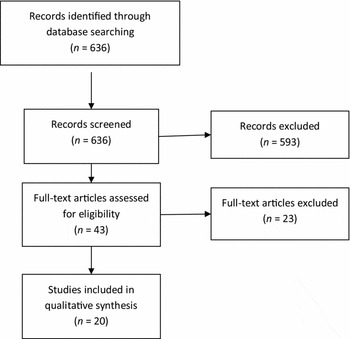
Eligibility criteria for inclusion of articles in our review were: research that was original and published between 1993 and 2010 that related to aspects of organizational culture and culture change in a health care setting, and that examined the effects of this on performance. Abstracts of identified papers were read initially by J.H., and discussed with other members of the authorship where there was uncertainty about relevance. Full texts of all relevant articles were then obtained. Of the 636 papers identified on initial screen, 593 did not meet the inclusion criteria and 43 full articles were retrieved. We identified 20 original papers examining a relationship between organizational culture and health care performance (see Figure 1). Six of these studiesReference Gerowitz41–Reference Zimmerman, Rousseau, Duffy, Devers, Gillies, Wagner, Draper, Shortell and Knaus46 were also in a paper by Scott et al.Reference Scott, Mannion, Marshall and Davies29
Flowchart of included studies

Organizational culture and performance: activity and outcome
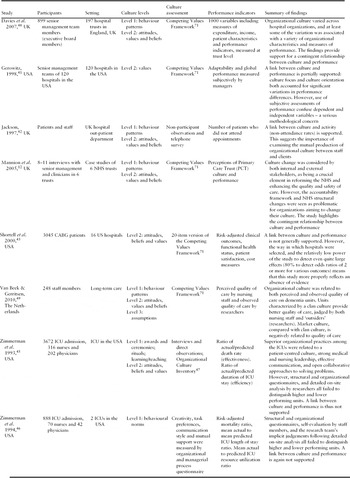
The eight studies relevant to organizational culture and performance, as reflected by activity and outcome, are shown in Table 1. The literature on organizational culture in health care highlights the complexities of any relationship between culture and performance, and the methodological difficulties in attempting to capture such relationships. Firm evidence for a link between culture and activity is limited and, despite some good studies, we found no evidence for a link between culture and health care performance in terms of clinical outcomes.
Organizational culture and performance: activity and outcome (adapted from Mannion et al.Reference Mannion, Davies and Marshall12 and Scott et al.Reference Scott, Mannion, Marshall and Davies29 and updated for this paper)

CABG, coronary artery bypass graft; ICU, intensive care unit.
One studyReference Jackson42 measured performance in terms of activity (rates of non-attendance for appointment) and supports a link between culture and performance. This study was conducted solely in the UK and highlights the importance of examining organizational culture as being mutually produced by both staff and patients. Non-participant observations of a hospital paediatric out-patient department were used to view the processes and attitudes of patients and staff during a typical out-patient session. Observations were supplemented with a telephone survey of patients/parents of patients who did not attend for their hospital appointment. This study highlights the potential interplay between the culture of the organization and patient behaviour. Patients’ attitudes and non-attendance for their hospital appointment may be influenced by the promptness of reception staff in attending to them. High levels of non-attendance may, in turn, influence the attitudes and behaviour of staff towards patients. Moreover, Jackson's studyReference Jackson42 highlights conceptual and methodological problems in distinguishing between culture and performance. Scott et al.Reference Scott, Mannion, Marshall and Davies29 note that what Jackson is observing are two aspects of process performance (the enactment of staff and patient roles) together with an activity outcome (non-attendance rates).
Three studies measured clinical outcomes (mortality rates, health status) as part of their performance indicators but failed to find a link between culture and performance.Reference Shortell43, Reference Zimmerman, Shortell, Rousseau, Duffy, Gillies, Knaus, Devers, Wagner and Draper45, Reference Zimmerman, Rousseau, Duffy, Devers, Gillies, Wagner, Draper, Shortell and Knaus46 The study of Zimmerman et al.Reference Zimmerman, Shortell, Rousseau, Duffy, Gillies, Knaus, Devers, Wagner and Draper45 involved 3672 Intensive Care Unit (ICU) admissions, 316 nurses and 202 physicians in nine ICUs in the United States. The assessment of culture was made utilizing a combination of interviews, direct observations and questionnaires, including the Organizational Culture Inventory.Reference Cooke and Lafferty47 Effectiveness was measured by the ratio of actual/predicted hospital death rate, and efficiency was measured by the ratio of actual/predicted length of ICU stay. Assessments of culture were made, blinded by actual mortality rates. The results of the organizational analysis indicated that superior organizational practices among the ICUs were related to a patient-centred culture, strong medical and nursing leadership, effective communication and co-ordination, and open, collaborative approaches to problem solving and the management of conflict. The on-site case studies, however, failed to predict, with any accuracy, those units with significantly better or worse performance in terms of risk-adjusted survival. This failure may be due to mismatch between the subjectively based on-site investigations of organizational culture and the objective assessment of actual risk-adjusted mortality. Zimmerman et al. followed up this earlier study with a more detailed study of two ICUs.Reference Zimmerman, Rousseau, Duffy, Devers, Gillies, Wagner, Draper, Shortell and Knaus46 The findings of the later study do not differ from those of the earlier study.
In a study of 3045 patients undergoing coronary artery bypass grafts in 116 hospitals, Shortell et al.Reference Shortell43 found that although a 2- to 4-fold difference in all major clinical coronary artery bypass grafts was observed among the 116 hospitals, little of this variation was associated with the impact of Total Quality Management (TQM) or organizational culture on performance in any systematic way. Patients receiving coronary artery bypass grafts from hospitals with high TQM scores were more satisfied with their nursing care but were more likely to have lengths of stay of 10 days or more; a supportive group culture was associated with shorter post-operative intubation times but longer operating room times; and a supportive group culture was also associated with higher patient physical and mental functional health status scores 6 months after coronary artery bypass grafts. Thus the study provides only weak and inconsistent evidence of associations between culture and performance.
Mannion et al.Reference Mannion, Davies and Marshall12 sought to explore further the nature of any linkages between organizational culture(s) and performance(s) in NHS settings in the UK – ‘whether’ there is a link and ‘how’ such links may be expressed and mediated. Utilizing a multi-method approach, Mannion and his colleagues drew on case studies from six acute hospital trusts. In their study, they found ‘overwhelming support’ across a ‘broad range of stakeholders’, internal (managers, clinicians and so forth) and external (consumer advocacy groups, Royal College senior officers, union leaders), for utilizing ideas of culture change in reforming the NHS. Culture change was considered crucial in improving the working lives of staff, and in enhancing the quality and safety of care patients and their carers received. Additionally, Mannion and his colleagues document a number of examples where culture change policies were considered to be having a positive impact on the organization (e.g. more openness, greater degree of patient-centred care, more team working and less restrictive practices).
The work of Mannion et al. highlights the methodological challenges in ‘measuring’ culture and the bi-directional nature of links between culture and performance.Reference Mannion, Davies and Marshall12 According to Mannion et al., ‘(T)he complex grouping, layering and subculturing that exist in organisations can never be fully captured’. Focusing primarily on the culture of NHS managers, in particular senior managers, their study highlights both the complexity and contested nature of the notion of culture. However, their study suggests significant quantitative associations between existing cultures and various aspects of measured performance. The Competing Values Framework (CVF) typology utilized by Mannion and his colleagues highlighted that different culture types may be more or less able to perform, depending on those aspects of performance valued within that culture. For example, acute trusts with developmental cultures were less likely to be awarded poor star ratings; trusts with hierarchical structures were more likely to perform well in terms of waiting times; and those with clan cultures scored better on measures of satisfaction among staff. These findings by Mannion and his colleagues reinforce the findings of previous work carried out across the US, the UK and Canada.Reference Gerowitz, Lemieux-Charles, Heginbothan and Johnson21
The work of Mannion et al.Reference Mannion, Davies and Marshall12 further draws attention to the ways in which performance and culture interact in an iterative manner, maybe even being mutually constituted. For example, highly visible performance assessments (such as star ratings) impacted on culture both directly (e.g. by influencing staff morale) and indirectly (through renewed management activity). Thus, they note, ‘while culture and performance seem to be linked in important and substantive ways, such links are many, varied, contingent and bi-directional’.Reference Mannion, Davies and Marshall12 This notion of a contingent relationship between culture and performance is further supported in the work of Davies et al.,Reference Davies, Mannion, Jacobs, Powell and Marshall48 who identified variations of organizational culture across hospitals that was associated with organizational characteristics and performance measures.
The final study to identify a relationship between organizational culture and performance in terms of activity and outcome is that of van Beek & Gerritsen.Reference Van Beek and Gerritsen49 Their study indicates that organizational culture in long-term dementia care is important for organizational performance. Drawing on the CVF, van Beek and Gerritsen used two independent measures of quality of care: the perceived quality of care by nursing staff of dementia units and the observed quality of care on the units by researchers. Their study found that organizational culture in long-term care is related to quality of care. Units that have a strong clan culture provide better quality of care than units with a market culture, according to nursing staff as well as to observers.
Organizational culture, health care performance and job burnout
A key challenge in linking organizational culture to quality of care is to identify the focal point at which a deficient hospital culture and inadequate organizational resources are most evident. Montgomery et al.Reference Montgomery, Panagopoulou, Kehoe and Valkanos50 argue that the ‘accumulated evidence’ suggests that such a point is physician burnout. They highlight the work of Bakker et al.,Reference Bakker, Schaufeli, Sixma, Bosveld and Van Dierendonck51 who argue that confrontation with demanding patients over a period of time produces perceptions of inequity and a lack of reciprocity in the General Practitioner (GP)/patient relationship, which, in turn, depletes the emotional resources of GPs and initiates a syndrome of burnout. Thus it is not the demands of patients in itself that initiates the burnout syndrome, but rather, the resulting perception of imbalance in the relationship between GPs and their patients. Moreover, GPs suffering emotional exhaustion depersonalize from their patients and experience a reduced feeling of competence. In a similar way, Linn et al.Reference Linn, Brook, Clark, Davies, Fink, Kosecoff and Salisbury52 argue that physicians experiencing burnout withdraw from their patients as a means of coping with their exhaustion (see also Reference Leiter, Schaufeli, Maslach and Marek53, Reference Leiter and Maslach54). In a minority of cases burnout has even been related to serious mistakes and patient death.Reference Firth-Cozens and Greenhalgh55
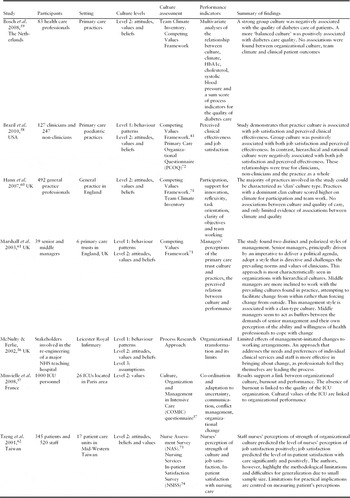
Six studies (Table 2) have explored all three issues and are highly revealing in terms of the meaningful relationship between organizational conditions (organizational culture), the ways in which physicians experience the organization (burnout, limited support) and the impact on service provision (clinical outcomes). One UK hospital studyReference McNulty and Ferlie56 that explored organizational culture and leadership showed that management-initiated changes to working arrangements had a variable and limited effect, while an approach that was adapted to the needs and preferences of individual clinical services and staff was more effective in bringing about change as professionals felt that, rather than having change imposed on them, they themselves were leading the process. In addition, the study of Minvielle et al.Reference Minvielle57 in 26 French ICUs highlighted the direct links between organizational culture, burnout and performance; with the absence of burnout being linked to quality of ICU organization, and cultural values of the ICUs being linked to organizational performance.
Organizational culture, job satisfaction and job burnout (adapted from Mannion et al.Reference Mannion, Davies and Marshall12 and Scott et al.Reference Scott, Mannion, Marshall and Davies29 and updated for this paper)

ICU, intensive care unit.
Organizational culture and job satisfaction
Brazil et al.Reference Brazil, Wakefield, Cloutier, Tennen and Hall58 examined the effect of organizational culture on job satisfaction and perceived clinical effectiveness in primary care paediatric practices located in Connecticut in the United States. Utilizing the CVF, they highlight the ways in which group culture is associated with high job satisfaction and perceived effectiveness. Their study involved 127 clinicians and 247 non-clinicians in 36 primary care paediatric practices in Connecticut, United States. Brazil and his colleagues sought to identify whether practice culture types predicted job satisfaction and perceived effectiveness. They found that high hierarchical (order, regulation, bounded by rules) and rational (competitiveness, leader as goal-oriented, emphasis on winning) oriented paediatric practices had employees, both clinicians and non-clinicians, who reported lower job satisfaction and perceived work effectiveness. In contrast, group cultures (team work, cohesiveness, participation) were associated with high job satisfaction and greater perceived work effectiveness. Brazil's study confirms recent studies in primary care showing that primary care organizations generally have group cultures.Reference Bosch, Dijkstra, Wensing, van der Weijden and Grol59–Reference Marshall, Mannion, Nelson and Davies61
A further study to explore both organizational culture and job satisfaction is that of Tzeng et al.Reference Tzeng, Ketefian and Redman62 Their exploratory project investigated the relationship between staff nurses’ assessment of organizational culture, job satisfaction and in-patient satisfaction with nursing care. The project involved 520 nurses working in a tertiary health care organization in Mid-Western Taiwan and 345 patients who had been hospitalized for at least one night in a variety of wards, medical and surgical. Tzeng found that the staff nurses’ perceptions of strength of organizational culture predicted the level of nurses’ perception of job satisfaction well and positively; job satisfaction predicted the level of in-patient satisfaction with care significantly and positively. The authors, however, highlight the methodological limitations of their study due to its small sample size, which led to difficulties for generalization. A further limitation was the reliance on patient perceptions as a measure of clinical outcome.
Organizational culture and patient safety
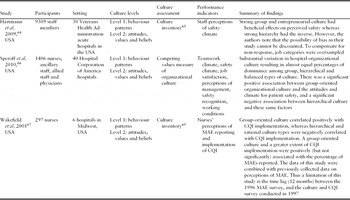
Improving patient safety is a priority in health care. Evidence on the relationship between hospital characteristics and safety outcomes remains sparse and conflicting. As shown in Table 3, few studies have examined the relationship between hospital characteristics and their patient safety climate (defined as employees’ perceptions regarding the specific issue of patient safety).Reference Cooper63
Organizational culture and patient safety (adapted from Mannion et al.Reference Mannion, Davies and Marshall12 and Scott et al.Reference Scott, Mannion, Marshall and Davies29 and updated for this paper)

MAE, medication administration error; CQI, continuous quality improvement.
Hartmann et al.Reference Hartmann, Hartmann, Meterko, Rosen, Zhao, Shokeen, Singer and Gaba64 assessed the relationship between hospitals’ organizational culture and safety climate in a quarter of Veterans Health Administration (VA) acute care hospitals in the United States. Drawing on the CVF,Reference Zamutto and Krakower65 staff perceptions of safety climate were measured using the Patient Safety Climate in Health Care Organisations (PSCHO) survey. The study involved 9309 staff members (senior administrators (defined as department head or above), hospital- based physicians and ‘other employees’) from 30 hospitals in the South, Northeast, Midwest and Western regions of the USA. Hartmann and her colleagues found a number of strong and consistent associations between organizational elements and their measure of safety climate. Consistent with research by Speroff et al.Reference Speroff, Nwosu, Greevy, Weinger, Talbot, Wall, Deshpande, France, Ely, Burgess, Englebright, Williams and Dittus66 and Wakefield et al.,67 Hartmann et al. found higher levels of group culture, characterized by mutual respect and civility, to be associated with higher levels of safety climate. Higher levels of entrepreneurial culture were associated with higher levels of safety climate. Inversely, hierarchy related to poorer outcomes. The more hierarchical the culture, the lower the level of safety climate. One possible explanation for this negative relationship may be that a strong emphasis on adherence to standard operating procedures, combined with a deference to rank, may create an environment in which workers are reluctant to raise safety issues out of concern for being blamed for breaking the rules.Reference Tucker and Edmondson68
Organizational culture and new management techniques
In 2001, Shortell and colleaguesReference Shortell44 published a study examining the implementation of evidence-based care management in US physician organizations. Utilizing the CVF, as well as a separate physician-specific patient-centred culture measure,Reference Kralewski, Wingert and Barbouche69 Shortell found that while implementation of evidence-based care was significantly associated with economic incentives such as compensation and the presence of managed care, there was no apparent relationship with culture. The authors explain the absence of any effect by noting that physician organizations in the USA are collections of physicians joined together under a legal umbrella, rather than coherent organizations with much that was shared.
A further study that explored the implementation of new management techniques is that of Konteh et al.,Reference Konteh, Mannion and Davies11 who looked at how clinical governance managers in the NHS in England were seeking to engage with the culture(s) of their organization to support quality improvement. The study found clear interest among clinical governance managers in culture renewal and management. Ninety-eight per cent of clinical governance managers saw the need to measure local culture in order to foster change for improved performance, 85% indicated that culture assessment should satisfy a formative purpose, whereas 64% believed that it should serve summative ends. While 99% of clinical governance managers acknowledged the importance of understanding and shaping local cultures, the majority were also conscious that the numerous challenges needed to be overcome in their effort to implement and sustain beneficial culture change.
Conclusions
Understanding the life of an organization through the notion of ‘organizational culture’ resonates throughout the academic and policy-related literature. Thus ‘culture matters’Reference Mannion, Davies and Marshall12 and is seen to matter, in the delivery of high levels of quality and performance in health care. Throughout the literature, there is recognition of the significance of culture and the need to engage with the shaping of it. Moreover, the literature acknowledges that, rather than a single uniform coherent culture, a variety of subcultures will exist within an organization. These subcultures may be separated along professional and occupational lines.
This literature review examining the relationship between organizational culture and performance in health care has found some evidence to suggest a relationship, but the evidence base is not extensive. This evidence, while problematic, is nonetheless supportive. A number of the studies reviewed claim to have uncovered evidence, while other studies failed to find a clear relationship. None of the studies found much evidence against. Moreover, it is clear that any relationship between culture and performance is highly unlikely to be simple: such relationships are more likely to be multiple, complex, contingent and dynamic.Reference Mannion, Davies and Marshall12
A number of the studies identified in our review draw on a typology approach to assessing culture. In these studies, the approach utilized is based on the CVF. This approach has strong origins in social theory and organizational studies. Moreover, as the CVF produces a culture typology, it is useful not only as a qualitative tool but also as an explanatory framework to aid qualitative data analysis.
The majority of studies focused on culture at Level 1 (patterns of behaviour) and Level 2 (espoused attitudes, values and beliefs). That only one of the studiesReference McNulty and Ferlie56 addressed Level 3 (assumptions), can be viewed as both a shortcoming and an indication of the difficulties in exploring the deeper levels of culture. Looking at discrepancies between espoused values and actual practice is one means of uncovering implicit assumptions.Reference Coffey and Atkinson70 The studies identified in our review drew largely on quantitative research methods. Future research that explores culture at Level 3 and seeks to address the discrepancies between espoused values and actual practice, will require greater utilization of qualitative methods.
Defining performance is problematic, as for any organization a range of possible measures exist. In health care, these measures include: measures of clinical process, health outcomes, finance, productivity, access and a range of employee-related issues. The studies reviewed examined a wide variety of measures of performance.
This literature review highlights the complexities involved in assessing the relationship between organizational culture and performance (in all its variety) in health care. That there is a definite relationship is, at present, supported by little firm evidence. Knowing whether culture is linked to performance is not enough on its own – there is also a need to uncover the ways in which they are linked, and why there is a relationship.Reference Mannion, Davies and Marshall12
Conflicts of interest
The authors have no conflicts of interest to declare.
Acknowledgements
This study was commissioned and funded by the Department of Health and Comic Relief under the PANICOA initiative. The research team wish to acknowledge this support. The views expressed are those of the authors and not necessarily those of the PANICOA programme, the NHS, the Department of Health or Comic Relief.