Introduction
Hermann introduced the use of temporalis fascia graft in tympanoplasty in 1960.Reference Hermann 1 Since then, it has become the most widely used graft for tympanoplasty across the world, as it is strong, durable, and easy to procure and handle.Reference Rizer 2 , Reference Wehrs 3 A large area (260 mm2) of the fascia on each side assures its availability, even in revision tympanoplasty. It has the added advantages of a low metabolic rate and a high collagen content.Reference Abul-Hassan, von Drasek and Acland 4 , Reference Dabholkar, Vora and Sikdar 5 Shea introduced the underlay technique of tympanoplasty at the same time that Hermann introduced the temporalis fascia graft.Reference Shea 6 A year later, in 1961, Austin and Shea modified this technique by incorporating a tympanomeatal flap elevation.Reference Austin and Shea 7 In 1973, Glasscock described the use of a post-auricular approach for underlay tympanoplasty; this is now a standard procedure worldwide.Reference Glasscock 8 An impressive success rate of more than 90 per cent is routinely observed with this technique.Reference Jackson, Kaylie, Glasscock, Brackmann, Shelton and Arriaga 9
A failure rate of 10 per cent associated with underlay tympanoplasty is attributed to numerous factors, such as: age, size and site of perforation, tympanosclerosis, status of middle-ear mucosa, eustachian tube physiology, type of graft used, haemorrhage, post-operative infection, and the otologists' surgical expertise in particular.Reference Athanasiadis-Sismanis, Gulya, Minor and Poe 10 – Reference Fukuchi, Cerchiari, Gracia, Rezende and Rapoport 12
A recent review of the literature suggested that the nature of the graft, whether it is dry or wet, might influence the outcome of tympanoplasty.Reference England, Strachan and Buckley 13 – Reference Loock and Naude 15 A dry graft might give poor results, as it rehydrates and shrinks, leading to alterations in its position relative to the perforation. Furthermore, major degenerative ultrastructural changes are seen in a dry graft associated with intra-operative preparation.Reference Alkan, Baylancicek, Sozen, Basak and Dadas 14 – Reference Walby, Kerr, Nevin and Woods 18 This affects the cellular elements in the graft, especially fibroblasts. It is hypothesised that a fresh wet graft is histologically more viable, on account of the greater number of fibroblasts, which promote wound healing, leading to better graft uptake.Reference Alkan, Baylancicek, Sozen, Basak and Dadas 14 – Reference Fisch, May, Fisch, May and Linder 16 , Reference Kumar, Abbas, Fausto, Aster, Kumar, Abbas and Fausto 19
Although the concepts of temporalis fascia graft shrinkage and dehydrated temporalis fascia graft degeneration are scientific facts, their impact on tympanoplasty has not been defined or validated. An extensive internet search revealed only two studies on the subject.Reference Alkan, Baylancicek, Sozen, Basak and Dadas 14 , Reference Loock and Naude 15 Thus, the present randomised, comparative cohort study was carried out at our institution. This study aimed to evaluate the success rate of tympanoplasty type I using an underlay technique in which dry and wet temporalis fascia graft were employed, and determine the effect, if any, of fibroblasts on the success rate.
Materials and methods
A prospective, randomised, comparative study was carried out at the ENT and pathology departments of Lady Hardinge Medical College and Smt Sucheta Kriplani Hospital, New Delhi, between 2012 and 2014. The study was approved by the Medical Division of the University Board of Studies, University of Delhi, India.
The study sample comprised 100 adult patients of either sex. These patients were selected from the ENT out-patient department, and randomly divided into 2 groups of 50 each using Research Randomizer (free web-based) software. Patients in one group underwent underlay tympanoplasty with a dry graft, whereas those in the other group underwent underlay tympanoplasty with a wet graft.
With regard to the sample size, considering the confidence limits of 90 per cent and power of 80 per cent, a minimum of 44 cases were required in each group, with expected success rates of 95 per cent for the wet graft and 75 per cent for the dry graft. This was calculated using Epi Info™ free statistical software, version 7 (developed by the Centers for Disease Control and Prevention), for unmatched case–control studies. We decided to include 50 patients in each group to account for any dropouts or non-respondents.
The following inclusion criteria were adopted in this study: the provision of informed consent, patients with chronic suppurative otitis media (mucosal type), those with a perforation in the pars tensa for a minimum period of six months, patients with a dry ear for a period of at least four weeks and an air–bone gap below 30 dB. Patients with cholesteatoma, granulation tissue in the ear, a history of previous ear surgery, only one hearing ear or hearing loss not in proportion to the perforation size were excluded from the study.
All the cases were subjected to a detailed clinical investigation. Specifically, relevant history and clinical examination were meticulously recorded in a proforma. Hearing was evaluated using pure tone audiometry, at frequencies of 0.5, 1, 2 and 3 kHz. All patients underwent routine tests for pre-anaesthetic check-up.
Thereafter, all patients underwent type I tympanoplasty under local anaesthesia, performed by a single surgeon (the first author). The grafts were procured via a post-auricular incision. For those patients who underwent a dry graft procedure, the graft was pressed in a graft press and dried with a hair dryer for 3–5 minutes just prior to insertion in the middle ear. For those who underwent a wet graft procedure, the temporalis fascia graft was procured after tympanomeatal flap elevation, just before placement in the middle ear. A small piece of temporalis fascia (dry or wet) was cut at the time of surgery and sent to the pathology department preserved in formalin for a fibroblast count (see the Fibroblast count methodology section below).
Post-operatively, patients were prescribed antibiotics (amoxicillin), analgesics (diclofenac plus paracetamol) and an anti-allergic (levocetirizine) for 7 days. All patients were discharged on post-operative day 1. The external auditory canal pack and the post-auricular stitches were removed on post-operative day 7.
Regular follow up was maintained in the ENT department on day 7 post-operatively, and again after 3 weeks, 3 months and 6 months. Repeat pure tone audiometry was conducted after six months to assess hearing improvement. The surgical and audiological results were recorded (see the Follow up section below).
The collected data were statistically analysed. As the sample sizes were small, significance was determined using the Mantel–Haenszel chi-square test (with Yates' correction) and the Fisher exact test for confirmation where applicable. Epi Info (version 7) and IBM® SPSS® Statistics (version 21) software packages were used for the statistical tests.
Fibroblast count methodology
Fibroblast counts were conducted in the pathology department. The temporalis fascia tissue sample was embedded in paraffin wax at 62 °C and cooled quickly. The sample was then cut into dimensions of 0.5 × 0.3 × 0.1 cm, and stained with haematoxylin and eosin. The stained tissue sections were examined under a light microscope to determine fibroblast count.
Follow up
For this study, an optimal follow-up period of six months was cleared by our Board of Studies. The most common causes of graft failure after tympanoplasty are improper surgical technique and post-operative infection. Thus, the first three months are the most important for graft observation; late graft failure is rare.Reference Singh, Sidhu, Sharma and Singh 20
Results
The age of patients in this study ranged from 16 to 55 years. In the dry graft group, there were 27 males (54 per cent) and 23 females (46 per cent). In the wet graft group, there were 24 males (48 per cent) and 26 females (52 per cent).
An intact graft at the end of six months was considered evidence of surgical success, and an improvement of 10 dB or more in two consecutive frequencies was considered evidence of audiological success (hearing improvement).Reference Singh, Sidhu, Sharma and Singh 20 – Reference Umapathy and Dekker 22 Hearing was assessed by comparing the air conduction thresholds of the six-month post-operative audiogram with those of the pre-operative audiogram. All residual perforations were considered surgical failures.
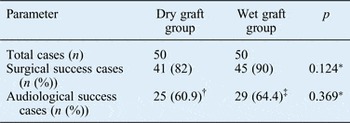
Surgical success rates of 82 per cent and 92 per cent were recorded in the dry graft group and wet graft group respectively (Table I). These data were subjected to statistical analysis (Table I) using the Mantel Haenszel chi-square test and Fisher exact test and were not found to be statistically significant (p = 0.124). Hence, it was concluded that the nature of the graft – whether the graft is wet or dry – does not influence the outcome of tympanoplasty.
Overall success

* p > 0.05 (not significant).
† Twenty-five of 41 surgical success cases had audiological improvement.
‡ Twenty-nine of 45 surgical success cases had audiological improvement
According to our audiological success criteria, out of 41 cases of surgical success in the dry graft group, only 25 showed audiological improvement. In the wet graft group, out of 45 cases of surgical success, 29 showed audiological improvement (Table I). This finding was not statistically significant (p = 0.369). Hence, both the groups had comparable audiological results.
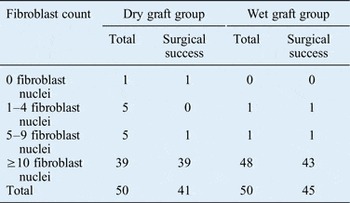
The fibroblast count was calculated in each dry and wet graft using high-power field microscopy. The fibroblast count was categorised as follows: 0 fibroblasts, 1–4 fibroblasts, 5–9 fibroblasts and 10 or more fibroblasts.Reference Alkan, Baylancicek, Sozen, Basak and Dadas 14 These data are shown in Table II.
Fibroblast count

Data represent numbers of cases
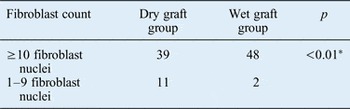
In the dry graft group, out of 50 patients, 39 had a fibroblast count of 10 or more. All these patients had a successful graft uptake. The remaining 11 patients had a fibroblast count of less than 10; of these, 2 patients had a successful graft uptake. In the wet graft group, 48 patients had a fibroblast count of 10 or more, with 43 patients having a successful graft uptake; 2 patients with a fibroblast count of less than 10 also had a successful graft uptake (Table II). Statistical evaluation of these data using the Fisher exact test revealed a p-value of less than 0.01 (Table III), which is significant. These findings demonstrate that fibroblast count was significantly higher in the wet graft group. However, no morphological degenerative changes were observed in the fibroblast nuclei, irrespective of the nature of the graft.
Significance of fibroblast count

Data represent numbers of cases unless indicated otherwise.
* Indicates statistical significance
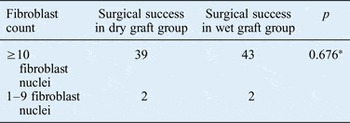
In order to evaluate the impact of fibroblast count on tympanoplasty, the data for those patients whose surgery was successful were statistically analysed in terms of fibroblast counts of 10 or more and less than 10 (Table IV). The Fisher exact test value was 0.676, with a non-significant p-value of more than 0.1, indicating that fibroblast count has no impact on tympanoplasty.
Impact of fibroblast count on surgical success

Data represent numbers of cases unless indicated otherwise.
* p > 0.05 (not significant)
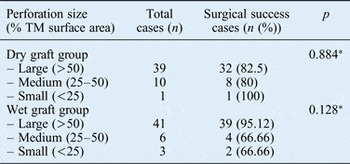
The impact of perforation size was also evaluated (Table V). The perforations were classified as large, medium or small depending on whether they involved more than 50 per cent, 25–50 per cent or less than 25 per cent of the total tympanic membrane surface area, respectively.Reference Singh, Sidhu, Sharma and Singh 20 In the dry graft group, 39 patients had large perforations, with 32 having successful graft uptake (82.05 per cent); 10 patients had medium-sized perforations, with 8 showing successful uptake (80 per cent); and 1 patient had a small perforation with successful uptake post-operatively (100 per cent). On statistical analysis (Table V), the findings were not significant (p = 0.884). In the wet graft group, 41 patients had large perforations, with 39 patients showing successful graft uptake (95.12 per cent); 6 patients had medium-sized perforations, with 4 showing successful uptake (66.66 per cent); and 3 patients had small perforations, with 2 showing successful uptake (66.66 per cent). Again, on statistical analysis (Table V), these findings were not significant (p = 0.128). Thus, in this study, perforation size did not affect the outcome of tympanoplasty, irrespective of the nature of the graft used.
Significance of perforation size

* p > 0.05 (not significant). TM = tympanic membrane
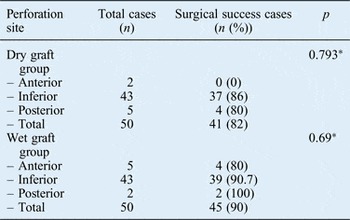
The impact of perforation site was also evaluated, with the perforations classified as anterior, inferior or posterior with respect to the handle of the malleus (Table VI).Reference Youngs, Ludman and Wright 23 In the dry graft group, out of 50 patients, 2 had anterior, 43 had inferior and 5 had posterior perforations. Success rates of 86 per cent and 80 per cent were recorded for inferior and posterior perforations, respectively. However, both patients with an anterior perforation had residual perforations. Statistical analysis (Table VI) showed that these findings were not significant (p = 0.793). In the wet graft group, 5 patients had anterior, 43 had inferior and 2 had posterior perforations, with respective success rates of 80 per cent, 90.7 per cent and 100 per cent. Statistical analysis (Table VI) again showed that the findings were not significant (p = 0.69).Thus, the success of tympanoplasty does not depend on the perforation site.
Significance of perforation site

* p > 0.05 (not significant)
Our results would be incomplete without addressing the issue of complications. No complications of underlay tympanoplasty, such as intra-operative bleeding, facial nerve palsy, chorda tympani nerve injury, wound haematoma, infection, perichondritis, epithelial pearl formation, granulation tissue formation at the tympanomeatal flap or sensorineural hearing loss, were recorded in our study in either of the groups. Moreover, no complication related to local anaesthesia was observed.
Discussion
Impact of dry and wet grafts on tympanoplasty outcome
Currently, limited information is available in the medical literature regarding the influence of dry and wet grafts on tympanoplasty success. Previous studies by Alkan et al. and Loock et al. found no statistically significant difference in the success of graft uptake with dry or wet grafts.Reference Alkan, Baylancicek, Sozen, Basak and Dadas 14 , Reference Loock and Naude 15 Recent studies by Aslan et al. and Bhardwaj et al. also found good perforation closure results when using Tutoplast® (i.e. dry and dehydrated) grafts.Reference Aslan, Uslu, Köybaşioğlu, Oz, Ileri and Ozbilen 24 , Reference Bhardwaj, Verma and Puri 25 Our study supports these findings.
Wormald and Alun-Jones, in 1991, were the first to highlight the concept of temporalis fascia graft shrinkage.Reference Wormald and Alun-Jones 26 However, the exact clinical implication of this finding was emphasised by England et al. in 1997.Reference England, Strachan and Buckley 13 These authors promulgated that when a dry graft is placed in the wet physiological environment of the middle ear, it will shrink and lose contact with the remnant margins of the tympanic membrane under which it is tucked, especially anteriorly, and cause graft failure. Indorewala also observed shrinkage and thickening of the temporalis fascia graft in an experimental study conducted on dogs in 2002.Reference Indorewala 27 Chow and Wei advocated that a large-sized graft be harvested in accordance with this concept of temporalis fascia graft shrinkage.Reference Chow and Wei 28
The impact of dry and wet grafts on perforation site was also examined in this study. No statistically significant impact was observed. Anterior perforations have a poor graft uptake. The plausible explanation for this is that physiologically the posterior half of the tympanic membrane is better infused than the anterior half, as blood supply to the posterior half is from the mallear artery, whilst the anterior half is perfused by branches of the annular ring.Reference Applebaum and Deutsch 29 However, it could also be a result of inappropriate graft placement below the anterior margin or inadequate Gelfoam support to the graft. Temporalis fascia graft shrinkage could be a contributory factor. However, to state that the use of a wet graft would improve graft uptake in anteriorly placed perforations would be too simplistic an assumption. A comparison of the anterior perforation results for dry and wet grafts (Table VII) revealed no statistical difference (p = 0.142), implying that the nature of the graft (dry or wet) has no impact on the outcome of tympanoplasty for anterior perforations.
Comparison of anterior perforation outcomes with dry and wet grafts

Data represent numbers of cases. Fisher exact test revealed p = 0.142 (not significant)
Effect of fibroblast count on graft uptake
It has been argued that better closure rates are obtained by using a wet graft, on account of increased fibroblast count. This is based on the assumption that fibroblasts lay down collagen for a reparative process in the wound, with formation of a granulation tissue matrix to allow the spread of epithelialisation, which thereby promotes successful graft uptake.Reference Alkan, Baylancicek, Sozen, Basak and Dadas 14 , Reference Loock and Naude 15 , Reference Kumar, Abbas, Fausto, Aster, Kumar, Abbas and Fausto 19 However, in this study, the success rates of dry and wet grafts were not significantly different with respect to their relative fibroblast counts (Table IV).
The only other study to take fibroblast count into consideration, by Alkan et al., in 2009, reported similar results.Reference Alkan, Baylancicek, Sozen, Basak and Dadas 14 Another study published in 2009, by Loock and Naude, failed to grow fibroblasts (in vitro) on any of the temporalis fascia grafts, and found equal graft uptake success rates for both wet and dry grafts.Reference Loock and Naude 15 Patterson et al. and Smyth et al. also failed to grow fibroblasts from temporalis fascia in their respective studies.Reference Patterson, Lockwood and Sheehy 30 , Reference Smyth, Kerr and Nevin 31 However, Walby et al. managed to grow fibroblasts on both dry and wet fascia grafts, giving credence to the theory that there are no pathological differences between the two types of temporalis fascia grafts.Reference Walby, Kerr, Nevin and Woods 18 Shenoi, in 1982, reported that dehydration of temporalis fascia leads to degeneration of the collagen matrix in the grafts.Reference Shenoi 17 However, the author reasoned that subtle heat used for graft drying during myringoplasty has only a minimal effect on the denaturation of collagen fibres; hence, physiologically, they still remain viable. Aslan et al. reported a graft uptake success rate of 94 per cent with dry grafts.Reference Aslan, Uslu, Köybaşioğlu, Oz, Ileri and Ozbilen 24
The best means to evaluate the role of fibroblasts on graft uptake would be to study the healed tympanic membranes histologically, but obviously this is unethical. We could find only one animal study, which revealed that autologous fascia seldom retained its structure and integrity after myringoplasty, and the authors suggested that graft fibroblast survival was unlikely.Reference Salen and Wersall 32 On the basis of these studies, it may be reasoned that fibroblasts in dry or wet grafts have minimal or no role to play in graft uptake, as was also observed in the present study.
We thus believe that the temporalis fascia graft merely serves as a framework for migration of epithelium over the perforation. These grafts serve as a form of tissue matrix scaffold that is then revascularised in readiness for epithelium migration.Reference Stenfors, Carlsoo and Winblad 33 – Reference Johnson, Smallman and Kent 35 The graft material merely acts as stratum corneum, under which the lower epidermal layers can proceed to close the defect.Reference Stenfors, Carlsoo and Winblad 33 – Reference Johnson, Smallman and Kent 35
Wet graft handling
The principal investigator (operating surgeon) in this study had no prior experience of performing tympanoplasty with a wet graft. Initially, we did encounter some difficulty in negotiating the graft under the tympanomeatal flap and tucking it under the tympanic membrane remnant. However, with subsequent experience, the wet graft posed no difficulty in handling, and the duration of surgery was comparable to that for the dry graft. In this context, it would be prudent to note that the average time taken to perform the tympanoplasty with a wet graft was 92 minutes and with a dry graft was 86 minutes. Contrary to our results, the only other study to evaluate surgical duration for dry and wet grafts found that surgery with dry graft took a longer time.Reference Alkan, Baylancicek, Sozen, Basak and Dadas 14
-
• This study evaluated dry versus wet temporalis fascia grafts in type I tympanoplasty
-
• The fibroblast count in each graft type was analysed, as was tympanoplasty success
-
• Fibroblast count was increased in wet graft tissue, but surgical outcomes were similar for dry and wet grafts
-
• The nature of temporalis fascia grafts, dry or wet, does not influence tympanoplasty outcome
Limitations
There are caveats to our study. Although it was a randomised study, the results were not ascertained blindly. As a single-institution study, the data reflected experience of our geographical area, and may not be generalisable. Further, potential bias (e.g. selection bias) and confounding may have crept in. Nevertheless, the true strength of this study lies in its prospective nature with randomisation, which allowed for accurate data assessment. The study is unique in its evaluation of the effect of fibroblast count on tympanoplasty. This study amalgamates the realities of clinical practice with independent statistical validation of data, and contributes further to the sparse medical literature available on the impact of dry and wet grafts on tympanoplasty.
Conclusion
A wet, fresh temporalis fascia graft has no significant benefit over a dried graft. These findings are based on our modest experience, and are presented to offer debate and impetus for future research on the subject.