Introduction
Dung beetles in the subfamily Scarabaeinae are a diverse and abundant component of the savannah ecosystem in sub-Saharan Africa, which supports some of the richest and most diverse mammalian communities in the world (Nieto et al., Reference Nieto, Hortal, Martínez-Maza, Morales, Ortiz-Jaureguizar, Pelaex-Campomanes, Pickford, Prado, Rodríguez, Senut, Soria, Varela, Huber, Sinclair and Lampe2005; Tshikae et al., Reference Tshikae, Davis and Scholtz2008). The majority of African Scarabaeinae is tunnelling (paracoprid) beetles, which comprise approximately 70% of species found (Davis et al., Reference Davis, Frolov and Scholtz2008; Stanbrook et al., Reference Stanbrook, Norrey, Kisingo and Jones2021). However, ball-rolling species (telocoprid) and species which colonize and breed in the dung balls of other beetle species (kleptocoprid) may also be abundant (Davis et al., Reference Davis, Frolov and Scholtz2008).
Tunnelling and dung burial by paracoprid beetles have a vital role in semiarid ecosystems. Their ecosystem services include removing dung from the soil surface (Holter, Reference Holter1979; Carvalho et al., Reference Carvalho, Frazao, Ferreira-Châline and França2018), bioturbation (Mittal, Reference Mittal1993) and nutrient cycling (Bang et al., Reference Bang, Lee, Kwon, Na, Jang and Kim2005). For example, the presence of the paracoprid beetles Copris ochus and Copris tripartitus increased the total crude protein in forage growth by 33%, and total digestible nutrient in grass shoots by 1.3% compared to beetle-free controls (Bang et al., Reference Bang, Lee, Kwon, Na, Jang and Kim2005). Furthermore, activity of Digitonthophagus gazella and Onthophagus taurus improved the physiochemical characteristics of soil, significantly increasing pH and soil nutrients (P, Ca and Zn) compared to beetle-free controls (Bertone et al., Reference Bertone, Green, Washburn, Poore and Watson2006). Improvements in soil health are likely to result in increased yield; for example, plots of coastal bermudagrass with dung beetle activity had significantly higher yield over the season than those without (Fincher, Reference Fincher1981).
Advances in our understanding of dung beetle functional contributions to ecosystems have not been matched by an understanding of the consequences of anthropogenic activities such as the conversion of landscapes to livestock agriculture (Raine and Slade, Reference Raine and Slade2019). In these landscapes, there has been a decrease in wild indigenous mammal density and an increase in the abundance of domesticated livestock (largely cattle and goats). A 38% reduction in the species richness of indigenous mammals was shown to alter patterns of dung association, and reduce dung beetle species richness by 43% across the Botswana Kalahari aridity gradient (Tshiake et al., Reference Tshikae, Davis and Scholtz2013a, Reference Tshikae, Davis and Scholtz2013b). Raine and Slade (Reference Raine and Slade2019) report consistent trends towards co-declines of dung beetles and mammals, and changes in the abundance and diversity of indigenous mammal species as a result of habitat disturbance are likely to have significant impacts on dung beetle communities. Coupled with anthropogenic-related climate change, this represents a substantial threat to coprophagous beetle species (Pamesan and Yohe, Reference Parmesan and Yohe2003; Thomas et al., Reference Thomas, Cameron, Green, Bakkenes, Beaumont, Collingham, Erasmus, Ferreira de Siqueira, Grainger, Hannah, Hughes, Huntley, van Jaarsveld, Midgley, Miles, Ortega-Huerta, Peterson, Phillips and Williams2004).
The impacts of agricultural intensification are likely to be particularly concerning in the context of the treatment of livestock with veterinary parasiticides (Verdú et al., Reference Verdú, Cortez, Ortiz, González-Rodríguez, Martinez-Pinna, Lumaret, Lobo, Numa and Sánchez-Piñero2015; Sands et al., Reference Sands, Mgidiswa, Nyamukondiwa and Wall2018). Formulations of the pyrethroids, deltamethrin and cypermethrin are widely used for biting-fly and tick control (Lovemore, Reference Lovemore1992; Spickett and Fivaz, Reference Spickett and Fivaz1992; Alexander and Wardhaugh, Reference Alexander and Wardhaugh2001). Following treatment, the main route of pyrethroid excretion in cattle is faecal (Floate et al., Reference Floate, Wardhaugh, Boxall and Sherratt2005) and residues are excreted into the dung of cattle at concentrations of about 0.01–0.4 ppm for up to 2 weeks after treatment (Wardhaugh et al., Reference Wardhaugh, Longstaff and Lacey1998; Vale et al., Reference Vale, Grant, Dewhurst and Aigreau2004). In faeces, excreted unmetabolized drug or metabolites (Venant et al., Reference Venant, Belli, Borrel and Mallet1990) may retain insecticidal properties (Floate et al., Reference Floate, Wardhaugh, Boxall and Sherratt2005; Wardhaugh, Reference Wardhaugh2005). Dung spiked with 10 ppm deltamethrin or alphacypermethrin and analysed for residues showed that there was no change in concentration over 2 months following field exposure (Vale et al., Reference Vale, Grant, Dewhurst and Aigreau2004). Dung contaminated with deltamethrin, cypermethrin, cyhalothrin, flumethrin and alphamethrin has been shown to adversely affect several dung beetle species leading to mortality and disruption of reproduction (Bianchin et al., Reference Bianchin, Honer, Gomes and Koller1992; Bianchin et al., Reference Bianchin, Alves and Koller1997, Reference Bianchin, Alves and Koller1998; Wardhaugh et al., Reference Wardhaugh, Longstaff and Lacey1998; Vale et al., Reference Vale, Grant, Dewhurst and Aigreau2004; Bang et al., Reference Bang, Lee, Na and Wall2007).
The environmental impact of widespread treatment of cattle with parasiticides is likely to be affected by the degree of niche overlap between the beetle communities that colonize cattle dung and those that colonize the dung of indigenous mammals. Beetles colonizing wild herbivore dung are not likely to encounter toxic faecal residues from veterinary parasiticides, whereas the greater the degree of niche overlap the greater the potential negative consequences. The aims of this study were therefore to assess dung beetle diversity and community structure across habitats and dung types in a grassland savannah region of the Makgadikgadi, Botswana, in an area which facilitated comparison between a pristine national park habitat dominated by large indigenous mammals, and a pastoral farming community dominated by domestic livestock.
Methods
Study area
The study was conducted at Khumaga Village in north-eastern Botswana (S20°28.165′, E24°30.875′) and in the Makgadikgadi Pans National Park (S20°26.947′, E24°36.988′). A permit to conduct the research was granted from the Ministry of Environment, Wildlife and Tourism Botswana [number EWT 8/36/4 XXXIII (9)]. The region is characterized by a summer rainfall season between November and March with annual rainfall between 450 and 500 mm, although periodic drought occurs, which is an intrinsic characteristic of a southern African system (Krüger and Scholtz, Reference Krüger and Scholtz1998). Sampling was undertaken between December 2015 and February 2016, during which time southern Africa experienced a severe drought with Botswana receiving <65% of the average annual rainfall (FEWS, 2016). The results of this study are therefore in the context of low rainfall and the dung beetle assemblages reported here may not be representative of high rainfall years.
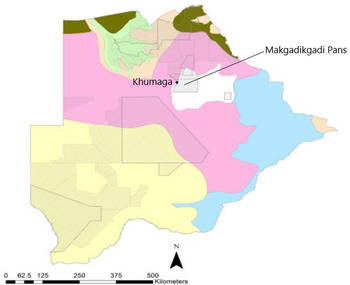
The study site is situated at a transition between two ecoregions (Olson et al., Reference Olson, Dinerstein, Wikramanayake, Burgess, Powell, Underwood, D'amico, Itoua, Strand, Morrison, Loucks, Allnutt, Ricketts, Kura, Lamoreux, Wettengel, Hedao and Kassem2001) bordered by the Boteti River. On the east of the river is Khumaga Village, characterized by Kalahari Acacia-Baikiaea Woodland (AT0709), and on the western side is the Makgadikgadi Pans National Park, a Zambezian Halophytic (AT0908) ecoregion (fig. 1). The landform is lacustrine plain with fossil river courses and recent fluvial deposits from the present channel of the Boteti (Venema and Kgaswanyane, Reference Venema and Kgaswanyane1996), with Kalahari sand soils consisting of haplic arenosols in Khumaga Village and calcaric arenosols in the Makgadikgadi Pans (De Wit and Nachtergaele, Reference De Wit and Nachtergaele1990).
Map of Botswana indicating the study site at Khumaga Village and the Makgadikgadi Pans National Park. The area shaded in pink corresponds to Kalahari Acacia-Baikiaea Woodland (AT0709) and white to Zambezian Halophytic (AT0908) ecoregions. Regions shaded in grey indicate protected areas. Adapted from D.E.A (2016).

Khumaga Village is a rural area characterized by small-scale cattle and goat pastoralists, whereas the Makgadikgadi Pans National Park represents a protected area with populations of large indigenous mammals including non-ruminant (elephant and zebra) and ruminant (blue wildebeest, giraffe, gemsbok, springbok and impala) herbivores, carnivores (lion and leopard) and omnivores (vervet monkey, baboon and warthog) (DWNP, 2012).
Pitfall trap bait
Four different types of dung were used to bait pitfall traps, representing the most common large mammals in the area. Wild animal dung was obtained from elephant (Loxodonta africana (Blumenbach)), zebra (Equus quagga burchellii (Gray)) and giraffe (Giraffa camelopardalis giraffa (von Schreber)) which roamed freely in the national park. Dung was also collected from Tswana/Sanga-type cattle (Bos taurus africanus Linnaeus) that foraged freely in the village during the day, were corralled overnight and had never been treated with parasiticides. These bait types represent both ruminant (cattle and giraffe) and non-ruminant (elephant and zebra) herbivores, and include small dry pellets (giraffe), large moderately dry course-fibred boluses (elephant and zebra) and large moist fine-fibred pats (cattle) (Davis and Scholtz, Reference Davis and Scholtz2001). Freshly voided cattle dung was collected from the village at 06:30 h on the day of use. Elephant, giraffe and zebra dung were collected from the national park between 16:00 and 18:00 h on the evening prior to trapping, by observing animals with binoculars and collecting any freshly voided dung, which was stored overnight in sealed buckets for use the following morning. Dung was collected from wild animals at this time for logistical reasons, due to it being the latest period of daylight activity before the trapping commenced the following day.
Trapping
Two separate trapping surveys were performed. The first used pitfall traps baited with cattle dung at three different sites: in the village, on the western bank of the Boteti which was the border of the national park, and 5 km inside the national park. The second survey, designed to identify trophic associations, used cattle, giraffe, elephant and zebra dung to bait pitfall traps at two different sites: within the village and 5 km inside the national park.
Eight pitfall traps were set up at 10 m intervals along a transect at each of the locations. For the second survey, two traps were randomly allocated to each of the four dung types and were pooled for analysis giving an adequate sample for analysis based on preliminary data. Traps consisted of three 560 ml plastic cups, each half-filled with water containing 0.5 ml detergent and buried alongside each other to form a triangle level with the soil surface. Above the cups, 150 g of dung wrapped in muslin was suspended at a height of 150 mm, and to prevent flooding, a plastic rain guard was placed 50 mm above the dung. Each 24 h trapping session was set up at 07:00 h and emptied at 18:30 h for collection of diurnal species, then immediately re-baited with fresh dung and emptied at 07:00 h the following morning for collection of nocturnal and crepuscular species. Trapping was repeated on three separate occasions for both surveys, 2 weeks apart to allow movement of individuals in the area without bait interference (da Silva and Hernández, Reference da Silva and Hernández2015), with locations surveyed simultaneously to control for climatic variation. This gave a total of nine trapping sessions for the cattle dung survey and six for the trophic association survey. This survey was conducted over a period of 12 weeks between December 2015 and February 2016. Beetles were stored in absolute ethanol prior to counting and identification.
Scarabaeinae dung beetles were identified at the species level where possible using morphological and ecological characteristics (Davis et al., Reference Davis, Frolov and Scholtz2008) and compared to reference collections at the National History Museum (London, UK) and the University of Pretoria (South Africa).
Data analysis
All statistical analyses were performed using RStudio (Version 1.2.1578, RStudio Team, 2019). The cattle dung survey and the trophic association survey were analysed separately. Dung beetle communities were described by total abundance, species richness, dominance concentration (DW) (Strong, Reference Strong2002) and asymptotic Shannon diversity (Hill number order q = 1). Furthermore, to overcome the ‘sampling problem’ in which species richness is highly sensitive to sample size and completeness and underestimates true species richness (Chao et al., Reference Chao, Gotelli, Hsieh, Sander, Ma, Colwell and Ellison2014), interpolation and extrapolation procedures were used to facilitate comparison of dung beetle assemblages using the R package ‘iNEXT’ (Chao et al., Reference Chao, Gotelli, Hsieh, Sander, Ma, Colwell and Ellison2014; Hsieh et al., Reference Hsieh, Ma and Chao2020).
A generalized linear model with a negative binomial error distribution was used to analyse count data of species abundance, including diel period, location and dung type (for the trophic association survey only) and their interactions as explanatory variables. The same model was used with species richness as the response variable for the trophic association survey, whereas a generalized linear model with a Poisson error distribution was a better fitting model for species richness in the cattle dung survey. Model assumptions were checked by the distribution of residuals (normality), residual deviance <2 × residual degrees of freedom (dispersion) and plotting the residuals against the dependent variable (homoscedasticity). For the dominance (DW) and diversity (Shannon) indices, a generalized linear model with a quasi-Poisson error distribution was performed with the above explanatory variables. If diel period was a significant factor, data from diurnal and nocturnal traps were analysed separately. Models were simplified by stepwise removal of non-significant factors and the resulting minimal model contrasted with Akaike's information criterion (AIC) to the global model, until the best fitting model was found (Bozdogan, Reference Bozdogan1987). Post-hoc analysis for generalized linear models was performed using the R package ‘multcomp’ (Hothorn et al., Reference Hothorn, Bretz and Westfall2008) with Tukey multiple comparisons of means. Separate analysis was carried out as described above for the explanatory variable herbivore type (ruminant or non-ruminant) due to non-independence of this variable from dung type.
The IndVal method (Dufrêne and Legendre, Reference Dufrêne and Legendre1997) is a technique used to find indicator species and species assemblages characterizing groups of sites, and was used to identify species that were associated with particular pitfall trap ‘groups’ such as diel period, location and dung type. The R package ‘indicspecies’ (De Cáceres and Legendre, Reference De Caceres and Legendre2009) was used to calculate the IndVal index between dung beetle species and pitfall trap groups, and to identify groups with the highest species association values. The IndVal index is a value between 0 and 1, and species with a value of ≥0.75 were considered indicators for a group, 0.5–0.75 of showing a degree of association and ≤0.5 indicating no association or generalist behaviour (subjective benchmark; Tshikae et al., Reference Tshikae, Davis and Scholtz2008; Stanbrook et al., Reference Stanbrook, Norrey, Kisingo and Jones2021). Permutation tests (n = 999) were then performed, and species with high (≥0.75) and significant IndVals were considered specialists for that group.
Canonical correspondence analysis (CCA) was used to analyse dung beetle community composition between pitfall trap groups. The R package vegan (Oksanen et al., Reference Oksanen, Blanchet, Friendly, Kindt, Legendre, McGlinn, Minchin, O'Hara, Simpson, Solymos, Stevens, Szoecs and Wagner2019) was used initially to confirm that the data were suitable for unimodal ordination, by running a detrended correspondence analysis (DCA) in which the first DCA axis was >3 standard deviations (Lepš and Šmilauer, Reference Lepš and Šmilauer2003), and subsequently to perform the CCA. Finally, analysis of variance-like permutation tests were used to assess the significance (P < 0.05) of environmental variables (habitat and dung type). Diurnal traps did not collect adequate species samples for reliable ordination, so analysis was focused on nocturnal and crepuscular traps.
Results
Cattle dung survey
Dung beetle assemblage structure
There were 12,013 dung beetles collected from the cow-dung baited pitfall traps between December 2015 and February 2016, belonging to 40 species and representing all of the nine dung beetle tribes found in Africa (Dichotomiini, Coprini, Canthonini, Gymnopleurini, Scarabaeini, Sisyphini, Onitini, Onthophagini and Oniticellini). Paracoprid beetles were the most dominant functional group comprising 58% of individuals and 52.5% of species. There were six (15%) putative kleptocoprids (species in the genera Caccobius and Cleptocaccobius, and Onthophagus pullus) which comprised of 19% of individuals. For two abundant species (Onthophagus vincus and Onthophagus nr. sugillatus) which comprised of 10% of individuals trapped, dung-use behaviour is not clear and may be a combination of paracoprid and kleptocoprid types (Davis, Reference Davis1996a, Reference Davis1996b). There were 11 species of telocoprid (27.5%) which comprised of 12.5% of total individuals.
Dung beetles in the tribe Onthophagini were the most abundant, comprising 79.3% of all individuals trapped. Canthonini, Dichotomini and Onitini were the most poorly represented tribes, with just 3, 7 and 1 individual(s), respectively. Kurtops signatus (tribe Onthophagini) was the most abundant species and accounted for 25.4% of all individuals. There were four highly abundant species, Scarabeaus zambezianus (tribe Scarabaeini), and K. signatus, Onthophagus stellio and Caccobius ferrugineus (all tribe Onthophagini) which together comprised of 65.8% of all dung beetles trapped. There were 11 rare species (<5 individuals trapped) (table 1) which together comprised just 0.17% of the total beetles trapped.
Abundance of 52 species of Scarabaeinae dung beetles trapped between December 2015 and January 2016 in Khumaga Village and the Makgadikgadi Pans National Park, north-eastern Botswana

Of the 40 species collected, 24 (60%) were nocturnal or crepuscular, 13 (32.5%) were diurnal and 3 (7.5%) were collected in both diurnal and nocturnal traps. There were 27 species (67.5%) found in all three locations (national park, riverside and village) and 2 (5%), 5 (12.5%) and 1 (2.5%) species collected from the national park, riverside or village only. Most individuals were collected in the national park (5554; 46.2%), with 2673 (22.3%) collected at the riverside and 3792 (31.6%) in the village (table 1).
Diel activity and habitat
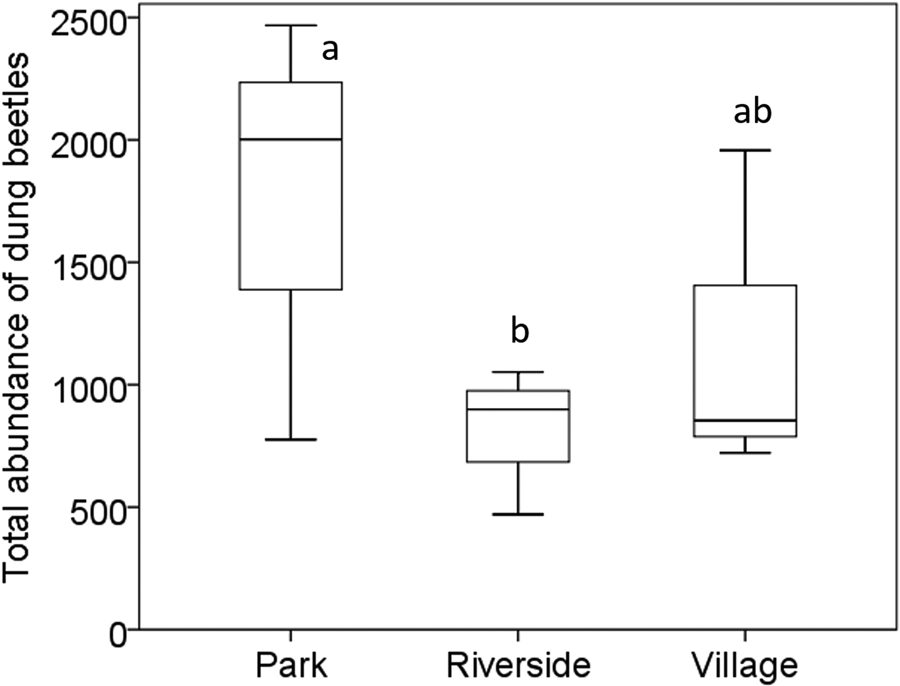
There was significantly higher abundance (χ21 = 64.6, P < 0.001), species richness (χ21 = 39.1, P < 0.001), dominance concentration (t 17 = 2.67, P < 0.05) and Shannon diversity (t 17 = 2.16, P < 0.05) in dung beetle communities attracted to nocturnal and crepuscular pitfall traps compared to diurnal traps. In the nocturnal and crepuscular traps, a greater abundance of dung beetles were trapped in the national park (fig. 2), but this relationship was only significant between the national park and the riverside (Z 8 = 2.27, P < 0.05). There were no statistically significant differences in the abundance of beetles trapped in diurnal traps between the three habitats.
Abundance of dung beetles attracted to nocturnal and crepuscular (18:30–07:00 h) cattle dung baited pitfall traps in the Makgadikgadi Pans National Park, the western bank of the Boteti river which borders the park, and inside Khumaga Village. Boxes labelled with the same letters are not statistically significant (P < 0.05, glm.nb(link = log)).

Indicator species
Three species showed an association with the national park: Pedaria sp. (Kalahari) (IndVal = 0.66), Onthophagus aeruginosus (IndVal = 0.65) and Chalconotus convexus (IndVal 0.58), and one species showed an association with the riverside, Onthophagus fallax (IndVal = 0.68). Escarabeaus remii was associated with all habitats except for the national park (IndVal = 0.68), whereas Copris cornifrons was associated with all habitats except for the village (IndVal = 0.63). Eighteen species were nocturnal/crepuscular specialists (P < 0.05, IndVal ≥ 0.75) (Supplementary table S1). Five of these had IndVal = 1 and were equally good indicator species for nocturnal/crepuscular dung beetle communities (S. zambezianus, Scarabeaus goryi, Metacatharsius troglodytes, D. gazella and O. vinctus). Four species were diurnal specialists (P < 0.05, IndVal ≥ 0.75) (Supplementary table S1) and Gymnopleurus ignitus was the best indicator species for diurnal communities (IndVal = 1).
Trophic association survey
Dung beetle assemblage structure
There were 13,032 dung beetles collected from the pitfall traps baited with cattle, elephant, zebra and giraffe dung between December 2015 and February 2016, belonging to 48 species representing all nine tribes of dung beetle found in Africa. Paracoprid beetles were the most dominant functional group comprising 49% of individuals and 60% of species. There were seven (15%) putative kleptocoprids (species in the genera Caccobius and Cleptocaccobius, and O. pullus) which comprised of 19% of the individuals. For two abundant species, O. vincus and O. nr. Sugillatus, which comprised of 29% of individuals trapped, dung-use behaviour is not clear and may be a combination of paracoprid and kleptocoprid types (Davis, Reference Davis1996a, Reference Davis1996b). There were ten species of telocoprid (21%) which comprised of just 2% of the total number of individuals.
Dung beetles in the tribe Onthophagini were the most abundant, comprising 90.4% of all the individuals trapped. Canthonini, Onitini and Oniticellini were the most poorly represented tribes, with just 1, 9 and 8 individual(s), respectively. O. stellio (tribe Onthophagini) was the most abundant species and accounted for 31.1% of all individuals. There were three highly abundant species, O. stellio, O. vinctus and C. ferrugineus, which together accounted for 70.4% of all the dung beetles trapped. There were 20 rare species (<5 individuals) (table 1) which together comprised of just 0.28% of the total beetles trapped.
Of the 48 species collected, 34 (70.8%) were nocturnal or crepuscular, 13 (27.1%) were diurnal and 1 (2.1%) was collected in both diurnal and nocturnal traps. Fourteen species (29.2%) were collected from all four dung types and 4 (8.3%), 3 (6.3%) and 7 (14.6%) were found exclusively in traps baited with elephant, zebra and cattle dung, respectively. Non-ruminant dung attracted the most individuals, with 5347 (41.0%) collected from elephant and 5126 (39.3%) from zebra dung traps. Ruminant dung attracted 2380 (18.2%) and 196 (1.5%) individuals from cattle and giraffe dung traps, respectively.
Diel activity and habitat
There was significantly higher abundance (χ21 = 48.1, P < 0.001), species richness (χ21 = 37.79, P < 0.001), dominance concentration (t 40 = 3.75, P < 0.001) and diversity (t 47 = 4.45, P < 0.001) of dung beetle communities attracted to nocturnal and crepuscular compared to diurnal pitfall traps. Six dung beetle species were associated with the national park habitat: Metacatharsius opacus (IndVal = 0.69), Caccobius cavatus (IndVal = 0.67), Caccobius nigritulus (IndVal = 0.64), Pedaria sp. (Kalahari) (IndVal = 0.59), Catharsius calaharicus (IndVal = 0.59) and S. goryi (IndVal = 0.56). Sixteen species were nocturnal/crepuscular specialists (P < 0.05, IndVal ≥ 0.75) (Supplementary table S2). Of these, M. troglodytes, D. gazella, Onthophagus fimetarius, O. stellio and C. ferrugineus were equally good indicator species for nocturnal/crepuscular dung beetle communities (IndVal = 1). Four species showed an association with diurnal traps (Supplementary table S2), and Kurtops quadriceps was a diurnal specialist (P < 0.05, IndVal = 0.85).
Trophic associations
For diurnal traps, there was a significant association between dung type and dung beetle abundance (χ23 = 26.27, P < 0.001). Significantly more dung beetles were attracted to cattle than to elephant (P < 0.05) or giraffe (P < 0.001) dung, and to zebra than giraffe dung (P < 0.05; fig. 3). For nocturnal and crepuscular traps, there was also a significant association between dung type and dung beetle abundance (χ23 = 14.07, P < 0.05). Significantly fewer dung beetles were attracted to giraffe dung than to cattle (P < 0.05), elephant (P < 0.001) or zebra (P < 0.001) dung (fig. 3).
Abundance, species richness, dominance concentration (DW) and diversity (asymptotic Hill order q = 1) of dung beetle communities attracted to cattle, giraffe, elephant and zebra dung in diurnal (07:00–18:30 h) and nocturnal (18:30–07:00 h) baited pitfall traps. Boxes labelled with the same letters are not statistically significant. Abundance and species richness (P < 0.05, glm.nb(link = log)), DW and diversity (P < 0.05, glm(quasi-Poisson(link = log))).

There was a significant association between dung type and species richness for diurnal traps (χ23 = 24.15, P < 0.001). Dung beetle communities attracted to cattle dung had significantly higher species richness than those attracted to giraffe (P < 0.05) or elephant (P < 0.05) dung, but not zebra (fig. 3). For nocturnal and crepuscular traps, there was also a significant association between dung type and species richness (χ23 = 13.58, P < 0.05). Dung beetle communities attracted to giraffe dung had significantly lower species richness than those attracted to cattle (P < 0.05) or elephant (P < 0.05) dung (fig. 3).
There were significant differences in dominance between dung beetle communities attracted to the different dung types for diurnal traps (F 3 = 6.51, P < 0.05). There was significantly higher dominance in dung beetle communities attracted to cattle dung than to giraffe (P < 0.001) or elephant (P < 0.05) dung, and to zebra than giraffe dung (P < 0.05; fig. 3). For nocturnal and crepuscular traps, there was a significant association between dung type and dominance (χ23 = 7.63, P < 0.05). Dung beetle communities attracted to cattle dung had significantly higher dominance than those attracted to giraffe dung (P < 0.05).
There were significant differences in diversity between dung beetle communities attracted to the different dung types for diurnal traps (F 3 = 7.68, P < 0.05). Dung beetle communities attracted to cattle dung had significantly higher diversity than those attracted to giraffe (P < 0.001) or elephant (P < 0.05; fig. 3). There were no significant differences in diversity for nocturnal or crepuscular traps.
There was no significant association between herbivore dung type and beetle abundance for diurnal traps. For nocturnal and crepuscular traps, there was a significant association between dung type and dung beetle abundance (χ21 = 5.09, P < 0.05). Non-ruminant dung attracted significantly more beetles than ruminant dung (P < 0.05; fig. 4). There were no significant differences in species richness, dominance concentration or diversity between ruminant and non-ruminant dung.
Abundance of dung beetles found in nocturnal or crepuscular (18:30–07:00 h) traps baited with non-ruminant (elephant and zebra) or ruminant (cattle and giraffe) herbivore dung. Boxes labelled with the same letters are not statistically significant (P < 0.05, glm.nb(link = log)).

There were no species that specialized on one particular dung type. Three species showed an association with cattle dung: G. ignitus (IndVal 0.61), Euoniticellus intermedius (IndVal = 0.61) and Neosisyphus calcaratus (IndVal = 0.7). Eight species showed an association with non-ruminant (zebra and elephant) dung: Onthophagiini sp. 2 (IndVal = 0.71), O. vinctus (IndVal = 0.70), C. cavatus (IndVal = 0.67), Onitis sp. 1 (IndVal = 0.61), Onthophagus sp. 13 (IndVal = 0.61), C. calaharicus (IndVal = 0.59), Pedaria sp. (Kalahari) (IndVal = 0.52) and Afrostrandius plebejus (IndVal = 0.51). There were 15 species associated with all dung types except for giraffe (IndVal = 0.58–0.92) (Supplementary table S2), and six species were identified as generalists, being found in all four dung types with no particular association: S. zambezianus, S. goryi, M. troglodytes, D. gazella, O. fimetarius and K. quadriceps.
Ordination
The proportion of the total variability captured by the CCA was 30%. The first canonical axis corresponded to dung type and accounted for approximately 56% of the constrained variability, and the second axis corresponded to habitat type and accounted for 28% of the constrained variability. Permutation tests indicated that dung beetle community composition varied significantly in relation to both dung type (χ23 = 0.23, P < 0.05) and habitat type (χ21 = 0.092, P < 0.05) (fig. 5).
CCA ordination of dung beetle assemblages attracted to nocturnal (19:00–07:00 h) pitfall traps baited with cattle (o), giraffe (+), elephant (Δ) and zebra (x) dung either inside Khumaga Village (grey points) or the Makgadikgadi Pans National Park (black points). In the top plot, traps with similar dung beetle communities are ordinated near to each other, and corresponding environmental variables (dung type and habitat) are indicated by arrows. The position of species on the bottom plot correlates with their abundance in these traps. Key to species codes: Afr.ple, A. plebejus; All.tha, A. thalassinus; Cac.cav, C. cavatus; Cac.fer, C. ferrugineus; Cac.nig, C. nigritulus; Cac.6, Caccobius sp. 6; Cat.cal, C. calaharicus; Cha.con, C. convexus; Che.1, Cheironitis sp. 1; Cle.vir, C. viridicollis; Cop.cor, C. cornifrons; Cop.ele, C. elephenor; Cop.3, C. sp. 3; Dig.gaz, D. gazella; Esc.rem, E. remii; Euo.int, E. intermedius; Gym.aen, G. aenescens; Gym.ign, G. ignitus; Hel.1, Heliocopris sp. 1; Het.1, Heteronitis sp. 1; Kep.1, K. prodigiosus; Kur.qua, K. quadriceps; Kur.sig, K. signatus; Met.opa, M. opacus; Met.tro, M. troglodytes; Neo.cal, N. calcaratus; Oni.1, Onitis sp. 1; Oni.2, O. sp. 2; Oni.3, O. sp. 3; Oni.4, O. sp. 4; Ont.ste, O. stellio; Ont.aer, O. aeruginosus; Ont.fal, O. fallax; Ont.fim, O. fimetarius; Ont.gra, O. granulatus; Ont.pul, O. pullus; Ont.ras, O. rasipennis; Ont. 13, O. sp. 13; Ont.14, O. sp. 14; Ont.15, O. sp. 15; Ont.16, O. sp. 16; Ont.nr.pro, O. sp. nr probus (granular); Ont.nr.sug, O. sp. nr sugillatus; Ont.vin, O. vinctus; Pac.1, Pachylomerus sp. 1; Ped.kal, Pedaria sp. (Kalahari); Pha.bos, P. boschas; Pha.wit, P. wittei; Sca.gor, S. goryi; Sca.zam, S. zambezianus.

Discussion
Dung beetle nesting behaviour is broadly classified into four functional groups: the telecoprids (ball rollers), paracoprids (tunnellers), endocoprids (dung dwellers) and kleptocoprids (brood parasites) (Simmons and Ridsill-Smith, Reference Simmons and Ridsill-Smith2011). Paracoprids dig tunnels in the soil beneath the dung pat and pack dung into brood masses at the end of these tunnels, laying a single egg in each mass. Telecoprid males form balls of dung which they roll away and bury below ground, where the female creates a brood ball. Endocoprids create broods within the dung pat itself and kleptocoprid females deposit their eggs into the brood masses already provisioned by telecoprids or paracoprids. Paracoprid Scarabaeinae are commonly the most abundant functional beetle group in African savannah landscapes (Davis et al., Reference Davis, Frolov and Scholtz2008). Of the Scarabaeine dung beetles collected in the current study, 60% were paracoprids whereas 15% were putative kleptocoprid species consisting of small-bodied Onthophagini or Dichotomiini, which colonize and breed in the dung balls of large telocoprid (ball-rolling) Scarabaeini (Davis et al., Reference Davis, Frolov and Scholtz2008). The kleptrocoprid genus Pedaria observed in this study has previously been recorded in the brood balls of the large paracoprid Heliocopris (Davis, Reference Davis1996a). Two species were collected, O. sp. nr sugillatus and the highly abundant O. vinctus, which have been recorded colonizing the dung balls of larger species, but it is not clear whether they breed in these dung balls, therefore they have been grouped as an intermediate between paracoprid and kleptocoprid (Davis, Reference Davis1996a). Of the seven most highly abundant species collected, 40% were putative kleptocoprids indicating that using the dung already claimed by larger beetles is a highly competitive strategy.
For both the cattle dung and the trophic association survey, there was significantly higher abundance, species richness, dominance and diversity in dung beetles collected from nocturnal and crepuscular rather than diurnal traps. This contrasts with previous data from Ivory Coast which shows a diurnal peak in abundance (Krell-Westerwalbesloh et al., Reference Krell-Westerwalbesloh, Krell and Linsenmair2004), and from South Africa which found the species richness of diurnal Scarabaeidae to be greater than that of dusk fliers (Davis, Reference Davis1996b). Data from Neotropical regions also suggest that diurnal species are at least twice as abundant as nocturnal or crepuscular species (Davis, Reference Davis1999; Feer and Pincebourde, Reference Feer2005). These studies used buffalo, cattle (ruminant herbivore) or human/howler monkey (omnivore) dung as bait. It has been suggested that dung beetle flight periods may be correlated with the defecation patterns of mammals (Simmons and Ridsill-Smith, Reference Simmons and Ridsill-Smith2011) and in the current study all three dung beetle species that showed an association with cattle (ruminant herbivore) dung were diurnal: G. ignitus, E. intermedius and N. calcaratus. Conversely, all eight dung beetle species that were associated with non-ruminant herbivore (elephant and zebra) dung were associated with nocturnal and crepuscular activity. Cattle produce dung mostly during the day with peaks in early morning and mid-afternoon (Simmons and Ridsill-Smith, Reference Simmons and Ridsill-Smith2011), whereas elephants are also active during night, particularly in the areas of human disturbance such as close to settlements (Gaynor et al., Reference Gaynor, Branco, Long, Gonçalves, Granli and Poole2018). Therefore, it may be that night-flying dung beetle species are prevalent in the current study area due to the abundance of dung from large monogastric wild animals which may also be active at these times. Studies have also shown that organisms may shift their foraging patterns in response to changing environments (Hamer et al., Reference Hamer, Humphreys, Magalhaes, Garthe, Hennicke, Peters, Grémillet, Skov and Wanless2009), and behavioural shifts in activity and foraging timing may be one of the compensatory mechanisms used by dung beetles in avoiding diurnal high temperature stress (Gotcha et al., Reference Gotcha, Machekano, Cuthbert and Nyamukondiwa2020). The drought conditions experienced during the current study could have contributed to the low diurnal activity, and future trends under scenarios of climate change may include shifts in diel activity as diurnal organisms move towards crepuscular or nocturnal foraging behaviour.
Differences in diel flight activity between dung beetle species is a mechanism for temporal resource partitioning that is thought to reduce competition (Hanski and Cambefort, Reference Hanski and Cambefort1991). These activity periods may be based on body size, for example large dung beetles can regulate their body temperatures to allow them to fly in cooler periods, whereas for smaller species low temperatures may constrain their ability to fly at night (Philips, Reference Philips, Simmons and Ridsill-Smith2011). In the current study, several species of large bodied Coprini and Scarabaeini were associated with nocturnal and crepuscular traps. However, some small-bodied species of Onthophagini were also found. These included the kleptocoprids C. cavatus, C. ferrugineus and C. nigritulus, which must synchronize their activity with the large beetles whose dung balls they utilize, as well as several species of paracoprid Onthophagus. Krell-Westerwalbesloh et al. (Reference Krell-Westerwalbesloh, Krell and Linsenmair2004) found the peak activity time of paracoprid dung beetles in Ivory Coast to be between 18:00 and 22:00 h. In South Africa, dusk activity by small-bodied paracoprid and kleptocoprid Onthopagus spp. has been shown to be concentrated between 18:30 and 18:50 h, whereas large-bodied paracoprids including Copris, Catharsius, Heliocopris and the kleptocoprid Pediaria all flew later between 18:50 and 19:50 h (Davis, Reference Davis1996b). In the current study, the nocturnal trapping period began at 18:30 h and therefore may have included crepuscular species, so it is likely that the smaller-bodied paracoprids active in this period were flying at dusk rather than during the night when temperatures were cooler. Although significantly associated with nocturnal and crepuscular traps in both surveys of the current study, C. nigritulus and O. sp. nr. sugillatus have been reported elsewhere to be diurnal species (Davis, Reference Davis1996b; Davis et al., Reference Davis, Frolov and Scholtz2008). Further research is needed to determine peak activity times of these species, which may be affected by climate change.
Telecoprid dung beetle activity has been shown to peak during the hottest part of the day (Krell-Westerwalbesloh et al., Reference Krell-Westerwalbesloh, Krell and Linsenmair2004), which may facilitate the energetically costly rolling behaviour at the highest possible speed. Two diurnal species in the current study were indeed small-bodied telecoprids (G. ignitus and N. calcaratus); however, the large-bodied telecoprids S. zambezianus and S. goryi were strongly associated with nocturnal or crepuscular activity. Large beetle species take longer to dissipate heat due to higher thermal inertia than small species (Gotcha et al., Reference Gotcha, Machekano, Cuthbert and Nyamukondiwa2020), so are at greater risk of overheating and may therefore avoid diurnal activity. As well as maintaining an elevated body temperature, the large size of these telecoprid beetles may have enabled them to be active in low light levels by the evolution of more sensitive eyes, since the superposition aperture and rhabdoms can be larger (Byrne and Dacke, Reference Byrne, Dacke, Simmons and Ridsill-Smith2011). The rhabdoms of S. zambezianus have been found to contain microvilli at two orthogonal orientations indicating adaptation for polarization sensitivity (Dacke et al., Reference Dacke, Nordström and Scholtz2003). Indeed, Scarabeaus satyrus has been shown to use celestial cues, including the polarized skylight pattern at twilight, as well as the stars, to navigate straight line paths when rolling brood balls away from dung pats (Dacke et al., Reference Dacke, Nordström and Scholtz2003, Reference Dacke, Baird, Byrne, Scholtz and Warrant2013).
There were no dung beetle species particularly associated with the Khumaga Village habitat, whereas three and six species were associated with the Makgadikgadi Pans National Park habitat in the cattle dung and trophic association surveys, respectively. Almost 40% of the species associated with the national park habitat were also associated with non-ruminant herbivore (elephant and zebra) dung and were mainly nocturnal or crepuscular. The remainder showed no particular dung type association or were generalists. In the trophic association survey, diurnal dung beetle species were collected with higher abundance, species richness, diversity and dominance from cattle dung baits compared to all other dung types. Diurnal dung beetles may therefore be at greater risk from the toxic effects of residues of veterinary insecticides in cattle dung, which have been shown to reduce the survival and development of larval Scarabaeinae in Botswana (Sands et al., Reference Sands, Mgidiswa, Nyamukondiwa and Wall2018). For nocturnal species, lowest abundance and species richness were found in giraffe dung baited traps, and highest abundance in non-ruminant (elephant and zebra) traps. Sitters et al. (Reference Sitters, Maechler, Edwards, Suter and Venterink2013) also found that significantly more dung beetles were attracted to non-ruminant (elephant and zebra) dung than ruminant (giraffe, wildebeest and buffalo) dung in a Tanzanian wildlife reserve. Dung of low-moisture content is thought to be unsuitable for dung beetles (Edwards, Reference Edwards1991) since the adult beetles feed on the liquid portion which contains very small, nutritious particles as opposed to the larger indigestible plant remains (Holter et al., Reference Holter, Scholtz and Wardhaugh2002). It is therefore unsurprising that the small dry pellets of giraffe dung attracted fewer dung beetles.
Community ordination revealed significantly distinct species assemblages between dung types, particularly between non-ruminant (elephant and zebra) and ruminant (cattle and giraffe) dung. It is evident that although true specialization is rare in dung breeding beetles, except on non-dung food resources such as carrion or fungus (Larsen et al., Reference Larsen, Lopera and Forsyth2006; Tshikae et al., Reference Tshikae, Davis and Scholtz2008), many species show some level of association with a particular dung type (Martin-Piera and Lobo, Reference Martin-Piera and Lobo1996; Larsen et al., Reference Larsen, Lopera and Forsyth2006; Frank et al., Reference Frank, Brückner, Hilpert, Heethoff and Blüthgen2017; Wurmitzer et al., Reference Wurmitzer, Blüthgen, Krell, Maldonado, Ocampo, Müller and Schmitt2017; Tocco et al., Reference Tocco, Balmer and Villet2018). Studies along the aridity gradient of the Botswana Kalahari (mesic northeast–arid southwest) have also shown separation between ruminant (cattle and sheep) and non-ruminant (elephant) dung beetle communities (Tshikae et al., Reference Tshikae, Davis and Scholtz2013a), and the species found in the current study most closely reflect those of the mesic northeast. However, Tshikae et al. (Reference Tshikae, Davis and Scholtz2013a) show that towards the arid southeast of Botswana, where there is an absence of native large mammal (elephant) dung, there is more species generalization, lower separation in communities between ruminant and non-ruminant dung, and reduced species richness. Decline in indigenous mammal densities due to expansion of the livestock sector, veterinary fences and ranching areas which interrupt routes of migration, and drought (Moleele and Mainah, Reference Moleele and Mainah2003; Tshikae et al., Reference Tshikae, Davis and Scholtz2013b), may therefore result in shifts in dung beetle species communities. Nocturnal or crepuscular species which are associated with native non-ruminant herbivore dung, as well as those species associated with protected areas such as the National Park, may be replaced in favour of diurnal species associated with domestic ruminant (cattle) dung.
This study focused on the dung of large herbivores that were abundant in the area, including ruminant (cattle and giraffe) and non-ruminant (zebra and elephant) dung, and did not include carnivore, omnivore or carrion baits. It is therefore unlikely to represent the full dung beetle species complement. In addition, the drought that occurred during the study period may have negatively impacted dung beetle species richness and abundance, which have been shown to increase after substantial rainfall (Davis, Reference Davis2002). Furthermore, care must be taken when interpreting results from baited pitfall traps, which reflect attraction to the bait and may not be a true representation of population abundance or structure. Nevertheless, the data highlight the potential impacts of livestock husbandry and the consequences that dung contaminated with pesticides or parasiticides may have on beetle diversity. This emphasizes the importance of conserving areas which maintain indigenous large mammal diversity and are protected from livestock incursions. Many dung beetle species show trophic associations with native non-ruminant herbivore dung such as zebra and elephant, however, these beetles can utilize a wide range of dung and will readily colonize cattle dung in the absence of other options. As more land is converted to livestock agriculture, the treatment of cattle with veterinary insecticides and associated contamination of dung with toxic residues (Sands et al., Reference Sands, Mgidiswa, Nyamukondiwa and Wall2018) could therefore negatively impact the majority of dung beetle species, especially in the absence of native non-ruminant dung types due to the loss of protected areas.
Supplementary material
The supplementary material for this article can be found at https://doi.org/10.1017/S0007485321000742
Acknowledgements
The authors thank Clarke Scholtz, Adrian Davies and Christian Deschodt (Scarab Research Group, University of Pretoria), and Max Barclay and Hitoshi Takano (NHM London) for taxonomic training and assistance. We thank Tiaan Theron and Heike Temme for providing the field site, Robert Bofedile for access to cattle for dung collection, and Jess Isden and Kate Evans of Elephants for Africa for practical support. Wayne L. Strong provided statistical advice. BS was supported by an NERC GW4+ studentship for which Dr Sarah Beynon acted as a CASE partner. CN was supported through a BIUST grant number BIUST/ds/R&I/17/2016.
Conflict of interest
The authors declare no competing interests.