Introduction
Dysmorphic concern is a term that has recently been used to refer to an over-concern with a perceived or slight defect in physical appearance (Oosthuizen et al. Reference Oosthuizen, Lambert and Castle1998). The trait, which lies on a continuum of severity from mild and non-impairing to clinically significant (Phillips, Reference Phillips2005), can occur in a wide range of psychiatric disorders, including schizophrenia (Oosthuizen et al. Reference Oosthuizen, Lambert and Castle1998), depression (Oosthuizen et al. Reference Oosthuizen, Lambert and Castle1998) and eating disorders (Mancuso et al. Reference Mancuso, Knoesen and Castle2010). In its extreme forms, however, the concern with an imagined or slight defect in physical appearance can be the most prominent feature and cause significant distress and/or impairment in its own right. In these cases, and once other psychiatric diagnoses have been ruled out, clinicians may diagnose body dysmorphic disorder (BDD). BDD is defined by an excessive preoccupation with an imagined or minor defect in physical appearance (i.e. dysmorphic concern) that leads to clinically significant distress and/or impairment in social and/or occupational functioning (APA, 2000). BDD is associated with substantial psychiatric co-morbidity (Pavan et al. Reference Pavan, Simonato, Marini, Mazzoleni, Pavan and Vindigni2008), poor quality of life (Didie et al. Reference Didie, Walters, Pinto, Menard, Eisen, Mancebo, Rasmussen and Phillips2007) and relatively high suicide rates (Phillips et al. Reference Phillips, Coles, Menard, Yen, Fay and Weisberg2005a ).
The causes of dysmorphic concern are largely unknown. Evidence from two family studies suggests that familial factors may play a role in predisposing individuals to BDD, the most severe form of dysmorphic concern. Bienvenu et al. (Reference Bienvenu, Samuels, Riddle, Hoehn-Saric, Liang, Cullen, Grados and Nestadt2000) showed that 8% of BDD patients have a family member with the same diagnosis, while Phillips et al. (Reference Phillips2005b ) found that 5.8% of first-degree relatives of patients with BDD also have the disorder. Whether this familiality is related to genetic and/or environmental risk factors is, however, unknown. A twin study on dysmorphic concern would be a first step towards understanding the extent to which genetic and environmental risk factors play a role in the aetiology of these disabling and poorly understood psychiatric symptoms.
Twin research has relied on different approaches over time to examine the heritability of mental disorders, including case studies of twins with the specific disorder under investigation, twin studies of a disorder using DSM criteria and twin studies using a dimensional approach ( Macdonald et al. Reference Macdonald, Murray, Clifford, Tsuang, Kendler and Lyons1991). Twin modelling methods are well suited to the study of continuously distributed traits, such as symptom scores or personality traits. The main advantage of the dimensional approach is that it resolves difficulties in recruiting twins with the full-blown disorder of interest and the resulting statistical power issues. The current study is embedded in this tradition and we are conceptualizing dysmorphic concern as a trait along a continuum, which may underlie a number of psychiatric conditions. The aim of the current study was to estimate the relative contribution of genetic and environmental factors to dysmorphic concerns in a large sample of monozygotic (MZ) and dizygotic (DZ) twins using a valid and reliable self-report measure.
Method
Participants
Participants were MZ and DZ twins from the TwinsUK adult twin registry, based at St Thomas' Hospital in London, England (www.twinsuk.ac.uk). The registry consists of a volunteer sample of approximately 10 000 Caucasian adult twins, aged between 16 and 90 years (Spector & Williams, Reference Spector and Williams2006) ascertained from the general population. These unselected DZ and MZ twins have been recruited since 1992 using twin registers and national media campaigns and used in a wide variety of studies. The twin registry has a female bias, as originally only adult female twins were recruited for investigations of conditions of higher prevalence in women. The registry then expanded to allow inclusion of male twins as well. The twin sample has been shown to be comparable to age-matched population singletons in terms of disease-related and lifestyle characteristics (Andrew et al. Reference Andrew, Hart, Snieder, de Lange, Spector and MacGregor2001). The Peas in the Pod questionnaire (Sarna et al. Reference Sarna, Kaprio, Sistonen and Koskenvuo1978) was used to ascertain zygosity, which was further confirmed by DNA fingerprinting or from genome-wide scans in cases of uncertainty. All participants provided informed consent approved by the St Thomas' Hospital Research Ethics Committee.
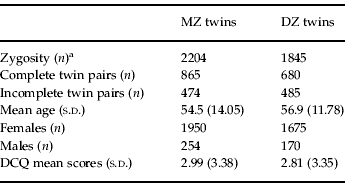
The Dysmorphic Concern Questionnaire (DCQ; Oosthuizen et al. Reference Oosthuizen, Lambert and Castle1998) was sent to all active twins in the registry (n=8236) as part of a longer self-completion questionnaire. A total of 4050 twins returned the questionnaire anonymously (Table 1). There were no significant differences between responders and non-responders in terms of zygosity (54% v. 52% MZ, respectively). There was, however, a significant difference in terms of gender (10.4% males among responders versus 19.5% among non-responders; χ2=131.71, degrees of freedom (df)=1, p<0.01) and age [mean 57 years (s.d.=13.10) for responders versus mean 48 years (s.d.=14.28) for non-responders; t=27.1, df=8217, p<0.01], with non-responders more likely to be male and younger.
Demographic characteristics of the 4050 participants

MZ, Monozygotic; DZ, dizygotic; DCQ, Dysmorphic Concern Questionnaire.
a n=1 female twin with missing zygosity.
Measures
The DCQ (Oosthuizen et al. Reference Oosthuizen, Lambert and Castle1998) is a brief (seven-item) self-report questionnaire assessing the extent of concern with physical appearance/body malfunctioning. Its items measure the following: the degree of concern with physical appearance, the degree to which the person considers being misshapen or malformed; concerns about bodily malfunction (e.g. excessive body odour, flatulence, sweating); the amount of consultation with cosmetic surgeons, dermatologists or physicians about these concerns; having been told by others/doctor that the person is normal-looking, but strongly believing something is wrong with appearance/body functioning; spending excessive time worrying about defect in appearance/body functioning; spending significant time covering up defects in appearance/body functioning. Each item is rated on a 4-point Likert scale (0=not at all; 1=like most people; 2=more than other people; 3=much more than other people), with a total score ranging from 0 to 21. Several studies have shown the questionnaire to be a reliable and valid measure for the assessment of dysmorphic concern (Oosthuizen et al. Reference Oosthuizen, Lambert and Castle1998; Stangier et al. Reference Stangier, Janich, Adam-Schwebe, Berger and Wolter2000; Jorgensen et al. Reference Jorgensen, Castle, Roberts and Groth-Marnat2001; Mancuso et al. Reference Mancuso, Knoesen and Castle2010). Two recent reports have also shown that certain empirically derived cut-offs on the DCQ are indicative of a likely BDD diagnosis with high sensitivity and specificity (Stangier et al. Reference Stangier, Janich, Adam-Schwebe, Berger and Wolter2000; Mancuso et al. Reference Mancuso, Knoesen and Castle2010). For instance, scores >11 show a sensitivity of 89.1% and specificity of 94.7% and correctly classify 94% of individuals (Mancuso et al. Reference Mancuso, Knoesen and Castle2010). Unpublished data from our group has also indicated that a score of 17 on the DCQ discriminates individuals diagnosed with BDD from individuals diagnosed with eating disorders with a specificity of 88% (Monzani et al. unpublished data). In the current study, the DCQ demonstrated good internal consistency (Cronbach's α=0.86) and a single-factor structure, explaining 45.16% of the variance (principal component analysis). Factor loadings ranged from 0.59 (belief in bodily malfunction) to 0.84 (spending excessive time worrying about appearance).
In an attempt to identify participants whose concern in physical appearance was due to an objective defect/disfigurement caused by a medical condition or injury, we also asked the following: ‘Are your appearance concerns due to an injury or medical condition that has disfigured you or significantly changed your appearance? Yes/No. If yes, please specify’). Individuals who answered yes and provided clear and recognizable causes for disfigurement, such as road accidents, operations (e.g. mastectomy, limb amputations) and medical conditions (e.g. cleft lip and palate, vitiligo, psoriasis) were selected. The analyses reported below were conducted first including and then excluding these individuals in an attempt to investigate the impact on heritability of dysmorphic concerns.
Statistical analyses
Twin analyses were carried out on female twins only (n=3544), using Mx (http://www.vcu.edu/mx/). Male twins (n=388), DZ opposite sex twins (n=77) and twins for whom co-twin sex was unknown (n=40) were excluded as the small number of cases in these categories did not allow sufficient power to investigate quantitative and qualitative sex differences in the liability to dysmorphic concerns.
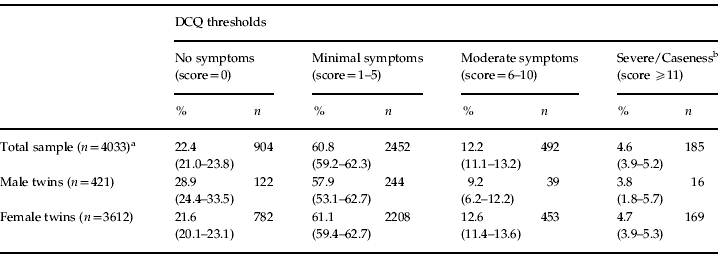
As skewness measures (skewness=1.84) indicated non-normality of the distribution for dysmorphic concern, we used liability-threshold modelling to calculate polychoric correlations for MZ and DZ twins, with the ultimate goal of estimating the genetic and environmental influences on dysmorphic concerns (Rijsdijk & Sham, Reference Rijsdijk and Sham2002). This method is commonly encountered in behavioural genetics when assessing the liability to a trait/disorder in a population. It is an approach used for the analysis of ordinal raw data and based on the assumptions that: (1) a trait, for instance, dysmorphic concern, has an underlying continuous distribution of liability; (2) the liability distribution of the trait/disorder has one or more thresholds that discriminate between different categories; once the liability passes a certain threshold, an individual will experience a specific trait/disorder. For our analysis, we used an extension of the above model to include three thresholds, resulting in four classes/categories of severity of the extent of dysmorphic concern: no symptoms/concern (DCQ score=0); minimal concerns (DCQ scores 1–5); moderate symptoms/concerns (DCQ scores 6–10); clinically significant symptoms/concerns (DCQ score ⩾11). We adopted a three-threshold solution as this gave the best representation of variability in our sample and also ensured a sufficient number of cases within each category. Further analyses were conducted using different thresholds, yielding estimates similar to the ones reported below; hence, we only report results based on the above thresholds.
The number of individuals in each category in the present sample can be found in Table 2.
Liability thresholds employed in the present study

DCQ, Dysmorphic Concern Questionnaire; CI, confidence intervals.
a n=4050 twins returned the DCQ but the questionnaires from 17 twins were incomplete.
b Cut-off ⩾11 (sensitivity 89.1%; specificity 94.7%).
Values in parentheses are 95% confidence intervals
Twin analyses seek to decompose the phenotypic variance into three factors: A (additive genetic, i.e. the proportion of phenotypic variation that can be attributed to genetic factors); C (common/shared environment, i.e. environmental effects shared by twins); E (unique/non-shared environment, i.e. environmental effects unique to each twin, plus measurement error).
Polychoric correlation analyses were first performed to test our model assumptions and estimate the correlation in liability to dysmorphic concern for MZ and DZ twins. Maximum-likelihood univariate model-fitting analyses (Neale & Cardon, Reference Neale and Cardon1992) were then undertaken to estimate the contribution of genetic and environmental factors to body dysmorphic concern, decomposing its variance into additive genetic, shared and non-shared environmental components.
Data were fitted to a saturated model, in which twin correlations and thresholds are estimated freely. Goodness of fit was assessed by comparing the −2 log-likelihood χ2 values of the saturated to the ACE model. To explain the observed data and pattern of variance using as few parameters as possible, reduced submodels, where the genetic parameter, shared environmental parameter and both these parameters are dropped (AE, CE, E models), were tested and compared to the full ACE model. The difference in the χ2 value relative to the change in degrees of freedom provided an indication of the goodness of fit and parsimony (Neale & Cardon, Reference Neale and Cardon1992).
Results
Polychoric correlations were approximately twice as large for MZ [r=0.45 (95% confidence intervals (CI) 0.37–0.52)] than were for DZ [r=0.20 (95% CI 0.09–0.29)] twins (n=3544). Greater similarity between MZ than DZ twins suggests a meaningful genetic influence on dysmorphic concerns. The moderate MZ correlation also suggests a non-shared environmental influence on this trait.
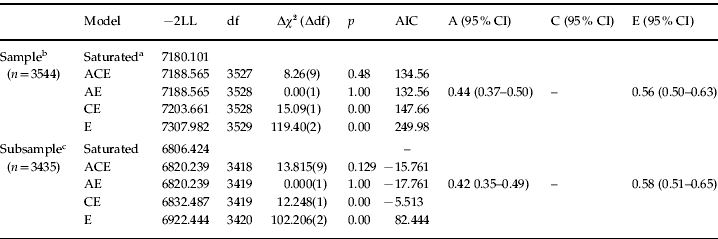
Genetic modelling showed the best-fitting model for dysmorphic concern to be the AE model. It was possible to drop the shared environmental parameter (C) without a significant reduction in fit, while dropping A or E, on the other hand, resulted in a significant decrease in fit. On the basis of a liability threshold model, 44% (95% CI 0.37–0.50) of the variation in liability to dysmorphic concerns was due to additive genetic factors and 56% (95% CI 0.50–0.63) of the variation in dysmorphic concerns was attributable to non-shared environmental influences plus measurement error. Model-fitting results and parameter estimates are summarized in Table 3. These heritability estimates did not change significantly after accounting for the effects of age (data available upon request).
Univariate liability-threshold model fitting results

2LL, Log likelihood; df, degrees of freedom; Δχ2, difference in goodness-of-fit statistic between the submodel and the full model; Δdf, change in degrees of freedom between the submodel and the full model; AIC, Akaike Information Criterion; A, additive genetic; C, common environment; E, unique environment; CI, confidence intervals.
a Thresholds for first- and second-born monzygotic (MZ) and dizygotic (DZ) female twins could be equated between twins and across zygosity without any loss in fit (χ2=8.2, df=9, p=0.5) and were as follows: −0.79; 0.93; 1.66.
b Female twins only. The following were excluded from this analysis: male twins (n=388); opposite sex DZ twins (n=77); twins for whom co-twin sex was unknown (n=40).
c Excluding female twins reporting that their appearance concerns were due to an objective injury or medical condition that has disfigured them or significantly changed their appearance (e.g. mastectomy) (n=109).
The results remained largely unchanged after the exclusion of the female participants (n=109) who reported an objective medical condition/injury accounting for their concern in physical appearance. Polychoric correlations were 0.44 (CI 0.36–0.51) and 0.18 (CI 0.08–0.29) for MZ and DZ twins, respectively. The maximum-likelihood univariate model-fitting analysis on 3435 female twins showed that the AE model was still the best-fitting model, with 42% (95% CI 35–49) of the variation in body dysmorphic concerns attributable to genetic factors and 58% (95% CI 51–65) to unique environmental factors plus measurement error.
Because the DCQ contains questions that respondents could answer positively, even if they did not have appearance concerns, particularly question 3 [‘Considered your body to be malfunctional in some way (e.g. excessive body odour, flatulence, sweating)’], we re-analysed the data excluding individuals who responded with a 0 (‘not at all’) or 1 (‘same as most people’) to questions 1 (‘been very concerned about some aspect of your physical appearance?’) or 2 (‘considered yourself misformed or misshapen in some way?’) in order to assess how many respondents scoring above the cut-off value of 11 did not have significant appearance concerns. Only six out of the 185 twins originally scoring >11 reported no or minimal concern in physical appearance and were eliminated. Not surprisingly, twin modelling results remained largely unchanged: the AE model was the best fit for our data, with 44% (CI 0.37–0.51) of variance attributable to genetic factors and unique environmental factors explaining the remaining variance [56% (CI 0.49–0.63)] in dysmorphic concern. Results also remained unchanged [A=44% (95% CI 0.37–0.51)] when completely excluding item 3 (body malfunction) to create a phenotype more purely related to physical appearance.
Finally, because a cut-off point of 17 on the DCQ has been shown to discriminate between BDD and eating disorder with high specificity (88%; Monzani et al. unpublished data), we repeated all analyses using this cut-off but the results remained unchanged (data available upon request).
Discussion
To our knowledge, this is the first study to estimate the contribution of genetic and environmental risk factors to dysmorphic concerns. Our main finding was that both genetic and unique environmental factors play an important role in the liability to developing excessive concerns with a perceived or slight defect in physical appearance. Results from the best-fitting model (AE model) suggest that 44% of the variation in liability to dysmorphic concerns is attributable to genetic factors, while individual environmental factors and measurement error account for the remaining variance (56%). By contrast, shared environmental factors did not seem to contribute to the liability to dysmorphic concerns in our sample, suggesting a negligible role of these factors in determining variation in the trait. We were also able to reappraise the heritability of dysmorphic concerns after the exclusion of those participants who identified an objective medical reason that could reasonably be associated with the self-reported body concerns and found that the results remained largely unchanged. Finally, additional analyses were performed using different cut-offs on the DCQ, as higher scores discriminate better between BDD and eating disorders, but the results remained unchanged.
Two previous family studies had suggested that the most extreme form of dysmorphic concern, BDD, might be a familial disorder (Bienvenu et al. Reference Bienvenu, Samuels, Riddle, Hoehn-Saric, Liang, Cullen, Grados and Nestadt2000; Phillips et al. Reference Phillips, Menard, Fay and Weisberg2005b ). Our findings extend the results of these family studies and further suggest that this familiality is likely to be primarily attributable to genetic factors since the effect of growing in the same family (shared environment) was not important. Further research is clearly needed to identify genes that increase the liability to dysmorphic concerns.
The results indicate that unique environmental factors are also important in increasing the liability to develop severe dysmorphic concerns. At least half of the variance in dysmorphic concern was due to these unique environmental factors. To our knowledge, no studies have been done to identify environmental risk factors to dysmorphic concerns in general, although there are some useful clues from the BDD literature. Patients with BDD report more appearance- and competency-related teasing experiences in childhood than healthy controls (Buhlmann et al. Reference Buhlmann, Cook, Fama and Wilhelm2007). There is also evidence that BDD patients have a high prevalence of childhood abuse and neglect (Didie et al. Reference Didie, Tortolani, Pope, Menard, Fay and Phillips2006). These adverse experiences may contribute to the early formation of beliefs regarding the importance of appearance (Veale et al. Reference Veale, Ennis and Lambrou2002) and/or interact with genetic factors to trigger dysmorphic concerns later in life.
Our results also shed some light on the prevalence of clinically significant dysmorphic concerns in the population. Data from the DCQ indicated that approximately 4% of the total sample had elevated degrees of dysmorphic concerns. Even following the exclusion of people reporting an objective medical condition/injury that may have accounted for their appearance concerns, rates remained high at 4%. Overall, the rate of those scoring above the cut-off value of 11 on the DCQ, and therefore more likely to endorse a BDD diagnosis, is higher than that reported in previous community-based BDD studies, where the prevalence ranged between 0.7% (Faravelli et al. Reference Faravelli, Salvatori, Galassi, Aiazzi, Drei and Cabras1997; Otto et al. Reference Otto, Wilhelm, Cohen and Harlow2001) and 2.4% (Koran et al. Reference Koran, Abujaoude, Large and Serpe2008), but generally lower than that reported in psychiatric and college samples, where rates range between 2% and 13% (Biby, Reference Biby1998; Grant et al. Reference Grant, Kim and Crow2001; Bohne et al. Reference Bohne, Wilhelm, Keuthen, Florin, Baer and Jenike2002; Conroy et al. Reference Conroy, Menard, Fleming-Ives, Modha, Cerullo and Phillips2008). It is important to note the DCQ is not a diagnostic tool and that it measures a broader construct than BDD. Therefore, it seems unlikely that all participants who scored above the cut-off in this study will meet criteria for BDD. Instead, our results are likely to apply to a range of psychiatric conditions that are characterized by excessive appearance concerns, including but not limited to BDD. Similarly, because the DCQ also measures other body-related concerns beyond appearance (that is, body odour and body malfunction), the results may also apply to other disorders, such as olfactory reference syndrome and hypochondriasis. However, only six out of the 185 twins originally scoring above the DCQ cut-off reported no or minimal concern in physical appearance, suggesting that most high-scoring individuals did have significant appearance concerns and that our results primarily relate to individuals with such concerns. Furthermore, exclusion of item 3 (body malfunction) did not alter the overall results, suggesting that the current findings primarily apply to appearance-related concerns.
Limitations
A number of limitations and methodological considerations should be taken into consideration when interpreting the current results. First, heritability estimates were limited to female Caucasian twins. The twin registry has an historical female bias and the small proportion of males in our sample, which reflects the difference in sex ratio in the registry, did not enable us to test heritability models in females and males separately. Nevertheless, given the comparable rates of significant dysmorphic concerns across both sexes in our sample (Table 2), there are no reasons to believe that the current heritability estimates only apply to women. Second, we were unable to estimate how much of the non-shared environmental variance was due to measurement error as data on dysmorphic concern was collected on one occasion only. Third, our findings need to be interpreted in the context of broader limitations of the twin design; in particular, the assumption of equal environment (Joseph, Reference Joseph2002). Finally, we did not exclude participants who had primary weight concerns; this could potentially lead to overestimation of the rate of significant dysmorphic concerns in our sample. However, there are reasons to believe that this had little impact on our results. First, the mean age of our sample was 56 years and the prevalence and incidence of eating disorder cases are quite rare in this age group (Soundy et al. Reference Soundy, Lucas, Suman and Melton1995; Hudson et al. Reference Hudson, Hiripi, Pope and Kessler2007). Second, more consistent with the BDD literature (but inconsistent with the eating disorder literature), we found a similar prevalence of significant dysmorphic concerns in female and male participants. Finally, our heritability estimates did not change when we used a more stringent cut-off, which is able to discriminate between BDD and eating disorders.
Conclusions
In conclusion, our findings suggest that both genetic and unique environmental factors play an important role in causing dysmorphic concerns. The present findings should encourage further research into identifying specific genes and environmental risk factors that increase the susceptibility to dysmorphic concerns and its diagnosable forms. Future research should also examine the extent to which genetic and environmental factors that confer risk to severe dysmorphic concerns are shared with other psychopathologically related symptoms, such as obsessive-compulsive and eating disorder symptoms.
Acknowledgements
The TwinsUK register is supported by the Wellcome Trust and the Department of Health via the National Institute for Health Research (NIHR) comprehensive Biomedical Research Centre award to Guy's & St Thomas' NHS Foundation Trust in partnership with King's College London.
Declaration of Interest
None.