Introduction
Microalgae, which are defined as microscopic algae, are unicellular, photosynthetic organisms which grow in salt or fresh water. As a rich source of nutrients and biologically active substances, including protein, amino acids, n-3 long chain polyunsaturated fatty acids (LCPUFA n-3), microelements, vitamins, antioxidants, and carotenoids, they have a long history of application as a food for humans (Belay et al., Reference BELAY, KATO and OTA1996).
The increasing demand for human protein food sources has resulted in a need for new feed materials which provide a safe source of nutrients for poultry and livestock. Several feeding experiments have demonstrated that microalgae of different species can be successfully included into poultry diets, for example as a defatted biomass byproduct from biofuel production, and can have a beneficial influence on birds’ health, performance, and the quality of meat and eggs. Especially important for the poultry industry are recent studies where microalgal biomass was efficiently used in the production of eggs containing health-promoting lipids, i.e. eggs enriched with health-promoting long-chain n-3 polyunsaturated fatty acids (LCPUFAs n-3). The traditional method of enriching eggs with LCPUFAs n-3 is to incorporate linseed or fish oil into the layer diet; however, this latter method is limited by the high demand for marine products and the risk of their contamination with heavy metals (Wu et al., Reference WU, OUYANG, DUAN, PANG, ZHANG, YUAN, XUE, NI, CHENG, DOMG, WEI, LI, YU, SUN, CHEN, LAI, DAI and LI2012). For this reason the use of some microalgae species, for instance Nannochloropsis gaditana, Schizochytrium limacinum, Phaeodactylum tricornutum, and Isochrysis galbana, in poultry nutrition could be of interest not only as a source of nutrients, but also as an alternative way of enriching of eggs with LCPUFAs n-3. The objective of this review is to discuss the results of current poultry studies where the effects of poultry feeding with microalgae have been examined.
Efficacy of microalgal biomass in poultry nutrition
spirulina
The blue-green algae (Spirulina) is cultivated worldwide for use in the food and feed industries. Because of their prokaryotic cell type, this microalgae is sometimes called cyanobacteria and can be classified into two species: Spirulina platensis and S. maxima. Dried Spirulina biomass has a high nutritional value for human and animals as it contains about 60-70% protein, as well as being a good source of essential fatty acids, vitamins and minerals (Khan et al., Reference KHAN, BHADOURIA and BISEN2005). Spirulina is a rich source of carotenoids and contains around 6,000 mg total xanthophylls and 7,000 mg total carotenoids/kg in freeze-dried biomass (Anderson et al., Reference ANDERSON, TANG and ROSS1991). The study by Muhling et al. (Reference MUHLING, BELAY and WHITTON2005) has shown a high concentration of gamma-linolenic acid in Spirulina biomass, which is an essential polyunsaturated fatty acid (12.9-29.4% total fatty acids).
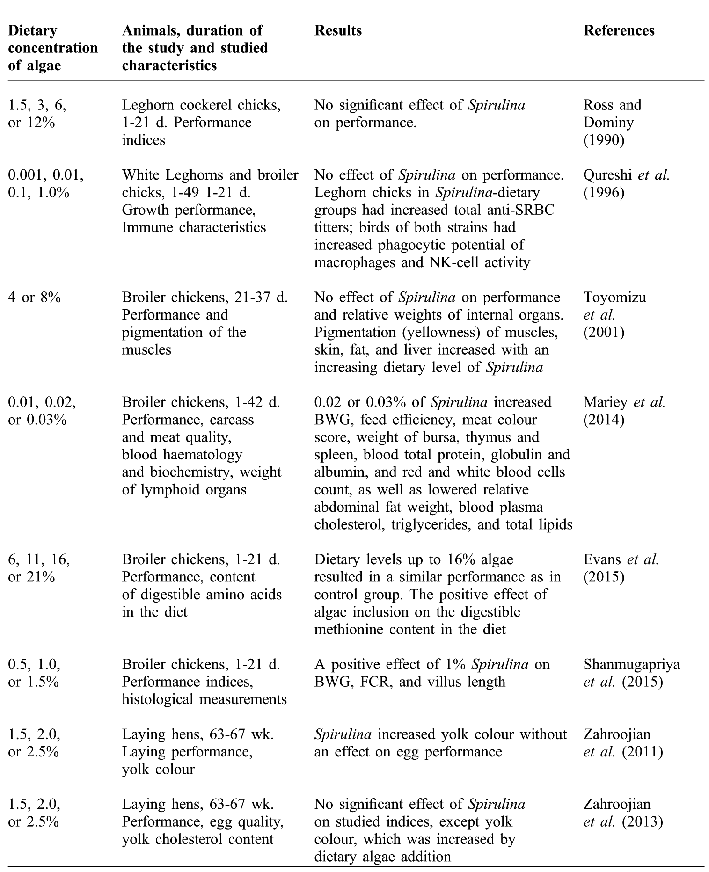
The results of the experiments on Spirulina inclusion use in broiler diets are summarised in Table 1. In recent work, Evans et al. (Reference EVANS, SMITH and MORITZ2015) showed that dried full-fat Spirulina algae had an energy value equal to 90% the energy of corn (2839 kcal TMEn/kg), as well as containing a high level of crude protein (76%) and essential amino acids. They also reported that up to 16% of dried algae can be incorporated into a broiler starter diet without any negative effects on the performance of chicks. Similar results were obtained in work by Ross and Dominy (Reference ROSS and DOMINY1990) who found no significant differences in performance of broilers fed a diet containing 1.5, 3, 6 or 12% dehydrated Spirulina in feed. They concluded that Spirulina at up to 12% of the diet may be substituted for other protein sources in broiler diets with good growth and FCR. Toyomizu et al. (Reference TOYOMIZU, SATO, TARODA, KATO and AKIBA2001) reported no difference in growth performance of broilers fed with or without 4 or 8% of Spirulina biomass in the diet. However, the yellowness of muscles, skin, fat and liver increased with an increasing dietary level of microalgae, being more attractive for consumers in certain markets. Hence, dietary Spirulina is useful for the manipulation of chicken meat colour, especially as the range where the fillets produced by feeding Spirulina do not fall under the extremes of either dark or light meat (Toyomizu et al., Reference TOYOMIZU, SATO, TARODA, KATO and AKIBA2001). Similar results were reported by Venkataraman et al. (Reference VENKATARAMAN, SOMASEKARAN and BECKER1994) who demonstrated no effect of dried Spirulina (included at 14 or 17% in the diet) as a replacement for dietary fish meal or groundnut cake protein on performance, dressing percentage and histopathology in the various organs of broiler. However they found a more intensive meat colour in the case of birds fed algal-supplemented diets. In contrast to the above authors, Shanmugapriya et al. (Reference SHANMUGAPRIYA, BABU, HARIHARAN, SIVANESWARAN and ANUSHA2015) recently observed improved body weight gain (BWG), FCR and villus length in broilers fed a diet containing Spirulina biomass. Mariey et al. (Reference MARIEY, SAMAK, ABOU-KHASHBA, SAYED and ABOU-ZEID2014) reported that a low dietary level of Spirulina biomass (0.02 or 0.03%) not only improved performance in broilers, but also increased dressing percentage, meat colour score, weight of lymphoid organs, improved blood morphology and decreased relative abdominal fat weight, blood cholesterol, triglycerides and total lipids.
Results of selected studies on the effects of Spirulina inclusion into poultry diets.

The results of several trials have shown that Spirulina can be used to enhance the immune function of birds. Quereshi et al. (Reference QUERESHI, GARLICH and KIDD1996) reported that broiler chicks fed diets containing 1% Spirulina had increased phytohaemagglutinin-mediated lymphocyte proliferation and phagocytic activity of macrophages compared to control treatment. Raju et al. (Reference RAJU, RAO, RADHIKA and CHAWAK2005) found that dietary Spirulina (0.05% in feed) can partially alleviate the negative effects of aflatoxin on weight of immune organs and BWG in broilers.
Experiments with laying hens have been mainly focussed on evaluating the efficiency of Spirulina biomass as a source of carotenoids for pigmentation of egg yolks. In experiments with laying hens, Zahroojian et al. (Reference ZAHROOJIAN, MORAVEJ and SHIVAZAD2011; Reference ZAHROOJIAN, MORAVEJ and SHIVAZAD2013) demonstrated that algal carotenoids were well absorbed and accumulated in the egg yolk, and 2.0-2.5% dietary Spirulina could be used to produce eggs with increased yolk colour with similar efficiency to a synthetic pigment. An earlier study with quail (Anderson et al., Reference ANDERSON, TANG and ROSS1991) showed that optimal yolk colour was achieved when 1% of Spirulina biomass was added to the diet. Mariey et al. (Reference MARIEY, SAMAK and IBRAHEM2012) reported improved egg production, hatchability and yolk colour when laying hens were fed a diet with a low level of Spirulina inclusion (0.1-0.2%).
A study with Japanese quail by Ross and Dominy (Reference ROSS and DOMINY1990) evaluated the effect of Spirulina included at 1.5, 3.0, 6.0, or 12.0% in the diet on growth performance, egg production and quality. The authors observed no significant differences due to the dietary microalgae level, except for increased yolk colour and fertility in birds fed with Spirulina, and concluded that up to 12% of Spirulina biomass could be included into diets. The results of the study with growing quail (aged 15-35 days) showed no negative effects in growth performance and meat quality when included in levels up to 4% of Spirulina in feed (Cheong et al., Reference CHEONG, KASIM, SAZILI, OMAR and TEOH2015).
chlorella
Chlorella, a unicellular, freshwater green microalgae used mainly for human food and biofuel production, has been studied in several animal experiments as a potential source of high quality protein (approximately 60%), essential amino acids, vitamins, minerals, and antioxidants. Chlorella biomass is a very good source of carotenoids, as it contains 1.2-1.3% of total pigments in dry mass (Batista et al., Reference BATISTA, GOUVEIA, BANDARRA, FRANCO and RAYMUNDO2013). As indicated by Kotrbacek et al. (Reference KOTRBACEK, DOUBEK and DOUCHA2015), this microalgae is too expensive to be used as protein material for animals, however, due to the content of many bioactive substances, even a low, economically acceptable dietary level of Chlorella biomass may beneficially affect animal performance.
A very early study with chickens (Combs, Reference COMBS1952) demonstrated that dried Chlorella, included into the diet at 10% could serve as a rich source of certain nutrients, i.e. carotene, riboflavin and vitamin B12, and increased performance in birds when the diet was deficient in these nutrients. Grau and Klein (Reference GRAU and KLEIN1957) reported that Chlorella biomass grown in sewage was a rich source of protein and xanthophyll pigments, and levels up to 20% in the diet was well tolerated by chicks. Similarly, Lipstein and Hurwitz (Reference LIPSTEIN and HURWITZ1983) found that Chlorella was a suitable protein supplement in broiler diets and, used at 5 or 10% dietary level, had no adverse effect on growth performance.
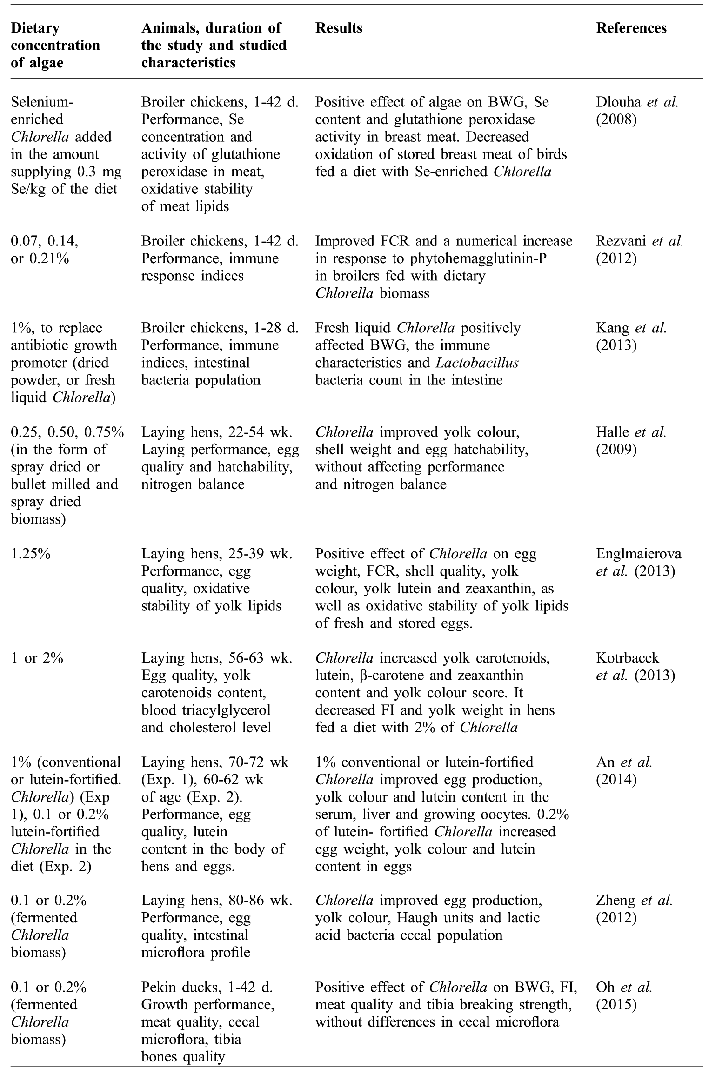
Kang et al. (Reference KANG, SALIM, AKTER, KIM, KIM, BANG, NA, HWANGBO, CHOI, KIM and SUH2013) studied the effects of the replacement of antibiotic growth promoter with different forms of Chlorella on performance, immune indices and the intestinal microfloral population. They found that Chlorella in its fresh liquid form included at a 1% dietary level beneficially affected BWG, some immune characteristics (e.g. number of white blood cells and lymphocytes, plasma IgA, IgM, and IgG concentrations) and the intestinal production of Lactobacillus bacteria (Table 2). Such an effect of dietary Chlorella appears to be based on multiple components, and the fibre fraction, among others including a polysaccharide named immurella, glycoprotein, and peptides contained in Chlorella, stimulate the immune response of birds (Kang et al., Reference KANG, SALIM, AKTER, KIM, KIM, BANG, NA, HWANGBO, CHOI, KIM and SUH2013). Likewise, Kotrbacek et al. (Reference KOTRBACEK, HALOUZKA, JURAJDA, KNOTKOVA and FILKA1994) found that broilers fed a diet with 0.5% Chlorella significantly increased the phagocytic activity of leucocytes and lymphatic tissue development. Rezvani et al. (Reference REZVANI, ZAGHARI and MORAVEJ2012) observed a numeric increase in response to phytohemagglutinin-P, which was accompanied by improved FCR in broilers fed supplementary Chlorella.
Results of selected studies on the effects of Chlorella inclusion to poultry diets.
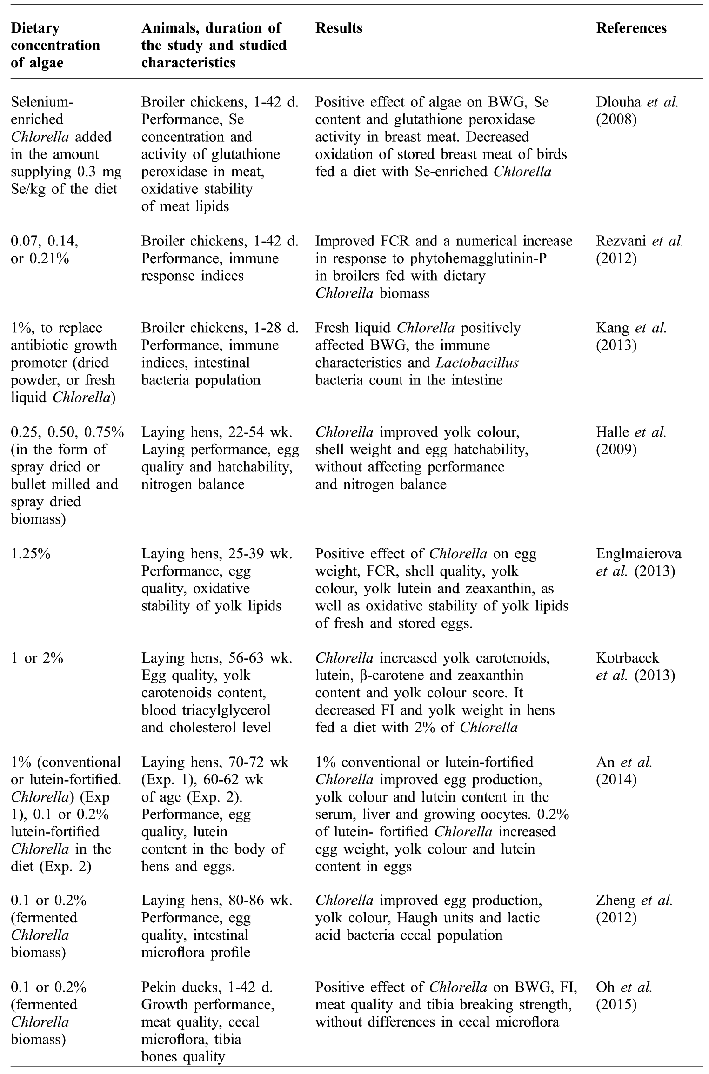
Because Chlorella is grown in the presence of high levels of selenite, it accumulates cellular selenium and there is a growing interest in the use of this algae as a rich source of Se for animals (Kotrbacek et al., Reference KOTRBACEK, DOUBEK and DOUCHA2015). In a study with broilers, Dlouha et al. (Reference DLOUHA, SEVCIKOVA, DOKOUPILOVA, ZITA, HEINDL and SKRIVAN2008) found that dietary addition of Se-enriched Chlorella biomass not only positively affected BWG but also increased Se content and glutathione peroxidase activity in breast meat, as well as decreasing the oxidation of breast meat stored under refrigeration.
A positive effect of Chlorella as a feed material for laying hens was found by Halle et al. (Reference HALLE, JANCZYK, FREYER and SOUFFRANT2009), who reported that layers fed a diet supplemented with dietary algae had increased egg hatchability, yolk colour and shell weight without affecting egg performance and nitrogen balance. In a subsequent study, the same authors showed a higher diversity of the microbiota community in the intestinal tract of hens fed a diet containing Chlorella and suggested that it could be responsible for the effects on egg quality (Janczyk et al., Reference JANCZYK, HALLE and SOUFFRANT2009). A beneficial influence of feeding Chlorella on laying performance, egg quality, and caecal lactic bacteria population was observed by Zheng et al. (Reference ZHENG, OH, JEON, MOON, KWON, LIM, AN and KANG2012). Skrivan et al. (Reference SKRIVAN, MAROUNEK, DLOUHA and SEVCIKOVA2008) reported that Se-enriched Chlorella was a more efficient source of Se than sodium selenite as, despite equal doses of Se supplementation, a higher Se content was found in eggs from hens fed diet supplemented with Chlorella. An et al. (Reference AN, JEON, KANG, KIM and HWANG2014) found that diet supplementation with conventional or lutein-enriched Chlorella could positively affect egg performance, yolk colour and lutein concentration in eggs. Hence, the use of Chlorella is a valuable tool for the production of chicken eggs enriched with natural lutein, and increasing consumption of this compound can prevent macular degeneration in the human ageing population. Englmaierova et al. (Reference ENGLMAIEROVA, SKRIVAN and BUBANCOVA2013) showed that supplementing layers with Chlorella not only increased the concentration of lutein and zeaxanthin, but also improved FCR, shell quality, and the oxidative stability of yolk lipids of fresh and stored eggs. In agreement, Kotrbacek et al. (Reference KOTRBACEK, SKRIVAN, KOPECKY, PENKAVA, HUDECKOVA, UHRIKOVA and DOUBEK2013) reported significantly increased yolk carotenoids’ content as well as yolk colour score in hens fed with Chlorella supplementation, however, dietary microalgae decreased feed intake and yolk weight.
other microalgae species
The results of an early study by Lipstein and Hurwitz (Reference LIPSTEIN and HURWITZ1981) showed that the microalgae Micractinium could be a useful protein source for broilers, and supplementing up to a 6% in the diet had no negative effect on growth performance. However, chickens fed a higher inclusion level of this algae had decreased feed intake and BWG. The study by Austic et al. (Reference AUSTIC, MUSTAFA, JUNG, GATRELL and LEI2013) evaluated the effects of Staurosira incorporation into the broilers’ diet, and the results indicated that Staurosira may be used to substitute 7.5% of soybean meal without any negative influence on performance or plasma and liver biomarkers, when an appropriate amino acids dietary level was maintained.
The aim of the study by Waldenstedt et al. (Reference WALDENSTEDT, INBORR, HANNSON and ELWINGER2003) was to evaluate the efficacy of an increasing dietary level of Haematococcus pluvalis meal, used as an astaxanthin source, in broiler chickens infected with Campylobacter jejuni. The authors showed no influence of algal meal on performance, but tissue astaxanthin concentrations were significantly higher with increasing levels of dietary algae. Caecal Campylobacter jejuni populations was not affected by Haematococcus pluvalis inclusion, however a diet with 0.18% algal meal reduced caecal Clostridium perfringens counts. Yan and Kim (Reference YAN and KIM2013) showed that adding 0.1 or 0.2% Schizochytrium to the diet improved the fatty acid composition of breast meat lipids, without affecting BWG in broilers.
Poultry products enriched with n-3 long chain polyunsaturated fatty acids are good examples of a functional food, i.e. food that, in addition to possessing traditionally understood nutritional value, can beneficially affect the metabolic and health status of consumers, thus reducing the risk of various chronic lifestyle diseases (Pietras and Orczewska-Dudek, Reference PIETRAS and ORCZEWSKA-DUDEK2013; Yanovych et al., Reference YANOVYCH, CZECH and ZASADNA2013; Zdunczyk and Jankowski, Reference ZDUNCZYK and JANKOWSKI2013). The results of several experiments have shown that microalgae, as a rich source of LCPUFAs n-3, can be introduced into the diet of laying hens to produce functional foods, i.e. designer eggs with naturally increased LCPUFAs n-3 concentration. For instance, Bruneel et al. (Reference BRUNEEL, LEMAHIEU, FRAEYE, RYCKEBOSCH, MUYLAERT, BUYSE and FOUBERT2013) reported an increased content of DHA in egg yolks of hens fed a diet containing Nannochloropsis gaditana and suggested that this algae may be used as an alternative to current sources of LCPUFA n-3 for the production of DHA-enriched eggs. A similar effect was seen on enhanced DHA yolk concentration through diet supplementation with the marine microalgae Schizochytrium limacinum (Rizzi et al., Reference RIZZI, BOCHOCCHIO, BARGELLINI, PARAZZA and SIMIOLO2009). What is important here is that the sensory characteristics of eggs enriched with LCPUFA n-3 by a addition of Schizochytrium were not altered (Parpinello et al., Reference PARPINELLO, MELUZZI, SIRRI, TALLARICO and VERSRI2006). The results of recent work by Park et al. (Reference PARK, UPADHAYA and KIM2015) have shown that the addition of Schizochytrium to layers’ diet not only significantly improved the fatty acids profile of the yolks but also positively affected laying performance and egg quality.
Lemahieu et al. (Reference LEMAHIEU, BRUNEEL, TERMOTE-VERHALLE, MUYLAERT, BUYSE and FOUBERT2013) compared the efficacy of four different algae species (Phaeodactylum tricornutum, Nannochloropsis oculata, Isochrysis galbana and Chlorella fusca) on the enrichment of egg yolks in LCPUFA n-3. They reported that the highest enrichment with PUFA n-3 as well as increased yolk colour was achieved with supplementation using Phaeodactylum or Isochrysis, and these two microalgae could be used as an alternative to current sources for the enrichment of eggs. Subsequent studies proved the suitability of Isochrysis as an LCPUFA n-3 source and showed that 2.4% dietary supplementation with Isochrysis lead to the highest LCPUFA n-3 enrichment in the yolk, and that this supplementation level should be considered as the optimal dose (Lemahieu et al., Reference LEMAHIEU, BRUNEEL, TERMOTE-VERHALLE, MUYLAERT, BUYSE and FOUBERT2014; Reference LEMAHIEU, BRUNEEL, RYCKEBOSCH, MUYLAERT, BUYSE and FOUBERT2015).
Because of a high content of lipids, certain microalgal species can be used as a suitable material for the production of biofuels. Once defatted, algae can provide a rich source of crude protein in poultry diets. Leng et al. (Reference LENG, HSU, AUSTIC and LEI2014) showed no adverse effect of feeding layers with 7.5% defatted Staurosira spp. when used for partial replacement of soybean meal. However, higher dietary levels (15%) worsened egg performance, feed intake and FCR. These authors indicated that such a decrease in performance was likely to be due to the high ash and sodium chloride concentrations of the algae. The results of a recent study by Ekmay et al. (Reference EKMAY, CHOU, MAGNUON and LEI2015) demonstrated that defatted Desmodesmus and Staurosira spp. could be used in laying hen diets at relatively high levels (up to 25% in the diet), as a source of well-digested dietary protein, without any negative effect on egg production.
A study with Muscovy ducks investigated the effects of diet supplementation with 0.5% microalgae Crypthecodinium cohnii (Schiavone et al., Reference SCHIAVONE, CHIARINI, MARZONI, CASTILLO, TASSONE and ROMBOLI2007). They demonstrated the positive effect of this microalgae on the fatty acid profile in breast meat lipids, without affecting growth performances or slaughter traits, as well as chemical composition, colour, pH, oxidative stability and sensory characteristics of the breast meat. An experiment with Japanese quail showed that diet supplementation with Schizochytrium sp. could be an effective way of bio-fortifying egg LCPUFA n-3 levels, as the yolks of birds fed a diet with 0.5% of this microalgae significantly increased DHA concentration, as well decreasing n-6/n-3 PUFA ratio and cholesterol content in yolk lipids (Gladkowski et al., Reference GLADKOWSKI, KIEŁBOWICZ, CHOJNACKA, BOBAK, SPYCHAJ, DOBRZANSKI, TRZISZKA and WAWRZENCZYK2014; Trziszka et al., Reference TRZISZKA, ŁUKASZEWICZ, BOBAK, KOWALCZYK, ADAMSKI and DOBRZAŃSKI2014).
Conclusions
Summarising the literature available, it can be concluded that, although chemical composition of different microalgal biomasses is diverse, many can safely be added to poultry diets. Several Spirulina, Chlorella and other microalgae species may be used to increase the pigmentation and nutritional value of meat and eggs for human consumption, e.g. to enhance these products with LCPUFA n-3 and carotenoids, as well as to partially replace conventional protein sources, mainly soybean meal.