1. Introduction
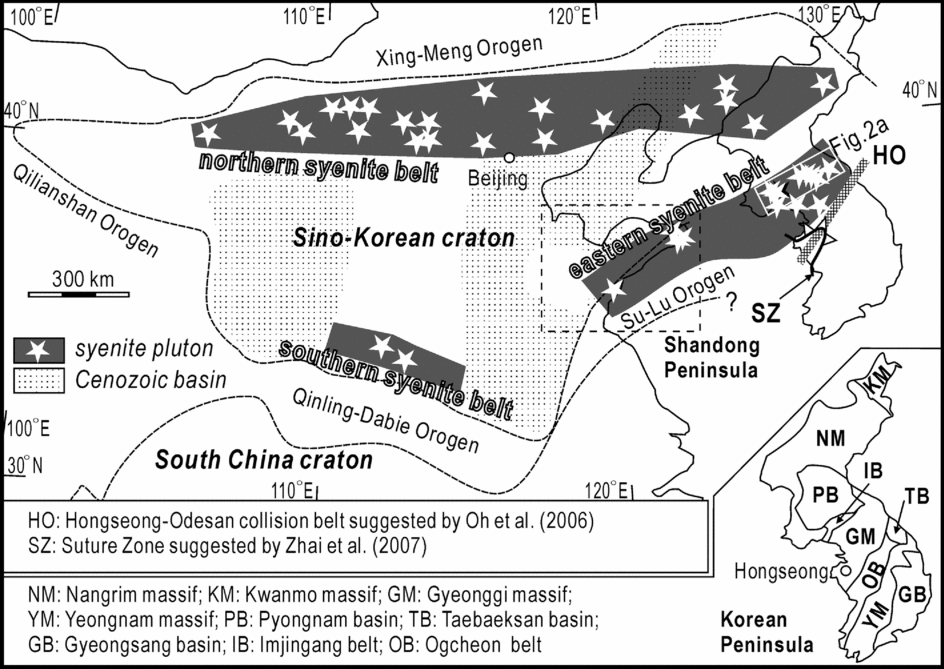
The North China craton, also referred to as the Sino-Korean craton, has experienced multiple collisions with the Xing-Meng, Qilianshan, Qinling-Dabie and Su-Lu orogens to the north, west, south and east, respectively (Fig. 1). The Qilianshan orogen may have formed during the Early Palaeozoic period, whereas the others are Permian–Triassic in age (e.g. Zhao et al. Reference Zhao, Wilde, Cawood and Sun2001). Controversy arises as to the extension of the Su-Lu orogen and the eastern boundary of the Sino-Korean craton in the Korean Peninsula: the Su-Lu orogen either has affected the Korean Peninsula (and thus the eastern boundary of the Sino-Korean craton; e.g. the Imjingang belt: Yin & Nie, Reference Yin and Nie1993; Xu & Zhu, Reference Xu and Zhu1995; Ree et al. Reference Ree, Cho, Kwon and Nakamura1996), or has never affected it (in which case the whole Korean Peninsula would belong to the Sino-Korean craton: e.g. Chang & Park, Reference Chang and Park2001; Ishiwatari & Tsujimori, Reference Ishiwatari and Tsujimori2003). The recent identification of Triassic eclogite in the Hongseong area (c. 230 Ma: Guo et al. Reference Guo, Zhai, Oh and Kim2004; Oh et al. Reference Oh, Kim, Choi, Zhai, Guo and Krishnan2005; Oh, Reference Oh2006) infers the extension of the Su-Lu orogen in the central Korean Peninsula, in the Hongseong–Odesan collision belt (Oh, Reference Oh2006), or a provisional suture zone in a crustal detachment-thrust model (Zhai et al. Reference Zhai, Guo, Li, Chen, Peng, Li, Hou and Fan2007) (Fig. 1).
Triassic syenite plutons in the Sino-Korea craton and tectonic subdivision of the Korean Peninsula.

Syenite is found in both non-orogenic (mostly intra-continental rift, e.g. East African Rift and Oslo Graben: Fitton & Upton, Reference Fitton and Upton1987; Zanvilevich et al. Reference Zanvilevich, Litvinovsky, Wickham and Bea1995) and post-collisional environments (e.g. Tibet and Su-Lu orogen: Turner et al. Reference Turner, Arnaud, Liu, Rogers, Hawkesworth, Harris, Kelley, Van Calsteren and Deng1996; Yang et al. Reference Guo, Chen, Zhang, Siebel and Zhai2005). Here we report geochronological and geochemical data from the rare samples of the Tokdal Complex (Fig. 2a), which is close to the military boundary of North Korea and South Korea. It is revealed to be post-collisional and Late Triassic in age, and it provides geological evidence for an extension of the syenite terrane in North China into the Korean Peninsula.
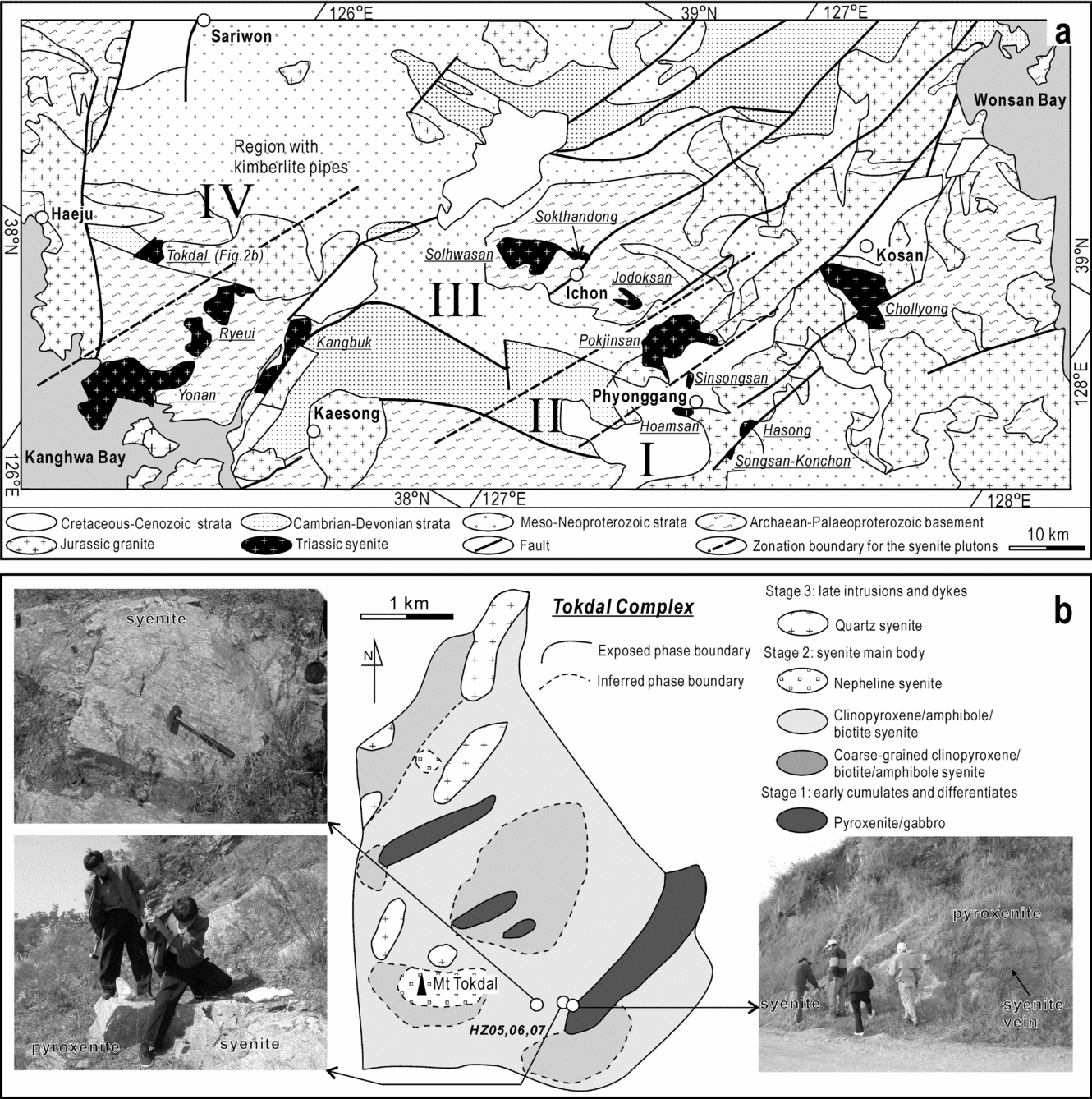
(a) Triassic syenite plutons in the southern North Korea (after Paek, Gap & Jon, Reference Paek, Gap and Jon1996; revised). ‘I’ to ‘IV’ refer to chemical zonations among syenite plutons. (b) Petrographic phases of the Tokdal Complex (after Paek, Gap & Jon, Reference Paek, Gap and Jon1996; revised). The inset photos show syenite main body and cumulate enclave/body.

2. Geological background
2.a. Tectonic subdivision and extension of the Sino-Korean craton in the Korean Peninsula
The Korean Peninsula can be generally subdivided into four massifs (Kwanmo, Nangrim, Gyeonggi and Yeongnam), three basins (Pyongnam, Taebaeksan and Gyeongsang) and two tectonic belts (Imjingang and Ogcheon) (Fig. 1; Paek, Gap & Jon, Reference Paek, Gap and Jon1996). All the massifs are composed of Archaean–Palaeoproterozoic rocks with basins on them, except the Kwanmo massif, which is a block in the Xing-Meng orogen. The Pyongnam (Mesoproterozoic–Palaeozoic), Taebaeksan (Palaeozoic) and Gyeongsang (Mesozoic) basins have developed on the Nangrim, Gyeonggi and Yeongnam massifs, respectively. The Imjingang belt consists of Palaeozoic (Devonian–Silurian?) metasediments between the Nangrim and Gyeonggi massifs (e.g. Paek, Gap & Jon, Reference Paek, Gap and Jon1996), whereas the Ogcheon belt is dominated by Neoproterozoic–Palaeozoic metasediments and metavolcanics between the Gyeonggi and Yeongnam massifs (e.g. Lee, Chang & Park, Reference Lee, Chang and Park1998). Although attributions of the massifs and basins in the Korean Peninsula to the Sino-Korean craton remain unresolved, the Nangrim massif and Pyongnam basin are suggested to be affinitive to the Sino-Korean craton (e.g. Yin & Nie, Reference Yin and Nie1993; Xu & Zhu, Reference Xu and Zhu1995; Chang & Park, Reference Chang and Park2001; Ishiwatari & Tsujimori, Reference Ishiwatari and Tsujimori2003; Oh, Reference Oh2006; Zhai et al. Reference Zhai, Guo, Li, Chen, Peng, Li, Hou and Fan2007; Wu et al. Reference Wu, Han, Yang, Wilde, Zhai and Park2007).
2.b. Syenite plutons in the Sino-Korean craton (northern and southern margins)
Numerous syenite bodies (c. 240–190 Ma) crop out along the north and south margins of the Sino-Korean craton as two syenite belts, that is, one northern syenite belt along the north margin (Yan et al. Reference Yan, Mu, Xu, He, Tan, Zhao, He, Zhang and Qiao2000a, Reference Yan, Tan, Xu, Mou, Shao, Cheng, Tong, Ren and Yang2001; Mu et al. Reference Mu, Shao, Chu, Yan and Qiao2001; Xu et al. Reference Xu, Yan, Lu, Zou, Tong, Cai, Liu and Zhang2001; Jiang et al. Reference Jiang, Sun, Chu, Mizuta and Ishiyanma2003; Lu et al. Reference Lu, Wu, Zhao and Zhang2003; Ren et al. Reference Ren, Yan, Mu, Cai, Tong, Li, Zhao, Gu, Yang and Chu2005; J. H. Yang, pers. comm.) and another along the south margin (Zhang et al. Reference Zhang, Zhu, Chang and Xie2002; Zhang, Zhu & Chang, Reference Zhang, Zhu and Chang2000, Reference Zhang, Zhu and Chang2003) (Fig. 1). Most plutons contain one or several nepheline- or aegirine-bearing syenite phases. They are thought to be generated from enriched lithospheric mantle in an extensional regime after the collisions in the north and south of the Sino-Korean craton, respectively. There are also syenite bodies in the central Sino-Korean craton (e.g. Mt Taihangshan). However, these show younger ages (135–122 Ma; Yan et al. Reference Yan, Xu, Mu, Wang, Chang, Chen, Zhao, Wang, Zhang, Qiao and Chu2000b) and have probably formed during different events.
2.c. Syenite plutons in the Sino-Korean craton (eastern margin: the Korean and Shandong peninsulas)
Late Triassic syenite plutons in North Korea are known as the Phyonggang Complex (e.g. Paek, Gap & Jon, Reference Paek, Gap and Jon1996). Two of the plutons belong to the northern syenite belt (Fig. 1), from which a U–Pb zircon LA-ICP-MS age of 234 ± 2 Ma was recently obtained (the Unsan Pluton: Wu et al. Reference Wu, Han, Yang, Wilde, Zhai and Park2007). More than ten other syenite plutons and some small satellite bodies are distributed to the south, covering a total area of about 530 km2. These southern plutons are mostly distributed along major faults. Previous K–Ar ages range from 190 to 300 Ma, but most analyses give ages of about 200 Ma (Paek, Gap & Jon, Reference Paek, Gap and Jon1996). From east to west, the syenite plutons change in composition from sodic to potassic, and they can be chemically divided into four zones with their boundaries along the major faults (numbered as ‘I’ to ‘IV’ in Fig. 2a; Paek, Gap & Jon, Reference Paek, Gap and Jon1996). They are composed of Na-pyroxene/alkali amphibole/biotite/nepheline syenite in the first zone, alkali amphibolite, gabbro and nepheline/quartz syenite in the second zone, alkali amphibole/biotite/quartz syenite without nepheline in the third zone, and pyroxenite, gabbro and clinopyroxene/amphibole/biotite/nepheline syenite in the fourth zone (the Tokdal Complex). In the fourth zone, there are also some kimberlite pipes (Paek, Gap & Jon, Reference Paek, Gap and Jon1996; Fig. 2a), which have yielded a phlogopite Rb–Sr isochron age of c. 225 Ma (J. H. Yang, pers. comm.). These kimberlite bodies are 20–60 m in radius and contain 5–70 vol.% xenoliths (dunite, harzburgite and peridotite) and >30 vol.% breccias. Paek, Gap & Jon (Reference Paek, Gap and Jon1996) suggested that the syenite plutons of all zones are differentiates of alkali basaltic magma related to the intra-continental rift-type tectonic zone along the major faults. Recent research reveals that the syenite terrane may continue into South Korea in the Gyeonggi massif (Sungwon Kim, pers. comm.).
In the Shandong Peninsula, there are several Late Triassic syenite plutons (c. 230–200 Ma, e.g. the Jiazishan, Chashan, Jinghai, Huangshan plutons, etc.) covering a total area of about 120 km2, called the Ningjin Super-unit by Shandong (2003) (Fig. 1). These plutons commonly intruded in up to three pulses, with systematic decreasing K contents in late pulses. The Jiazishan Complex is the largest body, with U–Pb zircon ages of c. 220 Ma (Chen et al. Reference Chen, Xie, Li, Zhang, Zhou, Park, Ahn, Chen and Zhang2003; Guo et al. Reference Guo, Chen, Zhang, Siebel and Zhai2005; Yang et al. Reference Yang, Chung, Wilde, Wu, Chu, Lo and Fan2005). It can be delineated as early gabbro- and apatite-cumulate enclaves, syenite main body, and late dykes. The syenite main body is composed of K-feldspar, plagioclase, small amounts of quartz and biotite, and variable amounts of amphibole and pyroxene (Chen et al. Reference Chen, Xie, Li, Zhang, Zhou, Park, Ahn, Chen and Zhang2003). The syenites in the Shandong and Korean peninsulas are distributed in a linear belt (Fig. 1). This can be called the eastern syenite belt, analogous to the southern and northern syenite belts in North China.
2.d. The Tokdal Complex
The Tokdal Complex crops out around Mt Tokdal in Hwanghae province with an exposed area of more than 30 km2 (Fig. 2b). This pluton intrudes Archaean–Palaeoproterozoic rocks, is faulted against Cambrian–Ordovician sediments, and is intruded by Jurassic granites. Three magmatic episodes/stages are distinguished: alkali pyroxenite and gabbro (occurring as bodies and enclaves in the later rocks, stage 1), alkali amphibole, clinopyroxene, biotite and/or nepheline syenite main body (stage 2), and quartz syenite dykes (stage 3) (Fig. 2b; Paek, Gap & Jon, Reference Paek, Gap and Jon1996).
3. Samples and analytical methods
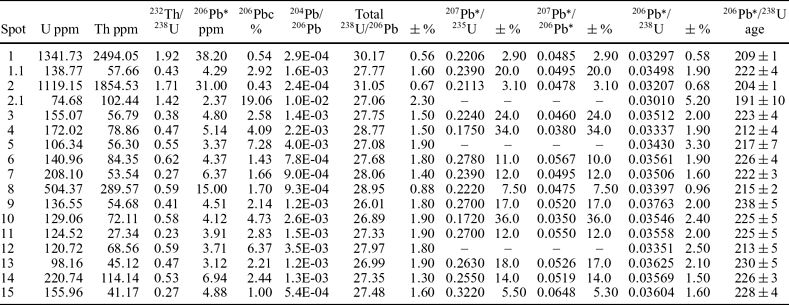
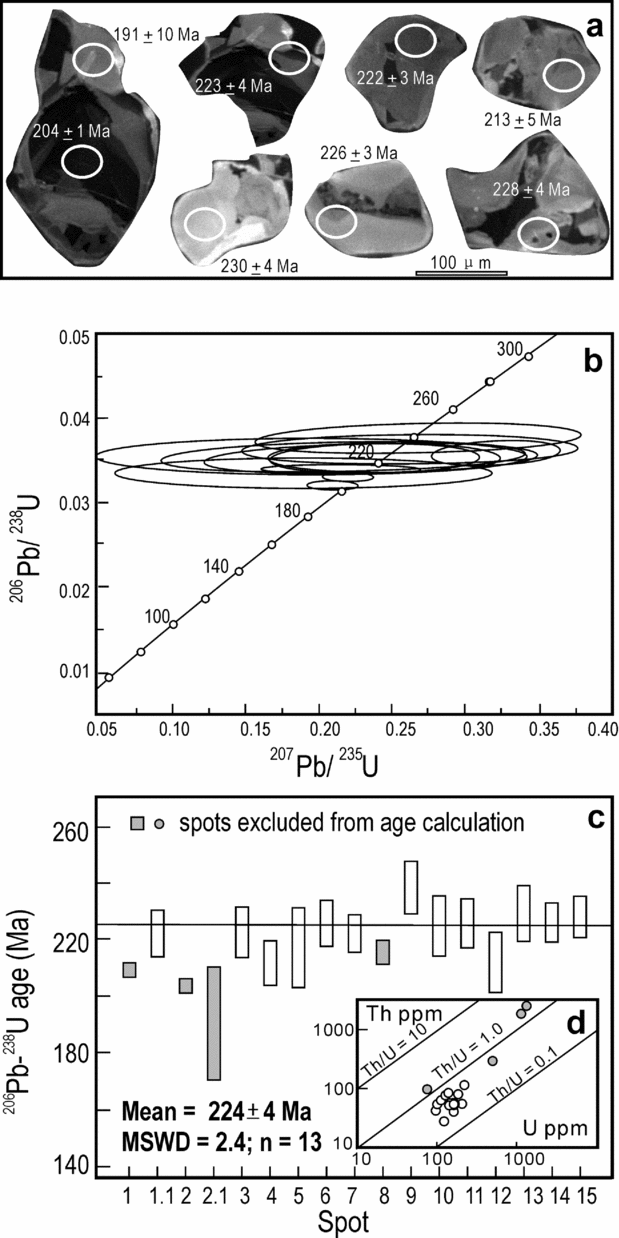
Several samples were picked from the foot of Mt Tokdal (Fig. 2b). The biotite syenite is from the main body (stage 2), while pyroxenite is from an early cumulate (stage 1). Zircon grains from a biotite syenite sample were separated using standard heavy liquid and magnetic techniques, and then selected and mounted in epoxy resin together with standard Temora zircon (417 Ma). The mount was polished to expose the centres of zircon grains, and then gold coated. Optical microscope images (transmission and reflection) were taken to obtain information about the shapes of the grains and their positions in the mount. Cathodoluminescence images were made, using the electron microprobe at the Institute of Geology, Chinese Academy of Geological Sciences, in order to examine their internal structures. The U–Pb analyses were performed on a SHRIMP II instrument at Beijing SHRIMP Centre. The radius of the ion target is about 30 μm. Mass resolution was about 5400 (1% peak height). Common Pb was corrected using the determined 204Pb. All data were processed using the Squid 1.02 and Isoplot 3.0 programs (Ludwig, Reference Ludwig2002, Reference Ludwig2003). The data in Table 1 are given in 1-sigma errors with weighted mean at a 95% confidence level.
Data of SHRIMP U–Pb zircon analyses

Notes: Errors are 1-sigma. Pbc and Pb* indicate the common and radiogenic portions, respectively. Common Pb is corrected using measured 204Pb. Entries with ‘−’ refer to unrealistic negative values.
Major-element analyses of minerals (in Appendix, available online as supplementary material at http://multimediafluids.uam.elogim.com/journals/geo and http://earthref.org/cgi-bin/er.cgi?s=erda.cgi?n=825) were performed on a JEOL 8100 electron microprobe at the Institute of Geology and Geophysics, Chinese Academy of Sciences (IGGCAS). The accelerating voltage was 15 kV, and the analysing current was 12 nA. The precision was about ± 1.5% for a concentration of >1 wt% relatively. Back-scattered electron images were taken by the same machine as complements of the optical microscopic images to check the micro-textures of rock and mineral.
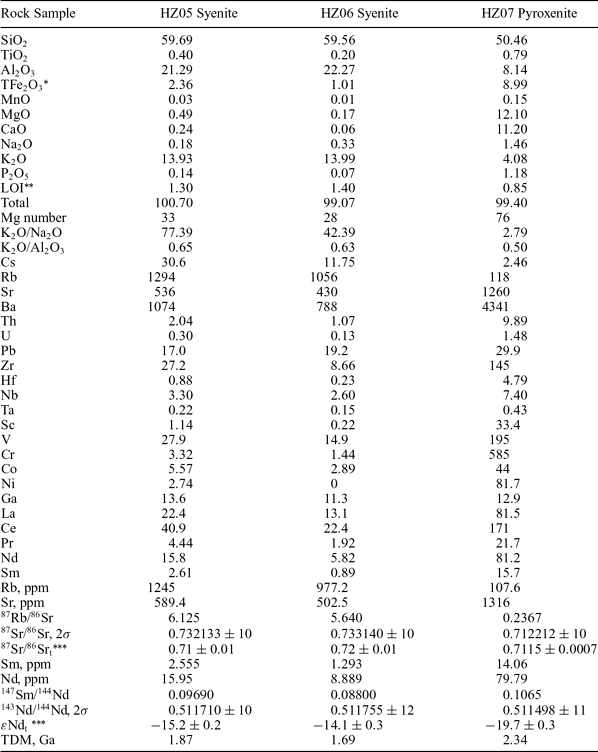
All the bulk compositions and Sr–Nd isotopes in Table 2 were analysed in the laboratories at the IGGCAS. Major element determinations were performed with X-ray fluorescence (Shimadzu XRF-1700/1500) after fusion with lithium tetraborate using Chinese national standard sample GBW07101-07114. The precision was better than 0.2 wt% in the analysis range. The loss on ignition was measured as the weight loss of the samples after one hour of baking under a constant temperature of 1000°C. Trace element analyses were done by an ELEMENT Inductively Coupled Plasma Mass Spectrometer (ICP-MS) after HNO3+HF digestion of about 40 mg sample powder in a Teflon® vessel, using Chinese national standard samples GSR1 (granite), GSR2 (rhyolite) and GSR3 (basalt). The relative standard deviation was better than 5% above the detection limits. Sr–Nd isotope determinations were performed on a Finnigan MAT 262 spectrometer in the Laboratory for Radiogenic Isotope Geochemistry, IGGCAS, after separation of elements by ion-exchange resins using reference standards NBS987 (Sr standard) and Ames (Nd standard). Standard material BCR-1 (basalt powder) was processed and analysed with the selected samples to check the procedure. The whole procedural blanks for Rb–Sr and Sm–Nd isotope analyses were better than 100 and 50 pg, respectively. The external precision (2σ) of 87Rb/86Sr and 147Sm/144Nd ratios were both better than 0.5%.
Selected whole rock major (wt%), trace elemental (ppm) and Sr-Nd isotopic data of the Tokdal Complex
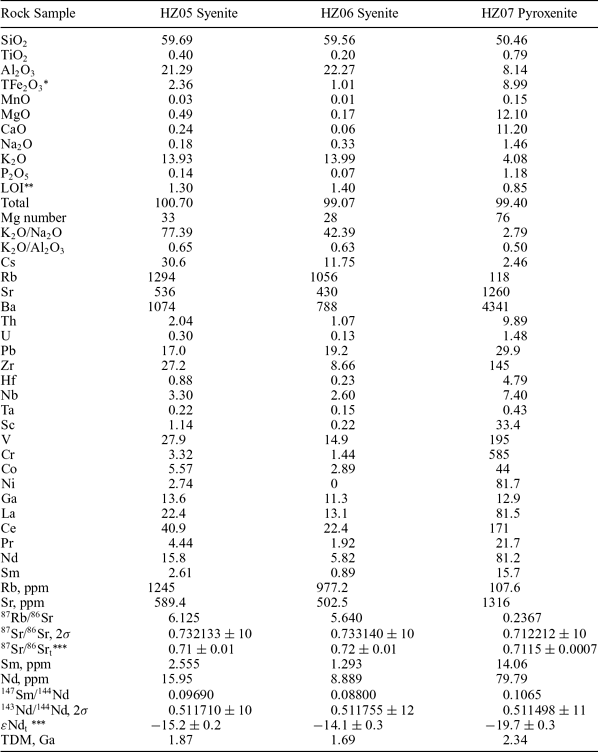
* Total iron as Fe3+. ** LOI = Loss On Ignition. *** t = 224 Ma.
4. Results
4.a. SHRIMP U–Pb zircon age
Zircon grains from biotite syenite sample HZ05 were separated. They generally have a grain size of larger than 100 μm and are rounded with irregular shapes (Fig. 3a). They are unzoned with transgressive patches indicating recrystallization overprints, perhaps during magmatic cooling or post-magmatic hydrothermal overgrowth or anatexis (e.g. Pidgeon, Reference Pidgeon1992; Nemchin & Pidgeon, Reference Nemchin and Pidgeon1997). Seventeen analysis spots on different zircon grains and domains were performed (Table 1, Fig. 3a). Apart from three spots (1, 2 and 2.1) with high Th/U ratios (1.42–1.92) and variable Th and U contents, other spots have Th/U ratios of 0.23–0.62, Th contents of 27–289 ppm and U contents of 98–504 ppm (Table 1; Fig. 3d). Excluding spots 1, 2 and 8 with high U content, probably resulting from recrystallization overprints, and spot 2.1 with high 204Pb content, the other 13 analyses yield a weighted mean 206Pb–238U age of 224 ± 4 Ma (MSWD = 2.4; Table 1, Fig. 3b, c). This age most likely represents the crystallization age of this rock.
(a) Cathodoluminescence images of zircons. (b) U–Pb concordia diagram. (c) Distribution plot of 206Pb–238U ages. (d) Th–U diagram.

4.b. Mineral compositions
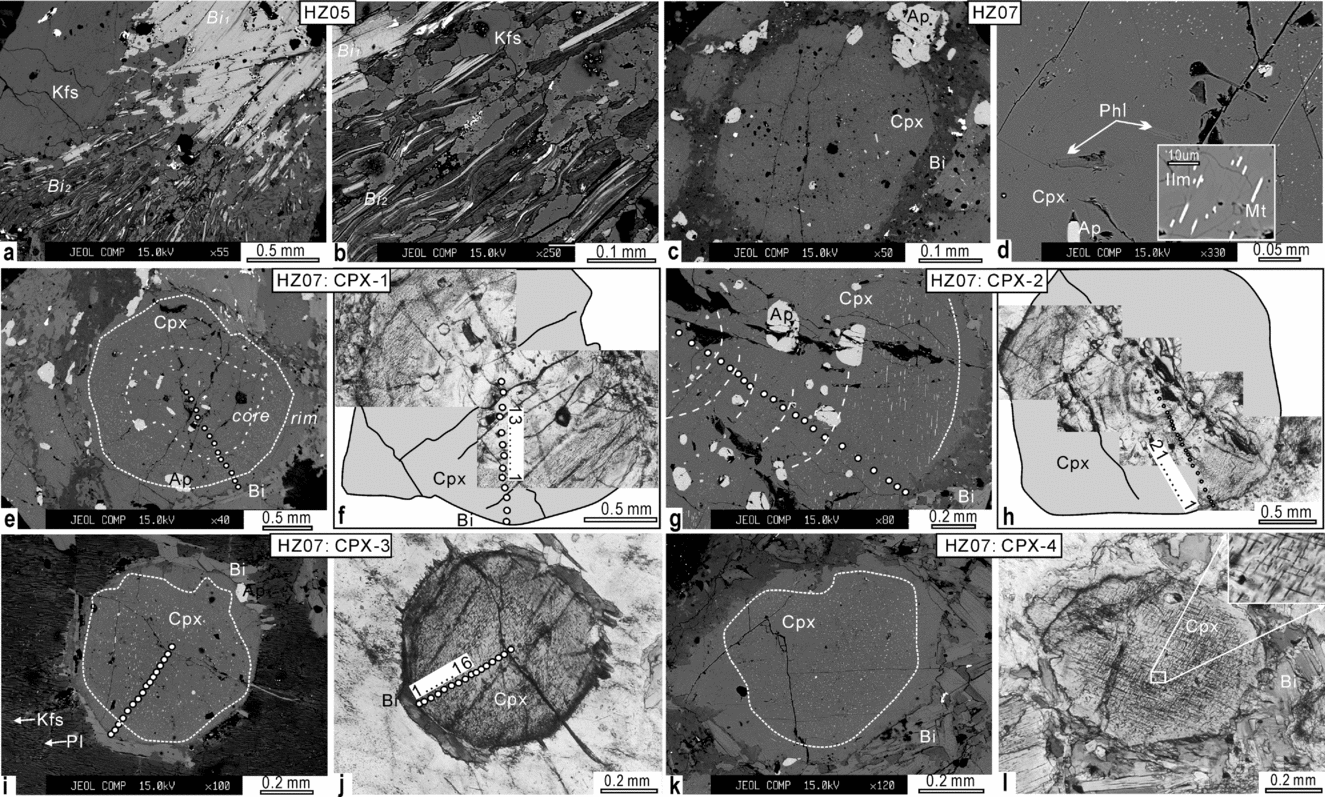
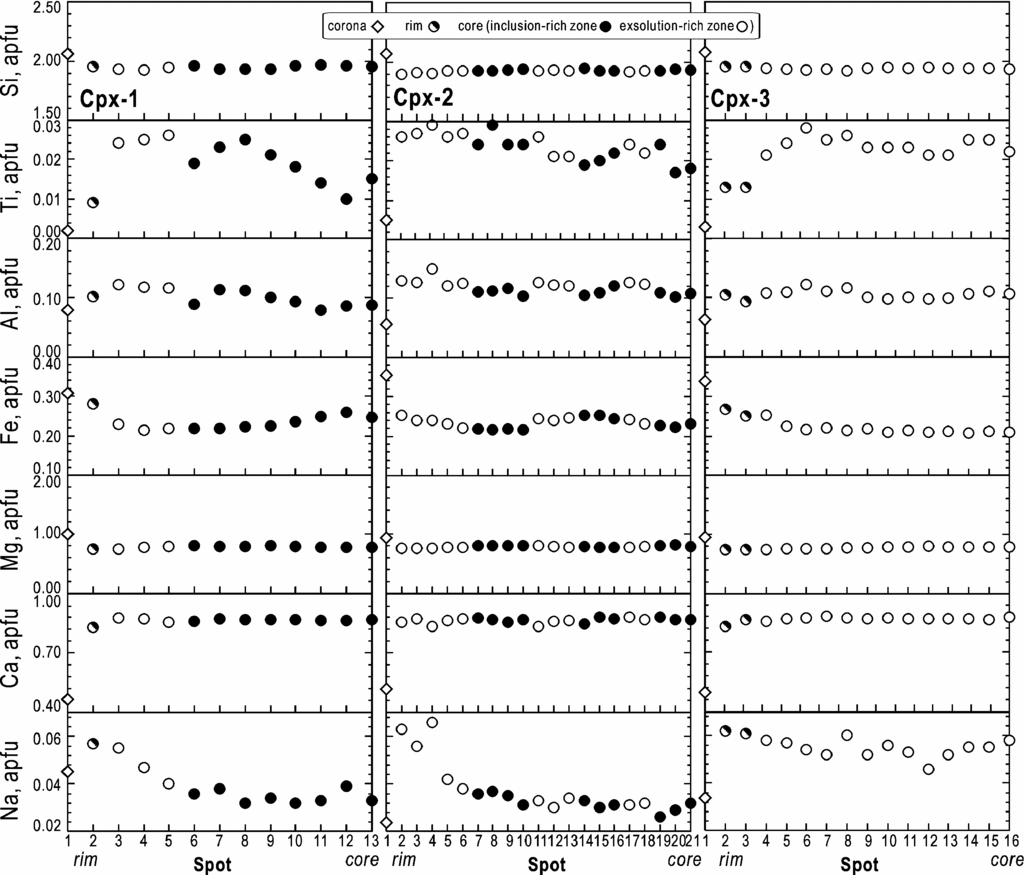
The syenite main body of the Tokdal Complex (stage 2) consists of K-feldspar, with variable amounts of clinopyroxene, amphibole, biotite, plagioclase, quartz and/or nepheline. Biotite syenite (e.g. samples HZ05 and HZ06) is the majority, and it generally comprises K-feldspar (~85 vol.%) and minor amounts of biotite (~10 vol.%) and magnetite. K-feldspar is mostly orthoclase (~98 wt%) with low anorthite components. Two types of biotite with similar compositions can be distinguished: one occurs as phenocrysts (large and euhedral), and the other one forms small slices with altered dark rims in the matrix (Fig. 4a, b). The early differentiates of the Tokdal Complex (stage 1) present as gabbro and pyroxenite cumulate. Pyroxenite is usually altered by syenite melt from the carrier (stage 2 syenite), for example, sample HZ07 is composed of 10 vol.% syenite tiny veins (K-feldspar + biotite) and 90 vol.% pyroxenite matrix (clinopyroxene + minor biotite) (Fig. 4c–l). K-feldspar in these cumulates is subhedral and lathy, up to 2–3 cm in length, and locally shows plagioclase exsolution with a composition of Ab80An18Or2 (Fig. 4i, j). Pyroxenite is generally composed of clinopyroxene and biotite, with minor apatite and titano-magnetite (Fig. 4c). The composition of clinopyroxene ranges between Wo44–48, En39–43, Fs11–16, Jd11–16 and Ae0–6, mostly diopside. A narrow augite corona with compositions of Wo26–28, En51–56, Fs17–20 and Jd2–5 around the diopside grains (Fig. 4c–l) can be observed. Generally, diopside grains have ‘clear’ rims and ‘dirty’ cores (Fig. 4c–l). In the cores, there are usually two types of zoning patterns: one type is rich in well-grown acicular magnetite and ilmenite exsolution but inclusion-free, whereas the other type has plenty of euhedral apatite as well as some phlogopite inclusion but is exsolution-free (Fig. 4e–h). It shows higher Ti, Al and Na contents but lower Si and Mg contents in exsolution-rich zoning compared to exsolution-free zoning (Fig. 5). The Mg numbers (calculated using molecular ratio of Mg2+/(Mg2++Fe2+)) of the clinopyroxene vary from 84 to 74, mostly around 80.
Selected backscattered electron (BSE) and optical microscope (OM) images show micro-texture of minerals in the samples HZ05 (a, b) and HZ07 (c–l). (a, b) Two kinds of Bi in sample HZ05 (BSE). (c) General texture of pyroxenite (BSE). (d) Phl + Ap inclusion and Ilm + Mt exsolution in Cpx (BSE). (e) and (f), (g) and (h), (i) and (j), and (k) and (l) show BSE and OM images for Cpx megacrysts labelled as Cpx-1, -2, -3, and -4 in pyroxenite, respectively. The small circles in Cpx show locations of probe profiles. Bi – biotite; Kfs – K-feldspar; Mt – magnetite; Ilm – ilmenite; Ap – apatite; Cpx – clinopyroxene; Phl – phlogopite; Pl – plagioclase.

Chemical variations in clinopyroxene in sample HZ07. See Figure 4 for the localities of spots in each clinopyroxene grain.

4.c. Chemical data
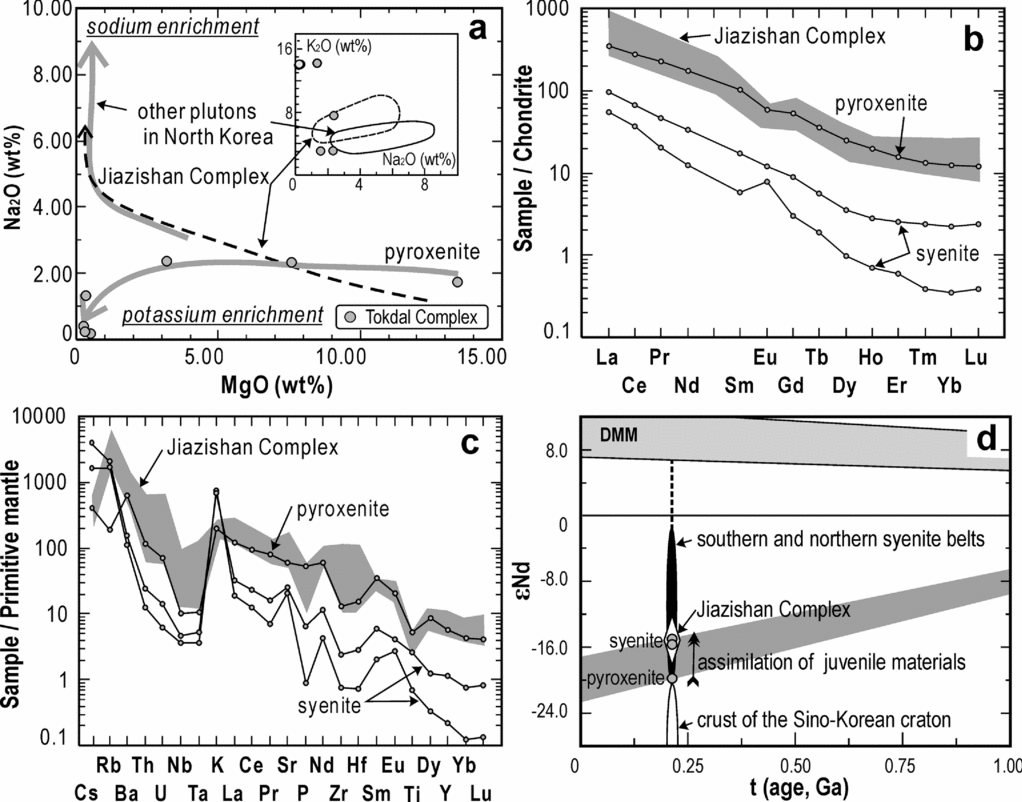
Syenite plutons in the central Korean Peninsula show an alkali affinity and belong to the potassic to ultra-potassic series. They show two distinctive differentiation trends: a potassium and a sodium enrichment trend (Fig. 6a). The Tokdal Complex has the highest K contents and K2O/Na2O ratios (>1.35; Table 2) among these plutons, and it shows potassium enrichment. The Tokdal rocks have high rare earth elements (REE) content and show light REE enrichment, with slight positive and negative Eu anomalies (Fig. 6b). They are enriched in large ion lithophile elements (LILE, e.g. Rb, Sr, K, La, Ce), but strongly depleted in high field strength elements (HFSE, e.g. Th, U, Nb, Ta, Zr, Hf; Fig. 6c). The high REE and other trace element contents in the pyroxenite (Fig. 6b, c) could have originated from the high concentrations in the mineral inclusion in the clinopyroxene (e.g. apatite, Fig. 4c–h) and partly inherited from the syenitic tiny veins in the pyroxenite, which are late-stage relic melt abundant in trace element concentrations. The Tokdal syenite main body has 87Sr/86Srt values of 0.71–0.72 and ϵNdt values of −14.1 to −15.2 (t = 224 Ma), while the pyroxenite has a 87Sr/86Srt value of 0.7115 and ϵNdt value of −19.7 (t = 224 Ma) (Table 2, Fig. 6d).
(a) Na2O v. MgO plot; inset: K2O v. Na2O plot. (b) Chondrite-normalized REE patterns. (c) Primitive mantle-normalized trace element spidergram. (d) ϵNd v. t (age) diagram for the Tokdal Complex and other syenite plutons in the Sino-Korean craton. Chondrite and primitive mantle-normalized values are from Sun & McDonough (Reference Sun, McDonough, Saunders and Norry1989). Data of syenite plutons in North Korea are from this study (Table 2) and Paek, Gap & Jon (Reference Paek, Gap and Jon1996); data from the northern and southern syenite belts of the Sino-Korean craton are from Yan et al. (Reference Yan, Mu, Xu, He, Tan, Zhao, He, Zhang and Qiao2000a) and Zhang, Zhu & Chang (Reference Zhang, Zhu and Chang2000), respectively; data from the Jiazishan Complex are from Yang et al. (Reference Guo, Chen, Zhang, Siebel and Zhai2005). The areas in (d) for upper and lower crust of Sino-Korean craton are from Jahn et al. (Reference Jahn, Wu, Lo and Tsai1999). DMM – depleted MORB mantle.

5. Discussion
5.a. Genesis of clinopyroxene in pyroxenite
The pyroxenite was identified as the earliest phase of the Tokdal Complex (Paek, Gap & Jon, Reference Paek, Gap and Jon1996). The fact that this pluton is characterized by rock types varying from pyroxenite, through gabbro, to clinopyroxene syenite (Fig. 2b) with systematically changing mineral assemblages and compositions also suggests that they are differentiates through the same magmatic process, in contrast to an extraneous origin for the pyroxenite. The extremely high Mg numbers (76; Table 2) of the pyroxenite are not compatible with a derivation in equilibrium with the liquid, but an accumulation of crystals.
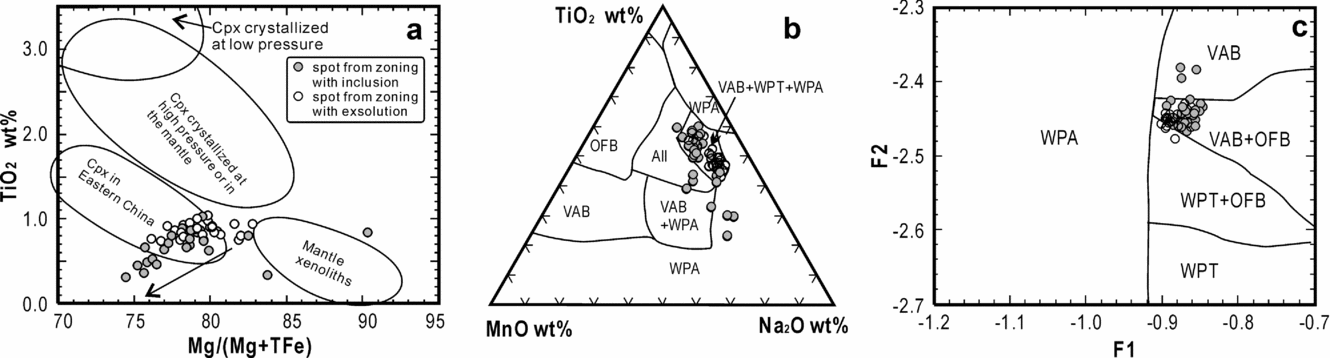
Based on the mineral assemblage and textural relationships (Fig. 4c–l), the augite coronas around clinopyroxene (diopside) in the pyroxenite may have resulted from reaction between the syenitic melt (K-feldspar) and pyroxene (diopside). The exsolution-rich (ilmenite and magnetite) zoning of clinopyroxene represents late decompression features, possibly related to ascent of magma and cumulate (e.g. Buseck, Nord & Veblen, Reference Buseck, Nord, Veblen and Prewitt1980; Rajesh, Reference Rajesh2006). The inclusion-rich (phlogopite and apatite) zoning is free of exsolution, and this could be due to its lower Fe and Ti contents resulting from differentiation. In Figure 7a, the clinopyroxene data plot into an area close to those crystallized at high pressure or in the mantle (after Wass, Reference Wass1979) and within the range of xenoliths from Cenozoic basalts from eastern China, which are thought to have been derived from the lithospheric mantle (e.g. Chen, Xia & Zhi, Reference Chen, Xia and Zhi1997; Yan & Chen, Reference Yan and Chen2005). Figure 7b and c (after Nisbet & Pearce, Reference Nisbet and Pearce1977) are based on data from clinopyroxene phenocrysts worldwide. Clinopyroxene crystals from the Tokdal Complex are similar to those from VABs (volcanic arc basalts) from cross-over reading of both diagrams. Since the Tokdal Complex is distributed in a continental block (Fig. 2a, b), an ancient active continental margin arc environment is suggested.
Diagrams for clinopyroxene in the early cumulates. (a) TiO2 (wt%) v. Mg/(Mg + TFe) diagram (molecular, TFe calculated using total iron as FeO): ‘Cpx in Eastern China’, representing field of clinopyroxene xenoliths in the Cenozoic basalt of Eastern China, is from Yan & Chen (Reference Yan and Chen2005); others are from Wass (Reference Wass1979). (b) MnO–Na2O–TiO2 diagram (after Nisbet & Pearce, Reference Nisbet and Pearce1977). (c) F1 v. F2 diagram (calculated using major compositions: F1 = −0.0120* SiO2 − 0.0807* TiO2 + 0.0026* Al2O3 − 0.0012* FeO − 0.0026* MnO + 0.0087* MgO − 0.0128* CaO − 0.0419* Na2O; F2 = −0.0469* SiO2 − 0.0818* TiO2 − 0.0212* Al2O3 − 0.0041* FeO − 0.01435* MnO − 0.0029* MgO + 0.0085* CaO + 0.0160* NaO, after Nisbet & Pearce, Reference Nisbet and Pearce1977). Although exsolution may bias the original compositions, this will have little effect on these diagrams. OFB – ocean-floor basalts; VAB – volcanic arc basalts; WPT – within plate tholeiitic basalts; WPA – within plate alkalic basalts.

5.b. Petrogenesis of the Tokdal Complex
Models proposed for the genesis of syenite include partial melting of crustal rocks (e.g. Lubala et al. Reference Lubala, Frick, Roders and Walraven1994), differentiation of mantle-derived magmas (e.g. Thorpe & Tindle, Reference Thorpe and Tindle1992; Lynch et al. Reference Lynch, Musselman, Gutmann and Patchett1993), or magma mixing (e.g. Zhao et al. Reference Zhao, Shiraishi, Ellis and Sheraton1995). Clinopyroxene in the early cumulate of the Tokdal Complex entrained by the syenite main body has been crystallized from a parental magma with Mg number up to 65 (using a partition coefficient of 0.36: after Kinzler, Reference Kinzler1997), approaching a value in accordance with derivation from a mantle source (e.g. Frey, Green & Roy, Reference Frey, Green and Roy1978). This mantle source component could have been from the enriched sub-continental lithospheric mantle beneath the Sino-Korean craton, based on the enriched LREE and LILE patterns (e.g. Zhang et al. Reference Zhang, Sun, Zhou, Fan, Zhou and Zhai2004). The Tokdal Complex shows K-enrichment with K2O contents of up to 14 wt% and K2O/Na2O ratios of >1.35. This K-enrichment cannot be the result of assimilation/contamination of crustal melts, as there is also K-enrichment in the early differentiates crystallized from magma with primitive compositions. Neither can it have been formed merely by fractional crystallization, as there is no K-depletion in any phase of this pluton. Thus the K-enrichment is possibly a feature originated from a magma source, that is, it could have originated from low-degree melting of a heterogeneous lithospheric mantle domain with high K contents, such as a phlogopite-bearing domain.
The Tokdal Complex yields various isotopic ratios (ϵNdt and 87Sr/86Srt), especially when early differentiates (e.g. pyroxenite) and late ones (e.g. biotite syenite) are compared (Fig. 6d). Although the variation in 87Sr/86Srt values could be ascribed to large uncertainties in the initial ratios, as the syenite rocks have very high Rb/Sr ratios (Table 2), the ϵNdt values are much more robust. The fact that the pyroxenite cumulate has lower ϵNdt values than the late syenite main body could be explained by incorporation of a high ϵNdt melt into the magma, but since the continent-crust has lower ϵNdt values than both the pyroxenite and syenite (Fig. 6d), this is not a good solution. Other explanations would be melting of heterogeneous mantle domains (e.g. Foley, Reference Foley1992), contamination of melt from juvenile mantle in the source regime, or contamination of melt from a subducted oceanic crust in the magma chamber. We suggest for now that the residue subducted-slab is the possible contamination source, considering the tectonic environment of this pluton (Section 5.c) and the highly depleted HFSE features in the late differentiates.
5.c. Tectonic environment and geological significance
The syenite plutons in North Korea were previously thought to have evolved in an intra-continental rift-type tectonic zone (Paek, Gap & Jon, Reference Paek, Gap and Jon1996), but there are no Triassic (or Carboniferous to Jurassic) basins or volcanic-sedimentary sequences in the related area to support a rift setting (Fig. 2a). The coeval kimberlite pipes in this area also suggest a thick lithosphere instead of rifting (Fig. 2a). Alternatively, a post-collisional environment is plausible, as the syenite was emplaced only a very short time interval after the collision, indicated by c. 230 Ma old eclogites in the Hongseong area (Fig. 1; Guo et al. Reference Guo, Zhai, Oh and Kim2004; Oh et al. Reference Oh, Kim, Choi, Zhai, Guo and Krishnan2005; Zhai et al. Reference Zhai, Guo, Li, Chen, Peng, Li, Hou and Fan2007). This is consistent with the inferred active continental margin environment, based on clinopyroxene compositions in the early cumulate (Section 5.a). The syenite plutons show geochemical polarity from K-rich compositions in the west to Na-rich compositions in the east, similar to those intruded in subduction-related environments (e.g. Dickinson & Hatherton, Reference Dickinson and Hatherton1967; Stern et al. Reference Stern, Jackson, Fryer and Ito1993; Savelli, Reference Savelli2000). The chemical zonation of syenite plutons is parallel to the major faults in this area and to the collision belt, based on the presence of the eclogites (Oh, Reference Oh2006; Zhai et al. Reference Zhai, Guo, Li, Chen, Peng, Li, Hou and Fan2007), and it also agrees with the collision polarity.
The Jiazishan Complex in the Shandong Peninsula has similar REE and trace element patterns and Sr–Nd isotopes close to those of the Tokdal Complex, except that Jiazishan displays Na-enrichment, which is similar to some other Na-enriched syenite plutons in North Korea (Fig. 6a–d). It is post-collisional, resulting from the closure of the Su-Lu orogen during the period 240–220 Ma (e.g. Chen et al. Reference Chen, Xie, Li, Zhang, Zhou, Park, Ahn, Chen and Zhang2003; Guo et al. Reference Guo, Chen, Zhang, Siebel and Zhai2005; Yang et al. Reference Yang, Chung, Wilde, Wu, Chu, Lo and Fan2005), and coeval with the Tokdal Complex. Thus the eastern syenite belt, represented by the Tokdal Complex and the Jiazishan Complex, could have recorded the same post-collisional event, and this syenite belt may constrain the eastern margin of the Sino-Korean craton, that is, this margin could have a similar orientation and be close to the eastern syenite belt. The eastern syenite belt is coeval and has comparable features with the northern and southern syenite belts in the Sino-Korean craton, and thus they represent adjacent post-collisional magmatic events encircling this craton and contributing to its final configuration in eastern Asia.
Acknowledgements
This research was supported by the National Scientific Foundation of China (Grant Nos 40602024, 40672128, 40502010 and 90714003). We appreciate discussions with Drs J.-H. Yang, H.-F. Zhang, K. Ye, R.-S. Zeng, F.-K. Chen, F.-Y. Wu, Q.-C. Fan, T.-S. Li, W. Siebel and T. Kusky. Special thanks are given to the Institute of Geology, State Academy of Sciences, DPR Korea, who supplied a chance for us to work in North Korea. We owe a great deal to Professors R.-J. Paek, W.-J. Choe, U.-R. Ri, and other Korean colleagues. This is also a contribution in memory of Prof. Ryong-Jun Paek, who passed away in 2006. Supplementary appendix is available online at http://multimediafluids.uam.elogim.com/journals/geo and http://earthref.org/cgi-bin/er.cgi?s=erda.cgi?n=825).