INTRODUCTION
Concussion is a common problem affecting millions of children and adolescents each year. A form of mild traumatic brain injury (mTBI), concussion, is accompanied by a characteristic set of physical (e.g., headache, nausea), cognitive (e.g., poor concentration, memory), and emotional (e.g., feeling overwhelmed, irritability) symptoms. In the majority of cases, these symptoms resolve in a week or two, and no specialized treatment is required. Symptoms can, however, persist for weeks or months, causing considerable distress.
It is well established that many students with TBI, particularly moderate to severe injuries, have long-term problems with classroom behaviors and academic achievement, often requiring support services (Prasad, Swank, & Ewing-Cobbs, Reference Prasad, Swank and Ewing-Cobbs2017; Treble-Barna et al., Reference Treble-Barna, Schultz, Minich, Taylor, Yeates, Stancin and Wade2017). While studies vary on the severity of TBI, age of injury onset, and time of testing postinjury, it does appear that some students with mTBI experience classroom and academic problems upon return to school. Whereas achievement test scores may be in the average range, a greater percentage of these students than peers receive academic modifications, educational resources, and grade retention (Ewing-Cobbs, Fletcher, Levin, Iovino, & Miner, Reference Ewing-Cobbs, Fletcher, Levin, Iovino and Miner1998; Glang et al., Reference Glang, Todis, Thomas, Hood, Bedell and Cockrell2008).
In youth recovering from concussion, return to sports is delayed until an athlete is symptom-free. However, in many cases, students will be back in school before concussion symptoms have resolved. This can result in significant academic difficulties due to trouble concentrating, intolerance of the often bright and noisy school environment, poor mental stamina, and other concussion-related problems. Makki et al. (Reference Makki, Leddy, Hinds, Baker, Paluch, Shucard and Willer2016) recently reported that for adolescents recovering from sports concussion, more hours in school was associated with worse concussion symptoms.
Unsurprisingly, concussion is more likely than other sports injuries to cause trouble with school work (Wasserman, Bazarian, Mapstone, Block, & van Wijngaarden, Reference Wasserman, Bazarian, Mapstone, Block and van Wijngaarden2016) and a number of recent studies have reported an association between duration of concussion symptoms and academic problems (Baker, Reference Baker2016; Field, Collins, Lovell, & Maroon, Reference Field, Collins, Lovell and Maroon2003; Ransom et al., Reference Ransom, Vaughan, Pratson, Sady, McGill and Gioia2015). Adolescents may be especially prone to school problems, as they take longer on average to recover from concussion than other age groups (Lax et al., Reference Lax, Paniccia, Agnihotri, Reed, Garmaise, Azadbakhsh and Keightley2015), and they usually have greater academic and extracurricular demands than younger children. Numerous authors have outlined suggestions for concussion-related academic accommodations (Halstead et al., Reference Halstead, McAvoy, Devore, Carl, Lee and Logan2013; Newlin & Hooper, Reference Newlin and Hooper2015), and a graduated return-to-school strategy was created for the most recent consensus statement on concussion in sport (McCrory et al., Reference McCrory, Meeuwisse, Dvořák, Aubry, Bailes, Broglio and Vos2017).
Concussion can cause at least temporary impairments in memory, processing speed, and other cognitive domains, and neurocognitive assessment is now an integral component of proper concussion management (Gioia, Reference Gioia2015). In most cases, concussion-related cognitive impairments will resolve in a matter of days or weeks (McCrea et al., Reference McCrea, Iverson, McAllister, Hammeke, Powell, Barr and Kelly2009), and multiple group studies of pediatric concussion have shown no differences between injured and control subjects by 3 months (Babikian et al., Reference Babikian, Satz, Zaucha, Light, Lewis and Asarnow2011; Kirkwood et al., Reference Kirkwood, Yeates, Taylor, Randolph, McCrea and Anderson2008). Also, long-term academic problems are not expected after pediatric concussion (Light et al., Reference Light, Asarnow, Satz, Zaucha, McCleary and Lewis1998), with neither grades nor graduation rates affected (Russell et al., Reference Russell, Hutchison, Selci, Leiter, Chateau and Ellis2016).
A number of researchers have identified prolonged, yet subtle, neurocognitive effects in adolescents, including changes in executive functioning (Howell, Osternig, Van Donkelaar, Mayr, & Chou, Reference Howell, Osternig, Van Donkelaar, Mayr and Chou2013) and in verbal learning during divided attention (Blanchet, Paradis-Giroux, Pépin, & McKerral, Reference Blanchet, Paradis-Giroux, Pépin and McKerral2009). More common, however, is the persistence of self-reported postconcussion symptoms. In a sample of subjects age 11–22 presenting to an emergency department after concussion, over 20% still complained of symptoms at 1 month including headache, fatigue, and taking longer to think (Eisenberg, Meehan, & Mannix, Reference Eisenberg, Meehan and Mannix2014). In a more recent study of pediatric patients who were initially seen in an emergency department, Barlow et al. (Reference Barlow, Crawford, Brooks, Turley and Mikrogianakis2015) reported that nearly 12% of children were still symptomatic at 3 months postinjury. Other estimates of prolonged recovery vary widely, from less than 5% to more than 38% of children still experiencing symptoms at 3 months (Rose, Fischer, & Heyer, Reference Rose, Fischer and Heyer2015).
Interestingly, students and their parents tend to base their perceptions of recovery mostly on the presence or absence of concussion symptoms (Sandel, Henry, French, & Lovell, Reference Sandel, Henry, French and Lovell2015). This can be problematic since concussion symptoms are subjective, nonspecific to concussion, and common in healthy youth. When symptoms do persist, factors other than the concussion itself appear to play an increasing role over time. For example, youth with a preinjury psychiatric history are more likely to experience prolonged symptoms (Corwin et al., Reference Corwin, Zonfrillo, Master, Arbogast, Grady, Robinson and Wiebe2014; Iverson et al., Reference Iverson, Gardner, Terry, Ponsford, Sills, Broshek and Solomon2017), as are those with a preexisting learning or attention disorder (Barlow et al., Reference Barlow, Crawford, Brooks, Turley and Mikrogianakis2015). Baseline levels of somatization are strongly predictive of postinjury symptom reports (Nelson et al., Reference Nelson, Guskiewicz, Barr, Hammeke, Randolph, Ahn and McCrea2016), and athletes with concussion may not cope as well after injury compared to those with other types of injuries (Kontos et al., Reference Kontos, Elbin, Newcomer Appaneal, Covassin and Collins2013). Increased symptoms of depression have been found in high school and collegiate athletes with concussion up to 14 days postinjury with associated neurocognitive decrements (Kontos, Covassin, Elbin, & Parker, Reference Kontos, Covassin, Elbin and Parker2012), and postinjury changes in mood and activity level can serve to maintain symptoms (Reed, Taha, Monette, & Keightley, Reference Reed, Taha, Monette and Keightley2016). In a comprehensive review of the literature on psychological factors and persistent postconcussion symptoms, Broshek, De Marco, and Freeman (Reference Broshek, De Marco and Freeman2015) reported that the neurobiological effects of concussion can cause anxiety and depression symptoms, and that psychosocial factors such as preinjury anxiety or misattribution of symptoms may contribute to prolonged recovery. Plourde, Yeates, and Brooks (Reference Plourde, Yeates and Brooks2018) did not find long-term (32+ months postinjury) problems in the psychosocial functioning of children and adolescents who sustained one or multiple concussions, but did note that preexisting mood and attention problems seemed to predict psychosocial adjustment.
Management of adolescent students recovering from concussion can be complicated by the direct effects of concussion, the academic expectations that continue despite injury, and the multiple intersecting factors that can contribute to reported symptoms. A better understanding of these variables can hopefully inform the development of more effective interventions. The purpose of this study was to compare adolescent students with persistent concussion symptoms to intact peers on measures of concussion symptoms, neurocognitive functioning, academic achievement, socioemotional status, and academic concerns. Because over 15% of children who undergo neuropsychological evaluation after concussion will meet criteria for invalid performance (Kirkwood & Kirk, Reference Kirkwood and Kirk2010), a validity measure was included in the assessment battery. Finally, in an effort to better quantify the academic stress that can be experienced by students recovering from concussion, we piloted a new self-report measure, the School Academic Issues Device (SAID), alongside a more commonly used self-report checklist, the Behavior Assessment System of Children, Second Edition (BASC-2). Since we planned to recruit participants from a specialized concussion clinic where most patients are at least a couple of weeks postinjury, we expected that the group of students with concussion would endorse more concussion symptoms, socioemotional symptoms, and academic/school concerns than peers, yet perform comparably to peers on neuropsychological and academic performance tests.
METHOD
Participants
After obtaining Institutional Review Board approval, participants with and without concussion between 13 and 17 years of age were recruited for this study. Participants who met American Congress of Rehabilitation Medicine criteria for mTBI (American Congress of Rehabilitation Medicine, 1993) and who were currently experiencing concussion symptoms were recruited at a hospital-based concussion clinic. Those with a history of other neurologic disease and learning or attention disorder were excluded. Control participants were recruited from the community via flyers and professional contacts. We enrolled 60 participants in the study. Three participants with concussion (and their matched controls) were removed from the analysis because they did not achieve a score of > 85% on the immediate recognition (IR), delayed recognition (DR), and consistency (CON) on the Medical Symptom Validity Test (MSVT; Green, Reference Green2004). One Concussion and one Control participants did not complete the full test battery due to technical challenges and subsequently were removed from analyses. Finally, two Concussion participants were outliers in terms of days postinjury (> 1 year) and were removed along with their matched controls.
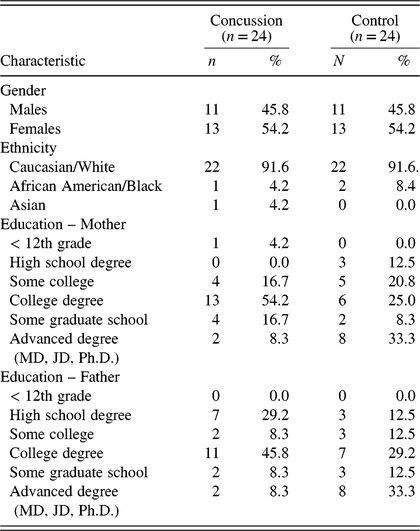
Demographic information is listed in Table 1. In total, 24 matched (on gender and within 1 year) pairs (22 males, 26 females) were retained. The average age was equivalent in the control (M = 14.89, SD = 1.31) and Concussion groups (M = 14.88, SD = 1.26), with a range of 13:2–17:9 years. The majority of participants identified as Caucasian in both groups (n = 22, 91.6%). The majority of participants reported no previous psychological diagnoses, but one Control and one Concussion participants reported a prior history of anxiety. Both groups were also statistically similar for maternal or paternal education levels.
Demographic characteristics

For Concussion participants, the number of days postinjury ranged from 13 to144 days, with an average of 61.96 days (SD = 38.14) and median number of 48.50 days. Fourteen participants (58.3%) reported no previous concussions, while 10 (41.7%) reported this was their second concussion. Unfortunately, we did not retain information about neuroimaging or specific injury characteristics. Of those who gave us anecdotal reports, 75% reported their injury as sports-related and 25% reported some loss of consciousness.
Measures
Immediate Postconcussion Assessment and Cognitive Testing
The Immediate Postconcussion Assessment and Cognitive Testing (ImPACT) is a brief, computerized neuropsychological assessment designed to measure concussion symptoms and specific cognitive processes commonly disrupted by concussion (Lovell, Reference Lovell2002). Six individual subtests (Word Memory, Design Memory, X’s and O’s, Symbol Matching, Color Matching, and Three Letters) contribute to five composite scores (Verbal Memory, Visual Memory, Visual Motor Speed, Reaction Time, and Impulse Control). Higher scores across the Verbal Memory, Visual Memory, and Visual Motor Speed composites indicate stronger performance, while lower scores on the Impulse Control and Reaction Time composites indicate better performance. In addition to cognitive testing, the ImPACT asks individuals to rate the severity of 22 concussion symptoms on a 7-point response scale (0 = not experiencing, 6 = severe), which yields a Total Symptom score ranging from 0 to 132.
With some exceptions (Broglio, Ferrara, Macciocchi, Baumgartner, & Elliott, Reference Broglio, Ferrara, Macciocchi, Baumgartner and Elliott2007), the ImPACT demonstrates adequate psychometric properties. Iverson et al. (Reference Iverson, Lovell and Collins2003) found test–retest reliabilities for the composite scores ranging from .67 to .86. The ImPACT has also been shown to be both sensitive (81.9%) and specific (89.4%) to the presence of concussion when the Symptom score and four composite scores were combined (Schatz & Putz, Reference Schatz and Putz2006). The ImPACT demonstrates good convergent validity, but a recent review questioned the measure’s discriminant and predictive validity (Alsalaheen, Stockdale, Pechumer, & Broglio, Reference Alsalaheen, Stockdale, Pechumer and Broglio2016).
Symbol Digit Modalities Test
The Symbol Digit Modalities Test (SDMT) was included as a measure of processing speed (Smith, Reference Smith1973). Subjects have 90 s to copy symbols into the blank spaces provided under a series of numbers using a key. The SDMT Total score is the number of correct items completed. The SDMT has been shown to be sensitive to the immediate effects of concussion (Collins et al., Reference Collins, Grindel, Lovell, Dede, Moser, Moser, Phalin, Nogle, Wasik, Cordry, Daugherty, Sears, Nicolette, Indelicato, McKeag and Sears1999) and accurately discriminates between individuals with head injury and healthy controls (Barr, Reference Barr2001). The SDMT also shows strong correlation to other measures of attention, concentration, and processing speed (Barr, Reference Barr2001).
Trail Making Test
The Trail Making Test (TMT) is commonly used to measure psychomotor speed and executive functioning (Reitan & Wolfson, Reference Reitan and Wolfson1985). Part A requires participants to connect a series of circled numbers that are randomly placed on a page, and Part B asks them to connect numbers and letters in alternating sequence. The subject’s score is the time to finish each part (TMT completion time), including time for error correction. Reliability estimates (i.e., inter-rater, test–retest) for Parts A and B are generally high (r = .80 - .95), and there is adequate convergent and ecological validity (Strauss, Sherman, & Spreen, Reference Strauss, Sherman and Spreen2006).
The Medical Symptom Validity Test
The MSVT (Green, Reference Green2004) is designed to detect suboptimal performance during neuropsychological evaluations and was administered orally for this study. The test presents pairs of related words, after which participants are asked to recall the words. Scores from three MSVT indexes (IR, DR, & CON) were used to create a dichotomous Pass/Fail variable (i.e., Effort) using the suggested cut score of 85%; one score below 85% equated to a Fail, while a Pass required all scores at 85% and above. Green (Reference Green2004) presents evidence of concurrent and predictive validity, but does not provide reliability estimates for the MSVT.
TestTracker
TestTracker is a computerized reading assessment system that guides students through a variety of academic tasks and questionnaires (Lewandowski, Gathje, Lovett, & Gordon, Reference Lewandowski, Gathje, Lovett and Gordon2013; Lewandowski, Hendricks, & Gordon, Reference Lewandowski, Hendricks and Gordon2015). The study used the comprehension, vocabulary, and word recognition tasks. Reliability estimates for these tasks are adequate (internal consistency .85 to .90; retest .65 to .80). Additional information on psychometric properties is detailed in a recent published study (Lewandowski, Lovett, Berger, & Gordon, Reference Lewandowski, Berger, Lovett and Gordon2016).
Reading comprehension
The reading comprehension task consisted of 10 passages, each between 300 and 400 words and followed by 5 multiple-choice questions that target both factual and inferential information. Readability estimates for the passages ranged from 9th to 15th grade level, using the Flesch–Kincaid Grade Level estimate. The Reading Comprehension score was the total number of questions answered correctly within a 20-min period. The results of an earlier validity investigation found that the percent correct of TestTracker reading comprehension questions correlated at r = .51 with percent correct of comprehension questions on the Nelson Denny Reading Test (NDRT).
Vocabulary
The vocabulary task requires an individual to identify a synonym for a target word from a list of five options in a 4-min period. The 80 vocabulary words were selected from graded word lists (8th–16th grade). The Vocabulary Correct score correlated (r = .64) with the vocabulary score from the NDRT, suggesting adequate construct validity.
Word recognition
This task assesses a student’s fluency of word/nonword recognition by asking individuals to decide if a three-to-six-letter string was a real English word. Sixty words were selected from graded word lists (8th–16th grade) and 60 nonwords were generated resemble real words (e.g., “aisle” vs. “niehl”). Students had 90 s to answer progressively more challenging items. The Word Recognition score was total number of correct items. This task is moderately correlated with the untimed Word Attack subtest of the Woodcock Johnson III, r = .47.
Behavior Assessment System for Children, Second Edition
The BASC-2 (Reynolds & Kamphaus, Reference Reynolds and Kamphaus2004) is a rating scale that evaluates the behaviors, thoughts, and emotions of children and adolescents aged 2.5–25 years. This study utilized the composites and subscales from the parent and self-report forms. The BASC-2 Parent Rating Scale (PRS) includes Externalizing Problems composite (Hyperactivity, Aggression, and Conduct Problems subscales), Internalizing Problems composite (Anxiety, Depression, and Somatization subscales), Behavioral Symptoms Index composite (Atypicality, Withdrawal, and Attention Problems subscales), and Adaptive Skills composite (Adaptability, Social Skills, Leadership, Activities of Daily Living, and Functional Communication subscales). The BASC-2 Self-Report (SRP) includes composite scores for School Problems (Attitude Towards Teachers, Attitude Towards School, and Sensation Seeking subscales), Internalizing Problems (Atypicality, Locus of Control, Social Stress, Anxiety, Depression, Sense of Inadequacy, and Somatization subscales), Inattention/Hyperactivity (Attention Problems and Hyperactivity subscales), Personal Adjustment (Relations with Parents, Interpersonal Relations, Self-Reliance, and Self-Esteem subscales), and the Emotional Symptoms Index composite (Anxiety, Social Stress, Depression, Sense of Inadequacy, Self-Reliance, and Self-Esteem subscales). Descriptive classifications include: T score ≥ 60 = Borderline risk and a T score ≥ 70 = Clinically Significant risk.
The BASC-2 manual reports generally strong reliability and validity estimates. The manual indicates good internal consistency for the PRS (α = .73 to .95) and for the SRP (α = .76 to .95). It also demonstrates strong convergent and concurrent validity with other behavioral scales (i.e., ASEBA Child Behavior Checklist). See the BASC-2 manual for more psychometric information (Reynolds & Kamphaus, Reference Reynolds and Kamphaus2004).
School Academic Issues Device
The SAID is a pilot self-report measure aimed at capturing students’ perceptions of their current academic concerns (e.g., I learn things in school then cannot remember them at home, I don’t have enough time to finish tests/quizzes). There are 26 Likert scale items ranging from 1 (not true) to 7 (very true). The dependent measure for this study was the sum of the 26 responses (Total score range = 26–182). Higher scores indicate greater academic concerns. The SAID demonstrated high internal consistency (α = .95) for the total sample.
Procedure
Testing was conducted in private rooms located in a medical building. After informed consent was obtained, the participant and parent completed the demographic survey and BASC-2 rating scales. The parent returned to the waiting room after completing the BASC-2 PRS. Next, the participant completed a 20-min EEG task located in a different room (not reported in this study). After the EEG task, participants returned to the initial testing room to complete MSVT, SDMT, TMT Parts A and B, SAID, ImPACT, and TestTracker. The logistics and delayed tasks precluded true counterbalancing of all measures; however, efforts were made to randomize the administration of TestTracker and ImPACT when possible.
RESULTS
Before conducting between-group comparisons, the data were analyzed for skewness and kurtosis within each group. Kurtosis was not present (< 2.0) when the variables were analyzed within each group separately; therefore, data transformations were not warranted. Age, gender, and preexisting history of anxiety were investigated as potential covariates. Age was a significant covariate on ImPACT Visual Motor Speed composite, and gender was a significant covariate on ImPACT Verbal Memory composite, TMT-B Completion Time, SDMT Total score, BASC-2 PRS Adaptive Skills composite, and BASC-2 SRP School Problems composite. Analyses reflected that prior history of anxiety (self-reported by one Concussion and one Control participants) was not a significant covariate for any of the outcome measures. Independent samples’ t tests were conducted on the remaining dependent measures without age or gender covariates. Bonferonni corrections were applied to each family of tests (e.g., ImPACT, BASC-2 PRS), which ranged from α = .01 to α = .017. For consistency, we used a conservative α level of .01 for all comparisons.
Concussion Symptoms
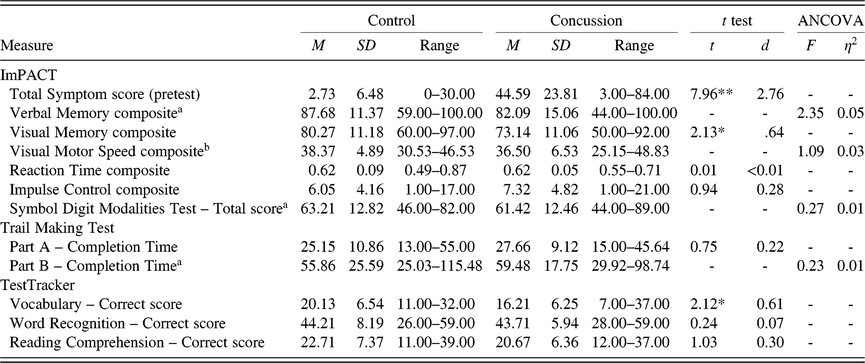
Students with concussion reported significantly more concussion symptoms (ImPACT Total Symptom score) than controls (see Table 2). The mean number of symptoms for the Concussion group was 45.67 (SD = 23.1) versus 3.38 (SD = 6.4) for the control group. These scores differed significantly (p < .01, d = 2.49) as expected, and the Concussion group was highly symptomatic compared to reference norms (Lovell et al., Reference Lovell, Iverson, Collins, Podell, Johnston, Pardini, Pardini, Norwig and Maroon2006). Within the Concussion group, the highest scores on the 7-point (0–6) scale were reported for Difficulty Concentrating (4.0), Headache (3.8), Fatigue (3.3), and Irritability (3.15). Those with concussion also reported sleeping either more than usual (1.85) or less than usual (1.56).
Results for neuropsychological and academic measures

Note. All mean scores for both groups are within the average range based on test norms. aGender as covariate. bAge as covariate.
* p < .05, **p < .01.
Neurocognitive Measures
Mean ImPACT composites scores are presented in Table 2. All ANCOVAs failed to meet alpha levels with Bonferroni corrections. Across the t tests of the four composite scores (Verbal Memory, Visual Memory, Visual Motor Speed, and Reaction Time), only the Visual Memory composite came close to reaching a significant group difference, t (42) = 2.13, p = .04, d = 0.64, but fell short of our adjusted .01 α level. For exploratory purposes, we further examined this composite by conducting independent samples t tests on the Design Memory and Xs and Os subtests separately. Results indicated that the Xs and Os Total Correct Memory score showed the largest group difference, t (42) = 1.38, p = .174, d = 0.42, yet this difference was not statistically significant. It should be noted that all ImPACT scores for both groups were within normal limits according to ImPACT normative ranges (Henry & Sandel, Reference Henry and Sandel2015). Scores for the TMT Parts A and B Completion Time and the SDMT Total are also presented in Table 2. Scores were not significantly different between groups nor outside normal levels. Overall, there were no significant group differences on any of the neuropsychological measures, and all scores were within the average range based on test norms.
Academic Achievement
No significant group differences were found on the TestTracker academic measures (see Table 2). Only the Vocabulary score approached significance, t (46) = 2.12, p = .03, d = 0.61 (control M = 20.13, SD = 6.5; concussion M = 16.21, SD = 6.3). The control group correctly answered almost four more vocabulary terms than the Concussion group. However, all mean scores from both groups were comparable to age-based TestTracker norms, suggesting no impairment in academic performance.
Socioemotional Perceptions (BASC-2)
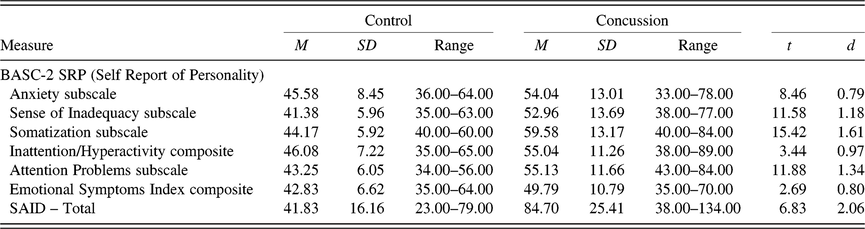
For convenience sake, only BASC-2 t tests with significant results are presented in Table 3. While some parent report measures met traditional alpha level (α = .05), no t tests on the BASC-2 PRS met the conservative alpha level (α = .01). On the other hand, significant findings were obtained on the student self-report measures. On the BASC-2 SRP composites, the Concussion group was found to have significantly higher T scores on the Inattention/Hyperactivity composite (p = .003, d = 0.97), the Internalizing Symptoms composite (p = .001, d = 1.10), and the Emotional Symptoms Index (p = .01, d = 0.97) compared to Control participants. Across all the BASC-2 subscales, results revealed that the Concussion group had significantly higher T scores on Attention Problems subscale (p < .001, d = 1.34), Sense of Inadequacy subscale (p < .001, d = 1.18), and Somatization subscale (p < .001, d = 1.61). The Anxiety (p = .011, d = 0.79) and Depression subscales (p = .032, d = 0.66) met traditional alpha values, but failed to approach significance with Bonferroni corrections. Though Concussion participants reported significantly more socioemotional problems than controls, the Concussion group’s BASC-2 T scores remained below the threshold for clinical significance (T score ≤ 60 = Borderline risk), and thus were still within the “normal” range relative to a normative peer group.
BASC-2 and SAID t test results with significant differences between groups

Note: All results reported in this table are significant at p < .01 and survived Bonferroni correction.
School Concerns
The t tests for the SAID Total score revealed a significant group difference, t (46) = 6.83, p < .001, d = 2.06, showing that the concussion students endorsed many more school concerns than their peers (see Table 2). A trend in their responses suggested worries about academic competence and efficiency (e.g., I have to reread to understand; I worry about falling behind). The youth in the Concussion group were not particularly worried about having the support or resources they need to do their work, as judged by items that were seldom endorsed (e.g., teachers don’t like me; I don’t have enough time to finish my work). The Concussion participants seemed to have perceptions of inadequacy and self-doubt with regard to academic work.
DISCUSSION
Students in this study who were tested an average of 62 days after concussion reported very elevated levels of concussion symptoms. They also reported significantly more academic and emotional distress than a group of uninjured matched (age and gender) controls. As expected given the time postinjury, students with concussion tended to perform almost identically to their uninjured peers on ImPACT neurocognitive tasks, neuropsychological screening measures, and time-sensitive academic achievement measures. Relative to Control participants, Concussion participants endorsed elevated levels of school problems, inattention, depression, anxiety, and somatization on the BASC-2, but these scores did not reach the threshold for clinical significance (T score > 60). Similarly, when compared to test norms, the Concussion group scores were not outside the average range on any academic or neurocognitive measure. Overall, students in this study who report persistent concussion symptoms perceive themselves as struggling academically, cognitively, and emotionally, despite performing comparably to uninjured peers.
Our finding of subtle if any group differences on objective measures is consistent with prior research showing that, in youth, neurocognitive performance tends to normalize by 3 months postconcussion (Kirkwood et al., Reference Kirkwood, Yeates, Taylor, Randolph, McCrea and Anderson2008). Research into academic problems after concussion also shows no long-term negative effects (Light et al., Reference Light, Asarnow, Satz, Zaucha, McCleary and Lewis1998; Russell et al., Reference Russell, Hutchison, Selci, Leiter, Chateau and Ellis2016). Yet despite these null findings, students with concussion often express persistent academic concerns, including learning problems, worrying about school, and seeking school resources and accommodations (Covassin, Elbin, Crutcher, Burkhart, & Kontos, Reference Covassin, Elbin, Crutcher, Burkhart and Kontos2013; Ransom et al., Reference Ransom, Vaughan, Pratson, Sady, McGill and Gioia2015; Wasserman et al., Reference Wasserman, Bazarian, Mapstone, Block and van Wijngaarden2016). In this study, a very large (d = 2.26) group difference was found on a new measure of academic concerns, with the Concussion participants scoring twice as high as the uninjured controls and endorsing greater concern about keeping up with schoolwork.
Interestingly, although performance on objective neuropsychological and academic measures was similar between the two groups, those with concussion did score somewhat lower on a visual memory task. The strength of this finding did not survive Bonferroni correction for significance level, but aligned with results of a prospective study (Rieger et al., Reference Rieger, Lewandowski, Callahan, Spenceley, Truckenmiller, Gathje and Miller2013) that found a group of youth with concussion performing significantly worse on the ImPACT X’s and O’s subtest at 3-month follow-up compared to youth with orthopedic injuries. Adolescents with concussion in the current study were tested an average of about 2 months postinjury and again scored lower on the ImPACT Visual Memory composite, with the largest subtest difference being on the X’s and O’s Total Correct Memory score. Ponsford et al. (Reference Ponsford, Cameron, Fitzgerald, Grant and Mikocka-Walus2011) reported the same finding of lower ImPACT Visual Memory scores 3 months postinjury in a prospective controlled study of adults with concussion recruited from an Emergency Department. Thus while the present Concussion group’s score still fell with average range based upon ImPACT norms, this repeated finding of lower performance than a control group across multiple studies is consistent with mounting evidence that physiologic recovery of the brain after concussion may take longer than previously thought and can lag behind the resolution of symptoms (McCrory et al., Reference McCrory, Meeuwisse, Dvořák, Aubry, Bailes, Broglio and Vos2017).
The lack of robust neuropsychological deficits in our concussion sample is mirrored in our findings on speeded academic performance measures. Only one of the three measures showed a group difference that approached significance, suggesting less fluency in correct identification of vocabulary terms. Whether or not this finding is mediated by some uncontrolled variable (e.g., IQ) is uncertain, but warrants further investigation.
The main finding in this study is that students who report persistent postconcussion symptoms an average of 2 months after injury also report higher levels of academic and emotional distress than their uninjured classmates. Elevations on the BASC-2 are highest for internalizing symptoms such as anxiety, depression, somatization, sense of inadequacy, and inattention, while responses on the SAID reflect considerable worry about academic competence and keeping up with schoolwork. It should be noted that although a number of group differences were found on the BASC-2, the Concussion group mean scores were still within the average range on every scale. Yet relative to peers, students with concussion in this study seemed to feel that something is still wrong with them. The finding of increased worry and distress is quite similar to that of Mrazik et al. (Reference Mrazik, Brooks, Jubinville, Meeuwisse and Emery2016) who reported that youth hockey players with concussion had higher BASC-2 scores than peers on scales of atypicality, locus of control, anxiety, depression, sense of inadequacy, somatization, and attention. Whether these feelings are grounded in subtle changes in brain functioning or in perceptions that emerge from weeks of feeling abnormal – or both – is uncertain. Broshek et al. (Reference Broshek, De Marco and Freeman2015) suggest that, just like in animal models, concussion in humans can result in anxiety, fear, and even depression, especially in those with a neurobiological vulnerability. Our findings and those of other researchers suggest that individuals with concussion are prone to internalized psychological concerns, at least while they are symptomatic. A recent study by Plourde, Yeates, and Brooks (Reference Plourde, Yeates and Brooks2018) did not find group differences on psychosocial measures at approximately 36 months after injury (vs. 2 months postinjury in this study), so it appears that academic and emotional concerns after concussion do subside over time.
Finally, difficulty in concentrating was the symptom most strongly endorsed by the Concussion group, followed by headache, fatigue, and irritability. Concussion participants were also more likely to report sleeping more or less than usual. Unsurprisingly, pain and sleep problems can magnify the subjective cognitive and emotional complaints reported by adolescents after concussion and can contribute to poorer outcome (Lavigne et al., Reference Lavigne, Khoury, Chauny and Desautels2015).
There are some limitations in the current study that require consideration. This study had a small sample size, and subtle differences may not have been detectable. It is also possible that the academic and cognitive measures we used were insensitive to the problems reported by Concussion participants. The generalizability of our findings is limited by recruitment from one hospital within a narrow geographic locale, the fact that participants were mostly Caucasian students from educated parents, and a lack of information about injury characteristics (e.g., loss of consciousness). We did not include an orthopedic injury control group, which would have allowed us to better account for any differences generally related to injury and trauma (vs. concussion specifically), and we also did not look at preinjury factors such as prior academic problems. We also realize that one of our strongest findings resulted from a pilot measure that, although promising, must be subjected to further psychometric validation.
Despite some limitations, results on the BASC-2 SRP and SAID yielded rather robust differences in how students with and without concussion perceived their emotional and academic well-being. Although scores for the Concussion group were not in the clinical range for the most part, it appeared that some of our Concussion participants would benefit from interventions aimed at both academic and emotional concerns. Multiple authors have proposed academic accommodations and return-to-learn strategies that can mitigate academic stress and increase the chances of a successful school reentry following concussion (e.g., Gioia, Reference Gioia2016; Halstead et al., Reference Halstead, McAvoy, Devore, Carl, Lee and Logan2013). New CDC guidelines for pediatric mTBI (Lumba- Brown et al., Reference Lumba-Brown, Yeates, Sarmiento, Breiding, Haegerich, Gioia, Turner, Benzel, Suskauer, Giza, Joseph, Broomand, Weissman, Gordon, Wright, Moser, McAvoy, Ewing-Cobbs, Duhaime, Putukian, Holshouser, Paulk, Wade, Herring, Halstead, Keenan, Choe, Christian, Guskiewicz, Raksin, Gregory, Mucha, Taylor, Callahan, DeWitt, Collins, Kirkwood, Ragheb, Ellenbogen, Spinks, Ganiats, Sabelhaus, Altenhofen, Hoffman, Getchius, Gronseth, Donnell, O’Connor and Timmons2018) highlight the importance of tailoring academic interventions to the unique needs of each student. Our results also indicate that monitoring academic stress may be as important as monitoring academic performance.
Our results are consistent with other research (Broshek et al., Reference Broshek, De Marco and Freeman2015) showing increased levels of depression, anxiety, and somatization in youth recovering from concussion. Students who are experiencing high levels of emotional distress may benefit from counseling to learn coping skills (Brent & Max, Reference Brent and Max2017) and to address possible misattribution of physical symptoms and other cognitive biases (Broshek et al., Reference Broshek, De Marco and Freeman2015). Also, while rest is commonly prescribed after concussion to reduce symptoms (McCrory et al., Reference McCrory, Meeuwisse, Dvořák, Aubry, Bailes, Broglio and Vos2017), there is increasing recognition that a prolonged period of inactivity may be counter-productive. Rather, it may be beneficial for students to resume normal activities including exercise and school/social activities, which can decrease stress and foster symptom recovery (Gagnon, Galli, Friedman, Grilli, & Iverson, Reference Gagnon, Galli, Friedman, Grilli and Iverson2009; Gioia, Reference Gioia2015). It appears that our findings support an emerging focus on health-related quality of life for youth with mTBI (Fineblit, Selci, Loewen, Ellis, & Russell, Reference Fineblit, Selci, Loewen, Ellis and Russell2016) and recognize the importance of physical, mental, social, and emotional outcomes that need to be addressed and monitored.
DECLARATION OF INTEREST
The authors report no conflicts of interest associated with this publication. The authors received no financial support for this work.