Introduction
Historically, there has been significant controversy on whether to disclose the diagnosis of terminal and potentially untreatable conditions, such as cancer or dementia to patients and their caregivers. From the 1960s to 1970s and onwards, physicians became more and more willing to disclose the diagnosis of cancer to patients and their caregivers (Novack et al., Reference Novack, Plumer, Smith, Ochitill, Morrow and Bennett1979). A similar, yet more complicated conflict exists in the case of dementia – dementia patients may lack insight into their own cognitive impairment, or even fail to remember their own diagnosis. Therefore, it is not surprising to see that only 29.5–68% of physicians regularly inform their AD patients with the diagnosis (Johnson et al., Reference Johnson, Bouman and Pinner2000; Raicher et al., Reference Raicher, Shimizu, Takahashi, Nitrini and Caramelli2008; Tarek et al., Reference Tarek, Segers and Van Nechel2009; Caruana-Pulpan and Scerri, Reference Caruana-Pulpan and Scerri2014).
Since the 1980s, a number of studies have been conducted worldwide focusing on the issue of disclosing a diagnosis of dementia or AD to the patient. More and more people began to realize that disclosure of the diagnosis would have a lasting impact on living with dementia (Vince et al., Reference Vince, Clarke and Wolverson2017). Several studies showed that 73–98% of the general population preferred to know the diagnosis if they were diagnosed AD (Erde et al., Reference Erde, Nadal and Scholl1988; Holroyd et al., Reference Holroyd, Snustad and Chalifoux1996; Sullivan and O'Conor, Reference Sullivan and O'Conor2001; Turnbull et al., Reference Turnbull, Wolf and Holroyd2003; Ouimet et al., Reference Ouimet, Dendukuri, Dion, Beizile and Elie2004; Umegaki et al., Reference Umegaki, Onishi, Suzuki, Endo and Iguchi2007; Shimizu et al., Reference Shimizu, Raicher, Takahashi, Caramelli and Nitrini2008). When the same question was posed to individuals with dementia or those who were referred to a memory clinic, 70–96% would want to know the diagnosis or agreed that having been told the diagnosis was helpful to them (Marzanski, Reference Marzanski2000; Jha et al., Reference Jha, Tabet and Orrell2001; Pinner and Bouman, Reference Pinner and Bouman2003; Elson, Reference Elson2006; Byszewski et al., Reference Byszewski, Molnar, Aminzadeh, Eisner, Gardezi and Bassett2007; Shimizu et al., Reference Shimizu, Raicher, Takahashi, Caramelli and Nitrini2008; Mormont et al., Reference Mormont, de Fays and Jamart2012). The main reasons supporting disclosure were “to plan for the future,” “it is my right to know,” and “to look for treatment options;” the main reasons for opposition were “it would upset or depress me” and “there are no benefits in knowing” (van den Dungen et al., Reference van den Dungen2014).
Yet, when the caregivers for the patients with dementia were asked if the diagnosis should be disclosed to the patient, approval rates vary dramatically from 17% in Ireland to 97% in Finland (Maguire et al., Reference Maguire, Kirby, Coen, Coakley, Lawlor and O'Neill1996; Fahy et al., Reference Fahy, Wald, Walker and Livingston2003; Pinner and Bouman, Reference Pinner and Bouman2003; Pucci et al., Reference Pucci, Belardinelli, Borsetti and Giuliani2003; Lin et al., Reference Lin, Liao, Wang and Liu2005; Laakkonen et al., Reference Laakkonen2008). The main argument cited against disclosure was the possibility of invoking depression, anxiety, or even self-harm; as the disclosure had resulted in the patient committing suicide in two previously reported cases (Ferris et al., Reference Ferris, Hofeldt, Carbone, Masciandaro, Troetel and Imbimbo1999).
The prevalence of dementia among individuals over 65 in China is 5.14% (Jia et al., Reference Jia2014), which equates to more than 7 million dementia patients. So far, there had not been a study focusing on the attitude toward disclosure of dementia diagnosis to the patients in China. Although the latest Chinese guideline on cognitive impairment and dementia recommended disclosing the diagnosis to both patients and caregivers (Jia et al., Reference Jia, Wang and Cai2011), this recommendation lacked support from evidenced-based research, and did not detail the suggested process for disclosure. Given the different cultural, religious, and economic backgrounds, it will be inappropriate to indiscriminately adopt outcomes from studies conducted in Europe or America to Chinese patients. Furthermore, as mentioned by Lin et al. Reference Lin, Liao, Wang and Liu2005, the word “chi-dai” (痴呆) traditionally used for “dementia” in the Chinese language is considered insulting and possibly humiliating, while the term “Alzheimer's disease” is unfamiliar among individuals with low levels of education. Therefore, it is important to find an appropriate manner to disclose a dementia diagnosis to patients in China. Although there had been studies from East Asia (Lin et al., Reference Lin, Liao, Wang and Liu2005; Umegaki et al., Reference Umegaki, Onishi, Suzuki, Endo and Iguchi2007), where the cultural environments are similar to that of China mainland, it would still be necessary to carry out culture-specific research on the topic of dementia diagnosis disclosure in Mainland China. In this study, we aim to obtain the attitude toward disclosing an AD diagnosis to patients in China with cognitive impairment from their caregivers, explore the factors that affect this attitude, compare the diagnosis of AD to that of terminal cancer and endeavor to find a culturally sensitive term in the Chinese language for disclosing the diagnosis of dementia.
Methods
The 17-item questionnaire was designed by two of the authors (Dr Yang Zou and Dr Gang Wang) with approval from the Research Ethics Committee, Ruijin Hospital affiliated to Shanghai Jiao Tong University School of Medicine, Shanghai, China. The questionnaire initially recorded a brief medical history of the patient, the caregiver's demographic information and their knowledge of AD. Then it investigated whether and why or why not the caregiver wished the AD diagnosis to be disclosed in three different situations – (1) disclosure to self if the caregiver was to develop dementia (disclosure to self), (2) disclosure to the caregiver's family members if the caregiver was to develop dementia (disclosure to family members), and (3) disclosure to a family member of the caregiver if that family member was diagnosed with dementia themselves (disclosure to the relative patient). The same questions were also applied in the setting of terminal cancer. We also inquired whether the interviewee would wish to know his risk of suffering from AD in the future, since advancing techniques, such as gene testing might allow prediction of familial AD decades ahead of time.
The questionnaire was delivered to 175 caregivers of patients, who attended the memory outpatient clinics in Ruijin Hospital affiliated to Shanghai Jiao Tong University School of Medicine, Huashan Hospital affiliated to Fudan University, and Shanghai Mental Health Center affiliated to Shanghai Jiao Tong University School of Medicine from May, 2016 to November, 2016. Caregivers for patients with cognitive impairment arising from any neurodegenerative condition, not limited to AD, as well as caregivers for patients with new onset cognitive impairment without an established diagnosis were included. Caregivers for patients with cognitive impairment secondary to confirmed psychiatric disorders were excluded. For caregivers with reading or visual difficulties, the questions were explained and the answers were recorded by a clinic staff member partaking in this study. Considering the term “senile dementia” in Chinese was far more commonly used than AD in China, we indicated that “senile dementia” was equivalent to AD in the first item of the questionnaire, and used “senile dementia” interchangeably with AD for the subsequent items.
Questionnaires with more than three missing items were considered as incomplete and therefore excluded. The data was entered with Epidata and analyzed with SPSS software. χ 2 tests were used to analyze the variables affecting the participants’ attitude toward disclosure of dementia diagnosis. The percentages of each item were calculated based on the actual number of answers because questionnaires with two or less incomplete items were still included in the overall calculations.
Results
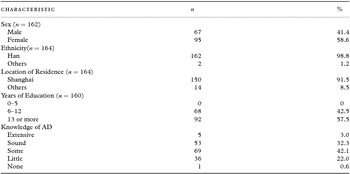
A total of 164 (93.7%) valid questionnaires were obtained from a total of 175. The average age of the caregivers was 52.7 years (SD = 15.4, range 17–92). The average years of education was 14.2 (SD = 2.7), with a minimum of 9 and maximum of 22. Among all the participants, 13 (8.1%) were single, 143 (88.8%) were married, and 5 (3.1%) were divorced or widowed. Ninety-six (62.3%) were a child of the patient, 37 (24.0%) were a spouse, 4(2.6%) were a grandchild, 3 (1.9%) were a brother or sister, 5 (3.2%) were a son-in-law or daughter-in-law, 1 (0.6%) was a mother, and 8 (5.2%) were other relatives. Regarding the diagnosis of the patients themselves, 74 (46.3%) had a formal diagnosis of AD, 37 (23.1%) were diagnosed as MCI, 8 (5.0%) were diagnosed as other types of dementia, and 41 (25.6%) were presenting for their first visit for cognitive decline without a formal diagnosis. The demographic characteristics of the study participants are listed in Table 1.
Demographic characteristics of the study participants

Most caregivers (135, 82.3%) indicated that they worried about potentially suffering from dementia in the future. Of the 119 caregivers for patients, who received a clinical diagnosis of dementia or MCI, 70 reported that the patient whom they cared for (58.8%) knew his/her own diagnoses themselves, 47 (39.5%) reported that the patient whom they cared for did not know the diagnosis, and 2 (1.7%) did not provide an answer. Half of the caregivers for the 70 patients who knew their own diagnosis believed that the patients had suffered emotionally from being informed of the diagnosis at the time of disclosure, and 30 (42.9%) believed that the patients were still suffering emotionally from knowing the diagnosis at the time of the questionnaire.
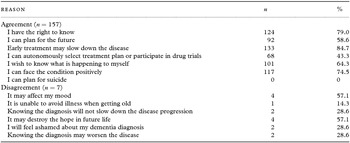
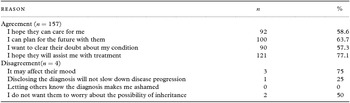
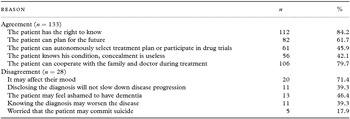
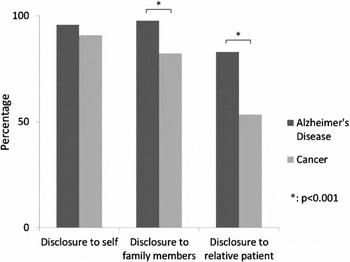
If the caregivers themselves were hypothetically affected by senile dementia, 157 (95.7%) would want to be told of the diagnosis (disclosure to self), and 160 (97.6%) wanted the doctor to tell the diagnosis to their family members (disclosure to family member). If a family member was to be diagnosed with AD, 136 (82.9%) wanted the doctor to disclose the diagnosis to the family member (disclosure to the relative patient). The reasons for and against disclosing were listed in Tables 2–4, respectively.
Reasons for and against disclosure if caregivers themselves suffered from AD (Disclosure to self)

Reasons for or against disclosure to their family member if caregivers themselves suffered from AD (Disclosure to family members)

Reasons for or against disclosure to the patient if a family member of the caregiver suffered from AD (Disclosure to relative patient)

The χ 2 test was applied to variables, including sex (male vs. female), age (≤55 vs. >55), education level (≤12 years vs. >12 years), knowledge of AD (extensive/sound vs. some/little/none) as well as the attitude toward disclosure to self, disclosure to family member, and disclosure to the relative patient. The p value of each of the above scenario was >0.05. Whether the participants considered senile dementia as disease or were afraid of having AD in the future did not have a significant impact on the selections in all three scenarios (p > 0.05 for all).
In consideration of which Chinese phrase would be most suitable for conveying the diagnosis, 56 participants (34.4%) preferred “cognitive impairment,” followed by memory loss (52, 31.9%), amnesia (50, 30.7%), brain deterioration (49, 30.1%), and AD (47, 28.8%). Only 8 (4.9%) were in favor of the traditional term “chi-dai” (dementia) and only 1 (0.6%) chose “shi-zhi” (intelligence loss).
Most caregivers (130, 80.2%) indicated that they would like to partake in a predictive test to know their risk for developing AD in the future. This result was not influenced by sex, age, or education levels (p > 0.05 for all), but there was a non-significant trend that participants with more knowledge of AD (p = 0.098) preferred not to undergo such risk stratification investigation.
When the hypothesized disease was changed from AD to cancer, 148 (90.8%) caregivers would want to be informed if they were diagnosed with cancer, 134 (82.2%) would want the doctors to tell their family members, and only 86 (53.4%) agreed that their close relative patients with cancer should be informed of the diagnosis themselves. The proportion of caregivers approving disclosure to family members was significantly fewer (p < 0.001), as was approval to disclose to the relative patient (p < 0.001). There was also a tendency toward not wishing to know their own diagnosis (p = 0.075), as demonstrated by Figure 1.
Caregivers’ attitudes toward diagnosis disclosure for Alzheimer's disease and cancer.

Discussion
Our study indicated that the vast majority of the caregivers for a patient with cognitive decline would wish themselves and their family members to be informed of their own potential AD diagnosis in the future, and also wished their family member afflicted with AD to be informed the diagnosis. These results were consistent with previous studies based on the general population or caregivers for AD patients (Sullivan and O'Conor, Reference Sullivan and O'Conor2001; Turnbull et al., Reference Turnbull, Wolf and Holroyd2003; Ouimet et al., Reference Ouimet, Dendukuri, Dion, Beizile and Elie2004; Lin et al., Reference Lin, Liao, Wang and Liu2005; Umegaki et al., Reference Umegaki, Onishi, Suzuki, Endo and Iguchi2007). Several studies attempted to identify the variables that may favor the disclosure the diagnosis (Holroyd et al., Reference Holroyd, Snustad and Chalifoux1996; Fahy et al., Reference Fahy, Wald, Walker and Livingston2003; Mormont et al., Reference Mormont, de Fays and Jamart2012), but none of the demographic characteristics, including age, educational level, or knowledge of AD was recognized to have predictive value on disclosure among the healthy general population or caregivers, which was replicated by our results.
When the same questions were applied to the diagnosis of terminal cancer, we found a significantly lower proportion of participants approving disclosure, which was inconsistent with the result of Holroyd et al. (Reference Holroyd, Snustad and Chalifoux1996). This may be secondary to the fact that we had not presented a vignette of the predicted quality of life for AD versus cancer patients, which had been the case in the above-mentioned study.
Even though more than 80% of caregivers approved disclosure of AD diagnosis to the patient in our study, only 58.8% of the patients were actually informed of their diagnosis. This may represent a change in mindset after becoming a caregiver for a cognitively impaired individual, since previous studies found that caregivers were less likely to inform the diagnosis of AD to an affected relative (Shimizu et al., Reference Shimizu, Raicher, Takahashi, Caramelli and Nitrini2008; Riva et al., Reference Riva2014). However, this is difficult to delineate as similar studies have not been conducted within the general Chinese population, who are not caregivers for the cognitively impaired.
The currently accepted manner of disclosing the dementia diagnosis in China is to inform a relative or a friend accompanying the patient, and leaving the companion to decide whether to tell the patient or not. Such a process not only saves time for the physicians, but also avoids the risk of potential doctor–patient conflict. However, it is also a violation of patient autonomy, as 79% of our participants approving disclosure to themselves believe that they had a right to know the diagnosis, which is consistent with the results of previous studies (van den Dungen et al., Reference van den Dungen2014). Most participants selected “I may slow down the disease through early treatment” as the reason that they would like to be informed, and when asked whether to tell a family member, the biggest driving factor for approval was “I hope they will assist me with treatment.” These results indicate that prognosis is the main concern associated with a diagnosis of dementia. For reasons disapproving disclosure, the fear of emotional trauma, such as depression and anxiety was the top concern in all three situations, but recent studies showed that disclosure of AD diagnosis may improve anxiety instead of worsening it (Mormont et al., Reference Mormont, Jamart and Jacques2014). Considering the Chinese phrase traditionally used for dementia (“chi-dai”) is associated with significant negative connotations and may result the patient feeling humiliated, we included the option of “being ashamed of the diagnosis” as a justification of non-disclosure. However, only a small number of the interviewees chose this to be their justification.
In recent years, risk stratification biomarkers, such as apolipoprotein E genetic testing, amyloid imaging, and cerebrospinal protein test have gained popularity. Some individuals prefer to undergo these risk stratification tests for an opportunity of early intervention or prevention, if they were found to be high risk. On the other hand, for a progressive and irreversible disease associated with significant morbidity like AD, many had questioned if knowing the risk years ahead of time could really be beneficial (Robinson et al., Reference Robinson, Canavan and O'Keeffe2014). In our study, 80.2% of the participants indicated that they would want to undergo series of testing to know their risk of future AD, even if the prediction is not definitive. However, there is a trend that those with better understanding of AD prefer not to undergo such testing. Similarly, in a previous study, 94.9% participants originally indicated that they would want to be risk stratified for AD, but this dropped to 81.0% after receiving information on the limited potential benefits and current limitations associated with biomarker testing (Gooblar et al., Reference Gooblar, Roe, Selsor, Gabel and Morris2015). The poor prognosis and lack of disease modifying treatment options may explain why individuals with more knowledge of AD did not wish to know their risk of AD in the future.
Although the term may be offensive, there were still eight (4.9%) participants who preferred “chi-dai” as an acceptable term for disclosing the diagnosis of dementia, possibly because it is the most well-recognized term in China. The term “cognitive impairment,” which sounds neutral and professional in Chinese was most welcomed, but “shi-zhi” (intelligence loss), which was well received in the study by Lin et al. (Reference Lin, Liao, Wang and Liu2005), was not as favored as postulated, with only one participant choosing it as an substitution for AD. “Shi-zhi” has already been recommended in Chinese mainland for several years as the preferred substitute for “chi-dai” to show respect and care to demented patients, yet it has not been well publicized to the general population.
Interestingly, our participants overall showed a high level of education, with a mean of 14.2 years, with all participants having received at least nine years of education. This may be the result of Shanghai being one of the most affluent Chinese cities with abundant educational resources, but there is also the possibility of selection bias, since less educated caregivers are less likely to present to memory clinics or to take part in a questionnaire-based study. Given the concern for the capacity of the cognitively impaired patients, as well as the fact that some of the patients had not been informed of the diagnosis, we did not administer the questionnaire to the patients themselves. This is a potential limitation of our study, as the caregiver's attitude toward disclosure of the diagnosis of dementia may be affected by the insight and level of function of the patient whom they cared for. Hence, the opinions from the patients themselves, the physicians and community populations in China remain as an unrevealed field for future research.
In conclusion, our study presents data on the attitudes toward disclosing a diagnosis of dementia to the patient in China from the perspective of their caregivers. Most of the interviewees wanted the doctors to disclose the diagnosis truthfully to themselves and their family members if they were to be diagnosed AD. Fewer, but still a majority of caregivers would want their relative with AD to be informed of the diagnosis. The traditional term of “chi-dai” was not favored by most caregivers. These results may help physicians to shift toward a paradigm of disclosing a diagnosis of dementia in an empathetic manner toward the patient and their caregivers. Further study is required to obtain the opinion from the general population as well as caregivers from a lower educational background in regions outside of metropolitan Shanghai.
Acknowledgments
We thank the caregivers and their families for their participation in this project. This study was supported by the “Shuguang Program” supported by Shanghai Education Development Foundation and Shanghai Municipal Education Commission.
Conflict of interest
None.
Description of authors' roles
Ru-jing Ren and Gang Wang designed the study and critically reviewed the manuscript. Yang Zou and Gang Wang designed the questionnaire. Yang Zou and Ning Song carried out the statistical analysis and draft the manuscript. Yong-bo Hu, Ying Gao, Yue-qi Zhang, Qian-hua Zhao, Xia Li and Guan-jun Li recruited the participants and performed the questionnaire. Qi-hao Guo, Shi-fu Xiao, and Sheng-di Chen supervised the data collection.