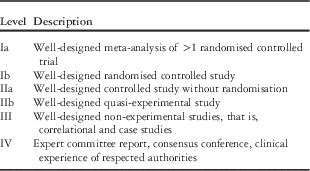
The era of foetal therapy began in 1961 with the first intrauterine transfusion for foetal anaemia due to haemolytic disease,Reference Liley1 followed by a report on stimulation of lung maturation by transplacental administration of glucocorticoids.Reference Liggins and Howie2 The first report of foetal cardiac therapy was an attempt to pace the heart in a foetus with complete heart block.Reference Carpenter, Strasburger and Garson3 There are still many unresolved issues, for example, whether it is possible to alter the progression of foetal aortic valve stenosis to hypoplastic left-heart syndrome by a foetal balloon valvuloplasty. In this introductory overview, we examine the quality of current evidence supporting or refuting proposed foetal cardiac therapies. The Grading of Recommendations Assessment, Development, and Evaluation systemReference Guyatt, Oxman and Vist4 is commonly used to assess the strength of published evidence, and the categories are listed in Table 1.
Hierarchy of levels of evidence.
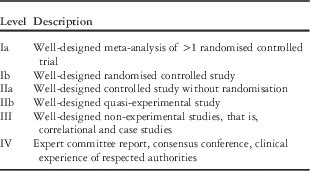
Adapted from the Scottish Intercollegiate Guidelines Network
The assessment considers the level of evidence and study quality where level of evidence refers to the establishment of a hierarchy of study designs based on the ability of the design to protect against bias. This varies, but usually randomised controlled trials are considered to be the design least susceptible to bias. The relative rarity and heterogeneous nature of patients within congenital heart disease cohorts result in difficulties in conducting randomised trials and in ensuring sufficient power to be able to demonstrate differences.
Non-cardiac foetal therapies: what works?
There are a few non-cardiac foetal therapies that have been shown by randomised controlled trials to be effective and safe and are now part of routine clinical management, for example, antenatal corticosteroids for lung maturationReference Roberts and Dalziel5 and endoscopic laser coagulation of placental anastomoses in twin-to-twin transfusion syndrome.Reference Senat, Deprest, Boulvain, Paupe, Winer and Ville6 Some non-cardiac foetal therapies have been investigated, but their efficacy has not been proven: randomised controlled trial of foetal endoscopic tracheal occlusion for diaphragmatic hernia to improve lung growth;Reference Harrison, Keller and Hawgood7 other studies have shown some benefit: a randomised controlled trial of prenatal repair of myelomeningocele has achieved better neurological function than after postnatal repair, a reduced need for shunting and improved motor outcomes, but surgery involves increased maternal and foetal risks.Reference Adzick, Thom and Spong8
There are difficulties in assessing treatments, often because of poor recruitment, such as the randomised controlled trial of shunting for lower urinary tract obstructionReference Morris, Malin and Quinlan-Jones9 in which a high termination rate resulted in a small number of patients randomised. Evidence that shunting of pleural fluid is effective in improving outcome is still based only on case series, with no accepted level of evidence. Cardiac studies suffer from similar problems with their study design. Multicentre collaborations provide larger numbers but often at the expense of widening the variability of recruitment and treatment options and increasing the difficulty of data collection.
Cardiac foetal therapies: what works?
Foetal tachyarrhythmias
It is generally recognised in clinical practice that transplacental pharmacological treatment of foetal tachyarrhythmias is often effective in terminating the arrhythmia and improving outcome. This has been accepted into clinical practice based on a large number of retrospective case series and anecdotal clinical experience by most foetal cardiologists and foetal medicine specialists. Because current treatment is often effective in converting a life-threatening foetal tachycardia to sinus rhythm, a placebo-controlled randomised trial would probably be considered unethical by most investigators today. What about the evidence base for selecting the antiarrhythmic agent with the best efficiency/safety profile in different foetal tachyarrhythmias, with or without hydrops? The practice differs between different institutions and there is no consensus of which treatment is the best. The evidence today is only from retrospective case series.Reference Skinner and Sharland10, Reference Jaeggi, Carvalho and De Groot11 This would be a possible subject for a multicentre controlled randomised trial,Reference Van den Heuvel, Bink-Boelkens, Du Marchie Sarvaas and Berger12, Reference Saul and Cain13 and one is being planned. In a preliminary survey, most of the 89 responding centres worldwide were interested in participating in a study that would include randomised two-arm comparisons for foetal supraventricular tachycardia without hydrops (digoxin versus flecainide), for atrial flutter without hydrops (digoxin versus sotalol), and for SVT with hydrops (combinations of sotalol+digoxin versus flecainide+digoxin). However, it was calculated that a total of 550 cases would be required to detect a 20% difference between treatment arms with 80% power. It is proposed that with 50 centres recruiting data collection could be completed within 4 years (Jaeggi, personal communication).
Foetal heart block
It is generally accepted that antibody-mediated isolated complete heart block is irreversible. Attempts to influence outcome has been along two strategies: to try to prevent the development of complete heart block by treating high-risk pregnant women prophylactically with steroids, and to improve prognosis once the heart block is established by steroid treatment. The main problem is that the development of foetal complete heart block cannot yet be predicted. The risk in antibody-positive women is only around 3%. As there are considerable side effects with steroid ingestion, prophylaxis of all antibody-positive pregnant women cannot be justified. Attempts to predict complete heart block by measuring foetal atrioventricular conduction time between 18 and 24 weeks’ gestation have been disappointing; the development of first-degree heart block does not predict the development of complete heart block,Reference Bergman, Eliasson, Bremme, Wahren-Herlenius and Sonesson14, Reference Jaeggi, Silverman, Laskin, Kingdom, Golding and Weber15 whereas second-degree heart block often progresses to complete block.Reference Askanase, Friedman and Copel16, Reference Eliasson, Sonesson and Sharland17 Most foetuses developing complete heart block do so directly from sinus rhythm, and therefore treating all foetuses with second-degree heart block would not solve the problem. There are, however, a few case reports of transplacental treatment with fluorinated steroids in foetuses with second-degree heart block with some evidence that it prevents the progression to complete heart block.Reference Askanase, Friedman and Copel16, Reference Breur, Visser, Kruize, Stoutenbeek and Meijboom18, Reference Bergman, Eliasson, Bremme, Wahren-Herlenius and Sonesson14 The Fetal Working Group of the Association for European Paediatric and Congenital Cardiology conducted a retrospective multicentre study on foetal heart blockReference Eliasson, Sonesson and Sharland17 reporting 175 foetuses with second- or third-degree heart block. Of the 175 foetuses, 15 had second-degree block and seven of those received antenatal steroid treatment. Of them, three reverted to sinus rhythm, but only two remained in sinus rhythm at follow-up, whereas three progressed to complete heart block. Of the eight patients with second-degree block who were not given steroids, none reverted to sinus rhythm, and five progressed to complete heart block. A randomised study on steroid treatment in second-degree heart block could perhaps be justified but would be difficult to perform because of the rarity of the condition. In the future, when we have an instrument to predict with a high degree of accuracy, perhaps based on the level and type of maternal antibodies, exactly which foetuses in such pregnancies will develop complete heart block, it might be possible to conduct a prospective randomised controlled study on the prevention of heart block.
The second treatment approach has been to try to improve outcome once complete heart block is established. In a retrospective review of 16 cases not treated with fluorinated steroids, and 21 cases in a later era who were treated with steroids, the 1-year survival rate was higher in the latter group.Reference Jaeggi, Fouron, Silverman, Ryan, Smallhorn and Hornberger19 Immune-mediated conditions such as myocarditis, hepatitis, and cardiomyopathy were less common in the treated group. In contrast with these findings, in the Association for European Paediatric and Congenital Cardiology multicentre study,Reference Eliasson, Sonesson and Sharland17 there were 67 patients who received treatment with fluorinated steroids, and 108 patients who did not. The survival at birth in both the groups was 91%. If one were designing a randomised study to resolve the question whether steroid treatment is justified in foetal complete heart block, 253 patients would be required in each arm to detect a 50% reduction in mortality from steroid treatment at a 5% significance level with 80% power.Reference Eliasson, Sonesson and Sharland17 Even if such a study were desirable, it would be difficult to organise and take 20 years or so to recruit the necessary number of patients.
Foetal aortic valve stenosis
It is now more than 20 years since the progression of foetal aortic stenosis to hypoplastic left-heart syndrome was reported.Reference Allan, Sharland and Tynan20 Others have subsequently confirmed this observation,Reference Hornberger, Sanders, Rein, Spevak, Parness and Colan21 which led to attempts to perform balloon dilatation of the aortic valve in a foetus.Reference Maxwell, Allan and Tynan22 In recent publications from Boston and Linz, a total of 94 such procedures have been reported.Reference McElhinney, Marshall and Wilkins-Haug23, Reference Artzt, Wertaschnigg, Veit, Klement, Gitter and Tulzer24 The rationale is to try to influence the risk of progression from aortic valve stenosis to hypoplastic left-heart syndrome, and the available evidence, based on retrospective case series,Reference McElhinney, Marshall and Wilkins-Haug23, Reference Artzt, Wertaschnigg, Veit, Klement, Gitter and Tulzer24 suggests that this may be possible in selected cases. This conclusion rests on the assumption that it is possible to identify, early enough in pregnancy, foetuses with aortic valve stenosis who have a close to 100% risk of progressing to hypoplastic left-heart syndrome if no intervention is performed, but still have the potential for left ventricular growth if the stenotic valve is opened. There are data from retrospective case series to support this assumption.,Reference McElhinney, Marshall and Wilkins-Haug23–Reference Mäkikallio, McElhinney and Levine25 However, this form of treatment is still considered experimental, largely because a prospective randomised study has not yet been conducted to prove its efficiency and safety. Would such a study at all be possible? It would probably be ethically justified as foetal aortic valvuloplasty is not a generally accepted treatment today, may be effective in decreasing the risk of a univentricular postnatal circulation, and is associated with a <10% risk of foetal death. Even if foetal intervention could increase the proportion of biventricular circulation treatment pathways in this group, it is mandatory to analyse the longer-term functional outcome with respect to pulmonary hypertension, later conversion to a univentricular circulation or cardiac transplant, or death and quality of life in biventricular compared with univentricular survivors. However, it is not accepted that a biventricular outcome is always better than a univentricular outcome. These issues could be addressed in a randomised study but would require a multicentre approach, including a referral algorithm to one or two centres for the intervention. Patient recruitment is likely to be difficult, especially in countries with a high termination rate following prenatal diagnosis of such a severe cardiac defect. Pregnant women might choose intervention in favour of termination if the procedure carried a near-zero risk to the mother (which it probably does), a low risk for foetal death or preterm labour, close to 100% risk of univentricular circulation without intervention (which is probably not true), a high rate of biventricular circulation as a result of the procedure, and a good long-term outcome of biventricular cases. Even if foetal intervention decreased the risk of a univentricular circulation by 50%, many families might not agree to participate in a randomised study, preferring a termination of pregnancy to a 50% chance of being randomised to intervention with only a 50% chance of an initial biventricular circulation after birth. The total risk of univentricular outcome would still be around 75%. In countries where termination of pregnancy is not an option or not culturally accepted, the scenario is different, as well as when the diagnosis is confirmed only after the legal time limit for termination of pregnancy.
The Fetal Working Group of the Association for European Paediatric and Congenital Cardiology has taken another approach to increase the evidence base in this condition. Inspired by the success of the retrospective study on foetal heart block,Reference Eliasson, Sonesson and Sharland17 representing the largest published series to date, the Fetal Working Group decided to conduct a European multicentre study on foetal aortic stenosis comprising a retrospective and prospective leg. The retrospective data collection comprised 5 years and was completed in March 2012 when over 200 cases had been included and is being analysed. The prospective study is in the final stage of preparation using a web-based case entering solution. The aims of these studies were to study the effect of foetal aortic valvuloplasty on postnatal circulation and survival compared with the natural history of foetal aortic valve stenosis in a large cohort of foetuses, analysing outcomes separately in those fulfilling the published criteria for intervention. A similar and parallel initiative is the International Fetal Cardiac Intervention Registry organised by The International Fetal Medicine and Surgery Society,Reference Oepkes, Moon-Grady, Wilkins-Haug, Tworetzky, Arzt and Devlieger26 which will include all types of foetal cardiac interventions. Such multicentre registries are a complementary strategy to increase the evidence base when randomised controlled trials are not possible or very difficult to organise, or as a basis for later design of randomised studies.
Hypoplastic left-heart syndrome
In hypoplastic left-heart syndrome, the postnatal prognosis is much worse if the atrial septum has been highly restrictive or intact prenatally, because this can cause severe arterial desaturation immediately after birth, secondary to pulmonary venous wall thickening. Therefore, it is logical that attempts have been made to create a large atrial communication prenatally, usually during the early or mid third trimester.Reference Marshall, Levine and Morash27–Reference Quintero, Huhta, Suh, Chmait, Romero and Angel29 Only case series have been published and this intervention is still considered an experimental procedure, although results indicate a better prognosis than without intervention. A randomised multicentre study in Europe would necessitate transport of patients to one or two centres performing this intervention as for aortic valvuloplasty, raising practical difficulties.
Pulmonary atresia intact ventricular septum
Foetal balloon valvuloplasty has been reported in critical pulmonary valve stenosis and pulmonary atresia with intact septumReference Tulzer, Arzt, Franklin, Loughna, Mair and Gardiner30 with, as in aortic valvuloplasty, the objective of achieving a biventricular circulation after birth. Morphological and functional predictors of biventricular versus univentricular circulation have been defined.Reference Gardiner, Belmar and Tulzer31 Judging from these small case series, and from the often favourable postnatal outcome in pulmonary atresia with intact septum, the role of foetal intervention in this condition seems less clear than in aortic stenosis.
Conclusion
In summary, the evidence for the efficacy and safety of foetal cardiac therapies has a poor evidence base with no randomised controlled studies. In the future, whenever possible, randomised studies should be conducted to prevent the uncontrolled spread of experimental procedures. When these are not possible, for ethical reasons, lack of scientific equipoise, or because of the rarity of a condition, multicentre registries, properly analysed, may contribute to an improvement of the evidence base. The Fetal Working Group of the Association for European Paediatric and Congenital Cardiology hopes to continue to initiate and support multicentre studies on foetal therapy in Europe and to consider cooperation with other international initiatives.
Acknowledgement
In addition MM was supported by Swedish Heart-Lung Foundation.