Internalizing symptoms, which include anxiety and depressive symptoms, increase in prevalence across adolescence (Kessler et al., Reference Kessler, Demler, Frank, Olfson, Pincus, Walters and Zaslavsky2005; Roza, Hofstra, van der Ende, & Verhulst, Reference Roza, Hofstra, van der Ende and Verhulst2003), with anxiety and mood disorders representing the most commonly diagnosed conditions during this developmental period (Merikangas et al., Reference Merikangas, He, Burstein, Swanson, Avenevoli, Cui and Swendsen2010). Internalizing symptoms impose massive costs, both financial and personal (Bodden, Dirksen, & Bögels, Reference Bodden, Dirksen and Bögels2008; Glied & Neufeld, Reference Glied and Neufeld2001; Lynch & Clarke, Reference Lynch and Clarke2006; Mandell, Guevara, Rostain, & Hadley, Reference Mandell, Guevara, Rostain and Hadley2003), suggesting the importance of targeting these disorders early and expeditiously. Of note, even moderate, subclinical internalizing symptomatology is associated with significant functional impairments (Angold, Costello, Farmer, Burns, & Erkanli, Reference Angold, Costello, Farmer, Burns and Erkanli1999; Copeland, Shanahan, Costello, & Angold, Reference Copeland, Shanahan, Costello and Angold2009; Dell'Osso et al., Reference Dell'Osso, Rucci, Ducci, Ciapparelli, Vivarelli, Carlini and Cassano2003). Further, symptoms of anxiety and depression during adolescence are predictive of anxiety and depressive disorders during adulthood (Copeland, Angold, Shanahan, & Costello, Reference Copeland, Angold, Shanahan and Costello2014; Garber, Kriss, Koch, & Lindholm, Reference Garber, Kriss, Koch and Lindholm1988; Lewinsohn, Clarke, Seeley, & Rohde, Reference Lewinsohn, Clarke, Seeley and Rhode1994; Rao et al., Reference Rao, Ryan, Birmaher, Dahl, Williamson, Kaufman and Nelson1995). Thus, identifying factors predictive of the emergence and persistence of internalizing symptoms has critical public health implications in terms of prevention and intervention efforts.
Relations Between Distress Tolerance (DT) and Internalizing Symptomatology
Low DT, conceptualized as the perceived or actual inability to tolerate negative experiential states (e.g., negative emotions, discomfort, and uncertainty; Leyro, Zvolensky, & Bernstein, Reference Leyro, Zvolensky and Bernstein2010), is a transdiagnostic risk factor associated with a variety of anxiety and depression-related disorders (Abrantes et al., Reference Abrantes, Strong, Lejuez, Kahler, Carpenter, Price and Brown2008; Ellis, Vanderlind, & Beevers, Reference Ellis, Vanderlind and Beevers2013; Harrington, Reference Harrington2006; Keough, Riccardi, Timpsno, Mitchell, & Schmidt, Reference Keough, Riccardi, Timpano, Mitchell and Schmidt2010; Telch, Jacquin, Smits, & Powers, Reference Telch, Jacquin, Smits and Powers2003; Timpano, Buckner, Richey, Murphy, & Schmidt, Reference Timpano, Buckner, Richey, Murphy and Schmidt2009), as well as with internalizing symptoms (Daughters, Gorka, Magidson, MacPherson, & Seitz-Brown, Reference Daughters, Gorka, Magidson, MacPherson and Seitz-Brown2013; Daughters et al., Reference Daughters, Reynolds, MacPherson, Kahler, Danielson, Zvolensky and Lejuez2009; Wolitzky-Taylor et al., Reference Wolitzky-Taylor, Guillot, Pang, Kirkpatrick, Zvolensky, Buckner and Leventhal2015). Individuals with low DT are thought to be more reactive to distress and more likely to attempt to avoid distress-eliciting situations (Leyro et al., Reference Leyro, Zvolensky and Bernstein2010). Following from this, youth with low DT are less likely to persist on distress-inducing tasks than youth with higher DT, despite both groups experiencing similar levels of distress (Danielson, Ruggiero, Daughters, & Lejuez Reference Danielson, Ruggiero, Daughters and Lejuez2010; Daughters et al., Reference Daughters, Reynolds, MacPherson, Kahler, Danielson, Zvolensky and Lejuez2009; MacPherson et al., Reference MacPherson, Reynolds, Daughters, Wang, Cassidy, Mayes and Lejuez2010). The impact of low DT on youth can be understood within a negative reinforcement framework, which highlights the escape and avoidance of negative affective states as the primary motivational factor across situations. This conceptualization fits nicely with behavioral theories of anxiety, which suggest avoidance is relevant to the development and persistence of anxiety (Barlow, Allen, & Choate, Reference Barlow, Allen and Choate2004; Glick & Orsillo, Reference Glick and Orsillo2011), giving credence to observed relations between low DT and anxiety (e.g., Cummings et al., Reference Cummings, Bornovalova, Ojanen, Hunt, MacPherson and Lejuez2013; Danielson et al., Reference Danielson, Ruggiero, Daughters and Lejuez2010; Daughters et al., Reference Daughters, Reynolds, MacPherson, Kahler, Danielson, Zvolensky and Lejuez2009). Furthermore, in relation to depression, low DT is associated with engagement in rumination, which can be conceptualized as emotional avoidance without active problem solving; here, rumination mediates relations between DT and depression (Magidson et al., Reference Magidson, Listhaus, Seitz-Brown, Anderson, Lindberg, Wilson and Daughters2013). Thus, low DT may be associated with the onset of internalizing symptomatology during this developmental period because of how it impacts youths’ engagement with day-to-day distress.
Initial conceptualizations of DT suggested it was a stable traitlike characteristic originating in childhood (Linehan, Reference Linehan1993), which has been demonstrated empirically among youth (Cummings et al., Reference Cummings, Bornovalova, Ojanen, Hunt, MacPherson and Lejuez2013). More recent work suggests DT has genetic correlates (Amstadter et al., Reference Amstadter, Daughters, MacPherson, Reynolds, Danielson, Wang and Lejuez2012), providing further evidence for the idea that DT likely impacts how youth react to distress throughout development. Given strong associations between low DT and internalizing disorders/symptoms, it is possible that low DT may be a critical factor relevant to the emergence and persistence of internalizing psychopathology. However, although several studies have linked low DT and internalizing symptomatology concurrently, no study, to our knowledge, has tested DT as a predictor of internalizing symptoms across early development. It is thus unknown whether low DT is merely associated with internalizing symptoms, or whether this traitlike characteristic increases youths’ vulnerability to the development of internalizing symptomatology during this critical developmental period. In addition, given the stability of DT during childhood and adolescence, it is possible that DT causes changes in other intermediary processes, thereby increasing rates of internalizing symptomatology during this period. However, this has not previously been examined. Thus, the current study aims to fill these gaps by furthering our understanding of how DT may serve as an early vulnerability factor for later psychopathology.
Mediators of the Relations Between DT and Internalizing Symptoms
Beyond establishing low DT as a potential risk factor for the development of internalizing symptomatology, it is critical to determine whether low DT impacts other intermediary processes relevant to the development of symptomatology. Given that DT is stable during adolescence (e.g., Cummings et al., Reference Cummings, Bornovalova, Ojanen, Hunt, MacPherson and Lejuez2013), it is possible that DT impacts youths’ reactions to different environmental factors encountered during the developmental transition from childhood to adolescence. One possible mechanism linking DT and internalizing symptoms is perceived stress, or the degree to which individuals experience stress as unmanageable and overwhelming, relative to their ability to cope with particular situations (Cohen, Kamarck, & Mermelstein, Reference Cohen, Kamarck and Mermelstein1983). Specifically, perceived stress is often operationalized as an individual's self-reported feelings of being unable to control or cope with nonspecific life stressors. Though related to depression and anxiety, perceived stress has been shown to be a distinct construct (Cohen et al., Reference Cohen, Kamarck and Mermelstein1983) and to predict internalizing symptoms above and beyond discrete negative life events (Cohen, Reference Cohen1986; Martin, Kazarian, & Breiter, Reference Martin, Kazarian and Breiter1995). Further, early elevations in perceived stress were found to predict increases in depression and anxiety symptoms over time among youth (Galaif, Sussman, Chou, & Wills, Reference Galaif, Sussman, Chou and Wills2003; Schmeelk-Cone & Zimmerman, Reference Schmeelk-Cone and Zimmerman2003; Varni & Katz, Reference Varni and Katz1997).
There are three main conceptual links suggesting that perceived stress may be an important mediator of the relations between DT and later internalizing symptomatology. These links highlight relations between (a) low DT and perceived stress, (b) perceptions of stress and internalizing symptomatology, and (c) low DT and internalizing symptoms through the mechanism of perceived stress.
First, emerging evidence suggests an important link between low DT and individuals’ perception of their day-to-day stressful experiences. For instance, in a daily diary study of adults, researchers found that low baseline DT was associated with reporting more daily life stressors across a variety of domains (Hawkins, Macatee, Guthrie, & Cougle, Reference Hawkins, Macatee, Guthrie and Cougle2013). Given that individuals with lower DT are not necessarily experiencing more distress, but rather are more reactive to the distress they are experiencing (e.g., Danielson et al., Reference Danielson, Ruggiero, Daughters and Lejuez2010; Daughters et al., Reference Daughters, Reynolds, MacPherson, Kahler, Danielson, Zvolensky and Lejuez2009; MacPherson et al., Reference MacPherson, Reynolds, Daughters, Wang, Cassidy, Mayes and Lejuez2010), we would expect that they would have a heightened awareness of potentially stressful events in their environments. Following from this, it is possible these individuals would be more likely to notice more stressful events in their environments and experience an accumulation of negative affect, resulting in the onset and maintenance of internalizing symptoms (Gross, Reference Gross1998, Reference Gross2002; Lynch & Mizon, Reference Lynch, Mizon, Zvolensky, Bernstein and Vujanovic2011).
Second, developmental trends in rates of perceived stress appear to mirror rates of internalizing symptoms; the perceived intensity of stressful events increases across adolescence, whereby older adolescents, specifically females, report experiencing stressful events as more intense than their younger counterparts (Jose & Ratcliffe, Reference Jose and Ratcliffe2004). The perception of stress in one's environment is consistently linked to the onset and maintenance of internalizing symptoms among youth (e.g., Hammen, Reference Hammen2005; Martin et al., Reference Martin, Kazarian and Breiter1995; Sontag & Graber, Reference Sontag and Graber2010), and researchers argue that this cognitive appraisal of the intensity of stress is central to the onset of psychopathology (e.g., Compas, Davis, Forsythe, & Wagner, Reference Compas, Davis, Forsythe and Wagner1987; Lazarus, Reference Lazarus1999). Thus, perceived stress may be an important predictor of internalizing symptomatology among youth.
Third, because distress-intolerant individuals may be more likely to perceive their lives as being increasingly stressful over time, these individuals might be those who are most likely to develop elevated levels of internalizing symptomatology. Related to this, cross-sectional research from an HIV-positive adult sample found that individuals with lower levels of DT reported experiencing stressful experiences and evidenced greater levels of depressive symptoms (O'Cleirigh, Ironson, & Smits, Reference O'Cleirigh, Ironson and Smits2007). Thus, perceived stress may mediate the relations between DT and internalizing symptoms such that lower levels of DT may make youth more aware of potential life stressors, which in turn may increase the likelihood of internalizing symptoms across development. In other words, children who are less able to tolerate distress may both perceive more stress in their environment (that they feel less able to cope with) and, consequently, experience greater increases in internalizing symptoms across this developmental period. These relations have not been examined previously in any sample, to our knowledge, and offer a potential intervention point for youth at risk for internalizing symptoms.
Measuring DT Among Youth
When investigating how low DT might relate to perceived stress and internalizing symptomatology, it is critical to consider the most appropriate methods for measuring the construct of DT among youth, as a number of self-report and behavioral measures of this construct exist (see Leyro et al., Reference Leyro, Zvolensky and Bernstein2010, for a review). Given methodological and interpretive problems with using self-report measures among youth, including youths’ difficulties interpreting questions and their willingness to accurately report inner experiences (Lejuez, Kahler, & Brown, Reference Lejuez, Kahler and Brown2003; Wills, Sandy, & Yaeger, Reference Wills, Sandy and Yaeger2002), the use of a behavioral measure of DT increases confidence in findings. Because behavioral measures do not rely on youths’ abilities to accurately describe inner states and motivations, they might better capture youths’ difficulties persisting when distressed. Empirical work demonstrates youths’ persistence on a behavioral task assessing DT, the Behavioral Indicator of Resiliency to Distress (BIRD), is unrelated to self-reported distress or to actual ability to succeed on this task (Amstadter et al., Reference Amstadter, Daughters, MacPherson, Reynolds, Danielson, Wang and Lejuez2012; Daughters et al., Reference Daughters, Reynolds, MacPherson, Kahler, Danielson, Zvolensky and Lejuez2009; MacPherson et al., Reference MacPherson, Reynolds, Daughters, Wang, Cassidy, Mayes and Lejuez2010); thus, this task captures willingness to persist, despite distress. For the present study, we were interested in understanding how DT impacted youths’ behavioral reactions to situations they perceived as stressful. Thus, behavioral assessments targeting youths’ ability to persist in goal-directed behavior when distressed were of particular interest.
Current Study
From a developmental psychopathology perspective, understanding individual factors relevant to the emergence of internalizing symptoms and disorders during adolescence (e.g., Kessler et al., Reference Kessler, Demler, Frank, Olfson, Pincus, Walters and Zaslavsky2005; Roza et al., Reference Roza, Hofstra, van der Ende and Verhulst2003) is critical. Examining both inter- and intraindividual differences, as well as developmental trajectories of risk, allows us to examine the role of change across adolescence in predicting vulnerabilities to the onset of anxiety and depression. Low DT and high perceived distress are two specific potential risk factors for the development of internalizing symptoms, and offer potential points of intervention and prevention. Thus, the current study aimed to examine the relationship between DT, perceived stress, and internalizing symptoms in a sample of community youth followed over 5 years during the critical developmental transition from late childhood to adolescence. To that end, we proposed three hypotheses. First, we hypothesized that perceived stress would increase across adolescence. Second, we hypothesized that lower levels of DT at baseline would be associated with greater increases in perceived stress over time. Third, we hypothesized that increases in perceived stress would mediate the relation between DT and later internalizing symptoms.
Method
Participants and procedures
The current study included youth recruited from a metropolitan area as part of a longitudinal study examining the development of psychopathology. Youth and their families were recruited through media outreach and through postings and fliers at community centers, area schools, libraries, and Boys and Girls clubs. Interested families were screened for proficiency in English and their ability to take part in annual assessments. Two cohorts of participants were recruited to take part in the study. The original cohort included 277 youth who were asked to participate annually over the course of six assessments; because key measures were not introduced until the second wave of data collection, the current study utilized data collected during years 2–6. Of the original sample of 277 adolescents recruited for the first cohort, 244 youth (45% girls) between ages 10 and 14 (M = 12.07 years, SD = 0.91 years) participated at the second wave of assessment (considered the baseline for the purposes of the current study). Youth who completed both Waves 1 and 2 did not significantly differ from students who completed only Wave 1 on any demographic or study variables (ps > .274). Over the course of the study, 246 youth participated in Wave 3, 231 participated in Wave 4, 210 participated in Wave 5, and 179 participated in Wave 6. Forty-nine percent of the sample identified as White, 35% as Black, 3% as Latino/a, 1% as Asian, and 12% as “other.”
A second cohort of adolescents was recruited approximately 4 years after the first cohort began the study to increase the racial diversity of the total sample. This cohort participated in three waves of data collection and therefore contributed data to the first two waves of the current study. The second cohort included 53 youth between the ages of 10 and 15 (M = 12.46 years, SD = 1.36 years) at the baseline (Wave 2) wave, and 50 youth at the following wave. Of those participating in the second cohort, 15% identified as White, 78% identified as Black, and 6.5% as other. Each cohort's corresponding waves of data were then combined (i.e., Cohort 1's Wave 1 and Cohort 2's Wave 1 were combined to create the total Wave 1 sample, etc.). The total number of youth who participated at every wave was 169; however, missing data estimation procedures (outlined below) allowed us to include all participants in the following analyses. In total, 331 adolescents contributed data to at least one data point used in the study.
Measures
Demographic variables
We collected demographic information at the baseline assessment, including age, sex, and race/ethnicity for each participant. In line with previous research (e.g., Billy & Udry, Reference Billy and Udry1985; Henry, Shcoeny, Deptula, & Slavick, Reference Henry, Schoeny, Deptula and Slavick2007), we dichotomized participants into White and non-White.
Perceived Stress Scale
Participant's perception of their personal stress level was measured using the Ten-Item Perceived Stress Scale (PSS-10; Cohen et al., Reference Cohen, Kamarck and Mermelstein1983). The PSS-10 is generally considered the most widely used measure of perceived stress (Taylor, Reference Taylor2015) and taps the appraisal of subjective stress in an individual's life. Youth were asked to rate how often they have perceived uncontrollable or unpredictable stress in their lives over the past month on a 5-point scale (0 = never, 4 = very often). Sample items from this scale include “In the last month, how often have you found that you could not cope with all things you had to do?” Previous research suggests that the PSS-10 can be further divided into two subscales: the perceived distress subscale and the perceived coping ability subscale (Martin et al., Reference Martin, Kazarian and Breiter1995). Cohen, the developer of the original scale, favored the use of either the full-scale score or the perceived distress subscale alone (Cohen & Williamson, Reference Cohen, Williamson, Spacapan and Oskamp1988). A recent psychometric study of the measure further supports a two-factor model of the scale, but also supports the utility of utilizing the total score (Taylor, Reference Taylor2015). Both the total score PSS-10 and the individual subscales have demonstrated good reliability and validity (Martin et al., Reference Martin, Kazarian and Breiter1995; Yeager et al., Reference Yeager, Johnson, Spitzer, Trzesniewski, Powers and Dweck2014). In the current sample, internal consistency was adequate for each wave of data for the full-scale (Cronbach α range = 0.60–0.67) and for the perceived distress subscale (Cronbach α range = 0.82–0.86). Given a lack of concordance in the literature regarding which scale more validly captures perceived stress (see Cohen & Williamson, 1988; Taylor, Reference Taylor2015), we opted to run all models using both the full-scale score and the perceived distress subscale.
Internalizing symptoms
The Revised Children's Anxiety and Depression Scale (Chorpita, Yim, Moffitt, Umemoto, & Francis, Reference Chorpita, Yim, Moffitt, Umemoto and Francis2000) is a youth self-report measure of anxiety and depression symptoms. This measure consists of 47 items measured on a 4-point Likert-type scale. Youth were asked to rate how often they experience specific internalizing symptoms, such as “I feel sad or empty.” Higher scores denote more symptomology. The measure is used widely among adolescents and demonstrates good reliability and validity (Chorpita et al., Reference Chorpita, Yim, Moffitt, Umemoto and Francis2000). Reliability was excellent in the current study (Cronbach αs = 0.94 and 0.95 at the baseline and final wave, respectively).
DT
The BIRD (Lejuez et al., Reference Lejuez, Daughters, Danielson and Ruggiero2006) was developed based upon the adult computerized DT task the Paced Auditory Serial Addition Test—Children (Lejuez et al., 2003) and has previously been used as an indicator of DT among youth (Danielson et al., Reference Danielson, Ruggiero, Daughters and Lejuez2010; Daughters et al., Reference Daughters, Reynolds, MacPherson, Kahler, Danielson, Zvolensky and Lejuez2009, Reference Daughters, Gorka, Magidson, MacPherson and Seitz-Brown2013; MacPherson et al., Reference MacPherson, Reynolds, Daughters, Wang, Cassidy, Mayes and Lejuez2010). Briefly, during the BIRD, youth have the option of persisting on a distressing task (with positive reinforcement available for persisting), or quitting the task to reduce emotional distress. More specifically, the task presents a series of 10 numbered boxes on a computer screen. Youth are instructed to click on a green dot that appears above one of the numbered boxes before the dot moves to another box. If the youth successfully clicks the box before the dot moves, an animated bird flies out of its cage while making a pleasant chirping sound, and the youth earns a point. If the youth is unable to click the green dot before it moves or the wrong box is clicked, the bird remains in its cage while making a loud and unpleasant noise, and no point is earned. The total number of points earned is recorded on the screen throughout the task, and youth are told their overall prize will depend on their performance on the task.
The task has three levels that sequentially increase in difficulty level. The first level of the BIRD lasts 3 min and begins with a 5-s latency between dot presentations. This latency is titrated based upon performance (correct answers reduce the latency by 0.5 s whereas incorrect answers increase the latency by 0.5 s), and an average latency is calculated based on the skill level of the youth. The second level of the BIRD lasts 5 min and is more difficult; it begins with the average latency from the previous level for 4 min and then reduces the latency in half for the final minute (i.e., the “challenge latency”). Following a brief rest period, the final level presents stimuli at the challenge latency for up to 5 min. Thus, both the difficulty of the task and the consequent discordant chirping noise create distress. Youth are told they have the option to quit the task at any point during the final level; however, their final prize will correspond to their total points when the task is terminated. As in previous studies, youth were shown possible prizes they could earn prior to beginning the task (e.g., DVDs, games, art supplies, sporting equipment), but were not provided information about the number of points necessary to earn these prizes. As in prior work, persistence on the final level of the BIRD was used to assess DT and was indicated by the number of seconds youth persisted (see Danielson et al., Reference Danielson, Ruggiero, Daughters and Lejuez2010).
In support of validity of the BIRD, the task reliably elicits distress in youth completing the task (Amstadter et al., Reference Amstadter, Daughters, MacPherson, Reynolds, Danielson, Wang and Lejuez2012; Cummings et al., Reference Cummings, Bornovalova, Ojanen, Hunt, MacPherson and Lejuez2013; Daughters et al., Reference Daughters, Reynolds, MacPherson, Kahler, Danielson, Zvolensky and Lejuez2009; MacPherson et al., Reference MacPherson, Reynolds, Daughters, Wang, Cassidy, Mayes and Lejuez2010), and task performance is related to both internalizing and externalizing symptomatology (Amstadter et al., Reference Amstadter, Daughters, MacPherson, Reynolds, Danielson, Wang and Lejuez2012; Cummings et al., Reference Cummings, Bornovalova, Ojanen, Hunt, MacPherson and Lejuez2013; Daughters et al., Reference Daughters, Reynolds, MacPherson, Kahler, Danielson, Zvolensky and Lejuez2009; MacPherson et al., Reference MacPherson, Reynolds, Daughters, Wang, Cassidy, Mayes and Lejuez2010). Further, youth who quit the task perform equally well on the task and do not differ in the amount of self-reported distress elicited by the task, as compared to youth who do not quit the task (Danielson et al., Reference Danielson, Ruggiero, Daughters and Lejuez2010; Daughters et al., Reference Daughters, Reynolds, MacPherson, Kahler, Danielson, Zvolensky and Lejuez2009; MacPherson et al., Reference MacPherson, Reynolds, Daughters, Wang, Cassidy, Mayes and Lejuez2010), demonstrating that the task does not simply measure success on the task, or distress in response to the task. Previous work provides support for concurrent validity (Daughters et al., Reference Daughters, Reynolds, MacPherson, Kahler, Danielson, Zvolensky and Lejuez2009) and test retest reliability (Cummings et al., Reference Cummings, Bornovalova, Ojanen, Hunt, MacPherson and Lejuez2013) of the BIRD.
Positive and Negative Affect Schedule—Children (PANAS-C)
To ensure youth actually experienced distress during the BIRD, youth completed the PANAS-C (Laurent et al., Reference Laurent, Catanzaro, Joiner, Rudolph, Potter, Lambert and Gathright1999) before the task and after the second level of the task (see Daughters et al., Reference Daughters, Reynolds, MacPherson, Kahler, Danielson, Zvolensky and Lejuez2009). The PANAS-C has good convergent and discriminant validity (Laurent et al., 1999). As in previous studies (e.g., Daughters et al., Reference Daughters, Reynolds, MacPherson, Kahler, Danielson, Zvolensky and Lejuez2009; MacPherson et al., Reference MacPherson, Reynolds, Daughters, Wang, Cassidy, Mayes and Lejuez2010), distress was indexed based on the summed scores of mad, frustrated, upset, embarrassed, and nervous, rated on a 10-point Likert scale.
Data analytic plan
In order to ensure that the BIRD was psychologically stressful, pre- to postaffect change on the PANAS-C was examined using paired-samples t tests. PANAS-C change scores were then compared among those who did versus did not quit the BIRD using an independent samples t test to determine whether quitting was significantly related to changes in negative affect. To ensure that the ability to succeed on the task did not impact a youth's choice to quit the task, differences in youths’ skill level as measured by the latency period between the time the child is presented a green dot and the time the child is able to press the corresponding box were examined using an independent samples t test (see Amstadter et al., Reference Amstadter, Daughters, MacPherson, Reynolds, Danielson, Wang and Lejuez2012; Daughters et al., Reference Daughters, Reynolds, MacPherson, Kahler, Danielson, Zvolensky and Lejuez2009; MacPherson et al., Reference MacPherson, Reynolds, Daughters, Wang, Cassidy, Mayes and Lejuez2010).
A latent growth model (LGM) approach was used to examine initial levels and change over time in rates of perceived stress. LGM utilizes multiple waves of data to estimate latent factors representing baseline levels and trajectories over time of targeted constructs. Specifically, means and variances are derived for both the latent intercept (initial level) and slope (change over time) using all available data points. Thus, even though participants from the second cohort did not complete the final three waves of the current study, their data can be entered to estimate both the latent intercept and the slope, allowing for increased power to find trends over time. A significant intercept mean would suggest that baseline value of perceived stress is different than zero, while a significant slope mean indicates that values of this construct change significantly over time. Significant variances in the intercept or slope term suggest individual differences around these estimates and support the inclusion of predictors of these differences.
In order to estimate the latent growth model of perceived stress, regression weights from the latent intercept term to each manifest measure were set to 1.0. Regression weights for the slope factor define the shape of the trajectory. We examined a model with regression weights constrained to 0.0, 1.0, 2.0, 3.0, and 4.0 (respectively) to represent a linear trend in change over time. Consistent with recommendations from Hancock, Harring, and Lawrence (Reference Hancock, Harring, Lawrence, Hancock and Mueller2013), a competing model in which regression weights were freely estimated was compared to the constrained linear model. The difference in fit, as indexed by the change in χ2 statistic and accompanying degrees of freedom, was evaluated, and the freely estimated model was chosen if it yielded a significantly improved model fit. Next, a more parsimonious model constraining the error variances to be equal across repeated measures (i.e., setting residuals to be homoscedastic) was examined. If these constraints did not result in a significant perturbation to model fit, the model was retained.
Next, we included our time-invariant predictors, including demographic variables and DT. In order to examine mediation, we included internalizing symptoms at the last data point and regressed these symptoms onto the latent intercept, slope, and our baseline time-invariant predictors, controlling for baseline internalizing symptoms. After fitting the model, we tested the indirect effect of DT on internalizing symptoms via changes in perceived stress over time (i.e., DT → latent slope of perceived stress → end point internalizing symptoms) by estimating its confidence interval, using the bootstrapping procedure recommended by Preacher and Hayes (Reference Preacher and Hayes2008). Unlike hypothesis testing based on parametric statistics, bootstrapping procedures do not assume normality (Preacher & Hayes, Reference Preacher and Hayes2008). An indirect effect with a confidence interval that does not contain 0 would indicate a statistically significant indirect effect (i.e., mediation).
Four fit indices were examined to determine how well our model reflected the data: the χ2 statistic, the comparative fit index (CFI; Bentler, Reference Bentler1988), the Tucker–Lewis index (TLI; Tucker & Lewis, Reference Tucker and Lewis1973), and the root mean square error of approximation (RMSEA; Steiger, Reference Steiger1990). Nonsignificant χ2 values indicate good fit; however, this index is sensitive to sample size. CFI and TLI values greater than 0.90 and RMSEA values less than 0.08 suggest acceptable fit (Schweizer, Reference Schweizer2010). All analyses were completed using Mplus 6.0 (Muthén & Muthén, Reference Muthén and Muthén2010), which utilizes full information maximum likelihood estimation methods to handle missing data. Enders (Reference Enders2010) recommends full information maximum likelihood because it provides less biased parameter estimates than procedures such as listwise or pairwise deletion under the missing at random assumption (Little & Rubin, Reference Little and Rubin1989). Thus, we were able to conduct all analyses on the full sample.
Results
Preliminary analyses
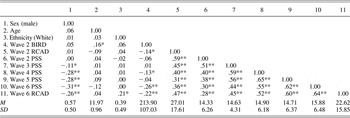
Missing data patterns among key variables at each wave were examined using Little's (Reference Little1988) missing completely at random test. Results from these analyses suggest that the data were missing completely at random, χ2 (170) = 179.06, p = .302. Data were next examined to ensure that they met the criteria for univariate normality. All skew and kurtosis statistics appeared to be in the acceptable range (≤3.0). We also examined the data for differences in rates of perceived stress between cohorts; no significant differences were detected. Descriptive statistics and correlations between all key variables are reported in Table 1.
Means, standard deviations, and correlations between key study variables

Note: BIRD, Behavioral Indicator of Resiliency to Distress; RCAD, Revised Children's Anxiety and Depression Scale; PSS, Perceived Stress Scale. Ethnicity is coded 1 = White, 0 = non-White; sex is coded 1 = male, 0 = female.
*p < .05. **p < .01.
We assessed whether the task was perceived as distressing by examining changes in negative affect before and after the BIRD task. Using a paired-samples t test, we found there was a significant increase in negative affect from pretask (M = 0.95, SE = 0.34) to posttask (M = 7.09, SE = 0.49); t (291) = –7.09, p < .001. In order to examine whether task-induced distress or task skill affected youths’ persistence on the task, mean-level changes in negative affect from pre- to posttask were examined using an independent-samples t test between groups of youth who did (M = 3.80, SE = 0.76) and did not (M = 3.01, SE = 0.60) quit the task. The difference between groups was not significant: t (236) = –0.81, p = .421. The mean latency period (a measure of task skill) was also examined; results suggest that youth who did (M = 1.50, SE = 0.02) and did not (M = 1.57, SE = 0.05) quit the task did not evidence different levels of skill: t (202) = 1.58, p = .117.
Unconditional model
We examined an unconditional linear growth model of perceived stress over time in which the latent slope factor loadings were constrained to be 0.0, 1.0, 2.0, 3.0, and 4.0 (respectively). Evaluation of model fit indices for the LGM suggested excellent fit to the data: χ2 (10) = 11.81, p = .298, CFI = 0.99, TLI = 0.99, RMSEA = 0.023, 90% confidence interval (CI) [0.000, 0.067]. We then compared the fit of this model to an unconditional model in which factor loadings associated with Waves 4–6 (corresponding to the third through last waves used in the current study) were freely estimated rather than fixed. The difference in fit between the linear model (with fixed estimates) and the freely estimated model was not significant: Δχ2 = 2.50, Δdf = 3, suggesting that changes in perceived stress can be described as a linear trend.Footnote 1 Next, we constrained the residual variances to be equal across time points. This resulted in a nonsignificant change in model fit: Δχ2 = 7.56, Δdf = 4; thus, we retained the more parsimonious linear growth model with homoscedastic residuals.Footnote 2
The means of both the intercept (M = 14.31, SE = 0.32, p < .001) and the slope (M = 0.31, SE = 0.12, p = .008) were significant, suggesting that baseline perceived stress is significantly greater than zero and, in support of our first hypothesis, perceived stress increases over time. Further, both the variances of the mean (variance = 21.81, SE = 2.68, p < .001) and the slope (variance = 1.57, SE = 0.35, p < .001) were significant, indicating individual differences around these estimates. The slope and intercept were also correlated with each other (r = –1.79, p = .023), indicating that participants who reported greater levels of perceived stress at baseline evidenced slower increases in perceived stress over time.
Conditional model
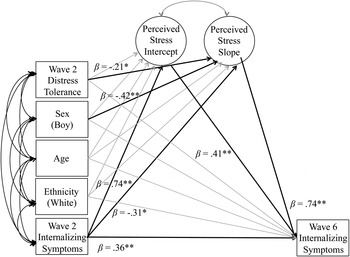
Next, we regressed the latent slope and intercept onto our baseline predictors, including age at baseline, sex, ethnicity, DT, and baseline internalizing symptoms. The model continued to fit the data well: χ2 (35) = 57.65, p = .009, CFI = 0.96, TLI = 0.96, RMSEA = 0.041, 90% CI [0.021, 0.060]. The results suggest that only baseline internalizing symptoms (β = 0.74, p < .001) significantly predicted the latent intercept of perceived stress, indicating that participants who endorsed higher initial levels of internalizing also reported higher baseline levels of perceived stress. DT (β = –0.21, p = .028), sex (β = –0.42, p < .001), and baseline internalizing symptoms (β = –0.31, p = .001) also significantly predicted changes in perceived stress over time. Consistent with our second hypothesis, these results suggest that lower initial levels of DT are associated with greater increases in perceived stress over time. Being female and reporting lower levels of internalizing symptoms at baseline were also associated with greater increases in perceived stress.Footnote 3
Mediation model
In order to examine whether changes in perceived stress mediate the relation between DT and later internalizing symptoms, we examined a model (see Figure 1) in which we regressed internalizing symptoms at the final wave on the latent intercept and slope of perceived stress, which in turn were regressed onto our baseline predictors. This model also fit the data well: χ2 (38) = 63.57, p = .006, CFI = 0.96, TLI = 0.96, RMSEA = 0.045, 90% CI [0.024, 0.064]. Both the latent intercept (β = 0.41, p < .001) and the slope (β = 0.74, p < .001) of the perceived stress growth curve significantly predicted Wave 6 internalizing symptoms, indicating that higher baseline levels and greater changes in perceived stress over time were associated with elevated internalizing symptoms, controlling for baseline levels. Next, we examined the pathway from DT to internalizing symptoms, via changes in perceived stress over time. In support of our third hypothesis, there was a significant, if small, indirect effect (unstandardized indirect effect = –0.022, SE = 0.01), 95% CI [–0.044, –0.001], suggesting that lower levels of DT predict increases in perceived stress over time, which in turn predict elevations in internalizing symptoms.Footnote 4
Latent growth curve model with standardized path estimates. For parsimony, the figure does not include the repeated measures of perceived stress over time that serve as indicators for the latent intercept and latent slope in the full latent growth curve model. Bold paths represent significant effects, and gray paths represent nonsignificant effects. Unstandardized estimates are reported for significant paths that are indicated by *p < .05 and **p < .01.

Discussion
The current study yielded three important findings regarding the relations between DT, perceived stress, and internalizing symptoms. First, consistent with existing literature, our results indicate that rates of perceived stress increase across adolescence. Second, these results provide the first published evidence that early levels of DT predict changes in perceived stress, such that distress-intolerant youth reported greater increases in the amount of stress they perceived in their environments over time. Third, these increases in perceived stress across adolescence mediated the relation between initial levels of DT and later internalizing symptoms. These findings are elaborated upon below.
Given that perceptions of stress may be particularly important in understanding the onset of internalizing symptoms (e.g., Cohen, Reference Cohen1986), investigations of the developmental trajectory and related predictors of perceived stress help to elucidate the relations between these constructs. Although research has consistently supported increases in rates of discrete stressful life events across adolescence (e.g., Ge, Conger, Lorenz, & Simons, Reference Ge, Conger, Lorenz and Simons1994; Larson & Ham, Reference Larson and Ham1993), less attention has been paid to changes in the perception of stress over this same time period. Of note, and consistent with research from previous studies (e.g., Hammen, Reference Hammen2005; Martin et al., Reference Martin, Kazarian and Breiter1995; Sontag & Graber, Reference Sontag and Graber2010), the trajectory of perceived stress appears to mirror that of the emergence of anxiety and depression. Specifically, our research supports previous findings that self-reported perceived stress increases from early to middle adolescence (e.g., van Jaarsveld, Fidler, Steptoe, Boniface, & Wardle, Reference van Jaarsveld, Fidler, Steptoe, Boniface and Wardle2009), which parallels increases in generalized anxiety and depressive symptoms across this same developmental period (e.g., Costello, Mustillo, Erkanli, Keeler, & Angold Reference Costello, Mustillo, Erkanli, Keeler and Angold2003; Merikangas et al., Reference Merikangas, He, Burstein, Swanson, Avenevoli, Cui and Swendsen2010). Although our finding that lower baseline internalizing symptoms were associated with greater increases in perceived stress over time was surprising, it is noteworthy that baseline internalizing symptoms were not correlated with other theoretically related constructs including sex and DT during this time period, indicating that the relation between internalizing symptoms and previously established correlates may change across development. Further research on the predictive validity of early internalizing symptoms is certainly warranted.
Our findings complement other research indicating that being female is associated with greater increases in perceived stress over time (e.g., Martin et al., Reference Martin, Kazarian and Breiter1995; Yarcheski & Mahon, Reference Yarcheski and Mahon2000). Given that rates of internalizing symptoms also increase more precipitously for girls than for boys across this developmental period (e.g., Kessler et al., Reference Kessler, Demler, Frank, Olfson, Pincus, Walters and Zaslavsky2005; Roza et al., Reference Roza, Hofstra, van der Ende and Verhulst2003), these results suggest that girls’ appraisal of their environments as more stressful may be an important explanatory factor in understanding this emergent gender difference. These findings also suggest that early to middle adolescence represents a particularly critical developmental period for experiencing increases in perceived stress, specifically among girls. It will be important in future work to examine whether these increases in perceived stress, as a function of low DT, may help to explain elevated rates of internalizing symptomatology in girls during this developmental transition.
As noted above, this is the first study to our knowledge that demonstrates relations between low DT and increases in perceived stress over time among youth. These results suggest that youth with lower DT are more likely to perceive events that occur in their environments as stressful, negative, and potentially intolerable. Our findings also support that perceived stress is an important mechanism linking early DT and later anxiety and depression symptoms. These results are consistent with a negative reinforcement framework, which suggests that the experience of feeling overwhelmed by stress may drive maladaptive stress-responses to alleviate negative feelings, which, paradoxically, serves to increase negative affect over time (e.g., Abrantes et al., Reference Abrantes, Strong, Lejuez, Kahler, Carpenter, Price and Brown2008; Daughters et al., Reference Daughters, Gorka, Magidson, MacPherson and Seitz-Brown2013). While this research did not examine specific stress-responses, such as self-reported escape and avoidance behaviors beyond quitting the BIRD task itself, it does help us to understand early mechanisms linking personality factors to increases in distressing feelings that may be a primary motivator for behavior. Although this framework has been used to explain the development of substance use and anxiety disorders (e.g., MacPherson et al., Reference MacPherson, Reynolds, Daughters, Wang, Cassidy, Mayes and Lejuez2010; Roemer, Salters, Raffa, & Orsillo, Reference Roemer, Salters, Raffa and Orsillo2005), recent work has also articulated how it can be used to explain internalizing symptomology more broadly (e.g., Daughters et al., Reference Daughters, Reynolds, MacPherson, Kahler, Danielson, Zvolensky and Lejuez2009). Recent research suggests that individuals with higher levels of perceived stress also self-report tendencies to use avoidance coping, indicating that individuals who experience their environments as more stressful are also more likely to avoid distressing situations as a means to cope with their own negative affect (Eisenbarth, Reference Eisenbarth2012; Hager & Runtz, Reference Hager and Runtz2012; Halama & Bakošova, Reference Halama and Bakošova2009; Sontag & Graber, Reference Sontag and Graber2010). Collectively, this provides initial evidence to suggest that lower DT youth may be those most likely to perceive events in their environments as stressful, to engage in avoidant coping when encountering these events, to generalize this behavior pattern across situations, and thus to develop elevated levels of internalizing symptomatology in response to this avoidance.
The current study therefore makes a critical contribution to the existing literature by demonstrating a temporal link between several of these constructs, including DT, perceived stress, and internalizing symptoms: early adolescents with greater distress intolerance are likely to experience their environments as uncontrollably stressful relative to their abilities to cope. This in turn is associated with concomitant increases in anxiety and depression symptoms. Although this mediation effect was small, we believe these findings address a critical gap in the literature: these results are the first, to our knowledge, to demonstrate a longitudinal link between these constructs during adolescence and add support for understanding the emergence of internalizing disorders from a negative reinforcement perspective.
Limitations and future research directions
Alongside these novel findings, the current study has several limitations. First, we did not have enough statistical power to simultaneously model changes in internalizing symptoms over time, which limits our understanding of the bidirectional nature of these relations. While we were able to examine baseline internalizing symptoms as a predictor of change in perceived stress, and changes in perceived stress as a predictor of resultant internalizing symptoms (controlling for rates at baseline), it is likely that trajectories of both stress and internalizing symptoms impact one another (e.g., Hammen, Reference Hammen2005). Future research should examine the relative effects of these constructs to better understand this vulnerable developmental period. Specifically, utilizing a multivariate growth modeling approach would allow researchers to examine transactional relations between these constructs over time and note the relative influence of change in either construct on the other. Second, a measure of discrete negative life events was not included in any of the waves examined in the current study. Given that the perception of stress both influences, and is influenced by, psychopathology, it will be important in future studies to disentangle the subjective perception of stress from objective stressful life events (for a review, see Monroe, Reference Monroe2008). Future research should consider discrete negative life events as a possible predictor of changes in perceived stress or, at a minimum, include life events as a time-varying control variable. Despite these concerns, the PSS-10 has been shown to uniquely predict related constructs, such as physical health outcomes, above and beyond psychological symptoms, suggesting promising discriminant validity (Cohen & Williamson, Reference Cohen and Williamson1991; Cohen, Tyrrell, & Smith, Reference Cohen, Tyrrell and Smith1993; Monroe & Kelley, Reference Monroe, Kelley, Cohen, Kessler and Gordon1995). Third, we did not have data on how youth actually coped with the stress they perceived in their environment. While perceived stress is associated with avoidant coping, which in turn is associated with the onset of internalizing symptoms (e.g., Abrantes et al., Reference Abrantes, Strong, Lejuez, Kahler, Carpenter, Price and Brown2008; Daughters et al., Reference Daughters, Gorka, Magidson, MacPherson and Seitz-Brown2013; Eisenbarth, Reference Eisenbarth2012; Hager & Runtz, Reference Hager and Runtz2012; Halama & Bakošova, Reference Halama and Bakošova2009; Sontag & Graber, Reference Sontag and Graber2010), we cannot be certain that youth actually engaged in this coping style. Future studies should also consider utilizing more fine-grained statistical methods, such as an autoregressive cross-lagged panel model, that would allow researchers to examine interwave change to determine whether avoidant coping mediates the relation between perceived stress and the onset of internalizing pathology. Fourth, more research needs to be done on the construct validity of DT among youth. While research has begun describing the nomological net of constructs related to DT among adults (see Leyro et al., Reference Leyro, Zvolensky and Bernstein2010), little of this work has been undertaken in child and adolescent populations, despite evidence that distress regulation processes may be qualitatively different among youth (i.e., Garber, Reference Garber1984). Thus, future studies should consider the convergent and discriminant validity of DT and related constructs, including neuroticism, grit, and resilience. Fifth and finally, while we were able to use a behavioral task to assess DT, we measured both perceived stress and internalizing symptoms utilizing self-report questionnaires that contained some similarly worded items, suggesting that monomethod bias may play a role in our findings. Despite considerable research demonstrating that these are distinct constructs (e.g., Cohen et al., Reference Cohen, Kamarck and Mermelstein1983), some items on the PSS-10 have overlap with internalizing symptomology, such as “In the last month, how often have you felt ‘nervous’ and ‘stressed.’” While the PSS-10 is the most widely used and validated measure of perceived stress (Taylor, Reference Taylor2015), future research should consider alternative ways of measuring this construct.
Conclusions and clinical implications
The current study examines an important pathway in the development of internalizing symptoms that is relevant for treatment development and preventative efforts. Findings suggest that early distress intolerance predicts increases in perceived stress, which in turn is associated with elevations in anxiety and depression symptoms. This has important implications for future treatment efforts and offers multiple points for prevention and intervention. Because internalizing symptoms during adolescence are an important predictor of internalizing disorders and functional impairments during adulthood (e.g., Copeland et al., Reference Copeland, Angold, Shanahan and Costello2014), early intervention efforts could help prevent long-term impairments related to anxiety and depression throughout the life span. Early adolescents with low DT presenting for treatment could be provided with interventions aimed at increasing willingness to experience emotions and to engage in valued interactions (e.g., Livheim et al., Reference Livheim, Hayes, Ghaderi, Magnusdottir, Hogfeldt, Rowse and Tengstrom2015), despite perceiving their environments as stressful. Increasing youths’ acceptance of distressing emotions (and, therefore, limiting their use of behaviors associated with avoiding or escaping distress) could serve to habituate children to these feelings, thereby increasing their tolerance for distress. Low DT has been successfully addressed in interventions among adults (e.g., Bornovalova, Gratz, Daughters, Hunt, & Lejuez Reference Bornovalova, Gratz, Daughters, Hunt and Lejuez2012; Linehan, Reference Linehan1993) and has been incorporated as a key treatment target for adolescents as well (e.g., Rathus & Miller, Reference Rathus and Miller2015). For instance, mindfulness training has been shown to increase affective DT specifically (Lotan, Tanay, & Bernstein, Reference Lotan, Tanay and Bernstein2013). Related to this, research could investigate the utility of adding a brief therapeutic component aimed at increasing youth DT to existing interventions specifically for internalizing symptoms. Given that emotion regulation capabilities are still developing during adolescence (e.g., McCrae et al., Reference McRae, Gross, Weber, Robertson, Sokol-Hessner, Ray and Ochsner2012), adapting existing interventions for use with adolescent populations may have tremendous utility in preventing the onset of internalizing symptoms across this vulnerable developmental period. Treatments focused on low DT could help to target emotional avoidance and increase resiliency in low DT youth.
Taken together, the current findings begin to shed light on the complex relations between distress intolerance, perceived stress, and internalizing symptoms. Our work points to the importance of considering youth willingness to tolerate distress and the impact of this willingness on their impressions of stress in their environments. Moreover, these findings suggest important next steps in understanding the onset of depression and anxiety during adolescence, as well as potential points for prevention and intervention efforts.