INTRODUCTION
Obstructive sleep apnea (OSA) is a sleep disorder characterized by repeated episodes of obstruction of the upper airway during sleep, leading to decreased blood oxygen levels (hypoxemia), decreased oxygen to the tissues (hypoxia), elevated blood carbon dioxide levels (hypercapnia), and sympathetic nervous system activation. This disorder also results in increased intrapleural pressure, poor sleep architecture, and frequent arousal from sleep. Associated symptoms of OSA include loud snoring and excessive daytime sleepiness (Epstein et al., Reference Epstein, Kristo, Strollo, Friedman, Malhotra, Patil and Weinstein2009).
The general prevalence of OSA is difficult to obtain and report, as some measures include a daytime sleepiness component, which reduces prevalence estimates, whereas others do not. Prevalence is estimated at 2 to 4% with the inclusion of daytime sleepiness (Epstein et al., Reference Epstein, Kristo, Strollo, Friedman, Malhotra, Patil and Weinstein2009; Gibson, Reference Gibson2005). It is thought that habituation to chronic hypoarousal might explain the incidence decline that arises when incorporating the subjective sleepiness requirement. Without daytime sleepiness, prevalence is estimated at 24% for men and 9% for women (American Academy of Sleep Medicine, 2005; Young, Palta. Dempsey, Skatrud, Weber, Badr, Reference Young, Palta, Dempsey, Skatrud, Weber and Badr.1993), representing a significant public health concern.
Health Comorbidities
Many factors play a role in identifying risks for OSA. Common comorbid health conditions include high body mass index, heart disease including congestive heart failure (CHF), atrial fibrillation, hypertension, type 2 diabetes, and stroke (Epstein et al., Reference Epstein, Kristo, Strollo, Friedman, Malhotra, Patil and Weinstein2009). These conditions may increase risk for developing OSA as well as increase disease burden, decrease quality of life, and negatively affect neurocognitive functioning (Engleman & Douglas, Reference Engleman and Douglas2004). In addition to medical comorbidities, psychological conditions, such as symptoms of depression and psychological distress, are often associated with OSA. For instance, among individuals with formally diagnosed psychiatric disorders (i.e., major depressive disorder and posttraumatic stress disorder) a recent meta-analysis suggests a higher prevalence of OSA than in the general population (median 48.1% and 42.7%, respectively, Gupta & Simpson, Reference Gupta and Simpson2015). The literature supports a similar relationship between chronic pain and OSA. Previous studies report 67 to 88% of individuals with chronic pain also experience sleep disturbance (Finan, Goodin, & Smith, Reference Finan, Goodin and Smith2013), and a recent systematic review concluded that sleep disturbance, an aspect of OSA, is a factor in the development and maintenance of chronic pain (Finan et al., Reference Finan, Goodin and Smith2013).
Cognitive Functioning and OSA
OSA has known deleterious neurocognitive correlates, particularly in the domains of attention, processing speed, new learning and recall, and executive functioning (Bucks, Olaithe, & Eastwood, Reference Bucks, Olaithe and Eastwood2013; Kilpinen, Saunamaki, & Jehkonen, Reference Kilpinen, Saunamaki and Jehkonen2014; Lee, Nagubadi,, Kryger, & Mokhlesi, Reference Lee, Nagubadi, Kryger and Mokhlesi2008; Quan et al., Reference Quan, Chan, Dement, Gevins, Goodwin, Gootlieb and Kushida2011). Specifically, studies indicate that adults with OSA are at increased risk of cognitive decline relative to age-matched controls and individuals with other sleep disorders (Arli et al., Reference Arli, Bilen, Titiz, Ulusoy, Mungan, Gurkas and Ak2015; Bucks et al., Reference Bucks, Olaithe and Eastwood2013). The cognitive sequelae of OSA has been associated with increased incidence of motor vehicle collisions, decreased quality of life, reduced work performance, and interpersonal relationship difficulties (Engleman & Douglas, Reference Engleman and Douglas2004; Lee et al., Reference Lee, Nagubadi, Kryger and Mokhlesi2008).
It is thought that neurocognitive impairment results from the hypoxia and/or sleep fragmentation that is endemic to OSA; however, it is not clear which physiologic marker of OSA is most important in predicting neurocognitive outcome and these markers may vary by cognitive domain (Quan et al., Reference Quan, Chan, Dement, Gevins, Goodwin, Gootlieb and Kushida2011). For instance, it may be that hypoxia is implicated in impairment in global cognition, whereas sleep fragmentation contributes to attentional deficits (Bucks et al., Reference Bucks, Olaithe and Eastwood2013; Quan et al., Reference Quan, Wright, Baldwin, Kaemingk, Goodwin, Kuo and Bootzin2006). A cross-sectional study involving sleep biomarkers and neurobehavioral testing suggests that sleep quality and subjective sleepiness are related to dysfunction in processing speed and theorizes that fronto-subcortical structures may be primarily involved to explain this dysfunction (Naismith, Winter, Gotsopoulos, Hickie, & Cistulli, Reference Naismith, Winter, Gotsopoulos, Hickie and Cistulli2004).
Per a critical review, researchers theorize it may be that intermittent hypoxic events influence vascular changes and brain tissues, including subcortical gray matter and basal ganglia, due to findings that hypoxia may have lasting effects on fine motor, but not simple motor coordination (Aloia, Arnedt, Davis, Riggs, & Byrd, Reference Aloia, Arnedt, Davis, Riggs and Byrd2004). However, another research study, notable for including the full range of OSA (mild to severe), along with those experiencing non-hypoxic, simple snoring, found impaired memory, processing speed, and attentional abilities among individuals experiencing hypoxia; in contrast, sleep fragmentation did not demonstrate consistent association with cognitive performance in this study (Arli et al., Reference Arli, Bilen, Titiz, Ulusoy, Mungan, Gurkas and Ak2015).
Still yet, there are studies with counter-intuitive findings. For example, in a two-group OSA study Hoth, Zimmerman, Meschede, Arnedt, and Aloia (Reference Hoth, Zimmerman, Meschede, Arnedt and Aloia2013) found that the high hypoxia group outperformed the low hypoxia group on immediate recall. The researchers hypothesized that intermittent hypoxia may offer protection against memory function decline in the same way it has been suggested to protect against cardiovascular disease. Given discrepancies and lack of clarity in the literature, further elucidation of OSA biomarkers and neurocognitive dysfunction is needed.
Functional Neuroimaging and Cognitive Function in OSA
Functional neuroimaging has helped generate and test hypotheses about the neurocognitive findings within OSA. Ayalon and Peterson (Reference Ayalon and Peterson2007) reviewed functional neuroimaging research in OSA populations across several modalities (e.g., transcranial Doppler, event-related potentials, magnetic resonance spectroscopy, and structural and functional magnetic resonance imaging) and paradigms (e.g., cognitive challenge, resting wakefulness, asleep). These authors note a pattern of contrasting findings; for instance, there is evidence of intact cognitive performance on certain tasks (e.g., verbal memory) that correlates with elevated functional activity suggestive of compensatory recruitment.
Alternatively, impaired executive/working-memory performance has been associated with hypoactivity in cortical and subcortical frontal regions without evidence for compensatory recruitment. Study differences are a proposed contributor for the variability. One proposed difference is the potential variations in the medical comorbidities across samples, which might differentially interact with OSA-related pathophysiology, manifesting as different neurobehavioral dysfunction.
Study Rationale and Aims
A challenge to clarifying these relationships has been reliance on limited and inconsistent neurocognitive measures to assess the effects of OSA on cognitive functioning, as well as the heterogeneity of OSA samples (severe vs. full-spectrum) and contrast groups (Bucks et al., Reference Bucks, Olaithe and Eastwood2013; Quan et al., Reference Quan, Chan, Dement, Gevins, Goodwin, Gootlieb and Kushida2011). Given disparate findings in the existing literature, additional research is necessary to elucidate the relationship between specific OSA markers and neurocognitive functioning. One possibility, is that comorbid characteristics of the various OSA samples used in the literature are contributing to the variety (and sometimes disparate) findings.
Given the high prevalence of health, psychological, and behavioral comorbidities with OSA (Lee et al., Reference Lee, Nagubadi, Kryger and Mokhlesi2008), investigators have called for studies to identify how medical and psychological factors influence cognitive outcomes in OSA (Kilpinen et al., Reference Kilpinen, Saunamaki and Jehkonen2014). Thus, the aim of the current study was to investigate the extent to which common health factors affect the relationships among objective sleep biomarkers from polysomnography (e.g., apneic-hypopneic index, average blood oxygen saturation [AVO2]) and neurocognitive functioning in OSA. We specifically were interested in the influence of depression, pain, and overall medical comorbidities, or disease burden, which we hypothesized interact with OSA pathophysiology to detrimentally affect cognitive functioning. Given disparate findings in the literature, we took an exploratory approach with regard to relationships among specific PSG biomarkers and performances on specific measures of cognitive functioning.
METHODS
Approval from both the Hospital and the associated University Research Ethics Boards was obtained for this study.
Sample
Four-hundred seventy-two patients referred for full-night polysomnography (PSG) at a major regional hospital, due to suspected OSA, were contacted to discuss participation in the study. Exclusion criteria included history of traumatic brain injury or stroke, neurological conditions, psychiatric diagnoses aside from depression, English as a second language, and current recreational substance use or alcohol use reaching “hazardous levels” per the National Institute of Alcohol Abuse and Alcoholism (Reid, Fiellin, O’Connor, Reference Reid, Fiellin and O’Connor1999). One-hundred four did not return attempts at contact. Two-hundred thirty-five declined to participate. Forty-three could not participate due to transportation limitations. Additional exclusions included 20 due to medical history and 8 due to English being a second language. The remaining total sample size of 62 exceeded estimated required N of 59 patients, calculated before data collection using average effect size parameters taken from extant meta-analyses (Beebe & Gozal, Reference Beebe and Gozal2002; Fulda & Schulz, Reference Fulda and Schulz2003).
One individual’s data were excluded from analysis after a diagnosis of schizophrenia was reported post assessment. During analysis, review of one participant’s PSG data revealed extremely low total sleep time (TST). Although potentially valid, this was thought to likely invalidate the other PSG variables, thereby disproportionately skewing the dataset. Thus, this individual was removed, leaving a total sample size of 60. Of note, two embedded performance validity indicators within the battery identified no invalid performances (i.e., a reliable digit span identified by Wolfe et al., Reference Wolfe, Millis, Hanks, Fichtenberg, Larrabee and Sweet2010, and a verbal fluency regression-formula cutoff by Sugarman & Axelrod, Reference Sugarman and Axelrod2015).
Measures
Questionnaires associated with comorbid conditions along with a series of neurocognitive measures were administered in the evening before each participant’s PSG.
Primary predictors: polysomnogram indicators
The most frequently used indicators of OSA severity, hypoxia, and sleep architecture disturbance, were collected from the PSGs of participants, based on the contemporaneous version of the American Academy of Sleep Medicine scoring manual (Iber, Reference Iber2007). These included the apnea-hypopnea index (AHI), which is a clinical index representing the average number of apneic and/or hypopneic events detected on PSG per hour of sleep (normal=AHI<5; mild OSA=5≤AHI <15; moderate OSA=15≤AHI<30; severe OSA=≥30). An apneic event represents a pause in breathing of at least 10 seconds with associated decrease in blood oxygenation; hypopneic events involve breath flow restriction of at least 3% with an associated decrease in blood oxygenation.
The average blood oxygenation saturation (AO2) is an overall hypoxia severity metric, averaged across the entire sleep period. Additionally, percentage of time asleep with blood oxygenation saturation below 85% (AO2<85) was examined. For context, blood oxygen saturation of less than 92% impedes oxygen’s penetration of red blood cell walls. TST is a raw sum of time spent asleep during the evaluation period. Additionally, percentage of time in the sleep study bed spent asleep, also known as sleep efficiency (SE%) was examined. Percentage of sleep time in each stage of non-REM sleep (stage 1=N1%; stage 2=N2%; stage 3=N3%) helps characterize the proportion of time spent involved in associated sleep-physiological processes (e.g., slow-wave sleep occurring during stage N3).
Potential moderators: comorbid conditions
Self-reported medical conditions and age were translated into a Charlson Comorbidity Index (CCI) score per published formulas, which captures total medical comorbidity burden (Charlson, Pompei, Ales, & Mackenzie, Reference Charlson, Pompei, Ales and MacKenzie1987; Charlson, Szatrowski, Peterson, & Gold, Reference Charlson, Szatrowski, Peterson and Gold1994). This index was designed to predict 1-year mortality risk. Twenty-two conditions contribute to the index, with each condition assigned a relative-risk weighted score of 1 (e.g., diabetes, CHF), 2 (e.g., tumor, hemiplegia), 3 (e.g., moderate-to-severe liver disease), or 6 (e.g., metastases, AIDS). Of note, given neurological/neuropsychiatric exclusion criteria, certain items on the CCI were not endorsed by the sample. Current pain level was indicated with a mark on a visual analogue scale (15 centimeter line) with the endpoints anchored as “no pain” and “unbearable pain.” This method was used to reduce interval-clustering response-bias in pain reporting. The Center for Epidemiological Studies Depression Scale (CESD; Radloff, Reference Radloff1977) was administered to measure depressive symptomatology. Various cutoffs have been used to identify clinical depression, although the standard of greater than 15 is most commonly used in non-psychiatric, community-dwelling populations (Lewinsohn, Seeley, Roberts, & Allen, Reference Lewinsohn, Seeley, Roberts and Allen1997).
Outcome: Neurocognitive Functioning
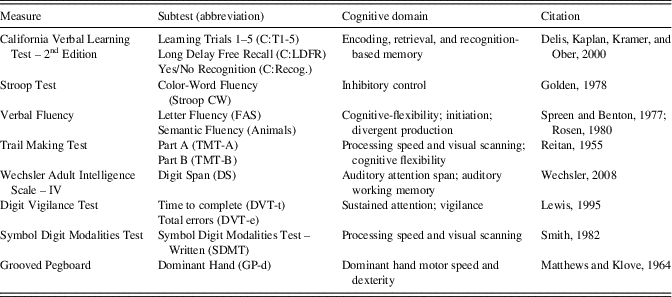
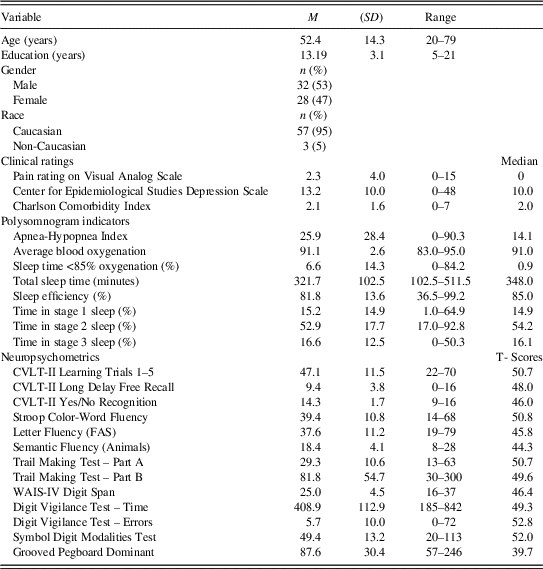
A series of neurocognitive measures was assembled based on recommendations that Dorrian, Rogers, and Dinges (Reference Dorrian, Rogers and Dinges2005) outlined regarding designing neurocognitive batteries sensitive to sleep deprivation. Table 1 contains a summary of the selected measures along with the cognitive processes they measure. Raw scores were used in analyses given the lack of co-norms available and to preserve maximal variance. Use of raw scores also allowed for separate examination of demographic characteristics, such as age. Given the expectation that certain demographics (e.g., age, gender, education) might be associated with cognitive performance, these variables were evaluated for inclusion as covariates in the final analyses. Table 1 contains a descriptive summary of the demographics, polysomnogram characteristics, neurocognitive performance, and comorbid conditions (e.g., pain, depression, health comorbidities).
Neuropsychological measures and associated cognitive domains

This methodological approach is congruent with NIMH Research Domain Criteria, which emphasize integrating a hierarchy of measurement methods to better understand behavioral functioning (Insel & Cuthbert, Reference Insel and Cuthbert2009).
Data Analyses
Given the moderate sample size and multiple variables and planned analyses, a conservative winnowing analytic approach was implemented to minimize familywise error (i.e., type 1 error due to multiple comparisons). Potential moderation models were identified using a stringent requirement that both a PSG variable and a comorbid condition (the proposed moderator) be significantly correlated with the cognitive performance measure of interest. First, bivariate correlations were run between PSG (8) and neurocognitive (13) variables. Second, the neurocognitive variables found to be significantly related to PSG variables were included in another bivariate correlation matrix containing potential moderators (3). This approach produced nine potential moderation models that were analyzed using the PROCESS version 3 add-on program within SPSS, version 24 (Hayes, Reference Hayes2017).
The Holm-Bonferroni sequential procedure to correct for multiple comparisons was selected for the moderation analyses due to it being a relatively powerful test that balances type 1 and type 2 error (Aickin & Gensler, Reference Aickin and Gensler1996). Within PROCESS, moderation effects were probed using simple slopes based on specified levels of the moderator (e.g., 16th, 50th, 84th percentiles) and regions of significance based on the Johnson-Neyman technique.
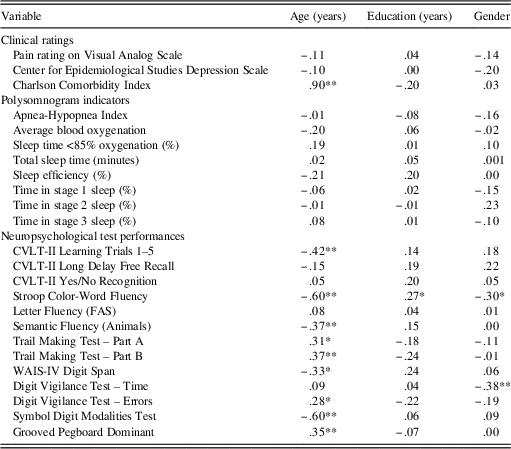
Age was the only demographic factor that correlated with cognitive scores or comorbid factors in the potential moderation models. As such, age was included as a covariate in all model calculations to control for the potential effects on cognitive performances; age was retained in model calculations even when found to be a non-significant predictor due to its importance theoretically and empirical justification within this sample.
RESULTS
This sample was demographically and clinically diverse, aside from racial/ethnic composition, as the majority of the sample (95%) identified as white or Caucasian (see Table 2). The sample was not broken into AHI-defined clinical subsets (e.g., mild vs. moderate vs. severe obstructive sleep apnea severity) for evaluation of group differences because all subsequent analyses used polysomnogram variables of interest in linear form, including AHI. However, to aid in characterization of the representativeness of this sample, the diagnostic subsets were: No OSA (n=21; MAHI=2.45; SD=1.41), Mild OSA (n=11; MAHI=10.03; SD=3.24), Moderate OSA (n=11; MAHI=23.48; SD=3.75), Severe OSA (n=17; MAHI=66.76; SD=16.93).
Sample characteristics: demographics, clinical ratings, polysomnogram indicators, and performances on neuropsychological tests (N=60)

Note. CVLT-II=California Verbal Learning Test – 2nd Edition. WAIS-IV=Wechsler Adult Intelligence Scale – IV. Neuropsychometric T- Scores have an M=50, SD=10.
Comparison of these characteristics with the overall larger referral population was not possible, but the demographics and sleep study characteristics were generally consistent with those of a large (N=1900) study that collected demographics and polysomnographic data from OSA referrals in the Texas area (Hesselbacher, Subramanian, Allen, Surani, & Surani, Reference Hesselbacher, Subramanian, Allen, Surani and Surani2012). The few exceptions included this study’s higher rate of Caucasian participants (95% vs. 52%; comparison sample included 45% Hispanic), as well as a higher variability in TST (SD=102.5 vs. 77.74).
Bivariate Correlations
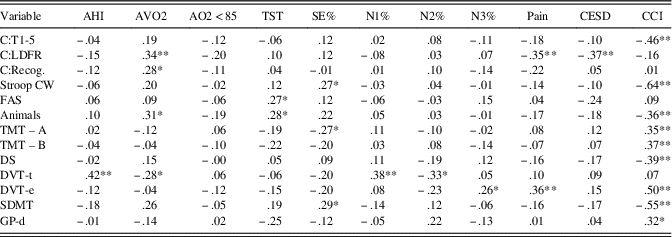
Bivariate correlation analyses between polysomnogram (PSG) and neurocognitive variables were conducted, and the PSG variables that were associated most consistently with neurocognitive performances was average blood oxygen saturation (Table 3), although indicators of amount or quality of sleep (e.g., TST, SE%) also demonstrated some significant findings (Table 3). These findings revealed a pattern in which higher blood oxygen saturation and sleep quality were associated with better performances on cognitive testing. The SE% was associated with processing speed, as measured by the Trail Making Test Part A and Symbol Digit Modalities Test, and inhibition on the Stroop Color Word Interference task (e.g., greater SE% corresponded with better performances).
Correlations between polysomnogram indicators, health comorbidities, and performances on neuropsychological tests (N=60)

Note. Neuropsychological performances reflect raw scores.
Top Row: AHI=Apnea-Hypopnea Index; AVO2=average blood oxygenation; AVO2<85=proportion of time asleep with blood oxygenation saturation below 85%; TST=total sleep time; SE%=sleep efficiency (%); N1%=time in stage 1 sleep; N2%=time in stage 2 sleep; N3%=time in stage 3 sleep; pain=rating on Visual Analog Scale; CESD=Center for Epidemiological Studies Depression Scale; CCI=Charlson Comorbidity Index.
Left Column: C: T1-5=CVLT-II Learning Trials 1-5; C:LDFR=CVLT-II Long Delay Free Recall; C:Recog.=CVLT-II Yes/No Recognition; Stroop CW=Stroop Color-Word Fluency; FAS=Letter Fluency; Animals=Semantic Fluency; TMT – A=Trail Making Test – Part A; TMT –B=Trail Making Test – Part B; DS=WAIS-IV Digit Span; DVT-t=Digit Vigilance Test – Time. DVT -e=Digit Vigilance Test – Errors; SDMT=Symbol Digit Modalities Test; GP-d= Grooved Pegboard Dominant.
*p<.05.
**p<.01
The other PSG variables, including AHI and percentage of time spent in stages 1 to 3 of sleep, N1%, N2%, and N3%, respectively, were associated solely with performances on the sustained attention test (Digit Vigilance Test, DVT). Roughly half of the neurocognitive test scores had at least one significant association with a PSG variable (each correlation being in the expected direction, i.e., “better quality” sleep being associated with better performance).
Additionally, bivariate correlation analyses between comorbid conditions and neurocognitive variables were conducted (Table 3). Health comorbidities as indicated by the CCI were inversely correlated with performances across most neurocognitive measures. Pain and depression followed a similar pattern but were correlated with fewer cognitive test performances. Bivariate correlation analyses between demographic factors and all variables of interest in the study also were conducted (Table 4). Age was strongly correlated with health comorbidities (CCI) and most cognitive test performances, with higher age associated with more health comorbidities and poorer cognitive test performances. Age was not correlated with AHI; an unexpected finding given that it is a strong demographic risk-factor for OSA. Gender and education were not correlated with PSG variables or health conditions but were correlated with a few cognitive test performances.
Correlations between demographics and clinical ratings, polysomnogram indicators, and performances on neuropsychological tests (N=60)

Note. CVLT-II=California Verbal Learning Test – 2nd Edition; WAIS-IV=Wechsler Adult Intelligence Scale – IV; Neuropsychological test performances=raw scores.
*p<.05.
**p<.01.
Moderation Analyses
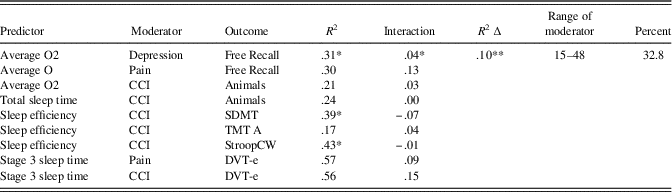
A summary of the moderation analyses is presented in Table 5. Several models were insignificant overall, and their interactions were insignificant. These models included the following: AVO2 Pain predicting CVLT-II Long Delay Free Recall, F(4,52)=3.07; p=.024; R 2=.30; AVO2 and comorbidities (CCI) predicting performance on a Semantic fluency measure (Animals), F(4,53)=3.74, p=.010, R 2=.21; TST and CCI predicting Animals, F(4,54)=2.88, p=.031, R 2=.24; SE% and CCI predicting performance on the Trail Making Test Part A, F(4,54)=3.04, p=.025, R 2=.17; time in stage 3 sleep (N3%) and Pain predicting errors on the DVT-errors, F(4,54)=1.57, p=.194, R 2=.57; N3% and CCI predicting DVT-errors, F(4,55)=2.69, p=.041, R 2=.56.
Data summary for potential moderation models predicting cognitive test performances from polysomnography indicators and health comorbidities (N=60)

Note. Bootstrap=10,000 with 95% CI; Process version 3, model number 1 was used for all analyses. Age was included as covariate in all models. R 2=variance explained by the total model; R 2 ∆=variance change with addition of moderator; Range=moderator values defining Johnson-Neyman significance region; Percent=percent of sample comprising moderation significance region; Average O2=average blood oxygenation; Depression=Center for Epidemiological Studies Depression Scale; Pain=rating on Visual Analog Scale; CCI=Charlson Comorbidity Index; Free Recall=CVLT-II Long Delay Free Recall; Animals=Semantic Fluency; SDMT=Symbol Digit Modalities Test; TMT – A=Trail Making Test – Part A; Stroop CW=Stroop Color-Word Fluency; DVT-e=Digit Vigilance Test – Errors.
*Significant at Holm-Adjusted p-value.
**p<.001.
The following models were significant overall, but their interactions were insignificant.
SEE% and CCI predicting performance on the Symbol Digit Modalities Test, F(4,55)=7.32, p<.001, R 2=.39; SE% and CCI predicting performance on the Stroop Color-Word Interference task, F(4,54)=12.87, p<.001, R 2=.43.
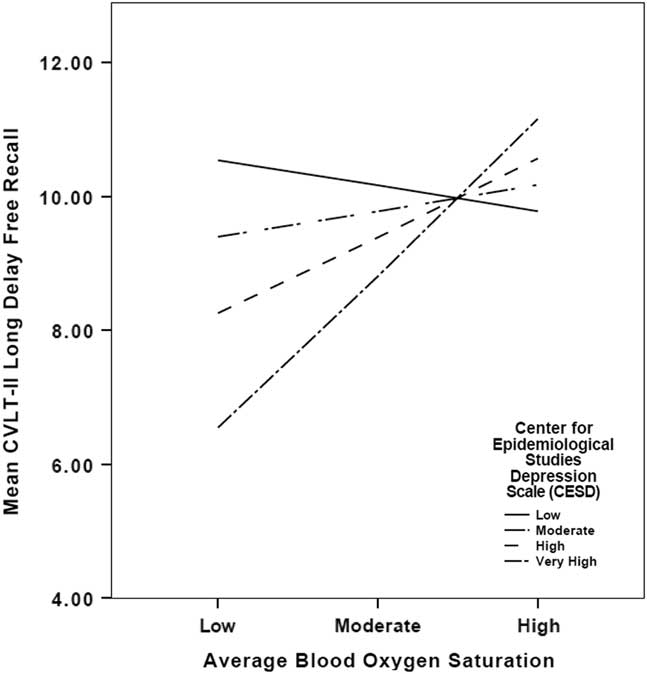
One model was significant overall, and the interaction was significant. The overall model with AVO2 and depression (CESD) predicting Long Delay Free Recall (memory) was significant and accounted for 31% of the variance, F(4,51)=18.57, p<.001, R 2=.31. Depression was a significant predictor of memory, b=−4.03, t(51)=−4.26, p<.001, but AVO2 was not a significant predictor of memory, b=−0.30, t(51)=−1.26, p=.213. The interaction between depression and AVO2 was significant, accounting for an additional 10% of the variance, b=.04, t(51)=4.08, p<.001, ΔR 2=0.10.
The interaction plot revealed that at higher levels of depression, reductions in AVO2 had an increasingly negative association with memory (Figure 1). Examination of significance regions revealed that when depression on the CESD was at least 13 (possible range on CESD is 0 to 60; clinical cut-point for depression on CESD is 16), AVO2, and memory were significantly related, b=0.27, t(51)=2.01, p=.05. As depression increased, the relationship between AVO2 and memory became increasingly positive, such that when depression was at the maximum level for this sample (48 of 60 on the CESD), b=1.79, t(51)=5.50, p=<.001. Overall, Cohen’s local effect size (f 2=.15) suggested a moderate practical significance of this moderation effect.
Depression Severity (CESD) moderates the relationship between average blood oxygen saturation and memory performance (CVLT-II words recalled after long delay) in individuals with obstructive sleep apnea. Note. CVLT-II=California Verbal Learning Test – 2nd Edition; CESD levels are defined as Low=16th percentile (raw score=4), Moderate=50th percentile (raw score=10), High=60th percentile (raw score=16; clinical cut-score), Very High=84th percentile (raw score=25); average blood oxygen saturation levels are defined as Low=16th percentile (average O2 saturation=88.1%), Average=50th percentile (average O2 saturation=91.0%, and High=84th percentile (average O2 saturation=94.0%).

DISCUSSION
The current study investigated the influence of biopsychosocial comorbidities on the relationship between PSG-derived sleep biomarkers and neurocognitive performance in individuals referred for evaluation of OSA. We found neuropsychological evidence of retrieval-based memory dysfunction that was related to average blood oxygen level during sleep, which was affected by the presence of clinically significant depression. Neuroanatomically, the cognitive findings indicate potential frontal-subcortical network involvement.
The prevailing view in the literature is that neurocognitive impairment seen in OSA is due to the adverse effects of sleep fragmentation and/or intermittent hypoxia (Bucks, Olaithe, & Eastwood, Reference Bucks, Olaithe and Eastwood2013). In this study, while indicators of sleep fragmentation and/or sleep-architecture changes did have some associations with cognition, AVO2 (reflecting hypoxemia) was the sleep biomarker most strongly and widely associated with neuropsychometirc performance, which is consistent with extant literature (Beebe & Gozal, Reference Beebe and Gozal2002; Cha et al., Reference Cha, Zea-Hernandez, Sin, Graw-Panzer, Shifteh, Isasi and Arens2017; Quan et al., Reference Quan, Wright, Baldwin, Kaemingk, Goodwin, Kuo and Bootzin2006; Yaffe et al., Reference Yaffe, Laffan, Harrison, Redline, Spira, Ensrud and Stone2011). Several studies have sought to determine whether more severe OSA is related to worse cognitive functioning; however, one meta-review found that only two of four studies detected such a dose-dependent relationship (Bucks et al., Reference Bucks, Olaithe and Eastwood2013). Some of this lack of clarity might relate to the effects of moderating factors, because, as the current study demonstrates, the effects of sleep on cognition vary among individuals with differing levels of psychosocial and/or psychiatric burden.
The primary novel finding from this study was that the relationship of oxygen saturation on delayed recall was moderated by depression severity, which is consistent with predictions described in prior research (e.g., Kerner & Roose, Reference Kerner and Roose2016). Among individuals with minimal depression, oxygen saturation was unrelated to memory performance. However, the relationship between oxygen saturation and memory performance emerged as depression severity approached an established clinical cutoff for the measure. In other words, as depression symptomatology approached clinically significant levels, hypoxemia’s inverse relationship with memory recall strengthened.
Although not uniform, there is evidence that short-term memory processes are relatively better preserved in OSA populations (presumably due to compensatory recruitment, e.g., Ayalon & Peterson, Reference Ayalon and Peterson2007). Thus, this interaction finding might suggest a “dual burden” phenomenon, whereby depression acts as a secondary contributor to neurocognitive functioning disturbance, in a brain already relying on compensatory activation to preserve memory functioning. In the presence of clinically significant depression symptoms, these findings indicate a relationship between oxygen saturation and memory performance even when oxygen saturation levels remain above typical cutoffs (e.g., relatively “low” oxygen saturation at −1 SD in this study was 88.1% vs. the typical<85% threshold). Although other studies have demonstrated associations between OSA and cognitive impairment (Torelli et al., Reference Torelli, Moscufo, Garreffa, Placidi, Romigi, Zannino and Malhotra2011), as well as associations between OSA and cerebrovascular lesion load and depressive symptomatology (Aloia, Arnedt, Davis, Riggs, & Byrd, Reference Aloia, Arnedt, Davis, Riggs and Byrd2004), this study’s interaction finding appears to be novel.
The specific pattern of memory dysfunction that was associated with sleep-breathing pathology in this study is consistent with frontal network dysfunction, which has been proposed previously by behavioral and neuroimaging studies that showed the adverse effects of intermittent hypoxia on sleepiness, memory, and executive dysfunction (Bucks et al., Reference Bucks, Olaithe and Eastwood2013, Reference Bucks, Olaithe and Marshall2011; Fulda & Schulz, Reference Fulda and Schulz2003). For example, resting-state fMRI research conducted by Santarnecchi and colleagues (Reference Santarnecchi, Sicilia, Richiardi, Vatti, Polizzotto, Marino and Rossi2013) identified frontal lobe homogeneity alternations in OSA patients, likely attributable to the repeated hypoxic/ hypercapnic events, which would be consistent with a frontal/executive pattern of memory dysfunction (i.e., retrieval/recall difficulties, with relatively preserved recognition).
Relatedly, similar frontal (orbital and anterior cingulate gyrus) homogeneity alterations have been reported in depressed individuals with cognitive symptoms, suggesting potential shared network pathology (Yao, Wang, Lu, Liu, & Teng, Reference Yao, Wang, Lu, Liu and Teng2009). One theory is that poor sleep leads to dysfunction of the suprachiasmatic nucleus in the hypothalamus, which then leads to predominant dysfunction of the prefrontal cortex. Since frontal regions are critical for regulating sleep and for regulating mood and brain outputs from the amygdala, the link between these areas provides a connection between poor sleep and depressed mood (Monteleone & Maj, Reference Monteleone and Maj2008).
Performance on other measures associated with frontal-subcortical network functioning (e.g., TMT-A, SDMT, DVT, Stroop-Interference) were found to correlate with PSG indicators of sleep functioning and CCI, and two moderation models identified main effects of each factor. Another similar unexpected finding was that while pain was negatively associated with certain expected cognitive performances (i.e., long delay free recall; errors on a vigilance task), it failed to interact with sleep biomarkers in those relationships. Pain and sleep are strongly bi-directionally related; thus, this was an unexpected finding (Finan, Goodin, & Smith, 2013). The lack of interaction effects in these findings suggests a lack of synergistic disruption of attentional processes, perhaps due to differences in the pathways these constructs affect cognitive performance—for example, disturbance of bottom–up arousal or top–down control elements of broader attentional functions.
Additionally, the lack of findings regarding the CCI should be cautiously interpreted, given that a subset of the contributing items were also exclusion criteria (e.g., dementia, cerebrovascular accident/transient ischemic attack). However, despite these exclusions, this sample’s CCI score did not appear to underestimate 1-year morbidity risk compared to general OSA CCI scores (e.g., Levine & Weaver, Reference Levine and Weaver2014).
Clinical Implications
Given the elevated comorbidity of sleep-related breathing disorders and depression within patient populations referred for neuropsychological assessment due to cognitive concerns (Peppard, Szklo-Coxe, Hla, & Young, Reference Peppard, Szklo-Coxe, Hla and Young2006), neuropsychologists frequently are asked to characterize cognition and make recommendations for individuals who carry the dual-burden of these diseases. The current findings highlight specific OSA sub-populations (i.e., those with psychiatric comorbidities) who may be at higher risk for impaired neurocognitive functioning. Furthermore, these results may inform clinical expectations of cognitive recovery course following treatment of chronic sleep disturbance and/or nighttime hypoxemia. Specifically, emphasizing that concurrent evaluation and management of clinically significant depression, in conjuncture with sleep-treatment, is likely to be important in reducing associated cognitive dysfunction.
These findings affirm the utility of brief cognitive and depression screening within those at risk of OSA, especially in patients with physical and psychiatric comorbidity (Gupta & Simpson, Reference Gupta and Simpson2015). The DOC-screening device (for depression, OSA, and cognitive impairment), for example, may be useful in this regard (Swartz et al., Reference Swartz, Cayley, Lanctôt, Murray, Cohen, Thorpe and Herrmann2017). The measure has been found to demonstrate strong sensitivity and specificity in detecting the ascribed clinical conditions, compared to gold-standard assessments, following stroke via integration of the most sensitive items of the PHQ-4 mood questionnaire, STOP sleep-breathing disorder screening items, and Montreal Cognitive Assessment neurocognitive screener.
This method of concurrent screening for interrelated cognitive, psychiatric, and sleep disorders may be equally successful for use by first-line providers caring for other patient populations with high risk for these overlapping comorbidities (e.g., primary care providers, gerontologists, sleep specialists, psychiatrists). Our findings suggest a need for early detection of OSA (e.g., methods outlined by Waters & Bucks, 2011) in order to potentially prevent long-term neuropsychological consequences. Finally, multidisciplinary care should consider the interrelationship between these health, sleep, and cognitive factors, which may offer a means of improving treatment compliance and self-care motivation (Crawford, Espie, Bartlett, & Grunstein, Reference Crawford, Espie, Bartlett and Grunstein2014).
Study Limitations
The participants were recruited from clinical referrals; therefore, all had reported, but not necessarily documented, sleep dysfunction. Not all participants were found to have polysomnogram-confirmed OSA (No OSA; n=21=35% of sample). We believe, however, that our sampling strategy was consistent with typical referrals to most outpatient sleep disorders clinics, and thus an externally valid sample. Another limitation is inherent to the CCI measure, which reflects a total 1-year morbidity risk associated with serious medical conditions but does not lend itself to exploration of the incidence and interrelationships of the individual contributing factors. Given the CCI reliably was related to cognitive performance, future research should consider measuring each underlying medical condition independently, to facilitate more detailed review of interactions with sleep and cognition.
Additionally, our sample was primarily Caucasian, so generalizing our findings to other racial groups may be limited. The issue of race becomes especially important because Blacks and Hispanics in North America have higher rates of OSA than Caucasians (Ralls & Grigg-Damberger, Reference Ralls and Grigg-Damberger2012; Punjabi, Reference Punjabi2008). However, the racial composition of our sample was reflective of the local population, and the age, gender, and sleep study characteristics were consistent with larger OSA referral groups (Hesselbacher et al., Reference Hesselbacher, Subramanian, Allen, Surani and Surani2012).
Another limitation may be the overall sample size, given this distribution of clinical severity. The power-analysis calculation used effect sizes from extant research, but in further review of these contributing sample-characteristics, the authors note that most studies use healthy controls versus moderate-to-severe OSA patients. Thus, the effect size used in the power analysis may have been liberal, under-powering this study’s sample size and, therefore, limiting our conclusions about null findings. Another consideration is that the a priori research supporting a causal relationship between sleep disturbance and neurocognitive dysfunction was used to conceptualize the moderation models. The interpretation of our results might change should evidence emerge suggesting a different causal-chain of pathology exists between the constructs within the OSA population, although this seems unlikely.
Finally, although our winnowing approach toward selecting models to test is a strength, avoiding type 1 error (i.e., false rejection of the null hypothesis), it also precluded detection of potentially significant interaction models. Readers are thus cautioned that null results of this study should be considered within a conservative interpretative framework. Thus, to continue to clarify the effects of medical-psychiatric comorbidities on cognitive performance among individuals at risk for OSA, future studies should evaluate potential moderating factors within larger and more diverse OSA samples. This would facilitate (1) greater power to facilitate more sensitive analytic approaches, and (2) more nuanced interpretation of the spectrum of effects clinical and demographic factors have on significant findings.
CONCLUSIONS
The present study extends the literature on the neuropsychological dysfunction associated with OSA by first examining the extent to which various patient characteristics and comorbidities affected the relationships between sleep biomarkers and neurocognitive functioning, and second by describing the nature in which those health comorbidities exert their effect on these relationships. Our findings demonstrate that among individuals referred for polysomnogram due to suspected OSA, depression is unique among the various medical-psychiatric factors examined in its influence on the relationships between sleep-breathing pathology and neurocognitive test performance. Therefore, it is important that researchers and clinicians engaged with OSA populations continue to rigorously incorporate assessment and management of psychiatric factors in their work.
ACKNOWLEDGMENTS
No conflicts of interest or sources of financial support are reported.