INTRODUCTION
International strategic alliances (ISAs) have been defined as relatively enduring interfirm co-operative arrangements between a focal firm and one or more autonomous firms based in different countries, which share or exchange resources, with the aim of improving performance (Parmigiani & Rivera Santos, Reference Parmigiani and Rivera-Santos2011). ISAs have emerged as a critical mechanism for gaining international competitive advantage and in global industries their management has become an essential part of firm strategy (Hoffmann, Reference Hoffmann2007; Vapola, Paukku, & Gabrielsson, Reference Vapola, Paukku and Gabrielsson2010; Swoboda, Meierer, Foscht, & Morschett, Reference Swoboda, Meierer, Foscht and Morschett2011). Although ISAs have been extensively studied, the empirical results show that many of these alliances have not achieved the expected results (Schilke & Goerzen, Reference Schilke and Goerzen2010), and consequently further research is needed into how the configuration of an ISA’s portfolio can influence firm performance.
The results of these studies are due in part to the fact that most researchers have only studied dyadic ties, or individual alliances, as their unit of analysis (Anand & Khanna, Reference Anand and Khanna2000; Sarkar, Aulakh, & Madhok, Reference Sarkar, Aulakh and Madhok2009), rather than looking at the portfolio as a whole. Given this narrow focus, we consider that there is a need to carry out a holistic analysis of this phenomenon, studying the complete set of alliances in which a firm participates, in order to understand how multinational corporations (MNCs) configure their alliance portfolios (Vapola, Paukku, & Gabrielsson, Reference Vapola, Paukku and Gabrielsson2010; Rice, Liao, Martin, & Galvin, Reference Rice, Liao, Martin and Galvin2012) and the results achieved from the configuration. The benefits of adopting this holistic approach at the time of configuring the portfolio (Bamford & Ernst, Reference Bamford and Ernst2002) arise from the focal actor’s access to the additional benefits that can be gained from managing the interdependencies between partners (Kale & Singh, Reference Kale and Singh2009; Wassmer, Reference Wassmer2010).
In order to adopt a holistic focus, the focal actor needs to know how to configure the alliance portfolio (Hoffman, Reference Hoffmann2007; Kale & Singh, Reference Kale and Singh2009), but this still remains a puzzle for the majority of firms. Portfolio configuration is a complex concept, comprising multiple dimensions that attempt to encompass the content of an alliance portfolio and its arrangements (Wassmer, Reference Wassmer2010). There is no consensus on what comprises the most important dimensions of the alliance portfolio configuration; most studies have focused on the structural (network ties, network configuration, size) and relational (trust, norms, obligations, and identification) dimensions (Wassmer, Reference Wassmer2010), while attributing less importance to the partner dimension that covers fundamental aspects such as the partners’ technological or cultural characteristics (Goerzen & Beamish, Reference Goerzen and Beamish2005; Lavie & Miller, Reference Lavie and Miller2008; Lahiri & Narayanan, Reference Lahiri and Narayanan2013). Moreover, the focus of the existing literature has been on portfolio configuration, and in particular on independent dimensions, but these dimensions have not been studied simultaneously as interdependent dimensions. An analysis of these interrelationships is important because the costs or benefits attributed to the alliance portfolio might not be justified by the role of the configuration dimensions considered independently, but by the relationships or direct and indirect influences between these dimensions (Wassmer, Reference Wassmer2010). This is the gap that our research aims to fill, and the central question that we intend to explore is: how do the interrelationships between the dimensions of the alliance portfolio configuration influence the firm’s performance?
To fulfill this aim, it is necessary to evaluate how efficiently an alliance portfolio is configured and therefore to associate the configuration dimensions with alliance portfolio performance. Using this procedure, we will be able to assess the holistic outcomes related to a firm’s alliance portfolio. Hoffmann (Reference Hoffmann2005) noted that these can be evaluated generally by assessing the quality and quantity of the resources that are qualitatively contributed by the focal firm’s partners (Koka & Prescott, Reference Koka and Prescott2002; Wassmer, Reference Wassmer2010). Accordingly, in this work we will use alliance portfolio capital (APC), which can be defined as ‘a critical source of competitive advantage, consisting as it does of an aggregate of interorganizational resources that are linked to a focal firm through their participation in a set of alliances’ (Sarkar, Aulakh, & Madhok, Reference Sarkar, Aulakh and Madhok2009: 585). Subsequently, we will examine the degree to which this APC affects the growth of international market share (Vapola, Paukku, & Gabrielsson, Reference Vapola, Paukku and Gabrielsson2010) because the literature shows that this is one of the most relevant measures for MNCs’ international activity (Rivera-Santos & Inkpen, Reference Rivera-Santos and Inkpen2009).
In conclusion, this work makes a theoretical and a practical contribution. First, it provides a better understanding of alliance portfolio configurations, which is a central concept in this field of research, and will give a better focus and orientation to future investigations in this subject area (Tolbert, Salancik, Krackhardt, & Andrews, Reference Tolbert, Salancik, Krackhardt and Andrews1995; Ahuja, Soda, & Zaheer, Reference Ahuja, Soda and Zaheer2012) by proposing a measure of this construct from dimensions that are studied simultaneously as interdependent dimensions. Second, we believe that this research makes an empirical or practical contribution, since the results suggest that multinational executives aiming to improve the performance of ISAs need to strategically manage the configuration of their alliance portfolios and in order to do so, should consider the interdependencies that exist between the various configuration dimensions.
Our paper is organized as follows. We begin with a review of the literature on alliance portfolio configuration, in order to identify and measure the dimensions that make up these constructs as well as their impact on APC and the growth of international market share. Subsequently, we propose four hypotheses and develop a multiple mediation model based on data from 103 international contractors (MNCs) in order to investigate the mediating role (for examples of multiple mediation models; cf. Hayes, Preacher, & Myers, Reference Hayes, Preacher and Myers2011) played by certain dimensions of the alliance portfolio configuration (relational and partner) in the relationships between the structural dimension and APC. We conclude with the main findings of this work, its limitations and future lines of research.
CONCEPTUAL BACKGROUND OF THE ALLIANCE PORTFOLIO
An alliance portfolio is the aggregate of all the strategic alliances of a focal firm (Hoffmann, Reference Hoffmann2007; Lavie & Miller, Reference Lavie and Miller2008) and includes all the direct ties with partner firms (the egocentric alliance network; Baum, Calabrese, & Silverman, Reference Baum, Calabrese and Silverman2000; Ozcan & Eisenhardt, Reference Ozcan and Eisenhardt2009). Because of this, the evaluation of any portfolio performance, such as positive spillovers and negative conflict between the portfolio’s partners, requires more than a mere summation of its individual alliances (dyadic ties; Bamford & Ernst, Reference Bamford and Ernst2002; Sarkar, Aulakh, & Madhok, Reference Sarkar, Aulakh and Madhok2009). The study of alliance portfolios is highly fragmented due to the variety of theoretical approaches and objectives pursued. Wassmer (Reference Wassmer2010) divided the research into three different groups: the emergence (Ahuja, Reference Ahuja2000b; Ozcan & Eisenhardt, Reference Ozcan and Eisenhardt2009), the configuration (Ahuja, Reference Ahuja2000a; Baum, Calabrese, & Silverman, Reference Baum, Calabrese and Silverman2000; Stuart, Reference Stuart2000) and the management (Anand & Khanna, Reference Anand and Khanna2000; Kale, Dyer, & Singh, Reference Kale, Dyer and Singh2002; Schilke & Goerzen, Reference Schilke and Goerzen2010) of the alliance portfolio. Given the objective of this paper, this study can be included in the second of these groups, which studies the configuration of the alliance portfolio, and seeks a greater insight into its principal dimensions and how these relate to each other.
CONCEPTUALIZATION AND HYPOTHESES
The configuration of an alliance portfolio
The configuration of alliance portfolios refers to the content of the portfolios and how this is arranged (Wassmer, Reference Wassmer2010). Alliance portfolio configuration is a complex concept that embraces a number of dimensions. In order to identify the principal configuration dimensions, we adopt the network perspective definition of the alliance portfolio: a focal firm’s egocentric alliance network (Ozcan & Eisenhardt, Reference Ozcan and Eisenhardt2009). This notion of the egocentric network includes the focal firm (ego), its set of partners (alters), and their connecting ties (relationships) (Wasserman & Faust, Reference Wasserman and Faust1994). Using this definition, Ahuja, Soda, and Zaheer (Reference Ahuja, Soda and Zaheer2012) state that the architecture of an alliance portfolio can be conceptualized from three perspectives: the nodes that make up the portfolio; the links that connect the nodes; and the patterns or interconnection models between the nodes. As can be seen in Figure 1, the focal actor must generate a pattern or relational structure to benefit the ego; select suitable alters in terms of diversity or interdependencies; and manage the portfolio to facilitate the development of informal self-enforcing safeguards in its relationships with its ego network partners, by producing strong bonds. To summarize, these dimensions must form a potentially beneficial architecture for the focal actor. Accordingly, some authors believe that there is an increasing need for firms to understand how to configure their alliance portfolios (Hoffman, Reference Hoffmann2007), as they realize that alliance portfolio success is a function of their skill or ability to design or configure their entire alliance portfolio (Parise & Casher, Reference Parise and Casher2003).
Alliance Portfolio Architecture (based on Ahuja, Soda, & Zaheer, Reference Ahuja, Soda and Zaheer2012)

There has been research into some of these dimensions. Lavie and Miller (Reference Lavie and Miller2008) introduced the concept of alliance portfolio internationalization in order to analyze the degree of foreignness of the alliance partners and Goerzen and Beamish (Reference Goerzen and Beamish2005) studied partner diversity. However, the nature of these dimensions and how they are related is still underexplored (Polites, Roberts, & Thatcher, Reference Polites, Roberts and Thatcher2012). We believe that this aspect is important for the literature because it would demonstrate that when they are designing their alliance portfolios, firms must base their decisions on a set of dimensions that are interrelated and therefore the performance of one dimension might be directly or indirectly affected by another dimension. In order to advance our knowledge of the relationships between dimensions, this work proposes a model of alliance portfolio configuration that begins with the structural dimension and in which the relational and partner dimensions play an important role as mediators in the explanation of international performance.
Finally, Hoffman (Reference Hoffmann2007) states that the configuration of a focal firm’s alliance portfolio determines the quality, quantity, and diversity of information and resources to which it has access, the efficiency of its access to network resources, and the flexibility or stability of the focal company’s position in the interorganizational field. In essence, the dimensions of the alliance portfolio configuration determine APC (Sarkar, Aulakh, & Madhok, Reference Sarkar, Aulakh and Madhok2009).
APC
APC refers to the extent to which the actors within the network possess valuable resources (Lin, Reference Lin1999; Batjargal, Reference Batjargal2003). These network resources encompass tangible and intangible resources (human resources, financial assets, marketing efforts, R&D investments, reputation, etc.; Hakansson & Snehota, Reference Hakansson and Snehota1995; Hakansson & Ford, Reference Hakansson and Ford2002; Lavie, Reference Lavie2007). APC is therefore a source of competitive advantage, consisting of a combination of network resources that are linked to the focal actor through its participation in the group of alliances that comprise its portfolio (Sarkar, Aulakh, & Madhok, Reference Sarkar, Aulakh and Madhok2009).
The configuration of an alliance portfolio should be driven by the focal firm’s intention to access and make use of its partners’ resources, as APC is derived from its configuration. Taking all of these aspects into account, Lavie (Reference Lavie2007) points out three possible value creation mechanisms that allow the focal firm to leverage alliance portfolio resources: utilizing the network resources directly; or indirectly; or combining them with internal resources. In this way, the construct becomes a critical factor in determining how to configure an alliance portfolio (Hsieh & Tsai, Reference Hsieh and Tsai2007). Moreover, some researchers state that the configuration of a more valuable APC often enables companies to increase their international market share (Gnyawali & Madhavan, Reference Gnyawali and Madhavan2001).
The relationship between the structural dimension and APC
The structural dimension refers to all of the interactions that exist between the nodes that form an alliance portfolio, or in other words, the network’s characteristics, such as the number of partners, its density, and the level of redundancy (Ahuja, Reference Ahuja2000a; Hoffmann, Reference Hoffmann2007; Koka & Prescott, Reference Koka and Prescott2008). In this work, therefore, we join other researchers (Tsai & Ghoshal, Reference Tsai and Ghoshal1998; Sarkar, Aulakh, & Madhok, Reference Sarkar, Aulakh and Madhok2009) in proposing that the structural dimension or the development of the relational pattern is the prime generator of APC.
In general, network density is rarely uniform throughout the structure. There are two main approaches to this issue. Coleman (Reference Coleman1988) posited that the greater the network cohesion, the greater the potential benefits that a firm can gain. This is due to increasing cooperation, trust, and knowledge-sharing between actors and consequently the actors’ performance (Gulati, Reference Gulati1995a; Ahuja, Reference Ahuja2000a; Wu, Reference Wu2008; Houghton, Smith, & Hood, Reference Houghton, Smith and Hood2009). Burt (Reference Burt1992) suggests that a network characterized by less prominence creates more bridges and structural holes, which can secure important advantages for the focal firm by exploiting its privileged relationships with isolated colleagues (Shipilov, Reference Shipilov2006; Houghton, Smith, & Hood, Reference Houghton, Smith and Hood2009). Thus, a sparse networks with few redundant ties and many structural holes implies an asymmetry of access to information within the network (Burt, Reference Burt1992; Sapsed, Grantham, & DeFillippi, Reference Sapsed, Grantham and DeFillippi2007).
Accordingly, if the structure of the alliance portfolio is characterized by a high density and a lack of structural holes, Coleman’s approach allows the focal firm to gain the benefits from its portfolio (Walker, Kogut, & Shan, Reference Walker, Kogut and Shan1997; Rowley, Behrens, & Krackhardt, Reference Rowley, Behrens and Krackhardt2000). The social cohesion approach views ties as channels through which tangible and intangible resources flow (Hatani & McGaughey, Reference Hatani and McGaughey2012; Phelps, Heidl, & Wadhwa, Reference Phelps, Heidl and Wadhwa2012). This alliance portfolio structure provides timing benefits that give the focal firm access to large quantities of resources, although these may be redundant and obsolete (Koka & Prescott, Reference Koka and Prescott2008). On the other hand, if the structure of the alliance portfolio is characterized by a low density and there are many structural holes, the focal firm can achieve benefits by adopting Burt’s approach, insofar as the ego occupies brokering positions that enable it to acquire more non-redundant, novel, and diverse information, resources and capabilities (Zaheer, Reference Zaheer1995; Rowley, Behrens, & Krackhardt, Reference Rowley, Behrens and Krackhardt2000; Koka & Prescott, Reference Koka and Prescott2008; Rost, Reference Rost2011).
Some researchers have supported a contingency approach to solve such contradictory predictions (Bae & Gargiulo, Reference Bae and Gargiulo2004). The explanation for the type of alliance portfolio structure that is best suited to the focal firm depends on contextual factors, such as the industry in which the firm operates; the type of network in which it is involved; the type of resource transfer; and the particular performance being analyzed (Ahuja, Reference Ahuja2000b; Rowley, Behrens, & Krackhardt, Reference Rowley, Behrens and Krackhardt2000; Inkpen & Tsang, Reference Inkpen and Tsang2005; Wassmer, Reference Wassmer2010). In this regard, some researchers have considered contingencies to differentiate between the value of closure and that of structural holes (Rowley, Behrens, & Krackhardt, Reference Rowley, Behrens and Krackhardt2000; Gulati & Higgins, Reference Gulati and Higgins2003; Soda, Usai, & Zaheer, Reference Soda, Usai and Zaheer2004; Hoffmann, Reference Hoffmann2007). Rowley, Behrens, & Krackhardt (Reference Rowley, Behrens and Krackhardt2000) noted that sparse ego networks are more beneficial in less stable, more uncertain or volatile environments, compared with dense ego networks, which function better in stable environments. This work focuses on a highly globalized sector, where companies can compete and operate anywhere in the world, and which is highly susceptible to political and economic factors. This approach generates high volatility, allowing differences to be bridged or brokered (Lavie & Miller, Reference Lavie and Miller2008). In this context and from the social network perspective, by leveraging the structure of its resource-accessing networks, especially when these afford the opportunity to bridge structural holes, the focal firm can enhance the value of its alliance portfolio (Dyer, Singh, & Kale, Reference Dyer, Singh and Kale2008; Koka & Prescott, Reference Koka and Prescott2008). Based on this logic and previous research, we hypothesize the following:
Hypothesis 1: The sparser the structure of alliance portfolio, the greater the value of the APC.
The mediating role of the relational dimension
In accordance with Granovetter’s concept of weak vs. strong ties, the relational dimension of the alliance portfolio shows how its economic actions are affected by the quality of its relationships (Granovetter, Reference Granovetter1985, Reference Granovetter1992). This dimension therefore refers to the characteristics and attributes of relationships such as trust and the quality of the relationships, which are mainly derived from the company’s history and reputation (Granovetter, Reference Granovetter1992; Gulati, Nohria, & Zaheer, Reference Gulati, Nohria and Zaheer2000). Previous studies have observed that when two actors interact over time, their relationships become stronger and the actors are more likely to view each other as trustworthy (Granovetter, Reference Granovetter1985; Tsai & Ghoshal, Reference Tsai and Ghoshal1998; Gulati & Gargiulo, Reference Gulati and Gargiulo1999). The earlier argument in relation to alliance governance, which has been extensively analyzed at a dyadic level (Gulati, Reference Gulati1998), is highly applicable at portfolio level, where the focal actor will attempt to manage the set of alliances that constitute the portfolio, based on relational aspects such mutual trust, rather than on formal contractual safeguards (Sarkar, Aulakh, & Madhok, Reference Sarkar, Aulakh and Madhok2009).
In their analysis of the structural dimension, some researchers point out the interconnection between structural dimension (sparse networks) and the relational dimension (strong ties; Rowley, Behrens, & Krackhardt, Reference Rowley, Behrens and Krackhardt2000; Rost, Reference Rost2011). Accordingly, when the focal actor designs a sparse ego-network, they should establish relationships that provide connections to other partners who enjoy a better relational reputation and who comply more closely with the portfolio’s aims and strategies. This encourages the establishment of informal governance mechanisms based on trust, which in turn leads to the development of strong relationships. In this way, the structural dimension encourages trust and perceived worthiness within the alliance portfolio, which has a positive impact on the relational dimension (Sarkar, Aulakh, & Madhok, Reference Sarkar, Aulakh and Madhok2009).
Thus, Sarkar, Aulakh, and Madhok (Reference Sarkar, Aulakh and Madhok2009) note that the relational dimension is associated with APC. As a result and from a TCE perspective, Dyer and Singh (Reference Dyer and Singh1998) establish that a critical determinant for achieving interorganizational competitive advantage lies in the effective governance of the focal actor in its relationships through its influence on transaction costs (Williamson, Reference Williamson1981) and on the predisposition of its partners to become involved in value creation initiatives. As the likelihood of developing opportunistic relationships and transaction costs decreases and transparency increases – which allows greater fluidity in the sharing and combination of richer and more valuable resources (Nielsen & Nielsen, Reference Nielsen and Nielsen2009) – there is a strengthening of the portfolio or ego network of the focal actor, which in turn increases the value of the APC (Sarkar, Aulakh, & Madhok, Reference Sarkar, Aulakh and Madhok2009).
In conclusion, it is likely that the focal firm will develop a pattern or interconnection model between nodes that has a positive impact on the quality of the ties (the relational dimension), which in turn contributes to the value of the APC (Kale, Dyer, & Singh, Reference Kale, Dyer and Singh2001; Sarkar, Aulakh, & Madhok, Reference Sarkar, Aulakh and Madhok2009). Furthermore, increased experience in managing cooperative relationships across firm boundaries will generate opportunities and leads to the leveraging of alliance capabilities with other partners (Koka & Prescott, Reference Koka and Prescott2008; Lai, Chang, & Chen, Reference Lai, Chang and Chen2010). Initial alliances have a knock-on effect on reputation and trustworthiness that facilitates the creation of more ties, not only between partners, but with other bodies. As a result, the sparse structure of the focal firm’s alliance portfolio provide multiple channels through which novel and diverse resources can flow (Sarkar, Aulakh, & Madhok, Reference Sarkar, Aulakh and Madhok2009). However, if these relationships are characterized by trust, through the strengthening of the flow of valuable resources through a variety of network ties, the firm will increase the value of its APC and consequently will achieve better international results (Tsai & Ghoshal, Reference Tsai and Ghoshal1998; Nielsen & Nielsen, Reference Nielsen and Nielsen2009). In accordance with these ideas, we propose the following hypothesis:
Hypothesis 2: The relationship between the sparseness of the alliance portfolio’s structure and the value of the APC is mediated by the relational dimension of the alliance portfolio.
The mediating role of the partner dimension
The partner dimension includes certain attributes of the partners, such as the nationality or geographical location of its headquarters, or the technologies that it uses to develop its activities (Wassmer, Reference Wassmer2010). This might increase value for the focal actor, as these characteristics are sometimes considered to be more important than the absolute number of alliances (Stuart, Reference Stuart2000; Jiang, Tao, & Santoro, Reference Jiang, Tao and Santoro2010).
Two types of partner diversity can be identified (Parkhe, Reference Parkhe1993). First, the partner diversity that can bring benefits to the focal firm by providing access to complementary resources, information, legitimacy, etc.; and second, the partner diversity that can incur significant costs arising from problems of communication, coordination, knowledge transfer, etc. (Chang & Wang, Reference Chang and Wang2007; Luo & Deng, Reference Luo and Deng2009; Wuyts & Dutta, Reference Wuyts and Dutta2014). Therefore, at the portfolio level, it is necessary to analyze whether the benefits from partner diversity outweigh the costs arising from having to manage different partners (Goerzen & Beamish, Reference Goerzen and Beamish2005; Jiang, Tao, & Santoro, Reference Jiang, Tao and Santoro2010). Luo and Deng (Reference Luo and Deng2009) observe that the existence of similar partners in a focal firm’s alliance portfolio will benefit the firm’s performance up to a certain threshold, but in order to go beyond this threshold, alliances with dissimilar partners are also required (Goerzen & Beamish, Reference Goerzen and Beamish2005), particularly in global markets (Baum, Calabrese, & Silverman, Reference Baum, Calabrese and Silverman2000). From the international business perspective, the literature has focused primarily on the two most important diversities for firms: technological (Stuart, Reference Stuart2000; Vasudeva & Anand, Reference Vasudeva and Anand2011) and cultural (Kaufmann & O’Neill Reference Kaufmann and O’Neill2007; Lavie & Miller, Reference Lavie and Miller2008). We have therefore included both of these diversities in the conceptualization of this dimension.
In their analysis of the structural dimension and from an resource-based view (RBV) perspective some researchers (Sarkar, Aulakh, & Madhok, Reference Sarkar, Aulakh and Madhok2009) note that the alliance portfolio’s social ties also act as the channels through which the ego firm may access its partners’ characteristics (Tsai & Ghoshal, Reference Tsai and Ghoshal1998; Parmigiani & Rivera-Santos, Reference Parmigiani and Rivera-Santos2011). This indicates that the structural dimension of the alliance portfolio configuration may have a significant impact on the partner dimension and accordingly, a sparse ego network with many structural holes will bring benefits, given that the partners’ characteristics (technological and cultural) are rich and diverse. With regard to technological diversity, when the focal firm’s partners operate in different market segments they may have access to different technologies and belong to different sub-industries (Baum, Calabrese, & Silverman, Reference Baum, Calabrese and Silverman2000; Koka & Prescott, Reference Koka and Prescott2002). These technologically diverse firms can be an important source of novel and diverse knowledge as well as other resources for the ego firm (Phelps, Reference Phelps2010; Vasudeva & Anand, Reference Vasudeva and Anand2011). For this reason, the focal actor should develop a sparse ego network that will give it access to partners with a diversity of technologies and knowledge. On the other hand, with regard to cultural diversity, some authors posit (Lavie & Miller, Reference Lavie and Miller2008) that the alliances in a global industry involve setting up interorganizational relations between partners from different nation states. These alliances provide the focal firms with valuable resources and capabilities and facilitate the transfer of knowledge and learning (Jiang, Tao, & Santoro, Reference Jiang, Tao and Santoro2010). Accordingly, international alliance portfolios may confer on the ego firm a greater legitimacy, reputation, flexibility, responsiveness, and the ability to adapt to global market conditions, and reduce risk and uncertainty (Eisenhardt & Schoonhoven, Reference Eisenhardt and Schoonhoven1996; Powell, Koput, & Smith-Doerr, Reference Powell, Koput and Smith-Doerr1996; Lavie & Miller, Reference Lavie and Miller2008).
Likewise, some authors point out that the partner dimension and more specifically, the right selection of partners, is reflected in the value of the APC (Brouthers, Brouthers, & Wilkinson, Reference Brouthers, Brouthers and Wilkinson1995). From the resource-based view perspective, Wassmer (Reference Wassmer2010) points out that the differences that exist within alliance portfolios, in terms of partner diversity, explains the variation in the benefits derived from these portfolios. Insofar as the partners’ different characteristics, in terms of their core business, capabilities or resources, might generate synergy interdependencies (Kenny & Fahy, Reference Kenny and Fahy2011), this will improve the competitive strength of the focal actor’s network in general and, as a result, the value of the alliance portfolio will increase (Baum, Calabrese, & Silverman, Reference Baum, Calabrese and Silverman2000; Parise & Casher, Reference Parise and Casher2003; Sarkar, Aulakh, & Madhok, Reference Sarkar, Aulakh and Madhok2009; Jiang, Tao, & Santoro, Reference Jiang, Tao and Santoro2010).
Bearing all of this in mind, in this work we propose that the partner dimension (including technological and cultural diversity) is an important mediator in the focal actor’s social structure (structural holes) – the value of the APC relationship (Tsai & Ghoshal, Reference Tsai and Ghoshal1998; Stuart, Reference Stuart2000; Lavie & Miller, Reference Lavie and Miller2008; Theingi, Purchase, & Phungphol, Reference Theingi, Purchase and Phungphol2008). From this perspective, therefore, we propose the following hypothesis:
Hypothesis 3: The relationship between the sparseness of the alliance portfolio’s structure and the value of the APC is mediated by the partner dimension of the alliance portfolio.
The relationship between APC and increased international market share
Sarkar, Aulakh, and Madhok (Reference Sarkar, Aulakh and Madhok2009) suggest that APC is a rare, valuable, and inimitable resource and will therefore have a positive impact on performance, conferring a competitive advantage on the focal actor. Gaining a competitive advantage in the context of our study – the global public works industry – is critical for most firms so that they might improve their international performance (Hoskisson, Hitt, Ireland, & Harrison, Reference Hoskisson, Hitt, Ireland and Harrison2008). In increasingly competitive and global environments, firms need to grow constantly and improve their performance and increase the size of their potential market by moving into international markets. This growth has often been linked to the firm’s size and international market share compared with other global competitors (Depperu & Cerrato, Reference Depperu and Cerrato2005; Hoffmann, Reference Hoffmann2005; Yip, Rugman, & Kudina, Reference Yip, Rugman and Kudina2006; Combs, Yasin, & Lisboa, Reference Combs, Yasin and Lisboa2007). The relationship between the APC and international performance has been studied from the Resource Based View (Woodcock, Beamish, & Makino, Reference Woodcock, Beamish and Makino1994; Chen, Reference Chen2009; Wassmer & Dussauge, Reference Wassmer and Dussauge2011) and from this perspective, inter-firm cooperation as a networking strategy is seen as a valuable way of accessing critical resources and developing complementary advantages between firms (Eisenhardt & Schoonhoven, Reference Eisenhardt and Schoonhoven1996). Therefore, the strategic alliances that make up a strong alliance portfolio become a fast and efficient mechanism for granting the focal actor access to external resources through its partners, facilitating the maintenance and growth of its competitive advantage in the international context (Park, Chen, & Gallagher, Reference Park, Chen and Gallagher2002; Sarkar, Aulakh, & Madhok, Reference Sarkar, Aulakh and Madhok2009). Based on this premise, the larger and better the resource endowment of the ego firm’s partners, the greater the potential returns available to it from its alliance portfolio (Bae & Gargiulo, Reference Bae and Gargiulo2004).
Taking all this into consideration, we propose that the value of the focal actor’s APC increases the likelihood that the firm’s international market share will increase (Tsai & Ghoshal, Reference Tsai and Ghoshal1998; Batjargal, Reference Batjargal2003; Theingi, Purchase & Phungphol, Reference Theingi, Purchase and Phungphol2008). In this way interorganizational relations, defined as APC, are transformed into economic value (Soda, Reference Soda2011). In accordance with these ideas:
Hypothesis 4: The value of the alliance capital is positively related to the increase in international market share.
METHOD
Sample selection
Keeping our research objectives in mind, we needed to select a specific industry that has reached a high level of globalization and whose structure would allow us to achieve our proposed objective. The global public works industry was chosen for a number of reasons. First, because it is a global sector, consisting of large MNCs that are able to undertake projects in any part of the world. Second, this industry has become increasingly internationalized in recent years, mainly through alliances or cooperative actions (Bresnen & Marshall, Reference Bresnen and Marshall2000; Crespin-Mazet & Ghauri, Reference Crespin-Mazet and Ghauri2007; Pryke, Zagkli, & Kougia, Reference Pryke, Zagkli and Kougia2011).Third, because we intend to study the international market share at a global level, it is important that the large contractors should operate within a similar institutional context. This minimizes the bias caused by governmental influences and makes it easier to study the technical and financial strength of the consortium, which is the critical issue in this industry (Ahadzi & Bowles, Reference Ahadzi and Bowles2004). Finally, it makes sense to analyze the alliance portfolio configuration in a particular sector or activity in which the number of actors is relatively easy to define or control (Ahuja, Reference Ahuja2000a; Koka & Prescott, Reference Koka and Prescott2002). The global public works industry is relatively small, since a company needs to reach a certain size and to be pre-qualified before it can undertake international projects (Ahadzi & Bowles, Reference Ahadzi and Bowles2004; Crespin-Mazet & Ghauri, Reference Crespin-Mazet and Ghauri2007).
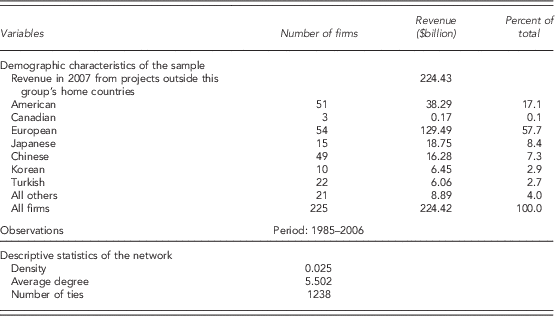
In the tradition of network analysis, it is necessary to limit the volume of data collected by selecting partial networks (Anand & Khanna, Reference Anand and Khanna2000; Kale, Dyer & Singh, Reference Kale, Dyer and Singh2002). Once this has been acknowledged, the sample can be selected in one of two ways. The first is to select the network around an individual, so as to generate ‘ego-centered’ networks containing a variety of social relations. The second method is to create an abstraction of the ‘global’ features of networks in relation to a particular aspect (Wasserman & Faust, Reference Wasserman and Faust1994). Knoke and Yang (Reference Knoke and Yang2008), also recognize this requirement, referring to two ways in which this can be achieved: adopting realist or nominalist strategies. Realist strategies are based on the boundaries imposed by individuals themselves, whereby ‘actors and their relations are included or excluded to the extent that the other actors judge them to be relevant’ (Knose and Yang, Reference Knoke and Yang2008: 15). Nominalist strategies are based on researcher-imposed boundaries, whereby ‘a researcher reaches network closure by imposing an a priori conceptual framework that serves an analytic or theoretical purpose for a particular project’ (Knose and Yang, Reference Knoke and Yang2008: 16). This partial selection is also supported by Laumann, Marsden, and Prensky (Reference Laumann, Marsden and Prensky1983). In view of the above, in our sample selection we have employed both criteria and consequently we needed two types of information in order to carry out our empirical analysis: the realist strategy requires relational information; and the nominalist strategy requires attributive information on the nodes. The relational data on the international activity of firms in this sector was taken from Public Works Financing, which publishes its annual ‘International Public Works Financing Projects Database’, listing more than 3,100 PPP (public–private partnership) infrastructure projects that have been proposed or carried out over the past 20 years (January 1985–December 2005). Certain researchers (Chen & Messner, Reference Chen and Messner2009) point to the importance of joint ventures and strategic alliances for international construction markets, in order to improve their market share. Other researchers (Akintoye & Main, Reference Akintoye and Main2007; Pryke, Zagkli, & Kougia, Reference Pryke, Zagkli and Kougia2011) observe that the use of collaborative relationships is so intense in the construction industry because of the need for risk sharing, access to innovation and technology, market responses, resource efficiency, and client requirements. To this end, data were identified on the Public Works Financing Database for all the projects that had been awarded to a consortium of firms, which amounted to 66.6% (2100 projects). For the purposes of this paper, we define an ISA as a collaborative linkage between two or more legally independent firms located in different countries. The motive for the alliance may be joint product development or entry into a new market (Kumar & Andersen, Reference Kumar and Andersen2000). Therefore, the interorganizational relationship that we have set out to study consists of the cooperative agreements and strategic alliances of a horizontal nature, involving both equity and non-equity, entered into by the contractors. The attributive data for the main contractors operating at an international level were taken from the Engineering News Record database, which publishes two annual classifications or rankings: The Top Global Contractors and The Top 225 International Contractors (Sarkar, Aulakh, & Cavusgil, Reference Sarkar, Aulakh and Cavusgil1998). The latter classification ranks companies according to construction revenue generated outside each company’s home country over a set period of time in US$ in millions. In this work, we have used the data for the years 2006 and 2007. Our sample consists of 103 firms, which were selected by applying two criteria: an attributive criterion – the firms must feature in The Top International Contractors – and a relational criterion – the firms must have participated in at least one coalition project with a partner from The Top International Contractors (Laumann, Marsden, & Prensky, Reference Laumann, Marsden and Prensky1983; Sarkar, Aulakh, & Cavusgil, Reference Sarkar, Aulakh and Cavusgil1998). With the relational and attributive information, we created alliance networks and matrices. These matrices were utilized to operationalize the network and non-network indicators for the different constructs of alliance portfolio configuration (Table 1).
Characteristics of the sample
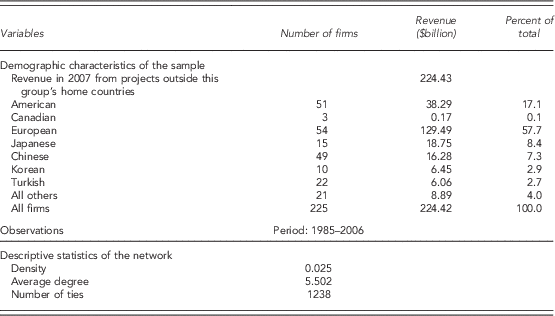
Source. Engineering News-Record (ENR).
Measures and assessment of epistemic relationships
In this section, we will explain the measures used in our study. However, we should first introduce the concept of epistemic relationships. An epistemic relationship, also known as a measurement model, describes the link between theory (latent variables) and data (manifest variables or indicators). There are two types of epistemic relationships (Jarvis, Mackenzie & Podsakoff, Reference Jarvis, Mackenzie and Podsakoff2003): first, the common latent construct model, which establishes that co-variation between indicators is explained by the variation in an underlying latent variable. In this case, indicators are reflective of the unobserved theoretical construct and, hence, co-vary with the level of that latent variable. Second, the composite latent construct model posits that the measures jointly influence the latent variable. Manifest variables, called formative indicators, give rise to the composite construct. This means that the indicators are not necessarily correlated. The choice between both types of measurement models should be based on theoretical considerations regarding the relationship between the indicators and the constructs being examined (Podsakoff, Shen, & Podsakoff, Reference Podsakoff, Shen and Podsakoff2006). In this vein, following the guidelines proposed by Jarvis et al. (Reference Jarvis, Mackenzie and Podsakoff2003), we have selected the corresponding epistemic relationship for our proposed measures. We will now go on to set out the measures used in our study.
We aim to measure APC by analyzing the partners’ resources that the ego firm can access from within its alliance portfolio, which will allow us to assess the competitiveness of the overall ego network. We therefore need to determine whether the firms in our study are powerful or resource-rich (Batjargal, Reference Batjargal2003). Following Gulati (Reference Gulati1995b), we divided The Top International Contractors in 2007 into four conglomerates through the hierarchical principal component analysis in which different financial and attributive firm indicators obtained from the LexisNexis Academic database were considered in an aggregate fashion. Some indicators proposed by Fombrun and Shanley (Reference Fombrun and Shanley1990) were used to measure the reputation of the firms according to their resources: size of the firm and economic profitability – in particular, the number of employees, logarithmic transformation of total sales, and productivity (sales per employee). From this analysis, we were able to identify that the resource-rich partners within our sample can be placed into two groups: first, the group of world-leading firms with sufficient capabilities and resources to undertake projects anywhere in the world (Group A); and second, the group of large firms with a lesser geographical reach and greater specialization (Group B). From this analysis, two measures were developed to determine the value of the portfolio or egonet (Borgatti & Li, Reference Borgatti and Li2009). The first of these (apc_1), shows the ratio of the number of a firm’s partners that could be classified as the most valuable or powerful (belonging to Group A) to the number of firms making up the neighborhood of the firm being analyzed. The second indicator (apc_2), represents the number of the firm’s partners, from of all the firms that make up its ego network that could be placed in groups A and B. In order to build the two indicators, we used matrix algebra to multiply the relational matrix (ISAs) by the vector representing the hierarchical conglomerate in which each firm is placed (Borgatti, Everett, & Freeman, Reference Borgatti, Everett and Freeman2002). Both manifest variables are considered to be reflective because they are seen as manifestations of the APC, share the same conceptual domain, and are highly correlated. In addition, we are interested in the variance shared by the measures (Podsakoff, Shen, & Podsakoff, Reference Podsakoff, Shen and Podsakoff2006).
The international market share growth (IMSG) construct aims to reflect the firm’s competitive position and is a non-financial performance indicator that is commonly accepted both in general strategy (Combs, Yasin, & Lisboa, Reference Combs, Yasin and Lisboa2007) and in international business (Depperu & Cerrato, Reference Depperu and Cerrato2005). Rugman and Verbeke (Reference Rugman and Verbeke2004) propose that market share provides an absolute measure of the firm’s international market penetration and international success (Leiblein & Reuer, Reference Leiblein and Reuer2004; Zhou, Wu, & Luo, Reference Zhou, Wu and Luo2007). In line with this, we associate international performance with the international market share, as this variable reflects the firm’s ‘power’ in the sector that, in the long term, will affect its economic profit. Moreover, some authors (Vapola, Paukku, & Gabrielsson, Reference Vapola, Paukku and Gabrielsson2010) have postulated that growth is the critical reason why firms internationalize their activities and Chen (Reference Chen2009) uses the market share as a measure of the international performance of MNCs. In order to operationalize this variable, we calculated the growth of the international market share (imsg). This was determined by the difference in a firm’s international market share, looking at foreign sales, between the years 2006 and 2007.
To measure the structural alliance portfolio (SAP), especifically structural holes, we used three reflective indicators of ego networks to measure two aspects of network structure: redundancy and ego network density (Vanhaverbeke, Gilsing, Beerkens, & Duysters, Reference Vanhaverbeke, Gilsing, Beerkens and Duysters2009). As in other studies (Ahuja, Reference Ahuja2000a; Soda, Reference Soda2011), we used the effective size indicator (effsize; Burt, Reference Burt1992) to measure the non-redundancy of the network. This measure is calculated as the number of alters (size of the portfolio) minus the average number of ties that each alter has to other alters (redundancy factor). Thus, in the case of the partners not being connected to each other, the effective size would match the size of the portfolio and its redundancy would be very low. If the effective size is low, the redundancy of the alliance portfolio would be very high. To measure ego network density, we used the brokerage (broker) and ego betweenness (egobetw) indicators. The brokerage indicator shows the number of pairs not directly connected. In an alliance portfolio, the focal firm is connected to its partners and if the ego firm’s partners are not connected to each other, the ego plays a critical role as a broker (Hanneman & Riddle, Reference Hanneman and Riddle2005). Second, the ego betweenness indicator records the percentage of all geodesic paths between partners that pass through the ego firm (Hanneman & Riddle, Reference Hanneman and Riddle2005). In this way, the indicator aims to measure the betweenness centralization of the overall alliance portfolio. In a similar way to previous studies in the literature (Rowley, Behrens, & Krackhardt, Reference Rowley, Behrens and Krackhardt2000; Koka & Prescott, Reference Koka and Prescott2002; Casanueva, Gallego, & Sancho, Reference Casanueva, Gallego and Sancho2013), in order to calculate structural measures a symmetric (non-directional) and dichotomized matrix was constructed, taking into account the strategic alliances that the companies of our firms had set up in the time period that our relational database spans (1985–2005). The three network indicators were calculated using the Ucinet VI SNA software package (Borgatti, Everett, & Freeman, Reference Borgatti, Everett and Freeman2002). Finally, with regard to the assessment of the epistemic relationship, the SAP variable is modeled using a common latent construct model. A reflective measurement model is used because the three indicators are considered to be reflections of the construct, they have a high level of interchangeability and are expected to co-vary (Podsakoff, Shen, & Podsakoff, Reference Podsakoff, Shen and Podsakoff2006).
The relational alliance portfolio (RAP) construct was operationalized by two indicators: multiple partners (m_partner) and repeated ties (r_ties). Both indicators could be viewed as a sign of trust between the partners and as a feature of the quality of the relationships that make up an alliance portfolio (Gulati, Reference Gulati1995a, Reference Gulati1995b; Koka & Prescott, Reference Koka and Prescott2002). Accordingly, following the methodology of Social Network Analysis applied in other studies (Rowley, Behrens, & Krackhardt, Reference Rowley, Behrens and Krackhardt2000; Koka & Prescott, Reference Koka and Prescott2002; Casanueva, Gallego & Sancho, Reference Casanueva, Gallego and Sancho2013), to calculate relational measures a symmetric (non-directional) and non-dichotomized matrix was constructed, given that to analyze the quality of the relationships we had to bear in mind the intensity of the ties, considering the strategic alliances that the firms that make up the sample had established in the time period, which our relational database spans (1985–2005). Multiple partners refers to the establishment of more than one interorganizational relationship with the same partner when carrying out a project during the time period under consideration. To calculate this ratio, we divided the number of partners the focal firm had engaged within more than one international alliance during the study period – 1985–2005 – by the number of partners that make up its alliance portfolio. The second indicator, repeated ties, was calculated as a ratio between the number of international alliances made by the focal firm during the period analyzed and the total number of partners making up the focal firm’s portfolio (Koka & Prescott, Reference Koka and Prescott2002). This indicator shows whether the repeated ties, or the alliance experience, have a positive effect on the configuration of the alliance portfolio (Lorenzoni & Lipparini, Reference Lorenzoni and Lipparini1999). Finally, the RAP variable is modeled using to a composite latent construct model because its indicators form this construct, the measures are not interchangeable, and do not co-vary. Furthermore, the study is interested in the aggregate variance of the three indicators.
We have used two indicators to measure the partner alliance portfolio variable (PAP): cultural diversity (country) and technological diversity (tech) (Koka & Prescott, Reference Koka and Prescott2002; Goerzen & Beamish, Reference Goerzen and Beamish2005). These indicators are considered to be formative because they are not necessarily correlated; they represent different conceptual facets that are not interchangeable, and we assume that they form or induce the construct (Roberts & Thatcher, Reference Roberts and Thatcher2009). The cultural diversity dimension reflects the attributes of the network that are linked to shared beliefs and codes. In our work, the higher value of this dimension reflects the possibility of not only acquiring information as a resource but also ‘managerial capabilities’ that may be of interest for developing the business in particular environments (Lavie & Miller, Reference Lavie and Miller2008). Although a great variety of approaches can be used to operationalize this dimension, we associate it with the cultural distance between the focal actor and its partners – its alliance portfolio (cultural). Taking Hofstede’s perspective (Hofstede, Reference Hofstede1980; Kogut & Singh, Reference Kogut and Singh1988), we have adopted the approach that has been widely acknowledged in the literature on internationalization as the best proxy. This includes the cultural differences between countries (Tihanyi, Griffith, & Russell, Reference Tihanyi, Griffith and Russell2005; Lavie & Miller, Reference Lavie and Miller2008), taking on board the possible criticisms that Hofstede’s work may have received:
 $$\mathop{\sum}\limits_{d=1}^4 {\left( {{{(I_{{dc}} {\minus}I_{{du}} )^{2} } \over {4Vd}}} \right)} $$
where I dc is the value in Hofstede’s index for the cultural dimension d of country c, u the focal actor’s country of origin, and Vd represents the variance between countries in Hofstede’s index in dimension d. We then calculated the average cultural distance of the firms’ egocentric network. Second, in order to analyze technological diversity, we used a measurement based on Koka and Prescott (Reference Koka and Prescott2002). Technological diversity has been frequently studied by the Standard Industry Classification (Fombrun & Shanley, Reference Fombrun and Shanley1990; Baum, Calabrese, & Silverman, Reference Baum, Calabrese and Silverman2000; Koka & Prescott, Reference Koka and Prescott2002; Gulati, Lavie, & Singh, Reference Gulati, Lavie and Singh2009). As the Standard Industry Classifications in our sample are very similar, we have classified the firms in this study by their main activity, as described in the Engineering News Record database (General Building; Manufacturing; Power; Water Supply; Sewerage/Solid Waste; Industrial/Petroleum Processing; Transportation; Hazardous Waste; Telecommunications). We used Blau’s heterogeneity index (Blau, Reference Blau1977) to calculate this indicator:
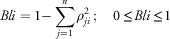 $$Bli=1{\minus}\mathop{\sum}\limits_{j=1}^n {\rho _{{ji}}^{2} \,} ;\quad 0\leq Bli\leq 1$$
where Bli is the Blau index for the focal firm i, j the number of categories (out of eight) that a partner can belong to (e.g., Water Supply), and  $$\rho$$
the proportion of alliance portfolio partners of the focal actor i that belong to category j. The Blau index is the approach most frequently used for measuring diversity in work group heterogeneity studies (Harrison & Klein, Reference Harrison and Klein2007). Finally, we controlled the size of the firm, as large companies have more opportunities for relations and therefore a higher probability of participating in strategic alliances than smaller firms, which suggests a link between size and the benefits that firms derive from their alliance portfolios (Schilke & Goerzen, Reference Schilke and Goerzen2010; Wassmer, Reference Wassmer2010). Firm size was measured by the number of its employees (Heimeriks & Duysters, Reference Heimeriks and Duysters2007; Schilke & Goerzen, Reference Schilke and Goerzen2010).
Data analysis
Our research model has been tested using partial least squares (PLS), a variance-based method of structural equation modeling (Henseler, Ringle, & Sinkovics, Reference Henseler, Ringle and Sinkovics2009). This study uses SmartPLS 2.0.M3 software (Ringle, Wende, & Will, Reference Ringle, Wende and Will2005), which allows both a simultaneous analysis of how well the measures relate to each construct (outer or measurement model) and whether the hypothesized relationships are empirically true at a theoretical level (inner or structural model; (Sosik, Kahai, & Piovoso, Reference Sosik, Kahai and Piovoso2009). PLS is primarily intended for causal-predictive analysis, where the problems explored are complex and prior theoretical knowledge is scarce. Consequently, PLS is an appropriate technique to use in a theory development situation, such as in this study (Chin, Reference Chin2010). The use of PLS is also advisable because of the presence of formative indicators (Roldán & Sánchez-Franco, Reference Roldán and Sánchez-Franco2012) and given the use of secondary data in this study (Gefen, Rigdon, & Straub, Reference Gefen, Rigdon and Straub2011). Finally, the size of the final sample also indicated the use of PLS in relation to covariance-based structural equation modeling (maximum-likelihood; Reinartz, Haenlein, & Henseler, Reference Reinartz, Haenlein and Henseler2009).
Mediation analysis
Hypotheses 2 and 3 represent mediation hypotheses, which propose how, or the means by which an exogenous variableFootnote 1 (SAP) affects an endogenous variableFootnote 2 (alliance portfolio capital) by means of mediating variables (RAP and PAP, respectively) once the effect of controls (e.g., size) has been considered (Preacher & Hayes, Reference Preacher and Hayes2008). This study specifically tests a multiple mediation model (Hayes, Preacher, & Myers, Reference Hayes, Preacher and Myers2011).
Figure 2a describes the total effect (c) of the SAP on the APC, which is the size variable that we have used as a control variable. Figure 2b shows c′ as the direct effect of the SAP on the APC (Hypothesis 1), controlling for both mediators (RAP and PAP) and the covariate (size). Meanwhile, a 1b 1 and a 2b 2 represent the indirect effects of the SAP on the value alliance portfolio via the two mediating variables, that is, the RAP (Hypothesis 2: a 1b 1) and the PAP (Hypothesis 3: a 2b 2) (Hayes, Preacher, & Myers, Reference Hayes, Preacher and Myers2011). A recommended approach for testing mediation hypotheses is bootstrapping, a nonparametric re-sampling procedure that does not impose the assumption of normality on the sampling distribution (Preacher & Hayes, Reference Preacher and Hayes2008).
Structural model: A multiple mediation model. (a) Model with total effect and (b) model with a multiple mediation design
RESULTS
Measurement model
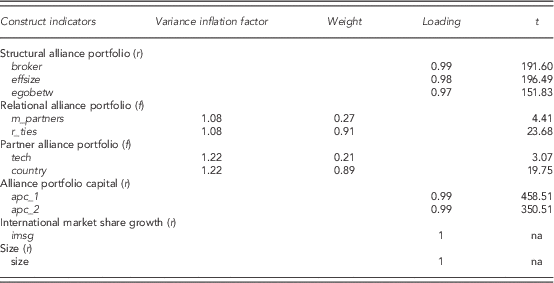
Reflective measurement models are evaluated with regard to reliability and validity (Henseler, Ringle, & Sinkovics, Reference Henseler, Ringle and Sinkovics2009). Individual item reliability is considered adequate when an item has a factor loading that is >0.707 on its respective construct (Carmines & Zeller, Reference Carmines and Zeller1979). In this study, all reflective indicators have loadings above 0.97 (Table 2).
Loadings and weights for the measurement model
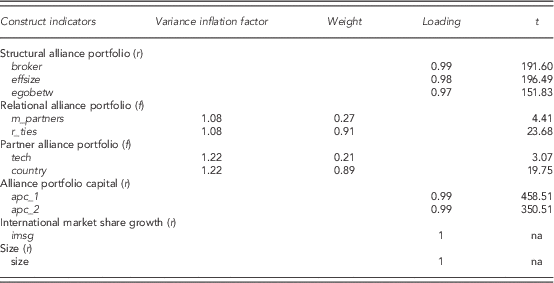
Notes. (r)=reflective; (f)=formative; na=non-applicable.
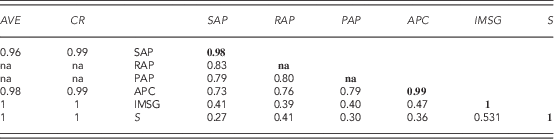
Construct reliability assessment evaluates the extent to which a variable or set of variables is consistent in what it intends to measure (Straub, Boudreau, & Gefen, Reference Straub, Boudreau and Gefen2004). Construct reliability is assessed using the composite reliability (ρ c) index and our interpretation of it follows the guidelines proposed by Nunnally and Bernstein (Reference Nunnally and Bernstein1994), who suggests 0.7 as a benchmark for a modest reliability applicable in the early stages of research. In this investigation, our reflective constructs are reliable (Table 3). Convergent validity is usually assessed by the average variance extracted (Fornell & Larcker, Reference Fornell and Larcker1981). This measure quantifies the amount of variance that a construct captures from its manifest variables or indicators relative to the amount due to measurement error (Chin, Reference Chin1998). Average variance extracted values should be >0.50. This means that 50% or more of the indicator variance should be accounted for. The average variance extracted measures for all our latent variables are >0.99 (Table 3). Finally, discriminant validity indicates the extent to which a given construct differs from other constructs. This condition is adapted in Table 3. For adequate discriminant validity, the diagonal elements in Table 3 should be significantly greater than the off-diagonal elements in the corresponding rows and columns. This condition is satisfied for the reflective latent variables in relation to the rest of the variables (Table 3).
Construct reliability, convergent, and discriminant validity coefficients
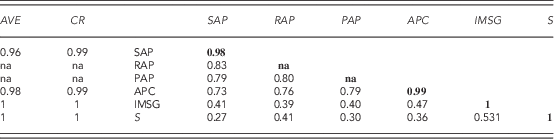
Notes. Diagonal elements (values in bold) are the square root of the variance shared between the constructs and their measures (AVE). Off-diagonal elements are the correlations among constructs. For discriminant validity, diagonal elements should be larger than off-diagonal elements.
APC=alliance portfolio capital; AVE=average variance extracted; CR=composite reliability; IMSG=international market share growth; na=non-applicable; PAP=partner alliance portfolio; RAP=relational alliance portfolio; S=size; SAP=structural alliance portfolio.
The evaluation of formative measurement models at the indicator level is based on testing potential multicollinearity between items, as well as on the analysis of weights (Roldán & Sánchez-Franco, Reference Roldán and Sánchez-Franco2012). A high collinearity between indicators would produce unstable estimates and would make it difficult to separate the distinct effect of the individual manifest variables on the construct (Petter, Straub, & Rai, Reference Petter, Straub and Rai2007). With this in mind, a collinearity test was performed using the SPSS program. Roberts and Thatcher (Reference Roberts and Thatcher2009) have recently indicated that a variance inflation factor statistic >3.3 signals a high multicollinearity. The maximum variance inflation factor value for our two formative constructs came to 1.22, which is well below the threshold of 3.3 (Table 2). We then assessed the weights of the formative indicators. Weights measure the contribution of each formative item to the variance of the latent variable (Roberts & Thatcher, Reference Roberts and Thatcher2009), which allows us to rank indicators according to their contribution. Both the RAP and the PAP presented formative indicators with significant weights. This means that their manifest variables explain a significant portion of the variance in the RAP and the PAP (Table 2). In addition, taking into account the weights’ magnitude, shown by the formative indicators, it can be observed that repeated ties (r_ties) (0.91) and cultural diversity (country) (0.89) represent the most important indicators in the make-up of their respective constructs.
Structural model
The assessment of the structural model is based on the algebraic sign, magnitude, and significance of the structural path coefficients, the R 2 values, and the Q 2 (redundancy) test for predictive relevance (Roldán & Sánchez-Franco, Reference Roldán and Sánchez-Franco2012). In addition, as a precautionary measure, we have tested the structural model for collinearity issues between predictor constructs. Our results indicate there are no significant levels of collinearity since the variance inflation factor values are below 5 and tolerance levels are above 0.20 (Hair, Hult, Ringle & Sarstedt, Reference Hair, Hult, Ringle and Sarstedt2014).
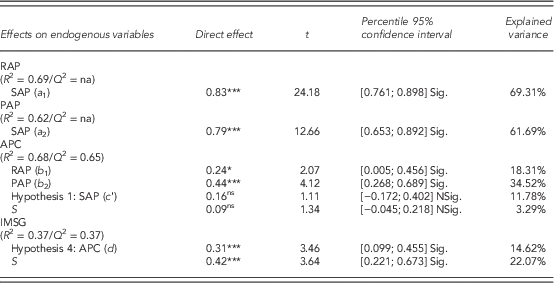
Following this, and consistent with Henseler, Ringle, and Sinkovics (Reference Henseler, Ringle and Sinkovics2009), bootstrapping (5,000 re-samples) was used to generate standard errors and t-statistics. This allows the statistical significance of the path coefficients to be evaluated. Simultaneously, the bootstrapping confidence interval (CI) of standardized regression coefficients is reported. ‘If a confidence interval for an estimated path coefficient w does not include zero, the hypothesis that w equals zero is rejected’ (Henseler, Ringle, & Sinkovics, Reference Henseler, Ringle and Sinkovics2009). Specifically, we have applied a percentile approach, which has the advantage of being completely distribution-free (Chin, Reference Chin2010). Six of the eight direct effects described in Figure 2b are significant. This outcome is also achieved by observing the percentile bootstrap 95% CI. From the analysis of these results, we can conclude that Hypothesis 1 is not supported. The direct effect of the SAP on the APC (c′) is not significant and its CI includes zero. However, Hypothesis 4 is supported (d). This study therefore shows that APC has a significant effect on the growth of international market share once the effect of size has been controlled.
We also evaluate the model using the cross-validated redundancy index (Q 2) for endogenous constructs using a reflective measurement model (Roldán & Sánchez-Franco, Reference Roldán and Sánchez-Franco2012). Chin (Reference Chin2010) suggests this measure to examine the predictive relevance of the theoretical/structural model. A Q 2>0 implies that the model has predictive relevance. The results summarized in Table 4 confirm that the structural model has satisfactory predictive relevance for the value alliance portfolio (Q 2=0.65) and market share growth (Q 2=0.37).
Effects on endogenous variables
Notes. Sig. denotes a significant direct effect at 0.05; Nsig. denotes a nonsignificant direct effect at 0.05.
APC=alliance portfolio capital; IMSG=international market share growth; PAP=partner alliance portfolio; RAP=relational alliance portfolio; S=size; SAP=structural alliance portfolio.
***p<.001, **p<.01, *p<.05, ns=not significant (based on t(4,999), one-tailed test); t(0.05, 4,999)=1.65, t(0.01, 4,999)=2.33, t(0.001, 4,999)=3.09
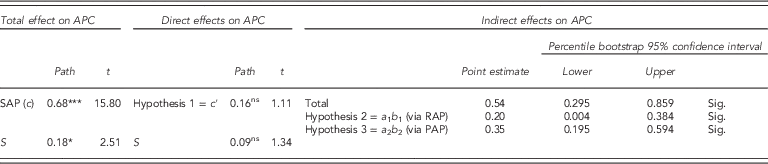
The mediation hypotheses (Hypothesis 2 to Hypothesis 3) have been tested by applying the analytical approach described by Hayes (Reference Hayes2009). We identify and contrast the total (c) and direct (Hypothesis 1: c′) effects of the SAP on the APC, as well as the indirect effects through the mediators (Hypothesis 2: a 1b 1; Hypothesis 3: a 2b 2), that is to say, via the RAP and the PAP variables, while the size variable is included as the covariate (Table 5). We have used the bootstrapping procedure to test the indirect effects. Following Castro and Roldán (Reference Castro and Roldán2013), we have applied a two-step procedure for testing mediation in PLS: (1) use the specific model in question with both direct and indirect paths included, and perform N bootstrap re-sampling and explicitly calculate the product of the direct paths that form the indirect path being assessed. (2) Estimate the significance using percentile bootstrap CI. As a result, 95% CI for mediators are generated. If the interval for a mediation hypothesis does not contain zero, it means that the indirect effect is significantly different from zero with 95% confidence. As Figure 2a and Table 5 show, the SAP has a significant total effect on the APC. When mediators are introduced (Figure 2b), the SAP no longer has a significant direct effect on the APC (Hypothesis 1: c′). As shown above, Hypothesis 1 is definitely not supported. However, Hypothesis 2 and Hypothesis 3 are supported, which means that both of the indirect effects of the SAP on the value alliance portfolio used in our research model are significant. Therefore, Table 4 shows that both the RAP (Hypothesis 2: a 1b 1) and the PAP (Hypothesis 3: a 2b 2) fully mediate the relationship between the SAP and the value of APC.
Summary of mediating effect tests
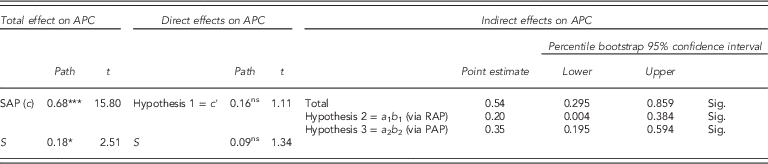
Notes. Sig. denotes a significant direct effect at 0.05; bootstrapping based on n=5.000 subsamples.
APC=alliance portfolio capital; PAP=partner alliance portfolio; RAP=relational alliance portfolio; S=size; SAP=structural alliance portfolio.
***p<.001; ns=not significant (based on t(4,999), one-tailed test); t(0.05, 4,999)=1.65, t(0.01, 4,999)=2.33, t(0.001, 4,999)=3.09; *p<.05; ns=not significant (based on t(4,999), two-tailed test); t(0.05, 4,999)=1.96.
DISCUSSION
In this study, we aim to increase our understanding of the configuration of the alliance portfolio by studying the relationships between the principal dimensions that determine the configuration of the alliance portfolio. To achieve this aim we have employed a statistical mediation analysis. The structural dimension could be placed at the beginning of the process (Tsai & Ghoshal, Reference Tsai and Ghoshal1998; Sarkar, Aulakh, & Madhok, Reference Sarkar, Aulakh and Madhok2009), while the relational and the partner dimensions of the alliance portfolio play a mediating role between the structural dimension and the APC. Our results show that the dimensions of the alliance portfolio configuration are interrelated in such a way that the relational and the partner dimensions mediate the effect of the structural dimension on the APC, and this construct positively affects the increase in international market share. Accordingly, the results attained have both theoretical and practical implications.
Theoretical implications
From a theoretical perspective, this article has attempted to answer the call from different scholars (Wassmer, Reference Wassmer2010) concerning the need for firms to know how to configure their alliance portfolio (Hoffmann, Reference Hoffmann2007; Kale & Singh, Reference Kale and Singh2009). Our investigation is based on a sequential framework (Tsai & Ghoshal, Reference Tsai and Ghoshal1998) and the multi-dimensional nature of the APC (Koka & Prescott, Reference Koka and Prescott2002; Sarkar, Aulakh, & Madhok, Reference Sarkar, Aulakh and Madhok2009; Wassmer, Reference Wassmer2010). By defining an alliance portfolio from the network perspective as a focal firm’s egocentric alliance network (Ozcan & Eisenhardt, Reference Ozcan and Eisenhardt2009), we have identified three dimensions that are found at different stages of the configuration process or positions within the alliance portfolio design: the structural, relational, and partner dimensions. When we consider the model with only the total effect (Figure 2a), our results indicate that the sparser the structure of alliance portfolio, that is, the lower the redundancy and density of the alliance portfolio structure (i.e., its structural dimension), the greater the APC and the higher the growth of the international market share achieved by the focal actor. Thus, the characteristics of this empirical context (global public works) show it to be the network structure defended by Burt, characterized by its reduced prominence, which increases its relevance for contractors (Ahuja, Reference Ahuja2000b; Rowley, Behrens, & Krackhardt, Reference Rowley, Behrens and Krackhardt2000; Inkpen & Tsang, Reference Inkpen and Tsang2005).
However, when we analyze the full model (Figure 2b), the importance of the structural dimension decreases considerably in favor of the relational and partner dimensions, which implies that it must affect the APC, albeit indirectly, through both the relational dimension and the partner dimension. Thus, on the one hand, with regard to the mediator dimension – the relational dimension, which is a consequence of the trust that develops and the strengthening of the relationships that make up the alliance portfolio (Gulati, Reference Gulati1995b; Sarkar, Aulakh, & Madhok, Reference Sarkar, Aulakh and Madhok2009) – these results support the arguments put forward by other researchers (Rowley, Behrens, & Krackhardt, Reference Rowley, Behrens and Krackhardt2000; Rost, Reference Rost2011). These researchers have posited that firms with strong ties, that is, with interorganizational relations characterized by high trust and a weak network structure (structural holes and low density), achieve better results. In this case, when the focal firm’s alliance portfolio is configured with a mix of structural holes and strong ties, the value of its APC improves and its alliance ambidexterity and international performance increases (Tiwana, Reference Tiwana2008). On the other hand, the dimension of the alliance portfolio configuration that has been mainly associated with firm performance is the partner dimension (Stuart, Reference Stuart2000; Goerzen & Beamish, Reference Goerzen and Beamish2005; Lavie & Miller, Reference Lavie and Miller2008). Our research shows that firms with a weak ego network structure (structural holes and low redundancy and density) and which have privileged access to technologically or culturally diverse partners can achieve a higher value APC and a greater increase in the growth of their international market share than their competitors. In fact, the partner dimension is the best predictor of the value of the APC in our research model (it explains 34.52% of its explained variance). This surpasses the direct influence of the structural and relational dimensions on the final endogenous variable. The APC also explains 14.62% of the variance of the growth in the international market share of the global contractors’ network. Furthermore, this study has helped to demystify the complex relationships between the different dimensions of the alliance portfolio configuration. Indeed, the structural model shows that all path coefficients between the SAP and the RAP and the PAP are significant. This demonstrates that the alliance portfolio configuration is a multidimensional concept, whose dimensions are interrelated. Consequently, the relational and partner dimensions of the alliance portfolio configuration are significant mediators in the relationship between the structural dimension and the value of the APC, while the APC positively affects the growth in international market share. In the presence of the relational and partner dimensions, the direct impact of the structural dimension on the value of the APC certainly loses significance. This has an important implication for this controversial subject area of the literature; if certain characteristics of the network structure are the most important ones in the portfolio for explaining its performance (Wassmer, Reference Wassmer2010). Our study therefore shows that the structural dimension is not an adequate predictor for analyzing the profitability of an alliance portfolio, given the existence of other configuration factors such as alliance partner quality (Stuart, Reference Stuart2000), or the quality of the alliance relationships (Sarkar, Aulakh, & Madhok, Reference Sarkar, Aulakh and Madhok2009), which provide a more complete explanation of the benefits for the focal actor that can be derived from the alliance portfolio. Therefore, because the alliance portfolio’s structure does not affect APC directly, but rather indirectly through the partner dimension (as the best predictor) and the relational dimension, it is clear that in order to maximize the benefits of structural holes, the focal firm should not only focus on designing sparse ego-networks but also on the characteristics of the partners and their relationships (Koka & Prescott, Reference Koka and Prescott2002). In the same vein, some researchers (Hagedoorn & Schakenraad, Reference Hagedoorn and Schakenraad1994; Baum, Calabrese, & Silverman, Reference Baum, Calabrese and Silverman2000; Jiang, Tao, & Santoro, Reference Jiang, Tao and Santoro2010) stress the importance of partner diversity, demonstrating that a small group of alliances with very different behaviors may yield more diverse resources, information, knowledge, and capabilities at a lower cost than a large group of alliances with similar partners. Another controversial question is whether the size of the focal actor determines the size of the portfolio, which in turn determines the benefits derived from the alliance portfolio (Wassmer, Reference Wassmer2010). Our results therefore show that on one hand, the firm size control variable presents a small and non-significant effect on APC, and on the other hand, discounting its effect on the growth of international market share, the relationship of APC with this variable is still significant.
In conclusion, studies that set out to analyze how the design of an alliance portfolio affects performance need to bear in mind that alliance portfolio configuration is a multidimensional concept, and that its dimensions are interrelated.
Managerial implications
The increasing importance of strategic alliances in the global business environment raises the question of how multinational firms (MNCs) should configure their alliance portfolios (Wassmer, Reference Wassmer2010). To answer this question it is necessary to have a clear understanding of the alliance portfolio configuration. This entails analyzing its dimensions and the relationships between them. In this empirical context, the results demonstrate that managers need to strategically select their partners and develop relational patterns that will enable the firm to construct a portfolio with low levels of density and redundancy, in which the relations within the portfolio can be organized on relational criteria, such as reciprocal trust, rather than on formal contractual safeguarding mechanisms (Sarkar, Aulakh, & Madhok, Reference Sarkar, Aulakh and Madhok2009). The relations should also provide access to partners that are culturally (Lavie & Miller, Reference Lavie and Miller2008) and technologically diverse (Baum, Calabrese, & Silverman, Reference Baum, Calabrese and Silverman2000; Gulati, Lavie, & Singh, Reference Gulati, Lavie and Singh2009). If managers strategically design their alliance portfolio to include a number of dimensions, taking into account the relations between them, they will achieve greater competitive strength for the portfolio in general, which will increase the value of the APC, which in turn will improve the overall performance of the portfolio.
This implies that the managers should evaluate the characteristics of the structure of the alliance portfolio as a whole; the characteristics of the partners or focal actor’s alters – with the aim of accessing resources and capabilities that they lack and avoiding redundancies; as well as the characteristics of the established alliances or relationships within the alliance portfolio, in order to avoid opportunistic behaviors and to encourage the exchange of resources. In conclusion, the individual alliance has to be treated as part of a larger portfolio (Duysters, de Man, & Wildman, Reference Duysters, de Man and Wildman1999) and managers need to maximize the ego network’s benefits and minimize its risks by selecting the most efficient configuration of the alliance portfolio (Wassmer, Reference Wassmer2010).
Limitations and future research
Despite our contributions, the present paper is not absent from certain limitations that, to some extent, can be seen as promising avenues for future research. One of such limitations is the methodology used for the testing of our model, which assumes linear relationships between latent variables and follows a soft modeling approach directed more towards prediction than causality. The predictability only allows a limited degree of control (Falk & Miller, Reference Falk and Miller1992); therefore, it would be interesting to apply other methodologies and to consider non-linear relationships between variables.
The cross-sectional design in order to test our research model also offers certain limitations to the results, as the configurations of alliance portfolios are dynamic and can evolve over time (Ahuja, Soda, & Zaheer, Reference Ahuja, Soda and Zaheer2012; Castro, Casanueva, & Galán, Reference Castro, Casanueva and Galán2014). In addition, the cross-sectional design does not permit to determine the causality between variables, but theoretical foundations make it possible to state the relationships between the constructs of the model (Baum, Calabrese, & Silverman, Reference Baum, Calabrese and Silverman2000; Rowley, Behrens, & Krackhardt, Reference Rowley, Behrens and Krackhardt2000; Tsai & Ghoshal, Reference Tsai and Ghoshal1998). Accordingly, future research should measure the constructs analyzed at several points in time, taking into account the dynamics that make up the different dimensions of the alliance portfolio configuration.
A further limitation is that this research has used a particular set of dimensions to look in greater depth at the configuration of the alliance portfolio, but it is possible to consider other variables (Polites, Roberts & Thatcher, Reference Polites, Roberts and Thatcher2012). Future research could also carry out an empirical analysis of the multidimensional construct, as a second order construct considering potential moderators such as the environmental context and alliance portfolio characteristics in order to conduct comparative research on alliance portfolio configurations (Wassmer, Reference Wassmer2010).
We cannot forget that we have focused our study in a specific industry in a global context, which may cause different results when applied to other industries. While this has the advantage of allowing the network to be analyzed at a global level, it shows little cohesion; however, we consider that the results can be generalized to other industries with frequent interorganizational relationships such as life sciences, computer software, cellular telephone, and so forth (Wassmer & Dussauge, Reference Wassmer and Dussauge2011). Thus, testing the conclusions in other industries with stronger connections between members, free of government influences, could be an important line of research (Ahadzi & Bowles, Reference Ahadzi and Bowles2004). This would allow us to advance our understanding of the effect of the configuration of the APC on a firm’s international performance. We might also analyze how a firm could develop the complementarities between closure capabilities and structural holes capabilities, which would contribute to the analysis of alliance portfolio ambidexterity (Tiwana, Reference Tiwana2008). Accordingly, the advantages and disadvantages of the dimensions of the alliance portfolio configuration and the importance of this ambidexterity could depend on the characteristics of the empirical context that is being analyzed (Inkpen & Tsang, Reference Inkpen and Tsang2005).
Finally, due to the data available, we have only analyzed alliances or consortia that were awarded contracts, being also interesting the study of those consortia that made unsuccessful bids. Moreover, in our sample selection we applied one realist and one nominalist criteria, from which we analyzed horizontal alliances between the world’s 250 principal contractors, but it can be supposed that the study of other horizontal and vertical sub-networks would be an interesting topic for research (Gulati, Reference Gulati1998; Grant & Baden-Fuller, Reference Grant and Baden-Fuller2004).
Acknowledgements
This research was supported by the Ministerio de Economía y Competitividad, Spain (ECO2013-45329-R).