How many mirrors do you have where you live? How often do you see yourself in a mirror, either deliberately or in passing through a public space? Even relatively small contemporary apartments typically have half a dozen or more, and we are so accustomed to seeing ourselves in passing in most of them that we do not even notice we are doing so, much less remember or count the times this occurs. In public spaces, in glassy modern architecture, mirrored hotel lobbies, in restaurants seeking to give the impression of larger spaces, in every restroom no matter how humble, in gyms, salons, and saloons, one is constantly facing oneself, intentionally or not.
Given the number of encounters one has on a casual daily basis with mirrors and accustomed as people are to the act of seeing them, would it surprise you terribly if you looked in a mirror and did not see yourself? Would you be surprised, for example, if, instead of your face, you saw the devil exposing his backside to you? You would not apparently be surprised if you were an early modern European. When such people looked into a mirror, it would appear that it might have been entirely possible that instead of seeing themselves, there might be a host of totally different people and things looking back.
Modern Anglo-Europeans are not now accustomed to thinking about looking glasses as possible sites of cultural memory or historical record. For us, the mirror is an instrument of the present or possibly the personal past, a last-minute assurance that the face you wish to present in public is indeed the one you currently are wearing, or, nostalgically, a trigger for memory of the glories of vanished youth in contrast to the wreckage of the present. It is the job of athletes to train themselves to see their image in a glass objectively to enable them to perfect their technique and form, whether ballet dancers, weight lifters, or dressage riders, by noting specific improvements or deviations in posture and form in the present moment. For the twenty-first-century gazer, not to be able to see one's self in the present moment, or to see oneself in a distorted or untrue image, is an alarming indicator of psychological disturbance, as found in teenage girls who starve themselves to death because when they look in a mirror they see fat, ugly bodies.
Such objective uses of the mirror obviously were important for early modern owners of looking glasses as well, although, as this article shall discuss, the experience of seeing oneself in a mirror would have been much rarer and to see oneself at full length, a privilege available to only very few. For a seventeenth-century English person especially during the 1640s through the 1670s, the period that will be the focus for this analysis, knowing in advance exactly who or what one might see when looking in the glass was problematic, it would seem, in a way that it simply is not for a twenty-first-century Anglo-American. Furthermore, the presence of a convention of belief that one might well see people and objects other than one's self in a physical reflective surface has an interesting bearing on how the contents of early modern English texts with mirror or looking glass titles are to be read in their wider cultural contexts. As David Norbrook has suggested in a recent essay, “The English Revolution and English Historiography,” the events of the war and the politics of the Interregnum had profoundly affected the ways in which histories, both personal and national, were written, as “people were being encouraged to look on themselves as agents in making and writing history.”Footnote 1 What in this article will be called “looking glass histories” add a further layer of complexity to his discussion of the transformation of history writing during this period that he sees as a contest between classical humanist interpretations such as Clarendon's and radical republican ones, such as May and Harrington’s. The texts to be discussed, in contrast, offer stories in mirrors, inviting the reader to look awry at contemporary people and events.
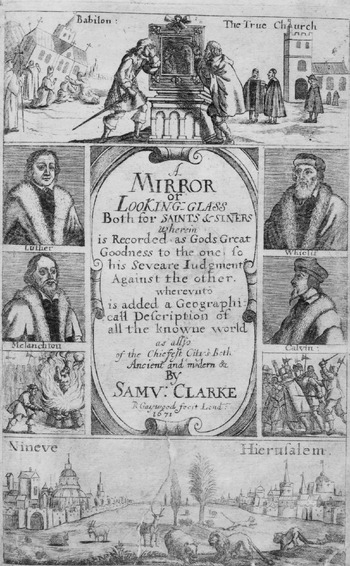
The starting point for this investigation is Samuel Clarke's 1646 edition of A Mirror or Looking-Glass Both for Saints and Sinners, which the seventeenth-century preacher and author John Bunyan probably used as a source for material in his Life and Death of Mr. Badman. In Bunyan's guide on how to get to hell rather than heaven, in addition to using scriptural examples of bad behavior, Bunyan notes that he also includes examples drawn from life that he himself has witnessed; apparently not having sufficient “loose livers” among his own congregation to supply enough examples, he also incorporated materials from several compendia of God's judgments against the wicked, including Clarke and Synrock's God's Sword Against Drunkards. The title page of the 1671 folio edition of Clarke (fig. 1), has caught the eye of many readers.Footnote 2 The contents of the volume, however, seem designed to bewilder the modern reader, as it appears to be not only an encyclopedia of sin and a score card for saints but also an early modern trivial pursuit lover's dream, covering the “wonders of God in Nature,” “rare, stupendous, and costly works made by the art and industry of Man,” “the most famous cities, temples, structures, statues, cabinets of rarities…which have been, or are now in the world.”Footnote 3 As if that were not enough for one's money, it also describes all the counties in England and Wales alphabetically, “together with the cities and most remarkable things in them: as also the Four Chief English Plantations in America.”
If one compiles a list of titles from the period in question, one becomes aware of encountering “Mirrors” and “Looking-Glasses” in the library at an alarming rate—even in a casual survey, it is clear that during the 1640s through the 1670s, there were a surprising number of publications that used the trope of the mirror or looking glass as a key element in their title. Herbert Grabes's German treatise, published originally in 1973, helpfully catalogs the use of mirror imagery in Medieval and Renaissance English texts. Although Grabes announces firmly that he is not concerned with “mere ‘ideas’ of reflection or mirroring” but rather in identifying the tenors of the mirror as metaphor and in evaluating what he terms their “originality,” he does include a synoptic list of mirror titles up through 1676. As becomes clear from Grabes's catalogue, the mirror image was popular in titles of the sixteenth century, for example, the well-known Mirrour for Magistrates, first produced under that title in 1559 and reissued in thirteen editions by 1620, the trend in titles peaking perhaps
—Samuel Clarke, A Mirror or Looking-Glass Both for Saints and Sinners (1671), title page. Reproduced by permission of the British Library (BL1309.K.12).

in the 1570s and 1580s, for example, with Margaret Tyler's translation of The Mirrour of Princely deedes and knighthod in 1578, which also enjoyed thirteen editions by 1601.Footnote 4 However, he notes that “the absolute high point in England was…reached around and shortly after the middle of the seventeenth century,” and he states that, “at a conservative estimate … a remarkable 185” mirror titles appear between 1640 and 1660 alone. In contrast, in the 1690s he notes, there were only fourteen such titles. Grabes ascribes the popularity in the midcentury to the proliferation of what he labels rather vaguely, “polemical writing of a religious or political nature.”Footnote 5
Literary critics have suggested that the characteristically very long running titles of mid- and late seventeenth-century books, sometimes occupying the complete title page, function as both a marketing device to entice consumers and also a means of establishing a relationship between reader, printer, and author.Footnote 6 When one begins to survey the titles of books and pamphlets issued in the later part of the seventeenth century, through the Civil War years, Interregnum, and early Restoration, it becomes clear that the mirror or looking glass is functioning as an enticement to readers to purchase and peruse its contents, but it functions in this way with a very different set of associations with the words for early modern readers.
For the twentieth and twenty-first centuries, the mirror has been a critical element in psychoanalytic discourse of identity and its formation. It is essential in the narration of the dramas of the individual but also of the universal psyche. Take away the psychodramas associated with the mirror and you lose the concept of narcissism as well as the “mirror stage.” The first, based on the Greek myth in which a beautiful youth spurning the love of a nymph becomes transfixed instead by a reflection of himself in a pool of water, has become the code word for the self-obsessed individual, whose desire is only for him- or herself. John Milton, in 1674, ingeniously enough, cast the prelapsarian Eve in this model, having her nearly miss meeting Adam for the first time as she becomes entranced by her image in a smooth lake which “returned as soon with answering looks / Of sympathy and love; there I had fixed / Mine eyes till now, and pined with vain desire / Had not a voice thus warned me, What thou seest, / What thou there seest fair creature is thyself.”Footnote 7 In the second term, the mirror phase, the Lacanian drama of childhood is necessarily enacted in the presence of the reflective surface, where the preverbal infant, unlike our unfallen Eve, recognizes its image and identifies it as being “me” rather than the Other, and, never tiring of the relationship between the real body and the specular one, between the body and setting in the specular image, the child is captivé. Thus, for Lacanians, begins the lifelong drama of creating identities through deceptive images of the self, continued in reflected notions of self and others. Take away the mirror as the surface in which one sees one's present self, even though that image is subject to endless misinterpretations and reconfigurations, and you pull out one of the fundamental tools of the discourse of modern identity. If you think of this in literal terms, one can only imagine the dismay of, to rephrase Catherine Clément's label, the weary sons of Lacan if suddenly they were plopped down in a world where an infant would be highly unlikely to see him- or herself in a mirror before the child was walking and talking or, worse yet, when the child did finally confront a mirror to see not him- or herself, but his or her parents’ lost purse of money or even the child's future spouse smiling back, much less the devil.
The trope of the mirror title or “looking glass history” occupies an equally important although different role in the narratives of self and of the individual in history found in early modern English texts. This analysis will concentrate on texts written during the era of the English Revolution and Interregnum, periods in which fundamental issues about political identity, and the discourses of authority, both national and domestic, were being renegotiated and reconfigured. Through its play with the past and with cultural memories, the early modern mirror title promises the reader an articulation of time in a particular space, in a way now unfamiliar to a modern reader, promising as it does that in that space of the book, the past will be present, in order to identify the present, and in order to create the future. In the trope of the looking glass, the personal and that person's location in history and cultural tradition are brought into focus.
To ground this discussion of the textual trope of gazing into a mirror, it is necessary first to describe briefly the mirror as a household object in the 1650s and 1660s and how a seventeenth-century reader might respond to an invitation to look into a textual mirror. The terms “mirror,” “looking glass,” and “glass” can be used interchangeably during the latter part of the seventeenth century to indicate a reflective surface, but these terms also carry with them distinctive individual associations that mingle with the central one of reflectivity, because of certain changes in the technology of making mirrors that were occurring in that particular period in England and abroad. They are all reflective surfaces, but they are surfaces that are quite different in their performances and in the reader's (or viewer’s) interaction with them. The term “mirror,” according to historians of objects, generally was used to refer to any highly polished metal surface, a common and fairly widely available domestic object, while “looking glass” is more typically associated with glass plates with reflective coatings, what we typically think of as mirrors, but which were not widely available until the very end of the seventeenth century.Footnote 8
Interestingly, most of the studies done on the history of the mirror and also on its use as a literary trope are about French culture. Sabine Melchior-Bonnet's 1994 study, Historie de Mirrour offers a truly sparkling assemblage of information about the development of mirror making as an art designed for the royal courts, the spread of mirrors to the provinces, and the various medieval and modern uses of the mirror image as vice and virtue. English mirrors, however, only make it into one page of this study because, apparently, in Melchior-Bonnet's view, the French dominated the production and sale of the materials. Truly transparent flat sheets of glass were difficult to produce, since most blown glass was tinted with impurities and bubbles. Larger wall mirrors tended to be created from blowing a ball of glass and then pouring melted lead inside it to coat the side; the resulting rounded mirror, sliced from the glass ball, had the convex shape we see in painting such as van Eyck's The Arnolfini Marriage. It was not until 1660s and 1670s, when Italian glassblowers were lured from Murano to Paris to work with French craftsmen, that the technology to produce what we think us as a flat mirror surface was established. This was demonstrated in the astonishing triumph of French glass-making art, the Hall of Mirrors at Versailles unveiled in 1682, consisting of seventeen false casement windows each with eighteen unframed mirrors, giving the illusion of a large single pane of mirror, a technological feat simply impossible before this period.Footnote 9
Quite early in the seventeenth century, English glassmakers were also raiding Venice for workers on a smaller scale. As early as 1618, Sir Robert Mansell apparently employed several specifically to make looking glasses. However, as Graham Child in his history of mirror making notes, England had “a restricted output of small, often poor quality mirror-plates” during this period.Footnote 10 Interestingly, in 1640, it was Sir Robert's absolute control over the glass-making industry that was one of the targets of the newly recalled Parliaments’ decrees abolishing monopolies. Not until the Restoration did mirror making become established in London, with the incorporation of the Worshipful Company of Glass sellers and Looking-glass Makers in 1664, with a membership of eighty-five by 1675. It was George Villiers, second Duke of Buckingham and crony of Charles II, who shrewdly gathered up the patents involved in mirror making and founded the Vauxhall Glass Works and created a new monopoly, one lasting through the end of the seventeenth century.Footnote 11
Even with this expanded access to new technology, a large flat sheet mirror such as we mount on the wall today still would have been a vastly costly object in an English house. In effect, the size of a typical household mirror would be closer to that of the cover of a book than what we think of as a wall mirror today. As Benjamin Goldberg notes in his general history of the mirror, Pepys records that his wife purchased in 1664 a smallish looking glass for the equivalent of several hundred dollars today and that “the reasonable price for a finished mirror [at the start of the eighteenth century] was exorbitant,” with the mirror plate itself costing approximately ten times as much as the accompanying table and stands together.Footnote 12 It is not until the very end of the seventeenth century that one begins seeing larger mirrors for over the mantelpiece, with ornate carved wood or gilt frames, resembling picture frames, which are typical of the work of Grindel Gribbons.
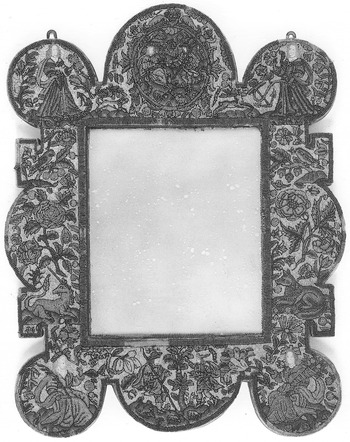
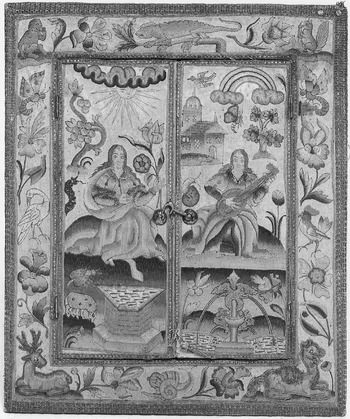
Smaller mirrors, made of different reflective surfaces such as polished metal, however, were more common and commonplace, although they took interesting forms. As Goldberg records, it was the fashion abroad among the social elite to include a small looking glass in the inner cover of a book externally resembling a prayer book. Late sixteenth-century pocket mirrors frequently had covers that depicted various iconic scenes and mythological characters, each associated with a story. Indeed, the elaborate covers and frames of the mirrors often outshone the mirror itself: English household mirrors were often framed, sometimes with needlepoint tapestries, as seen in the two accompanying illustrations of mirrors from the early 1660s (figs. 2–3). If one thinks about the ways in which
—English wall mirror, embroidered beaded frame, circa 1660

seventeenth-century English mirrors were contained and presented, when one looks in such a mirror, in addition to the reflective surface, the person who gazes at his or her image is also invited to read the images in thread worked by their proud women owners, creating a reflection framed by narrative, their image embedded in another's story.
Small mirrors, however, also played a variety of functions other than being used to check one's facial appearance, and it is worth noting here
—English wall mirror with tapestry frame and cover, circa 1660

how often the functions appear to be contradictory. Although such notions of the alternative uses of the mirror are usually labeled as superstitions in today's method of classifying systems of knowledge, perhaps the modern reader can momentarily suspend judgment and merely see them as part of an alternative view of the life of things peculiar to this culture. In popular culture throughout Europe, from the Middle Ages well through the nineteenth century, there existed the belief that a reflective surface does not recreate the present but instead reveals the future. This was sufficiently common that the divination of future events by use of reflective surfaces received the name, “catoptromancy” and was of some concern in the medieval church, which defined a range of reflective surfaces, from mirrors to swords, even to polished fingernails, that might enable the present viewer to know the future.Footnote 13
In the English countryside and villages, mirrors or looking glasses could also be used for the discovery of lost objects by so-called cunning men and women—a beneficial use of a reflective surface, which feeds into our sense of gazing into a crystal ball or a crystal glass; this use of crystal is to see not what is present, but what is absent. Alan Macfarlane records a good example of this, which was part of the Essex witchcraft trial proceedings in the sixteenth century, where witchcraft was proven in a case involving the recovery of stolen cloth: in an almost Fieldingesque blend of legalese and magic, it was determined at the trial that the “cunning man brought with him a looking glass (about 7 or 8 inches square) and did hang the said glass up over the bench.… And he had the said examinate look in it, and said as far as he could guess, he should see the face of him that had the same linen.”Footnote 14 Similar charges about the use of mirrors to locate lost objects or to reveal the identity of either wrongdoers or future wooers are characteristic also in the witchcraft trials in the 1640s and early 1650s.
Worth noting, too, is that the dominant theory of vision during the middle part of the seventeenth century was the Lucretian concept of optics, which holds that “the image stemmed from the object itself, which emits very fine corpuscles called simulacra, appearances, or forms (eidola), which issue forth in all directions and then pull together at the moment they meet up with the eye.”Footnote 15 In Lucy Hutchinson's mid-seventeenth-century translation of Lucretius, she explains to the reader in the section on mirror images that the projection or ejection from the mirror is what creates what seems to be an “image beyond the glass”: “through the glances of the exteriour light / Brings in the outward objects to our sight. / So, when the glasse the image first ejects, / Before that it upon our sight reflects, / It putts in motion all the ayre that flies / Betweene the glasse it comes from, and our eies, / And all that moving ayre which thus it drives / First strikes our sight, before the glasse arrives.”Footnote 16 Following that first impression, “when the glasse it self comes to our sence, / The image cast from us, reflected thence, / Returning to our sight, we then behold / Allthough the ayre it chases is first rolld / Before our eies, and doth its touches give, / Before we can the thing it selfe perceive, / Which makes the image seeme beyond the glass.”
In addition to their properties both to reflect images directly back and to generate and project still other images to the viewer, mirrors also paradoxically had the ability to absorb. This is why folklore demands that in the house of a dying person the mirrors be covered lest their souls should become trapped within the mirror. The reflective surface of the mirror also could be used as protective measures, especially against witches. So-called witch balls or spherical mirrors that could be hung in the corner of a room date also from this period in England in the seventeenth century: since witches supposedly cannot bear the sight of their own reflection, or in some stories have no reflection at all, it effectively will prevent a witch from being in any part of the room.Footnote 17
Thus, to be invited to gaze into a mirror or looking glass would open up the possibility of a wide range of experiences to follow. When we turn to its presence in the titles of written texts, we might at first think that it functions merely to indicate that a description of an exemplary life or type of sinner will be invoked. There are, interestingly enough, almost no examples of this sort of text using the trope of a “portrait of” or a “painting of” a type of person or event as the title, a convention that became important in the eighteenth century and that might seem more familiar and logical to the modern reader. That is to say, readers in the 1640s–1670s were being invited to view a “looking glass” for a good woman, a drunkard, a religious prince, or children, but they were not invited to see their picture or portrait; that is, they were not directed to look at man-made recreations of appearances. When the looking glass is incorporated into the title of a book or treatise, it operates as an invitation to read in a certain fashion; what is interesting about the proliferation of titles during the 1640s–1670s identified by Grabes is the ways in which the trope is used to invite different types of reader participation in the construction of the contents.
The looking glass trope was found to be useful for several different types of projects. Following Grabes's lead, one can classify types of texts using mirrors/looking glasses in their titles. First of these are treatises that are collections of examples drawn from scripture, history, and contemporary times, such as Clarke's A Mirror or Looking-Glass Both for Saints and Sinners; second, treatises using arguments from scripture to analyze specific contemporary religious and political conflicts, such as the anonymous pamphlets, A Mirror; Wherein Rumpers and Fanaticks…May See their Deformity, and abhor both themselves and their actions (1660) and The Female Duel, or The Ladies Looking-glass. Representing A Scripture-Combat about business of Religion, fairly carried on, between a Roman Catholick Lady, and the wife of a Dignified person in the Church of England. Together with their jyont answer to an Anabaptists Paper sent in defiance of them both: Entitled the Dipper Drowned (1661); third, treatises devoted to mechanical arts, including mathematics, architecture, optics, and navigation, such as Speculum Nauticum. A Looking-Glass for Sea-men by John Aspley that instructs one on the use of the plain scale in navigation; fourth, almanacs and broadsides, as seen in Speculum perspicuum Uranicum: Or a Glasse wherein you may behold the Revolution of the year of our Lord Christ 1655; and finally, fictional narratives, as found in Edward Panton's Speculum Juventutis: Or, A True Mirror where Errors in Breeding Noble and Generous Youth, with the Miseries and Mischeifs that usually atten-d it, are clearly manifest; as likewise Remedies for every growing Evil. Portray’d to the Life in the Legend of Sisara and Vallinda (1671). In this context, it is worth noting that while Melchior-Bonnet postulates that the mirror served as an “omnipresent metaphor in all spiritual literature of the Middle Ages,” she attributes the power of the metaphor to the fact that “optical science, which, during this era, rose to the highest rank among sciences and enjoyed, as did the art of glassmaking, an unequaled prestige.”Footnote 18 It is no coincidence; one feels that during the latter part of the seventeenth and early eighteenth century, the center for development of optical theory was without doubt England, and, indeed, one finds the interest in the science of optics merging with the older theological and philosophical uses of the metaphor in the titles of this period. As the title page for Joseph Moxton's 1670 Practical Perspective makes clear in its offer to teach the reader “Catoptricks, How to Delineate confused Appeareances, so as when seen in a Mirror or Pollisht Body of any intended shape, the reflection shall shew a Designe,” the mirror technology for looking awry was a well-established convention for readers and viewers.
The simplest of these looking glass texts is the broadside. We find a group of mirror titles in the very early 1670s. A Looking-Glass for a Bad Husband: Or, a Caveat for a Spend-thrift (1670) is joined by Fancies Favourite, or The Mirror of the Times (1670), A Looking-Glass for Ladies, or A mirrour for married-women (1674), and A Looking glass for a Covetous Miser: Or A comfort to a Contented Minde (1673). All of these large folio sheets feature a very long descriptive title, a woodcut related to the subject, the song to which the new material is to be sung, and the lyric. Illustrated broadsheet ballads were intended to be posted and were often hung on walls, and their pictures were an important part of their appeal.Footnote 19 So, in effect, the broadside mirror text acts as a textual wall mirror for the reader, except, of course, the image is ejected, to use Hutchinson's terms, not reflected. By looking at the picture of the young lady contemplating her gallant suitor, or the contrast between the dissolute drunken, spendthrift husband and the virtuous and rather Cromwellian good husband, the reader/viewer is invited first to recognize the image of a type of character or situation and then to participate in the drama or story set forth in the lyrics, often by direct address to the reader or hearer to step inside the frame themselves.
You that are bad Husbands,
I pray you drawn near,
Good counsel here's for you,
If you will give ear:
Then observe it rightly,
And bear it in mind,
A great deal of Benefit:
In it you’ll find.
Here you may learn how
To live gallant and brave,
If you will endeavour
For to get and save.Footnote 20
Ten stanzas follow recommending those who intend to be good husbands to be careful and saving of their money, to love their good wives, and especially to avoid bad company. In contrast to the excellent husband, illustrated with a suitably sober gentleman, we are offered a second image of an inebriated lout and told that
But some there be that
Will at an Ale-house sit,
And waste away credit,
Both money and wit:
Until they have spent all,
They will nere quiet rest,
But makes themselves
Worser then is any Beast.
We see similar patterns of inviting the reader or listener to view the woodcut image and then to join in the actions of the figures depicted in the “mirror”—“Come, come, away you Maidens fair / This song to you I will indite, / ‘Tis of a Young Man I’ll declare / who in his praise I needs must write,” opens Fancies Favourite, who goes on to describe the patient lover as “the mirrour of the times is he” in his steady devotion. The song advises the maiden not to be coy, like the rather odd-looking lady holding a mask in her hand in the woodcut, but instead “You maidens all that hear my Song, / I would not have you for him long / But if you do, persuaded be / You may find some as good as he.” Footnote 21
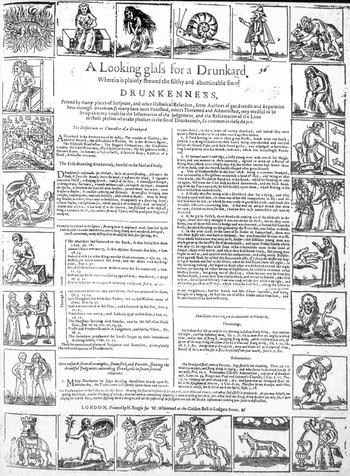
Another 1670 broadside offers the reader not new lyrics to an old tune but instead a wallchart of depravity. A Looking Glass for a Drunkard is framed by a series of separate panels that a caption at the bottom helpfully glosses for us: the panels show us “the several postures of Drunkards, both men and women, and what sad effects it produceth. As you may behold, one killing his friend, another picking of a Locke, man and woman committing adultery, a woman killing her child, &” (fig. 4). Physically, the broadside very much resembles the tapestry-framed small wall mirrors of the period with its frame of different images and its text in the center; one is invited visually to move from the larger images of drunkenness to the extremely fine print that offers examples first from Scripture “showing how Drunkenness made some fall by the Sword, others become Murderers, other being drunk were murdered and betrayed; incest committed, many destroyed in the midst of their sins-sporting &c,” then follows with “several examples, Domestick and Forrein, shewing the dreadful Judgments attending Drunkards in several relations,” to conclude with “Threatenings and exhortation to Drunkards.”Footnote 22
The content of the textual examples is nearly as interesting as trying to figure out the various sins in the picture panels. The foreign and domestic examples are both contemporary and historical and in no particular order. Indeed, the act of reading them straight on in sequence completely disorders and disorients one's sense of chronology and space: we learn of the sad fate of the Dutch slaughtered by the Turks on
—A Looking Glass for a Drunkard. Reproduced by permission of the British Library (BL816.M.22).

St. Martin's day because they were too drunk to defend themselves; of a Turk in his own country sentenced to have boiling lead poured down his throat for drinking; and move with no transition to a “lusty young man with two of his Neighbours and one woman in their company” at Barnwel near Cambridge who drank an entire barrel of strong beer and within twenty-four hours were dead, to a Godmanchester man in 1618 who fell on a pitchfork while unloading hay, to three Norfolk drunkards at an unspecified date leaving an alehouse and falling in rivers, falling from horses, and freezing to death, concluding with the case of one Peter Bester, who in 1556 in Switzerland in a drunken state gave his body to the devil only to become paralyzed and die miserably.
One finds that same disorienting historical perspective when one examines closely the contents of the broadsides’ textual opposite, the massive folio volumes with which this essay opened, Samuel Clarke's A Mirror or Looking-Glass Both for Saints and Sinners, which first appeared in 1646 and was enlarged and reprinted four times by 1671. He also wrote one other looking glass text, A Looking-glass for persecutors (1674). Clarke has mostly slipped past the historian's gaze, both literary and social, except for Paul Hunter's sharp-eyed rescue of him from oblivion and placing him in the context of the pleasures to be found in reading didactic literature in his study Before Novels. It is a little strange to me that Clarke does not figure in accounts of the shift in historiography that Norbrook identifies, because, as Hunter notes, in addition to collecting lives of saints, sinners, and notable clergymen, Clarke also wrote histories of Queen Elizabeth, Sir Francis Drake, Hannibal, Edward II, Nero, Judas, William the Conqueror, and Tamerlane, to name just a few.Footnote 23 He also published a chronological gazette of historical events called The Historian's Guide, which begins with Adam in the year “0” and continues to the present, or rather his present. Perhaps the reason for this is as his friend Richard Baxter said in the epistle to the reader of the posthumously published The Lives of Sundry Eminent Persons in this Later Age (1683), “we have disswasives and perswasives to this kind of History”:Footnote 24
Some Enemies deride [Clarke] for Writing Lives with no more Art: But I take that to be his Commendation; He did not make the Histories, but take them made by faithful acquaintance of the dead: And he was not to patch or paint the dead, nor to add any thing of his own, but to deliver naked truth:… I see Mr. Clarke is but the reciter of other mens words, and the Collector into one Volume of many mens lives.
The contents of the looking glass volumes are collections of individual personal histories, grouped by topic. Baxter notes of A Mirror or Looking-Glass Both for Saints and Sinners that “some good men say, that many of the lives of excellent men in his first Book are short and dry,” but Baxter states firmly, “that's our loss, but none of his fault.… To have made Stories himself had been unworthy a Historian.”
Clarke himself describes the contents of his looking glass histories as being,
the Fruit of my spare Hours, it having been my Recreation for these many Years, to read the best histories which I could meet with: And for the help of my Memorie, I have collected the eminentest & most remarkable Examples which did occur, and reduced them under several Heads, distinguished into several Chapters: Which I have found very useful, profitable, and pleasing unto me; and presuming that they may be so to others also, I have now this Fourth time published them to the world, that so they which either have Money to buy, nor Leisure to read many Volumes, may find in this little Epitome, the choicest and cheifest things in them. Footnote 25
As it soon becomes clear, however, Clarke has indeed shaped and fashioned rather than cut and pasted his individual looking glass histories. He notes that in addition to textual sources, “I have also sometimes set down more pleasant stories, which may have their use, and prevent Tediousness to the Reader.” Also he “inserted some memorable Examples from my own observation and from the Observation of other godly Ministers who have friendly imparted them to me, which were never before in Print.” In the first edition, the material is presented in chapter form, but, by the second, a helpful alphabetical list of topics is included to help the reader navigate through the over two thousand entries; by 1671 the contents have become alphabetized, leading off with “Abstinence, Temperance and Sobriety in Meats, Drinks, Apparel, Riches, and House-hold Furniture,” and concluding with “Women Learned,” “Women Constant,” and “Zeal, blind and bloudy.”
On reading one of these sections, it becomes clear that looking glass histories are catoptric spaces, where the reader's questions about the present and the future can be answered by looking at the past—“Doest thou see the enemies of Gods Church to thrive, and prosper in their Malice and Cruelty? Here thou maist see what the end of them is like to be, if they speedily repent not,” Clarke assures us. Likewise, “Wouldst thou see the amiableness & desireableness of Vertues & Graces? Here thou maist see it held forth unto thee in excellent Mirrours, or Looking-glasses…Would thou find out, and propose some choice Patterns and Presidents for thine Imitation? Here thou shalt find store, and variety of them.”Footnote 26 Like the physical mirror surrounded by a visual text, the reader cannot help but see others while seeking to see him- or herself; like the broadside mirror texts, the reader is invited in, to see him- or herself through gazing not on one's own image but by contemplating the projected representations of the others. By reading these little personal historical narratives, light is projected on current events, and possibly on future fates. By stocking one's personal memory with these scenes from other's past experiences, one is given a narrative, Clarke suggests, which enables a reader to negotiate the perilous times of war and political instability.
Unlike later Whig structuring of the past, the historical past as represented in these little collected biographies and accounts of significant historical moments does not proceed as a type of logical progression or organic, developmental progress. Although it may well seem that Clarke has an obsession with lists and ordering systems (apparently shared by his wife as seen in his account of her private writings), the effect of reading these encyclopedic volumes is anything but orderly. Entering one of Clarke's topics puts one “in” history, but it is a type of history in which chronology and geography are irrelevant. In the same fashion as the broadside mirror for drunkards moved the reader back and forth through time and space at dizzying rates, so, too, does Clarke.
For example, one might expect the section on “the wicked lives, and woful deaths of many of the Popes and Popelings” to have some sort of chronological structure. In Clarke's history of the Catholic Church, however—written so that “the common people [who] are kept in such miserable ignorance” may be convinced of the proposition “That Rome is Babylon, and the Pope Antichrist are things now so evident and notorious, that few question it”Footnote 27—any sense of historical continuity, development, or change is impossible to detect. He opens with “Pope Joane, whose proper name was Gilberta, a Dutch woman, cloathing her self in mans apparel, and attaining to learning, procured to be chose Pope under the name of John the Eighth: who afterwards playing the whore, fell in travel in the time of a solemne procession, and died thereof,” but the accounts of the sins of the various other Pope Johns is interrupted by the account of Pope Stephen the sixth, who supposedly dug up his predecessor's body and cut off its fingers, from whence we leap rapidly to Pope Benedict the ninth, who attained his title through sorcery and was strangled by the devil. This chapter runs for eleven pages, through a gallery of lustful, war- and whore-mongering illiterates, most of whom met with lurid deaths. Historical events and persons are introduced, but seemingly at random: Dr. Crammer appears to plead before the pope for Henry VIII's divorce shortly before we read about King John of England being killed by an emissary of the pope's with wine laced with “the poison of a filthy toade,” which is immediately followed by Catesby's 1605 powder plot.Footnote 28 Events are important, people are important, specific dates are important—but chronology or the ordering of dates, the very glue and cement of traditional histories, is not.
As with the broadside text on drunkenness, Clarke likewise introduces contemporary examples and mixes them indiscriminately with biblical, classical, and historical ones. It rapidly becomes clear that the broadside compositor was an admirer of Clarke's text, for after opening with scripture, Clarke moves into accounts from Plutarch, and then we meet again the drunken Dutch slaughtered by Turks. In Clarke's narrative, this is followed by King Edgar of England, a citation from Demosthenes, Alexander the Great, and “not long since a Cavalier in Salusbury in the midst of his health drinking and carrowsing” toasted the devil, which resulted in, after a “hideous noise and …a stinking savour,” him being whisked away through the window. This sets off a string of English events, in which it is noticeable that women often feature as participants, such as the hostess at an inn encouraging her customers to drink resulting in God causing her tongue to swell to such an extent she died three days later.Footnote 29 The chapter ends with a series of dated events, with specific names attached, Richard Bourne in 1621, Thomas Alred in 1618, John Vitner 1628, the sad fate of five drunk Bohemians in 1551, and concluding with Anacreon and the Emperor Zeno.
Quite clearly, chronology is not important to Clarke's method of recording personal history; nor would it appear is geographical location, in the sense of being used as a means of organizing materials. The reader moves back and forth between time and place within the narrative rather than proceeding in a logically straightforward manner. As in the décor of sword/sorcerer films and TV programs, the magical historic past represented there seems to be compiled of a happy hodgepodge of whatever historical costume drama outfits and weapons are handy on the set, mingling iconography of Arthurian knights with Greek deities and ninja footwork, so that all the past is simultaneously present in one space. What Clarke's equally chaotic presentation does, however, is to suggest that the past need not stay firmly in one place, that there seems to be a continuity in action and result that transcends any particular moment or place. Ancient history mingles casually with recent events; scoffing cavaliers rub shoulders with drunken Anacreon, John Bone of Ely, a coachman, with Alexander the Great. By looking at these examples from the past, the reader is invited to insert him- or herself into the collage composed from other's histories, to project their image into the looking glass, as it were, and to become part of the story through “seeing themselves” as present in the representations of the past. In looking glass history, one sees oneself textually and knows oneself, not by gazing at one's own reflected image but by shifting the perspective to one side, looking awry, gazing first at others and then projecting oneself into others’ images.
In writing his own autobiography, Clarke does follow a more orthodox chronology and records the important events and people with whom he dealt during the 1640s and afterward. The looking glass factor, however, is also very much present here, too. In recounting his conflicts with Bishop Morton in Warwickshire and his meeting with Charles I, he also interweaves the fates of some of his parishioners, such as the “lusty young woman, Daughter of John Waldren,” who danced on the Sabbath and died miserably three days later. As he tracks the hand of providence in his own participation of the events of the war and afterward, the national and the political are never divorced from the particular and the local. History is not abstract and distant from Clarke, nor is it only kings, bishops, and battles.
It is clear from Clarke's own account of his historical labors that Clarke envisioned the looking glass history as capable of infinite expansion and elaboration, growing from a mere twelve or fourteen sheets in 1646 to what he reckons as two hundred forty sheets by 1657. After being ejected himself from his ministry by the Act of Conformity, he found even more time to read, compose, and revise his histories. Unlike Clarendon, Hutchinson, or Harrington's accounts of the events of their days, Clarke, by his continual expansion of the A Mirror or Looking-Glass Both for Saints and Sinners over nearly a thirty-year period, gives one the sense of history being always in motion and commotion. It is notable that unlike formally structured histories, there is room in Clarke's to record the lives of common people, laborers as well as emperors, women as well as men, going about the business of governing countries as well as governing religious households.
What might Clarke see when he looked in his mirror? Apparently from this text, he saw history, memory, and tradition. He saw great emperors and theologians and drunken farmers and wayward wenches, women as well as men engaged in using the catoptric mirror to make a design out of the seeming disorder of the times. In it he saw the past simultaneously with the present, and, thanks to “catoptromancy,” perhaps the future, too. He invites his reader to use the mirror to see awry, that is, to be able to see themselves clearly by repositioning themselves, readers who were already familiar with the convention of physically framing mirrors with illustrative scenes and stories. Using the trope of the mirror in a book title, looking glass historians urge the reader/viewer to place themselves within the stories so closely tied to both early modern physical mirrors and textual ones, to see oneself along with seeing others. Clarke, as well as his clearly enthusiastic seventeenth-century readers both male and female who propelled the expanded editions, experienced history differently from the formal national accounts of monarchs and statesmen.
Speaking more generally, what interest does this trope of the mirror title, so popular during this particular period of English history, hold for the modern reader? For the modern reader, Clarke and other mirror texts continue to invite readers inside, in search of self and of history, but also to reconsider the ways in which history itself is structured, presented, and ejected from the text. In this seemingly quaint set of early modern beliefs about mirrors and history, so closely tied to the optical technology of its day, what is there for the postmodern? Historians, whether literary, cultural, or political are still engaged at times, in my opinion, in a type of looking glass dynamics with the past—it is seductively easy when gazing at the historical past to remark with some satisfaction, “look, they are just like me,” narcissus-like in our gaze and our desire. Perhaps a step away and awry would be in order—the figures in the past are simply not like us in many different ways, in terms of linguistics, science, systems of belief, and simple material existence. The desire to find similitude, however, in itself is not, I think, a bad move, as Clarke repeatedly points out; perhaps the value in the looking glass text for the postmodern viewer then is to be forced to look at the past from a disorienting perspective and to see the distinctions and the differences, while still being permitted to observe that, “in spite of all the differences, I am in many ways still like them.”