Introduction
The existence of life on planets within multiple star systems has been long thought to be, at best, capable of providing only marginal habitats. We recently introduced a mechanism (Mason et al. Reference Mason, Zuluaga, Clark and Cuartas-Restrepo2013) that we will now refer to as the Binary Habitability Mechanism (BHM), by which tidal interaction between stars in moderately close binaries provide a means for improved habitability conditions. Namely, for some combinations of eccentricity and orbital period, a sufficiently strong tidal torque exists between the stars. This torque, i.e. a breaking tide, often results in the slowing of stellar rotation rates to synchronous or pseudo-synchronous locking with the binary period. The larger star synchronizes first and in many cases this locking occurs on a timescale faster than the standard mass-loss torque experienced by single stars. This rotational evolution reduces the stellar magnetic dynamo thereby substantially reducing extreme ultraviolet (XUV) flux and stellar wind flux from coronal emission. Atmospheric erosion is especially important before planets develop dynamos and therefore have magnetic protection (see e.g. Zuluaga et al. Reference Zuluaga, Bustamante, Cuartas and Hoyos2013).
The idea that planets in multiple star systems might be habitable is not new (Huang Reference Huang1960). Harrington (Reference Harrington1977) used numerical integrations to show that planetary orbits may be stable in either p-type (circumbinary) or s-type (satellite) configurations. In the current paper, we focus on p-type planets as they may undergo tidal evolution. Harrington found that stable orbits exist as long as one of the semi-major axes is 3–4 times longer than the other. This result was confirmed by Holman & Wiegert (Reference Holman and Wiegert1999), providing the stability limitations used in this paper. Haghighipour (Reference Haghighipour2009) addressed theoretical pros and cons associated with the formation of planets in both p-type and s-type planetary systems. The dynamical stability of exoplanets and protoplanetary disks of binaries in the solar neighbourhood were studied numerically by Liu (Reference Liu2012). Theoretical circumbinary ice lines, assumed to separate rocky planet zones from giant planet zones around stars, have been calculated by Clanton (Reference Clanton2013), who finds in particular, that solar-mass twins may have ice lines outside of the stability limit as long as the binary separation is less than 1 AU. The theoretical binaries presented in the current study (see Table 1), are well within this limit, so they potentially have rocky planets.
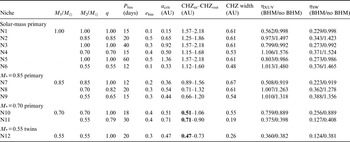
Selected binary habitability niches. Here the masses of the primary and secondary are M1 and M2, respectively, q = M2/M1, ebin and Pbin are the eccentricity and period of the binary system, acrit is the critical distance for orbital stability, CHZin and CHZout are the inner and outer edges of the circumbinary CHZ and ηXUV;SW are the asymptotic time-integrated XUV and SW fluxes (see Eq. (1)). We compare the integrated fluxes when the BHM is operating and when we assume it is not. In cases for which the calculated CHZin is greater than the critical limit (N10, N11 and N12), the CHZin is set to be equal to the critical stability limit (values in boldface)

Several authors have developed prescriptions for determining the locations and widths of habitable zones (HZs) surrounding binary systems (Mason & Clark Reference Mason and Clark2012; Quarles et al. Reference Quarles, Musielak and Cuntz2012; Mason et al. Reference Mason, Zuluaga, Clark and Cuartas-Restrepo2013; Kane & Hinkel Reference Kane and Hinkel2013; Haghighipour & Kaltenegger Reference Haghighipour and Kaltenegger2013). The standard approach is to use the models of Kasting et al. (Reference Kasting, Whitmire and Reynolds1993), updated by Kopparapu et al. (Reference Kopparapu, Ramirez, Kasting, Eymet, Robinson, Mahadevan, Terrien, Domagal-Goldman, Meadows and Deshpande2013) and derived for single stars, along with various methods for dealing, most often approximately, with the spectral characteristics of the stars. Most recently, HZ definitions around single main sequence stars have been extended by the inclusion of a range of planetary masses (Kopparapu et al. Reference Kopparapu, Ramirez, SchottelKotte, Kasting, Domagal-Goldman and Eymet2014).
Consequences for planetary habitability are not limited to the restrictions placed by the standard HZ definition. Exposure of planetary atmospheres to high levels of the XUV flux, like those orbiting in the HZ of highly active stars, appear to have dramatic consequences.
For single stars, relations exist between age, rotation rate and magnetic activity (Basri Reference Basri1987; Wood et al. Reference Wood, Müller, Zank, Linsky and Redfield2005). Rapidly rotating stars are luminous XUV sources, due to intense chromospheric activity, and thereby undergo significant mass loss (Wood et al. Reference Wood, Müller, Zank, Linsky and Redfield2005). What we like to call ‘stellar aggression’ poses high risks to weakly magnetized planets. The effect lessens as the star loses angular momentum, via mass loss. These relationships have been used to evaluate the evolution of stellar aggression and its role in terrestrial planet habitability (Grießmeier et al. Reference Grießmeier, Preusse, Khodachenko, Motschmann, Mann and Rucker2007; Zuluaga et al. Reference Zuluaga, Bustamante, Cuartas and Hoyos2013).
When these relationships are applied to binaries (Mason et al. Reference Mason, Zuluaga, Clark and Cuartas-Restrepo2013), we find that early tidal spin-down of one or both stars produces an effective stellar rotational ageing. Thus a reduction of stellar aggression likely results in a reduction of mass loss from planetary atmospheres. However, there are two sides to the tidal interaction coin. For some binary configurations, especially those with short periods, P bin <10 days, the stellar rotation effect increases activity. Hence, XUV radiation photoionizes H and other atoms as well as heats and expands the outer atmosphere. Thereby driving mass loss from the atmosphere of exoplanets and thus reducing their chances for habitability.
We begin, in the ‘The binary habitability mechanism’ section, by illustrating BHM calculations for an ensemble of 12 p-type planetary systems. Different mass ratios of the binary are explored with several periods and eccentricities. The HZ limits of Kopparapu et al. (Reference Kopparapu, Ramirez, SchottelKotte, Kasting, Domagal-Goldman and Eymet2014) are applied and stellar models are used to determine continuous habitable zone (CHZ) limits. In each case, a hypothetical Earth-like planet is placed at the inner edge of the CHZ. Stellar rotational evolution and the resulting XUV and stellar wind (hereafter SW) fluxes as well as planetary atmosphere mass-loss rates are calculated as a function of time. Integrated XUV and SW values are compared to Earth conditions. We find niches comparable to or in some cases superior to that enjoyed by the Earth. We present four examples in detail. Specifically niches N1, N6, N7 and N9, are discussed in order to illustrate advantages some circumbinary planets have over single-star planetary systems.
In the ‘Binary benefits’ section, we identify several factors promoting habitability in BHM protected planetary systems. These include: (1) increased water retention (allowing lower mass planets); (2) multiple habitable circumbinary planets (due to wide and distant CHZs in some cases); (3) extended habitability lifetimes (for lower mass primaries); and (4) high photosynthetic photon flux density (for photosynthetic biomass production).
Finally, in the ‘Discussion and conclusions’ section, we summarize our results and suggest that BHM candidates should be among the targets selected for observation in searches for Earth-like planets such as the Transiting Exoplanet Survey Satellite (TESS) (Ricker et al. Reference Ricker2010) and the Planetary Transits and Oscillations of stars telescope (PLATO) (Rauer et al. Reference Rauer2013).
The binary habitability mechanism
In moderately close binaries, tidal interaction between stellar components is able to erode rotation and ultimately leave both stars in resonant states where the period of rotation is closely related to the binary orbital period (Mason et al. Reference Mason, Zuluaga, Clark and Cuartas-Restrepo2013). Since the rotation is closely correlated to chromospheric activity, a star whose rotation has been sufficiently reduced will be less aggressive, in terms of XUV and SW flux. Hence, there will be a corresponding reduction in planetary atmospheric mass loss. Our results suggest that planets will find better conditions to maintain life in circumbinary HZ orbits, when the BHM operates, as compared to single-star systems.
To apply the mechanism, we model several aspects of the binary system including: (1) the limits of the circumbinary HZ as a function of the luminosity of the stars; (2) the continuous circumbinary HZ, by incorporating stellar evolution models; (3) the star–star tidal interaction resulting in the rotational breaking of both stars; and (4) the binary extrapolation of single-star relationships between stellar rotational period, magnetic activity, XUV and SW evolution to derive (5) planetary atmospheric mass loss. An outline of BHM calculations and preliminary results for six Kepler circumbinary planets were presented by Mason et al. (Reference Mason, Zuluaga, Clark and Cuartas-Restrepo2013).
To provide the reader an opportunity to explore BHM parameter space we have developed and tested a publicly available on-line tool, the ‘BHM Calculator’, BHMcalc (http://bit.ly/BHM-calculatorhttp://bit.ly/BHM-calculator). The spirit of this tool is similar to that created by Müller & Haghighipour (Reference Müller and Haghighipour2014). However, our aim is not only to provide renditions of the instantaneous circumbinary HZ, but also to calculate BHM properties of the system including those related to the rotational evolution of the stellar components and the combined XUV and SW fluxes as measured at different distances from the binary. Moreover, our tool provides numerical results that can be further manipulated and used to calculate other properties. For details of the models used by the BHMcalc and their validation please refer to Mason et al. (Reference Mason, Zuluaga, Clark and Cuartas-Restrepo2013).
For illustration purposes, we examine an ensemble of 12 binary configurations derived from four different primary masses, 1.00, 0.85, 0.70 and 0.55 M ⊙ (see Table 1). Here and elsewhere in this paper, we define the masses of the primary and secondary as M 1 and M 2, respectively, a bin is the semi-major axis of the binary, e bin is the binary eccentricity, and P bin is the orbital period of the binary. The semi-major axis of the planet is a, and the age of the system is τ.
The configurations shown in Table 1 are selected from among a continuum of binary configurations for which we have found more favourable habitability conditions. The BHM calculator generates stellar rotational evolution, time evolution and integrated XUV flux, time evolution and integrated SW flux, integrated planetary atmospheric mass loss, and insolation and photosynthetic photon flux density plots. We evaluate integrated XUV and SW proxies for Earth-like habitability to quantify stellar aggression. When XUV and SW proxies are less than corresponding values for the Earth, we call these favourable configurations, Binary Habitability Niches.
For each potential niche, we compute the limits of the circumbinary CHZ, defined as the region where habitable conditions, in terms of insolation and following the criteria defined by Kopparapu et al. (Reference Kopparapu, Ramirez, SchottelKotte, Kasting, Domagal-Goldman and Eymet2014), are maintained during the main sequence phase of the primary component. The edges of the circumbinary ‘instantaneous’ HZ have been estimated using refinements of the model proposed in (Mason et al. Reference Mason, Zuluaga, Clark and Cuartas-Restrepo2013). We have verified that our estimations are consistent with independent results obtained by Kane & Hinkel (Reference Kane and Hinkel2013), Haghighipour & Kaltenegger (Reference Haghighipour and Kaltenegger2013), and Müller & Haghighipour (Reference Müller and Haghighipour2014). For calculating HZs we have used the extreme limit criteria given as ‘Recent Venus’ (RV) for the inner edge and ‘Early Mars’ (EM) for the outer edge of the HZ. The evolution of stellar properties has been obtained from a fine grid of theoretical isochrones calculated by the Padova Group (Girardi et al. Reference Girardi, Bressan, Bertelli and Chiosi2000).
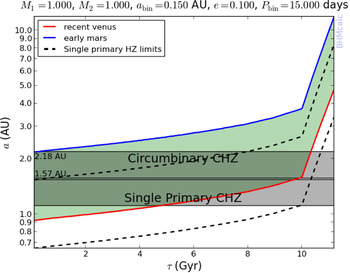
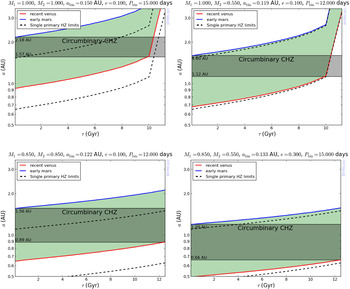
To illustrate differences between single and circumbinary CHZs, we present Fig. 1 showing the evolution of the instantaneous circumstellar and circumbinary HZ limits for a single solar-mass star and for solar-twins (niche N1 in Table 1). The limits of the CHZ in both cases are highlighted. To compare CHZs for niches N1, N6, N7 and N9, the CHZ for these cases are shown in Fig. 2.
Evolution of the habitable zone around a single solar-mass star (dashed lines) and solar twins (continuous lines) of niche N1. The masses of the primary and secondary are M 1 and M 2, respectively, a bin is the semi-major axis of the binary, e is the binary eccentricity, and P bin is the orbital period of the binary. The semi-major axis of the planet, a, is plotted as a function of the age of the system, τ. The stars are considered to be coevol. At τ=10 Gyr, the primary star abandons the main sequence. The position of the inner edge of the HZ at this time defines the innermost limit of the CHZ. Since the vertical scale is logarithmic, the width of the single-star CHZ and the circumbinary CHZ are shaded and appear equal, but do not overlap. However, the circumbinary CHZ ranges from CHZin=1.57 AU to CHZin=2.18 AU, whereas the single CHZ goes from 1.11 to 1.53 AU, i.e. the circumbinary CHZ of N1 is 45% wider and 42% more distant than in the single-star case.

The CHZ for selected binary systems, N1, N6, N7 and N9 are shown. The vertical axes are all shown on the same scale for easy comparison. The top two panels (niches N1 and N6) contain solar-mass primaries. For maximum longevity, those planets should reside at distances that are greater than the middle of the CHZ (shaded region). On the other hand, the bottom two panels (niches N7 and N9), involve lower mass primaries with planets optimally positioned at the inner edge of the CHZ. The horizontal scales and the corresponding CHZ limits for lower mass primaries are based on a final age of 12.5 Gyr, based on the age of the Galaxy. See the text for more details.

To evaluate how favourable a potential binary is, we need to calculate the level of stellar aggression to which a planet at a given distance from the binary is subject, compared with the level of aggression experienced by Earth. We have identified two proxies for aggression: (1) the XUV flux, i.e. the combined flux in XUV and in X-rays and (2) the SW flux. High levels of XUV flux are responsible for enhanced non-thermal and thermal mass loss from planetary atmospheres (see e.g. Tian Reference Tian2009). In addition, high SW fluxes are potentially able to remove tens to hundreds of bars from unmagnetized Earth-like planets (Lammer et al. Reference Lammer, Kasting, Chassefière, Johnson, Kulikov and Tian2009, Reference Lammer, Lichtenegger, Khodachenko, Kulikov, Griessmeier, Beaulieu, Dieters and Tinetti2012; Zendejas et al. Reference Zendejas, Segura and Raga2010).
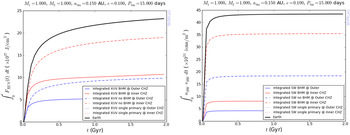
Since most of the aggression occurs during the earliest phases of stellar evolution, the time-integrated XUV and SW fluxes reach an asymptotic value within the first Gyr or so. Figure 3 shows the results of such integrations in the case of a solar-mass single star and solar twins at different positions inside their respective CHZs.
Time-integrated XUV (left) and SW (right) fluxes on the CHZ of solar twins (niche 1), shown including BHM (solid lines) and without BHM (dashed lines). For comparison purposes we have included the same quantity calculated in the CHZ of a solar-mass single star (single primary, dotted lines) and more specifically at the Earth distance (thick solid line). Note that in both cases the inner CHZ with no BHM is slightly below Earth values, this is because the Earth is closer to the Sun than the solar inner CHZ, which is at 1.1 AU.

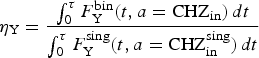
In order to compare to Earth-level aggression, we have also calculated the asymptotic time-integrated fluxes on an Earth-like planet, with semi-major axis a, located at the inner edge of the CHZ of a solar-mass star (a=1.11 AU) and at the analogous position, but around each binary habitability niche. The ratio of the latter to the former, η Y, is
 $$\eta _{\rm Y} = \displaystyle{{\int\nolimits_0^\tau {F_{\rm Y}^{{\rm bin}} (t,a = {\rm CHZ}_{{\rm in}} )\,dt}} \over {\int\nolimits_0^\tau {F_{\rm Y}^{{\rm sing}} (t,a = {\rm CHZ}_{{\rm in}}^{{\rm sing}} )\,dt}}} $$
where τ is an arbitrary time larger than 1 Gyr (we have assumed τ=2 Gyr) and Y stands for either XUV or SW.
In Table 1, input parameters for the selected binary habitability niches are provided as well as model outputs for CHZ and stellar aggression proxies. Notice that for mass ratios close to 1, as well as large eccentricities and periods, the critical distance a crit (Mason et al. Reference Mason, Zuluaga, Clark and Cuartas-Restrepo2013) can be inside of the HZ as in examples N5, N10, N11 and N12, which have been highlighted in bold text. In these cases, the inner CHZ values are determined by the orbital stability limit rather than the HZ limit.
The examples in Table 1 are selected to cover a range of mass ratios as well as several equal mass pairs and a range of orbital parameters. These are not chosen to be ideal or comprehensive in any way, only to provide examples for illustration.
For brevity, we focus the rest of the discussion on four examples, N1, N6, N7 and N9. Evolution of the HZ for two cases involving equal mass stars and two cases with disparate stars are shown. Niche N1, solar-mass twins and niche N7, 0.85 M ⊙ twins, are shown in the left panels of Fig. 2. Right panels of the same figure show examples of lower mass-ratio binaries. Specifically, niche N6, a solar-mass primary with a 0.55 M ⊙ companion, and niche N9, a 0.85 M ⊙ primary with a 0.55 M ⊙ secondary are shown. Two important properties are apparent. Binaries with a lower mass primary (bottom two panels) have a wider CHZ, due to the larger increase in luminosity of solar-mass stars (top two panels) as a function of time. Also, twins (left two panels) generally have wider CHZs than disparate binaries (right two panels) due to the minimal flux variation of twins as a function of binary phase.
Binaries with differing mass components and short periods or small eccentricities have critical distances well inside the inner HZ limit. The ability for a planet to remain in the CHZ for the entirety of the primary star's evolutionary lifetime requires it to be in the outer region of the CHZ near the beginning. For these purposes, we define the optimal distance, for solar or greater mass primaries, as being the one that places the planet in the HZ for the longest period of time; i.e. the early-Mars limit at ZAMS. Those binaries containing a solar-mass primary have long-lived niches for planets residing at distances that are greater than the middle of the CHZ. However, there is a trade-off. Distant planets receive less radiation for photosynthetic consumption than closer ones. So, for binaries with lower mass primaries, and hence long lifetimes; the optimum planetary distance is near the inner edge of the CHZ. This position maximizes stellar insolation as long as stellar aggression is sufficiently low.
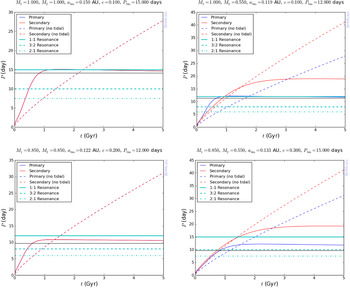
The essence of the BHM effect is the early tidal evolution of stellar rotation in moderately close binaries. We model the tidal torque using the formalism of Hut (Reference Hut1981) and Zahn (Reference Zahn2008). However, we include both the tidal synchronization torque and the standard single-star mass-loss torque to determine the time evolution of the rotation of both stars. Rotational evolution results for niches N1, N6, N7 and N9 are shown in Fig. 4. This selection provides an illustration of the variety of effects encountered. For example, in the top left plot involving solar-mass twins at low eccentricity, niche N1, both stars synchronize to the 15 day binary period in 0.5 Gyr. The lower left plot, niche N7, however, shows synchronization of the primary in 1 Gyr, but only a mild increase in stellar rotation period of the secondary until 2 Gyr. Notice for non-zero eccentricity, such as the top right plot, niche N6, a case of a solar-mass primary and M-type companion with e=0.1, the primary synchronizes to the binary period of 12 days. However, the rotation period of the secondary synchronizes over a longer time and to a longer period.
Stellar rotation period evolution for niches N1, N6, N7 and N9; the same examples as those shown in Fig. 2. These models include both the tidal synchronization torque of the binary and the standard single-star mass-loss torque. The left two panels show 1.0 and 0.85 M ⊙ twins, so the stellar components evolve to the same period at the same time. The right panels show two different mass ratios and one can see that the primary synchronizes first and in cases with higher eccentricity, such as N9, in the bottom right panel, the primary pseudo-synchronizes well short of the binary period, whereas the secondary synchronizes at a rotational period that is few days longer than the binary period.

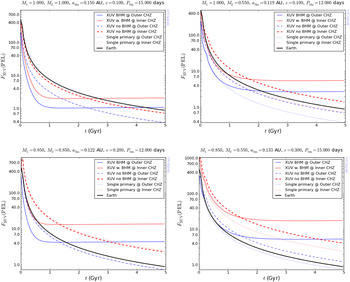
These early rotational evolution effects provide enhanced habitability over single stars during the early aggressive stages of stellar evolution. In Fig. 5, the evolution of XUV flux for the same niches shown in Figs 2 and 4 are presented. Time evolution plots show the dramatic decrease in aggression during the first Gyr in these cases.
Stellar XUV evolution for niches N1, N6, N7 and N9; the same examples as those shown in Figs 2 and 4. In each case, there is an early decrease in XUV flux. The effect of strong tidal breaking (see Fig. 1) on XUV emission during first Gyr is clear as the XUV flux drops precipitously. Tidal breaking results in a total integrated XUV flux significantly less than that incident on the Earth at all points within the CHZ (see Table 1).

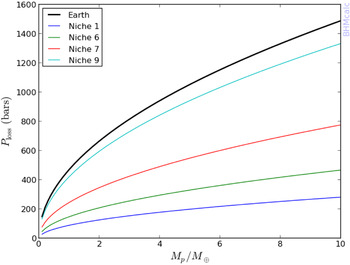
In Fig. 6, the time-integrated mass loss derived for niches N1, N6, N7 and N9, is shown as a function of planetary mass. For each niche, we consider a planet located at the inner edge of the CHZ, providing an upper limit. Mass-loss is compared to planets located at 1 AU from a single solar-mass star (i.e. at an Earth-like location). Mass loss is calculated for a non-magnetized planet having an atmosphere of arbitrary mass. That is, an atmosphere with no limits on the amount of mass that could be stripped-off by the stellar wind. For this purpose, we use the simplified model of Zendejas et al. (Reference Zendejas, Segura and Raga2010). We assume an entrapment factor of α=0.3 (see Eq. (2) in Zendejas et al. Reference Zendejas, Segura and Raga2010) and an atmosphere composed primarily of CO2. Massive planets, for a given density, lose more mass because they have a larger atmospheric cross-section exposed to the erosion of the stellar wind. Moreover, by expressing a given value of the total mass loss in bars it is clear that more massive planets, having larger gravities will also lose more pressure. Significantly, mass-loss for any of the binary niches examined here is less than planets in an Earth-like location, for any planetary mass and any point within the CHZ.
Atmospheric mass loss for circumbinary planets in niches N1, N6, N7, N9 (the same niches as those presented in Figs 2, 4 and 5) at the inner edge of the CHZ are shown as a function of planetary mass. The corresponding estimate for the Earth is shown for reference. In each of these cases, mass loss for an Earth-like planet is less than that experienced by the Earth at all points within the circumbinary HZ.

Binary benefits
Rather than discussing the limits of habitability as a function of atmospheric and geophysical variants, this discussion focuses on specific examples of binaries that provide conditions that are likely to promote planetary habitability equal to or beyond that experienced by the Earth. The idea that the Earth may not represent ideal conditions for the origin and maintenance of life, especially complex or intelligent life, is proposed by Heller & Armstrong (Reference Heller and Armstrong2014), who argue that Earth-like habitability (in single-star systems) may be enhanced by tweaking factors, such as: (1) reducing stellar mass, thereby increasing the lifetime of the HZ; (2) increasing planetary mass, thereby increasing the strength and lifetime of the planet's magnetic protection (see Zuluaga et al. Reference Zuluaga, Bustamante, Cuartas and Hoyos2013) and (3) increasing the semi-major axis of the planet, in order to increase its time in the HZ; just to name a few. In this paper, we show that this concept of super habitability naturally extends to circumbinary planets. So here, we elaborate on some exceptional circumbinary planet configurations.
We identify four benefits that a minority of main sequence binaries possess as the direct result of BHM operation. These are:
-
1. Water retention. Binaries could provide opportunities for lower mass planets and those with weaker magnetic protection as well as inner HZ (Venus-like) planets to preserve its atmosphere and key volatiles and hence to have better chance for habitability.
-
2. Multiplanet habitability. With ample water around some binaries, BHM might make it possible to have more than one habitable planet. Many circumbinary CHZs are wider and more distant than the solar CHZ. This can be potentially an advantage for a hypothetical panspermia mechanism as well as other potential advantages for advanced life.
-
3. Long habitability lifetimes. Binary systems with lower mass primaries could provide moist habitats for a timescale longer than the Hubble time. These binaries include stars that would likely be too active to sustain life as we know it as a single star.
-
4. Photosynthetic photon flux density. The amount of light useful for photosynthesis is sufficient in many cases to drive photosynthesis and some circumbinary planets may have more photon flux density that that received by the Earth, especially near the inner edge of the HZ.
Not all of these benefits are shared by all habitable circumbinary planets. Some details on each of these follow.
Water retention
If the period of a binary is longer than about 10 days and short enough and/or eccentric enough to allow for the operation of BHM; then synchronization of stellar rotation with binary rotation occurs. Planets within the circumbinary HZ experience reduced stellar aggression and potentially retain moist atmospheres. Details concerning the effects of increased, or decreased, XUV flux and stellar winds on planetary atmospheres and life are complex. The retention of water on the surface and in the atmosphere depends sensitively on the atmospheric composition (Tian Reference Tian2009) as well as geophysical factors such as volcanic out-gassing fluxes and composition.
It is clear that for solar-mass primaries in particular (see niches N1, N3 and N5 in Table 1) atmospheric mass loss and by proxy water loss, is expected to be less than that experienced by the Earth. This is the result of early synchronization for periods of up to 50 days depending upon binary eccentricity. In the case given as niche N3, very little synchronization takes place. Such niches exist without the aid of tidal breaking.
Multiplanet habitability
Most of the examples listed in Table 1 have wider HZs than that of the Sun, roughly 0.4 AU. These niches have not all been optimized for CHZ width which occurs for the lowest eccentricity binaries. Solar-mass twins, see Niches N1, N3 and N5, again, provide excellent habitability conditions having CHZs up to about 50% wider than the solar CHZ.
Circumbinary HZs are naturally more distant from the binary centre of mass than those of single stars of the same type as the primary. This is simply because there are two sources of radiation rather than one. Having a more distant HZ has an important effect for circumbinary planets. Because the Hill radius of a circumbinary planet depends directly on the semi-major axis of the planet and only weakly on the mass of the binary, circumbinary planets may have moons located farther from their host planet than is possible for single-star HZ planets. Heller & Zuluaga (Reference Heller and Zuluaga2013) investigated habitability of exomoons and find that moons may be adversely affected by the magnetospheres of the host planet. In addition, Moons too close to their planets may undergo significant tidal heating (Heller & Barnes Reference Heller and Barnes2013). A detailed study of the habitability of circumbinary exomoons is beyond the scope of the current paper, but larger Hill radii allow Moons to be located farther from their host planet and thereby they may avoid harmful effects of planetary aggression. For an interesting discussion on the potential habitability of exomoons at the Hill radius, see Hinkel & Kane (Reference Hinkel and Kane2013).
Long habitability lifetimes
A clear benefit is gained if life may be supported by lower mass stars. For circumbinary planets, the lifetime of habitability is limited by the evolutionary lifetime of the primary star. As one would expect, the CHZ lifetime increases for lower mass primaries. Ultimately for long-lived stars, it is the geothermal lifetime of the planet that determines its habitability lifetime, barring planetary scale intelligent engineering to prolong planetary habitability.
The points that follow apply equally to single stars and they do to binaries, because they concern the relation between the narrowing of the CHZ in comparison to the instantaneous HZ. In each of the examples shown in Fig. 2, BHM operates, providing reduced XUV flux, especially at early times, and lower atmosphere mass loss than the Earth has experienced for many billions of years. However, there are a few salient points to consider. In the top two panels of Fig. 2, the CHZ of binaries with 1.0 M ⊙ primaries are shown. We choose a 12.5 Gyr lifetime (of order the age of the Galaxy) as longer lifetimes are likely limited by planetary factors. For solar twins, the CHZ is less than half the width of the instantaneous CHZ. This effect is seen for solar-like HZ in Fig. 1, where it is apparent that the Earth is not in the CHZ of the Solar system. In the bottom two panels of Fig. 2, the CHZ of binaries with 0.85 M ⊙ primaries are shown. Over the course of 12.5 Gyr, the instantaneous HZ moves much more slowly outward for 0.85 M ⊙ primaries. For lower mass primaries the CHZ is essentially the same width as the instantaneous HZ. Hence, it is more likely for a planet in the instantaneous HZ to be in the CHZ if it has a lower mass primary.
Photosynthetic photon flux density
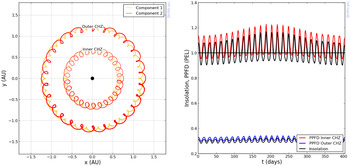
Photosynthetic photon flux density (hereafter PPFD) is defined as the number of photons incident per unit time on a unit surface area at the top of the atmosphere within some wavelength range considered to be available for use by photosynthetic life. See Kiang et al. (Reference Kiang, Segura, Tinetti, Govindjee, Blankenship, Cohen, Siefert, Crisp and Meadows2007a, Reference Kiang, Siefert, Govindjee and Blankenshipb) for detailed studies of this topic. Here we consider a PPFD bandpass of 4000–14 000 Å as a compromise between the extreme ranges used in those papers. In Fig. 7, planet centred coordinates, stellar insolation, as well as the PPFD received by a circumbinary planet orbiting in niche 9 is shown. From these plots we can see that variation in flux is increased for planets close to the binary. Variation in flux decreases farther from the binary, while insolation received near the outer edge of the CHZ is at a minimum level. The examples shown are for planets with zero eccentricity. For other cases, we refer the reader to the BHM calculator where these conditions may be explored. As long as the planet remains within the CHZ at all times, variability of insolation and PPFD will remain within the limits given by the examples shown.
In the left panel, planetocentric coordinates (in AU) are used to show changes in distance between the planet and the two stars of niche N9. The primary is shown in yellow and the secondary is shown in red. Two planets, with circular orbits, at the inner and outer CHZ limits are shown. In the right panel, the insolation (black) and the PPFD (red for the inner planet and blue for the outer planet) are shown in Earth equivalent units. The PPFD curve is higher than the insolation curve for both planets. Specifically, notice that the inner CHZ planet has an insolation about the same as the Earth, while the PPFD is significantly higher.

Both insolation and PPFD are calculated at the sub-solar point (in the reference case of the Earth) and at the sub-binary centre of mass in the circumbinary case. The time-averaged insolation of the circumbinary planet located at CHZ in is nearly equal to that of the Earth. As seen from Fig. 7, the PPFD incident on the circumbinary planet at the inner CHZ edge is a factor of ~1.1 times that incident on the Earth. The implication is that the additional PPFD provided by the lower mass companion to a solar-mass primary will supply increased energy to the biosphere over that available for Earth life. That is, a perfect Earth analogue of a binary of this type might be expected to generate significantly more biomass than the Earth.
Discussion and conclusions
To properly address the possibility of life on exoplanets, factors beyond the standard concept of the HZ must be considered. Mason et al. (Reference Mason, Zuluaga, Clark and Cuartas-Restrepo2013) identified a novel mechanism potentially enhancing habitability of circumbinary planets with respect to those found around single stars. In summary, the early tidal breaking of the primary's rotation results in a reduction of XUV and SW fluxes, which is expected to cause mass loss from planetary atmospheres. Main sequence binaries with periods in the 10–50-day range often provide excellent habitable environments, within which life may thrive. Planets and moons in these HZs need less magnetic protection than their single-star counterparts.
We have shown that BHM allows superlative circumbinary HZs. One of the implications of this discovery is that many binaries could potentially harbour planetary systems with more than one habitable planet per system increasing our chances to find habitable planets in the Galaxy. To see why this could be propitious for life, consider that many constraints on life are specific to entire planetary systems, independent of the number of worlds in HZs. For instance, life on rocky planets or moons likely requires the right abundance of volatiles and radiogenic elements for prolonged geologic activity. Catastrophic sterilization events such as nearby supernovae and gamma-ray bursts affect entire planetary systems not just specific worlds. Giant planets may either enhance or disrupt the development of complex life within a given system, irrespective of how many habitable planets exist in the HZ.
It might be rare for a particular planetary system to possess qualities that promote life and to be lucky enough to avoid cataclysm. However, multiple habitable planets within a planetary system may possess improved chances for advanced life to develop as panspermia may occur in planetary systems with several habitable worlds. We speculate that exomoons within a BHM-protected HZ, may be habitable in some cases as a larger Hill radius allows more distant exomoon orbits. The best predictor of life on one HZ planet might be the presence of life on its neighbour. Reduced stellar aggression, as the result of BHM, may mean that circumbinary habitability goes hand in hand with planetary systems with multiple habitable worlds.
We find that habitability around binary stars is more complex than that of single stars. Owing to this added complexity, especially via the operation of BHM; there is a broad diversity in conditions experienced by circumbinary planets. Single-star habitability on the other hand, appears to be a trade-off between long lifetimes and prolonged desiccative activity of low mass stars, versus the high luminosity, but short lifetimes of high mass main sequence stars. The Sun appears to lie somewhere within a fairly narrow single-star habitable niche. However, in BHM binaries that have lower than solar-mass primaries, long stellar lifetimes are accompanied by reduced activity. Obvious advantages of long lifetimes include more time for the origin and development of life and more time for life to recover from catastrophes producing mass extinctions.
In addition, the combined spectrum incident on some circumbinary planets may allow for the more rapid recovery from global catastrophes, because, in some cases circumbinary planets are bathed in considerable photosynthetic flux. Such high flux may allow for quick recovery, due to enhanced biomass production. Such cataclysms include impacts, supernovae and gamma-ray burst sterilization, and hyper-volcanism. It is possible that life is capable of modulating planetary conditions such as atmospheric composition, soil content and temperature. This is the so-called Gaia effect (Lovelock Reference Lovelock1972). Namely, life forms of a planet may adapt so well that they eventually couple with their environment in such a way that they act as a single self-regulating system. It is not clear whether or not the Gaia effect works on the Earth. However, it is natural to expect that the effectiveness of life to regulate habitability conditions of its host planet might be a direct function of the biomass the planet can manage to produce (Zuluaga et al. Reference Zuluaga, Salazar, Cuartas-Restrepo and Poveda2014). Photosynthetic photon flux density in excess of Earth levels suggests that these circumbinary planets should be considered to be super habitable.
Upcoming missions to search for planets such as the TESS (Ricker et al. Reference Ricker2010) and the PLATO (Rauer et al. Reference Rauer2013) are expected to discover many new planets. Some of these planets will be orbiting binaries. TESS is not optimized for planets located in the HZ of their host stars as they are most sensitive to short-period planets, since it will observe most fields for only ~27 days. Nevertheless, it will likely find many small planets located in or near the solar neighbourhood. Follow-up studies of these nearby putative planetary systems may reveal additional planets with larger orbits. PLATO is expected to discover many more planets and is sensitive to planets orbiting in the HZ. Detection of circumbinary planets is intrinsically more difficult than finding planets around single stars. However, the success of the Kepler mission in finding circumbinary planets despite no expectations, is encouraging. See Welsh et al. (Reference Welsh, Orosz, Carter, Fabrycky and Haghighipour2014) for a review of these discoveries.
Circumbinary HZ planets have been discovered and a mechanism for sustained habitability in these systems has been established. We therefore strongly suggest that binaries with BHM-protected HZs are strong candidates for extraterrestrial life and should be included in programmes to detect habitable planets.
Acknowledgements
This work is supported in part from incentive funds to P. A. Mason associated with an NSF/PAARE grant to the University of Texas at El Paso. J.I. Zuluaga and P.A. Cuartas-Restrepo are supported by CODI-UdeA.