The introduction of the gel-filtration technique was preceded by a combination of events which together make an extraordinary example of how scientific tradition, the prepared mind of the scientist, and close links between academia and industry are all utilized in an optimal way. (Janson Reference Janson1987, 361)
As you mentioned in your letter the pleasures of creativity give the best condition for achieving good research results. To optimize creative joy it is necessary that the individual researcher – within the framework of the Department's research programme – be given great freedom not only to choose research problems but in how to approach their solution. I and many other researchers at the Biochemical Department are very grateful to you because we have always enjoyed this inspiring freedom and have thus been given the possibility to experience great personal satisfaction in our work.Footnote 1
The publication of research results will not happen before Pharmacia has had an opportunity to partake of them. If it can then be claimed that publication would prevent or obstruct patenting of results publication shall be postponed until patent application has been filed.Footnote 2
Introduction
Current Scandinavian research policy tends to emphasize innovation and short-term economic goals. The case of Swedish “separation science” – concerned with separating large molecules like proteins for purposes of purification – shows that the development of commercially productive research may be almost glacially slow by contemporary policy standards and that it is embedded in cultural, social, economic, and political relations. The idea that science is socially constructed is at the root of a by now venerable tradition in the history of science. The purpose of this paper is to explore some mechanisms of what may be called the social construction of innovation – i.e. the emergence of a rationale for routine industrial collaboration and commercialization in academic research (that may indeed also have epistemological consequences). These mechanisms will be analyzed as discursive and social practices from the points of view of “moral economy” and “storytelling.” It will be shown how the idea of a “grand tradition” of separation science was used as a vehicle for creating a rationale for innovation whereas the moral economy of research – even innovation-oriented research – was not easily integrated within such a framework.
Separation was a specialty among Swedish physical chemists and biochemists at Uppsala University from the 1920s until the 1980s. In the decades after World War II they liked to describe Uppsala as the Mecca of separation science (or even of biochemistry), thinking of the Departments of Physical Chemistry and Biochemistry (Biokemiska institutionen, BKI) under the leadership of The (Theodor) Svedberg and Arne Tiselius, Jerker Porath, and Stellan Hjertén.Footnote 3 By 1960 three important techniques for separating and purifying large molecules had been invented or drastically improved there: ultracentrifugation, electrophoresis, and gel filtration; soon more were to follow, such as affinity chromatography.
The success of the Uppsala school was commercial as well as academic; in particular the long collaboration with the drug company Pharmacia was productive. Pharmacia was a small company before it struck up a partnership with Tiselius’ group in the 1940s, developing Dextran as a blood-plasma substitute (marketed as Macrodex) (Lundgren Reference Lundgren and Frängsmyr1987). It moved from Stockholm to Uppsala in order to facilitate further collaboration. In the 1960s it continued to grow, in time engulfing other companies that were also collaborating with the separation researchers (Frankelius Reference Frankelius1999). The slogan “United in Separation” was used in 1987 when Pharmacia merged with LKB, a competitor in the area of separation products that had been founded in the 1940s by, among others, Svedberg (fig. 1).
Centerfold advertisement in Bioteknik & Biokemi [Biotechnology & Biochemistry] 3 (1987).

The advertisement campaign emphasized that the companies were “genuinely Swedish,” that they had “historic ties to Uppsala University,” and that they were “guardians of the heritage from the Nobel Prize winners Theodor Svedberg and Arne Tiselius” as well as “world leaders in the area of separation science.” During the period when Pharmacia flourished and became one of the largest drug companies in the world it repeatedly used the connections with the separation scientists at Uppsala University, in particular the two Nobel Prize winners, as a “storytelling” device, in order to highlight the company's excellent academic credentials. And, as we shall see, the scientists too narrated stories about the science-industry partnership as seen from their perspective. This paper will discuss one success story of this kind in particular, namely that of Sephadex (Separation Pharmacia Dextran) – one of two Dextran products that helped launch the collaboration between BKI and the drug company and to lay a foundation for the latter's big pharma prominence.
A Grand Tradition in Science-Industry-Policy
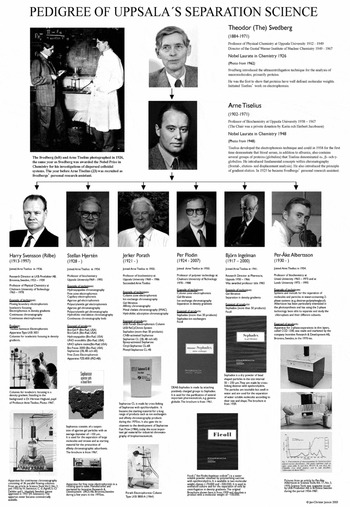
Like Pharmacia the chemists at BKI told stories about the vibrant history of separation science. Figure 2 is a representation of the genealogy of separation science from 2003, when the tradition had become mostly of historical interest. I use the term “Grand Tradition” to denote the idea, visualized by this poster, that separation science at Uppsala University had a long and successful history – comparable to e.g. those of quantum physics in Copenhagen or organic chemistry in Zurich.Footnote 4 It was used to define the image of the Uppsala scientists and was part of the internal culture at BKI. As we will see it has also been used in Swedish innovation propaganda.
The grand tradition of separation science as captured on a poster made by Jan-Christer Janson for an exhibition at Uppsala University in 2003. Used by permission.

The separation-science tradition originated with Svedberg and the ultracentrifuge, developed between the mid-1920s and the mid-1930s. Svedberg, much inspired by American ideals, was a trailblazer for university-industry collaboration, and his disciple Tiselius – whose main line of work was in electrophoresis – likewise went into partnership with chemical firms, in particular Pharmacia (Elzen Reference Elzen1988; Kay Reference Kay1993; Lundgren Reference Lundgren and Widmalm1999; Widmalm Reference Widmalm2004; Widmalm Reference Widmalm, Fors, Houltz and Baraldi2006; Widmalm Reference Widmalm and Widmalm2008). Tiselius followed Svedberg also in that he was a key player in the early construction of a Swedish research policy; he stopped being an active researcher in the early 1950s but was a leading policy player until his death in 1971 (Tunlid Reference Tunlid and Widmalm2008).
Soon after World War II, when various research councils were created, it was decided that scientists at universities funded by government grants were allowed to patent inventions made in the course of their work; hence Swedish scientists had economic incentives to commercialize innovations from the time the government system of science funding was set up (Nybom Reference Nybom1997; Benner Reference Benner2001). Tiselius supported patenting as a means to utilize research results and to obtain funding from industry. In this period the ruling Social Democratic party embraced a program of funding research for technological, social, and economic purposes and Tiselius threw his considerable authority behind these policies, arguing that science was the “life blood of welfare policy” (Tiselius Reference Tiselius1956; cf. Lundin et al. Reference Lundin, Stenlås and Gribbe2010). In order to underline this message Tiselius used an expression that would recur in almost everything he wrote on research and policy: that chance favors the prepared mind (Lundgren Reference Lundgren and Frängsmyr1987, 117). Tiselius interpreted Pasteur's dictum in the context of the so-called linear model – arguing that material progress depends on unpredictable fundamental research, and that the exploitation of such knowledge depends on a well-functioning system for research and higher education as well as on constructive collaboration between university and industry (Weinberger 1996, 192–194).
In the 1950s and 1960s the system of higher education and research was vastly expanded. Leading scientists worried that the bureaucratization of research threatened to remove them from direct political influence and in 1962, a Government Research Committee (Forskningsberedningen) was created in order to guarantee the scientific elite direct access to government and in particular the Prime Minister who chaired the committee. Through this committee and from other platforms as well Tiselius lobbied in order to promote what he called the “new biology” – including not only biochemistry but microbiology and molecular biology – frequently contrasting its usefulness with the relative wastefulness of Big Science (Tunlid Reference Tunlid and Widmalm2008, 105–107; Weinberger 1996, 243–247).Footnote 5 In particular he emphasized the importance of life science for the drug industry, of which his own laboratory provided a shining example. In this way the Grand Tradition of separation science was used as a model and simultaneously given legitimacy on the policy level. And funding for industry-related research did increase. In the early 1960s several new agencies for supporting such R&D were founded of which the most important was Malmfonden (the “ore fund” – financed through profits from the state-owned minerals group LKAB). Towards the end of the decade these agencies would be merged into a new entity, STU (Styrelsen för Teknisk Utveckling, the “Agency for Technological Development”) (Pettersson Reference Pettersson2012). Malmfonden and STU did not support fundamental research at all, and the fact that they became important sources of funding for BKI was symptomatic of the emerging symbiosis between the department and industry, in particular Pharmacia.
Moral Economy and Storytelling
From around 1930, when the centrifuge technology was established, a peculiar “moral economy of research” was established among the Uppsala chemists. Moral economy is here taken to mean a norm system that includes views on what characterizes good research practice in a technical and intellectual as well as a moral sense. A moral economy of research implies how scientists should conduct various kinds of exchange (intellectual, economic, symbolic), including what rewards are appropriate for productive work. It goes beyond officially recognized norms, like Robert Merton's CUDOS, and includes less explicit rules of behavior and valuations characteristic of historically specific scientific cultures. A moral economy must therefore be investigated empirically, as a practice (Atkinson-Grosjean and Fairley Reference Atkinson-Grosjean and Fairley2009; Daston Reference Daston1995; Rasmussen Reference Rasmussen2004). E. P. Thompson pointed out that the moral economy of the British eighteenth-century working class “re-echoed” the authorities’ “paternalist tradition” (Thompson Reference Thompson1971, 79). The same is doubtlessly true of modern research with the difference that select members of the research community are also members of the socioeconomic and political elite, so that the moral economy of research is shaped in a kind of political echo chamber.Footnote 6 This paper aims to give some sense of how the resonances of norms and ideals in science, industry, and politics were shaped in postwar Sweden. The moral economy of research that will be discussed was not static and not homogenous. There were indeed entrenched academic values at stake but these were never isolated from competing or complementary norm systems. I will focus in particular on the resonances and dissonance between academic and economic values.
The moral economy of research in Uppsala biochemistry was shaped by different forms of exchange – first and foremost within the scientific community. First, the international scientific exchange of the Svedberg-Tiselius network was intense: money and people circulated through channels opened up by the Rockefeller Foundation and with Uppsala as an important node (Kay Reference Kay1993, 112–13). The result was an Americanized scientific culture where journal publications and technical proficiency were highly valued. Second, a growing intimacy between scientists and industrial partners familiarized the scientists with the handling of conflicts between publishing and patenting, between scientific credibility and advertising, and between departmental and private economies (Nordlund Reference Nordlund2011; Widmalm Reference Widmalm and Widmalm2008). Third, a strong policy position seems to have infused the moral economy of research in Tiselius’ group with a sense of special national significance. This is an aspect of the moral economy of research that I will only be able to hint at here, but there are indications that BKI was promoted as a model for developments in Swedish science that was indicative of the ongoing exchange of norms between policy and laboratory levels above all through the activities of Tiselius.Footnote 7 It is hence fair to say that leading members of the Uppsala chemists’ network occupied a central position in an emerging “Triple Helix” of science, industry, and politics that took shape during the war years and that evolved thereafter from institutional platforms like the research councils or the Government Research Committee (Etzkowitz and Leydesdorff Reference Etzkowitz and Leydesdorff2000).
All of these influences helped shape a moral economy of research where science that was sponsored by local industry simultaneously was evaluated for its international academic impact, where patents had to be weighed against journal publications, where career opportunities at the university were compared with careers in private enterprise, and where laboratory organization was co-produced with national research policy. In this context the idea of a Grand Tradition of separation science, that included close collaboration with industry, served to stabilize the moral economy as it implied that simultaneous commercial and academic success was possible as well as desirable. As we shall see, however, there was no closure for the moral economy at BKI. Diverging narratives – indicating what Steven Shapin calls “normative uncertainty” – continued to flourish on individual as well as institutional levels (Shapin Reference Shapin2008).
The moral economy of research may be gauged from the various accounts produced by actors, accounts that exemplify “storytelling” in the sense that this term is used in connection with analyses of corporate culture. According to consultant Morgan Marzec, corporate stories that reflect company strategy, values etc. are manufactured in order to be told and retold “in the dynamic setting of everyday conversation on the frontline,” ideally so that employees (including managers) “commit to living their corporate story” (Marzec Reference Marzec2007, 34–35; emphasis in the original). In more critical accounts corporate stories are seen as a “vehicle for social control” that nevertheless express meaning on individual and collective levels (Boyce Reference Boyce1996, 7). The narrative about the Grand Tradition of Uppsala separation research is one such story that conveys meaning and justification to a balancing act between academic and economic norms. On a more general level the linear model itself functioned as a story, recounted innumerable times in policy; on a micro level there were stories about what happened at the moment of discovery, such as Tiselius’ favorite tale of serendipity. As we will see it underpinned a fusion of academic and economic norms, in effect creating a moral space where scientists could engage with private enterprise and still remain bona fide academic researchers.
Sephadex and the Prepared Mind
In the 1950s the tradition of separation science in biochemistry and the commercial interests of Pharmacia converged in the development and marketing of products for a new kind of separation, so-called gel filtration – the separation of substances through “molecular sieving,” a multi-purpose method with a huge market that has been used ever since. Sephadex made separation for research purposes and various applications – analysis as well as extraction – feasible on a larger scale than earlier methods. It was cheaper, not demanding heavy electro-technical or centrifuge technology, and it could be automated as the separation medium in effect cleaned itself and could be used again and again. The medium used in Sephadex was Dextran, the very substance that had brought the biochemical department and Pharmacia together in the 1940s. Hence the development of gel filtration was an outgrowth of knowledge established through years of collaborative work on a specific chemical substance. This does not mean that discovery was simple or even that we can say exactly how it happened.
Official accounts of the invention of Sephadex abound, and I will come back to some of them in the last section of this paper. Accounts emerging from BKI tended to emphasize the Grand Tradition but also the element of serendipity. Porath recounted in several papers how an Italian guest researcher had forgotten to turn on the electricity in a column of starch that was used for electrophoresis and that separation happened anyhow – interpreted by Porath as separation due to molecular size (Porath Reference Porath, Gehrke, Wixom and Bayer2001, 461–462; Porath Reference Porath1978, 173–174). This was the Eureka moment in the discovery of gel filtration. Tiselius repeatedly used this story, and a similar one concerning Macrodex, in order to illustrate that chance favors the prepared mind. The following quotation is typical:
The development of the gel filtration method and its manifold applications offers many interesting aspects of how research is done in reality. Laymen who are not familiar with science tend to believe that new discoveries or methods are developed in a strictly logical fashion. As we all know here, this is not the case. Research follows a very crooked way and it is first when we have arrived that we can say which way we should have chosen. Gel filtration in Uppsala started more or less by an accident: the electric current in an electrophoresis experiment was turned off by mistake but the separation in the column proceeded nevertheless. . . . One has sometimes remembered Arthur Koestlers [sic] description of research workers . . . as “Sleep-walkers” in his book with just this title. But, of course, the essential thing in this kind of work is and has always been “the prepared mind” which makes one stop and think when something unexpected happens. This is an attitude which I have always tried to encourage among my many associates in the Institute of Biochemistry in Uppsala.Footnote 8
Sephadex was born because there was a young researcher at hand, Jerker Porath, with a mind prepared by the already venerable tradition of separation science. Though development of method and product was carried out in a collaboration with Pharmacia – in particular with Porath's good friend Per Flodin who had been hired there from BKI – it was the academic scientist who led the work and who achieved the main scientific credit for it by having his name first on the 1959 paper in Nature that announced the discovery and which became a “citation classic.” This was the official BKI version of events.
The moral economy of research deducible from this story is a system of exchange and rewards where science comes first and economic effects are spin offs, produced by systematic and long-term research combined with happy coincidences. In policy contexts Tiselius, like Svedberg before him, emphasized that science should interact with industry but that its prepared minds and sleepwalkers should not be “directed” by commercial or political interests.Footnote 9 The version of the linear model that they subscribed to implied that industrial collaboration was morally “clean” in the sense that research was not driven by economic interests; it could produce commercial success without being dirtied by commercial motives. As we will see Porath stuck to this interpretation despite becoming more intimately involved with industry than even his predecessors.
Stories about serendipity hence bolstered the idea of academic autonomy at the same time as they served to underpin the notion that science is foundational for economic progress.Footnote 10 First, by implying that innovation can not be directed as it depends on a capability to produce and exploit what could not be foreseen. Second, because the very idea of serendipity was built into the fabric of patent law.
BKI and Pharmacia had been immersed, from the 1940s, in patent disputes in the US during the period when the “flash of genius” stipulation was still in place – i.e. that only discoveries that could be considered so original as to constitute a flash of genius could be patented. This changed in 1952. After this, discoveries or inventions that could be patented had to be “non-obvious,” which meant that they could not be predicted by anyone who possessed ordinary technical skills in the field to which the invention belonged (Rich 1972–Reference Rich1973; Fisher 1991). As late as 1956, twelve years after the original patent had been filed, Tiselius was asked by Pharmacia's CEO Elis Göth to meet with the Head of the Patent Office of the Department of Justice in order to give a full description of exactly how Macrodex had been invented.Footnote 11 Presumably he gave them the established account, emphasizing the element of chance and preparedness, as it fitted American patent requirements exactly. By simultaneously promoting the image of the researcher as an autonomous innovator and of scientific discovery as non-obvious in the legal sense the emphasis on serendipity served to harmonize academic and economic norms on a discursive level. On a practical level harmonization demanded more practical measures, as is illustrated by the handling of issues concerning information and publication.
In connection with Sephadex the question how to treat sensitive information was dealt with informally with Tiselius asking Göth what could be said to whom when.Footnote 12 It seems from available sources that this did not give rise to conflicts, but that Tiselius and his staff simply followed Göth's instructions. Regulations of the exchange of information and resources between BKI and Pharmacia gradually became more formal. In the early 1960s the scientists wanted Pharmacia, which had already funded some work at the department, to recompense them in a more regular fashion, e.g. with a certain percentage of the sales of Sephadex. In return the company would have exclusive rights to patents emerging from the collaboration.Footnote 13 The idea for such an agreement seems to have come up when Porath discussed economic support during “a nightly meeting” with Gösta Virding, soon to succeed Göth as Pharmacia's CEO.Footnote 14 An agreement was reached in November 1964 when Pharmacia promised to fund a project at BKI suggested by Porath that involved combining Dextran with biologically active substances. For this Pharmacia would pay 240,000 Swedish Crowns, a substantial sum. The terms of the offer were stated in a letter from Göth to Tiselius: “Priorities are made of projects in here mentioned areas that are of interest to and important for Pharmacia.”Footnote 15
Hence Pharmacia expected BKI not only to do work in the designated area but to prioritize such research that was of interest to Pharmacia. As for the handling of intellectual property the contract-like letter was both vague and suggestive. It said that the department and Pharmacia would have “intimate contact” in order to be able to handle “the interests at hand with regard to publishing and patenting of achieved results.”Footnote 16 In April 1968 a more formal contract made this part of the terms a little more explicit. Inventions made through the collaboration would first be offered to Pharmacia for patenting; similar work carried out in collaboration with other firms would be excepted though Pharmacia was to be told about inventions deriving from such collaborations.Footnote 17 As we will see these terms of collaboration were further formalized a few years later with the creation of a licensing company at BKI.
Reorganization
The possible negative effects of “directed” research were brought up in the early postwar Swedish policy discussions. Tiselius said that science should become more involved with industry and was emphatic that this need not pose a threat against scientific integrity. He was dismissive of colleagues who valued academic “freedom” more than the bounty of new resources being promised by industrial collaboration and government funding, for example pointing out to the members of the Government Research Committee that many of those who had seen the research councils as a threat to freedom a few years later were now among their most eager customers.Footnote 18 Modern research demanded ever more resources and promised – in the case of biology at least – ever more important, and profitable, applications. By the late 1960s Tiselius had come to advocate something like a symbiosis between academic and industrial research where the boundaries indicated by the linear model were becoming blurred or irrelevant:
All too often . . . fundamental research is seen as exclusively giving and private businesses as only receiving. There are however more and more examples of mutuality when it comes to inspiration and information. It may be very rewarding for researchers to discover what grows beyond the well-pruned academic flower beds. If the development in our country, as I hope it will, goes in the direction of more research-dependent industries such collaboration will become self evident and the much-discussed problem concerning the freedom of researchers will recede into the background.Footnote 19
This was indeed how things were now going at BKI, where Tiselius had just retired from his chair and been succeeded by the even more commercially minded Porath.
The mid-60s was a turbulent time for BKI. On the national level a major overhaul of biological research and education took place and Tiselius was (not always successfully) using his political clout in order to modernize the field by promoting new and to his mind useful branches like biochemistry and molecular biology at the expense of older specialties like systematics (Tunlid Reference Tunlid and Widmalm2008). At Uppsala a large new Biomedical Center (BMC) was being planned where BKI would find a new home and where one hoped to expand by establishing a “separation center.” At the same time the Wallenberg Foundation was financing a new laboratory where some groups at BKI would move. Research was expanding with the help of resources from industry, private foundations and government funding agencies. Future prospects seemed nothing less than glowing: through the work of Porath and Hjertén and their collaborators separation research made great strides forward at BKI; the number of researchers was growing; government and industry seemed equally interested in supporting the “new biology.” But there were nevertheless great worries concerning how to keep up the ongoing expansion until the promises of new laboratories and grants had been fulfilled. There were many researchers working at BKI but precious few tenured positions. The inflow of American money (from the Rockefeller Foundation but also from the US Army) was drying up; there was a constant need for new funding and in general it was therefore difficult to plan ahead.
Another worry was how to handle the balance of power at BKI with a growing number of ambitious younger researchers and with formal power still concentrated at the top, where there was one chair holder only. Since the 1950s there had been an informal system for running the department – there were regular meetings of senior staff (the professor and the associate professors, non-tenured docents) where research planning was discussed. But in the early 1960s, first graduate students and then more established researchers started to complain that the department was being run inefficiently and that the leadership was sometimes out of touch.Footnote 20 In 1966 broader “staff meetings” (the English term was used) replaced the more exclusive meetings among senior researchers, but the grumblings continued. At the same time the leadership – in effect Tiselius and Porath – began to seriously worry about how to keep a growing and somewhat disorderly organization going financially. The result was a series of meetings where all the research staff participated and discussed how to restructure activities at BKI in the face of internal organizational problems as well as financial difficulties.
I will not attempt to relate all details of the rather complicated discussions that ensued but will focus on a few aspects of research organization that speak directly to the question of moral economy. In brief it was decided – without much opposition if one judges from protocols and other documents – that research should be streamlined so that collaboration around a few areas was prioritized at the expense of breadth and individualism. One important question was how far one should let advanced students and PhD candidates decide on the direction of their own research. Tiselius and Porath agreed that advanced students should be integrated with ongoing research and perhaps fulfill tasks that had been the responsibility of technicians, thus saving money as well as encouraging teamwork. PhD candidates were expected to have less individual freedom as well. Such changes were described as being in line with a general tendency to decrease the emphasis on original work in favor of teamwork.Footnote 21 They would go hand in hand with a concentration of resources, where it was seen as self-evident by Tiselius and Porath that one should focus on the most successful research areas – a principle that Tiselius had advocated also on the level of national science policy, using the cliché “nothing succeeds like success.”Footnote 22
These questions were discussed in terms of what “norms” should guide the research organization at BKI.Footnote 23 Porath proposed a list of six criteria that one should stick to when making priorities, though these were (as critics pointed out) rather vague: to increase fundamental knowledge, encourage enthusiastic collaboration, make technically useful contributions etc. The most important criterion from a practical perspective was that one should make use of “traditions and knowledge” at the BKI, which meant that “methodological research” – i.e. separation – should be prioritized.Footnote 24 Hence the storyline about the Grand Tradition was now used in order to narrow down research efforts at BKI. Project cleansing [projektsanering] was a term used, implying that the process would be in some sense sanitary.Footnote 25
The guiding principle laid down by the BKI leadership was that methodological research would “not at present be questioned.” In a broader sense Porath thought one should concentrate on “chemical structure and biological function,” an expression signaling a continued focus on proteins and other research associated with the emerging field of molecular biology.Footnote 26 But the main thing was to concentrate on fewer areas:
We must connect personnel and resources; unite raw material, apparatus, and experts. Increase communication between researchers. Only in this way will it be possible for us to strengthen research like we wish to do and as it is necessary for us to do. Then conflicts regarding the allocation of funds and the distribution of positions and of co-workers may perhaps be avoided. The Department will have a sharper profile and will be better able to guard its interests.Footnote 27
Only a couple of research areas could be supported in the future according to Porath, and one of these was separation science. Projects that could not be narrowed down would have to be disbanded or preferably relocated within the next two years.
This was the conclusion of the discussion concerning organization at BKI towards the end of 1966. In terms of moral economy the result was less independence for junior researchers and a correspondingly stronger position for BKI's leadership. The focus on separation science not only meant that one took a stance regarding scientific priorities but also that one chose to focus on industrially and commercially oriented research.Footnote 28 This becomes clear if one looks at how research funding progressed during this period.
A New Moral Economy
During 1966–1967 Tiselius and Porath prepared two large applications for Malmfonden.Footnote 29 They stressed that the situation at BKI was dire as funding was running out at the same time as plans to integrate BKI with several other life-science departments at the planned BMC were some years from being realized (BKI moved there in 1975, two years before the official opening). These plans included the creation of a “separation center” where cross-disciplinary as well as industrial needs for separation would be fulfilled. Tiselius and Porath hoped that Malmfonden could help out by financing separation research as well as creating the separation center in the years before the new organizational structure would settle. The organization they envisaged included the following four elements.
The first organizational component was BKI itself, home of the Grand Tradition in separation science. BKI would continue to do this kind of work – as one had made clear in the internal discussions – for the foreseeable future. As we have seen this was in line with Tiselius’ standpoint in policy, that resources should be concentrated on areas that were already successful.
The second organizational component was BMC – more than a new laboratory it represented an ideal of cross-disciplinary collaboration that Tiselius also promoted on a policy level. He and Porath regarded separation science as vital for the cross-disciplinary new biology where the identification and purification of large molecules, not least proteins, was a common concern.
The third organizational component was the separation center that would be created at BMC. Uppsala University and the Government had already approved these plans. Furthermore they were supported through a campaign among Swedish chemists who claimed that it would serve useful purposes throughout the nation.Footnote 30 The separation center was not only thought of as a hotbed of cross disciplinary methodological research and large scale separation work but would interact with private businesses and to some extent function as a commercial enterprise. Porath as well as Hjertén later claimed that its main purpose was to decrease economic risk taking by helping to bridge the sometimes daunting gap between laboratory and industrial-scale production of substances that might be commercially interesting.Footnote 31 Tiselius and Porath claimed that the research directors at the major Swedish pharmaceutical companies, including Pharmacia, supported the idea.Footnote 32
The fourth component of the new organizational structure would be commercial in a more direct sense. BKI would create a company to handle patents and licensing. The creation of TBF (Tillämpad Biokemisk Forskning [Applied Biochemical Research]) in 1970 was not part of the scheme with which one approached Malmfonden but belonged to the same organizational reform package.Footnote 33
Despite political, academic, and industrial support the scheme was not an immediate success. Malmfonden did not have a developed peer-review system but brought in evaluations at least concerning larger proposals such as the one from BKI (which was for 1,000,000 Swedish Crowns) from the more academically oriented research councils. In this case there were reviews from the technological, scientific, and medical councils – all of them critical of the idea of a separation center (but positive to the separation research component of the proposal). It was considered dangerous or inappropriate to mix technical and commercial routine or development work with academic research. For example Nils Gustav Rosén, who was University Chancellor at the time and who signed the review from the technological council, emphasized that there should be “a clear boundary between purely commissioned work and research.” The council was in favor of the funding proposal only insofar as the biochemists could produce a convincing organizational plan that would make clear how “boundaries were going to be maintained between the two areas of work.”Footnote 34
We have seen how Porath described the new organization at BKI in terms that could have been borrowed from Actor Network Theory – emphasizing the need to coordinate men as well as machines in order to produce maximum efficiency. But now he and Tiselius ran into opposition in the form of boundary work by the academic peer review establishment: organization and efficiency was all very well as long as the distinction between academic and commercial interests did not become too blurred.Footnote 35 Malmfonden could not go against the three councils and decided not to give any money for establishing the separation center. They did approve the other parts of the application however so that BKI got about 70 percent of the sum they had applied for.
This did not stop the chemists at BKI from going through with their scheme. The center already had political support and would in time be launched, with the building of BMC. In 1968 Malmfonden was replaced by STU and this agency was more positive toward funding the future center. In late 1970 the new organizational package was announced to the general public in an article in the leading broadsheet Dagens Nyheter, based on interviews with Tiselius, Porath, and Otto Stelling, the CEO of TBF. The article included a version of the Grand Tradition, claiming that Pharmacia was “largely founded on ideas from the Uppsala department” (Moberg Reference Moberg1970).Footnote 36
The new organization defined a strategy for efficient large-scale research and development but also a new moral economy of research with a strong emphasis on economic outcomes (for industrial partners as well as for the researchers themselves who would benefit from patents licensed by TBF).Footnote 37 The new moral economy is illustrated by new terms of collaboration between Pharmacia and TBF according to which the company would give a yearly grant to BKI for separation research in exchange for options on patents that might result from such work. Furthermore the terms included provisions concerning how the collaboration should be organized – recurring meetings for planning purposes and for exchanging information, etc. Last but not least they included regulations concerning intellectual ownership. Secrecy was to be maintained by both parties; patents should be applied for by the party considered as the “inventor” (or by both, if invention was the result of collaboration); publication would be regulated so as not to interfere with the process of patenting (i.e. it was to be delayed if circumstances demanded it).Footnote 38 These terms in effect made Porath's group at BKI an industrial research unit, following a commercial moral economy of research. Or so it must have seemed from Pharmacia's perspective.
The End of Tradition
It is not possible here to detail the effects of Porath's and Tiselius’ attempt to create a stable organization for commercially oriented separation science. But there are indications that it was less than successful in the long run. When “Biochemical separation and analysis” in Sweden was evaluated by the Science Research Council in 1990 (by “an international group of experts”) reviews of individual research groups were broadly positive, or at least polite, but the overall conclusion was not favorable: “Sadly . . . the area could be in jeopardy within a few years when the major investigators retire, since they have not effectively succeeded in doing what Tiselius did for them; namely, producing their own scientific offspring” (Ingman and Brinkman Reference Ingman and Brinkman1990). By this time Porath himself had reached the mandatory retirement age and moved on to a position at the University of Arizona. In a sense his offspring had been the new organization that was created around 1970 with the support of Government, Pharmacia, and STU. The separation center was in effect a commercial venture to be situated within the heart of the university's new flagship institution BMC. This was an anomaly, and the center was forced to stop accepting fees from commercial actors and became nothing like the separation research powerhouse envisaged by Porath. The most qualified separation researchers in the generation after Porath were employed abroad or by industry, not least Pharmacia.Footnote 39 The fast-growing drug company in effect defoliated Porath's research organization.
In 1977 Uppsala University celebrated its fifth centennial by publishing a number of books on the historical development of various scientific disciplines. In one volume Hjertén and Porath described the development of biochemistry ending their account in a, considering the circumstances, remarkable manner – namely by complaining about the lack of enthusiasm among younger colleagues for the Grand Tradition of separation science at Uppsala:
The general theme of the Institute research program has always been the subject of internal criticism from young students and doctoral candidates who accuse us, the directors, of being too weakly interested in current biochemical problems. To some extent this may be true and we often follow in the footsteps of Tiselius when we try to justify the direction of our research. (Hjertén and Porath Reference Hjerén and Porath1976, 66)
The quotation shows that the two major representatives of the tradition in the generation after Tiselius feared that it was drawing to a close. Porath made similar hints when he wrote in the following year that “we, the promulgators of [the] tradition” of Svedberg and Tiselius were convinced that the tradition should be kept up despite broad criticism (Porath Reference Porath1978, 183). Hjertén later complained even more bitterly about the lack of understanding from the Swedish academic establishment regarding the importance of the tradition of separation science (Hjertén Reference Hjertén and Haleem2001, 423–424).
In the following decades alternative versions of the story about Sephadex were told in ways that indicated alternative interpretations of the relationship between academic research and commercial development and different moral economies. Per Flodin, the co-inventor of Sephadex who had made a career in the chemical industry and at the Gothenburg technological institute Chalmers, gave his version of events in a few publications aimed at scientific colleagues, claiming that Sephadex was an industrial project through and through (Flodin Reference Flodin1998; Flodin Reference Flodin, Ettre and Zlatkis1979). The famous paper in Nature announcing the discovery in 1959, he wrote, was allowed by the company mainly because they saw it as a form of advertising. The reason that Porath's name appeared first was not that he was the intellectual leader of the project but that they had an agreement to take turns putting their name first on anything they published. Flodin emphasized that it was Pharmacia who decided completely what was to be done, said, and published about the project. In the final end Flodin got a PhD out of his work on Sephadex, the publication of which was financed by the company for marketing reasons. The moral economy of research that his story evocates is very similar to the one manifested in Pharmacia's contract with TBF.
In 2001 Hjertén published an account of how Sephadex was invented that likewise was aimed at an audience of peers and which focused on the corruption of scientific values. Hjertén claimed that he had come up with the original idea to use Dextran as a medium for separating large molecules and that he performed the first experiments showing that this was possible, but that he had not wanted a stake in the patent resulting from the discovery as he did not understand its commercial potential (Hjertén Reference Hjertén and Haleem2001, 432–433).Footnote 40 Furthermore Hjertén stated that Tiselius saw to it that information about earlier scientific work that might have been important for the development of Sephadex was suppressed in order to safeguard Pharmacia's patent. Even though Hjertén himself became a very successful separation researcher, and a professor at BKI, he distanced himself from the strong commercial orientation of Porath and others, maintaining that fundamental research rather than economic profit was always his driving force.Footnote 41 This story is, in a sense, one of betrayal of scientific values. Hjertén identified himself with the Grand Tradition as much as anyone but emphasized its “traditional” academic aspects – for instance that Tiselius’ leadership had been so very successful because he had offered unlimited academic freedom, encouraging creativity, personal satisfaction, and joy (Hjertén Reference Hjertén1977).
As I have already mentioned Porath published several accounts of the discovery of Sephadex, often in connection with broader overviews of work in separation science. By and large his storyline was the same as that of Tiselius, described above – even in referring to the prepared mind (Porath Reference Porath, Gehrke, Wixom and Bayer2001). In contrast to Flodin, Porath stressed the academic aspects of the work that led to gel filtration, emphasizing his own role rather than Flodin's or Pharmacia's (Porath Reference Porath1978). Like Hjertén, Porath eulogized Tiselius, underscoring his broadmindedness and in particular praising him for promoting a “bridging of the gap between the men of industry and of the Academy” (ibid., 170). According to Flodin's narrative the initiative to develop Sephadex came from Björn Ingelman and himself; in Porath's version of the discovery story it was Tiselius who convinced the reluctant CEO of Pharmacia, Elis Göth, to risk marketing the substance (ibid.; cf. Porath Reference Porath, Ettre and Zlatkis1979, 325). The general impression from Porath's accounts is that the academic researchers were driving both innovation and commercialization.
The three versions of events cannot be untangled in the sense that it would be possible to decide who was right. Much depends on vantage points, which the actors themselves to some degree acknowledge.Footnote 42 The three stories seem to represent three types of moral economy: that of industrial research, of primarily academic research, and of commercially oriented university research. Porath successfully carved out a career at the intersection between academy and industry (in effect helping to create such an intersection) but he has always emphasized that his main interest was academic, i.e. by claiming that patents to him were a means of funding academic work. As we have seen his commercial activities raised opposition among academic peers and his focus on methodology alienated him from younger researchers in his own department. What moral economy emerges in such an ambivalent situation?
Porath himself described this quandary in a letter from 1983 to the CEO of Pharmacia, Gunnar Wessman, where he outlined his views on the collaboration between BKI and Pharmacia thus far. Porath contrasted the academic and economic norm systems, seemingly placing himself in the latter camp:
The inventor who is employed by a company is considered to have sold his future innovations to the company. The company therefore has a legal right to let the originator of new ideas assume an anonymous position among employees. For an academic it is the other way around; he fights his whole life against anonymity. He must, for the sake of his career and to secure his future as a renowned researcher, assert his individuality at any price. Without recognition he will get no funding, no collaborators, no students etc. Publications are his products. Most scientists at universities have been . . . very unwilling to collaborate with industry, especially of course when he/she suspects their own activities will suffer. . . . In my view it is the other way around: the most important task is to provide industry with new ways of thinking and new products, to bring the scientific frontline out to the industrial applications.Footnote 43
Porath then recounted the Grand Tradition in order to drive home the point that he and his co-workers represented the highest order of academic excellence. He then complained that they did not get the respect that they deserved, neither from STU – the agency that funded much work done in collaboration between BKI and Pharmacia – nor from the company. Pharmacia, wrote Porath, “betrays its moral duty against us university researchers and innovators” by repeatedly promoting its products without even mentioning the university researchers who were responsible. In particular this was true of a historical account produced by Pharmacia, where the company's research director Björn Ingelman and Per Flodin were given all credit for the invention of gel filtration. As it was Porath who made the pivotal discovery and Porath who convinced Tiselius to use his influence with Göth in order to make Pharmacia develop the product this was “erroneous historiography.” And there were other examples of how Pharmacia had failed to give both intellectual credit and (sufficient) economic rewards to the inventors of new separation methods at BKI. They did not even understand the market for these products as they sometimes failed to heed good advice from the academic chemists concerning new methodologies that would turn out to be commercially successful. But worst of all was that Pharmacia failed to acknowledge the work by Porath and colleagues as such acknowledgement was the very currency of academic exchange on which standing in that community as well as funding depended. The letter ended with a plea for economic support with no strings attached, as a “university department should on principle not be controlled – not even indirectly – by economic dependence on a single company.”
The sentiments expressed by Porath in this long (nine typewritten pages) cri de coeur are in harmony with the moral economy of research expressed by Tiselius around 1960; this episode therefore shows that industrial collaboration did not obliterate academic norms. But it does not show that there was a fundamental incompatibility between academic and economic norms either. Competitiveness and secrecy were hardly the result of commercial values being imposed on science; they were intrinsic to academic research since time immemorial (Eisenberg Reference Eisenberg1987). Porath's complaint was not that collaboration had infringed on aspects of the CUDOS norm system. It was rather that by not acknowledging their individuality and by not heeding their expert advice the company had treated the academic scientists as industrial employees. The vital distinction between academy and industry, and thereby any grounds for a partnership, had thus been obliterated.
The moral economy of research developed at Svedberg's and Tiselius’ labs was inclusive – both in the sense that it allowed for a variety of research orientations (“leadership – without leading” as one of his many successful disciples lovingly characterized Tiselius’ approach)Footnote 44 and in that it was open to industrial collaboration to a degree that was unusual in Sweden before the 1970s. From the mid-1960s and in particular after Porath took over the chair, focus became even more commercial and the broad variety of research orientations was narrowed down in favor of the Grand Tradition of separation science. This put strains on the moral economy; some younger researchers became dissatisfied, many left for industry. The leadership of the department felt alienated from the younger generation and also from an academic establishment that no longer seemed interested in supporting what appeared to have become an industrial enterprise in academic clothing (Hjertén Reference Hjertén and Haleem2001, 423–424). Porath's complaints to Pharmacia's leadership should be seen in this light: as a pioneering innovation-oriented university researcher he experienced alienation on all sides.
Epilogue: The Innovation Turn
STU, the funding agency whose dismissive attitude toward ongoing academic work so angered Porath, exemplifies what, in a Swedish context, used to be called “sectorial research.” It had a mandate to encourage interaction between academic research and private enterprise in the high-tech sector whereas other sectorial funding agencies supported R&D in more traditional areas, such as construction and building. Towards the end of the twentieth century sectorial research had earned a bad reputation and a major overhaul of the system for research funding was undertaken. One result of this was the dissolution of STU and the creation of a new government agency with a similar task, Vinnova, named after the systems of innovation approach in innovation studies (Verket för INNOVAtionssystem [Agency for Innovation Systems]). As its name suggests Vinnova's approach to funding was more theoretically sophisticated (relying on Innovation Systems, cluster models, and the idea of a Triple Helix) – it was also more ideologically aggressive. Among other things the agency took it upon itself to push for a general reorientation of all research in the direction of “innovation” (Eklund Reference Eklund2007); it is under the auspices of Vinnova that the social construction of innovation gets in full swing.
In 2002 Vinnova published an evaluation of its predecessors’ funding of biotechnology, in particular its economic effects. The report makes a point of the fact that Porath's later work could not have been funded by academic agencies (those who gave the separation center thumbs down in 1967) as it was too much geared towards technical application (Norgren et al. Reference Norgren, Markusson, Granat and Friborg2002, 14–15). Vinnova considered STU's strategy of supporting such work a success, however, as Porath's group continued to contribute to Pharmacia's escalating profits (about ten times the amount of provided by STU, it was estimated). Seen from the perspective of storytelling, the agency promulgated a narrative that put neither the academic researcher nor the industrial scientist in the leading role but rather the policy-driven financer. This implies a version of the moral economy of research similar to Flodin’s, but with one important difference. The commercial success of separation science is seen as the result of (innovation) policy. This viewpoint has become ubiquitous in Swedish research policy since around 2000.
In other Scandinavian countries a comparable example of early strong developments in the life science sector – integrating national policy, local enterprise, and lively academic research – is to be found in Copenhagen, Denmark. There, from the late nineteenth century, a durable biochemical industry developed in close connection with research and development (at the university and the Carlsberg Laboratory) around insulin production and later enzymes. Nordisk Insulinlaboratorium (later Nordisk Gentofte) and Novo Terapeutisk Laboratorium (later Novo Industri) were founded in the 1920s and later (1989) gave rise to the Novo Nordisk conglomerate that, unlike Pharmacia, has not been Americanized. Since the mid-1990s research, development, and product marketing in the biotech area in and around Copenhagen and Malmö in Sweden, with Novo Nordisk as a major player, has been organized and marketed as “Medicon Valley,” a “cluster,” or “regional innovation system,” or “innovation island” (outside the “blue banana” of European innovation) boasting some 300 companies and strong research facilities at the universities of Lund and Copenhagen.Footnote 45 It is not a coincidence that colliding geographic metaphors abound, as much of the boosterism around regional projects like this is steeped in the terminology of innovation-oriented economic geography. The theoretical premise of economic geography, that spatial configurations matter for economic development, has a perfect fit with regional (political) economic interests (Malmgren and Maskell Reference Malmberg and Maskell2002). Medicon Valley was not only conceptualized as an economic-geographic entity in the 1990s, it has also been analyzed as a shining example of such a construct (island, region etc.) (Norus Reference Norus2006; Nelund and Norus Reference Nelund, Norus and Hilpert2003). Such performativity has been typical also of the Stockholm-Uppsala region since around 2000. As Alexandra Waluszewski has pointed out, the regional understanding of later developments of the BKI-Pharmacia story – with the disappearance of the Pharmacia around 2000 supposedly giving rise to a rich harvest of small biotech start-ups – was permeated with economic-geographical conceptualizations that have been used to market what has sometimes been referred to as a “biotech valley” (Waluszewski Reference Waluszewski2004).
So Sweden now has two supposedly world-leading biotech clusters, one which is half Danish, and both of which claim a long heritage – in the case of Stockholm-Uppsala leaning on the BKI-Pharmacia tradition and in the case of Medicon Valley on the three pillars of insulin, enzymes, and beer (Medicon Valley hinting that the early research endeavors of the Carlsberg Brewery makes it the “cradle of biotech”).Footnote 46 Swedish research policy has lately done much, in the name of innovation, to support both areas diverting unheard amounts of money to the European Spallation Source at Lund (and Copenhagen) and the so-called SciLifeLab in Stockholm-Uppsala. A heavy concentration of research funding, coupled with regional political and private investments, is now becoming a research policy standard model in Sweden. The intellectual rationale for this is economic (geographic) and in a sense also historical, as new investments are being done with reference to successful pedigrees. The idea of “Tradition” is thus given an unmitigated economistic interpretation in Medicon Valley as well as in Stockholm-Uppsala. It is unclear what sort of moral economy of research emerges in and around these environments. Possibly none at all, as the ongoing social construction of innovation, if triumphant, could undermine the very idea of independent academic research.
Acknowledgments
Research for this paper was carried out within the project “The Research Policy Laboratory” (Det forskningspolitiska laboratoriet), which is financed by the Swedish Research Council (Vetenskapsrådet). I am grateful for comments from collaborators in this project: Mats Benner, Richard Danell, Francis Lee, and Anna Tunlid. I am likewise grateful for comments from two anonymous reviewers and from the editors of this special issue of Science in Context. Last but not least I am greatly indebted to Stellan Hjertén, Jerker Porath, Jan-Christer Janson, and Karin Caldwell who have been extremely helpful interviewees. Jerker Porath and Jan-Christer Janson have given me access to documents that would otherwise have been hard or impossible to find.