1. Introduction
It is estimated that at least 60% of the existing continental crust separated from the mantle before 2.5 Ga (Belousova et al. Reference Belousova, Kostitsyn, Griffin, Begg, O'Reilly and Pearson2010), and the Archaean is the most important period of crustal growth on Earth, with a peak at 2.7 Ga (Condie, Reference Condie1998). Archaean tonalitic–trondhjemitic–granodioritic (TTG) gneiss is one of the major crust-forming suites (e.g. Nutman et al. Reference Nutman, Friend, Kinny and McGregor1993, Reference Nutman, Friend, Barker and McGregor2004; Martin, Reference Martin and Condie1994; Kemp & Hawkesworth, Reference Kemp, Hawkesworth, Rudnick, Holland and Turekian2003) and usually occurs in high-grade metamorphic complexes, in which migmatites are common. Multiple generations of magmatic zircons can be obtained from polyphase migmatites which have magmatic precursors, among them the oldest zircon population may yield the age of protolith emplacement and younger zircon populations may date subsequent reworking events (e.g. Kinny & Nutman, Reference Kinny and Nutman1996; Andersson, Möller & Johansson, Reference Andersson, Möller and Johansson2002). Furthermore, Hf isotope geochemistry of U–Pb-dated zircons is a powerful tool to reveal the relative contributions of juvenile materials versus recycled continental crust (e.g. Amelin et al. Reference Amelin, Lee, Halliday and Pidgeon1999; Griffin et al. Reference Griffin, Belousova, Shee, Pearson and O'Reilly2004; Condie et al. Reference Condie, Beyer, Belousova, Griffin and O'Reilly2005; Iizuka et al. Reference Iizuka, Hirata, Komiya, Rino, Katayama, Motoki and Maruyama2005; Hawkesworth & Kemp, Reference Hawkesworth and Kemp2006; Kemp et al. Reference Kemp, Hawkesworth, Paterson and Kinny2006; Scherer et al. Reference Scherer, Whitehouse and Münker2007; Bahlburg et al. Reference Bahlburg, Vervoort, Du Frane, Bock, Augustsson and Reimann2009; Belousova et al. Reference Belousova, Reid, Griffin and O'Reilly2009; Zeh et al. Reference Zeh, Gerdes, Barton and Klemde2010). Therefore, crustal growth by addition of juvenile material is likely to be distinguished from crustal recycling.
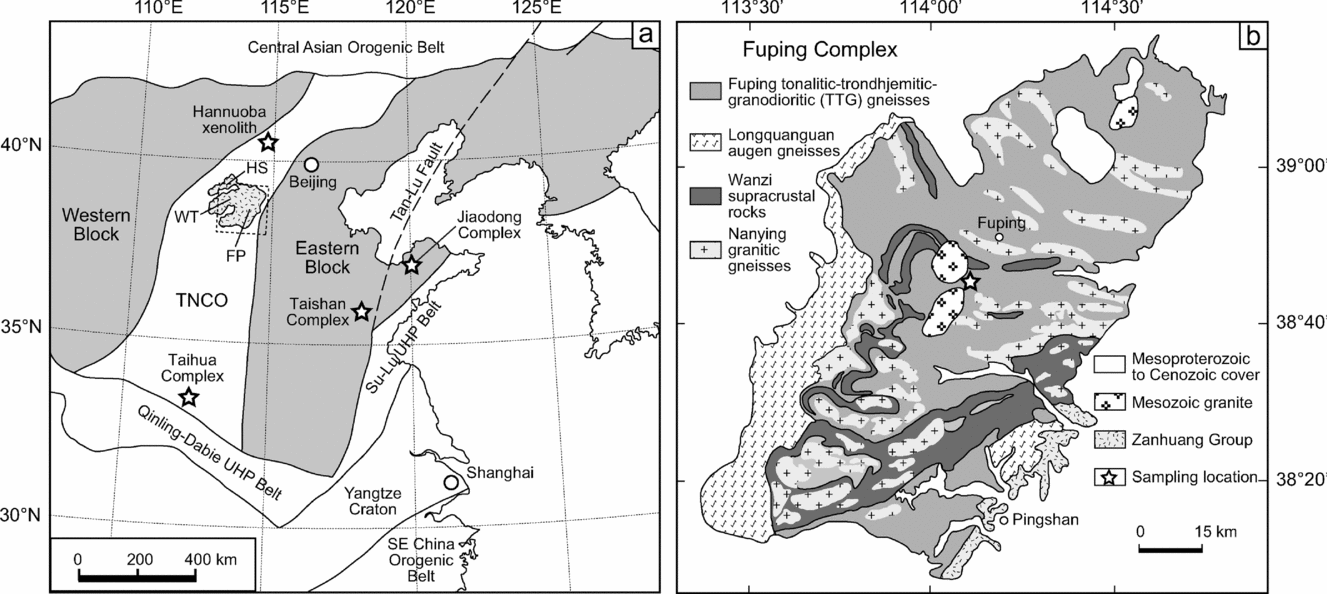
Archaean crustal growth has been recorded in the North China Craton (NCC). Zircon U–Pb ages and Hf isotopes show that crustal growth mainly occurred at around the 2.5 Ga Archaean–Proterozoic transition (e.g. Chen et al. Reference Chen, Liu, Geng and Liu2006; Xia et al. Reference Xia, Sun, Zhao, Wu, Xu, Zhang, He and Zhang2006b; Yang et al. Reference Yang, Wu, Shao, Wilde, Xie and Liu2006, Reference Yang, Wu, Wilde and Zhao2008, Reference Yang, Gao, Chen, Tang, Yuan, Gong, Xie and Wang2009; Diwu et al. Reference Diwu, Sun, Yuan, Wang, Zhong and Liu2008, Reference Diwu, Sun, Gao, Wang and Liu2011; Liu, F. et al. Reference Liu, Guo, Lu and Diwu2009; Ren et al. Reference Ren, Han, Zhang, Li, Yang and Zhang2011; Wang et al. Reference Wang, Liu, Bai, Yang, Li and Zhang2011), which generated 60% of the present crustal volume of the NCC (Yang et al. Reference Yang, Gao, Chen, Tang, Yuan, Gong, Xie and Wang2009). The earliest crust-forming episode in the NCC was at 2.9 to 2.7 Ga (Zhai, Bian & Zhao, Reference Zhai, Bian and Zhao2000; Zhai, Reference Zhai, Malps, Fletcher, Ali and Aichison2004; Wu et al. Reference Wu, Zhao, Wilde and Sun2005), probably with a major phase of crustal growth at ~2.7 Ga (Zhai & Santosh, Reference Zhai and Santosh2011), but ~2.5 Ga crustal growth may have been strongly superimposed on the ~2.7 Ga event so that 2.7 Ga crustal growth has been reported only from the Jiaodong and Taishan complexes in the Eastern Block (Jahn et al. Reference Jahn, Liu, Wan, Song and Wu2008; Jiang et al. Reference Jiang, Guo, Zhai and Zhang2010; Wan et al. Reference Wan, Liu, Wang, Yang, Wang, Dong, Zhou, Du, Yang and Diwu2011), the Taihua Complex in the southern segment of the Trans-North China Orogen (TNCO) (Diwu et al. Reference Diwu, Sun, Lin and Wang2010) and one Al-augite pyroxenite xenolith entrained in the Tertiary Hannuoba alkali basalts overlying the northern segment of the TNCO (Jiang et al. Reference Jiang, Guo, Zhai and Zhang2010; Fig. 1a).
(a) Simplified tectonic map of the North China Craton (NCC) (Zhao et al. Reference Zhao, Wilde, Cawood and Lu1998, Reference Zhao, Sun, Wilde and Li2005) and locations of the Fuping (FP), Wutai (WT) and Hengshan (HS) complexes in the middle segment of the Trans-North China Orogen (TNCO). The NCC is characterized by prevalent development of ~2.5 Ga juvenile crust, but ~2.7 Ga crustal growth, as shown with stars, has been recorded in the Jiaodong and Taishan complexes in the Eastern Block (Jahn et al. Reference Jahn, Liu, Wan, Song and Wu2008; Jiang et al. Reference Jiang, Guo, Zhai and Zhang2010; Wan et al. Reference Wan, Liu, Wang, Yang, Wang, Dong, Zhou, Du, Yang and Diwu2011), the Taihua Complex in the southern segment of the TNCO (Diwu et al. Reference Diwu, Sun, Lin and Wang2010) and a lower crustal xenolith from the northern segment of the TNCO (Jiang et al. Reference Jiang, Guo, Zhai and Zhang2010). The approximate location of (b) is shown with a box. (b) Simplified geological map of the Fuping Complex (Zhao et al. Reference Zhao, Wilde, Cawood and Lu2000, Reference Zhao, Wilde, Cawood and Sun2002), showing major lithological units, their relationships and sampling location. UHP – ultrahigh pressure.

In the TNCO, nearly all Neoarchaean–Palaeoproterozoic metamorphic complexes contain ~2.7 Ga old continental components, as indicated by 2.85 to 2.65 Ga lithologies (Liu, D. Y. et al. Reference Liu, Wilde, Wan, Wang, Valley, Kito, Dong, Xie, Yang, Zhang and Guo2009) or xenocrystic zircons (Sun, Armstrong & Lambert, Reference Sun, Armstrong and Lambert1992; Wilde, Cawood & Wang, Reference Wilde, Cawood and Wang1997; Wilde, Zhao & Sun, Reference Wilde, Zhao and Sun2002; Wilde et al. Reference Wilde, Cawood, Wang, Nemchin, Zhao, Malps, Fletcher, Ali and Aichison2004; Kröner et al. Reference Kröner, Wilde, Li and Wang2005). Recent zircon Hf isotopic studies have revealed that the TNCO is characterized by widespread crustal growth at ~2.5 Ga (Xia et al. Reference Xia, Sun, Zhao, Wu, Xu, Zhang, He and Zhang2006b; Diwu et al. Reference Diwu, Sun, Yuan, Wang, Zhong and Liu2008, Reference Diwu, Sun, Gao, Wang and Liu2011; Liu, F. et al. Reference Liu, Guo, Lu and Diwu2009), but the Lüliang khondalites in the middle segment of the TNCO and the Jining khondalites in the Western Block show zircon Hf isotope evidence for local crustal growth at 2.1 Ga (Xia et al. Reference Xia, Sun, Zhao, Wu and Xie2006a, Reference Xia, Sun, Zhao, Wu, Xu, Zhang and He2008). Particularly, two major phases of crustal growth at ~2.7 and ~2.5 Ga have been identified in the southern and northern segments of the TNCO (Diwu et al. Reference Diwu, Sun, Yuan, Wang, Zhong and Liu2008, Reference Diwu, Sun, Lin and Wang2010, Reference Diwu, Sun, Gao, Wang and Liu2011; Liu, F. et al. Reference Liu, Guo, Lu and Diwu2009; Jiang et al. Reference Jiang, Guo, Zhai and Zhang2010), although some of the ~2.5 Ga rocks in the northern segment of the TNCO may have been derived from reworking of ~2.7 Ga juvenile crust (Jiang et al. Reference Jiang, Guo, Zhai and Zhang2010).
The Wutai, Hengshan and Fuping complexes constitute the largest Neoarchaean–Palaeoproterozoic terrane in the middle segment of the TNCO (Fig. 1b). This terrane is characterized by widespread 2.5 Ga TTG and other gneisses, which may have marked the onset of plate tectonics on the NCC, probably along an Andean-type continental margin arc on the western margin of the Eastern Block (Kröner et al. Reference Kröner, Wilde, Li and Wang2005; Zhao, Reference Zhao2007; Wang, Reference Wang2009; Li et al. Reference Li, Zhao, Wilde, Zhang, Sun, Zhang and Dai2010). The oldest juvenile crust in the terrane may be represented by 2.56 to 2.52 Ga granitoids and greenstones in the Wutai Complex (Wilde et al. Reference Wilde, Cawood, Wang, Nemchin, Zhao, Malps, Fletcher, Ali and Aichison2004; Kröner et al. Reference Kröner, Wilde, Li and Wang2005; Polat et al. Reference Polat, Kusky, Li, Fryer, Kerrich and Patrick2005; Zhao et al. Reference Zhao, Kröner, Wilde, Sun, Li, Li, Zhang, Xia and He2007). Rare 2.7 Ga TTG basement rocks, which probably represent the remnants of older continental crust in the TNCO, may be tectonically sandwiched in between the ~2.5 Ga gneisses (Kröner et al. Reference Kröner, Wilde, Li and Wang2005), and the Neoarchaean rocks underwent reworking at ~2.1 Ga and metamorphism at ~1.85 Ga (Kröner et al. Reference Kröner, Wilde, Li and Wang2005 and references therein; Zhao et al. Reference Zhao, Guo, Peng and Liu2011). However, there has been no evidence for 2.7 Ga crustal growth in the middle segment of the TNCO. Here we present in situ U–Pb dating and Hf isotopic analyses of the Fuping TTG gneisses to provide the evidence of ~2.7 Ga continental crustal growth in the middle segment of the TNCO.
2. Geological setting
As the largest cratonic terrane in eastern Asia, the NCC can be divided into the Eastern and Western blocks with the TNCO in between (Fig. 1a). The TNCO is currently thought to have resulted from the final amalgamation of the Eastern and Western blocks at 1.95 to 1.85 Ga (Zhao et al. Reference Zhao, Wilde, Cawood and Lu1998, Reference Zhao, Sun, Wilde and Li2005, Reference Zhao, Kröner, Wilde, Sun, Li, Li, Zhang, Xia and He2007, Reference Zhao, Wilde, Guo, Cawood, Sun and Li2010; Wilde, Zhao & Sun, Reference Wilde, Zhao and Sun2002; Wilde et al. Reference Wilde, Cawood, Wang, Nemchin, Zhao, Malps, Fletcher, Ali and Aichison2004, Reference Wilde, Cawood, Wang and Nemchin2005; Kröner et al. Reference Kröner, Wilde, Li and Wang2005, Reference Kröner, Wilde, Zhao, O'Brien, Sun, Liu, Wan, Liu and Guo2006; Polat et al. Reference Polat, Kusky, Li, Fryer, Kerrich and Patrick2005; Faure et al. Reference Faure, Trap, Lin, Monie and Bruguier2007; Zhao & Kröner, Reference Zhao and Kröner2007; Lu et al. Reference Lu, Zhao, Wang and Hao2008; Trap et al. Reference Trap, Faure, Lin, Bruguier and Monie2008; Zhang et al. Reference Zhang, Zhao and Liu2006, Reference Zhang, Zhao, Li, Sun, Liu, Wilde, Kröner and Yin2007, Reference Zhang, Zhao, Li, Sun, Wilde, Liu and Yin2009; Li et al. Reference Li, Zhao, Wilde, Zhang, Sun, Zhang and Dai2010). Alternatively, some researchers argue that the final collision between the Eastern and Western blocks took place at around 2.5 Ga (e.g. Zhai, Bian & Zhao, Reference Zhai, Bian and Zhao2000; Kusky & Li, Reference Kusky and Li2003; Zhai, Reference Zhai, Malps, Fletcher, Ali and Aichison2004; Li & Kusky, Reference Li and Kusky2007; Zhai & Santosh, Reference Zhai and Santosh2011).
The Fuping Complex is one of the ~2.5 Ga crust-forming suites in the middle segment of the TNCO (Fig. 1a). It is composed of four major lithological units with different ages (Liu et al. Reference Liu, Liang, Zhao, Hua and Jian2000; Zhao et al. Reference Zhao, Wilde, Cawood and Sun2002).
As the predominant rock type in the Fuping Complex (Fig. 1b), the Fuping TTG gneisses were mainly emplaced at 2.53 to 2.47 Ga (Guan et al. Reference Guan, Sun, Wilde, Zhou and Zhai2002; Zhao et al. Reference Zhao, Wilde, Cawood and Sun2002; Yang et al. Reference Yang, Du, Wan and Liu2004; Trap et al. Reference Trap, Faure, Lin, Bruguier and Monie2008) and pervasively underwent deformation and metamorphism at 1.87 to 1.80 Ga (Guan et al. Reference Guan, Sun, Wilde, Zhou and Zhai2002; Zhao et al. Reference Zhao, Wilde, Cawood and Sun2002, Reference Zhao, Kröner, Wilde, Sun, Li, Li, Zhang, Xia and He2007; Yang et al. Reference Yang, Du, Wan and Liu2004). Stromatic migmatite is widespread in the complex, and the leucosomes are essentially parallel or sub-parallel to the well-developed foliations of the host gneisses. The leucosomes are composed mainly of K-feldspar and quartz, with minor albite, and may have resulted from the in situ partial melting or segregation of the gneisses (e.g. Ren, Yang & Du, Reference Ren, Yang and Du2009; Zhang et al. Reference Zhang, Zhao, Li, Sun, Wilde, Liu and Yin2009). Locally, the TTG gneisses contain metabasic and metasedimentary enclaves. One hornblende gneiss enclave yielded a zircon U–Pb age of 2.70 Ga (Guan et al. Reference Guan, Sun, Wilde, Zhou and Zhai2002). The metabasic enclaves gave two Sm–Nd isochron ages of 2.68 and 2.66 Ga (Zhang, Wu & Ye, Reference Zhang, Wu and Ye1991; Sun, Armstrong & Lambert, Reference Sun, Armstrong and Lambert1992) and have εNd(t) values of +3.96 to +3.29 at 2.7 Ga, close to the contemporaneous depleted mantle, and thus they are considered as evidence for ~2.7 Ga crustal growth (Liu et al. Reference Liu, Pan, Li, Li and Zhang2002).
The Longquanguan augen gneisses were derived from 2.54 to 2.50 Ga granodiorite, monzogranite and granitic pegmatite (Wilde, Cawood & Wang, Reference Wilde, Cawood and Wang1997; Zhao et al. Reference Zhao, Wilde, Cawood and Sun2002) and underwent deformation at 1.87 to 1.84 Ga (Zhang, Zhao & Liu, Reference Zhang, Zhao and Liu2006).
The Nanying granitic gneisses were derived either from 2.10 to 2.02 Ga predominant monzogranite and syenogranite as well as minor quartz diorite and granodiorite (Guan et al. Reference Guan, Sun, Wilde, Zhou and Zhai2002; Zhao et al. Reference Zhao, Wilde, Cawood and Sun2002; Liu et al. Reference Liu, Pan, Xie, Zhang and Li2005; Trap et al. Reference Trap, Faure, Lin, Bruguier and Monie2008) or from partial melting of ~2.7 Ga crustal rocks and/or ~2.5 Ga TTG gneisses (Liu et al. Reference Liu, Pan, Li, Li and Zhang2002; Trap et al. Reference Trap, Faure, Lin, Bruguier and Monie2008). Nevertheless, the Nanying granitic gneisses were metamorphosed at 1.85 to 1.82 Ga (Guan et al. Reference Guan, Sun, Wilde, Zhou and Zhai2002; Zhao et al. Reference Zhao, Wilde, Cawood and Sun2002).
The Wanzi supracrustal rocks are dominantly aluminous schist and gneiss, with minor amounts of calc-silicate rocks, marble and amphibolite. These rocks underwent metamorphism at 1.84 to 1.82 Ga (Xia et al. Reference Xia, Sun, Zhao, Wu, Xu, Zhang, He and Zhang2006b). Magmatic zircons of ~2.50 and ~2.09 Ga age have been reported from the Wanzi supracrustal rocks (Zhao et al. Reference Zhao, Wilde, Cawood and Sun2002; Li et al. Reference Li, Yang, Du, Wan and Liu2005; Xia et al. Reference Xia, Sun, Zhao, Wu, Xu, Zhang, He and Zhang2006b), and thus the Wanzi supracrustal rocks may have been sourced from the Fuping TTG and Nanying granitic gneisses (Xia et al. Reference Xia, Sun, Zhao, Wu, Xu, Zhang, He and Zhang2006b).
The Fuping TTG and Nanying granitic gneisses are also cross-cut by granitic pegmatite and leucogranitic dykes whose zircon U–Pb ages are in a range of 1.84 to 1.79 Ga (Wilde et al. Reference Wilde, Cawood, Wang and Nemchin1998; Zhang et al. Reference Zhang, Zhao, Li, Sun, Wilde, Liu and Yin2009), nearly concurrent with the metamorphic ages of the gneisses.
Previous data clearly reveal two phases of magmatism in the Fuping Complex: ~2.5 Ga Fuping TTG and Longquanguan augen gneisses and ~2.1 Ga Nanying granitic gneisses.
3. Samples and analytical procedures
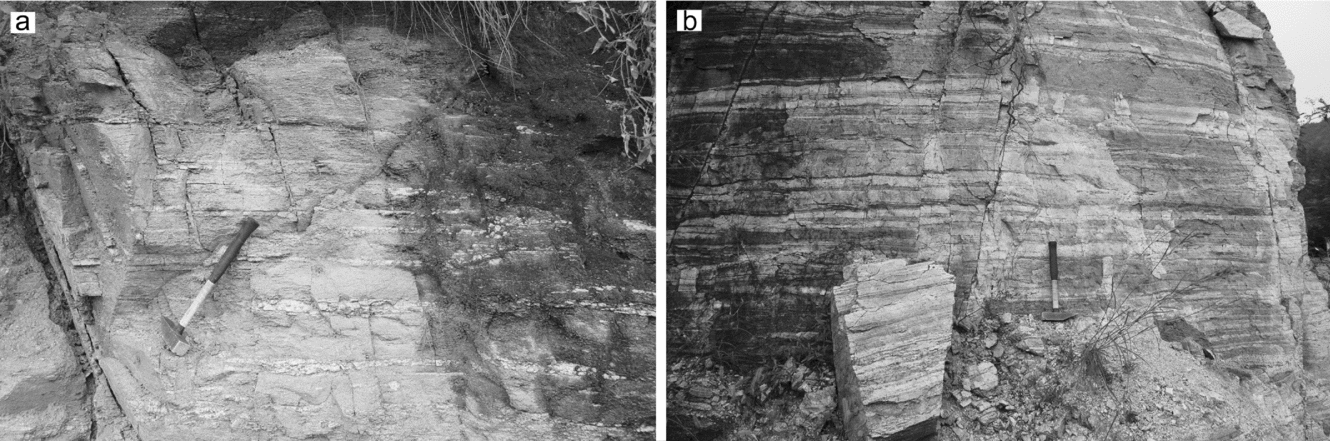
Two TTG gneiss samples 08CWW04 and 08CWW05 (Fig. 2a, b) were collected from two road-cuts in the central part of the Fuping Complex, about 13 km southwest of Fuping County (Fig. 1b). They are about 500 m apart from each other. The TTG gneisses are stromatic migmatite, in which millimetre to centimetre thick leucosomes are abundant and almost parallel to the foliations of the host gneisses. In both samples, the leucosomes have an assemblage of quartz, K-feldspar, plagioclase and minor biotite. The melanosome in 08CWW04 consists of quartz, K-feldspar, plagioclase, hornblende, trace garnet and accessory zircon, titanite, apatite and Ti-Fe oxide, whereas those in 08CWW05 have an assemblage of quartz, plagioclase, hornblende, biotite, and accessory zircon, apatite and Ti-Fe oxide, with relict clinopyroxene.
Field photographs of the Fuping TTG gneiss from which sample 08CWW04 at 38°45′52.8″N, 114°05′10.4″E (a) and sample 08CWW05 at 38°46′02.1″N, 114°05′31.0″E (b) were collected. As a result of strong migmatization, the TTG gneiss is a stromatic migmatite, with the leucosomes parallel or sub-parallel to the well-developed foliations of the host gneiss.

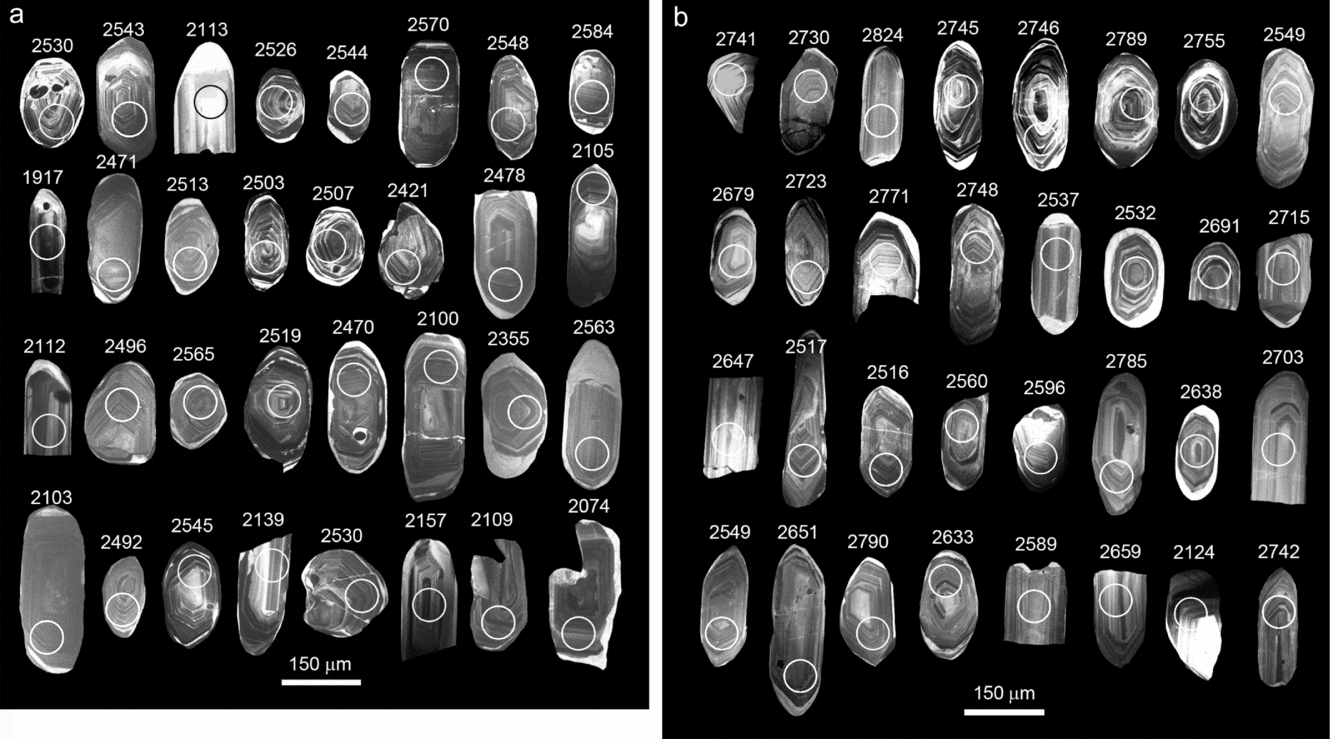
Zircons were separated from crushed rock samples using conventional heavy liquid and magnetic techniques. Zircons were hand-picked and mounted in epoxy resin, and polished to about half of their size to expose the core of the grain. With combined studies by transmitted and reflected light and cathodoluminescence (CL) microscopy, potential target sites for U–Pb dating and Hf isotope analyses were chosen using the CL images.
U–Pb and Hf isotope analyses were performed using a GeoLas PLUS 193 nm excimer ArF laser ablation system, simultaneously attached to an Agilent 7500a inductively coupled plasma mass spectrometer (ICP-MS) and to a Neptune Plasma multi-collector ICP-MS at the Institute of Geology and Geophysics, Chinese Academy of Sciences in Beijing, China. Material ablated by laser was carried in different proportions into the ICP-MS for U–Pb and MC-ICP-MS for Lu–Hf isotopic composition analysis (Xie et al. Reference Xie, Zhang, Zhang, Sun and Wu2008). The common-Pb correction followed the method described by Anderson (Reference Anderson2002). Hf isotopic composition analysis by MC-ICP-MS was described by Wu et al. (Reference Wu, Yang, Xie, Yang and Xu2006). The ratio 176Lu/175Lu = 0.02655 (Machado & Simonetti, Reference Machado, Simonetti and Sylvester2001) was adopted in the corrections of 176Lu interference on 176Hf assuming that their fractionations are identical. Interference of 176Yb on 176Hf was corrected using mass bias obtained online and assuming 176Yb/172Yb = 0.5887 (Wu et al. Reference Wu, Yang, Xie, Yang and Xu2006). In this study, a beam diameter of 63 μm, pulse rate of 8 Hz and energy density of 15 J/cm2 were used, and each analytical spot was subjected to 200 ablation cycles. Reference zircon 91500 and NIST SRM 610 were used for elemental analyses, and zircon 91500 was also used as the external standard for Hf isotopic analyses and yielded an average 176Hf/177Hf value of 0.282311 ± 0.000006 (2σ, n = 34), in agreement with the recommended value of 0.282305 within error (Wu et al. Reference Wu, Yang, Xie, Yang and Xu2006). The calculated ages and concordia plots were obtained using ISOPLOT 3.0 (Ludwig, Reference Ludwig2003).
4. Results
Zircons from both samples are mostly prismatic, with well-developed pyramidal faces, and, in general, sizes range from 100 to 200 μm in length and 60 to 110 μm in width. Most zircons have well-formed crystal faces and contain no inherited cores, but some zircon grains have a bright overgrowth rim. All of the analysed zircon domains are free of inclusions and show a simple internal structure with micro-scale oscillatory zoning, which indicate their magmatic origin (Corfu et al. Reference Corfu, Hanchar, Hoskin and Kinny2003). All the analyses were conducted on the clear oscillatory-zoned domains (Fig. 3).

4.a. U–Pb ages
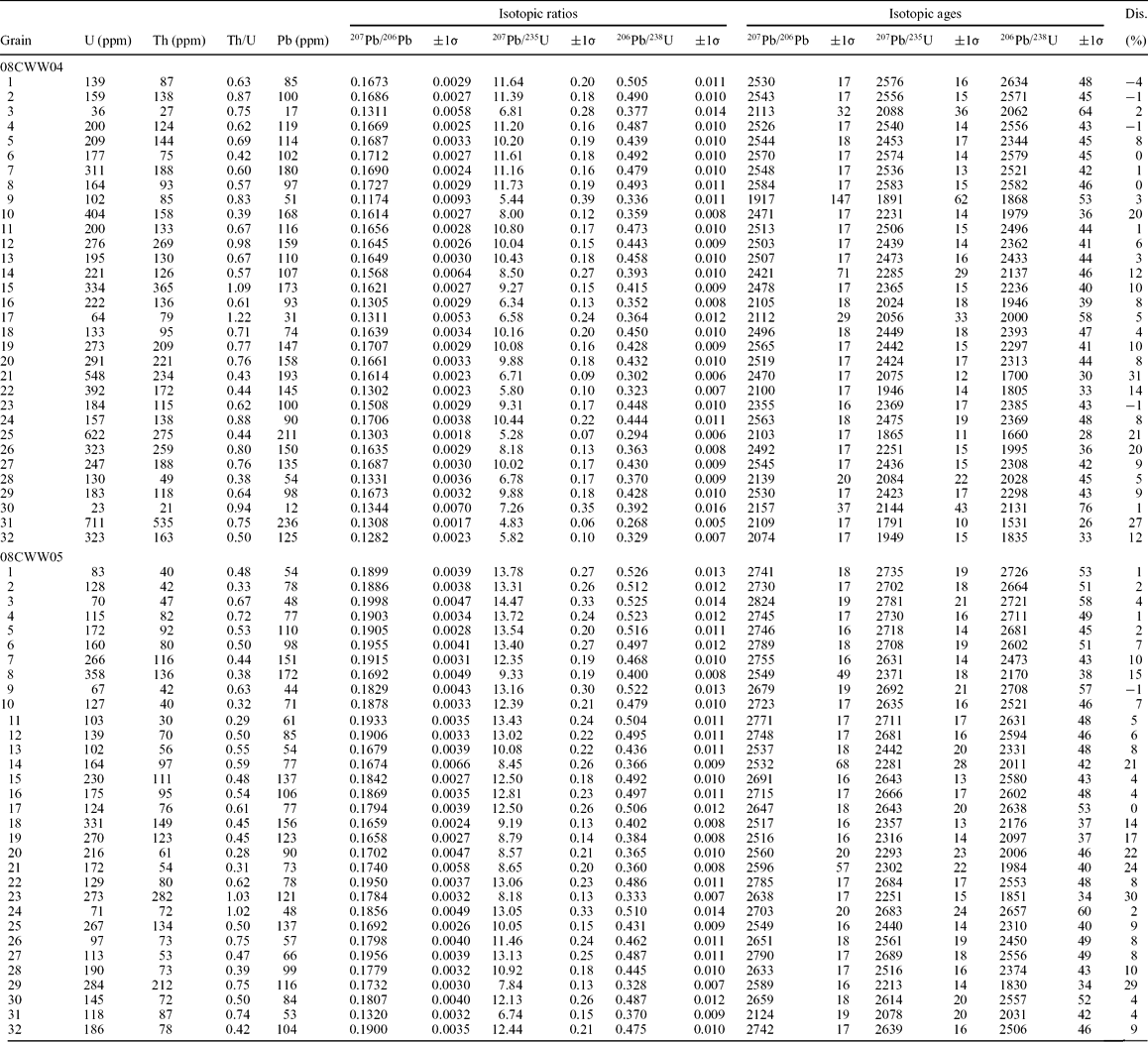
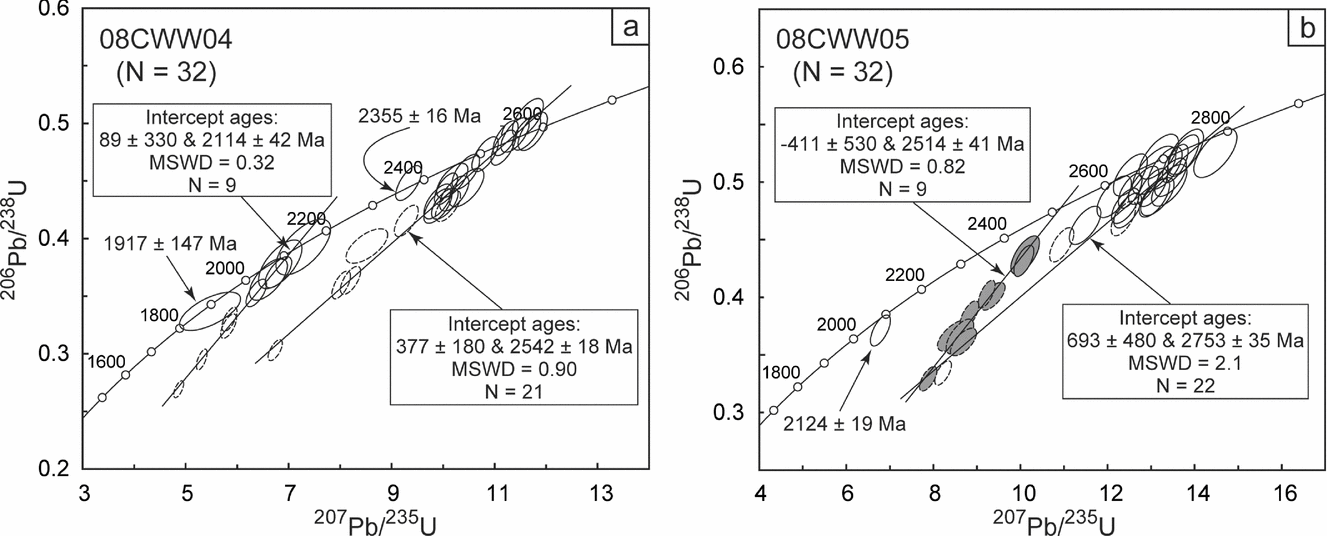
Thirty-two magmatic zircons from sample 08CWW04 were analysed (Table 1). They have variable U (23 to 711 ppm) and Th (21 to 535 ppm) concentrations, show a narrow range of Th/U ratios (0.38 to 1.22), and yielded Neoarchaean and Palaeoproterozoic 207Pb/206Pb ages (2584 to 1917 Ma), with a large discordance (= 100 × (1 − (206Pb/238U age)/(207Pb/206Pb age))) range of up to 31% (Table 1). Grain 9 yielded a 207Pb/206Pb age of 1917 ± 147 Ma, and its error of up to 8% is much larger than those (< 3%) of other zircons. Grain 23 gave a 207Pb/206Pb age of 2355 ± 16 Ma, significantly deviant from the other grains. The remaining 30 ages may be divided into two contrasting groups (Fig. 4a). The younger group includes nine grains with 207Pb/206Pb ages of 2157 to 2074 Ma, which yielded an upper intercept age at 2114 ± 42 Ma. Of nine analysed grains, five concordant and near-concordant zircons with < 10% discordance defined a weighted mean 207Pb/206Pb age of 2121 ± 21 Ma. The older group consists of 21 grains with 207Pb/206Pb ages ranging from 2584 to 2470 Ma, which yielded an upper intercept age at 2542 ± 18 Ma. Of 21 analysed grains, 15 concordant and near-concordant zircons gave a weighted mean 207Pb/206Pb age of 2535 ± 14 Ma.
U–Pb analytical data for magmatic zircons from the Fuping TTG gneisses

Dis. (discordance) = 100 × (1 − (206Pb/238U age)/(207Pb/206Pb age)).
Concordia diagrams of zircon U–Pb data from 08CWW04 (a) and 08CWW05 (b). The intercept ages are given at 2σ levels, but individual 207Pb/206Pb ages at 1σ level, and dashed circles are discordant zircons with > 10% discordance. Filled circles in (b) define a slightly younger age than the major population (see text). MSWD – mean square of weighted deviates.

Thirty-two magmatic zircons from sample 08CWW05 were analysed (Table 1). They have variable U (67 to 358 ppm) and Th (30 to 282 ppm) concentrations, show a narrow range of Th/U ratios (0.28 to 1.03) and also yielded Neoarchaean and Palaeoproterozoic 207Pb/206Pb ages (2824 to 2124 Ma), with a large discordance range of up to 30% (Table 1). Except for grain 31 with the youngest 207Pb/206Pb age of 2124 ± 19 Ma, the other 31 ages can be divided into two contrasting groups (Fig. 4b). The younger group includes nine grains with 207Pb/206Pb ages of 2596 to 2516 Ma, which yielded an upper intercept age at 2514 ± 41 Ma. The older group consists of 22 grains with 207Pb/206Pb ages of 2824 to 2633 Ma, which yielded an upper intercept age at 2753 ± 35 Ma. Of 22 analysed zircons, the most concordant zircons with ≤ 1% discordance yielded different 207Pb/206Pb ages. For example, grains 1 and 4 gave 207Pb/206Pb ages of 2741 ± 18 and 2745 ± 17 Ma, respectively, the same as the upper intercept age, whereas grains 9 and 17 yielded 207Pb/206Pb ages of 2679 ± 19 and 2647 ± 18 Ma, respectively, significantly younger than the upper intercept age. The older group is likely to include predominant 2.75 Ga and subdominant 2.65 Ga zircons.
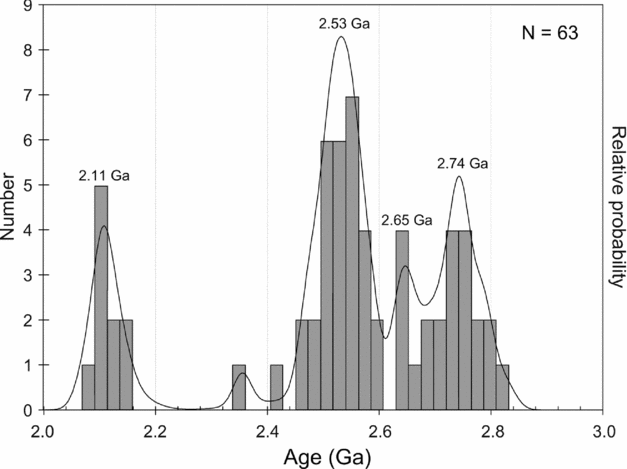
It is interesting to note that the youngest zircon with 4% discordance from 08CWW05 yielded a 207Pb/206Pb age of 2124 ± 19 Ma, identical to the upper intercept age of the younger group from 08CWW04. Similarly, the younger group from 08CWW05 gave an upper intercept age of 2514 ± 41 Ma, consistent with the upper intercept age of 2542 ± 18 Ma yielded by the older group from 08CWW04 within error. Except for grain 9 with a large error from 08CWW04, the pooled 63 other zircons from both samples yielded three major age peaks at 2.74, 2.53 and 2.11 Ga and one secondary age peak at 2.65 Ga (Fig. 5).
Probability diagram of pooled 207Pb/206Pb ages of 63 zircons, except grain 9 with a 207Pb/206Pb age of 1917 ± 147 Ma from 08CWW04. See text for discussion.

4.b. Hf isotopes
The U–Pb analyses indicate that all of the dated zircons may have undergone recent or ancient Pb loss to a varying extent, as indicated by the lower intercept ages of individual zircon groups from both samples (Fig. 4). In this case, accurate εHf(t) values can be calculated using the upper intercept ages for individual zircon groups (Amelin, Lee & Halliday, Reference Amelin, Lee and Halliday2000).
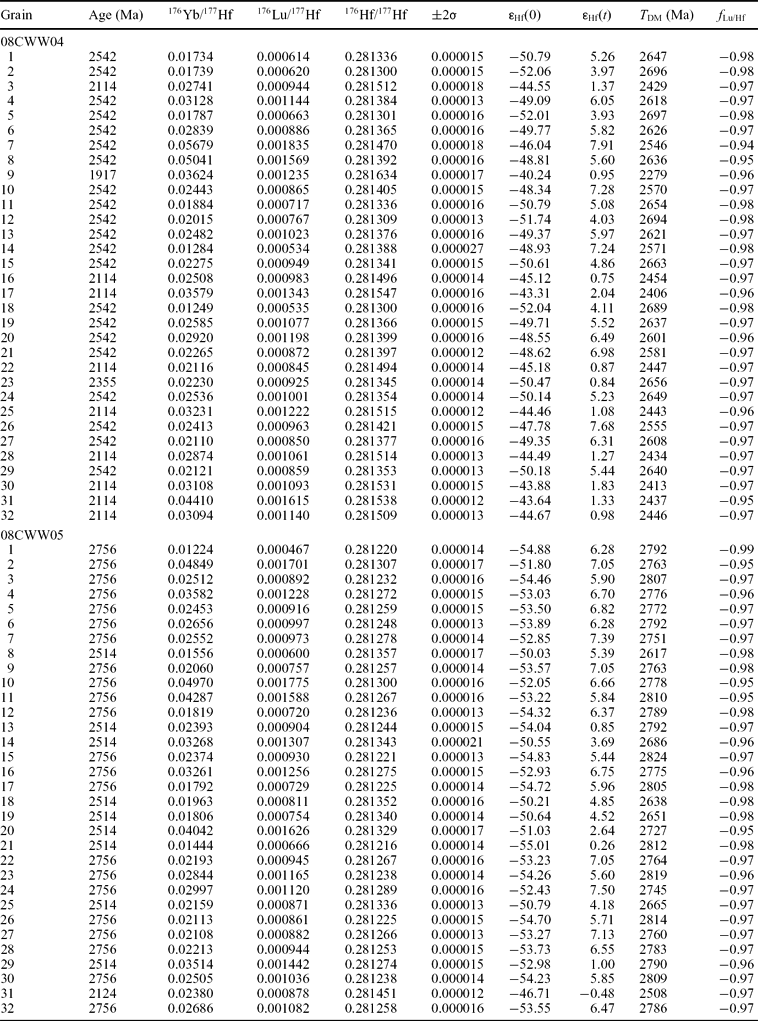
For 08CWW04, nine zircons of the younger group have 176Hf/177Hf ratios of 0.281494 to 0.281547, εHf(t) values of +0.75 to +2.04 at 2114 Ma and T DM of 2406 to 2454 Ma, whereas 21 zircons of the older group have 176Hf/177Hf ratios of 0.281300 to 0.281470, εHf(t) values of +3.93 to +7.91 at 2542 Ma and T DM of 2546 to 2697 Ma. Grains 9 and 23 have similar εHf(t) values of +0.95 and +0.84, but their T DM are 2279 and 2656 Ma, respectively (Table 2).
Hf isotopic compositions of magmatic zircons from the Fuping TTG gneisses

The notations of εHf, f Lu/Hf and T DM in this study are defined as:
εHf(0) = ((176Hf/177Hf)S/(176Hf/177Hf)CHUR,0 −1) × 10000
εHf(t) = ((176Hf/177Hf)S − (176Lu/177Hf)S ×(eλt −1))/((176Hf/177Hf)CHUR,0 − (176Lu/177Hf)CHUR × (eλt −1)−1) × 10000
T DM = 1/λ × ln (1 + ((176Hf/177Hf)S − (176Hf/177Hf)DM)/((176Lu/177Hf)S − (176Lu/177Hf)DM))
f Lu/Hf = (176Lu/177Hf)S/(176Lu/177Hf)CHUR − 1
where (176Lu/177Hf)S and (176Hf/177Hf)S are the measured values of samples, (176Lu/177Hf)CHUR = 0.0332 and (176Hf/177Hf)CHUR,0 = 0.282772 (Blichert-Toft & Albarède, Reference Blichert-Toft and Albarède1997); (176Lu/177Hf)DM = 0.0384 and (176Hf/177Hf)DM = 0.28325 (Griffin et al. Reference Griffin, Pearson, Belousova, Jackson, Van Achterbergh, O'Reilly and Shee2000), t = crystallization time of zircon, and λ = 176Lu decay constant (1.867 × 10⁻¹¹ year−1; Soderlund et al. Reference Soderlund, Patchett, Vervoort and Isachsen2004).
For 08CWW05, nine zircons of the younger group have 176Hf/177Hf ratios of 0.281216 to 0.281357, εHf(t) values of +0.26 to +5.39 at 2514 Ma and a wide T DM range of 2617 to 2812 Ma, whereas 22 zircons of the older group have 176Hf/177Hf ratios of 0.281220 to 0.281307, εHf(t) values of +5.44 to +7.50 at 2756 Ma and a narrow T DM range of 2745 to 2824 Ma (Table 2). The youngest grain 31 with a 207Pb/206Pb age of 2124 ± 19 Ma has the lowest εHf(t) value of −0.48 and the youngest T DM of 2508 Ma.
5. Discussion
5.a. Two generations of TTG gneisses
In general, both samples contain mixed magmatic zircon populations. The older and younger zircon populations in each sample may yield ages for protolith and subsequent magmatic events, respectively.
It is well known that the Fuping TTG gneisses were mainly formed at ~2.5 Ga, as indicated by zircon U–Pb ages of 2.53 to 2.47 Ga (Guan et al. Reference Guan, Sun, Wilde, Zhou and Zhai2002; Zhao et al. Reference Zhao, Wilde, Cawood and Sun2002; Yang et al. Reference Yang, Du, Wan and Liu2004). The older zircon group from 08CWW04 yielded an upper intercept age at 2542 ± 18 Ma (Fig. 4a). This age is in good agreement with the published age range for the Fuping TTG gneisses and thus considered as the crystallization age of this TTG gneiss sample.
The older zircon group from 08CWW05 yielded an upper intercept age at 2753 ± 35 Ma (Fig. 4b). This age is considered as the crystallization age of this TTG gneiss sample, but it is much older than the crystallization age of 08CWW04 and the published ages of 2.53 to 2.47 Ga for the Fuping TTG gneisses (Guan et al. Reference Guan, Sun, Wilde, Zhou and Zhai2002; Zhao et al. Reference Zhao, Wilde, Cawood and Sun2002; Yang et al. Reference Yang, Du, Wan and Liu2004). Hence, this age provides convincing evidence for the presence of ~2.7 Ga TTG gneisses in the Fuping Complex. Our data, combined with the published age data for the Fuping TTG gneisses (Guan et al. Reference Guan, Sun, Wilde, Zhou and Zhai2002; Zhao et al. Reference Zhao, Wilde, Cawood and Sun2002; Yang et al. Reference Yang, Du, Wan and Liu2004), clearly indicate that there are two generations of TTG gneisses in the Fuping Complex: the older was formed at ~2.7 Ga and the younger at ~2.5 Ga, respectively.
Regionally, 2.7 and 2.5 Ga TTG gneisses have been recognized in the Hengshan Complex (Kröner et al. Reference Kröner, Wilde, Li and Wang2005; Faure et al. Reference Faure, Trap, Lin, Monie and Bruguier2007), but 2.7 Ga gneisses are rare (Kröner et al. Reference Kröner, Wilde, Li and Wang2005). This is very similar to the Fuping Complex, in which ~2.5 Ga TTG gneisses are widespread, with rare occurrences of 2.7 Ga hornblende gneiss enclaves and TTG gneisses within 2.5 Ga TTG gneisses (Guan et al. Reference Guan, Sun, Wilde, Zhou and Zhai2002; this study) and 2.7 Ga granitoids within 2.5 Ga Longquanguan augen gneisses (Wilde, Cawood & Wang, Reference Wilde, Cawood and Wang1997). These 2.7 Ga rocks are likely to be tectonically sandwiched in between 2.5 Ga ones (Kröner et al. Reference Kröner, Wilde, Li and Wang2005) and possibly responsible for the 2.82 to 2.61 Ga xenocrystic zircons of the Wanzi supracrustal rocks (Zhao et al. Reference Zhao, Wilde, Cawood and Sun2002; Li et al. Reference Li, Yang, Du, Wan and Liu2005; Xia et al. Reference Xia, Sun, Zhao, Wu, Xu, Zhang, He and Zhang2006b).
It should be noted that the 2.7 Ga TTG gneisses in the Fuping Complex also contain a 2.65 Ga zircon population (Fig. 6). In the Hengshan Complex, 2.7 Ga TTG gneisses have zircon U–Pb ages of 2.67 to 2.71 Ga (Kröner et al. Reference Kröner, Wilde, Li and Wang2005; Faure et al. Reference Faure, Trap, Lin, Monie and Bruguier2007). Therefore, the 2.65 Ga zircons might have crystallized from a late pulse of 2.7 Ga magmatism. Alternatively, this age would have recorded a separate magmatic event in the Fuping Complex. More data are needed to clarify the possibilities.
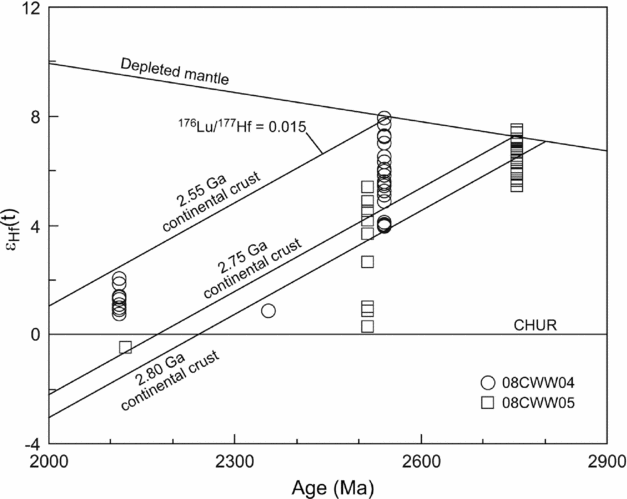
εHf(t) v. 207Pb/206Pb age plot of 63 zircons from both samples, except grain 9 with a 207Pb/206Pb age of 1917 ± 147 Ma from 08CWW04. Note that 2.75 and 2.54 Ga zircons have the highest εHf(t) values almost equal to the contemporaneous depleted mantle, suggesting two phases of crustal growth in the Fuping Complex. In contrast, 2.1 Ga zircons have εHf(t) values significantly lower than the contemporaneous depleted mantle and just between the 2.55 and 2.75 Ga continental crust. This may have simply resulted from intracrustal recycling in the Fuping Complex at ~2.1 Ga, during which the Nanying granitic gneiss was probably formed by partial melting of ~2.7 and/or ~2.5 Ga TTG gneiss (see text for discussion). See notes below Table 2 for the depleted mantle and continental crust growth lines. CHUR – chondritic uniform reservoir.

On the other hand, the younger zircon U–Pb age of 2.51 Ga from the older TTG gneisses is consistent with the crystallization age of the younger TTG gneisses (Fig. 3). This suggests that a younger magmatic event took place in the older TTG gneisses at ~2.5 Ga. Similarly, the younger TTG gneisses also yielded a younger zircon age of 2.1 Ga, the same as the ages of the Nanying granitic gneisses (Guan et al. Reference Guan, Sun, Wilde, Zhou and Zhai2002; Zhao et al. Reference Zhao, Wilde, Cawood and Sun2002; Trap et al. Reference Trap, Faure, Lin, Bruguier and Monie2008). This may be a record of a magmatic event in the younger TTG gneisses, which is responsible for crustal reworking giving rise to the Nanying granitic gneisses at 2.1 Ga (Liu et al. Reference Liu, Pan, Li, Li and Zhang2002; Trap et al. Reference Trap, Faure, Lin, Bruguier and Monie2008). The same event also generated 2.1 Ga granites in the Hengshan and Wutai complexes (Kröner et al. Reference Kröner, Wilde, Li and Wang2005). This event may have been recorded in the older TTG gneisses, as indicated by the youngest zircon with a 207Pb/206Pb age of 2.12 Ga from 08CWW05 (Fig. 4b). Therefore, the Nanying granitic gneisses are thought to be derived from partial melting of ~2.7 Ga crustal rocks and/or ~2.5 Ga TTG gneisses (Liu et al. Reference Liu, Pan, Li, Li and Zhang2002; Trap et al. Reference Trap, Faure, Lin, Bruguier and Monie2008).
Zircon U–Pb ages clearly indicate the presence of 2.7 and 2.5 Ga TTG gneisses in the Fuping Complex and both generations of TTG gneisses underwent partial melting at 2.1 Ga.
5.b. Crustal growth versus intracrustal recycling
According to their upper intercept ages, 62 zircons from both samples, excepting grains 9 and 23 from 08CWW04, can be divided into three groups: 2.1, 2.5 and 2.7 Ga. Individual groups show different εHf(t) ranges (Fig. 6) and thus provide important information on the relative contributions of juvenile materials versus recycled continental crust.
2.7 Ga zircons have positive εHf(t) values of up to +7.50 (Table 2). The highest εHf(t) values are almost the same as the contemporaneous depleted mantle (Fig. 6), similar to 2.7 Ga rocks in the northern and southern segments of the TNCO (Jiang et al. Reference Jiang, Guo, Zhai and Zhang2010; Diwu et al. Reference Diwu, Sun, Lin and Wang2010). This indicates that the older TTG gneisses were mainly derived from juvenile material and thus represent a major phase of crustal growth in the Fuping Complex at 2.75 Ga.
2.5 Ga zircons from both samples have positive εHf(t) values (Table 2), but those from 08CWW04 have εHf(t) values just between 2.80 Ga continental crust and the contemporaneous depleted mantle (Fig. 6). This is similar to 2.5 Ga rocks in the northern and southern segments of the TNCO (Liu, F. et al. Reference Liu, Guo, Lu and Diwu2009; Diwu et al. Reference Diwu, Sun, Yuan, Wang, Zhong and Liu2008, Reference Diwu, Sun, Gao, Wang and Liu2011). Therefore, 2.5 Ga TTG gneisses in the Fuping Complex could not be simply derived from reworking of 2.7 Ga TTG gneisses. Instead, the younger TTG gneisses could have resulted from a mixing between the depleted mantle and the older TTG gneisses. More and more involvement of the depleted mantle-derived melts in partial melts from the older TTG gneisses may have enhanced εHf(t) values from 2.80 Ga continental crust to the contemporaneous depleted mantle. Therefore, another phase of crustal growth in the Fuping Complex occurred at 2.5 Ga.
2.5 Ga zircons from 08CWW05 show a large range of εHf(t) values, generally lower than those from 08CWW04 (Fig. 6). Among them, some have higher εHf(t) values than 2.75 Ga continental crust, implying that juvenile material was also involved in 2.7 Ga TTG gneisses at 2.5 Ga, and some have relatively low εHf(t) values, even significantly lower than 2.80 Ga continental crust, similar to the lower εHf(t) values of 2.7 Ga zircons from 08CWW05 (Fig. 6). This may suggest the possible presence of > 2.80 Ga continental crust beneath the Fuping Complex.
2.1 Ga zircons from both samples suggest that both generations of TTG gneisses in the Fuping Complex were subjected to a major phase of magmatism at 2.1 Ga. These zircons have εHf(t) values of −0.47 to +2.04, just falling in between the 2.75 and 2.55 Ga continental crust values (Fig. 6), implying that 2.1 Ga magmatism was only a process of intracrustal recycling within the Fuping Complex. This magmatic event is temporally consistent with the Nanying granitic gneisses (Guan et al. Reference Guan, Sun, Wilde, Zhou and Zhai2002; Zhao et al. Reference Zhao, Wilde, Cawood and Sun2002; Xia et al. Reference Xia, Sun, Zhao, Wu, Xu, Zhang, He and Zhang2006b), suggesting that the Nanying granitic gneisses were derived from partial melting of 2.7 Ga crustal rocks and/or 2.5 Ga TTG gneisses at 2.1 Ga (Liu et al. Reference Liu, Pan, Li, Li and Zhang2002; Trap et al. Reference Trap, Faure, Lin, Bruguier and Monie2008). This magmatic event may be also responsible for 2.1 Ga granites in the Hengshan and Wutai complexes (Kröner et al. Reference Kröner, Wilde, Li and Wang2005; Zhao et al. Reference Zhao, Guo, Peng and Liu2011). In addition, some 2.1 Ga detrital zircons from the Wanzi supracrustal rocks may suggest involvement of minor juvenile material and more mature crust in the process of intracrustal recycling (Xia et al. Reference Xia, Sun, Zhao, Wu, Xu, Zhang, He and Zhang2006b). Regionally, some detrital zircons from the Lüliang khondalites, southwest of the Fuping Complex, and the Jining khondalites in the Western Block have εHf(t) values close to the contemporaneous depleted mantle, implying another phase of local crustal growth in the NCC at ~2.1 Ga (Xia et al. Reference Xia, Sun, Zhao, Wu and Xie2006a, Reference Xia, Sun, Zhao, Wu, Xu, Zhang and He2008). By contrast, 2.1 Ga zircons from the Fuping TTG gneisses show no recognizable input of juvenile material, very similar to those from the 2.1 Ga potassic granites in the Hengshan Complex (Zhao et al. Reference Zhao, Guo, Peng and Liu2011). This may imply that the depleted mantle-derived melts could chiefly transfer sufficient heat into the crust to induce the reworking of 2.7 and 2.5 Ga TTG gneisses in the Fuping Complex at ~2.1 Ga.
Available data show that the southern, middle and northern segments of the TNCO, like the Eastern Block of the NCC, underwent two phases of major crustal growth at ~2.7 and ~2.5 Ga. This is consistent with the Neoarchaean being a major period of lithospheric mantle formation in the NCC and other cratons (Menzies et al. Reference Menzies, Xu, Zhang and Fan2007). In particular, our work provides further evidence for ~2.7 Ga crustal growth in the NCC.
6. Conclusions
Based upon new zircon U–Pb ages, two generations of TTG gneisses have been identified in the Fuping Complex: the older was formed at 2.75 Ga and the younger at 2.53 Ga. The two generations of TTG gneisses in the Fuping Complex are characterized by positive zircon εHf(t) values, with the highest values almost equal to the contemporaneous depleted mantle. This demonstrates that abundant juvenile material contributed to each generation of TTG gneisses. In addition to the well-established crustal growth at 2.5 Ga, 2.7 Ga crustal growth did occur in the middle segment of the TNCO. The two generations of TTG gneisses in the Fuping Complex were also subjected to one phase of magmatism at 2.11 Ga, almost concurrent with the Nanying granitic gneisses in the complex. Therefore, the Fuping Complex in the middle segment of the TNCO has recorded two major phases of crustal growth at ~2.7 and ~2.5 Ga, the same as in the southern and northern segments of the TNCO. In addition, the Fuping Complex was subjected to one major phase of intracrustal recycling at ~2.1 Ga.
Acknowledgements
We are grateful to Shuwen Liu, Chunjing Wei, Jinghui Guo, Qiugen Li, Guo-Jun Miao, Jia-Fu Chen, Lei Zhang, Yin-Zhang Zhou, Lie-Wen Xie and Li Chen for their help during this work. Mark Allen and Guochun Zhao are particularly thanked for their constructive comments and suggestions, which have greatly helped us to improve our presentation and discussion. This work was supported by the National Science Foundation of China (grants 40772141 and 90714006) and China Geological Survey (project no. 1212010611803).