Implication
Aging brain will increase the risk of many diseases caused by age-related oxidative stress. And obese animals may be suffering more oxidative stress. In the current study, gene expression of Sirtuins that were correlated to aging and antioxidant capacity were examined in brain between fatty and lean pigs. The effect of age on Sirtuins’ expression was also investigated. These results will provide further insight of Sirtuins’ physiological roles and for manipulating these genes expression in regulating metabolism and oxidative stress in pigs.
Introduction
Silent information regulator 2 (Sir2) is a NAD-dependent histone deacetylase (HDAC) which connects metabolism with longevity in yeast and worms (Haigis and Guarente, Reference Haigis and Guarente2006). Mammals contain seven homologs of yeast Sir2 (Sirtuins, Sirt1-7), which are categorized by their highly conserved central NAD+-binding and catalytic domain and also by unique additional N-terminal and/or C-terminal sequences of variable length (Haigis and Guarente, Reference Haigis and Guarente2006; Michan and Sinclair, Reference Michan and Sinclair2007). Like Sir2, the mammal Sirtuins also play important roles in a variety of biological processes, including metabolism (Rodgers et al., Reference Rodgers, Lerin, Haas, Gygi, Spiegelman and Puigserver2005; Lomb et al., Reference Lomb, Laurent and Haigis2010), apoptosis (Verdin et al., Reference Verdin, Hirschey, Finley and Haigis2010; Kyrylenko and Baniahmad, Reference Kyrylenko and Baniahmad2010), oxidative stress and cytokine responses (Kubota et al., Reference Kubota, Kurihara, Mochimaru, Satofuka, Noda, Ozawa, Oike, Ishida and Tsubota2009) and further influencing aging (Donmez and Guarente, Reference Donmez and Guarente2010; Haigis and Sinclair, Reference Haigis and Sinclair2010).
Aging will lead to a progressive deterioration of physiological functions and metabolic processes. In brain, aging increased the risk of psychiatric disorders and vascular diseases caused by age-related oxidative damage (Mariani et al., Reference Mariani, Polidori, Cherubini and Mecocci2005; Bell and Guarente, Reference Bell and Guarente2011). Sirtuins are highly expressed in brain (Liszt et al., Reference Liszt, Ford, Kurtev and Guarente2005; Michishita et al., Reference Michishita, Park, Burneskis, Barrett and Horikawa2005), indicating that they may play critical roles in brain development and nervous system (Sakamoto et al., Reference Sakamoto, Miura, Shimamoto and Horio2004). Sirt1 and Sirt3 have been proved to protect from oxidative stress in brain (Bause and Haigis, Reference Bause and Haigis2013; Chong et al., Reference Chong, Shang, Wang and Maiese2012). But the knowledge of roles of the other Sirtuins in brain oxidative stress is limited.
Obesity is a global problem and many people are suffering from obesity. Results showed that the total antioxidant capacity (T-AOC) in plasma is different between obese and healthy people (Ozata et al., Reference Ozata, Mergen, Oktenli, Aydin, Sanisoglu, Bolu, Yilmaz, Sayal, Isimer and Ozdemir2002; Chrysohoou et al., Reference Chrysohoou, Panagiotakos, Pitsavos, Skoumas, Papademetriou, Economou and Stefanadis2007). Obesity can also lead to oxidative stress in rats (Beltowski et al., Reference Beltowski, Wojcicka, Gorny and Marciniak2000). However the difference of antioxidant capacity in brain between fatty and lean animals still needs to be researched.
In pigs, high levels of porcine Sirt1-7 mRNA were also found in brain (Shan et al., Reference Shan, Wang, Wu, Liu, Guo, Zhang, Liu and Xu2009; Ghinis-Hozumi et al., Reference Ghinis-Hozumi, Antaramian, Villarroya, Pina and Mora2013). At the same time, the antioxidants such as superoxide dismutase (SOD), glutathione peroxidase (GSH-Px), and catalase (CAT) activity in pork could be affected by genetic type (Hernandez et al., Reference Hernandez, Zomeno, Arino and Blasco2004). Jinhua pigs have been proved to possess higher fat content compared with Landrace pigs in our previous study, and Sirt1 expression is different in adipose tissue between the two breeds (Shan et al., Reference Shan, Ren, Liu, Zhu and Wang2010). Whether the Sirtuins expression and antioxidant capacity are different in brain between the two breeds is unknown.
Therefore, based on our previous studies (Shan et al., Reference Shan, Wang, Wu, Liu, Guo, Zhang, Liu and Xu2009 and Reference Shan, Ren, Liu, Zhu and Wang2010), the objective of the current study was to compare the differences of Sirtuins gene expression and the concentrations of the T-AOC, total superoxide dismutase (T-SOD), GSH-Px, CAT, and malondialdehyde (MDA) in brain between Jinhua pigs (a fatty breed of China) and Landrace pigs (a leaner breed) at the same age (180 days of age), as well as the same BW of 64 kg, respectively. In addition, the effects of age on Sirtuins expression in porcine brain were also studied.
Material and methods
Animals and experimental design
In Experiment 1, four male Jinhua pigs (average BW of 64 kg) and four male Danish Landrace pigs (average BW of 99 kg) at 180 days, as well as four male Jinhua pigs (180 days of age) and four male Danish Landrace pigs (120 days) at the average BW of 64 kg were used to determine the breed differences of Sirtuins gene expression and the concentration of antioxidants in brain. In Experiment 2, 12 male Jinhua pigs and 12 male Danish Landrace pigs (30, 60, and 120 days of age; four pigs per age) were selected randomly and used for investigating the expression pattern of Sirtuins in brain at different stages. Pigs were euthanized and cerebral part of the forebrains were collected and rapidly frozen in liquid nitrogen, then, stored at −80°C until analysis for the gene expression of Sirtuins.
Assay of antioxidants activity
The brain tissues were homogenized in 0.1 g/ml wet weight of ice-cold isotonic physiological saline and centrifuged at 4°C. The supernatants were then subjected to the measurement of total protein (TP), T-AOC, T-SOD, GSH-Px, CAT, and MDA by using the commercial kits (Nanjing Jiancheng Bioengineering Institute, Nanjing, China), respectively. The activity of each enzyme was expressed as units per mg protein for brain tissues.
Total RNA extraction and reverse transcription
Total RNA was isolated from the porcine brain tissues using Trizol Reagent (Invitrogen Life Technologies, Carlsbad, CA, USA) according to the manufacturer’s instructions. The purity and concentration of total RNA were determined by NanoDrop 2000 (Thermo Scientific Inc., Wilmington, DE, USA). For each sample, 2 μg of total RNA were used to synthesize cDNA according to our procedures published previously (Shan et al., Reference Shan, Wang, Wu, Liu, Guo, Zhang, Liu and Xu2009).
Quantitative real-time PCR
Quantitative real-time PCR was performed using the real-time PCR system (StepOnePlus™ Real-Time PCR System; Applied Biosystems, Foster City, CA, USA) and a kit (SYBR Premix Ex Taq kit; Takara Biotechnology Co. Ltd, Dalian, China). In this study, 18S rRNA (18S) was used as the reference gene. Oligonucleotide primers (Shanghai Sangon Co., Ltd, Shanghai, China) specific for porcine Sirt1-7, and 18S were based on previous studies (Jin et al., Reference Jin, Tan, Lei, Gan, Chen, Long, Feng and Yang2009; Shan et al., Reference Shan, Wang, Wu, Liu, Guo, Zhang, Liu and Xu2009) (Supplementary Table S1). The PCR system and cycling conditions were the same as those described previously (Shan et al., Reference Shan, Wang, Wu, Liu, Guo, Zhang, Liu and Xu2009). The 2−ΔΔCT method was used to analyze the relative changes in each gene expression (Livak and Schmittgen, Reference Livak and Schmittgen2001). The measurements were repeated three times.
Statistical analysis
All experimental data in figures are presented as means±s.e.m. Comparisons were made by unpaired two-tailed Student’s t-tests or one-way ANOVA, as appropriate. Effects were considered significant at P<0.05.
Results
Antioxidants capacity in the brains of Jinhua and Landrace pigs
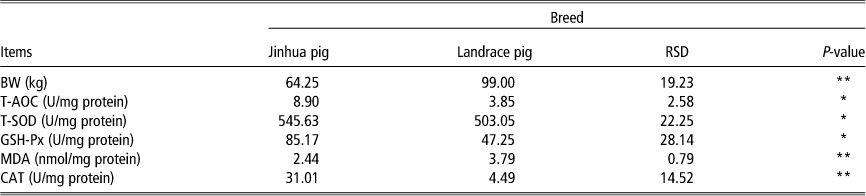
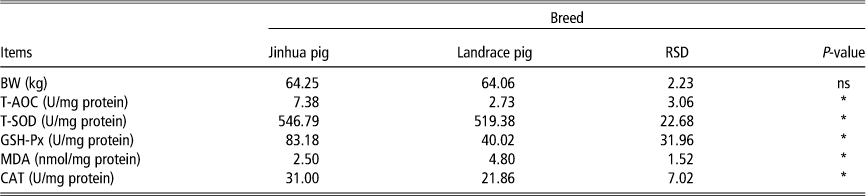
At the age of 180 days, the BW of Jinhua pigs was less (P<0.01; Table 1) than Landrace pigs. Compared with Landrace pigs, the concentrations of T-AOC, T-SOD, GSH-Px, and CAT in the brain tissue homogenate of Jinhua pigs were greater by 56.74% (P<0.05), 7.80% (P<0.05), 44.52% (P<0.05), 85.52% (P<0.01), while the MDA levels were lower by 35.62% (P<0.01), respectively (Table 1). Likewise, at the same BW of 64 kg, the concentrations of T-AOC, T-SOD, and GSH-Px in the brain tissue homogenate of Jinhua pigs were also greater (P<0.05) than Landrace pigs, but the MDA levels were significantly lower in Jinhua pigs comparatively (Table 2).
Effect of breed on antioxidant indexes in porcine brain at the same age of 180 days1
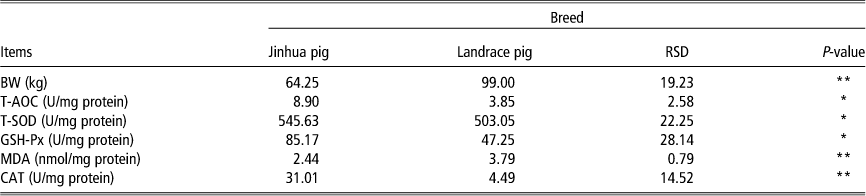
RSD=relative standard deviation; T-AOC=total antioxidative capacity; T-SOD=total superoxide dismutase; GSH-Px= glutathione peroxidase; MDA=malondialdehyde; CAT=catalase.
* P<0.05.
** P<0.01.
Effect of breed on antioxidant indexes in porcine brain at the same BW of 64 kg

RSD=relative standard deviation; T-AOC=total antioxidative capacity; T-SOD=total superoxide dismutase; GSH-Px=glutathione peroxidase; MDA=malondialdehyde; CAT=catalase.
ns=P>0.05.
* P<0.05.
Sirtuins’ mRNA levels in Jinhua and Landrace pigs
At the same age of 180 days, the mRNA levels of Sirt1 (P<0.05), Sirt2 (P<0.01), and Sirt4 (P<0.05) of Jinhua pigs were greater than Landrace pigs, while the mRNA levels of Sirt3, Sirt5, Sirt6, and Sirt7 of Jinhua pigs were lower (P<0.01) compared with Landrace pigs (Figure 1a). At the same BW of 64 kg, results also showed that the mRNA levels of Sirt1 (P<0.05), Sirt2 (P<0.01), and Sirt4 (P<0.01), as well as Sirt3 (P<0.01), and Sirt6 (P<0.05) in Jinhua pigs were greater than Landrace pigs. However, the mRNA levels of Sirt5 (P<0.05), and Sirt7 (P<0.01) in Landrace brain were greater than that of Jinhua pigs (Figure 1b).
Effects of breed on the mRNA levels of Sirtuins in brain at the same age of 180 days (a) or at the same BW of 64 kg (b). Gene expression was determined by real-time PCR and was normalized to 18S ribosomal RNA and expressed relative to expression in Jinhua pigs. Each column represents the mean of four individual pigs±s.e.m. *P<0.05; **P<0.01.
Effect of age on the mRNA levels of Sirtuins in the two breeds
In Jinhua pigs, the mRNA levels of Sirtuin genes were decreased with age in brain. At 30 days, the mRNA levels of Sirt1-7 were greater than that of 120 days (P<0.01) (Figure 2a). The levels of Sirt1 (P<0.05), Sirt2 (P<0.01), Sirt3 (P<0.01), Sirt5 (P<0.01), Sirt6 (P<0.01), and Sirt7 (P<0.05) mRNA at 30 days were greater compared with that of 60 days (Figure 2a). Compared with 60 days, the mRNA levels of Sirt1 (P<0.05), Sirt2 (P<0.05), Sirt3 (P<0.01), Sirt4 (P<0.01), Sirt5 (P<0.05), Sirt6 (P<0.01), and Sirt7 (P<0.05) were lower at 120 days (Figure 2a). Likewise, the mRNA levels of Sirtuins in Landrace pigs also decreased with age (Figure 2b). In Landrace, the mRNA levels of Sirt1-7 of 30-day pigs were significantly greater than that of 60- and 120-day pigs except Sirt2. At 60 days, the mRNA expressions of Sirt1-7 were remarkable greater compared with 120-day pigs except Sirt2. The mRNA level of Sirt2 was also decreased with age in Landrace (P>0.05).
Effects of age on the mRNA levels of Sirtuins in brain of Jinhua pigs (a) and Landrace pigs (b). Gene expression was determined by real-time PCR and was normalized to 18S ribosomal RNA and expressed relative to expression in pigs at 30 days. Each column represents the mean of four individual pigs±s.e.m. *P<0.05; **P<0.01.
Discussion
The expressions of Sirtuins are ubiquitous but particularly high in brain tissues, suggesting the important roles in brain and nervous system (Michishita et al., Reference Michishita, Park, Burneskis, Barrett and Horikawa2005; Albani et al., Reference Albani, Polito and Forloni2010). In pigs, high levels of porcine Sirt1-7 mRNA were also found in brain (Jin et al., Reference Jin, Tan, Lei, Gan, Chen, Long, Feng and Yang2009; Shan et al., Reference Shan, Wang, Wu, Liu, Guo, Zhang, Liu and Xu2009). In the current study, we investigated the breed differences and the effect of age on the expression of Sirtuins in porcine brain. We found that the mRNA levels of Sirt1, the most studied Sirtuins, in Jinhua pigs were greater than Landrace pigs either at the same age or at the same BW. Sirt1 expression of fatty pigs was greater than lean pigs in brain.
Except Sirt1, the most extensively studied Sirtuins, the expression and function of other Sirtuins in pigs are little known (Ghinis-Hozumi et al., Reference Ghinis-Hozumi, Antaramian, Villarroya, Pina and Mora2013). We also studied the expression pattern of Sirt2-7 in brain and found that the mRNA levels of Sirt2 and Sirt4 of fatty Jinhua pigs were greater, while the mRNA levels of Sirt3-7 of lean Landrace pigs were greater at the age of 180 days. At 64 kg, the mRNA levels of Sirtuins in Jinhua pigs, except Sirt5 and Sirt7, were significantly greater than Landrace pigs. The Sirt5 and Sirt7 expression were comparatively greater in Landrace pigs. This points toward differential expressions of Sirtuins genes between fatty and lean pigs indicating physiological differences of the brains between the said breeds.
It has been shown that pig genotype could affect the antioxidant capacity such as SOD, GSH-Px and CAT activity in pork (Hernandez et al., Reference Hernandez, Zomeno, Arino and Blasco2004). The antioxidants concentration in brain homogenates of the fatty breed Jinhua pigs and the leaner breed Landrace pigs were also examined in the current study. Results showed that the concentrations of T-AOC, T-SOD, GSH-Px, and CAT in Jinhua pigs were greater, while the MDA levels were lower compared with Landrace pigs. Our previous finding also showed Jinhua had higher antioxidant enzymes activity than Landrace pigs in muscle (Guo et al., Reference Guo, Shan, Wu, Zhu, Ren, An and Wang2011). This result is different with the results of plasma antioxidants activity between obesity and healthy humans (Ozata et al., Reference Ozata, Mergen, Oktenli, Aydin, Sanisoglu, Bolu, Yilmaz, Sayal, Isimer and Ozdemir2002; Chrysohoou et al., Reference Chrysohoou, Panagiotakos, Pitsavos, Skoumas, Papademetriou, Economou and Stefanadis2007). The greater antioxidant capacity in Jinhua pigs may be caused by pig genotype. Additionally, Sirtuins such as Sirt1, Sirt3, Sirt4, and Sirt5 may play a role in energy metabolism and alleviating oxidative stress (Gan and Mucke, Reference Gan and Mucke2008; Li et al., Reference Li, Xu, McBurney and Longo2008; Nakagawa and Guarente, Reference Nakagawa and Guarente2011). Recent study showed that Sirt1 can contribute to oxidative damage in mammals, and inhibition of Sirt1 increased oxidative stress resistance in neurons (Li et al., Reference Li, Xu, McBurney and Longo2008). Consistent with the previous findings, our current study showed that Jinhua pigs had higher Sirt1 expression and antioxidants concentration in brain than Landrace pigs. Since Sirt2 and Sirt4 also highly expressed in brain of Jinhua pigs, Sirt1, Sirt2, and Sirt4 may play critical roles in brain antioxidant capacity in pigs. Sirtuins have been proved to play an important role in the regulation of energy balance in livestock (Ghinis-Hozumi et al., Reference Ghinis-Hozumi, Antaramian, Villarroya, Pina and Mora2013), however there is little research about the role of Sirtuins and antioxidant capacity in porcine brain. Our results will add new knowledge to Sirtuins’ function in livestock. Since Sirt3 can deacetylate the critical antioxidant enzyme manganese superoxide dismutase (SOD2) (Bell and Guarente, Reference Bell and Guarente2011), these results also implied that Sirtuins might protect brain from oxidative stress through regulating antioxidants such as SOD, GSH-Px, and CAT concentration.
Meanwhile, Sirtuins were shown to promote longevity in diverse organisms and their pathways could affect diseases of aging in mammals, including neurodegenerative diseases, stress responses, diabetes, and cancer (Gan and Mucke, Reference Gan and Mucke2008; Donmez and Guarente, Reference Donmez and Guarente2010). Sirt1 plays important roles in the response to metabolism, longevity, and aging (Engel and Mahlknecht, Reference Engel and Mahlknecht2008). Previous studies showed that the expression of Sirt1 changed with aging (Alcendor et al., Reference Alcendor, Gao, Zhai, Zablocki, Holle, Yu, Tian, Wagner, Vatner and Sadoshima2007; Ferrara et al., Reference Ferrara, Rinaldi, Corbi, Conti, Stiuso, Boccuti, Rengo, Rossi and Filippelli2008). In brains, recent studies showed that Sirt1 expression was modified in specific areas of the brain in mice upon aging, and Sirt1 mRNA levels were strongly decreased upon aging in the hypothalamus (Lafontaine-Lacasse et al., Reference Lafontaine-Lacasse, Richard and Picard2010). However, other studies demonstrated that myocardial Sirt1 expression showed no difference between young and old rats (Cross et al., Reference Cross, Roby, Deschenes and Harris2008). In line with the previous studies (Lafontaine-Lacasse et al., Reference Lafontaine-Lacasse, Richard and Picard2010), our current study also showed that the mRNA levels of Sirtuins were decreased with age in brain of Jinhua and Landrace pigs. These findings may provide new insight into the changes that occur in Sirtuins levels in the aging brain.
In summary, we have first demonstrated clear differences in the expression of Sirtuins and the antioxidants activity in brains of fatty pigs (Jinhua pigs) and lean pigs (Landrace pigs). Fatty breed (Jinhua pigs) had greater Sirtuins expression and antioxidant concentration in brain. Furthermore, age can down-regulate the expression of Sirtuins in brains of Jinhua and Landrace pigs. These results may provide useful information for better understanding of the physiological roles of Sirtuins and for further regulating metabolism and antioxidant stress in pigs.
Acknowledgments
This work was supported by the National Natural Science Foundation of China (31001013) and the National Basic Research Program of China (2012CB124705).