In 2003 Prime Minister Tony Blair's director of strategy and communications, Alistair Campbell, famously interrupted a interview with the prime minister to tell the journalist that ‘We don't do God’. That succinctly summarizes the role of religion in elite political discourse in Britain over the last fifty years. Very few politicians refer to religion and very few, with the ironic exception of Tony Blair, are overtly religious. This is perhaps not surprising as Britain is a very secular country and the role of religion in post-war politics has generally been perceived as weak. Indeed Britain was typically thought of as the archetypal example of a ‘one social cleavage’ society, with a dominant class cleavage splitting voters and splitting parties. Despite this class cleavage having declined enormously, there is little work that looks at the other important ‘frozen’ cleavages that Lipset and Rokkan identified.Footnote 1 In this article I show that not only is the religious cleavage of important historical interest in Britain, but it is also of current importance in shaping people's party choices. Moreover, I test the mechanisms behind this religious cleavage and show that it is not a proxy for other social cleavages, such as class or national identity, nor is it based on religiosity and its impact on people's ideology. Rather, religion matters today in British politics much as it did in the distant past: religious denominations have long-standing associations with parties and these links are passed down from parents to children. These findings have wide-ranging implications for electoral politics and the way in which we view both the underlying mechanisms that maintain cleavage politics and the persistence of those political cleavages over time.
The Religious Cleavage Over Time
In many European countries, religion has been seen as the central social cleavage around which politics has been organized. Although Lipset and Rokkan's original article emphasized the owner/worker class cleavage as the dominant division, it was actually religion that appeared most important in many countries over the immediate post-war period.Footnote 2 Most European countries had Christian Democratic parties that directly appealed to religious voters, and some countries, most notably the Netherlands, had parties that explicitly appealed to specific denominations.Footnote 3 An exception to this pattern is Britain. Britain has no Christian Democratic party and traditionally it is the class cleavage that has been seen as the most important.Footnote 4
The continuing importance of the religious cleavage in the rest of Western Europe has been both acknowledged, but also questioned, over the last twenty years. Some have claimed that religion remains an important division in many European societies,Footnote 5 but much of the literature has focused on the decline of religion as a political force. Secularization, it is argued, has resulted in fewer people identifying with, as well as practising, a religion in most countries, meaning that religious divisions have become less important.Footnote 6 More generally, the decline of the religious cleavage is often discussed as part, and parcel, of the decline of social cleavages as a whole.Footnote 7
What is common to much of this cross-national work about the decline, or not, of religious politics is that Britain is typically talked of as a ‘mono-religious Protestant’ state in which neither denomination nor religiosity matters.Footnote 8 Norris and Inglehart argue that there are no ‘religious parties’ in Britain and so do not measure links between party and religion over time, and Brooks et al. do not measure Catholicism in Britain, ‘as almost all respondents with religious identities are Protestants’.Footnote 9 This is not to say that there is no work that examines religion and voting in Britain. Indeed, even some of the earliest studies of British voting behaviour tend to mention religion inter alia. Butler and Stokes and also Rose show that the reputation of the Church of England as the ‘Tory party at prayer’ is to some extent deserved.Footnote 10 Nonetheless, this role of religion is presented as interesting, but not nearly as central as class to party choices. Some recent work has looked at religious politics in Britain more intently, but in all cases in a rather partial way. For example, Kotler-Berkowitz measures religion and its links to party very carefully using data from the 1990s, but fails to analyse whether this has changed over time and does not distinguish between the very different political and religious traditions of England and Scotland.Footnote 11 Moreover, those comparisons over time that do exist are either of single time points,Footnote 12 only look at denominational difference,Footnote 13 or only look at differences by religiosity.Footnote 14 Here I look at both religiosity and denomination over the most comprehensive time series that is available.
Britain is an important test case. If religious cleavages are alive and well in Britain, then this suggests that the religious cleavage can survive in even the most unpromising of circumstances. Description is thus an important part of this article: is there a religious cleavage in Britain and, if so, how has it changed? A more important part of this article, however, is explanation. Almost all the above literature, whether comparative or not, fails to examine the mechanisms through which religion affects party choices. This paper also aims to answer the question of why religion matters.
Why Might Religion Matter?
Much of the literature does not explicitly set out the mechanisms that underpin links between religion and vote choice. Here I systematically examine why religion affects voters’ choices. There are three important explanations that we might consider. The first is that religion is simply correlated with other dominant explanations of voting behaviour. The most obvious of these is class. As Manza and Wright put it, ‘religion can … provide a basis for social stratification and inequality, in which members of a “dominant” denomination have privileged access to valued positions’.Footnote 15 Manza and Wright talk about the ‘WASP’ denominations in the United States, but in the British context we might see this as akin to the dominant Anglican and Presbyterian national churches. Class, historically the most important cleavage in British politics, is the obvious other determinant of vote to examine with reference to denomination. Religiosity, by contrast, is unlikely to be linked to class, but is very likely to be associated with birth cohort. Religious people are typically older,Footnote 16 and older people are more likely to vote for the Conservatives.Footnote 17 The first step is thus to account properly for these other socio-structural factors that are associated with party choice, religious denomination and religious practice.
The second mechanism is somewhat different. This is that religion produces, or is at least correlated with, a particular set of values that are more or less similar to the policy offerings of different parties. These values might be ideological. In particular, there is good reason to believe that religious people are socially conservative, and in favour of ‘traditional’ family life and so forth.Footnote 18 The alleged emergence of the ‘God gap’ in the United States, religiously observant people with conservative attitudes increasingly voting Republican, is one highly visible example of this mechanism.Footnote 19 There is also more recent evidence that religious people are more economically right wing and opposed to a redistributive welfare state.Footnote 20 Either way, if religion affects ideology then the mechanism could be this: parties differ ideologically, religion produces ideological differences in the electorate and, therefore, there are differences in party choice by religion. This is analogous to the way in which income affects people's views on redistribution and those views on redistribution predict party choices.Footnote 21
This explanation is primarily about religiosity, as we might expect all religious behaviour to produce similar changes in values.Footnote 22 Values can also be affected by denominational adherence, however. In particular, the other values that may be affected by religion are those of national identity. The Church of England is not the Church of Britain, and therefore we might see Anglicanism produce a distinctively English outlook that chimes better with the more English Conservative party. By contrast, the Church of Scotland represents a more British than Scottish outlook. Protestantism in Scotland is associated with the Union Jack and the Empire, symbols that ‘appealed to Scotland's indigenous Protestant community rather than its immigrant Catholic population’.Footnote 23 Labour and the Scottish National Party (SNP) are associated much more with Scottishness, and to that extent, we might expect Presbyterians with a weaker Scottish identity to favour the unionist and less Scottish Conservatives. Again, the mechanism is that religion creates a certain national identity, and this affects which party is chosen.
The final explanation is related more directly to the history of particular political parties and how divisions based on religion may continue to structure voting behaviour even after the issues that linked parties to particular religious groups have faded away. This is the classic Lipset and Rokkan view of cleavages. It is also, under a different name, the traditional view of religious voting in the United States in which religious divisions from the nineteenth century continued to shape patterns of party support 100 years later.Footnote 24 There are four main historical associations in Britain that we might consider. First, there is the link between the Church of England and the Conservative party. The Church of England is the established church, and as Madeley says, this aligned ‘the supporters of Anglican privileges with the Conservatives’, as the Conservatives were the party of established privilege in the nineteenth century.Footnote 25 Secondly, and by contrast, the Liberals were clearly aligned with Nonconformists in the nineteenth and early twentieth centuries. This was related not just to the disestablishment of Anglicanism in Wales, but also education policy and the temperance movement. Thirdly, Labour explicitly mobilized Catholics as the party grew in the early twentieth century. This was in the main related to issues of Irish Home Rule, which Labour supported, but also explained by the fact that Catholics were predominantly working-class Irish immigrants who were natural supporters of the new workers’ party. Finally, a similar story can be told about Scotland in this period. Presbyterians were the established dominant church that allied itself with the unionist Conservative party, and the immigrant Catholic population allied with the newly founded Labour party. These historical divisions over policy were real, and as Wald has shown, using voting data at the aggregate level, they explain why different groups voted for different parties.Footnote 26
This is a description of a ‘frozen cleavage’. The mechanism by which this ‘freezing’ takes place is not entirely clear cut, but an obvious explanation would be that party attachments are, at least partially, heritable. As Giurcanu and Wald put it in the US context, ‘religious subcultures develop strong and durable ties to particular parties … [that are] transmitted to young members of the group through the normal process of political socialization’.Footnote 27 This third explanation thus depends on children being socialized into their parents’ religion and their party. Even if this socialization is imperfect, it will allow the divisions that characterized the political world of people's parents, grandparents and beyond to continue to shape the way in which people choose political parties today. If this explanation is correct, then religion is not a mask behind which other cleavages (whether economic, ideological or national) lie, rather it is that the conflicts of the past continue to resonate in the contemporary world.
Hypotheses
The first hypothesis relates to the descriptive part of the article and whether the religious cleavage has changed. As discussed at the beginning of the article, some have argued that religious cleavages, like other social cleavages, have declined in importance in most countries. In particular, secularization has been claimed to have reduced the effect of religious divisions. Is this true in Britain?
Hypothesis 1: Religious divisions in party support have declined over time.
Hypotheses 2–4 relate to the explanatory part of the article and thus how we account for religious divisions. The second hypothesis is that the effects of religion are simply a proxy for the effects of class and other social characteristics. Accounting for class should eliminate any denominational differences due to religion. This general argument holds not just for occupational class, and other related factors such as income, housing and schooling, but also for factors that we know are related to party choice and religious behaviour such as age. Older people are typically more religious than younger people, and older people typically support different parties to those favoured by younger people.
Hypothesis 2: Any religious divisions in party support are due to class and other social characteristics that predict either denomination and party preference, or religiosity and party preference.
The third hypothesis relates to a different mechanism whereby religion can affect party choice. Here the explanation for differences in party choice by religion is that religion affects people's ideology, especially in terms of social conservatism, but also potentially in terms of economic ideology and national identity. In that sense, the cleavage is due to the differences in values that religious identification and religious practice create.
Hypothesis 3: Religious divisions in party support are due to the differences in values (both ideology and national identity) that religion produces.
The final hypothesis, which I split into two, concerns the frozen cleavage mechanism. If religious divisions today are based on the political conflicts of the past then the patterns formed by religion and party in the nineteenth and early twentieth century should be replicated today. Specifically, we should expect Catholics to support Labour, Nonconformists to support the Liberals and Anglicans and Presbyterians to support the Conservatives.
Hypothesis 4a: Religious divisions in party support are similar to the party links with religious groups in the past.
The second part of the frozen cleavage story is the mechanism of transmission. Accounting for people's parents’ party identifications should substantially reduce the effect of religion, given that the dominant mechanism depends on parents passing on their religious group's party preferences to their children.
Hypothesis 4b: Religious divisions in party support are due to parental party attachments.
Data And Methods
These hypotheses are tested using two sets of surveys. The first group of surveys derives from the British Election Study (BES), which has been conducted at every election in Britain since 1964. For the over-time analysis I use all the surveys apart from the ones conducted in 1974, 2001 and 2005, which either did not have measures of religious identity, measures of religious attendance or both. To test Hypothesis 4b I use the subset of the BES surveys from 1979–97 that contain a question about parental party identification. The second data source is the British Social Attitudes Survey (BSA), which has been fielded in almost every year since 1983. For the over-time analysis I use all twenty-five BSA surveys, but the regression models are limited to the 1996–2010 period as key questions were not asked in earlier surveys. I examine Scotland separately from England and Wales (which I combine and refer to as England from here on), given the very different religious traditions of Scotland and England.Footnote 28 The main dependent variable of party choice is operationalized using the two party identification questions on the BES and a set of three party identification and vote intention questions on the BSA. Using measures of party identification rather than simple vote choice allows the measurement of party preference in non-election years and also eliminates the problem of tactical voting which the first-past-the-post British electoral system generates. BES respondents in England are asked:
‘Generally speaking, do you think of yourself as Conservative, Labour, Liberal Democrat or what?’
[IF NO] ‘Do you generally think of yourself as a little closer to one of the parties than the others?’
After 1970 in Scotland and Wales respondents were also explicitly given the option of SNP or Plaid Cymru respectively. Around a half of initial non-identifiers on the first question were willing to place themselves ‘closer to a party’ on the second question. Across the whole 1964–2010 dataset less than 10 per cent of respondents give no party identity. This rises over time, but even in 2010 only 15 per cent of people are unwilling to assign themselves a party identification. The BSA question is slightly different as it does not prompt people with a party label. The three questions are as below:
‘Generally speaking do you think of yourself as a supporter of any one political party?’
[IF NO] ‘Do you think of yourself as a little closer to one political party than to others?’
[IF NO] ‘If there were a general election tomorrow, which political party do you think you would be most likely to support?’
Across the whole 1983–2010 dataset 17 per cent of people give no party choice (although this figure is notably lower in election years), and there is the same rise in choosing no party over the period, from slightly above 10 per cent in the 1980s to slightly above 20 per cent in the 2000s. For both the BSA and BES data people who were unwilling to give a party choice were excluded.
In England (and Wales) identifiers with minor parties (these are mainly the Greens and the United Kingdom Independence Party (UKIP)) and the Welsh nationalists (Plaid Cymru) are also dropped from the analysis. Very few people choose these parties and for the BES data overall less than 2 per cent of people identify with parties that are not the Conservatives, Liberals or Labour in England, which rises to 3 per cent in 2010. In Scotland, SNP identifiers are included, but identifiers with minor parties (mainly the Scottish Socialists and the Greens) are not included in the analysis. Again, these smaller parties attract few supporters: 1 per cent for the whole BES sample and 2 per cent in 2010.
Measuring Religion
Religion is measured using both a question about religiosity (church attendance) and a question about denominational identification. For denomination in England, for both sets of data, people are categorized as Church of England, Catholic, NonconformistFootnote 29 and no religion. For the whole BSA dataset, these groups make up 36 per cent, 10 per cent, 7 per cent and 47 per cent of the sample respectively. In Scotland, for both sets of data, people are categorized as Church of Scotland, Catholic and no religion. For the whole BSA dataset, these groups make up 38 per cent, 15 per cent and 47 per cent of the sample respectively. In both sets of surveys the question format consisted of asking first whether people regarded themselves as ‘belonging to any particular religion’, and then following up an affirmative answer with an unprompted ‘which one?’Footnote 30 Those who gave any other response to the question on religious identity are excluded from analysis. These are people who are either non-Christian (around 5 per cent of the English original BSA sample, who are in the main Muslim), identify as simply ‘Christian’ (around 3 per cent of the English original BSA sample), or finally identify as Church of Scotland but who in live England (less than 1 per cent of the English original BSA sample) or identify as Church of England/NonconformistFootnote 31 but live in Scotland (around 4 per cent of the Scottish original BSA sample).
Religious practice is measured using a straightforward question about church attendance. The exact wording of this question for both the BSA and BES (after the 1970s) includes the preamble, ‘apart from such special occasions as weddings, funerals and baptisms’, which means that any reported attendance is presumably a choice rather than a duty to friends and family.Footnote 32 For the over-time analyses, I simply distinguish between practising and non-practising Church of England identifiers in England, and between practising and non-practising Church of Scotland identifiers in Scotland. Practising in this context is taken to be attendance of more than a few times a year. In later models, in which the data are pooled over many years, religious attendance can be broken down further and for all religious denominations, not just the dominant one. The distinction made is between regular attendees (those who go to church several times a month or more), people with irregular attendance (several times a year or more) and those who attend church once a year or less.
Measuring Social Characteristics and Values
The models that test Hypotheses 2–4 also include a large number of important control variables. These can be divided into (a) socio-structural factors to test Hypothesis 2, (b) ideological values to test Hypothesis 3, and (c), measures of parental party identity to test Hypothesis 4. The first of these includes measures of social position: occupational social class (a slightly modified version of the commonly employed Erikson–Goldthorpe class schema), household income (top decile, ninth decile, fourth quintile, third quintile, second quintile and first quintile), education (degree, some higher education, A-levels or equivalent, O-levels or equivalent, CSEs or equivalent, apprenticeship, no qualifications), private schooling (attended private primary or secondary school, only attended state schools) and housing type (council housing, private rental or owner-occupier). Also included are other measures linked to the basic class cleavage in British politics such as employment status (in work, retired, unemployed/incapacitated or housewife/househusband), sector of work (public or private) and trade-union membership (current member, former member or never member). Finally, I include social characteristics that are known to be connected to both party choice and religion such as sex, birth cohort (categorized into seven ten-year birth cohorts), region (for England only) and ethnicity (white or non-white).
The second group of independent variables measure the basic values and ideology of the electorate. First is a measure of economic left–right position; secondly, a measure of social conservatism; and thirdly, a group of variables that measure national identity. As discussed, these correspond to three distinct possibilities: that religious people, regardless of denomination, are more socially conservative, that religious people, regardless of denomination, are more economically right-wing, or that certain denominations have a distinctive form of national identity. The first two of these are measured using batteries of questions that tap into issues of inequality, redistribution and public ownership and, secondly, issues of censorship, child rearing and crime. Both have received extensive testing of reliability and validity.Footnote 33 For left–right ideology, respondents were asked to what extent they agreed with the following statements:
‘There is one law for the rich and one law for the poor’
‘Ordinary working people do not get their fair share of the nation's wealth’
‘Big business benefits owners at the expense of workers’
‘Government should redistribute income from the better off to those who are less well off’
‘Management will always try to get the better of employees if it gets the chance’
There are five similar items for social conservatism–liberalism:
‘Schools should teach children to obey authority’
‘Censorship of films and magazines is necessary to uphold moral standards’
‘People who break the law should be given stiffer sentences’
‘Young people today do not have enough respect for traditional British values’
‘For some crimes, the death penalty is the most appropriate sentence’
Both sets of questions had a Likert scale response format: ‘Strongly agree’, ‘Agree’, ‘Neither agree nor disagree’, ‘Disagree’, ‘Strongly disagree’. The individual item responses are summed and divided by five to make two scales.Footnote 34
To measure national identity, respondents were asked, ‘Which of these words describes the way you think of yourself?’ and were then given a list that included the descriptions, British, English, Scottish, Irish, European, as well as number of other options. If someone gave more than one option, they were then asked, ‘Which one best describes the way you think of yourself?’ For respondents in England I create a five-category variable measuring Englishness versus Britishness: people who thought of themselves as solely English, as better described as English than British, as better described as British than English, solely English and neither English nor British. For people in Scotland I create a similar variable that measures Scottishness versus Britishness. Also included are two variables that measure whether respondents think of themselves as Irish or European.
Finally, parental party identity is measured using two questions that ask respondents to name the party with which their mother and their father identified. This question is only available for the BES up to 1997. Of the available sample around 80 per cent of people were willing to identify their mother/father's preferred party.
Analysis
Is there an Enduring Religious Cleavage?
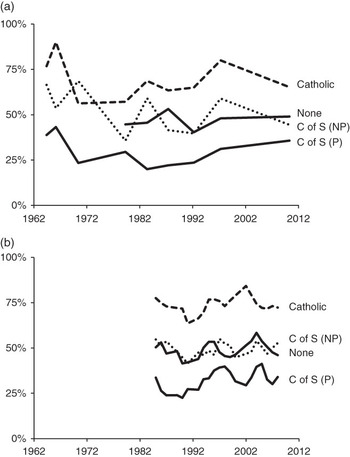
First, how have religion and party choice varied over the last fifty years in Britain? I start with Scotland. Figure 1 shows the relationship between religion and Labour party support in Scotland using the BES data that cover 1964 to 2010 and the BSA data which cover 1983 to 2010. The graph for the BSA data shows three-year moving averages to reduce some of the ‘noise’. Unfortunately, the BES question on religious identity changed in 1979 so I cannot reliably measure those with no religion before 1979 as the numbers are so small.
Labour support, by religion in Scotland over time, BES and BSA data

There are three important points to note here. First, religious denomination has a very large effect for both sets of data. Catholics are considerably more likely to be Labour supporters than those with no religion, who are in turn considerably more likely to be Labour supporters than practising Presbyterians. These patterns are essentially identical for the BES and BSA. Secondly, there are clear effects of religious observance. People who identify with the Church of Scotland but do not actually attend services are no different to those who do not have a religious identification. Thirdly, while the total proportion of people supporting Labour varies over time, the pattern of religious voting appears to remain almost completely constant. There is a 30–40 per cent gap between Catholics and practising Presbyterians in their support for Labour, which is as evident in the 2000s as it was in the 1960s. This lack of change was tested more formally by running a logit regression model with year as an interval level variable, religion and an interaction between year and religion. There is no statistically significant change in the difference between practising Presbyterian and Catholic Labour support for either the BES (1964–2010) or BSA (1983–2010) data (see Appendix Table A1).
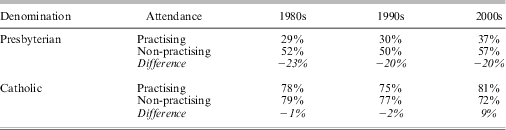
In Table 1, the BSA data are grouped by decade, making it possible to distinguish between practising and non-practising Catholics. As Table 1 shows, the impact of religious denomination is large, but the impact of religious practice is confined to Presbyterians in Scotland. Over three-quarters of Catholics, regardless of whether they attend church or not, support Labour, while practising Presbyterians are twenty percentage points less likely to support Labour than non-practising Presbyterians in the 1980s, 1990s and 2000s.
Average Labour Support for Practising and Non-Practising Presbyterians and Catholics in Scotland for Each Decade, BSA Data 1983–2010

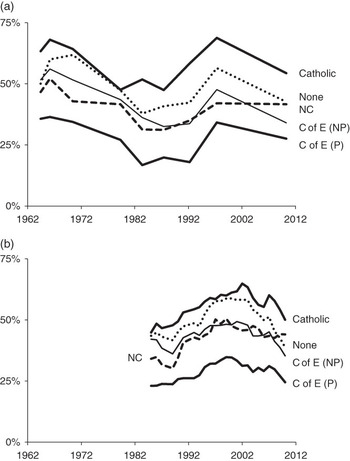
There are similar, though less extreme, patterns in England. Figure 2 shows the change over time in Labour support by religion for the different religious groups. Here the ‘no religion’ category can be extended back to the 1960s, although, to be clear, it is not entirely comparable to the irreligious group from 1979 onwards. Nonetheless, the basic pattern of Catholics supporting Labour more than those with no religion, and the irreligious supporting Labour more than practising Anglicans is surprisingly similar to Scotland. Again, while there is a great deal of change over time in Labour's total support, there is little change in these differences by religion. Moreover, while the gap between Catholics and practising Anglicans is smaller than the gap between Catholics and practising Presbyterians, it is still large: over 25 percentage points on average. Again, changes in this gap over time were tested more formally and again there is no statistically significant change in the difference between practising Anglican and Catholic Labour support for either the BES (1964–2010) or BSA (1983–2010) data (see Appendix Table A2).
Labour support, by religion in England over time, BES and BSA data

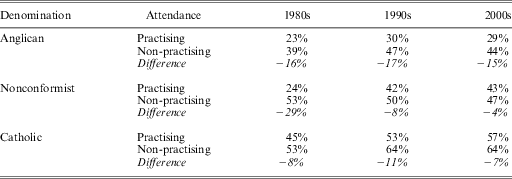
There are also some differences between England and Scotland. The first obvious difference is that there is the extra group of Nonconformists, who lie somewhere in between the practising Anglican group and the irreligious in terms of Labour support. There is also more of a distinction between non-practising Anglicans and those with no religion than was the case in Scotland. Non-practising Anglicans are consistently less likely to support Labour than those with no religion. Table 2 breaks down the religious denominations by church attendance, like Table 1.
Average Labour Support, for Practising and Non-Practising Anglicans, Nonconformists and Catholics in England for Each Decade, BSA Data 1983–2010

Again there are broad similarities with Scotland. For example, the large difference between Catholics and Anglicans remains, as does the lack of change in how religious practice affects party choices. Nonetheless, there are some differences. First, there is an effect of religious practice that appears to decrease Labour support amongst all three religious groups in all decades. Those who simply identify with a religion are more likely to support Labour than those who attend church relatively regularly. Nonetheless, Anglican church attendance seems to have a much greater effect on reducing Labour support than does Catholic or Nonconformist church attendance. Secondly, this pattern is constant for Anglicans and Catholics, but does change for Nonconformists. In the 1980s there was much less support for Labour from practising Nonconformists, but this difference reduced substantially in the 1990s.
Is This Truly a ‘Religious’ Cleavage?
Religion matters. It matters more in Scotland than in England, but in both nations religion is an exceptionally good predictor of party choice. Even at the height of class voting in Britain, the difference between the middle and working class was only the same as the difference between Catholics and practising Anglicans in England, and was less than the difference between Catholics and practising Presbyterians in Scotland. Moreover these differences are quite constant over time (with the sole exception of practising Nonconformists between the 1980s and 1990s). Of course, this sheds little light on why religion matters. Hypothesis 2 suggests that these religious differences are illusory, that they are due to other social structural factors that correlate with both religion and party preference. Equally, Hypothesis 3 suggests that the explanation for religious differences in party support is that they are due to ideology or national identity.
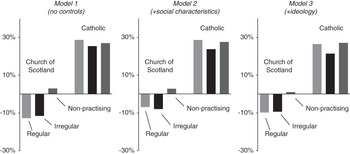
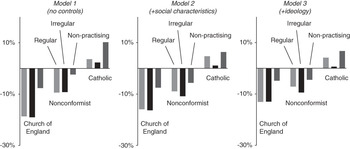
To test Hypotheses 2 and 3 I have run a series of multinominal logit regression models on the pooled BSA data for which I have full measures available (every survey from 1996–2010). The data are pooled as there is no evidence that there were major changes in the impact of religion over the forty-year period, let alone this narrower fourteen-year period (including interactions between year and religion in the models makes no difference to the results shown here). Model 1 contains just religion and year as independent variables. Note that religious practice is broken down further by separating out regular churchgoers (church going of several times a month or more) from irregular churchgoers (church going of more than once a year) from non-practising (church going of once a year or less). Model 2 then adds socio-structural variables and Model 3 adds measures of ideology and national identity.
The full tables of these models are in the Appendix (Table A3 for Scotland and A4 for England), but Figure 3 shows predicted probabilities from the models of the impact of religion on Labour support in Scotland. The figure shows the difference between the two religious groups and the ‘no religion’ group. Model 1 confirms what we have already seen (to generate the predicted probabilities the year is set to 2010). Practising (whether regularly or irregularly) Presbyterians are less Labour than those with no religion, non-practising Presbyterians are very similar to those with no religion, and all Catholics are much more Labour than those with no religion. Frequency of attendance appears to make little difference; the most devout church goers who attend almost weekly look very similar to those who attend less frequently. This is true for both Presbyterians and Catholics.
Predicted probabilities of Labour support, by religion, compared to those with no religion in Scotland from a series of multinomial logistic regression models using BSA data 1996–2010

More interesting though is the comparison between the three models. First, the inclusion of social structural controls such as class makes very little difference to the patterns of association between religion and party. Practising Presbyterians move a little closer to those with no religion and Catholics in terms of Labour support (due to Presbyterians being slightly more middle class and older), but there is little overall change. Secondly, the inclusion of ideology and national identity actually slightly widens the gap between practising Presbyterians and those with no religion. Thus the results of Model 3 look almost identical to the results of Model 1.Footnote 35 We cannot account for religious voting in Scotland by reference to the different social position of people in different religious groups, and we cannot account for religious voting by reference to differences in ideology, whether economic, social or national. For Scotland, Hypotheses 2 and 3 can be refuted. How far does this analysis apply to England?
Figure 4 shows a similar set of predicted probabilities from a similar set of models for England.Footnote 36 Again Model 1 in effect just replicates the earlier graphs with religion and year as the only variables included. Again, the difference between regular and irregular churchgoers is slight for all three religious groups, but the difference between non-practising and practising people is evident for all three in England. Practising Anglicans, Nonconformists and Catholics are all less Labour than their non-practising counterparts. Model 2 introduces social-structural controls and there are some differences from Model 1. In the main, we see a reduction in the effect of religious practice. All three groups within each denomination become more similar. Nonetheless, it is clear that class, cohort and so forth cannot explain away the effects of religious denomination. There is still an almost 20 percentage point gap between Catholics and practising Anglicans in their support for Labour. It is interesting that the denominational differences remain, but, with suitable controls added to the model, the effects of religious attendance become much more marked for Anglicans than they do for Nonconformists and Catholics. Model 3 emphasizes that point further. Controlling for ideology and national identity again reduces the differences between religious groups in England. But while the effects of religious denomination may be smaller, in many ways the pattern now matches the pattern seen in Scotland. Nonconformists as a group look rather similar: regardless of religious practice they are less likely to support Labour (and in fact more likely to support the Liberals). Catholics as a group look rather similar too: regardless of religious practice they are more likely to support Labour. Finally, Anglicans look a bit different. Practising Anglicans are much less likely to support Labour, 13 percentage points less than secularists for both regular and irregular churchgoers, but non-practising Anglicans are more similar to those with no religion.
Predicted probabilities of Labour support, by religion compared to those with no religion in England from a series of multinomial logistic regression models using BSA data 1996–2010

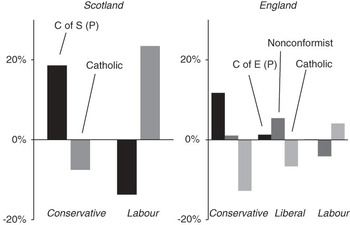
It appears, therefore, that party choices are associated with religion because of the frozen religious cleavage, not because it is a product of another economic, social or national cleavage. In both cases, people in the dominant national church are less enamoured of the Labour party, but only when they are socialized within the church. People identifying with one of the non-national churches, whether Nonconformist or Catholic, do not require this socialization within church, however. As part of the minority, their allegiance to the Labour party, for Catholics, and the Liberal party, for Nonconformists, appears tied to their religious identity regardless of practice. Overall, these results thus appear to support Hypothesis 4a. Denominations are linked to different parties in a particular way. Figure 5 shows the relative chances of supporting a particular party for different denominations relative to those with no religion. As we have seen previously, Catholics, unlike in every other European country, are more likely to support the left. Nonconformists are more likely to support the Liberals and practising members of the established churches in both Scotland and England are more likely to support the establishment party of the Conservatives. As Hypothesis 4a suggested, these are the same patterns evident in the early twentieth century.
Predicted probabilities of different party support, by religion compared to those with no religion in Scotland and England (controlling for social characteristics, ideology and national identity) using BSA data 1996–2010

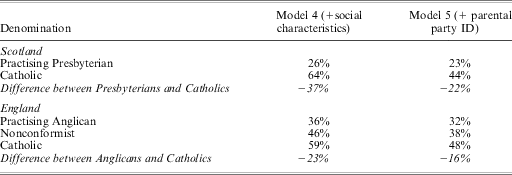
There is a second piece of evidence, though, that relates to the way in which parents socialize their children. For frozen cleavages to persist, children need to inherit their partisanship to some extent, and this inheritance must account, at least in part, for the denominational differences in party identity. This can be tested by modelling party support using religion and including a measure of parental party attachment. Unfortunately, this measure is only available for the BES surveys prior to 2001, so the data used here come from the 1979, 1983, 1987, 1992 and 1997 surveys. Controls for most social characteristics (income and employment status are not available) are also included, but none of the ideological and identity measures used previously. The absence of the latter measures should not present a problem given that they had only small effects. Table 3 shows the results of these models in terms of predicted probabilities of supporting Labour (Tables A5 and A6 in the Appendix show the full models for Scotland and England respectively).Footnote 37 Model 4 includes a simplified measure of religion and most of the demographic controls used in Models 2 and 3 earlier. Model 5 adds in parental party attachment (for both mother and father).
Predicted Probabilities of Labour Support, for Selected Religious Groups from a Series of Multinomial Logistic Regression Models Using BES Data 1979–1997

As Table 3 shows the inclusion of parental party identification does not eliminate the effect of religion, but it does drastically reduce it. The gap between Catholics and practising Presbyterians in Scotland falls from 37 per cent to 22 per cent when parental party identification is held consistent. The gap between Catholics and practising Anglicans in England is also substantially reduced from 23 per cent to 16 per cent. While Hypothesis 4b is not completely supported, these models suggest that parental socialization into a religious and party identity is an important mechanism that contributes to the persistence of the link between religion and party loyalty.
Conclusion
British voters, perhaps surprisingly, do ‘do religion’. Religious cleavages in both Scotland and England are large and stable over time. Even more importantly, these divisions cannot be reduced to differences in the social make-up of the religious groups, or to ideological differences between religious communities, whether on economic, moral or national identity grounds. In that sense, these are truly denominational divisions that appear to reflect conflicts from the beginning of the twentieth century or even earlier. Anglicans and Presbyterians are more likely to support the Conservatives; Catholics are more likely to support Labour; and Nonconformists are more likely to support the Liberals. Not all denominations are equal, however. In particular, identification with the established church in both Scotland and England seems to have little impact on party choice unless it is accompanied by church attendance. This makes sense as many people may have a lingering identification with established churches, but this is, by its very nature, a much weaker identification than with one of the minority religious groups. There is a frequently quoted footnote from Butler and Stokes that perhaps illustrates this:
One of our interviewers recorded a colloquy with a respondent who said ‘none’ in answer to her original question about religious affiliation. She then inquired, on her own initiative, whether she ought to put him down as ‘atheist’ or ‘agnostic’. After hearing her account [of the difference between the two] … the respondent said, ‘You had better put me down as Church of England’Footnote 38
Identifying with the national state church simply means less than identifying oneself as Catholic or Methodist and therefore being a member of a minority group. Thus denominational identification creates a party political difference only between practising Presbyterians or Anglicans on the one hand and Catholics or Nonconformists on the other. It appears that these differences are due, at least in part, to the way in which partisan affiliations are passed down from parents to their offspring.
All of this marks out the religious cleavage as perhaps different in type to other social cleavages in Britain, and also hints at why we might not have seen such a drastic decline in the role of religious cleavages in politics more generally.Footnote 39 The class cleavage is about inequalities in society and the role that parties play in reducing or increasing those inequalities. Thus class mainly manifests itself by affecting people's ideology which, given differences among the parties in terms of that ideology, will affect people's party choices. Religion, at least in Britain, is not like that. Instead, it is a relic of past associations between groups and parties. This highlights the point that the reasons why class has declined in political importance in many countries may not apply to religion in the same way. This has important implications for how we view religious cleavages and, more generally, how we explain the persistence of some cleavages when others seem to change rapidly.
These findings, while specific to Britain and the religious cleavage, suggest that cleavages that seem to be built on very little today can ironically be more resilient than those that seem to be built more firmly on the self-interest of today's voters. The reason for this is that the cleavage that this article examines is, in some senses, simply a marker of parents’ and grandparents’ party affiliation from an era when religion did matter for self-interested voters. As crucially very few people change their denomination from their parents, other than to give up religion,Footnote 40 someone's religious denomination tells us in what kind of political household their parents and grandparents were raised. If I was brought up in a Scottish Catholic household then it is likely that I was brought up in Labour household and my parents were brought up in a Labour household. More importantly, as religion is itself a product of parental socialization, someone's religion also tells us something about the effectiveness of socialization within that family.Footnote 41 Religion is thus a stronger, more resilient cleavage because it is not about contemporary politics and contemporary party policy, but because it is rooted in those socialization processes. This suggests that cleavages that sustain themselves past any resonance in contemporary political debate are likely to be ones for which interlocking socialized identities are key.
That said, the exact method of socialization in the case presented here is not completely clear. Parental party affiliations can only partially account for the relationship between religion and party choice. This may be due to relatively poor recall measures of what parents thought and did,Footnote 42 but it may also be due to other underlying socialization mechanisms. For example, the extent to which people of different religious denominations live and work in different neighbourhoods and different areas of the country may affect how people form party attachments.
There is a more important caveat, however. The number of people effectively socialized into a religious identity, and thus a matching party identity, has fallen dramatically in most countries. Divisions among religious groups may be stable, but the number of people in each of those religious groups has changed considerably. In Britain in the mid 1980s, according to the BSA, around 18 per cent of the English and Welsh population who identified with a party were practising Anglicans, around 12 per cent were Catholic and 10 per cent were Nonconformists. By 2010, the number of practising Anglicans, even on the generous definition of practising used here, had almost halved to 11 per cent; the number of Nonconformists had halved to 5 per cent and the number of Catholics remained constant at 12 per cent. There is a similar story in Scotland, where the number of practising Presbyterians decreased from around a quarter of the population to nearer 10–15 per cent and the number of Catholics similarly decreased from around a quarter of people to 10–15 per cent. In effect, while some families are socializing their children into religious and party identities, others are not. As Best argues, when thinking about social cleavages, we need to consider group size as well as the strength of association between those groups and parties.Footnote 43 In this sense religion has become less important. There are fewer people in the groups that identify with specific parties. Nonetheless, there is still a substantial minority of people in Britain with a religious identity that matters for party choice, and in most other European countries this group is considerably larger. Given this, we should not only take seriously the role of the religious cleavage in shaping party choices in the past, but also think about how it will matter in the future.