The dynamic interplay between psychopathology and personal and social competence has received increasing interest from clinical and developmental psychology (e.g., Masten, Burt, & Coatsworth, Reference Masten, Burt, Coatsworth, Cicchetti and Cohen2006). Many personal and social competences have been identified as potential sources of influence on the development of psychopathology. That is, deficiencies in personal and social competence are associated with increases in internalizing and externalizing problems. Conversely, symptoms of psychopathology may jeopardize the execution of developmental tasks and hinder the development of associated competences. The current insight is that personal and social competences may develop in a dynamic manner along with symptoms of psychopathology, and become entangled with the manifestation of psychopathology in childhood and adolescence (Masten, Reference Masten2006; Rutter, Reference Rutter2000; Rutter & Sroufe, Reference Rutter and Sroufe2000; Sameroff, Reference Sameroff2000; Sameroff & Mackenzie, Reference Sameroff and Mackenzie2003). Over two decades ago, Cicchetti and Schneider-Rosen (Reference Cicchetti, Schneider–Rosen, Rutter, Izard and Read1986) had already posited that successful development is the result of the acquisition of social, emotional, and cognitive competences. Failure to acquire such competences is hypothesized to influence the development of internalizing and externalizing problems (Masten, Reference Masten2006; Patterson & Capaldi, Reference Patterson, Capaldi, Rolf, Masten, Cicchetti, Nuechterlein and Weintraub1990; Sameroff, Reference Sameroff2000), for example, by constraining the options for dealing with day-to-day challenges and increasing the individual's vulnerability to stress.
Results from several studies underscore the dynamic, transactional association between the development of social–emotional competences and the development of psychopathology. For instance, a number of preventive interventions, aimed at improving children's competences to reduce psychopathology have been successful (see Greenberg, Domitrovich, & Bumbarger, Reference Greenberg, Domitrovich and Bumbarger2001), lending indirect support for the causal influence of competence on psychopathological development. More direct support for the role of competences in psychopathology development comes from results of preventive intervention studies showing that reductions in levels of psychopathology were partially accounted for by improvements in peer relations, such as improved peer acceptance, reduced peer victimization, and reduced affiliation with deviant friends (Bierman et al., Reference Bierman, Coie, Dodge, Greenberg, Lochman and McMahon2002; van Lier & Crijnen, Reference van Lier and Crijnen2005; Vitaro, Brendgen, Pagani, Tremblay, & McDuff, Reference Vitaro, Brendgen, Pagani, Tremblay and McDuff1999; Vuijk, van Lier, Crijnen, & Huizink, Reference Vuijk, van Lier, Crijnen and Huizink2007; Witvliet, van Lier, Cuijpers, & Koot, Reference Witvliet, van Lier, Cuijpers and Koot2009). Similarly, in several studies iatrogenic, or unwanted negative effects of intervention were explained by negative peer influences on initially nonaggressive children (Dishion & Dodge, Reference Dishion and Dodge2005; Dishion, McCord, & Poulin, Reference Dishion, McCord and Poulin1999; Dishion, Poulin, & Burraston, Reference Dishion, Poulin and Burraston2001; van Lier, Vitaro, & Eisner, Reference van Lier, Vitaro and Eisner2007). Other recognition for the entanglement of psychopathology and competences comes from developmental psychopathology, positive psychology, and resilience theory (for an overview, see Masten et al., Reference Masten, Burt, Coatsworth, Cicchetti and Cohen2006). Despite this increasing recognition, studies directed at disentangling the interplay between personal and social competences and psychopathology are still limited in number and scope. In the present study, we aim at unraveling the interplay between the development of peer social relations and the development of externalizing and internalizing problems in a sample of 653 kindergarten children, followed annually to fourth-grade elementary school.
Interplay Between Psychopathology and Peer Social Relations
Whenever children move into groups, such as with the transition to kindergarten or elementary school, they start to form social relations with peers. If positive, such relations generally are of importance for learning and rehearsing social norms and social skills. However, some children fail to build up adequate, prosocial relations with mainstream peers. Several studies have demonstrated the link between poor social relations with peers in childhood and a variety of developmental and psychological difficulties in childhood and adolescence. Although most studies demonstrated associations with externalizing problems (see overviews by Boivin, Vitaro, & Poulin, Reference Boivin, Vitaro, Poulin, Tremblay, Hartup and Archer2005; Deater-Deckard, Reference Deater-Deckard2001; Parker, Rubin, Erath, Wojslawowicz, & Buskirk, Reference Parker, Rubin, Erath, Wojslawowicz, Buskirk, Cicchetti and Cohen2006; Rubin, Bukowski, & Parker, Reference Rubin, Bukowski, Parker, Damon and Eisenberg1998; Rubin, Bukowski, & Parker, Reference Rubin, Bukowski, Parker and Eisenberg2006; van Lier & Koot, Reference van Lier, Koot, Loeber, Slot, Van der Laan and Hoeve2008), others demonstrated associations with internalizing problems, such as anxiety, depression, and loneliness (Ladd, Reference Ladd2006; Ladd & Troop-Gordon, Reference Ladd and Troop-Gordon2003; McDougall, Hymel, Vaillancourt, & Mercer, Reference McDougall, Hymel, Vaillancourt, Mercer and Leary2001; Parker et al., Reference Parker, Rubin, Erath, Wojslawowicz, Buskirk, Cicchetti and Cohen2006; Rubin et al., Reference Rubin, Bukowski, Parker, Damon and Eisenberg1998, Reference Rubin, Bukowski, Parker and Eisenberg2006).
Despite the empirical evidence of links between poor peer relations and child psychopathology, the developmental mechanisms of this association are far from clear, as most studies did not study the nature of the link. Several ways on how peer social relations and forms of psychopathology may become associated over time have been suggested (Caron & Rutter, Reference Caron and Rutter1991; Masten, Reference Masten2006; Masten et al., Reference Masten, Burt, Coatsworth, Cicchetti and Cohen2006). For instance, symptoms of psychopathology may undermine the formation of satisfactory social relations, which subsequently may influence the course of psychopathology (Masten, Reference Masten2006; Sameroff, Reference Sameroff2000). This proposed process of transactional relations, or developmental cascades between psychopathology and peer relations, is supported by substantial empirical evidence. Externalizing problems is among the best predictors of peer rejection (Boivin et al., Reference Boivin, Vitaro, Poulin, Tremblay, Hartup and Archer2005; Deater-Deckard, Reference Deater-Deckard2001; Rubin et al., Reference Rubin, Bukowski, Parker, Damon and Eisenberg1998, Reference Rubin, Bukowski, Parker and Eisenberg2006; van Lier & Koot, Reference van Lier and Crijnen2008). Peer rejection, in turn, may deprive children from the opportunity to develop prosocial relations with peers (Haselager et al., Reference Haselager, Cillessen, Van Lieshout, Riksen-Walraven, Hartup and Bukowski2002; Rubin et al., Reference Rubin, Bukowski, Parker and Eisenberg2006) through its influence on emotional, cognitive, and behavioral tendencies. For example, rejected children likely react to the experience of rejection by developing distorted social cognitions (Dodge et al., Reference Dodge, Lansford, Burks, Bates, Pettit and Fontaine2003), or by engaging in coercive exchanges with peers (Snyder et al., Reference Snyder, Schrepferman, McEachern, Barner, Johnson and Provines2008). The emotional, cognitive, and behavioral responses to the experiences of peer rejection may influence the development of both externalizing and internalizing psychopathology.
Although there is a coherent theoretical account and empirical evidence for the transactional nature of the association between psychopathology and child peer relations is emerging, our view on the actual developmental process is still limited because most studies do not have the data to adequately test for what have been called developmental cascades, or transactional links, between psychopathology and social competences. To test developmental cascades or transactional links between peer social relations and psychopathology, parallel measured symptoms of different forms of psychopathology and preferably different peer relational indicators need to be available (Masten et al., Reference Masten, Burt, Coatsworth, Cicchetti and Cohen2006). In this study we will test for developmental cascades between externalizing and internalizing problems with three indicators of poor peer relations, namely, poor peer acceptance, victimization by peers, and having few friends, in a sample of Dutch elementary schoolchildren followed annually from kindergarten to fourth-grade elementary school.
Developmental Links Between Childhood Externalizing and Internalizing Problems
The co-occurrence between childhood externalizing and internalizing problems is well established (e.g., Caron & Rutter, Reference Caron and Rutter1991). For instance, in the general population of children from the United States, the average correlation between ratings of externalizing and internalizing problems at given ages is approximately .50 (.54 and .45 for parent and teacher reports, respectively; Achenbach & Rescorla, Reference Achenbach and Rescorla2001), and similar correlations have been found in the general Dutch population (Verhulst, Van der Ende, & Koot, Reference Verhulst, Van der Ende and Koot1996, Reference Verhulst, Van der Ende and Koot1997). Similarly, both in general population and clinical samples, diagnoses of disruptive disorders co-occur frequently with diagnoses of anxiety and depression, with co-occurrence rates ranging from 9% to 83% (Angold & Costello, Reference Angold and Costello1993; Costello, Mustillo, Erkanli, Keeler, & Angold, Reference Costello, Mustillo, Erkanli, Keeler and Angold2003; Wolff & Ollendick, Reference Wolff and Ollendick2006). There is also evidence that externalizing and internalizing problems influence each other over time. For instance, childhood externalizing problems are predictive of adolescent and young adulthood depressive problems and anxiety disorders (Capaldi, Reference Capaldi1992; Hofstra, van der Ende, & Verhulst, Reference Hofstra, van der Ende and Verhulst2002; Kiesner, Reference Kiesner2002; Stoolmiller, Kim, & Capaldi, Reference Stoolmiller, Kim and Capaldi2005). Evidence within the childhood years is limited, but the study by Mesman, Bongers, and Koot (Reference Mesman, Bongers and Koot2001) tested the links between emotional and behavioral problems from age 3 to 10 years (three assessments). They found from parent reports for both boys and girls that oppositional and aggressive behavior problems at age 3 years predicted internalizing problems at age 10 year, either directly or through social problems or internalizing problems at age 5 years. Teachers reported for boys only that internalizing (withdrawn-depressed) problems at age 3 years contributed to externalizing problems at age 10 via social problems at age 5 years. This suggests that some of the cross-time associations between externalizing and internalizing problems may be accounted for by a mutual association with social problems. Alternatively, both types of psychopathology may be linked through a developmental cascade from one type to the other via consequential social problems.
The Complexity of Poor Experiences With Peers
Before we delve into the role of peer relations in the development of psychopathology any further, we first discuss the different manifestations of poor experiences with peers, and how these may be linked to each other. Poor experiences with peers are expressed in a number of ways (Deater-Deckard, Reference Deater-Deckard2001; Rubin et al., Reference Rubin, Bukowski, Parker and Eisenberg2006). Nonacceptance by peers, often expressed by low social preference (SP) or rejection by peers, is among the most frequently studied manifestation of poor peer relations. During elementary school, approximately 10–15% of children become poorly accepted, or rejected by their peers. Peer rejection has been linked with limited opportunities to acquire social skills and learning social norms (Haselager et al., Reference Haselager, Cillessen, Van Lieshout, Riksen-Walraven, Hartup and Bukowski2002), and to predict coercive exchanges (Snyder et al., Reference Snyder, Schrepferman, McEachern, Barner, Johnson and Provines2008), and distorted social cognitions (Dodge et al., Reference Dodge, Lansford, Burks, Bates, Pettit and Fontaine2003). Hence, experiences of peer rejection may undermine successful social and cognitive development in children, thereby explaining the link with psychopathology development.
However, poorly accepted children likely run into multiple problems with their peers, including victimization by peers, and having difficulty forming friendship relations (Deater-Deckard, Reference Deater-Deckard2001; Rubin et al., Reference Rubin, Bukowski, Parker and Eisenberg2006). Thus, the three most studied indicators of poor relations with peers are interrelated themselves. For instance, rejected children are likely to become victimized (Buhs & Ladd, Reference Buhs and Ladd2001; Buhs, Ladd, & Herald, Reference Buhs, Ladd and Herald2006; Graham & Juvonen, Reference Graham and Juvonen1998; Ladd & Troop-Gordon, Reference Ladd and Troop-Gordon2003), possibly because the aggressors may not be blamed for their actions on these unpopular, rejected children, and the aggressors' behavior toward their victims is justified because they “get what they deserve” (Teräsahjo & Salmivalli, Reference Teräsahjo and Salmivalli2003). However, it may not be the low social acceptance per se, but rather the difficulty in forming friendships that explains why children become victimized. Although rejection and lack of friendships are conceptually different (Bukowski & Hoza, Reference Bukowski, Hoza, Berndt and Ladd1989), many rejected children experience difficulties in forming friendships (Pedersen, Vitaro, Barker, & Borge, Reference Pedersen, Vitaro, Barker and Borge2007), and established friendships tend to be of low quality (Bagwell, Coie, Terry, & Lochman, Reference Bagwell, Coie, Terry and Lochman2000; Brendgen, Little, & Krappmann, Reference Brendgen, Little and Krappmann2000). The resulting limited social network, which is often of low quality, may make these children easy targets for victimization because they are not protected by friends. Studies showed that experiences of victimization were observed most among children who had a low number of friends (Hodges, Boivin, Vitaro, & Bukowski, Reference Hodges, Boivin, Vitaro and Bukowski1999; Schwartz, McFadyen-Ketchum, Dodge, Pettit, & Bates, Reference Schwartz, McFadyen-Ketchum, Dodge, Pettit and Bates1999). Therefore, when studying possible cascades between psychopathology and peer relations, it is important to use multiple indicators of poor peer relations as the interplay between them may add to the explanation of the psychopathology–peer relations link.
Transactional Influences Between Developments in Psychopathology and Peer Relations
Already some decades ago, experimental studies showed a directional effect between externalizing problems and peer rejection (Coie & Kupersmidt, Reference Coie and Kupersmidt1983; Dodge, Reference Dodge1983). In these studies nonacquainted children were grouped and their emerging peer status was observed. The results showed that verbal and physical aggression preceded the emergence of peer rejection. In turn, peer rejection and friendlessness, possibly via their detrimental influence on social and cognitive development, have been theorized (Patterson & Capaldi, Reference Patterson, Capaldi, Rolf, Masten, Cicchetti, Nuechterlein and Weintraub1990) and empirically demonstrated to be linked to both externalizing and internalizing problems in childhood, adolescence, and adulthood (Bagwell, Newcomb, & Bukowski, Reference Bagwell, Newcomb and Bukowski1998; Boivin et al., Reference Boivin, Vitaro, Poulin, Tremblay, Hartup and Archer2005; Capaldi, Reference Capaldi1992; Capaldi & Stoolmiller, Reference Capaldi and Stoolmiller1999; Dodge et al., Reference Dodge, Lansford, Burks, Bates, Pettit and Fontaine2003; Haselager et al., Reference Haselager, Cillessen, Van Lieshout, Riksen-Walraven, Hartup and Bukowski2002; Keiley, Bates, Dodge, & Pettit, Reference Keiley, Bates, Dodge and Pettit2000; Kiesner, Reference Kiesner2002; Miller-Johnson, Coie, Maumary-Gremaud, & Bierman, Reference Miller-Johnson, Coie, Maumary-Gremaud and Bierman2002; Miller-Johnson, Coie, Maumary-Gremoud, Lochman, & Terry, Reference Miller-Johnson, Coie, Maumary-Gremoud, Lochman and Terry1999; Parker et al., Reference Parker, Rubin, Erath, Wojslawowicz, Buskirk, Cicchetti and Cohen2006). Similarly, experiences of victimization have been shown to be predictive of serious maladjustment problems, and although externalizing outcomes are among them, sticking are the links between victimization and serious internalizing outcomes, such as diagnosis of depression and anxiety, suicidal ideation, and suicide attempts (Klomek, Marrocco, Kleinman, Shonfeld, & Gould, Reference Klomek, Marrocco, Kleinman, Shonfeld and Gould2007; Sourander et al., Reference Sourander, Jensen, Ronning, Niemela, Helenius and Sillanmaki2007).
Despite the importance of these studies, they never showed how the developmental course of peer relations is linked with the development of psychopathology because of the lack of data to adequately test for transactional influences. There are a few exceptions, however. For instance, there is growing evidence for transactional links between peer rejection and externalizing problems over the childhood years (Ladd, Reference Ladd2006; Ladd & Troop-Gordon, Reference Ladd and Troop-Gordon2003; Laird, Jordan, Dodge, Pettit, & Bates, Reference Laird, Jordan, Dodge, Pettit and Bates2001; Sturaro, van Lier, Cuijpers, & Koot, in press). That is, peer rejection is evoked by children's externalizing problems, but once established, peer rejection has an independent (i.e., transactional) effect on the development of externalizing problems. However, the studies reporting these results focused specifically on externalizing outcomes or, as in the study of Ladd (Reference Ladd2006), addressed links of peer relations with externalizing and internalizing problems separately. Nonetheless, some recent studies have explored the role of peer relations in the development of both internalizing and externalizing problems simultaneously (Burt, Obradovic, Long, & Masten, Reference Burt, Obradovic, Long and Masten2008; Leadbeater and Hoglund, Reference Leadbeater and Hoglund2009; Kiesner, Reference Kiesner2002; Ladd & Troop-Gordon, Reference Ladd and Troop-Gordon2003; Pedersen et al., Reference Pedersen, Vitaro, Barker and Borge2007). Although limited in scope, Burt and colleagues focused on broad indices of social competence, Leadbeater and Hoglund only studied peer victimization, whereas Kiesner studied only peer rejection. Burt and colleagues found support for the role of social competence in the development of psychopathology, but this study started at age 10 years. Leadbeater and Hoglund followed children over the first 3 years of elementary school and found that aggression predicted peer victimization, in addition to finding one link between aggression and internalizing problems. No cascade from aggression to internalizing problems via peer victimization was found. Kiesner did find paths from externalizing problems to peer rejection, and a path from peer rejection to symptoms of depression among late elementary schoolchildren. However, the overall indirect path was not significant, suggesting that peer rejection did not account for the link between externalizing problems and symptoms of depression. Thus, although suggestive evidence is available, evidence on potential cascade effects between externalizing problems, poor peer relations, and internalizing problems is limited. Furthermore, the importance of different indices of poor peer relations has not been established.
Two studies did use multiple indicators of poor peer relations. Ladd and Troop-Gordon (Reference Ladd and Troop-Gordon2003) found that kindergarten aggression, but not anxiety predicted pooled Grades 1–3 rejection, friendlessness, and victimization scores. Friendlessness predicted fourth-grade internalizing problems only, whereas rejection and victimization predicted both internalizing and externalizing outcomes in fourth grade. Pedersen and colleagues (2007) found that age 6–7 disruptiveness predicted subsequent experiences of rejection and friendlessness at ages 8–9, and 10–11 years, whereas age 6–7 anxiety was only linked with friendlessness. Rejection predicted subsequent friendlessness, but no reverse links were found. Early adolescent depression was predicted only by friendlessness, whereas early adolescent loneliness was predicted by both rejection and friendlessness. Neither rejection nor friendlessness predicted adolescent delinquency once childhood aggression was accounted for. Thus, there is some evidence that multiple indicators of poor peer relations form cascades in the development of internalizing and externalizing psychopathology. However, the studies reviewed above rarely used multiple indicators of poor relations with peers, pooled assessments into cross-age scores thereby masking the possible interplay between different manifestations of peer relational difficulties to a certain degree, or studied their associations with externalizing and internalizing outcomes separately.
The Present Study
The goal of this study was to explore the role of peer rejection, victimization, and friendedness in the development of internalizing and externalizing problems in 653 children from the general population followed annually from kindergarten to fourth-grade elementary school. Based on prior studies, we hypothesize to find evidence that kindergarten externalizing problems predict multiple indices of poor relations with peers. We further expect that the interplay among peer rejection, victimization, and friendedness adds to the prediction of the development of both externalizing and internalizing problems over the kindergarten to fourth-grade age period. When studying these hypothesized developmental cascades, we need to take sex differences into account. During kindergarten and early elementary school, boys are higher than girls on externalizing problems (Bongers, Koot, van der Ende, & Verhulst, Reference Bongers, Koot, van der Ende and Verhulst2003; Moffitt, Caspi, Rutter, & Silva, Reference Moffitt, Caspi, Rutter and Silva2001), although not so much on internalizing problems (Bongers et al., Reference Bongers, Koot, van der Ende and Verhulst2003). Boys also are more likely to experience poor relations with peers (Moffitt et al., Reference Moffitt, Caspi, Rutter and Silva2001; Pedersen et al., Reference Pedersen, Vitaro, Barker and Borge2007). Of more importance, the pathways between different types of psychopathology and peer relations across time may be different for males and females (Mesman et al., Reference Mesman, Bongers and Koot2001). For example, males appear to be more affected by poor relations with peers in their development of psychopathology (Moffitt et al., Reference Moffitt, Caspi, Rutter and Silva2001). However, other studies, using study designs resembling ours, did not find such differences (Ladd, Reference Ladd2006; Ladd & Troop-Gordon, Reference Ladd and Troop-Gordon2003; Pedersen et al., Reference Pedersen, Vitaro, Barker and Borge2007). Thus, we take potential sex differences in cross-time associations between psychopathology and peer relations into account.
Methods
Sample
The study started in second-grade kindergarten during the school year 2003–2004, when 30 elementary schools (47 classrooms) participated in the study. Children from these classrooms, in total 742 children, and those children who repeated first-grade elementary school at the end of that school year (n = 100), and thus moved into the study cohort's sampling frame (total N = 842), were eligible for inclusion. Signed parental informed consent for children's participation was obtained for 90% of the children, making the total sample 758 children. The mean age of the children was 6.27 years (SD = 0.46) at the start of the study. The sample was evenly composed of males and females (49.7% females). Fifty-eight percent of the children were from Dutch Caucasian background, 10% Moroccan, 10% Turkish, 6% Surinamese, 5% Netherlands Antillean, and 11% had other ethnic backgrounds. Thirty-eight percent of the children were from families with low socioeconomic status (SES), which was approximately similar to the general Dutch population (32% low SES; Statistics Netherlands, 2006).
Only children who participated from kindergarten onward were included in the present study (n = 653 children). Excluded children did not differ from the study sample with respect to sex, χ2 (1, N = 758) = 2.68, p = .10, but were more often from families with low SES, χ2 (1, N = 758) = 6.56, p < .01. Included children did not differ in their first grade SP, F (1, 753) = 1.97, p = .16, effect size (ES) = 0.11, victimization, F (1, 757) = 0.54, p = .45, ES = 0.06, or friendedness scores, F (1, 746) = 3.04, p = .08, ES = 0.13, from excluded children.
Approximately two-thirds of the children received a universal preventive intervention program, the Good Behavior Game (GBG; Dolan, Jaylan, Werthamer, & Kellam, Reference Dolan, Jaylan, Werthamer and Kellam1989; Van der Sar & Goudswaard, Reference Van der Sar and Goudswaard2001), from first to third grade. The GBG is a classroom-based program aimed at reducing disruptive behavior. Classes were randomly assigned to intervention versus control condition.
Measures
Teacher ratings of internalizing and externalizing problems in kindergarten, first-, and fourth-grade elementary school were obtained with the Problem Behavior at School Interview (Erasmus Medical Center, 2000). The Problem Behavior at School Interview is a 43-item teacher interview assessing behavioral and emotional problems in children on a 5-point Likert scale (never applicable–often applicable). The conduct problems, oppositional problems, and anxiety and depression scales were used. The Conduct Problems Scale consists of 13 items, such as this child fights, this child attacks other children physically, this child destroys property belonging to others, and this child is truant. The Oppositional Defiant Scale consists of 7 items including has temper tantrums, is stubborn, is disobedient at school, and is defiant. Cronbach α values were 0.90, 0.90, and 0.92 for the Conduct Problems Scale and 0.90, 0.91, and 0.93 for the Oppositional Defiant Scale in kindergarten, first grade, and fourth grade, respectively. The Anxiety Scale consisted of 5 items (e.g., this child is anxious, worries about many things). The Depression Scale comprised 7 items, including cries or is sad at school, enjoys little at school, and feels too guilty. Alpha values were 0.81, 0.81, and 0.79 for anxiety and 0.78, 0.83, and 0.81 for depression in kindergarten, first grade, and fourth grade, respectively.
The conduct problems and oppositional problems scale scores (r = .84, .83, and .83 in kindergarten, first grade, and fourth grade, respectively) were summed to an overall externalizing score. The anxiety and depression scale scores (r = .68, .67, and .63 in kindergarten, first grade, and fourth grade, respectively) were summed into an overall internalizing score.
Peer nominations of externalizing and internalizing problems in first and fourth grade were obtained by asking each child to nominate all classmates of either sex that fit either of four descriptions: starts fights (conduct problems), does not obey to rules at school (opposition), is fearful (anxiety), and is sad easily (depression). Children's nominations for each of these descriptions were divided by the number of children in the class minus 1 (self-nominations were not allowed). The conduct problems and oppositions (r = .78) nominations were summed to an overall externalizing problems score. The anxiety and depression (r = .57) nominations were summed to an overall internalizing problems score.
The correlations between teacher and peer rated externalizing problems scores in first and fourth grade were .64 and .73 (p < .01), and these correlations were .20 and .27 (p < .01) for internalizing. To obtain a multi-informant score for the age 10 outcomes, the teacher- and peer-rated externalizing and internalizing scores were summed (divided by 2) into a multi-informant externalizing score and a multi-informant internalizing score.
SP scores were used as a measure of peer rejection. Each year, from first grade onward, children nominated an unlimited number of children in their class they liked most and liked least (Coie, Dodge, & Coppotelli, Reference Coie, Dodge and Coppotelli1982). Children's liked-most and liked-least scores were divided by the number of children in the classroom minus 1 (nominating oneself was not allowed). SP scores were computed by subtracting this liked-least score from the liked-most score for each child. Low scores indicate poor acceptance by classmates (peer rejection).
Teacher ratings of victimization were collected from first to fourth grade through the Social Experience Questionnaire—Teacher Report, which is a validated teacher-reported measure of peer victimization (Cullerton-Sen & Crick, Reference Cullerton-Sen and Crick2005). Items assess experiences of physical and relational victimization on a 5-point Likert scale from 1 (never) to 5 (almost always). Physical victimization was assessed by three items (gets hit or kicked by peers; gets pushed or shoved by peers; and gets physically threatened by peers). Cronbach α values ranged from 0.82 to 0.92. Relational victimization was also assessed by three items: gets excluded when someone is mad at them; gets ignored by other kids when someone is mad at him/her; and this child gets told “you aren't my friend/buddy” if they do not comply with a classmates request. Cronbach α values ranged from 0.86 to 0.92. Correlations between the physical and relational victimization scale ranged between .50 and .71. An overall victimization score was computed by summing the two scale scores.
Number of mutual friends (friendedness) was assessed annually by asking children to nominate their best friends in the class. Unlimited nominations were used. The number of reciprocated friendship nominations (i.e., the nominated best friend in turn nominated the participant as one of his/her best friends) of a child were identified. To control for differences in class size, the number of reciprocated best-friends scores for each participant was divided by the class size minus one (self-nomination was not allowed). Lower scores indicate having fewer friends in the class (lower friendedness).
Child's gender was dummy coded as 0 = female, 1 = male.
Results
Descriptive statistics
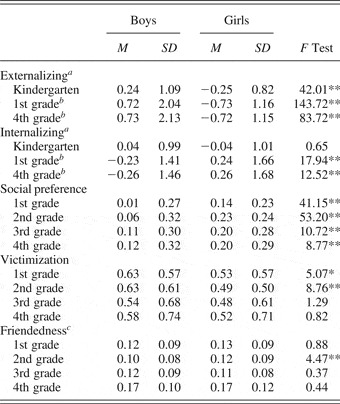
Means of externalizing and internalizing problems, SP, victimization, and friendedness are in Table 1. Boys had higher scores on externalizing and lower scores on social preference. Only in first and second grade did boys have higher victimization scores than girls. No consistent sex differences were found for friendedness. Girls had higher internalizing scores than boys in fourth grade, but not in kindergarten.
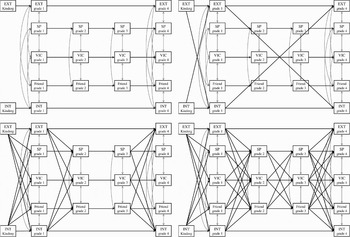
Hypothesized models of directional and additive associations among externalizing (EXT) and internalizing (INT) problems, peer social preference (SP), peer victimization (VIC), and friendedness (Friend). (Top left) Model 1 assumes individual stabilities only. (Top right) Model 2 (psychopathology model) assumes only longitudinal links between externalizing and internalizing problems. (Bottom left) Model 3 (cascade model) assumes links between forms of psychopathology and peer relations, but no links between forms of peer relations. (Bottom right) Model 4 (full cascade model) assumes developmental links between psychopathology and peer relations as well as developmental links between forms of peer relations.

Means and standard deviations of psychopathology and peer relations for boys and girls

aEntries reflect Z-standardized scores. bEntries reflect combined teacher and peer report. cScores reflect the percentage of classmates with reciprocated friend nominations.
*p < .05. **p < .01.
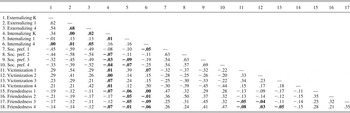
The correlations between the study variables are in Table 2. Significant stabilities coefficients were found for externalizing and internalizing problems, as well as for each of the three peer relation measures, showing that each of the repeatedly assessed study variables are somewhat (victimization) to highly (SP) stable across the study period. Cross-age correlations between kindergarten externalizing and fourth grade internalizing problems, or vice versa were not significant. Cross-age correlations between kindergarten externalizing problems and peer relations were significant. In contrast, kindergarten internalizing problems were mostly not significantly related to peer relation measures. Significant concurrent and longitudinal correlations between rejection, victimization, and friendedness were also found.
Correlations between externalizing and internalizing problems, social preference, victimization, and friendedness

Note: K, kindergarten; 1–4, Grades 1–4; Soc. pref., social preference. All coefficients are significant at p < .05 except bold entries, which reflect nonsignificant correlation coefficients.
Model fitting
The cascade hypotheses were tested by defining transactional, or autoregressive cross-lagged models (Jöreskog, Reference Jöreskog1970) that were fitted in Mplus 5.1 (Muthén & Muthén, Reference Muthén and Muthén1998–2009). The autoregressive paths of the model, in which the repeatedly assessed variables are regressed on their immediate prior values, are used to test continuity within variables. The cross-lagged, cross-time paths are allowed for to test associations between the repeated assessments. Cross-sectional correlations between parallel assessed variables were included in the model. Model fit was determined using the comparative fit index (CFI) and Tucker–Lewis index (TLI; acceptable values > 0.90; Bentler, Reference Bentler1990) and the root mean square error of approximation (RMSEA; acceptable values < 0.08; Browne & Cudeck, Reference Browne, Cudeck, Bollen and Long1993). To account for the possible nonnormal distribution of the study variables, a maximum likelihood robust estimator, which provides robust standard errors, was used.
We started by fitting a model with only autoregressive paths, and concurrent correlations between psychopathology and peer relations (see Figure 1, Model 1). This model assumes only individual stabilities within each repeatedly measured construct. Hence, this model assumes no longitudinal links between psychopathology and peer relations, nor any longitudinal links between externalizing and internalizing problems. Based on modifications indices, we allowed three second-order autoregressive paths: two for SP, and one for victimization. The fit statistics for this model are provided in Table 3. These show that this model had a poor fit to the data.
Fit statistics and model comparisons for nested models

Note: SEM, stuctural equation modeling; CFI, comparative fit index; TLI, Tucker–Lewis index; RMSEA, root mean square error of approximation; Δχ2 statistics are based on the Satorra Bentler chi-square difference test.
We therefore fitted a second model. This model allowed for cross-time links between externalizing and internalizing problems (see Figure 1, Model 2). This model did not allow for cross-time links between measures of psychopathology and peer relations, thereby assuming that peer relations were unrelated to the joint development of externalizing and internalizing problems. A chi-square difference test (Satorra, Reference Satorra, Heijmans, Pollock and Satorra2000) showed that this model significantly better fitted the data (see Table 3). However, it nonetheless had a poor fit to the data (see Table 3, psychopathology model).
We then allowed for cross-lagged paths between kindergarten externalizing and internalizing problems with peer relations and the cross-lagged paths between social relations and fourth-grade externalizing and internalizing problems. This model therefore assumes a cascade between psychopathology and peer relations (see Figure 1, Model 3). We again allowed for three second-order paths, one from kindergarten internalizing to third-grade friendedness, and two from kindergarten externalizing to victimization and SP in third grade, respectively. Note that no links between social relations were allowed for at this stage. This model thus assumed that although peer relations are needed to explain the joint development of internalizing and externalizing problems, no longitudinal relations between various forms of peer relations need to be accounted for. Table 3 (cascade model) shows that this improved model fit, but its fit was nonetheless unacceptable.
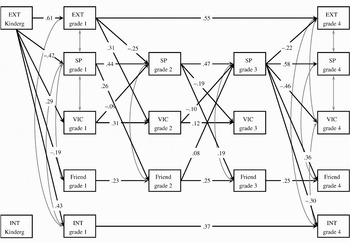
We then fitted the full cascade model (see Figure 1, Model 4). This model allowed for cross-lagged paths between SP, victimization, and friendedness. Adding these paths improved model fit again and resulted in a satisfactory fit according to all fit indices (see Table 3, full cascade model). This model was therefore used for the remainder of the analyses. Nonsignificant paths were deleted from the model. This model had a good fit to the data, χ2 (95) = 188.72, p < .01, CFI = 0.98, TLI = 0.95, RMSEA = 0.04. The significant path estimates are provided in Figure 2.
Standardized path coefficients for significant paths among externalizing (EXT) and internalizing (INT) problems, social preference (SP), victimization (VIC), and friendedness (Friend; full cascade model). Significant cross-sectional correlations are shown, but higher order regression paths are not. All numeric paths are significant at p < .05.

As indicated earlier, approximately two-thirds of the sample participated in a classroom-based preventive intervention study, the GBG program. The GBG program was implemented in first and second grade. Previous results showed that the GBG reduces externalizing problems (Ialongo et al., Reference Ialongo, Werthamer, Kellam, Brown, Wang and Lin1999; Kellam, Rebok, Ialongo, & Mayer, Reference Kellam, Rebok, Ialongo and Mayer1994; van Lier, Vuijk, & Crijnen, Reference van Lier, Vuijk and Crijnen2005). Our goal was not to analyze intervention effects, and all paths were controlled for intervention status. Note that this study focuses on developmental links, or rank orders among repeatedly assessed variables. The intervention may cause reductions in levels of psychopathology, or even reductions in levels of peer risks, such as improved peer acceptance, or having more friends. To validly use both the intervention and control sample in this study, we needed to establish that despite possible differences in levels of psychopathology and in the manifestation of peer relations, the size of the associations between the study variables was similar for control and intervention children. If this is the case, we are able to conclude that the intervention did not affect the developmental pathways, although it might have affected the levels of outcome variables. For example, after exposure to the program intervention children may have become less likely to be rejected, and therefore less at risk for psychopathology development. However, if intervention or control group children experience peer rejection, this equally affected these children's psychopathology development, regardless whether they were in the intervention or control condition.
To test for potential effects of the intervention of the associations between study variables as tested in the full cascade model, a multiple-group model was fitted in which controls were compared to intervention group children. Controls served as the reference category. An overall test of the size of the cross-lagged paths showed that these path estimates were similar for control- and intervention children, Δχ2 (17) = 26.16, p > .05. However, differences in the size of the autoregressive paths were found, Δχ2 (13) = 26.31, p < .05. This was accounted for by two paths: the path from third-grade friendedness to fourth-grade friendedness was stronger among controls, and the path from second-grade victimization to third-grade victimization was stronger among intervention children.
Data up to fourth grade were complete for 467 children. Missing data were handled through full information maximum likelihood estimation. However, to test whether cases with missing data influenced model estimation we reestimated the final model for only those 467 children. All paths remained significant. Given the lack of any consistent differences between intervention and control children, and because missing data did not affect the results, we report the results on all available data in the remainder of this section.
Externalizing and internalizing problems and peer relations
The results from the cross-lagged model in the full sample are depicted in Figure 2. These results showed stability paths for externalizing problems, and a significant stability path for first-grade to fourth-grade internalizing problems. However, no significant path from kindergarten internalizing problems to first-grade internalizing problems was found, indicating lack of stability for internalizing problems across this age period. However, a direct path from kindergarten externalizing to first-grade internalizing problems was found.
The results also showed a complex picture of indirect paths from first-grade externalizing problems to fourth-grade internalizing problems via peer relations. Specifically, kindergarten as well as first-grade externalizing problems, but not internalizing problems, predicted low SP, victimization, and low friendedness 1 year later. In turn, over Grades 1–3 SP consistently predicted friendedness, indicating that low levels of SP were linked with having fewer friends 1 year later. Low levels of SP in second and third grade also predicted new experiences of peer victimization in third and fourth grade, respectively. Moreover, lower levels of SP in third grade were uniquely linked with both externalizing and internalizing problems in fourth grade, above and beyond continuities of these problems from first grade.
Experiences of victimization did not predict growth in internalizing or externalizing problems in fourth grade. However, experiences of victimization added to the prediction of lower levels of SP from Grade 1 to Grade 2 and from Grade 2 to Grade 3, thereby increasing the stability of low levels of social acceptance by peers. Friendedness only predicted low SP at one occasion (from Grade 2 to Grade 3), but it did not predict the development of victimization or psychopathology.
Our results thus suggest that the cross-over link from externalizing to internalizing problems was accounted for by low levels of peer acceptance (SP). Moreover, our results suggest that peer victimization added to the stability of SP, thereby indirectly adding to the cross-over effect from externalizing to internalizing problems. We statistically tested whether these indirect paths were significant (MacKinnon, Lockwood, & Williams, Reference MacKinnon, Lockwood and Williams2004). Results did show that the combined path from first-grade externalizing, via the interrelated experiences of (low) SP and victimization, to fourth-grade internalizing was significant (B = 0.03, SE = 0.01, β = 0.04, p < .01). Although we could not control for co-occurring kindergarten poor peer relations in these data, the path from kindergarten externalizing, via SP over Grades 1–3, to fourth-grade internalizing was also significant (B = 0.02, SE = 0.01, β = 0.03, p < .01). Finally, experiences of SP, partly because of peer victimization, also statistically accounted for the development of externalizing problems from first to fourth grade (B = 0.04, SE = 0.01, β = 0.03, p < .01).
Sex differences
To test for sex differences in the strengths of the associations, we fitted a multiple-group model, in which boys were contrasted with girls. We then tested whether the strengths of the associations were different for boys compared to girls. Results showed that although no differences were found in the autoregressive paths, Δχ2 (13) = 10.16, p > .05, differences in the size of the cross-lagged paths were found, Δχ2 (17) = 27.89, p = .05. This difference was accounted for by the path from third-grade SP to fourth-grade externalizing problems, which was significant for both males and females, but stronger for males.
Discussion
It has been theorized that social competence and psychopathology development are closely related across time and exert a mutual influence, thereby constituting the basis for child adaptation and maladaptation. Testing these assumptions, we found that both externalizing and internalizing forms of psychopathology and related, but conceptually diverse forms of peer relations, including peer rejection, victimization, and friendlessness, develop intricate transactional relations over time. Early externalizing problems had a negative influence on all three manifestations of peer social relations. The resulting continuity of poor peer experiences, and the interplay between peer rejection and victimization in turn, added to continuation of engagement in externalizing problems and explained the cross-over effect from externalizing to internalizing problems.
With respect to the role of peer relations in the development of psychopathology, our results add to the growing body of research showing the importance of the dynamic interplay between poor peer acceptance and externalizing behavior development during childhood (Ladd, Reference Ladd2006; Sturaro et al., in press; Vitaro, Pedersen, & Brendgen, Reference Vitaro, Pedersen and Brendgen2007). Moreover, the results of the present study also suggest cascade effects across the early school years from externalizing problems to internalizing problems, via poor peer relations. Neither kindergarten nor first-grade internalizing problems predicted difficulties in relations with peers. However, peer rejection as well as victimization partially explained why children with initially elevated levels of externalizing problems were eventually also at risk of developing internalizing problems. The present study's results with regard to peer rejection and victimization largely concur with earlier findings (Ladd & Troop-Gordon, Reference Ladd and Troop-Gordon2003). However, unlike Ladd and Troop-Gordon (Reference Ladd and Troop-Gordon2003) we did not find a cross-time link between victimization and externalizing problems. A methodological difference between the two studies may explain this difference in results, as in the study by Ladd and Troop-Gordon victimization experiences over Grades 1–3 were pooled, whereas we tested year-by-year associations. Our study also showed that although peer victimization added to the prediction of peer rejection, it did not link to the development of externalizing or internalizing problems above and beyond the influence of peer rejection. Previous studies showed the long-term negative effects of exposure to peer victimization (Klomek et al., Reference Klomek, Marrocco, Kleinman, Shonfeld and Gould2007; Sourander et al., Reference Sourander, Jensen, Ronning, Niemela, Helenius and Sillanmaki2007). However, these studies did not control for effects of peer acceptance in their analyses. A recent study by Leadbeater and Hoglund (Reference Leadbeater and Hoglund2009) followed children over first to third grade and also found no additive effects of peer victimization on the development of internalizing problems, and although that study did find a significant path from victimization to the development of aggression, it did not control for peer acceptance.
It is important to note that these findings hold, regardless of the child's gender. Apparently, despite sex differences in levels of externalizing and internalizing problems as well as peer rejection and victimization, the pattern of cross-time associations and influences found in this study was virtually identical for boys and girls. This suggests that in the early school period externalizing problems affect peer relations, peer relations influence each other, and peer relations affect externalizing and internalizing problem development in similar ways in girls and boys. The single sex difference in pathways found in this study indicated that girls' externalizing problems may be somewhat less affected by peer rejection than boys'.
Our finding of cascade effects from externalizing to internalizing problems via peer relational difficulty supports one of the possible explanations for the co-occurrence between different forms of psychopathology forwarded by Caron and Rutter (Reference Caron and Rutter1991). These authors suggested that one of the reasons why seemingly different manifestations of psychopathology may co-occur is because problems in one domain (in our case externalizing problems) create a context (in our case difficulties in peer relations) in which symptoms of another domain (in our case internalizing problems) may develop. Note that the zero-order Pearson correlation coefficient between kindergarten or first grade externalizing problems and fourth grade internalizing problems was nonsignificant. Our results thus suggest that failures in forming positive peer relations evoked by early externalizing problems constitute the elements that eventually place children at increased risk to also develop internalizing problems.
Our results also demonstrate that to understand the role of peer relations in the development of psychopathology, multiple indicators of difficulties in peer relations should be assessed. Kindergarten and first-grade externalizing problems uniquely predicted all three studied indicators of poor relations with peers, thus supporting that these three variables are actually different, albeit related manifestations of peer difficulties in childhood. Transactional links between peer rejection and victimization were found with age, suggesting that part of the continuity of each of both domains of peer relation difficulties depends on the influence of its counterpart. In addition, as expected, peer rejection added to the prediction of failure in forming friendships, although friendedness was not linked to the development of psychopathology above and beyond the influence of peer rejection.
Finally, our results demonstrated the influential power of peer rejection (as an indicator of failing relations with peers) in the development of childhood psychopathology during the school years. Experiences of peer rejection added to the development of internalizing as well as externalizing behavior, in addition to predicting experiences of victimization and having fewer friends. However, it is uncertain whether peer rejection remains such a strong factor in the development of psychopathology after the early school years. In late childhood or early adolescence, peer rejection has been shown to lose its influence on the development of externalizing problems (Ladd, Reference Ladd2006; Vitaro et al., Reference Vitaro, Pedersen and Brendgen2007). However, in the study by Ladd, it was also found that across the elementary school period, peer rejection remained a strong predictor of subsequent internalizing problems, suggesting that peer rejection may only lose its influence on the development of externalizing problems, not internalizing problems.
This study does have limitations. First, although the schools in our study were from metropolitan and rural areas of The Netherlands, they were not drawn randomly. As a consequence, our sample may not represent the general population of children visiting kindergarten and early elementary school. However, it is unlikely that our sample is very different. For instance, the percentage of low SES families in our sample (38%) was just slightly higher than the general Dutch population, of which 32% is of low SES (Statistics Netherlands, 2006). Second, influences of peers were limited to peers within the classrooms. Children may have friends outside the classroom. However, the majority of elementary school children tend to select their friends inside the classroom even when external nominations are allowed (Kupersmidt, Burchinal, & Patterson, Reference Kupersmidt, Burchinal and Patterson1995). Third, note that the associations demonstrated in this study by no means imply causal links. For instance, we did not study the hypothesized mediating processes (e.g., lack of prosocial skills, coercive exchanges, distorted social cognitions, low self-esteem, loneliness) that may explain why peer rejection or victimization added to the development externalizing and internalizing problems.
Conclusion
This study showed a complex interplay between psychopathology and peer relations, thereby supporting the idea of developmental cascades in children's psychopathology development. This has implications for our understanding of, and future research on psychopathology development, and prevention or intervention. Our results showed that children who enter elementary school with externalizing problems run the risk that their behavior problems become embedded in multiple problems with peers, and that these problems explain why these children remain high on externalizing problems, and why they develop internalizing problems. Therefore, studies on the development of psychopathology may profit from taking the complex influence of peer relations on psychopathology development into account. However, no final conclusions on the efficacy of peer relations in transactional relations with and between manifestations of psychopathology should be drawn. As Masten and colleagues (2006) already warned, developmental cascades may represent spurious associations, because of nonaccounted for important variables. For instance, both the manifestation and development of childhood externalizing behavior are highly influenced by genes (Bartels et al., Reference Bartels, van den Oord, Hudziak, Rietveld, van Beijsterveldt and Boomsma2004), and continues to be so in adolescence and adulthood (Rhee & Waldman, Reference Rhee and Waldman2002). It is more important that these genetic influences on externalizing problems may also account for the social experiences children encounter or may explain who are most influenced by them (Kendler & Eaves, Reference Kendler and Eaves1986; see also Brendgen et al., Reference Brendgen, Boivin, Vitaro, Bukowski, Dionne and Tremblay2008; Brendgen, Vitaro, et al., Reference Brendgen, Vitaro, Boivin, Girard, Bukowski and Dionne2009; Bullock, Deater-Deckard, & Leve, Reference Bullock, Deater-Deckard and Leve2006; Kendler et al., Reference Kendler, Jacobson, Gardner, Gillespie, Aggen and Prescott2007; van Lier, Boivin, et al., Reference van Lier, Boivin, Dionne, Vitaro, Brendgen and Koot2007). Future studies should also focus on potential mediating processes, such as social cognitions, coercive exchanges, and social skills, that are hypothesized to link poor peer experiences to psychopathology development. Although studies on such intermediate processes have been conducted (Dodge et al., Reference Dodge, Lansford, Burks, Bates, Pettit and Fontaine2003; Ladd & Troop-Gordon, Reference Ladd and Troop-Gordon2003; Snyder et al., Reference Snyder, Schrepferman, McEachern, Barner, Johnson and Provines2008), studies that have systematically and repeatedly assessed indices of psychopathology, multiple peer relations, and hypothesized direct consequences of poor peer relations over a prolonged developmental span are lacking. To get a better insight in the developmental cascades, such studies are needed.
Our findings also have implications for prevention. The results of this study suggest that preventive interventions should be directed at the early peer processes that seem to be elicited by early externalizing problems, in order to stop the development of the complex process of increasing intertwining of psychopathology and peer social relations. However, it is unlikely that any preventative program may be able to fully block the negative peer experiences that are evoked by early externalizing problems. Prevention should also be directed at behavioral development at earlier ages, to prevent children from entering elementary school with high levels of externalizing problems, and from becoming entangled in the intricate chain, or cascade of events linking psychopathology and poor peer relations that may be difficult to halt once it is established.