Introduction
Kinship care has been defined as ‘the practice of kin stepping in to raise children when the birth parents are unable to do so’ (Dunne & Kettler, Reference Dunne and Kettler2007, p. 333). Carers may be relative carers, typically grandparents, aunts and older cousins, or non-relative carers, including family friends or those who may have had, at best, a tenuous link with the child prior to assuming the role of caregiver (Kiraly & Humphries, Reference Kiraly and Humphreys2013). Kinship care may be formal care, where children are placed as a result of statutory involvement, or informal care where there may be an absence of agency assessment or involvement (Dunne & Kettler, Reference Dunne and Kettler2007). This paper will focus on formal kinship care, acknowledging that although kinship carers do not comprise a homogeneous group, the literature highlights a number of common characteristics: they are older, poorer and more frequently experience ill-health than foster carers (Boetto, Reference Boetto2010; Gladstone & Brown, Reference Gladstone and Brown2007). In spite of the constraints faced by kinship carers, some evidence suggests that children in kinship care may be faring better than their counterparts in foster care (Winoker et al., 2009, in Harnett, Dawe, & Russell, Reference Harnett, Dawe and Russell2012). A systematic review of 62 studies involving outcomes for children in care, for example, found that children placed with kinship carers demonstrated fewer behaviour problems and had stronger adaptive behaviours when compared with children placed in foster care (Winoker et al., 2009, in Harnett et al., Reference Harnett, Dawe and Russell2012). A brief observation in relation to the needs of children in out-of-home care, and the development of therapeutic approaches to foster care follows.
The Needs of Children in Out-of-home Care
All children who are the subject of statutory involvement and placed in out-of-home care, by virtue of their placement, have been assessed as having experienced abuse, neglect or abandonment (Children Youth and Families Act (CYFA), 2005). Those children in statutory kinship placements have met the same ‘threshold’ as their counterparts in foster care, where, according to the Victorian legislation, the child has either been abandoned, or found to have ‘suffered or (is) likely to suffer’ significant harm as a result of physical injury, sexual abuse, psychological harm or physical neglect (CYFA, 2005, s. 162). The legislative provisions establishing children in need of protection are similar across other states and territories in Australia, commonly requiring a threshold of ‘significant harm’ be established in order to warrant statutory intervention (Australian Institute of Family Studies, 2014). It follows that these children may have experienced complex developmental trauma and, as a consequence, may been seen as requiring more than the provision of safe and stable accommodation to facilitate recovery (Golding & Hughes, Reference Golding and Hughes2014), whether they are placed in the formal out-of-home care system or within a kinship placement.
Therapeutic Approaches to Foster Care
Models of foster care recognising the need for therapeutic care have developed nationally and internationally, with some promising evaluation results (Chamberlain, Price, Laurent, Landsverk, & Reid, Reference Chamberlain, Price, Laurent, Landsverk and Reid2008; Fisher, Chamberlain, & Leve, Reference Fisher, Chamberlain and Leve2009; Frederico et al., Reference Frederico, Long, McNamara, McPherson, Rose and Gilbert2012; Smith, Chamberlain, & Eddy, Reference Smith, Chamberlain and Eddy2010). Research over at least two decades indicating positive outcomes associated with therapeutic approaches to foster care identified decreased rates of substance use (Smith et al., Reference Smith, Chamberlain and Eddy2010), and enhanced placement stability for children and young people (McClung, Reference McClung2007). Some literature has identified the value of models of foster care that promote healing and recovery from complex developmental trauma experienced as a result of abuse and neglect (Frederico et al., Reference Frederico, Long, McNamara, McPherson, Rose and Gilbert2012; Ryan, Reference Ryan2007; Tomlinson & Philpot, Reference Tomlinson and Philpot2007, Reference Tomlinson and Philpot2009). Internationally, models of therapeutic care range from those that are behaviourally oriented, with a strong focus on the needs of adolescents (Chamberlain Reference Chamberlain, Alexander and Curtis2000; Fisher, Chamberlain, & Leve, Reference Fisher, Chamberlain and Leve2009), to those models that have as their foundation attachment theory and relational responses designed to promote the carer–child relationship as the focus of the therapeutic ‘work’ (Frederico et al, Reference Frederico, Long, McNamara, McPherson, Rose and Gilbert2012; Golding & Hughes, Reference Golding and Hughes2014; Siegal, Reference Siegal2012). Within Australia, most states and territories have a version of ‘enhanced’ foster care with some variation in programme design and implementation (Child Protection Development, Department of Communities, 2011). The Victorian Circle Program, for example, is a programme based on the significance of relationships in response to the child's experience of attachment disruption (Frederico et al., Reference Frederico, Long, McNamara, McPherson, Rose and Gilbert2012). A recent evaluation of this programme found that, compared to children in generalist foster care, children placed in the Circle Program were more likely to remain in a stable placement and that Circle carers were more likely to continue to offer care (Frederico et al., Reference Frederico, Long, McNamara, McPherson, Rose and Gilbert2012).
Kinship Care, Foster Care . . . What is the Difference?
Both foster and kinship care offer a home-based environment for children who are unable to live with their families. Both forms of care aim to offer safety and stability, and, if required, can potentially become ‘permanent care’ arrangements for children (CYFA, 2005).
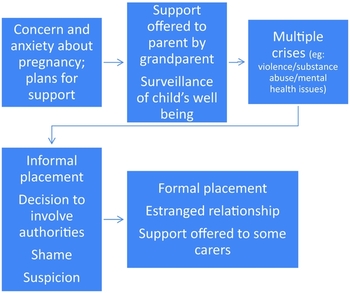
A key distinction between the two forms of care relates to those kinship placements offered by relative carers, in particular grandparent carers. Becoming a kinship carer may be unplanned and occur as a result of tragic circumstances, impacting on both the child in need of care and the carer (Harnett, Dawe, & Russell, Reference Harnett, Dawe and Russell2012). An analysis of the trajectory for a formal (grandparent) kinship carer versus a foster carer, from initial contemplation of care to placement, is summarised below, and is based on the authors’ personal and professional experience (Figures 1 and 2). These diagrams highlight quite dramatically the distinctions between the two forms of care, not just at the onset but potentially on an ongoing basis.
The road to foster care.

The road to kinship care (for a relative carer).

The diagrams highlight the distinctions between the two forms of care from initial contemplation, where typically a prospective foster carer initiates contact with a relevant agency expressing interest in and motivation to become a carer. Attendance at an initial information session follows. In order to proceed with an application, prospective carers undergo an assessment and screening process, which involves a level of self-reflection and third-party endorsement via referee checks. Prospective carers must then successfully undertake a mandatory training programme in order to become accredited and have a child placed in their care. Carers have the right to veto certain placements according to their preference and capacity according to gender and age, for example. A placement can be made on completion of this process and supported on an on-going basis by the foster-care agency staff.
Contrast this process with that indicated in Figure 2, which summarises the typical trajectory for a formal kinship (grandparent) carer. Concerns and anxiety about the wellbeing of the unborn child may have been present from the moment that the pregnancy is confirmed, in light of a history of difficulties. Early efforts may be made to support the young adult to parent safely, and involve attempts to care and support while maintaining a level of surveillence in relation to the infant. A crisis (or multiple crises) occurs, which typically involves the ‘co-occurrence of domestic violence, parental subtance misuse and mental health problems‘ (Bromfield, Lamont, Parker, & Horsfall, Reference Bromfield, Lamont, Parker and Horsfall2010, p. 1). The impact of these crises may be experienced directly by the carer as well as the child. An initial placement at this time may require the grandparent to make critical decisions to involve authorities, including the police and child protection. This may result in an estranged relationship between grandparent and their own child, with the grandparent carer ultimately making a decision to care for their grandchild. Working with, and responding to, statutory services may be experienced as supportive by the grandparent; however, particularly in the initial assessment phase of involvement, may be experienced as shaming and the bureaucratic and legal process confusing.
Current Programme Models of Kinship Care
Although children in formal kinship care have been identified as having experienced ‘significant harm’ in the same manner as other children who are placed in foster care, it seems that this knowledge has yet to be translated into service delivery in Victoria. Responding to the evidence that kinship carers are relatively physically and financially disadvantaged, funded services appear to have a distinct focus on practical support, information provision and advocacy for carers (Berry Street Victoria, 2012), and are silent in relation to the needs of carers or children to recover from trauma. Kinship placements can, in fact, be seen to have a complex array of needs that may include the practical need for support, financial assistance and advocacy. Based on the analysis of the process undertaken to become a kinship carer, the need for emotional and psychological support is highlighted as a legitimate need, where, in the scenario identified above, caring for a grandchild may trigger traumatic memories and involve ongoing relationship conflict of an extreme nature. This analysis is consistent with a finding that kinship carers consistently experience high levels of stress, anxiety and depression (Dunne & Kettler, Reference Dunne and Kettler2007), and ‘disappointment and frustration at the injustice of their situation’.
Toward a Model of Therapeutic Kinship Care
In light of the complexities for carers and the implications of the care context, a definition of therapeutic kinship care is offered: therapuetic kinship care involves the provision of a nurturing and therapeutic family environment combined with active and structured therapeutic education, ensuring that care and wider support services are provided in a clinically effective environment.
Relational approaches to therapeutic care kinship care build upon the theory of ‘intersubjectivity’ that has been described as central to developmental psychotherapy (Golding & Hughes, Reference Golding and Hughes2014) and in summary is defined as ‘the shared, reciprocal experience between the parent and child whereby the experience of each is having an impact on the experience of the other’ (Becker-Weidman & Hughes 2008, p. 329). Intersubjectivity is said to emerge from a relationship where there is shared affect or attunement, and is the foundation of an effective therapeutic response to children who have experienced trauma (Briere & Scott, Reference Briere and Scott2006; Golding & Hughes, Reference Golding and Hughes2014; Siegal, Reference Siegal2012).
The essence of the model is the theraputic mileu established within the home by well-regulated, nurturing carers who are trauma informed, and supported by the wider community. In light of the complexities identified earlier in relation to grandparent carers, the authors propose a model comprised of three core components, as follows:
1. Recognising and Responding to the Unique Needs of the Kinship Carer
For grandparent kinship carers to create and maintain meaningful relationships with traumatised children, acknowldgement of the complex and potentially traumatic material that this raises for them is seen as essential. A comprehensive self-care plan for carers, which includes knowing when to become actively help-seeking, is an important component of therapuetic kinship care. This plan is designed to attend to the amelioration of identified triggers and stressors for the grandparent carer. In order to offer a well-regulated and emotionally nurturing envornment, where grandparent carers can remain focused and optimistic about the future, appropriately targeted psychological support, knowledge and skill development is required. This support requirement goes beyond the current provision of practical assistance, peer support and advocacy.
2. The Primary-care Team Surrounding the Child
The primary-care team is comprised of the grandparent caregivers and immediate family (aunts and uncles), or close family or friends, providing the day-to-day care in the family home, creating and maintaining the therapeutic milieu and need to operate as a team. Clear communication and negotiation of roles and responsibilities are essential, as is a shared understanding of the current issues that the child is facing. This component of the model draws upon accessible models of practice with children who have experienced trauma, highlighting the importance of a playful, accepting, curious and empathetic approach to the relationship (Becker-Weidman & Hughes, 2008; Golding & Hughes, Reference Golding and Hughes2014). With their own emotional needs attended to, kinship carers are more able to offer the troubled child a consistently playful yet empathetic response.
3. The Secondary-care Team Surrounding the Child
Wider support services need to recognise that children who have experienced complex trauma may have a multiplicity of biological/social/psychological developmental challenges that require a coordinated, multidisciplinary response (Becker-Weidman & Hughes, 2008; Hughes, Reference Hughes2006, Reference Hughes2007).The surrounding support team may include child care/kinder and school, GP and paediatrician, a neuropsychologist, child protection, an array of medical and dental specialists, a church community, sporting associations, extended family and a flexible, family-friendly workplace. Through planned and proactive coordination of the support resources, healing may be facilitated for the child. These supports may require continuous monitoring, review and, at times, education and advocacy in light of the changing developmental needs of the child.
Conclusion
A child who has been subject to trauma and loss requires a deep, meaningful and sustained primary attachment relationship to heal. This challenge is faced by both kinship and foster carers, caring for children who have experienced trauma. The additional considerations for kinship care are the challenges that grandparent carers may face as a result of their own experience of trauma, including the fracturing of the relationship with their (adult) child and exposure to that child's difficulties, most commonly substance abuse, violence and mental health issues. Kinship carers need to be educated, supported and resourced to go beyond merely accommodating their kin, to providing care that responds to the identified impact of trauma and its healing. In order to faciliate therapeutic kinship care as an option for children, close attention should given to the need for trauma-informed support, ongoing education and appropriate resourcing of kinship-care placements.
Authors’ Note
The authors are kinship carers (grandparents) and professionals in the child welfare field, currently in the role of National Therapeutic Care Manager, Australian Childhood Foundation (N.M.) and social work academic (L.M.). Our professional experience led us to identify the need to apply a tailored model of therapeutic care as we raise our grandchildren. We do not present ourselves as expert carers; however, we hope that, in sharing our ideas based on our personal and professional experience, programme development in relation to kinship care might be extended.