Introduction
Patients with anorexia nervosa (AN) very often deny their illness and symptoms. As early as 1873, Lasègue observed of a patient with AN that ‘not only does she not sigh for recovery, but she is not ill-pleased with her condition’ (Lasègue, Reference Lasègue, Kaufman and Heiman1964, p. 151). Bruch (Reference Bruch1973)described the ‘delusional denial of thinness’ as a core feature of AN and distinguished ‘primary’ AN from the atypical non-delusional form of the illness. Currently, it is commonly held that a lack of insight or denial of the illness is present in almost every patient with AN, at least in the early phase of the illness, contributing to difficulties in assessment, avoidance of treatment, poor adherence to treatment, and high rates of drop-out and relapse (Vitousek et al. Reference Vitousek, Watson and Wilson1998). Patients with bulimia nervosa (BN) are typically more motivated to recover but are often overly concerned with reaching an ideal body shape and value the function of binge-purge behaviour (Vitousek et al. Reference Vitousek, Daly and Heiser1991).
Although impaired insight is considered by therapists as a common feature of eating disorders (EDs) and of great clinical importance, there have been relatively few attempts to study this phenomenon. It is possible that the concept of insight is presumed to be of relevance only in psychosis, whereas EDs are non-psychotic disorders. Lack of insight is a core feature of schizophrenia, which has been linked to poor treatment compliance (Kemp & David, Reference Kemp, David and Blackwell1997), severity of psychopathology (Mintz et al. Reference Mintz, Dobson and Romney2003), poor global functioning (Pyne et al. Reference Pyne, Bean and Sullivan2001) and poor outcome (David et al. Reference David, van Os, Jones, Harvey, Foerster and Fahy1995). However, the clinical importance of insight is not limited to schizophrenia (David, Reference David, Amador and David2004). According to some studies, poor insight may also be a common feature in patients with mood disorders (Ghaemi & Rosenquist, Reference Ghaemi, Rosenquist, Amador and David2004).
There is now general agreement that insight is not an all-or-none phenomenon but rather a multi-dimensional one, and consists of several partially overlapping dimensions, including the ability to recognize that one has a mental illness, compliance with treatment, and the capacity to relabel unusual mental events as pathological (David, Reference David1990). Although mechanisms underlying insight impairment are still unknown, good insight was found to be at least partially dependent on intact neurocognitive functioning in psychosis (Morgan & David, Reference Morgan, David, Amador and David2004; Aleman et al. Reference Aleman, Agrawal, Morgan and David2006) and bipolar disorder (Varga et al. Reference Varga, Magnusson, Flekkoy, Ronneberg and Opjordsmoen2006, Reference Varga, Magnusson, Flekkoy, David and Opjordsmoen2007; Dias et al. Reference Dias, Brissos and Carita2008).
To the best of our knowledge, there is as yet no disorder-specific scale for the assessment of insight in EDs, nor data about its possible components. Several previous studies have reported rates of denial of illness in AN based on dichotomous classifications (deniers and admitters) inferred by clinical evaluation (Halmi, Reference Halmi1974; Fisher et al. Reference Fisher, Schneider, Burns, Symons and Mandel2001) or from low scores on self-report symptom questionnaires by participants who met diagnostic criteria (Vanderdeycken & Vanderlinden, Reference Vanderdeycken and Vanderlinden1983; Newton et al. Reference Newton, Butler and Slade1988; Couturier & Lock, Reference Couturier and Lock2006; Viglione et al. Reference Viglione, Muratori, Maestro, Brunori and Picchi2006). Other studies have used denial subscales of clinical instruments to investigate possible associations between insight and outcome or other clinical aspects of EDs (Morgan & Russell, Reference Morgan and Russell1975; Casper et al. Reference Casper, Halmi, Goldberg, Eckert and Davis1979; Goldberg et al. Reference Goldberg, Halmi, Eckert, Casper, Davis and Roper1979; Halmi et al. Reference Halmi, Goldberg, Casper, Eckert and Davis1979; Eckert et al. Reference Eckert, Goldberg, Halmi, Casper and Davis1982; Steinhausen, Reference Steinhausen1986; Casper & Heller, Reference Casper and Heller1991; Sunday et al. Reference Sunday, Halmi and Einhorn1995; Saccomani et al. Reference Saccomani, Savoini, Cirrincione, Vercellino and Ravera1998; Bizeul et al. Reference Bizeul, Sadowsky and Rigaud2001). Only one study has assessed insight in patients with AN through a structured interview previously used in patients with psychosis, and found that higher levels of insight were associated with better long-term outcome measures (Greenfeld et al. Reference Greenfeld, Anyan, Hobart, Quinlan and Plantes1991).
There are no data on the possible relationship between insight and cognitive impairments in EDs. Denial is usually considered to be a bias rather than a deficit, including either unconsciously motivated distortion of facts or deliberate refusal of self-disclosure (Vitousek et al. Reference Vitousek, Daly and Heiser1991, Reference Vitousek, Watson and Wilson1998). However, neurobiologically impaired self-awareness and psychotic-like reality distortion are also possible causes of denial in EDs (Vandereycken, Reference Vandereycken2006b). Moreover, deficits in various cognitive domains have been reported in patients with EDs and some of them may precede the development of eating-disordered behaviour (Lena et al. Reference Lena, Fiocco and Leyenaar2004). In particular, problems in set shifting and in the ability to shift a course of thought or action according to the demands of the situation (Lezak et al. Reference Lezak, Howieson and Loring2004) have been repeatedly reported in patients with EDs (Tchanturia et al. Reference Tchanturia, Campbell, Morris and Treasure2005; Roberts et al. Reference Roberts, Tchanturia, Stahl, Southgate and Treasure2007; Tenconi et al. Reference Tenconi, Santonastaso, Degortes, Bosello, Titton, Mapelli and Favaro2010) and have been found in individuals who had recovered (long-term) from AN (Tchanturia et al. Reference Tchanturia, Morris, Surguladze and Treasure2002, Reference Tchanturia, Morris, Anderluh, Collier, Nikolaou and Treasure2004b) and also in both affected and unaffected sister pairs (Holliday et al. Reference Holliday, Tchanturia, Landau, Collier and Treasure2005; Roberts et al. Reference Roberts, Tchanturia and Treasure2010). It has been suggested that difficulties in set shifting may be a risk factor for developing an ED (Southgate et al. Reference Southgate, Tchanturia, Treasure and Swain2006; Tchanturia et al. Reference Tchanturia, Campbell, Morris and Treasure2005; Steinglass & Walsh, Reference Steinglass and Walsh2006).
Aims of the study
The present study used a new disorder-specific scale to explore the general level and components of insight in AN and BN and investigated the relationship between insight, clinical characteristics and neurocognitive function in EDs.
Method
Participants
Forty patients (25 with AN and 15 with BN) were recruited from the South London and Maudsley National Health Service (NHS) Foundation Trust ED service. All patients fulfilled the DSM-IV-TR criteria for either AN or BN. In the AN group, 16 had the restricting type of the illness (AN-R) and nine had the binge-purge type (AN-B/P). Exclusion criteria for participation in the study were a history of head injury, psychosis or substance abuse-related disorders. All of the patients with AN were receiving in-patient treatment (four were involuntarily hospitalized) and all of the patients with BN were undergoing an out-patient treatment programme. At the time of assessment 31% of the patients were taking antidepressant medication [selective serotonin reuptake inhibitors (SSRIs)] and none were being treated with benzodiazepines or antipsychotics.
A healthy control (HC) group (n=35) was recruited by advertisement in the local community. Inclusion criteria were a body mass index (BMI) between 20 and 25 kg/m2 and no personal or family history of abnormal eating behaviour, other mental or neurological disorders.
All participants were female and native English speakers. The groups were matched for age, ethnicity (all white Caucasians), education level, and general intellectual ability as measured by the National Adult Reading Test – Revised (NART-R; Nelson & Willison, Reference Nelson and Willison1991). Basic demographic data were obtained, and participants' weight and height were measured on the day of testing. All participants had been informed about the research procedures and given written informed consent as approved by the South London and Maudsley NHS Trust Ethical Committee.
Clinical instruments
The Schedule for the Assessment of Insight – modification for ED (SAI-ED)
A modified version of the SAI – Expanded (SAI-E; Kemp & David, Reference Kemp, David and Blackwell1997) was developed as a short, self-report instrument and administered along with a battery of other clinical and neuropsychological tests to the patients with EDs. SAI-E is a semi-structured interview that measures the above-mentioned three major components of insight in psychosis (David, Reference David1990) with additional items on the awareness of psychological changes, awareness of the need for treatment, and awareness of the psychosocial consequences of the illness. A supplementary ‘hypothetical contradiction’ item that evaluates patient's capacity to take into account another person's perspective (Brett-Jones et al. Reference Brett-Jones, Garety and Hemsley1987) is also included in the scale. SAI-E has proven validity and reliability in patients with psychosis (David et al. Reference David, Buchanan, Reed and Almeida1992; Kemp & David, Reference Kemp, David and Blackwell1997; Sanz et al. Reference Sanz, Constable, Lopez-Ibor, Kemp and David1998). The modified version of the SAI for ED (SAI-ED) contains items on recognition of illness and relabelling of symptoms but not on the third main component, compliance with treatment, which could not be reliably evaluated solely on the basis of the self-reports. The remaining items of the SAI-E were included as being similar with questions used for the assessment of denial in previous studies in EDs (Morgan & Russell, Reference Morgan and Russell1975; Goldberg et al. Reference Goldberg, Halmi, Eckert, Casper, Davis and Roper1979; Vandereycken, Reference Vandereycken2006a; Vandereycken & Van Humbeeck, Reference Vandereycken and Van Humbeeck2008). We also included separate items on the need for physical and psychological treatment due to the specific nature of the EDs. The SAI-ED (see Appendix) consists of seven items presented as a series of questions in which each subject can give either a positive or a negative answer or declare they are ‘unsure’. As only a small number of patients (0–15%) responded ‘unsure’ to all the items, the scoring was dichotomized: 1 (intact insight) for the positive answers and 0 (impaired insight) for both the negative and ‘unsure’ answers.
Other instruments
The Hospital Anxiety and Depression Scale (HADS; Zigmond & Snaith, Reference Zigmond and Snaith1983) is a self-report scale consisting of two respective seven-item subscales that measure current anxiety and depression. The Maudsley Obsessive–Compulsive Inventory (MOCI; Hodgson & Rachman, Reference Hodgson and Rachman1977) was used to measure obsessionality. This is a self-report 30-item instrument, including four subscales: Checking, Cleaning, Doubting and Slowness.
Neuropsychological tests
A series of neuropsychological tests were selected to measure executive function and in particular to explore various aspects of cognitive flexibility. The neuropsychological battery included some tests used in previous studies on set shifting in ED (Tchanturia et al. Reference Tchanturia, Anderluh, Morris, Rabe-Hesketh, Collier, Sanchez and Treasure2004a, Reference Tchanturia, Morris, Anderluh, Collier, Nikolaou and Treasureb).
The Trail Making Task (TMT) – computerized version (Kravariti et al. Reference Kravariti, Morris, Rabe-Hesketh, Murray and Frangou2003)
This computerized test has the core features of the TMT parts A and B (TMT-A and TMT-B; Reitan, Reference Reitan1958), namely a manual response and an alternation between number and letter sets. There are three levels: a motor control task in which responses were made to a shifting ‘ball’ on a computer screen; an ascending alphabetic sequence; and an alphabetic and numeric sequence, equivalent to TMT-B. Both the time taken and the number of errors were measured at each level (motor, alphabetic, and set shifting).
The Verbal Fluency Task (Controlled Oral Word Association; FAS) (Lezak et al. Reference Lezak, Howieson and Loring2004)
In this task, participants are asked to name as many words as possible in one minute, beginning with the letters ‘f’, ‘a’ and ‘s’, without repetition and excluding proper nouns, numbers and sequences. The sum of all the words generated (minus exclusions) and the number of perserverative responses were recorded.
The Brixton Test (Burgess & Shallice, Reference Burgess and Shallice1997)
Participants are asked to predict the movement of a blue circle, which changes location after each response. A rule has to be inferred from its movements to make correct predictions. Occasionally, the pattern of movement changes and the participant has to abandon the old rule in favour of a new one. The task measure includes the total number of errors made by incorrect predictions.
Statistical methods
As the variables in our study sample were not normally distributed, the non-parametric Mann–Whitney test was used to assess the differences between the diagnostic groups, on both the clinical and the neuropsychological measures. The scores of the SAI-ED items were compared using the χ2 test.
Multi-dimensional scaling (MDS) analysis was used to clarify the internal structure of the SAI-ED. MDS can produce heuristic illustrations of the relationship between the items, giving useful information unattainable through significance tests. Using a set of computational procedures, the degree of dissimilarity between two items can be converted into the geometric distance between two points in a space of a given number of dimensions (Kruskal & Wish, Reference Kruskal and Wish1978), which we shall refer to as an MDS ‘map’. MDS solutions can provide the most parsimonious model with the least possible dimensions. The location of the items on the MDS map can be used for the detection of clusters of items or individual items (Kemmler et al. Reference Kemmler, Holzner, Kopp, Dunser, Greil, Hahn and Sperner-Unterweger2002). We used the MDS proximity scaling (proxscal) procedure and considered the Jaccard measure as a measure of (dis)similarities. To select the optimal number of dimensions, the normalized raw stress was used as a badness-of-fit measure and Tucker's ϕ coefficient of congruence as a goodness-of-fit measure (Borg & Groenen, Reference Borg and Groenen1997).
Cronbach's α for the SAI-ED was estimated to examine the internal consistency of the scale. Finally, simple linear regression was used to examine the relationship between insight and clinical and cognitive covariates and a multiple regression analysis was performed to examine the independent strength of the associations. Statistical analyses were performed using SPSS version 15.0 (SPSS Inc., USA).
Results
Demographic, clinical and cognitive data
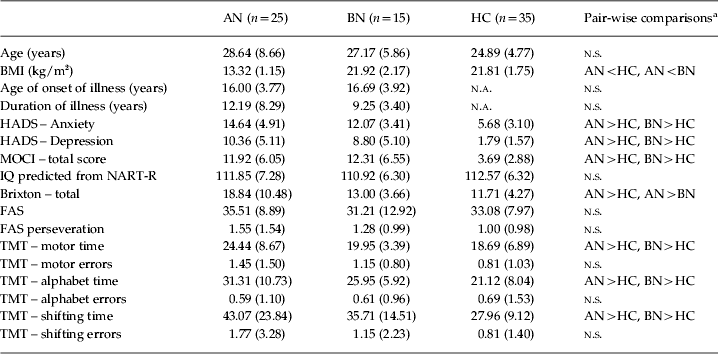
Demographic, clinical and neurocognitive characteristics of the study groups are presented in Table 1. The groups were found to be well matched with respect to age and IQ (as predicted by the NART-R score). A preliminary analysis showed no significant differences in neuropsychological performance between patients on and off antidepressant medication (data not presented here) and medication was not further controlled for.
Demographic, clinical and neurocognitive characteristics of anorexia nervosa (AN), bulimia nervosa (BN) and healthy control (HC) groups
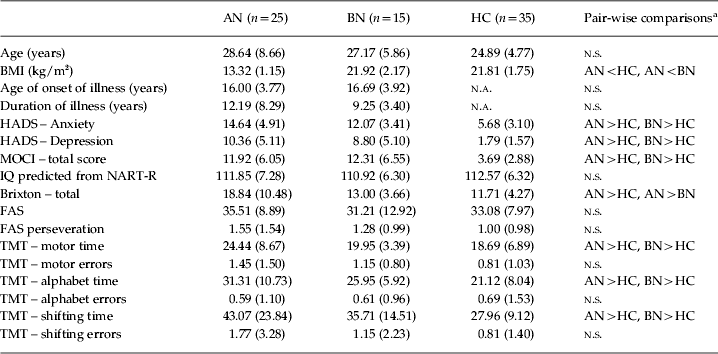
BMI, Body mass index; HADS, Hospital Anxiety and Depression Scale; MOCI, Maudsley Obsessive–Compulsive Inventory; NART-R, National Adult Reading Test – Revised; FAS, Verbal Fluency Task; TMT, Trail Making Test; n.a., not applicable; n.s., not significant.
Values given as mean (standard deviation).
a p<0.05.
As expected, the AN group had a significantly lower BMI than the HC group. Both AN and BN groups showed higher scores than the HC group on the HADS anxiety and depression subscales. Moreover, both patient groups showed significantly higher scores than the controls on the MOCI, including scores on the subscales, with the only exception of the Slowness subscale in which BN and HC groups' scores were not significantly different. Compared to the HC group, both AN and BN groups performed significantly slower on the TMT (motor speed, alphabet sequence and shifting time); the AN group also had significantly higher perseverative errors on the Brixton test.
Compared with BN patients, AN patients had a lower BMI and higher scores on the Slowness subscale of the MOCI. No difference in clinical and neuropsychological variables was found between the AN-R and AN-B/P subgroups.
Internal structure of the SAI-ED
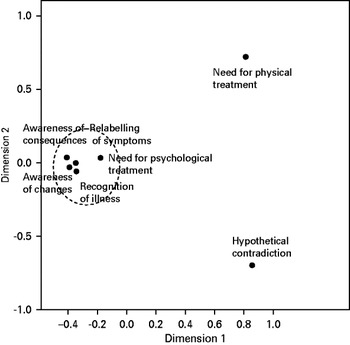
The internal structure of the SAI-ED, as determined on the MDS map, is shown in Fig. 1. The solution of the MDS procedure turned out to be two-dimensional. The normalized raw stress was 0.00024 and Tucker's ϕ was 0.999, indicating that the solution identified was robust.
Two-dimensional plot from multi-dimensional scaling (MDS) analysis of items of the Schedule for the Assessment of Insight – modification for Eating Disorders (SAI-ED) in 40 patients with EDs.

Five items of the SAI-ED (‘awareness of psychological changes’, ‘recognition of illness’, ‘awareness of psychosocial consequences’, ‘awareness of need for psychological treatment’ and ‘relabelling of symptoms’) are located close together on the MDS map, whereas both ‘awareness of need for physical treatment’ and ‘hypothetical contradiction’ are placed at a large distance from all the other items. Regarding the geometry of an MDS map, a cluster of items lying close to each other indicates that the items within this cluster are correlated positively, whereas an individual remote item often indicates an item measuring different aspects from all the other items or being subject to floor or ceiling effects (Kemmler et al. Reference Kemmler, Holzner, Kopp, Dunser, Greil, Hahn and Sperner-Unterweger2002). In our study, MDS analysis yielded a single cluster of five SAI-ED items that could be allocated to the same subscale, and the two above-mentioned remote items that need to be evaluated separately. Accordingly, in the following analysis, we used the ‘Awareness’ subscale score, which is derived from the sum of scores for the five clustered items, and the scores on the two remote items. Cronbach's α for both the SAI-ED and the Awareness subscale was 0.77, indicating a high level of internal consistency.
Assessment of insight in ED using the SAI-ED
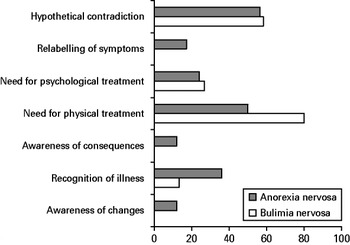
Although there were no statistically significant differences between the AN and BN groups on the SAI-ED items, more patients from the AN group did not recognize that they had a mental illness and could not relabel their eating-related problems as the symptoms of an illness compared to the BN patients (see Fig. 2). The effect size of the difference between the AN and BN groups on the SAI-ED total score was small (Cohen's d=0.37) whereas on the awareness subtotal score it was moderate (Cohen's d=0.55). With respect to the distribution of the SAI-ED total scores, we found that six participants with AN (24%; all of them with AN-R) and none with BN scored lower than 4 (χ2=4.23, p<0.040). The distribution was similar between the AN and BN groups regarding the range 4–7.
Scores (impaired %) of the anorexia nervosa (AN) and bulimia nervosa (BN) groups on items of the Schedule for the Assessment of Insight – modification for Eating Disorders (SAI-ED).

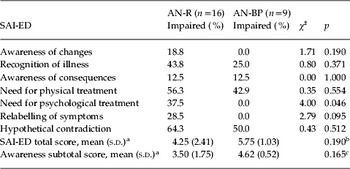
Within the AN group, the AN-R subgroup scored significantly lower on ‘acceptance of the need for psychological treatment’ compared to the AN-B/P group (Table 2). The effect sizes of the differences between the AN-R and AN-B/P groups on both the SAI-ED total score and the awareness subtotal score were large (Cohen's d=0.77 and 0.81 respectively).
SAI-ED scores of anorexia nervosa restricting type (AN-R) and binge/purging type (AN-BP) subgroups

SAI-ED, Schedule for the Assessment of Insight – modification for Eating Disorders; s.d., standard deviation.
a Mann–Whitney test.
b Cohen's d=0.77 (values of Cohen's d for small, medium and large effect sizes are 0.20, 0.50 and 0.80 respectively).
c Cohen's d=0.81.
Relationships between insight and other clinical and cognitive characteristics
Based on the MDS solution, we performed regression analyses separately for the Awareness subscale and the two remaining items. In a bivariate regression, there was a significant relationship between BMI and awareness subtotal score (R 2=0.11, β=0.33, F=4.66, p=0.037). Poor performance on TMT-B (shifting time) was inversely related to illness awareness (R 2=0.11, β=−0.32, F=4.49, p=0.041), whereas no association was found between the results in the other cognitive tests and the awareness subtotal score. The analysis also revealed no significant association between awareness of illness and age, IQ or duration of illness. Of particular interest, levels of anxiety, depression and obsessionality had no influence on the awareness of illness. A logistic regression revealed no association between scores on both the ‘acceptance of the need for physical treatment’ and ‘hypothetical contradiction’ items and any clinical or cognitive variable.
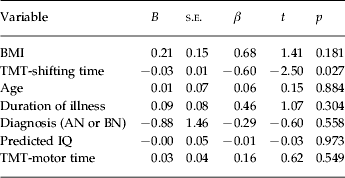
A multiple regression model was then created using the step-up criteria, with the awareness subtotal score as a dependent variable, BMI and TMT-shifting time as predictors, and age, diagnosis (AN or BN), duration of illness, IQ and motor speed (TMT-motor time) as potential confounders. In the final model, which explained 56% of the variance, only the variance level accounted for by the TMT-shifting time score remained significant (Table 3).
The effects of BMI and set-shifting ability (TMT-shifting time) on insight, controlling for potential confounders (age, diagnosis, duration of illness, IQ and motor speed), calculated using multiple regression analysisFootnote a
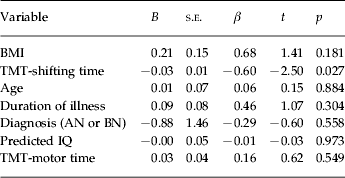
BMI, Body mass index; TMT, Trail Making Test; AN, anorexia nervosa; BN, bulimia nervosa; B, the regression coefficient; s.e., standard error of B; β, standardized regression coefficient.
a Dependent variable: Awareness subtotal score.
R 2=0.56, F=3.03, p=0.033.
Discussion
The modified SAI-ED is a short self-report measure for assessing the level of insight in EDs. However, MDS has shown that two items may measure different aspects than the rest of the items. We also found that more patients in both the AN and BN groups gave negative answers to these two questions compared to the remaining items of the SAI-ED (range 50–80% v. 0–36%). It is probable that the term ‘physical treatment’ has a variety of meanings to patients with an ED, such as medication, refeeding or treatment for their physical condition. As we have used a self-report format for the assessment, we are unable to comment on what our patients refused, especially those who were aware of their mental disorder and symptoms and accepted psychological treatment. On the contrary, the discrepancy of the ‘hypothetical contradiction’ item, an additional item of the SAI-ED, might reveal a specific aspect of denial of the illness in EDs. A large proportion of patients, although aware of their disorder, might be reluctant to express this awareness to a hypothetical other so as to maintain control over their eating behaviour or to avoid stigma. In any case, ‘hypothetical contradiction’ could be useful for the differentiation between deliberate denial and a lack of awareness of the illness. Denial of the illness was found to be a deliberate strategy in 57–73% of the cases in a recent retrospective survey on the internet in ex-patients with EDs (Vandereycken & Van Humbeeck, Reference Vandereycken and Van Humbeeck2008).
The majority of the AN and BN patients had relatively high scores on the SAI-ED. However, it should be taken into account that all of our study participants were attending treatment programmes and thus were to some degree help-seekers, with the exception of four involuntarily hospitalized AN patients. Patients lacking insight often refuse any contact with mental health services. Therefore, the level of insight may differ between our sample and community samples with the same illness. Moreover, the mean duration of illness in our sample was more than 10 years whereas the level of insight might be lower in the early phase of the illness, especially in AN (Vitousek et al. Reference Vitousek, Watson and Wilson1998). However, a quarter of the AN group had a low total score on the SAI-ED, whereas more than a third were not aware of having a mental disorder. Previous studies have reported widely discrepant rates of denial of illness in AN, ranging from 15% to 80%, probably because of inconsistent criteria used to designate patients as denying or insightful (Vitousek et al. Reference Vitousek, Watson and Wilson1998; Couturier & Lock, Reference Couturier and Lock2006; Viglione et al. Reference Viglione, Muratori, Maestro, Brunori and Picchi2006). In one study using a semi-structured interview to assess delusionality of eating beliefs in AN, 20% of patients were categorized as delusional (Steinglass et al. Reference Steinglass, Eisen, Attia, Mayer and Walsh2007). This could be considered consistent with our findings because a strong conviction of their beliefs about body shape and weight is a core aspect of a lack of awareness of the illness in patients with EDs. None of the previous studies have reported data on the degree of insight in BN. According to our results, although BN patients had higher levels of overall insight compared to AN patients, there were difficulties in recognizing that they had a mental disorder and accepting the need for psychological treatment.
AN-R patients had poorer overall insight than AN-B/P patients. Furthermore, only AN-R patients showed difficulties in awareness of psychological changes, relabelling of their symptoms and recognition of the need for psychological treatment. If poor insight contributes substantially to avoidance of treatment and resistance to change in patients with AN, it is likely that these problems would be more prominent in patients with the restrictive type of the disorder. In support of this assumption, Sunday et al. (Reference Sunday, Halmi and Einhorn1995) found that AN-R patients had significantly less desire to change their ED-related preoccupations and rituals than both AN-B/P and BN patients. Overall, the level of insight seems to correlate with an obsessionality–impulsivity spectrum in EDs: AN, especially AN-R, represents an obsessive and less insightful end whereas BN represents the more impulsive and insightful end. Similarly, poor insight is related to more severe obsessionality in obsessive–compulsive disorder (Alonso et al. Reference Alonso, Menchon, Segalas, Jaurrieta, Jimenez-Murcia, Cardoner, Labad, Real, Pertusa and Vallejo2008; Catapano et al. Reference Catapano, Perris, Fabrazzo, Cioffi, Giacco, De Santis and Maj2010) and body dysmorphic disorder (Eisen et al. Reference Eisen, Phillips, Coles and Rasmussen2004), whereas the level of insight is higher in the ‘impulsivity’ cluster of obsessive–compulsive spectrum disorders than in other clusters (Lochner et al. Reference Lochner, Hemmings, Kinnear, Niehaus, Nel, Corfield, Moolman-Smook, Seedat and Stein2005).
In this study we found that insight was not related to duration of illness, suggesting that poor insight is present not only in early but also in chronic phases of EDs. This is in line with a previous prospective study showing that insight remains consistent over time in patients with AN (Greenfeld et al. Reference Greenfeld, Anyan, Hobart, Quinlan and Plantes1991). A positive association was found between the level of insight and BMI in the total sample. However, this association did not remain significant when we controlled for diagnosis and other potential confounders in the regression analysis and therefore may reflect the difference in insight levels between the AN and BN groups, which differed significantly in BMI.
Depression, anxiety and obsessionality levels were increased significantly in both the AN and BN patients compared to the HC. None of these clinical variables were found to be related to insight. Previous studies in AN have revealed contradictory results, showing either an inverse (Steinhausen, Reference Steinhausen1986; Newton et al. Reference Newton, Butler and Slade1988; Viglione et al. Reference Viglione, Muratori, Maestro, Brunori and Picchi2006) or no (Couturier & Lock, Reference Couturier and Lock2006) association between denial of the illness and levels of depression and anxiety. It remains unclear whether patients denying their ED also deny symptoms of depression and anxiety.
Lack of insight and depression are inversely related in all conditions studied from schizophrenia through to Alzheimer's disease (Mintz et al. Reference Mintz, Dobson and Romney2003; Gilleen et al. Reference Gilleen, Greenwood, David and Prigatano2010). However, this does not seem to apply to ED patients. A possible explanation for this might be that a large proportion of patients suffer from an additional affective or anxiety disorder, which often precedes the onset of an ED and remains at long-term follow-up (Steinhausen, Reference Steinhausen2002; Godart et al. Reference Godart, Perdereau, Rein, Berthoz, Wallier, Jeammet and Flament2007; Swinbourne & Touyz, Reference Swinbourne and Touyz2007; Steinhausen & Weber, Reference Steinhausen and Weber2009). Another explanation is that aspects of EDs are often valued by patients, unlike schizophrenia and Alzheimer's disease (Vitousek et al. Reference Vitousek, Watson and Wilson1998; Serpell et al. Reference Serpell, Treasure, Teasdale and Sullivan1999; Schmidt & Treasure, Reference Schmidt and Treasure2006). Patients more aware of their chronic illness, such as psychosis or dementia, might experience depressive symptoms due to appraisals of loss, entrapment, shame and self-blame (Iqbal et al. Reference Iqbal, Birchwood, Chadwick and Trower2000); however, even insightful patients with EDs perceive both psychosocial benefits and costs stemming from their illness (Serpell et al. Reference Serpell, Treasure, Teasdale and Sullivan1999).
No association was found between insight and IQ in the ED group, in contrast to findings of similar studies in schizophrenia (Morgan & David, Reference Morgan, David, Amador and David2004). This was to be expected because impairments in general intellectual functioning are a core feature of psychosis but not of EDs. Reduced insight was associated with worse performance on TMT-B but not on the other neuropsychological tests. Shifting time in the TMT was found to be a moderate predictor of illness awareness, indicating a weak but significant relationship between insight and mental flexibility in EDs. Moreover, the effect of this variable on illness awareness remained significant after controlling for potential confounders, namely age, diagnosis, duration of illness, IQ and motor speed. Our findings are in line with previous studies showing that impairment in set shifting contributes to poor insight in patients with schizophrenia (Morgan & David, Reference Morgan, David, Amador and David2004; Aleman et al. Reference Aleman, Agrawal, Morgan and David2006). With regard to the cognitive mechanism of insight, it has been proposed that mental flexibility plays an important role, as it refers to the capacity ‘to hold an abstract representation related to an actual situation, but different from it, at the same time as the more obvious immediate representation’ (Drake & Lewis, Reference Drake and Lewis2003). This capacity enables patients to evaluate their own experiences, thoughts and behaviour in relation to knowledge of symptoms of mental illness.
There are several limitations to this study. We evaluated patients attending treatment programmes, probably lowering variance in insight and decreasing the chances of detecting other significant associations. Moreover, our AN group consisted of in-patients, who exhibit more severe symptoms or refuse other therapeutic options and might therefore have poorer insight than the out-patients. The sample size was relatively small, therefore some potentially important subgroup differences did not reach statistical significance. Finally, impairment in other cognitive domains might also affect insight and further investigation is therefore warranted. Only prospective studies could shed light on the possible effect of weight gain on insight in AN, as there is evidence of improvement in cognitive performance after refeeding (Hatch et al. Reference Hatch, Madden, Kohn, Clarke, Touyz, Gordon and Williams2010).
In conclusion, this small-scale study has shown that, out of all patients with ED, the patients with the restricting type of AN demonstrated a profile of most severe impairment of insight. Furthermore, our findings indicate some specific aspects of the insight construct in EDs. Unlike psychosis, lack of insight is not linked to abnormal experiences or deficits in general intelligence. Patients with EDs may deny their illness and symptoms, either deliberately or unintentionally, so as to retain what they consider as psychosocial benefits from their illness and thus may give negative answers in the SAI-ED or other insight scales. However, cognitive rigidity seems to contribute to the unawareness of the illness, probably influencing the persistence of disorder-related beliefs. At any rate, insight impairment may be an important maintaining factor, especially in AN-R. Consequently, insight in EDs is a complex phenomenon dependent on interacting cognitive and psychological factors, and might represent a distinct aspect of ED psychopathology.
Appendix
Schedule for the Assessment of Insight: modification for eating disorders (SAI-ED)
1. Do you think you are experiencing any emotional or psychological changes or difficulties?
Yes/Unsure/No
2. Do you think your condition amounts to a psychological/nervous disorder?
Yes/Unsure/No
3. Has your nervous /psychological condition led to adverse consequences or problems in your life? (For example, conflict with others, neglect, financial or accommodation difficulties, irrational, impulsive or dangerous behaviour, physical deterioration, work difficulties)
Yes/Unsure/No
4. Do you think your current condition or the problems resulting from it warrant (need) physical treatment?
Yes/Unsure/No
5. Do you think your current condition or the problems resulting from it warrant (need) psychological treatment?
Yes/Unsure/No
6. Do you think that eating-related problems represent a part of your current nervous/psychological condition?
Yes/Unsure/No
7. How do you feel when people think you are overly preoccupied with your weight, shape, eating?
That's when I know I'm sick/I'm confused and I don't know what to think/They're wrong
Declaration of Interest
None.
Acknowledgements
This work was conducted in the Eating Disorder Service, South London and Maudsley NHS Foundation Trust, London, UK.