Introduction
In Galba truncatula, the cercarial production of a digenean is determined by several factors: (1) the sensitivity of the snail population to parasite infection; (2) the increase of snail height during natural or experimental infection of the snail (this factor is dependent of the quality of the diet provided as food for snails); (3) the infectivity and number of miracidia used for each snail at exposure; and (4) the environmental conditions (temperature, humidity, etc.) of snail breeding (Rondelaud et al., Reference Rondelaud, Vignoles and Dreyfuss2009). Under these conditions, there was great variation in the number of cercariae reported by authors for the same parasite species. In the case of Fasciola hepatica, for example, up to 2275 metacercariae were shed by a snail subjected to a multiple miracidial infection and fed with a high-quality diet (Kendall, Reference Kendall1949; Kendall & Ollerenshaw, Reference Kendall and Ollerenshaw1963). However, cercarial production was often lower. In snails living on acid soils (the shell height of adults was often less than 8 mm) and subjected to single-miracidium infections, the total number of cercariae produced within the snail was a mean of 343.9 if the development of redial generations was normal, whereas only 233.2 cercariae were formed in the case of an abnormal development of redial generations (Augot & Rondelaud, Reference Augot and Rondelaud2001).
In G. truncatula it is difficult to determine accurately the total number of cercariae produced by every infected snail, for several reasons. First, snails shedding cercariae still contained some larvae within their body at their death (Dreyfuss et al., Reference Dreyfuss, Vareille-Morel and Rondelaud1994) while some infected snails died without emission (Vignoles et al., Reference Vignoles, Dreyfuss and Rondelaud2002). Second, calculation of the total number of cercariae via the development of intraredial germinal masses (Augot & Rondelaud, Reference Augot and Rondelaud2001) gave only theoretical numbers which are generally underestimated. Third, snail sacrifice gave accurate numbers for intraredial or free cercariae within the snail (Vignoles et al., Reference Vignoles, Rondelaud and Dreyfuss2008) but it must be performed at a given date of snail infection, which is difficult to choose because parasite infection continues to develop within the snail until its death. As no information on the total number of F. hepatica cercariae developing in G. truncatula is available in literature, it is difficult to determine how many snails must be used for an experimental infection to obtain a given number of cercariae, for example, for commercial production of metacercariae. For this reason, there was always an excess of infected snails which were no longer used. In view of this situation, one may wonder how many cercariae the snail can harbour in relation to the growth of its shell and the number of miracidia used for snail exposure. To answer this question, experimental infections of G. truncatula originating from two populations were carried out by subjecting each snail to one, two, three or five miracidia at exposure, by raising it at a constant temperature of 24°C, and by sacrificing it at day 70 post-exposure (p.e.). The choice of this date was based on the report by Vignoles et al. (Reference Vignoles, Rondelaud and Dreyfuss2008). According to these authors, many cercariae of Paramphistomum daubneyi were free within the snail or were shed by it at day 70 p.e. when a temperature of 24°C is used for snail breeding.
Materials and methods
Snails and parasite
The two populations of G. truncatula were living in central France. The first (A) originated from the department of Creuse and inhabited a road ditch at Masvaudier, commune of Saint Michel de Veisse. This habitat was located on a siliceous soil, so that the shell height of adults was often less than 8 mm. The population (B) came from the department of Indre and was living in a road ditch at Chézeau Chrétien, commune of Migné. As this habitat was located on a calcareous soil, the shell height of adults ranged from 11 to 12 mm. Both populations were known to be highly susceptible to infection with local miracidia of F. hepatica. Snails measuring 4 mm in height were collected from both sites between October 2007 and February 2008, according to the experimental protocol given in table 1. The eggs of F. hepatica were collected from the gall bladders of heavily infected cattle at the slaughterhouse of Limoges, department of Haute Vienne. They were washed several times with spring water and were incubated at 20°C for 20 days in the dark (Ollerenshaw, Reference Ollerenshaw1971).
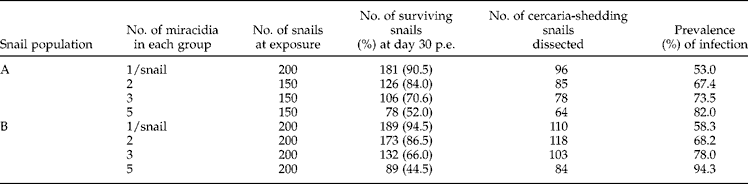
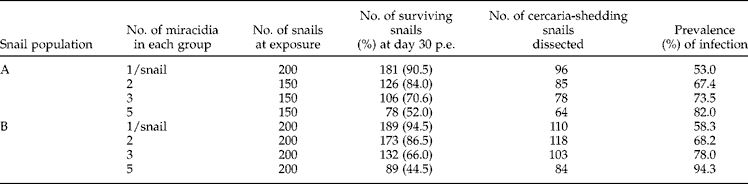
Principal characteristics of the G. truncatula groups used in this experiment.
Experimental protocol
Table 1 gives the number of groups for every population, the protocol of snail infection, and the number of snails in every group at the beginning of the experiment. Snails from two groups were subjected to routine bimiracidial exposures with F. hepatica. The same protocol was also used for infections with one, three and five miracidia per snail (two snail groups per type of infection). The use of four miracidia per snail was not performed because of the limited availability of suitably sized snails sampled from the two locations. After exposure, the eight groups of G. truncatula were reared for 30 days in 14-cm-diameter Petri dishes (Rondelaud et al., Reference Rondelaud, Fousi, Vignoles, Moncef and Dreyfuss2007), with ten snails and 150 ml of spring water (dissolved calcium content, 60 mg/l) per dish. Dried leaves of cos lettuce plus several dead leaves of Glyceria fluitans (Poaceae) were added in each dish. Every Petri dish was cleaned twice a week, while the water was changed daily. The dishes were placed in a room under a constant temperature of 24°C and a diurnal photophase of 12 h with a 3000–4000 lux light intensity over the dishes. At day 30 p.e., surviving snails were placed individually in 35-mm Petri dishes with 2–3 ml of spring water, a fragment of G. fluitans leaf, and a small piece of dried lettuce per dish. These dishes were maintained in the same air-conditioned room. The water was changed every day. Metacercariae were counted daily before their removal from dishes.
In every experimental group, sacrifices of G. truncatula were performed at day 70 p.e. and concerned only snails which had shed some cercariae before this date. Indeed, infected G. truncatula that died without shedding contained fewer free rediae and fewer cercariae than individuals for which cercarial shedding occurred regularly (unpublished data). Counts were made on live rediae, cercariae and metacercariae.
Parameters studied
Four main parameters were investigated: (1) the number of free and live rediae; (2) the quantity of intraredial cercariae; (3) the number of free cercariae but unencysted after dissection; and (4) the number of the whole metacercariae (encysted after cercarial shedding or after dissection). Individual values recorded for each parameter were averaged and standard deviations were calculated, taking into account snail group and the date of sacrifice. A one-way analysis of variance (Stat-Itcf, 1988) was used to establish levels of significance. Two additional parameters examined were snail survival at day 30 p.e. and the global prevalence of infection with F. hepatica in every snail group (calculated in comparison with the total number of dissected snails, whatever the date). These percentages were compared using a χ2 test (Stat-Itcf, 1988). The last parameter measured was the shell height of infected snails at day 70 p.e. Individual values recorded for this shell size were averaged and the differences between snail groups were subjected to a one-way analysis of variance (Stat-Itcf, 1988).
Results
Table 1 gives snail survival at day 30 p.e. and the prevalence of snail infection. In population A, the increasing number of miracidia at snail exposure caused a significant reduction of snail survival (χ2 = 76.94, P < 0.001) and a significant change of prevalence (χ2 = 25.25, P < 0.001). Similar findings were also noted in population B, for snail survival (χ2 = 164.81, P < 0.001) and prevalence (χ2 = 53.88, P < 0.001). Comparison of survival between both snail populations showed only insignificant differences. In contrast, the global prevalence of infection was significantly greater (χ2 = 4.49, P < 0.05) in the four groups from population B than in those from population A. The shell height of infected snails ranged from 7.3 ± 1.1 mm to 7.8 ± 1.0 mm in population A, and from 8.8 ± 1.2 mm to 9.3 ± 1.2 mm in community B. No significant difference between the shell heights of the different snail groups was found.
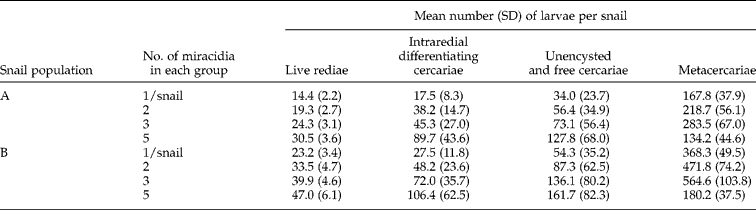
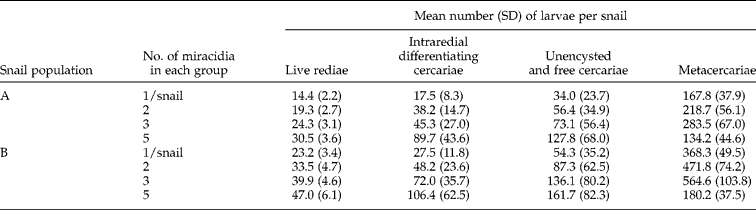
When the number of miracidia used for each snail increased at exposure, the quantity of live rediae per snail at day 70 p.e. (table 2) rose: from 14.4 to 30.5 rediae in population A, and from 23.2 to 47.0 in community B. In each population, significant differences between groups (A: F = 5.92, P < 0.01; B: F = 17.86, P < 0.001) were noted. Similar results were also found for intraredial differentiating cercariae (A: F = 6.29, P < 0.01; B: F = 3.81, P < 0.05). In spite of numerical increases recorded for unencysted and free cercariae, only insignificant differences between mean values from each population were noted. The number of metacercariae produced by each snail (after a shedding and/or after dissection) increased up to three miracidia per snail in each population and strongly decreased in infections with five miracidia. Significant differences between these mean values (A: F = 7.35, P < 0.01; B: F = 26.21, P < 0.001) were found. In population B, the mean number of metacercariae in the three-miracidia group was practically the double of that noted in the corresponding group from community A. In contrast, the difference between mean values found for infections with five miracidia per snail was insignificant.
Mean values (SD) for the number of live rediae of F. hepatica and that of intraredial differentiating cercariae in eight groups of G. truncatula at day 70 p.e. at 24°C.
In population A, the highest numbers found for live rediae were 37 in the three-miracidia group and 41 in snails exposed to five miracidia, while maxima of 53 and 65 rediae, respectively, were noted in the corresponding groups from community B. The highest individual numbers of metacercariae in the two- and three-miracidia groups were 377 and 452, respectively, for population A, while they were 632 and 903 in the corresponding groups from community B (data not shown). If the number of metacercariae recorded for every snail was added to figures noted for intraredial and free cercariae, the greatest values were 627 and 1156, respectively, in the three-miracidia infections from populations A and B, respectively (data not shown). Cercarial production ranged from 1001 to 1100 in three G. truncatula, from 901 to 1000 in five snails, and was less than 900 in the others.
Discussion
Knowing the precise number of cercariae that G. truncatula can produce, according to its shell growth and the number of miracidia used for its infection, is of great importance to appreciate its aptitude for sustaining the larval development of F. hepatica. In the present study, even if the shell height of infected snails in relation to the geographical origin of the population showed no significant difference at day 70 p.e., the mean number of rediae, that of intraredial cercariae, and the mean quantity of metacercariae were significantly greater in snails from population B than in those from community A, in all miracidial-exposed snail groups. This finding demonstrated the importance of the volume of the snail's body for the numerical development of larvae, and this result agreed with reports from other authors regarding the relation between the size of infected snails and the number of F. hepatica rediae (Rondelaud & Barthe, Reference Rondelaud and Barthe1987), or that of cercariae (Kendall, Reference Kendall1949; Kendall & Ollerenshaw, Reference Kendall and Ollerenshaw1963). As unencysted and free cercariae of F. hepatica showed only insignificant differences between snail groups, the most valid explanation is to consider these free cercariae as a short-term larval stage, as most cercariae present in a snail after its dissection were able to encyst and form viable metacercariae from day 45 p.e. at 24°C (unpublished data).
In the present study, more metacercariae were obtained from three-miracidia infections at day 70 p.e. than from snails exposed to one and two miracidia. This finding agreed with the report by Lee et al. (Reference Lee, Cho and Lee1995) according to which some Lymnaea viridis, each infected with three miracidia of F. hepatica, produced more metacercariae than snails with single-miracidium infections. In contrast, in the case of five-miracidia infections, our results and those of the above authors disagreed. According to Lee et al. (Reference Lee, Cho and Lee1995), five-miracidia infections provided as many metacercariae as three-miracidia infections when snails were bred at 23–27°C, whereas the number of cysts noted in the five-miracidia infections of the present study was clearly lower at day 70 p.e. To explain this discordance, the most valid hypothesis is the delay of cercarial differentiation in the five-miracidia groups, probably because of the volume of the snail host, which would be too small to assure the complete development of five sporocysts. This explanation is supported by the great quantities of intraredial and free cercariae in five-miracidia infections when compared to values found in snails each infected by two or three miracidia.
If the number of metacercariae counted in dissected snails was added to the quantity of intraredial cercariae and that of free cercariae, a total of 1156 larvae was found for a single snail from population B. Higher numbers of F. hepatica metacercariae have been reported in the literature for cercaria-shedding snails: 2275 and 2018 from two G. truncatula exposed to large numbers of miracidia (Kendall, Reference Kendall1949; Kendall & Ollerenshaw, Reference Kendall and Ollerenshaw1963), 3661 metacercariae from a single L. viridis infected by three miracidia (Lee et al., Reference Lee, Cho and Lee1995), and a mean of 1629 from two G. truncatula subjected to bimiracidial exposures (Rondelaud et al., Reference Rondelaud, Denève, Belfaiza, Mekroud, Abrous, Moncef and Dreyfuss2004). However, the number of snails shedding such quantities of cercariae was very low and it is currently difficult to propose a valid hypothesis to explain these findings. In our opinion, the mean numbers of metacercariae reported in the present study need to be taken into account as a basis for determining the experimental number of snails required to be infected with F. hepatica when the production of metacercariae for commercial purposes by means of dissected molluscs is needed.