INTRODUCTION
Trichomonas gallinae is a protozoan parasite which commonly infects the upper digestive tract of columbids (i.e. pigeons and doves) and birds of prey (i.e. eagles, hawks and owls) and less frequently can also infect a variety of other avian taxa including passerines (such as finches and sparrows) (Amin et al. Reference Amin, Bilic, Liebhart and Hess2014). In 2005, trichomonosis was first recognized as an emerging infectious disease of wild finches in Great Britain (GB) (Pennycott et al. Reference Pennycott, Lawson, Cunningham, Simpson and Chantrey2005; Lawson et al. Reference Lawson, Cunningham, Chantrey, Hughes, Kirkwood, Pennycott and Simpson2006). The species affected in the summer/autumn seasonal epidemic were primarily greenfinch (Chloris [Carduelis] chloris) and chaffinch (Fringilla coelebs). Although pre-existing sporadic reports of disease in free-ranging finches do exist, the 2005–2006 (and ongoing) outbreak is the first reported instance of large-scale epidemic mortality due to trichomonosis in any passerine species (Lawson et al. Reference Lawson, Robinson, Colvile, Peck, Chantrey, Pennycott, Simpson, Toms and Cunningham2012). In the years following the initial outbreak in the western and central counties of England and Wales, finch trichomonosis spread to eastern England (2007) and then to southern Fennoscandia (2008) and Germany (2009); epidemiological and historical banding return data supported chaffinch migration as the most likely mechanism of the observed pattern of disease spread (Peters et al. Reference Peters, Kilwinski, Reckling and Henning2009; Neimanis et al. Reference Neimanis, Handeland, Isomursu, Agren, Mattsson, Hamnes, Bergsjø and Hirvelä-Koski2010; Robinson et al. Reference Robinson, Lawson, Toms, Peck, Kirkwood, Chantrey, Clatworthy, Evans, Hughes, Hutchinson, John, Pennycott, Perkins, Rowley, Simpson, Tyler and Cunningham2010; Lawson et al. Reference Lawson, Robinson, Neimanis, Handeland, Isomursu, Agren, Hamnes, Tyler, Chantrey, Hughes, Pennycott, Simpson, John, Peck, Toms, Bennett, Kirkwood and Cunningham2011a ). The disease range of finch trichomonosis has continued to extend further eastward within continental Europe and had reached Austria and Slovenia by 2012 (Ganas et al. Reference Ganas, Jaskulska, Lawson, Zadravec, Hess and Bilic2014). Concurrently, finch trichomonosis has spread westward from Britain with finch mortality incidents reported in Northern Ireland from 2006 and in the Republic of Ireland from 2007 (Lawson et al. Reference Lawson, Robinson, Colvile, Peck, Chantrey, Pennycott, Simpson, Toms and Cunningham2012).
In the late summer/early autumn of 2007, trichomonosis was first recognized in the purple finch (Carpodacus purpureus) populations of Nova Scotia, Canada (Forzán et al. Reference Forzán, Vanderstichel, Melekhovets and McBurney2010). In the following summer and autumn, the Canadian Wildlife Health Cooperative (CWHC), Atlantic region, confirmed additional Canadian mortalities from trichomonosis in the purple finch populations of Nova Scotia and Prince Edward Island (PEI) and in American goldfinch (Carduelis tristis) populations of New Brunswick (Forzán et al. Reference Forzán, Vanderstichel, Melekhovets and McBurney2010). In 2009, the CWHC confirmed finch trichomonosis incidents in all the three Canadian Maritime provinces during the same seasons, and diagnosed the disease in a new species, the pine siskin (Carduelis pinus) (CWHC unpublished data). The diagnosis of trichomonosis in the Canadian Maritime provinces in the summer and autumn of three consecutive years and the infection of multiple finch species not known to be previously affected by the disease, suggests that finch trichomonosis is an emerging disease in this region. Prior to the emergence of trichomonosis in the passerine bird populations of the Canadian Maritime provinces, this disease was not diagnosed in any of the region's wild avian species since the CWHC, Atlantic Region, began collecting diagnostic wildlife health data in 1992. While it is assumed that T. gallinae is present in the columbid populations of the Canadian Maritime provinces due to the parasite's ubiquitous distribution in wild pigeon and dove populations worldwide (Amin et al. Reference Amin, Bilic, Liebhart and Hess2014), to our knowledge reports of T. gallinae in the region's columbid populations have not been documented. Lastly, it is noteworthy that the Canadian Maritime provinces represent the eastern limit of North America with closest geographical proximity to the UK and that finch trichomonosis emerged in the years immediately subsequent to the onset of epidemic mortality in British finches.
The aims of the present study were to firstly investigate the sequence diversity of T. gallinae recovered from finches and columbids from the Canadian Maritime provinces. Secondly, to compare the Canadian T. gallinae sequences with those published from other countries, including isolates from GB. Finally, to provide a description of the temporal, geographical and species-specific variation amongst the isolates examined from the Canadian Maritime provinces. Genotyping of isolates was determined by polymerase chain reaction (PCR) and sequencing of the internal transcribed spacer (ITS) region (5·8S rDNA and flanking ITS regions, ITS1 and ITS2) and the hydrogenosomal Fe-hydrogenase (Fe-hyd) gene to evaluate finer scale evolutionary relationships amongst these organisms (Lawson et al. Reference Lawson, Cunningham, Chantrey, Hughes, John, Bunbury, Bell and Tyler2011b ; Chi et al. Reference Chi, Lawson, Durrant, Beckmann, John, Alrefaei, Kirkbride, Bell, Cunningham and Tyler2013).
MATERIALS AND METHODS
Columbid and passerine capture methods
When suspected finch trichomonosis incidents in the Canadian Maritime provinces were reported by members of the public, the CWHC, Atlantic region, facilitated the immediate submission of recently dead passerines by encouraging property owners to submit specimens for a detailed post-mortem examination (PME). When PME confirmed trichomonosis (on the basis of gross and microscopic lesions or microscopic lesions alone consistent with trichomonosis with or without a positive culture of Trichomonas sp. from upper alimentary tract lesions), the site was visited to live-capture all species of birds present and sample them for Trichomonas sp. by culture (see culture technique below). In addition, food and water sources provided at these sites were individually sampled for Trichomonas sp. by culture (see culture technique below).
To investigate the heterogeneity of T. gallinae in sympatric columbid populations in PEI, known locations of high-columbid population densities were selected for extensive trapping, without pre-existing knowledge of the presence of T. gallinae or trichomonosis within these populations.
All the birds were captured under a Canadian Wildlife Federation license (permit #SC2707) and Canadian Council on Animal Care guidelines (UPEI protocol #10–020, 6003687) by standard methods including mist net, whoosh net and walk-in box trap. Passerines were captured for this study using a mist net (Bleitz Wildlife Foundation California, 50D-2 ply mesh, 1½″ mesh, 7′ × 42′, Stock # 26N-50/2) for 2 days per location in May–September of 2009 and 2011. Columbid species required extensive time for acclimatization to the box trap, and as a result, columbids were ground trapped at each site on multiple days sometimes occurring over a period of several weeks in May–December of 2009 and 2010. A ground box trap (Safeguard single compartment pigeon trap, 28″L × 24″W × 8″H, with eight entry doors, and a capacity to hold up to 30 birds) was baited with bird seed for a minimum of 12 days prior to commence trapping. It is important to note that during the allotted baiting period, all regular supplementary feed sources were removed from the property to ensure the birds fed in the baited area. Mourning dove, another target species, was difficult to capture with the ground box-trap so their capture was also facilitated by the use of a whoosh-net (Hawkseye Nets Virginia Beach, VA, USA – 2 1/8″ mesh, 23′ whoosh net). Similar to the box-trap protocol, the area over which the whoosh-net was fired was baited with bird seed for a minimum of 5 days prior to attempted capture.
Birds captured by all methods were sexed and aged by plumage (hatch year or adult) when possible, weighed, banded and examined for clinical signs consistent with trichomonosis such as the typical oropharyngeal lesions, fluffed up feathers, saliva on the face, food at the commissures of the beak or matted in the feathers of the head or chest and/or reluctance or inability to fly. If T. gallinae was isolated from a bird with no clinical evidence of trichomonosis it was designated as ‘apparently healthy’. If T. gallinae was isolated from a bird with clinical signs consistent with trichomonosis, the infection was defined as a clinical case of trichomonosis. Opportunistic sampling was also undertaken for Trichomonas sp. by culture of wild passerines and columbids admitted to the Atlantic Veterinary College Teaching Hospital and of rock pigeons that were humanely killed during removal from cattle barns in the winter months on PEI.
Trichomonad culture
Prior to swabbing live-birds, the end of a sterile calcium-alginate cotton-tipped swab with an aluminium shaft (Puritan™ Medical, Fisher Scientific, Canada, catalogue number 22-029-501) was bent into a gentle curve representing ~120° angle to match the natural anatomical curvature of the oral cavity as it opens into the oesophagus. The distance between the start of the curve and cotton tip was equivalent to the distance between the oral cavity and crop, and the positioning of this curve depended on the species of bird. Anatomically, bending the swab at the 120° angle facilitated the movement of the swab from the oral cavity to the crop. After bending, the swab was moistened with sterile saline and gently inserted into the oral cavity of the bird by pushing the tip against a commissure of the beak. The swab was slowly and gently advanced into the oesophagus to the level of the crop while allowing the bird to swallow. Due to the thinness of the oesophageal and ingluvial walls in passerine birds this procedure was done with extreme caution and only by experienced individuals to avoid iatrogenic damage. Once in the crop, the swab was gently rotated, moved up and down and removed. Care was taken to swab any visible oropharyngeal trichomonosis lesions. The crop and lesions of dead birds were swabbed once the upper digestive tract was opened for PME. After collection, all the swabs were used to immediately inoculate an InPouch TF™ test medium kit (BioMed Diagnostics, White City, OR, USA) on-site prior to transport back to the laboratory for incubation at 37 °C and were daily monitored for 10 days. If the site was not in the province of PEI, the samples were placed in a Hova-Bator egg incubator (circulated air model no. 2362N, 20·3 W, 115 V AC, G.Q.F.MFG. Co. Inc. Savannah, GA) set at 37 °C for transport to the laboratory at the University of PEI.
Bird seed and water sources at sites experiencing trichomonosis mortality were independently swabbed. The swabs were used to immediately inoculate an InPouch TF™ test medium kit on-site prior to transport back to the laboratory for incubation at 37 °C and daily monitoring for 10 days. If the site was not in the province of PEI, the samples were placed in a Hova-Bator egg incubator for transport to the laboratory at the University of PEI as described above.
Parasite culture and cryopreservation
Parasite cultures were monitored daily using a double-chamber hemacytometer, counts of motile trichomonads were performed on both grids and if results did not correlate within 10%, the process was repeated and the average of the four counts was taken instead of the two. Once the parasites reached mid-log phase, they were cryopreserved by adding 100 μL of 100% glycerol to 1 mL of the parasite culture. This total volume was subdivided into four separate 500 μL aliquots and stored in liquid nitrogen. An additional 1 mL aliquot of the original parasite culture was collected to be used for DNA extraction.
PCR for ITS region and Fe-hyd gene regions
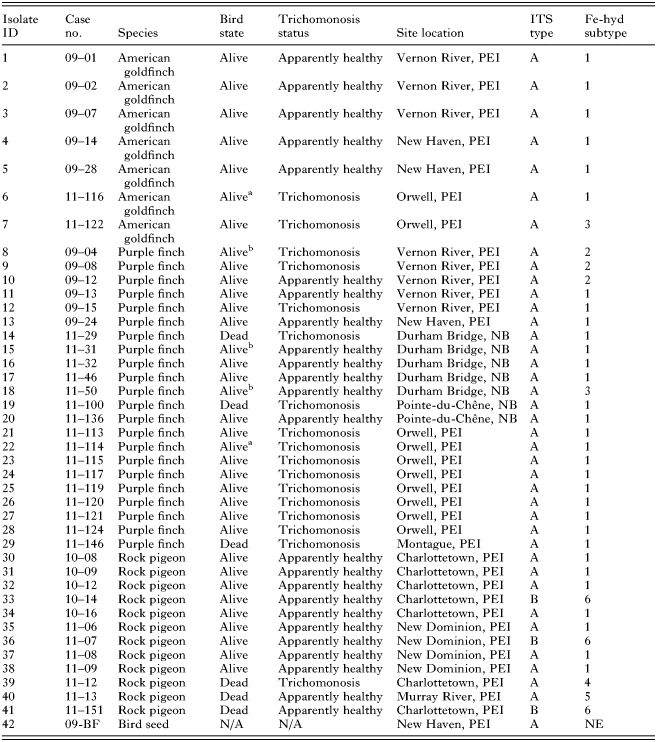
Trichomonas sp. DNA was obtained from culture isolates using a QIAamp DNA Mini Kit (QIAGEN, Toronto, ON, Canada) as per the manufacturer's instructions for cell cultures. DNA extracts of 42 isolates (Table 1) were examined using PCR protocols specific for the ITS1/5·8S rRNA/ITS2 region (subsequently referred to as the ITS region) and Fe-hyd gene. DNA amplification of the ITS region (~300 bp) was performed using trichomonad-specific primers TFR1 (5′-TGCTTCAGTTCAGCGGGTCTTCC-3′) and TFR2 (5′-CGGTAGGTGAACCTGCCGTTGG-3′) (Felleisen, Reference Felleisen1997) while amplification of the Fe-hyd gene (~900 bp) used the primers TrichhydFOR (5′-GTTTGGGATGGCCTCAGAAT-3′) and TrichhydREV (5′-AGCCGAAGATGTTGTCGAAT-3′) (Lawson et al. Reference Lawson, Cunningham, Chantrey, Hughes, John, Bunbury, Bell and Tyler2011b ; Chi et al. Reference Chi, Lawson, Durrant, Beckmann, John, Alrefaei, Kirkbride, Bell, Cunningham and Tyler2013). Each PCR reaction mixture contained 12·5 μL Amplitaq Gold Master Mix (Applied Biosystems, Life Technologies, Burlington, ON, Canada), 4·5 μL nuclease free water, 2·5 μL forward primer (10 μ m), 2·5 μL reverse primer (10 μ m) and 3 μL of undiluted target DNA and was performed in duplicate. For each reaction, negative controls substituted target DNA with 3 μL of nuclease-free water and positive controls used 3 μL of T. gallinae DNA (purple finch isolate from Forzán et al. Reference Forzán, Vanderstichel, Melekhovets and McBurney2010; parasite species confirmed by sequencing the ITS region) and T. gallinae DNA from a British greenfinch (species confirmed by sequencing the Fe-hyd gene), respectively. PCR parameters for the ITS region amplification were 94 °C for 2 min, followed by 40 cycles of 94 °C for 30 s, 67 °C for 30 s, 72 °C for 2 min and a final extension at 72 °C for 15 min. PCR parameters for Fe-hyd gene amplification were 94 °C for 15 min, followed by 35 cycles of 94 °C for 1 min, 66 °C for 30 s, 72 °C for 1 min and a final extension at 72 °C for 5 min. PCR amplicons were then examined via 1% agarose gel electrophoresis with ethidium bromide.
Case data and T. gallinae isolates used for the ITS region and Fe-hydrogenase (Fe-hyd) gene PCR analyses. The last two digits of the year of collection are indicated as the first two digits of the case number
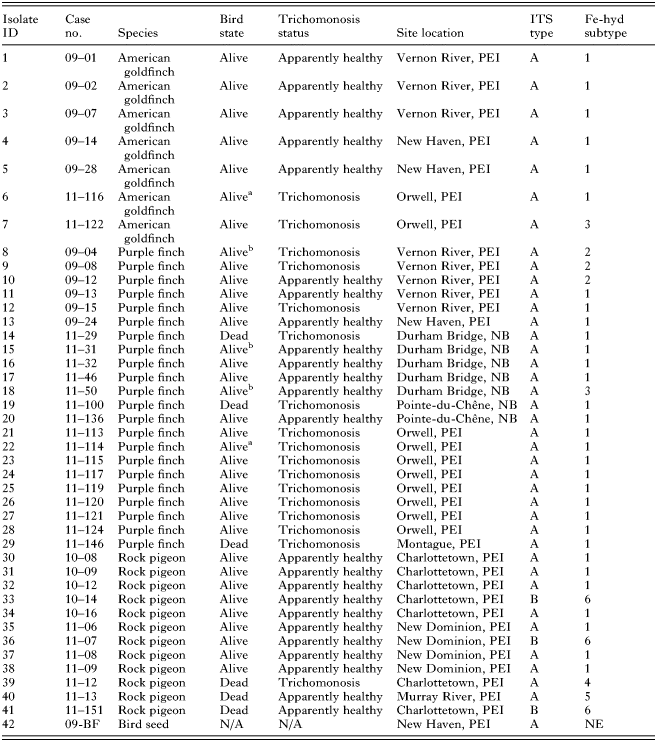
Bird state (alive or dead) indicates whether the sample was collected in-field from live-sampling or at necropsy. ITS typing and Fe-hyd subtyping results from sequence data are recorded.
NE, not evaluated as the PCR was unsuccessful.
a Died immediately after swabbing (approx. 45 min.), confirmed trichomonosis as cause of death via post-mortem examination.
b Died after swabbing (days–weeks), confirmed trichomonosis as cause of death via post-mortem examination.
DNA sequencing and phylogeny reconstruction
PCR products were sequenced in both directions at the McGill University and Genome Québec Innovation Centre, Montréal, Québec, Canada. Sequences were aligned with published trichomonad sequences from GenBank using BioEdit (Hall, Reference Hall1999). Phylogenies were constructed separately for the ITS region and Fe-hyd gene by neighbour-joining (NJ), maximum parsimony (MP) and maximum likelihood (ML) methods using MEGA version 6.0 (Tamura et al. Reference Tamura, Stecher, Peterson, Filipski and Kumar2013). Statistical support for NJ, ML and MP tree topologies were bootstrap-sampled 1000 times and support values (%) of NJ, MP and ML analysis were superimposed on the NJ consensus trees.
For phylogeny reconstruction using the ITS region, NJ tree evolutionary distances were computed using the Jukes-Cantor method (Jukes and Cantor, Reference Jukes, Cantor and Munro1969) and were reported in the units of the number of base substitutions per site. The MP tree was obtained using the Subtree-Pruning-Regrafting algorithm (Nei and Kumar, Reference Nei and Kumar2000) with search level 1 in which the initial trees were obtained with the random addition of sequences (10 replicates). The ML tree was constructed using Jukes-Cantor substitution model (Jukes and Cantor, Reference Jukes, Cantor and Munro1969) as determined by the lowest Bayesian Information Criterion score and highest Akaike Information Criterion, corrected value (Tamura et al. Reference Tamura, Stecher, Peterson, Filipski and Kumar2013). Initial tree(s) for the heuristic search were obtained by applying the NJ method to a pairwise distance matrix estimated using Maximum Composite Likelihood. For ITS region trees, there were a total of 37 nucleotide sequences using 209 positions in the final dataset. All positions containing gaps and missing data were eliminated. Bootstrap values (1000 replicates) for each NJ, MP and ML trees were computed following Felsenstein (Reference Felsenstein1985).
For phylogeny reconstruction based on the Fe-hyd gene, the NJ, MP and ML used the same parameters as for the ITS region sequences including bootstrap replicates (1000). For Fe-hyd trees, there were 15 nucleotide sequences with a total of 803 positions in the final dataset. All positions containing gaps and missing data were eliminated.
RESULTS
Parasite recovery from columbids, finches and environmental samples
Forty-two trichomonad isolates were collected between 2009 and 2011 from rock pigeons (n = 12), finch species (n = 29) and bird seed (n = 1) from the Canadian Maritime provinces (Table 1 and Fig. 1). For this study, 37 live-mourning doves were captured, swabbed and cultured, and none of these individuals were positive for T. gallinae. Additionally, no water samples were positive for T. gallinae. In the individuals that died of trichomonosis, no gross or microscopic lesions consistent with another disease being the primary problem (e.g. avipoxvirus infection or salmonellosis) were identified at post-mortem or with histopathology.
Geographical distribution of the sites in the Canadian Maritime provinces where T. gallinae isolates were collected. Superscripts correspond to the birds from which the isolate was recovered: F, finch; P, pigeon; and BS, bird seed. Refer to Table 1 for additional details for each isolate.

ITS region sequence and phylogeny
ITS region sequences of 300 nucleotides were derived for the 42 trichomonad isolates recovered from finches, rock pigeons and from a bird seed sample in the Canadian Maritime provinces. Two distinct ITS region types were recognized that share 98·5% similarity, (1) Sequence Type A (GenBank: KF214772) was identified in 39 T. gallinae isolates collected from American goldfinches (n = 7; 5 apparently healthy individuals and 2 with trichomonosis), purple finches (n = 22; 8 apparently healthy individuals and 14 with trichomonosis), rock pigeons (n = 9; 8 apparently healthy individuals and 1 with trichomonosis) and an aggregate of moist bird seed removed from several birdfeeders and deposited in a compost bin at a site confirmed to be experiencing finch trichomonosis (n = 1) and (2) Sequence Type B (GenBank: KF214773) was identified in T. gallinae isolates from 3 apparently healthy rock pigeons (Table 1).
The ITS region phylogeny confirms that the T. gallinae isolates formed a monophyletic assemblage within the trichomonads with two well-supported groups, Type A and B (Fig. 2). Type A contains 39 PEI isolates from finches and rock pigeons as well as the bird seed sample (GenBank: KF214772) and also representative isolates including the UK finch epidemic strain (GenBank: GQ150752) and other isolates from finches, columbids and raptors from Brazil, Europe, Mauritius, Australia and the USA (Fig. 2). Type B contains an additional three isolates derived from PEI rock pigeons (GenBank: KF214773) with no evidence of trichomonosis, along with representative isolates derived from columbids, raptors and a canary from diverse geographic regions including the USA, Europe and Australia (Fig. 2).
Neighbour-joining 60% bootstrap-consensus tree based on T. gallinae ITS region sequences. Values at nodes represent the bootstrap percentages from 1000 replicates for neighbour-joining, maximum parsimony and maximum likelihood, respectively. There were a total of 209 positions in the final dataset as all positions containing gaps and missing data were eliminated. GenBank accession numbers are given along with host names or isolate designations and country for each trichomonad. Isolates in bold are from birds sampled in the present study. For additional isolate details see Table 1. * indicates UK Finch epidemic strain.

Fe-hyd gene sequence and phylogeny
The Fe-hyd nucleotide sequences (901 nucleotides) were obtained from all finch and rock pigeon isolates from the Canadian Maritime provinces (n = 41). Multiple attempts to amplify the Fe-hyd gene from DNA extracted from the bird seed sample (isolate 42) were unsuccessful. Six different Fe-hyd sequence subtypes were discovered that share between 98·1 and 99·8% similarities. The six Fe-hyd subtypes identified in the present study are indicated in Table 1. The first subtype (GenBank: KJ184167) included American goldfinch isolates 1–6, purple finch isolates 8, 11–17 and 19–29 and rock pigeon isolates 32, 34–35 and 37–38 that were identical to the clonal UK finch epidemic strain (GenBank: JF681136, Lawson et al. Reference Lawson, Cunningham, Chantrey, Hughes, John, Bunbury, Bell and Tyler2011b ). The second subtype (GenBank: KJ184168) included purple finch isolates 9 and 10, while the third subtype (GenBank: KJ184169) included American goldfinch isolate 7 and purple finch isolate 18, respectively; each subtype differed by one unique single nucleotide polymorphism (SNP) from the UK finch epidemic strain A1. Similarly, the fourth subtype (GenBank: KJ184170) from rock pigeon isolate 39 was identical to an isolate from a Madagascar turtle dove (Streptopelia picturata) from the Seychelles (GenBank: JF681141), while the fifth subtype (GenBank: KJ184171) from rock pigeon isolate 40 differed by one SNP. The sixth subtype (GenBank: KJ184172) included rock pigeon isolates 33, 36 and 41 that were identical to an isolate from a wood pigeon (Columba palumbus) from the UK (GenBank: KC529662).
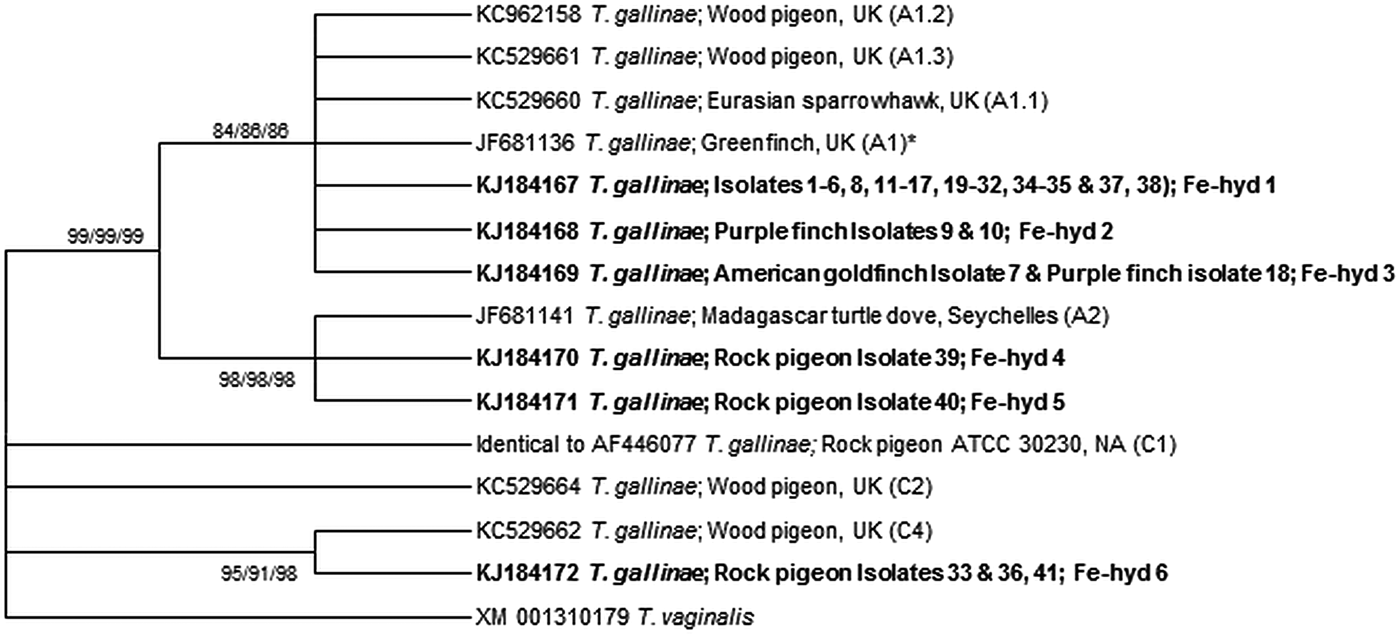
The Fe-hyd phylogeny shows two distinct clusters of sequences. Isolates 1–6, 8, 11–17, 19–32, 34–35 and 37–38 (GenBank: KJ184167), isolates 7 and 18 from American goldfinch and purple finch (GenBank: KJ184169) and the isolate from purple finches 9 and 10 (GenBank: KJ184168) all grouped with the UK finch epidemic strain A1 (GenBank: JF681136). The second cluster contains the two PEI rock pigeons isolates 39 and 40 (GenBank: KJ184170 and KJ184171, respectively) in a well-supported (98% by all three phylogeny methods) cluster with an isolate from a Madagascar turtle dove from the Seychelles (A2) (Fig. 3).
Neighbour-joining 60% bootstrap-consensus tree based on Trichomonas gallinae Fe-hydrogenase gene sequences. Values at nodes represent the bootstrap percentages from 1000 replicates for neighbour-joining, maximum parsimony and maximum likelihood, respectively. There were a total of 803 positions in the final dataset. GenBank accession numbers are given beside host names or isolate designations and country for each trichomonad. Isolates in bold are from birds sampled and designated into the six Fe-hyd subtypes identified in the present study. For additional isolate details see Table 1. * indicates UK Finch epidemic strain.
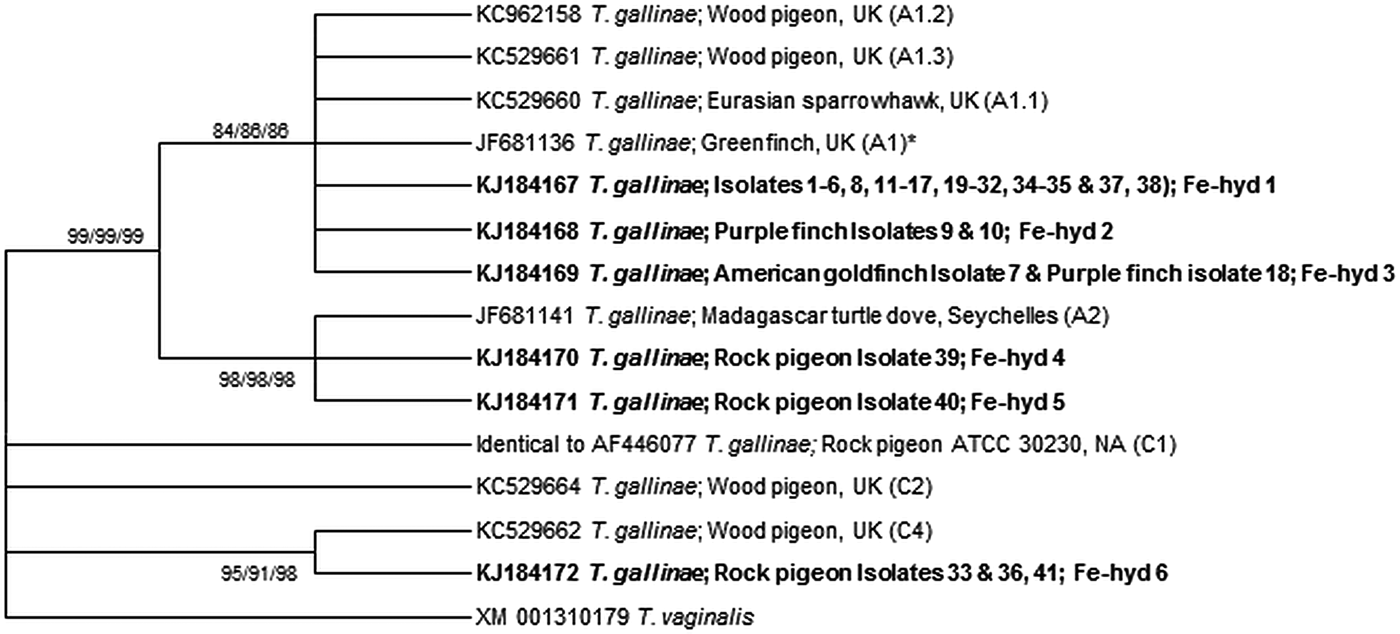
The three other PEI rock pigeon isolates 33, 36 and 41 (GenBank: KJ184172) grouped with a T. gallinae isolate from a wood pigeon from the UK (C4). These sequences along with the remaining T. gallinae Fe-hyd gene sequences show a less cohesive branching structure (Fig. 3).
DISCUSSION
This study utilized ITS region and the Fe-hyd gene sequencing to investigate the genetic diversity of T. gallinae in finch and columbid populations of the Canadian Maritime provinces following the emergence of finch trichomonosis in this region.
The ITS region analysis revealed that two T. gallinae sequence types are present in the wild avifauna of the Canadian Maritime provinces. In phylogenies based on ITS region sequence data, T. gallinae splits into two very distinct groups as noted by previous authors (Gerhold et al. Reference Gerhold, Yablsey, Smith, Ostergaard, Mannan and Fischer2008; Sansano-Maestre et al. 2009; Grabensteiner et al. Reference Grabensteiner, Bilic, Kolbe and Hess2010; Lawson et al. Reference Lawson, Cunningham, Chantrey, Hughes, John, Bunbury, Bell and Tyler2011b ).
All finch isolates in this study, whether they originated from apparently healthy birds or birds with trichomonosis, were identical to the T. gallinae Type A that has been previously identified in European finches and is widespread in North American columbids (Gerhold et al. Reference Gerhold, Yablsey, Smith, Ostergaard, Mannan and Fischer2008; Lawson et al. Reference Lawson, Cunningham, Chantrey, Hughes, John, Bunbury, Bell and Tyler2011b ; Girard et al. Reference Girard, Rogers, Woods, Chouicha, Miller and Johnson2014). Importantly, this same type was identified in nine rock pigeons (eight apparently healthy individuals and one with trichomonosis) (Table 1). Thus, the ITS region sequence typing alone cannot discriminate whether the origin of trichomonosis in finches in the Canadian Maritime provinces is a translocation of the European finch strain or is simply the result of contact with infected sympatric columbids. However, because both American goldfinch and purple finch populations in the Canadian Maritimes are considered local resident populations with limited distance North–South migrations (mainly associated with weather conditions and food availability) and rock pigeons are non-migratory year-round residents, a plausible scenario for transmission between these species at local bird feeding stations is reasonable without requiring movement of the disease from Europe to the Canadian Maritime provinces.
A common factor in the emergence of trichomonosis in finches in all geographical locations is that the mortality is identified where large numbers of birds congregate at private birdfeeding and watering stations (Forzán et al. Reference Forzán, Vanderstichel, Melekhovets and McBurney2010; Neimanis et al. Reference Neimanis, Handeland, Isomursu, Agren, Mattsson, Hamnes, Bergsjø and Hirvelä-Koski2010; Robinson et al. Reference Robinson, Lawson, Toms, Peck, Kirkwood, Chantrey, Clatworthy, Evans, Hughes, Hutchinson, John, Pennycott, Perkins, Rowley, Simpson, Tyler and Cunningham2010). Therefore, it has been suggested that indirect transmission associated with contaminated bird seed, water bowls or bird baths plays a role in the epidemiology of this disease (Boal and Mannan, Reference Boal and Mannan1999; Neimanis et al. Reference Neimanis, Handeland, Isomursu, Agren, Mattsson, Hamnes, Bergsjø and Hirvelä-Koski2010; Robinson et al. Reference Robinson, Lawson, Toms, Peck, Kirkwood, Chantrey, Clatworthy, Evans, Hughes, Hutchinson, John, Pennycott, Perkins, Rowley, Simpson, Tyler and Cunningham2010; Gerhold et al. Reference Gerhold, Maestas and Harnage2013). In the present study, T. gallinae was not detected in water collected from sites where trichomonosis mortalities were occurring. This was surprising given that Bunbury et al. (Reference Bunbury, Jones, Greenwood and Bell2007) were successful in recovering T. gallinae from puddles and Gerhold et al. (Reference Gerhold, Maestas and Harnage2013) found that T. gallinae was able to survive for up to 20 min in both distilled and chlorinated water when organic matter (detritus, leaves and soil) was present. One caveat to our water sampling success was that property owners undergoing bird mortalities in their backyards became more diligent in cleaning feeders and waterers. Thereby reducing the likelihood of recovering parasites from water samples collected in our study. In support of this fact, the only successful isolation of T. gallinae from bird seed was from a composite sample disposed of in a compost bin at a property experiencing trichomonosis mortality. This isolation supports the experimental evidence that showed T. gallinae can survive in moist grain for 120 h (Kocan, 1969). Furthermore, ITS typing confirmed that the bird seed isolate was Type A, identical to T. gallinae isolates recovered from sick birds on the same property.
Interestingly, we also identified three rock pigeons infected with Type B T. gallinae, a type that has been reported in columbids from the USA, eastern Spain and Austria as well as in raptors from eastern Spain (Gerhold et al. Reference Gerhold, Yablsey, Smith, Ostergaard, Mannan and Fischer2008; Sansano-Maestre et al. Reference Simpson and Molenaar2009). In a prevalence study of T. gallinae, Sansano-Maestre et al. (Reference Simpson and Molenaar2009) examined pigeons and raptors with gross lesions consistent with trichomonosis and apparently healthy birds with no identifiable lesions and found that Type A T. gallinae were recovered more frequently from birds with gross lesions of trichomonosis, whereas Type B T. gallinae were recovered from individuals with no lesions, suggesting a relationship between Type A and increased virulence. Sansano-Maestre et al. (Reference Simpson and Molenaar2009) also speculated that Type B parasites may be adapted to pigeon hosts as this Type was much more prevalent in pigeons than in raptors. Similar to Sansano-Maestre et al. (Reference Simpson and Molenaar2009) study, we found that all Type B isolates were recovered from apparently healthy rock pigeons, and all finch species and rock pigeons with evidence of clinical trichomonosis were infected with Type A. However, it is important to note that while all isolates recovered from either finches or pigeons with clinical evidence of trichomonosis were Type A, Type A isolates were also recovered from apparently healthy birds. Also, while rock pigeon isolates were not all Type B, all Type B isolates in our study were recovered exclusively from rock pigeons, all of which were apparently healthy individuals. Thus our results are consistent with the hypothesis put forward by Sansano-Maestre et al. that there may be a relationship between Type A and increased virulence.
Through examination of multiple gene regions (ITS region, Fe-hyd gene and small sub-unit rDNA), as well as random amplified polymorphic DNA analyses, Lawson et al. (Reference Lawson, Cunningham, Chantrey, Hughes, John, Bunbury, Bell and Tyler2011b ) examined over 50 isolates obtained from finch trichomonosis cases and found no evidence for multiple strains, concluding that a clonal strain of Type A was responsible for the emergence of epidemic trichomonosis in GB. Lawson et al. (Reference Lawson, Cunningham, Chantrey, Hughes, John, Bunbury, Bell and Tyler2011b ) further speculated that due to the clonal nature of the passerine epidemic strain, most likely, it arose recently from a bottleneck, such as a single spill-over event (i.e. host-switching) from columbids to sympatric finches. In the present study, ITS region sequence analysis revealed that all Type A isolates from the Canadian Maritime provinces were identical to the UK finch epidemic strain. Furthermore, our examination of the Fe-hyd gene also revealed that several finch and rock pigeon isolates were identical to the UK finch epidemic strain (Lawson et al. Reference Lawson, Cunningham, Chantrey, Hughes, John, Bunbury, Bell and Tyler2011b ). However, it is equally important that Fe-hyd sequence analysis also revealed single nucleotide polymorphisms amongst some of the Canadian Type A isolates. Based on Fe-hyd nucleotide sequence analysis, four Canadian Type A isolates, including American goldfinch, purple finch and rock pigeon isolates, and one Canadian Type B isolate, only from a rock pigeon, were found to be different from both the clonal UK epidemic strain and the Canadian Maritime provinces’ isolates similar to the clonal UK epidemic strain mentioned above (see Figs 2 and 3). This suggests divergence not only from the British finch and Seychelles columbid strains they were compared to, but also from each other, indicating that a number of strains of T. gallinae are present in the wild avifauna of the Canadian Maritime provinces. Analysis of the Fe-hyd gene sequences from the Canadian Maritime provinces bird isolates showed that there is fine-scale variation amongst isolates akin to that observed in UK columbid populations. This observation suggests that the emergence of finch trichomonosis in this region may have been caused by multiple spill-over events, either from sympatric columbids, another bird species as yet unknown to be infected with the parasite or from virulent T. gallinae developing independently within the Canadian Maritime provinces’ finch populations. In support of this view a recent paper has reported the presence of the UK finch epidemic subtype A1 in North American columbids (Girard et al. Reference Girard, Rogers, Woods, Chouicha, Miller and Johnson2014) similar to the findings in this study.
Indeed, when historic T. gallinae DNA samples were subtyped, the A1 subtype had also been isolated from Mauritian columbids sampled in 2004 (unpublished data) suggesting distribution of this subtype may actually be longstanding and global. Other reports of finch trichomonosis in North America have since emerged in west and East-central USA (Gerhold, Reference Gerhold2009) and Western Canada (Canadian Cooperative Wildlife Health Centre unpublished data) in 2009. During the winter and spring of 2009, the Southeastern Cooperative Wildlife Disease Study (SCWDS) conducted PMEs on passerines of multiple species, including American goldfinch, house finch (Carpodacus mexicanus), northern cardinal (Cardinalis cardinalis), pine siskin and purple finch, submitted from mortality incidents from the eastern USA and found that whilst the majority had salmonellosis, at least 12 birds were suffering from trichomonosis or had concurrent infection with both of these pathogens which result in upper alimentary tract lesions (Gerhold, Reference Gerhold2009; Hernandez et al. Reference Hernandez, Keel, Sanchez, Trees, Gerner-Smidt, Adams, Cheng, Ray, Martin, Presotto, Ruder, Brown, Blehert, Cottrell and Maurer2013).
As with GB, there is evidence of some finch trichomonosis incidents in North America prior to the emergence of finch trichomonosis in the Canadian Maritime Provinces in 2007. On the western coast of the USA, Anderson et al. (Reference Anderson, Grahn, Van Hoosear and BonDurant2009) screened birds for trichomonad parasites on admission to a northern California wildlife rehabilitation facility over a period of 4 years (2001–2005) and found evidence of a low prevalence of the infection in the house finch (1·7%) with a high case fatality rate (95·5%); these authors hypothesized that the infection may be endemic in this (and other) passerine species in the region. Moreover, an outbreak affecting house finches, house sparrows and American goldfinches, contemporaneous with American mourning dove mortality (Zenaida macroura), occurred in the Midwest (Kentucky, Ohio and Indiana) in the autumn of 2002. A combination of trichomonosis and West Nile virus (WNV) infection was diagnosed as the cause of mortality (estimated total of 200 birds) although the relative importance of these agents was not described (NWHC, 2002). In the summer of 2006, a mixed species mortality incident of circa 200 birds involving house finches, American goldfinches and a gray catbird (Dumetella carolinensis) was reported to the SCWDS. In total 18 birds were submitted for PME with trichomonosis confirmed in 10 cases and WNV infection detected in one bird (Gerhold, Reference Gerhold2009).
Various potential routes exist through which the UK finch epidemic strain of T. gallinae could have been introduced to the Canadian Maritime Provinces. Bird migration is believed to be the primary route of spread of the disease within Europe. Large numbers of the finch and columbid species in which trichomonosis has been most frequently diagnosed in GB in recent years have been banded (1960–2012 inclusive) (greenfinch n = 2 107 976, chaffinch n = 1 287 396, goldfinch (Carduelis carduelis) n = 466 108, siskin (Carduelis spinus) n = 503 097 and collared dove n = 37 780, wood pigeon n = 45 823); however, no banded birds of these species have been recovered in North America over that period suggesting international exchange is negligible (Robinson and Clark, Reference Robinson and Clark2013). Indeed, there are remarkably few exchanges of any British wild bird species recorded with North America, with the most frequent being for seabirds and waders, including the kittiwake (Rissa tridactyla) n = 73, Manx shearwater (Puffinus puffinus) n = 25, knot (Calidris canutus) n = 19, turnstone (Arenaria interpres) n = 14, and fulmar (Fulmarus glacialis) n = 13; all other species with <10 individual birds recorded as North American band recoveries are seabirds, shorebirds or waterfowl species in which T. gallinae infection has not been recorded (Robinson and Clark, Reference Robinson and Clark2013). Collectively, therefore bird migration from Europe is an unlikely route of introduction. Since T. gallinae is not capable of long-term environmental persistence, movement with fomites is also an implausible method of parasite translocation. Anthropogenic movement of captive birds, whether deliberate (e.g. cage and aviary birds, game birds, zoological collections) or accidental (e.g. wild bird stowaways or stray racing pigeons) could have occurred; however, there is no available evidence to support or refute this hypothesis further. Collectively, therefore, whilst the emergence of finch trichomonosis in the Canadian Maritime Provinces occurred shortly after the emergence of the disease in GB in time, there is no clear candidate for a plausible route of introduction of the finch epidemic strain of T. gallinae from the UK.
Instead, there is evidence that favours the hypothesis that finch trichomonosis emerged locally in the Canadian Maritime Provinces, through spill-over from sympatric birds; this route is most consistent with the SNPs in Fe-hyd subtypes found amongst the finch and columbid isolates from PEI. The occurrence of endemic finch trichomonosis in western USA (Anderson et al. Reference Anderson, Grahn, Van Hoosear and BonDurant2009), and other isolated finch mortality incidents due to the disease, indicates that parasite strains with the potential to cause disease in passerines have been present in North America for some time.
Future studies should examine T. gallinae isolates using multiple gene regions, or full genome sequencing, in order to provide more detailed information about their genetics which could lead to a better understanding of the epidemiology of avian trichomonosis and the mechanisms of disease emergence.
ACKNOWLEDGEMENTS
The authors wish to thank the Canadian Cooperative Wildlife Health Centre, Atlantic Region and the AVC Lobster Science Centre for technical support, particularly Fiep DeBie and Adam Acorn, and use of equipment during the completion of this study. Dwaine Oakley, Holland College Wildlife Technology Program, provided technical expertise and training for trapping, mist netting and handling birds. Also thanks to Rob Robinson from the British Trust for Ornithology, UK, for his assistance with the bird migration data.
FINANCIAL SUPPORT
This research was funded through a grant from the Sir James Dunn Animal Welfare Centre, Atlantic Veterinary College (SM, MF and SG). Work in the UK was supported in part by a grant from the John and Pamela Salter Foundation (KT and BL).