Introduction
Fertility behaviour has been the focus of many demographers and researchers across various disciplines (Potter et al., Reference Potter, Schmertmann and Cavenaghi2002; Jayachandran, Reference Jayachandran2017; Sobotka, Reference Sobotka2017; Zalak & Goujon, Reference Zalak and Goujon2017). Fertility can be difficult to predict due to changes in female education, marriage patterns and the lifestyle of modern society (Furuoka, Reference Furuoka2009; Kreager et al., Reference Kreager, Felson, Warner and Wenger2013). Understanding fertility has important policy implications in areas such as health care, supply of schools and social security (McNicoll, Reference McNicoll2001; Potter et al., Reference Potter, Schmertmann and Cavenaghi2002). One reliable indicator of future fertility is desire for additional children (Miller, Reference Miller2011).
Human capital is a key factor influencing the desire for additional children (Musick et al., Reference Musick, England, Edgington and Kangas2009; Testa, Reference Testa2014). Women with higher education have higher incomes, and thus more autonomy in reproductive decisions (Weinberger, Reference Weinberger1987; Kost & Forrest, Reference Kost and Forrest1995; Sujatha & Reddy, Reference Sujatha and Reddy2009). However, the relationship between education and fertility desire remains controversial in some country contexts. In many developing countries, women with lower education have higher fertility desires, as children could provide child labour and old-age security (Martin, Reference Martin1995; Arokiasamy et al., Reference Arokiasamy, Mcnay and Cassen2004; Jayachandran, Reference Jayachandran2017; Yen et al., Reference Yen, Chankrajang and Truc2017). On the other hand, women with more schooling have higher fertility desires in several European countries (Fort et al., Reference Fort, Schneeweis and Winter-Ebmer2011; Testa, Reference Testa2014). This could be explained by institutional context, such as childcare and parental leave policies (Fort et al., Reference Fort, Schneeweis and Winter-Ebmer2011). In such contexts, the trade-off between child-rearing and career is minimized, and women with higher education (and therefore income) can afford to have more children.
Vietnam provides a unique case study to investigate the relationship between education and desire for additional children as the country has experienced high economic growth and rapid demographic transition while maintaining a Confucianism tradition. This study incorporates the role of son preference and regional differences. There are two main reasons for this. First, Vietnam is well documented for having a son preference (Bélanger, Reference Bélanger2002; Guilmoto et al., Reference Guilmoto, Hoang and Van2009), as evidenced by the high sex ratio at birth (SRB) of 112.2 in 2016 by the General Statistical Office of Vietnam (GSO, 2017). The growth rate of the SRB in Vietnam has been higher than that of several countries known for son preference, such as India and China. The four main factors driving the high SRB in Vietnam are gender preference, low fertility, a high abortion rate and prenatal sex determination by ultrasound technology, as reported by GSO and the United Nations Population Fund (Guilmoto, Reference Guilmoto2012a; GSO & UNFPA, 2016). Studies have indicated that the root cause of son preference is the perceived higher benefits of sons, such as the right to inherit land and worship of ancestors (Bélanger, Reference Bélanger2002; UNFPA, 2012; Le et al., Reference Le, Duong, Nguyen, Nguyen, Bui and Pham2017;).
Second, there are notable regional differences in Vietnam, particularly in social norms and economic situations. These are due to factors such as geographical location, ethnic diversity and historical context (Bélanger, Reference Bélanger2000). The total fertility rate (TFR) also differs significantly across regions. For example, in 2015, the TFR was 1.63 in the South East region and 2.69 in the Northern Midlands and mountain areas (GSO, 2017). The differences between regions are especially evident between the North and the South, where the former has more rigid regulations while the latter is known to be an easier place to start private businesses (Tran et al., Reference Tran, Grafton and Kompas2009). These socioeconomic and cultural differences are likely to influence the desire to have more children.
Previous studies have suggested that the demand for additional children is strongly influenced by the presence of sons in a patriarchal family system (Ali, Reference Ali1989; Muhammad, Reference Muhammad2009). While it is expected that those with no sons are more likely to want more children, whether and how education plays a role here is not clear. To the knowledge of the authors of this study, there has been no previous work investigating the role of women’s education and the sex composition of living children on desire for additional children in the different economic regions in Vietnam. To fill in this gap, this study investigated the relationship between women’s education and the desire for additional children among women of reproductive age (18–49) in six economic regions in Vietnam.
The Vietnamese context: a brief overview
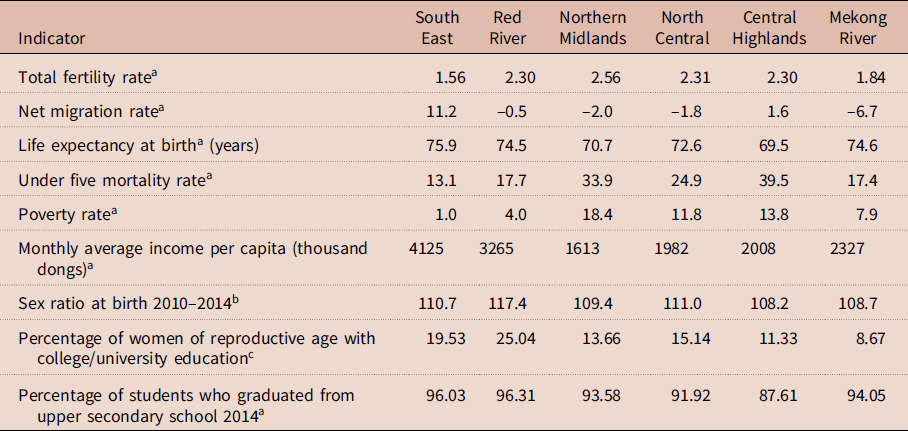
Vietnam has been undergoing a rapid fertility decline, where the TFR has fallen sharply from 5.49 in 1975 to 2.05 in 2019 (United Nations Population Division, 2019). However, there are considerable differences in the TFR across regions, due to the level of socioeconomic development, social norm and each region’s stage in the demographic transition. In 2014, the TFR was lowest in the South East (1.56) and highest in the Northern Midlands and mountain areas (2.56) (GSO, 2014) (see Table 1). Among the six economic regions, the Northern Midlands and mountain areas, the North Central and central coastal areas, and the Central Highlands are considered to be less-developed regions with high poverty rates (18.4, 11.8 and 13.8, respectively), low life expectancy (69.75 years, 70.7 years and 72.6 years, respectively) and the highest under-five mortality rates (33.9, 24.9 and 39.5, respectively). On the other hand, the South East (which includes Ho Chi Minh City) and the Red River Delta (which includes Ha Noi) are considered the most economically developed regions with low percentages living in poverty (1 and 4, respectively), high average monthly incomes, the highest life expectancy (around 75 years) and the lowest under-five mortality rates (13.1 and 17.7, respectively).
Descriptive statistics of demographic and socioeconomic indicators for the six regions of Vietnam, 2014

a Source: GSO (2019) and custom data acquired via website https://www.gso.gov.
b Source: GSO & UNFPA (2016).
c Authors’ calculation based on 2014 MICS.
Net migration rate is defined as: (number of in migrants–number of out migrants) per 1000 population. Under-five mortality rate is defined as the number of deaths under age 5 per 1000 live births in a year. Poverty rate is defined as the proportion of the population with income below the official poverty line. The Vietnamese Government’s poverty line for the 2011–2015 period was calculated by monthly average income per capita (calculated from monthly average household income divided by number of household members) as follows: 400 thousand dongs for rural areas and 500 thousand dongs for urban areas in 2010; 570 thousand dongs and 710 thousand dongs in 2013; 605 thousand dongs and 750 thousand dongs in 2014; 615 thousand dongs and 760 thousand dongs in 2015 and 630 thousand dongs and 780 thousand dongs in 2016, respectively.
The sex ratio at birth (SRB) in Vietnam is high compared with other countries in Asia (Guilmoto, Reference Guilmoto2012a; GSO & UNFPA, 2016). It has continued to increase, from 109 in 2011 to 112.2 in 2016 (GSO, 2017), and has been higher than the biological standard (104–106 boys/100 girls) since 1999 (Guilmoto, Reference Guilmoto2012b). Table 1 shows the wide differences in the SRB across regions. The highest SRB was found in the Red River Delta (117.4), and the lowest in the Central Highlands (108.2).
The high SRB in Vietnam is a consequence of factors such as low fertility, a high abortion rate and prenatal sex determination (Guilmoto, Reference Guilmoto2012a; GSO & UNFPA, 2016). Low fertility, a high SRB, increased life expectancy and unequal economic development across regions suggest that in the future Vietnam will experience population ageing and an unbalanced gender structure. However, the scenario is likely to differ across economic regions.
The government of Vietnam has focused on women’s education and achieved considerable success (Huong, Reference Huong2012). However, differences across regions persist, especially in higher education (Fry, Reference Fry, Hirosato and Kitamura2009). In 2014, the Red River Delta had the highest percentage of reproductive age women with a college/university education (25.04%), while the Mekong River Delta had the lowest (8.67%) (Table 1). The percentage of students who graduated from upper secondary schools was highest in the Red River Delta (96.31%) and the South East (96.03%), and lowest in the Central Highlands (87.61%).
The Vietnamese education system has gone through a number of changes, from the French colonial education system (before 1945) to the education system of Ho Chi Minh (1945–1954), followed by the continuing education system and the United States and Soviet education systems (1954–1975), and finally to the current 12-year education system that has been in place since 1990. Furthermore, Vietnam has had three major educational reforms: (1) the reform to reduce the influence of colonial education (1945–1950), (2) the reform of the general education system (1956–1958) (Nguyen & Nguyen, Reference Nguyen, Nguyen, Fredriksen and Tan2008) and (3) the reform to improve textbooks (1981–1982). Along with the 1986 economic reform, the Vietnamese government also started to apply tuition fees. In addition, the government has also implemented the renovation of teaching and learning methods, the improvement of teachers’ skills, especially language proficiency (under the National Foreign Languages 2020 project) and the application of new textbooks for lower secondary education (Hamano, Reference Hamano2008; Asadullah et al., Reference Asadullah, Perera and Xiao2020).
This study analysed women aged 18–49 in 2014 who were born in or after 1965. The Vietnam War (1954–1975) has been a key factor shaping the education systems of Vietnam since 1954. In that year, Vietnam was divided into two countries: South Vietnam (Republic of Vietnam) and North Vietnam (Democratic Republic of Vietnam), as discussed in a report by the Ministry of Education and Training and the United Nations Educational, Scientific and Cultural Organization (Huong & Fry, Reference Huong and Fry2004; MOET & UNESCO, 2014). Education in South Vietnam has been influenced by the United States while education in North Vietnam followed the system of the Union of Soviet Socialist Republics. In addition, from 1976 until now the education system of Vietnam has operated under a socialist-oriented market economy (Dang & Sukontamarn, Reference Dang and Sukontamarn2020).
Methods
Data
This study used nationally representative data from the 2014 Vietnam Multiple Indicator Cluster Survey (MICS). The main data collection unit was the General Statistics Office of Vietnam, operating with technical and financial support from the United Nations Children’s Fund (UNICEF). The MICS employed systematic sampling, and the sample was stratified by economic region. The survey included data on reproductive health (both maternal fertility and history of birth), women’s background, household information, children’s characteristics and other relevant information.
As this study investigated women’s reproductive behaviour, information was used on women aged 18–49 (reproductive age). Moreover, as desire for additional children was the dependent variable and children’s sex composition was one of the main independent variables, this research focused on women with at least one child who were not pregnant at the time of the survey, and who were able to get pregnant. This limited the sample to 6417 women.
Outcome variable
The study’s outcome variable was women’s desire for additional children, defined as the desire at the time of interview to have another child in the future. The variable came from the interview question, ‘I would like to ask some questions about the future. Would you like to have another child or would you prefer not to have any more children?’ There were two possible answers: ‘Yes, I would like to have another child’ or ‘No, I do not want any more children’.
The above question was directly addressed to the women. Previous studies have suggested that a woman’s fertility desire can be influenced by her husband, family members, friends and even social norms (Thomson et al., Reference Thomson, Mcdonald and Bumpass1990). However, it was not possible to investigate the extent of this influence due to data limitation. This study therefore focused on exploring women’s fertility desires, recognizing that the expressed fertility desire might have been affected by that of a respondent’s husband or by other people.
Explanatory variables
Women’s education
The main independent variable was women’s education. This variable was constructed from the question in the women’s questionnaire: ‘What is the highest level of education that you received?’ Given the changes in the education system over the years, MICS converted the reported level of education to the equivalent of the current 12-year unified education system. Education was classified into five levels: (1) No education, Lower Primary and Primary, (2) Lower Secondary, (3) Upper Secondary, (4) Professional School (with professional secondary education and vocational training), and (5) College/University and above. This is in accordance with the 1998 Education Law and the 2005 Education Law in Vietnam (Vietnam National Assembly, 2005).
For the analysis, education was re-coded into dummy variables with the baseline being ‘Lower Secondary’, as the largest proportion of the sample had this level of education. No education, Lower Primary and Primary levels were combined into one group as the percentage of women with no education was very small (due to the compulsory education law). Reproductive age is usually taken as between 15 and 49 years; however, this study focused on women aged 18–49 because of the possibility that some women under 18 had not completed their education at the time of survey.
Sex composition of living children
For the main analysis, the women in the sample were divided into two groups based on their number of living children:
-
Group 1: Women with one child, and children’s sex composition defined as: (i) one son and (ii) one daughter.
-
Group 2: Women with two or more children, and children’s sex composition defined as: (i) all children were sons, (ii) all children were daughters, (iii) children of mixed sex.
Region
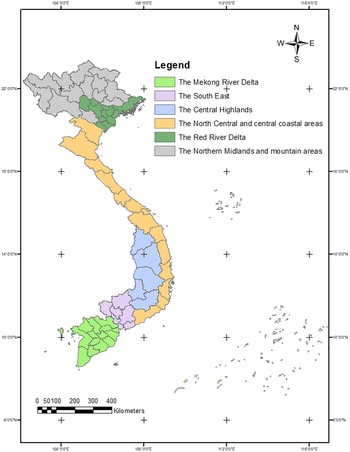
Figure 1 is a map of the six economic regions of Vietnam. Since 1976, Vietnam has introduced various systems of economic regions (Ha Huu Nga, 2007). The analysis in this study followed the current system of six economic regions based on Decree No. 92/ND-CP dated 7th September 2006. The six economic regions are the Red River Delta (Red River), the Northern Midlands and mountain areas (Northern Midlands), the North Central and central coastal areas (North Central), the Central Highlands, the South East and the Mekong River Delta (Mekong River). The main purpose of zoning into six regions was to promote the socioeconomic development of each region. In addition, the differences in SRB, TFR, pace of development and education, as mentioned above, were also the basis for the division of Vietnam into six economic regions (Development Strategy Institute, 2004).
Map of six economic regions in Vietnam. Source: author’s construct based on Decree No. 445/QD-TTG dated 7th September 2009.

Control variables
The control variables used in the analyses were women’s characteristics, household characteristics, children’s characteristics, social indicators and other factors that are known to affect women’s desire for additional children. These control variables are discussed in more detail below.
Analysis
For the main analysis, the probit regression model was applied on the variable ‘desire for additional children’ for women with one child and women with two or more children. The reason for separate regressions for each group was that Vietnam introduced the two-child policy in 1988 to limit couples who were employed in government entities or who were members of the Communist party to have no more than two children. The analyses were run separately for each region to investigate the relationship between women’s education and desire for additional children for each region. Marginal effects were reported.
The estimated probability of desire for additional children came from the equation:
 $$Pr (Y = 1|X) = \Phi ({X^T}\beta )$$
where Pr denotes the probability that a woman wanted to have more children, and Ф is the Cumulative Distribution Function (CDF) of the standard normal distribution. Here β is estimated by maximum likelihood; X T is the set of independent variables including women’s education and covariate variables that were comprised of the following:
-
Variables indicating the woman’s level of education: No education/Lower Primary/Primary, Upper Secondary, Professional School (professional secondary education and vocational training), College/University & above. Here Lower Secondary was the baseline category.
-
Women’s characteristics: age at last birth, female-headed household, ethnicity, marital status, religion, work status, urban/rural residence).
-
Household characteristics: having older persons in household, family wealth status.
-
Children’s characteristics: children’s sex composition and child mortality, number of children alive and age of last child.
-
Social indicators and other factors: sex ratio at birth, attitudes towards domestic violence and access to mass media.
A correlation test was conducted for the independent variables using correlation matrices and variance inflation factors. The results indicated that none of the independent variables had a high correlation with any other variable.
In addition, the relationship between education and desire for additional children among women with son(s) only, daughter(s) only, and children of both genders was assessed. Previous studies have shown that son preference is an important factor influencing the fertility decisions of Vietnamese couples (Haughton & Haughton, Reference Haughton and Haughton1995). By analysing the relationship between education and desire for additional children separately for each group, the aim was to understand how son preference varies with women’s level of education.
Results
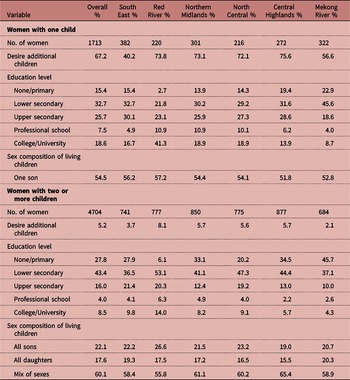
Table 2 presents the descriptive statistics of the main variables. For women with one child, 67.2% preferred to have additional children, while for women with two or more children the corresponding figure was 5.2%. Large regional variations were observed. The two regions with the highest percentage of women who wanted additional children were the Central Highlands for women with one child (75.6%) and the Red River Delta for women with two or more children (8.1%). The South East and the Mekong River Delta, both located in southern Vietnam, were the regions where women wanted fewer children compared with other regions in Vietnam. For the South East and the Mekong River Delta, 40.2% and 56.6% of women with one child, and 3.7% and 2.1% of women with two or more children, respectively, wanted additional children.
Women’s desire for additional children by education level and sex composition of children

Source: authors’ calculation based on Vietnam MICS 2014.
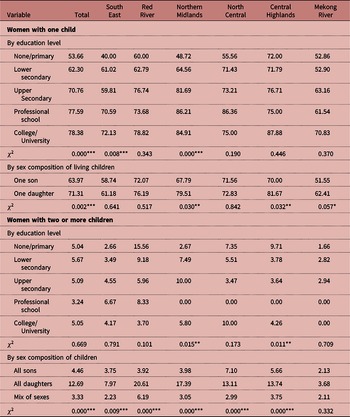
Table 3 shows the percentage of women who desired additional children based on the women’s education level and children’s sex composition. The statistics are presented for the group with one child and the group with two or more children, stratified by region. For both groups of women, a larger percentage of those with only daughter(s) wanted additional children compared with those with only son(s). The association between education and desire for additional children differed according to (i) the number of children and (ii) region. For women with one child, the results showed a positive association in all regions, with those with higher education were more likely to want another child. The differences in the desire for additional children according to level of education were statistically significant in the South East and Northern Midlands regions.
Percentage of women who wanted additional children by their education level and sex composition of living children, by region

Source: authors’ calculation using data from MICS 2014 in Vietnam.
***p<0.01; **p<0.05; *p<0.1
For women with two or more children, the relationship between women’s education and desire for additional children was not clear. Those with college/university education had the smallest percentage wanting additional children in two of the six regions (the Red River Delta and the Mekong River Delta), although the differences were not statistically significant. In the Northern Midlands, those with upper secondary education had the highest percentage wanting additional children, and in the Central Highlands, those with primary education or lower had the highest percentage wanting additional children.
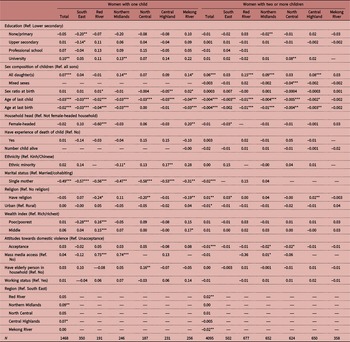
Table 4 presents the probit regression results on the desire for additional children for women with one child and women with two or more children. Marginal effects were reported. Chi-squared tests were conducted to test the difference between the coefficients for different levels of education. In the case of women with one child, significant differences were found in: (1) the South East (between lower secondary and upper secondary, p<0.1), upper secondary and university, p<0.05), (2) the Northern Midlands (between lower secondary and university, p<0.01) and (3) the Central Highlands (between upper secondary and university, p<0.05). In the case of women with two or more children, significant differences were found in: (1) the Northern Midlands (between lower secondary, upper secondary and university, p<0.1) and (2) the Central Highlands (between lower secondary and university, p<0.05). The Wald test was applied to test the joint significance of the coefficients of education. The results showed that, for the group with one child, the coefficients of education were jointly significant in the South East and the Northern Midlands, and for the group with two or more children the coefficients of education were jointly significant in the Northern Midlands.
Probit regression results on the desire for additional children of women with one living child, and women with two or more living children

Source: authors’ calculation using data from MICS 2014 in Vietnam.
***p<0.01; **p<0.05; *p<0.1.
Marginal effects are reported. Certain cells are left blank as the variables are automatically dropped from the regressions due to predicting success or failure perfectly.
For all of Vietnam, those with higher education were more likely to want another child compared with those with lower education in the group with one child. For women with one child, those in the Northern Midlands and the Central Highlands were more likely to want another child compared with those in the South East. For women with two or more children, those in the Red River were more likely to want another child, while those in the Mekong River were less likely to, compared with those in the South East.
The results for each region showed that education was significantly correlated with fertility desire in two out of six regions. For the South East, those with a primary education or lower and those with upper secondary education were less likely to want another child compared with those with lower secondary education. The variables indicating professional school and college/university education were not statistically significant. For the Northern Midlands, those with college/university education were more likely to want another child compared with those with lower secondary education. For all other regions, education was not significantly correlated with desire for additional children. It should be noted that the positive association between education and desire for additional children was found in areas with the highest level of development (the South East, with the poverty rate of 1) as well as in areas with the lowest level of development (the Northern Midlands with poverty rates of 18.4) (Table 1).
For women with two or more children, for Vietnam overall, education was not significantly correlated with desire for additional children (Table 4). Women in the Red River Delta were more likely, while women in the Mekong River Delta were less likely to want another child compared with those in the South East. The results for each region showed that education was positively correlated with desire for additional children in the Northern Midlands (where those with primary education or lower were less likely to want another child compared with those with lower secondary education) and the North Central region (where those with college/university education were more likely to want another child compared with those with lower secondary education). For all other regions, education was not significantly correlated with desire for additional children.
As Vietnam has been documented as having son preference (Bélanger, Reference Bélanger2002), it was expected that those with only daughter(s) would be more likely to want another child compared with those with only son(s). The results in Table 4 support this hypothesis. Son preference was evident in the Northern Midlands and the Mekong River Delta in the group with one child, and in the Red River Delta, the Northern Midlands and the Central Highlands in the group with two or more children. Additionally, in the North Central region, women with children of both genders were less likely to want another child compared with those with all sons, suggesting preference for mixed-gender offspring.
For control variables, for women with one child, those who lived in provinces with a high SRB in the Central Highlands were less likely to want another child; however, a reverse result was found in the Red River Delta and the Mekong River Delta. For the more economically developed Red River Delta and the Mekong River Delta, it was possible that women in provinces with a strong son preference (as reflected by high SRBs) were more likely to want another child, as they would probably want to have a son (or another son) and were able to afford it.
The age of the last child was negatively correlated with desire for additional children for Vietnam overall and almost all regions, except the Mekong River Delta in the case of women with two or more children. This was as expected, as women whose youngest child was older were likely to be older themselves, and therefore the women would be less likely to want to have another child. Women’s age at last birth was negatively correlated with their desire for additional children for the South East, Red River Delta, Northern Midlands and Mekong River Delta regions for the group with one child. A similar result was found for the North Central region, the Red River Delta, the Northern Midlands and the Central Highlands for the group with two or more children. Those who were older at the time of their last birth were less likely to want another child.
For women in the Northern Midlands and North Central regions with two or more children, those who thought that domestic violence was acceptable were less likely to want another child. For women with one child in the South East, women in higher wealth quintiles were more likely to want another child compared with women in the lowest wealth quintile. However, the opposite result was found in the Red River Delta. In the North Central region, women with one child who lived with an elderly person were more likely to want another child compared with those who did not. It is possible that older persons can provide support for child-rearing.
For women in the Red River Delta, North Central and Mekong River Delta regions with one child, those who had a religion were less likely to want another child compared with those with no religion. For women with two or more children in the South East and the Central Highlands, those who had a religion were more likely to want another child compared with those with no religion.
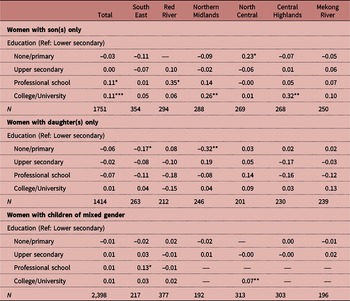
Table 5 shows the results of the investigation into the relationship between education and desire for additional children among women with son(s) only, daughter(s) only and children of both genders. Each regression includes women with one child and women with two or more children, and controls for the number of children. Other control variables were the same as in Table 4. Marginal effects were reported. Chi-squared tests were conducted to test the difference between the coefficients for different levels of education. For women with son(s) only, significant differences were found in: (1) the Red River (between lower secondary and professional school, p<0.1), (2) the Northern Midlands (between lower secondary and university, p<0.05; between upper secondary and university, p<0.05) and (3) the Central Highlands (between lower secondary and university, p<0.05; between upper secondary and university, p<0.05). For women with daughter(s) only, significant differences were found in the Northern Midlands (between each level of education, p<0.1). For women with children of mixed sex, significant differences were found in: (1) the South East (between lower secondary and professional school, p<0.1) and (2) the North Central (between lower secondary and university, p<0.05). The Wald test was applied to test joint significance of the coefficients of education. The results showed that, for the group with only daughter(s), the coefficients of education were jointly significant in the Northern Midlands. For the group with children of mixed sex the coefficients of education were jointly significant in the North Central region. The results provide insights into the relationship between education and desire for additional children based on the genders of living children.
Probit regression on the desire for additional children of women with son(s) only, daughter(s) only and mixed-sex children by level of education

Source: authors’ calculation using data from MICS 2014 in Vietnam.
***p<0.01; **p<0.05; *p<0.1.
Marginal effects are reported. All models control for SRB, age of last child, age at last birth, female-headed household, child mortality, number of children, ethnicity, marital status, religion, residence, family wealth status, attitude towards domestic violence, mass media access, having older persons in the household and work status. Certain cells are left blank as these variables were automatically dropped from the regressions due to predicting success or failure perfectly.
For women with son(s) only, for Vietnam overall, those with professional and college/university education were more likely to want another child compared with those with lower secondary education. Higher levels of education in the Red River Delta, the Northern Midlands and the Central Highlands were positively and significantly correlated with desire for additional children. On the other hand, for the North Central region, women with primary education or lower were more likely to want another child compared with those with lower secondary education.
For women with daughter(s) only, for the South East and the Northern Midlands, those with primary education or lower were less likely to want another child compared with those with lower secondary education (Table 5). For Vietnam overall, education was not significantly correlated with desire for additional children, controlling for other factors.
In the case of women with at least one son and one daughter, for the South East, those with professional education were more likely to want another child compared with those with lower secondary education. For the North Central region, those with university education were more likely to want another child compared with those with lower secondary education. For Vietnam overall, however, education was not significantly correlated with desire for additional children.
Overall, given the son preference in Vietnam, for women with at least one son, women with lower levels of education appeared more likely not to want another child compared with those with higher levels of education. For women with only daughter(s) and no sons, however, education was not significantly correlated with desire for additional children. The results in Table 5 demonstrate differences across regions.
Discussion
This study investigated the relationship between women’s education and their desire for additional children in Vietnam, taking into account the role of children’s sex composition and regional differences. In contrast to the evidence from other developing countries, in the case of women with one child, education was positively associated with a desire for additional children in two out of six regions, namely the South East and the Northern Midlands. The same result was observed in the case of women with two or more children in two regions, namely the Northern Midlands and the North Central region. It should be noted that women with one child were not constrained by the two-child policy, while women with two or more children were. The positive association between education and fertility desire was in line with existing research in developed countries such as that conducted by Heiland et al. (Reference Heiland, Prskawetz and Sanderson2008) in Germany, Kravdal & Rindfuss (Reference Kravdal and Rindfuss2008) in Norway and Testa (Reference Testa2014) in several European countries. For all regions, a larger percentage of women with lower education preferred to stop at one child.
The results imply that economic concern was probably a factor determining women’s fertility in Vietnam. The norm of having two children seemed to be strongest among those with college/university education. This was as expected because those who worked for the government (and were thus required to follow the two-child policy) were mostly those with higher education. Vietnam implemented a national family planning policy, the one-or-two-child policy, in 1988 to limit the fertility of couples who were employed in government entities or who were members of the Communist party. This policy limited the number of children that couples could have to no more than two children, except in the case of ethnic minority women. This policy has had a lasting impact on Vietnam’s population as having two children seems to have become a norm in Vietnam (Goodkind, Reference Goodkind1995; Wiersema et al., Reference Wiersema, Drukker, Dung, Nhu, Nhu and Lambalk2006; Ngo, Reference Ngo2020).
The results do not allow causation between education and desire for additional children to be established. As noted in Kan and Lee (Reference Kan and Lee2018), women’s choice of schooling and fertility are jointly determined. Such decisions are part of a woman’s lifetime allocation plan (Becker, Reference Becker1960, Reference Becker1981). As women’s education is an endogenous variable, research on the influence of education on fertility decisions often employs exogenous shocks such as changes in compulsory education (see, for example, Monstad et al., Reference Monstad, Propper and Salvanes2008; Kan & Lee, Reference Kan and Lee2018). This paper instead focused on the relationship between education and desire for additional children considering the gender of existing children and investigating how the relationship varies by region. Moreover, decisions regarding schooling and childbearing are likely to be influenced by common unobserved factors, such as social norms or family-specific characteristics (Kan & Lee, Reference Kan and Lee2018). Therefore, any significant relationship between education and desire for additional children found may contain unobserved effects of other factors, such as job opportunities for women, social norms, as well as family-specific characteristics.
The positive relationship between women’s education and desire for additional children in the context of Vietnam can be explained by three main reasons. The first is the cost of child-rearing. Women with higher education tend to have higher socioeconomic status, enabling them to afford the increased cost of child-rearing. This issue is discussed by Day (Reference Day2018), who showed that economic factors have an influence on fertility decisions. Income inequality in Vietnam has led to the division of women into high-income and low-income groups. Consequently, those with high income have been able to pay for childcare services provided by women with low income who have migrated to areas with high net migration rates such as the South East. In the framework of the income and substitution effects in decisions about fertility (Becker, Reference Becker1960), this makes the substitution effect smaller, leading to the income effect outweighing the substitution effect. Supporting this explanation are the findings that for women living in the South East with one child, those with higher wealth indexes are more likely to want another child. Moreover, the finding that women with lower levels of education are less likely to want additional children can be explained by the theory on the trade-off between quantity and quality of children (Becker et al., Reference Becker, Duesenberry and Okun1960; Becker & Lewis, Reference Becker and Lewis1973; Becker, Reference Becker1991). Here resource-constrained women (i.e. those with lower education) face the trade-off more than do those with higher education (and therefore higher incomes). Highly educated women can afford to invest in their children’s education, leading to higher fertility desires compared with women with lower education. The phenomenon of high investment in children’s education, or ‘education fever’, in East Asia reduces the desire to have more children among parents who are afraid of not being able to pay for the ‘social standard education’ for their children (Anderson & Kohler, Reference Anderson and Kohler2013).
The second reason is support or lack thereof from spouses in child-rearing. Based on the positive assortative marriage matching theory (Dalmia, Reference Dalmia2004), women with high education tend to marry men who also have high education. This is especially true in the traditional society of Vietnam, where women prefer spouses who are ‘a head higher’ (in terms of education and social economic status). The spouses are therefore better able to support the women in both childcare responsibilities and financial support for child-rearing.
Lastly, women with higher education can utilize support systems such as maternity leave, childcare services and reproductive technology. This is because women with higher education are more likely to work in the formal system and benefit from maternity leave policies. Additionally, women with low education are more likely to live in remote areas with few childcare centres and limited reproductive technology. Support systems, thus, allow women with higher education to be more able to combine work and family, leading to higher fertility desire.
Although the results indicate a positive relationship between women’s education and fertility desire, 67.47% of women with one child, and only 5.19% of women with two or more children, wanted to have more children. This strikes a warning bell, in that Vietnam’s fertility rates in the coming years will be lower and that increasing fertility in developing countries such as Vietnam is necessary. This is an obvious result of the demographic transition and is in line with other studies on fertility that have shown that fertility has gone too low (TFR under 1.6), to the lowest-low or ultra-low levels (TFR under 1.3) of other countries (Billari & Kohler, Reference Billari and Kohler2004; Jones et al., Reference Jones, Straughan and Chan2008; Lee & Choi, Reference Lee, Choi, Rindfuss and Choe2015).
Another key result of this study is that, along with education, children’s sex composition is an important factor influencing desire for additional children. Women with one daughter are more likely to want another child relative to those with one son. The stopping rule, i.e. the decision to stop having children once a couple have a son, was one possible mechanism (Haughton & Haughton, Reference Haughton and Haughton1995, Reference Haughton and Haughton1998). Preference for one male offspring was another possible mechanism at play here (Vu, Reference Vu2014). The findings are consistent with previous research regarding the importance of having a son because of perceived social and economic benefits (Das Gupta et al., Reference Das Gupta, Zhenghua, Bohua, Zhenming, Chung and Hwa-Ok2003; UNFPA, 2012; Le et al., Reference Le, Duong, Nguyen, Nguyen, Bui and Pham2017). The results also found that women who had children of both genders were less likely to want more children compared with those with all sons. This suggests that fertility desire in Vietnam is characterized by both son preference and mixed-gender preference, which is in line with the findings of Vu (Reference Vu2014) and Yen et al. (Reference Yen, Sukontamarn and Dang2020).
There are major disparities across economic regions in Vietnam in terms of geographical, historical and cultural conditions, as well as level of government infrastructure investment, which has led to regional differences in fertility desire (Benjamin et al., Reference Benjamin, Brandt and McCaig2017). Overall, women with higher education have been more likely to want additional children compared with those with lower education; however, in-depth analysis based on children’s sex composition presents interesting results for specific regions. In the case of women in North Central with son(s) only, the results suggest that higher education is negatively associated with the desire for additional children. On the other hand, for those with son(s) only, women with low education were more likely to want another child.
The North Central region, comprising fourteen provinces, is one of the most important cultural centres of Vietnam. The region is home to four world cultural heritage sites and is the ancient capital of the kings of the Ho, Hau Le and Trinh Dynasties – and most notably the Nguyen Dynasty (Michaud, Reference Michaud2000). It is also known as the Land of Kings. The long history and political hereditary traditions have created a unique social norm, where the choice to pursue a political career is preferred over other jobs. The vast majority of politicians in Vietnam come from this land (Gainsborough, Reference Gainsborough2013). Traditionally, boys are more likely to inherit their parents’ political careers, and families holding high positions in society are more likely to want sons so they can transfer their power to them. As women with high education tend to marry men of high social status, they are likely to place importance on having a son. This may partly explain the finding that, for women with son(s) only, the better educated ones were more likely not to want another child.
Social norms and individual attitudes also shape fertility desire. The study findings showed that SRB at the provincial level was correlated with fertility desire, reflecting the role of social norms. The results also showed that women who did not accept violence from their husbands had a higher fertility desire than did those who did accept violence. The results here should be of particular interest to feminist activists and policymakers in Vietnam. The implications are that an institutional context that supports women’s reproductive rights, family-friendly policies (such as the provision of high-quality day care), policies enhancing husband’s time for childcare and policies aimed at improving gender equality, can contribute to increasing fertility.
Furthermore, both the descriptive statistics and empirical findings suggest a big gap in desire for additional children between women who have one child and women who have two or more children. The desire for additional children appears to decrease with the number of living children the women have.
The results provide a special picture of regional differences in the relationship between religion and the desire to have another child, and thus this study identified a gap for research on the impact of religion on reproductive behaviour in Vietnam. It should be noted that the two-child policy only applied to those working in the government sector or members of the Communist Party, while most people who reported having a religion were not part of the Vietnamese Communist Party as the party discourages having a religion. Therefore, religious people were unlikely to be controlled by the two-child policy. This explains the finding in this study that women with two or more children who had a religion were more likely to want another child.
The differences in fertility desire according to wealth index reflect variations in the stage of development and sector of employment across regions. The South East has a higher level of development, higher living costs and a faster pace of urbanization than does the Red River Delta. Only couples with relatively stable incomes can afford to have many children. This possibly explains the results that the rich in the South East were more likely to want additional children compared with the poor. For the Red River Delta the poor were more likely to want another child compared with the rich. The main sector of occupation in the Red River Delta is agriculture, which requires labour. Moreover, the cost of living in the region is still low. These together help to explain the higher fertility desire among the poor in the Red River Delta.
The results of this paper can shed light on the future population of Vietnam. The findings suggest that highly educated women in Vietnam are more likely to want additional children. Moreover, migrants can contribute to the increase in fertility in big cities such as Ho Chi Minh, through the provision of low-cost childcare services. On a cautionary note, the results on fertility desire found in this paper may or may not be generalized to actual fertility. The correlation between fertility desire and actual fertility may differ according to social context, and actual fertility may also depend on the husband’s desire for more children (Thomson et al., Reference Thomson, Mcdonald and Bumpass1990; Bracher & Santow, Reference Bracher and Santow1991).
The study had its limitations. First, as it employed secondary data, certain variables that could have contributed to a better understanding of fertility desire in Vietnam were not available in the dataset. These included the number and gender of desired children, women’s health, husband’s desire for more children, Communist Party membership and government cadres. Secondly, fertility desire can be affected by a woman’s husband, mother-in-law, relatives, friends and even social norms (Thomson et al., Reference Thomson, Mcdonald and Bumpass1990). However, data on these areas were not available. Despite these limitations, the results shed light on how educational differences across the regions in Vietnam influence women’s desire for additional children.
Acknowledgments
The authors wish to acknowledge UNICEF MICS for providing the data that made this research possible. In addition, they would like to thank Nekehia Tamara Quashie, Truc Ngoc Hoang Dang, Vatana Chea, M. Niaz Asadullah, Ananda, Patamaka Sukontamarn, Pham Van Tuan, the editor of the Journal of Biosocial Science and the anonymous referees whose comments and suggestions were valuable in helping to improve the quality of the paper.
Funding
This research is supported by Ratchadapisek Somphot Fund for Postdoctoral Fellowship, Chulalongkorn University, Bangkok, Thailand.
Conflicts of Interest
The authors have no conflicts of interest to declare.
Ethical Approval
This research used the 2014 Multiple Indicator Cluster Surveys (MICS) data set collected in Vietnam with UNICEF support. The MICS researchers ensured that all participants and their official representatives had the objectives and contents of the research clearly explained to them. The respondents had the right to stop or interrupt interviews at any time without any penalty, and all identifying information was removed. Survey data are available upon request on the official website of the institute at: http://mics.unicef.org/surveys.