Introduction
Isotopic dating of the smectite to illite trend applies to all crystals containing more or less K-bearing layers, according to the kinetic model of the theoretical reaction path (Essene & Peacor, Reference Essene and Peacor1995). Their K-Ar and Rb-Sr isotopic systems are controlled by the progressive incorporation of alkalis into the interlayers, illitization being routinely identified by XRD analysis since the mid-1950s (e.g., Burst, Reference Burst1959; Hower et al., Reference Hower, Eslinger, Hower and Perry1976; Środoń & Eberl, Reference Środoń and Eberl1984; Weaver, Reference Weaver1957). In fact, depending on the solid-state transformation or dissolution/precipitation mechanism of illitization, and assuming that particle-size separation was completed successfully, one might expect different isotopic records for variously sized illite crystals that depend on the host rock and the initial smectite, as well as on the duration and the chemistry of the interacting pore waters. Clauer et al. (Reference Clauer, Williams, Lemarchand, Florian and Honty2018) decrypted such illitization processes by analyzing the isotope composition, contents and locations of B and Li in illite layers of smectite-rich mixed-layered illite-smectite (labeled I-S hereafter) by secondary-ion mass spectrometry (SIMS) and nuclear magnetic resonance (NMR) to improve the intimate crystal localization of B. More recently Hindshaw et al. (Reference Hindshaw, Tosca, Goût, Tosca and Tipper2019) confirmed the site occupancy of Li in Mg-smectite using Li-NMR. By now and depending on the intrinsic illitization process, the different isotopic trends obtained for nanometer-sized illite crystals of bentonites mostly (e.g., Clauer et al., Reference Clauer, Środoń, Francù and Šucha1997; Honty et al., Reference Honty, Uhlík, Šucha, Caplovicová, Francù, Clauer and Biron2004) suggest various processes for the smectite-to-illite trend that can potentially be evaluated by analyzing the light-elemental isotopic changes according to the crystal sizes that represent successive growth stages (e.g., Williams et al., Reference Williams, Clauer, Hervig and Sylvester2012).
The bentonite-type rocks do, basically, not contain detrital minerals, unless being somehow bioturbated and contaminated by host sediments on which they were deposited, when the layers were centimeter-thin and when they are subjected to episodic pore-water influxes (e.g., Šucha et al., Reference Šucha, Kraus, Gerthofferová, Peteš and Sereková1993). Combined with the lack of detrital minerals, this volcanic origin allows the isotopic dating of the authigenic clay minerals that crystallized after deposition (e.g., Baadsgaard et al., Reference Baadsgaard, Lerbekmo and McDougall1988; Clauer et al., Reference Clauer, Liewig, Pierret and Toulkeridis2003; Huff, Reference Huff2008; Samson et al., Reference Samson, Patchett, Roddick and Parrish1989; Toulkeridis et al., Reference Toulkeridis, Clauer, Chaudhuri and Goldstein1998), with complementary information about the chemistry of the interacting fluids. For instance, relative to the initial volcanic material the 87Sr/86Sr ratio of the new authigenic crystals can reveal some chemical information about the interacting fluids. This was the case for bentonite layers of the Campos Basin, offshore the Brazilian coast (Clauer et al., Reference Clauer, Środoń, Aubert, Uysal and Toulkeridis2020), for which ultra-fine nanometer-sized smectite-rich crystals (<20 nm) yield different initial 87Sr/86Sr ratios that suggest different crystallization conditions within the same type of diagenetic clay material. This various origin of such identical minerals was the onset of the present study for completing the available information with B and Li isotopic signatures in order, potentially, to identify best the crystallization process with the origin of the interacting fluid carriers. Indeed, B and Li were shown to be informative tracers of clay minerals as B substitutes Si in the tetrahedral sheets, while Li prefers the octahedral sheets. Such exchanges with paleo-fluids can, therefore, trace crystallographic changes as long as the potentially polluting exchangeable interlayer cations are removed (Williams et al., Reference Williams, Clauer, Hervig and Sylvester2012).
The present study was conceived to gain additional information about the smectite-to-illite process by studying an illitization process of a smectite based on the detailed analysis of the B and Li isotopic compositions and contents. Indeed, these B and Li data may depend on the origin of the host rocks and/or on the chemical composition of the interacting fluids. Unfortunately, only two smectite-rich bentonite layers from offshore of Brazil (Fig. 1) were available for these complementary analyses. However, the extracted preliminary information was thought to be of help for future studies, as such bentonite rocks are often selected for studying the smectite to illite trend during low-temperature devitrification of original volcanic ash (Christidis & Huff, Reference Christidis and Huff2009). This initial devitrification step includes a diagenetic precipitation of authigenic smectite followed by that of illite when the interacting fluids become K-enriched and the temperature increases during burial (e.g., Altaner et al., Reference Altaner, Hower, Whitney and Aronson1984; Elliott & Aronson, Reference Elliott and Aronson1987).
Map of the southwestern offshore margin of the South Atlantic ocean along the Brazilian continental margin with the location of the Campos Basin. The map was reproduced with the permission of Contreras (Reference Contreras2011), its author

Geological setting
The hosting Campos Basin represents a rift-system of 115,000 km2 on the southern Brazilian continental margin between 20° and 24°S, with up to 9,000 m of continental to deep-marine sediments interlayered with basalt and ash layers (Mohriak et al., Reference Mohriak, Mello, Karner, Dewey, Maxwell, Tankard and Balkwill1990; Fig. 1). Numerous volcanic ash beds were described within the central Upper-Cretaceous sequence of the basin (e.g., Alves et al., Reference Alves, Mizusaki and Caddah1993; Viana et al., Reference Viana, Faugères, Kowsmann, Lima, Caddah and Rizzo1998). Between 5 cm and 1 m thick, they occur mostly near the top of sandy layers that are often bioturbated and mixed with the host shales. The associated tectonic activity probably initiated turbidite flows with bentonite layers during Santonian/Campanian time (85.8-83.5 Ma; Caddah et al., Reference Caddah, Alves and Mizusaki1998) that were buried to about 2,800 m, collected from drill-cores and described in an earlier publication (Clauer et al., Reference Clauer, Środoń, Aubert, Uysal and Toulkeridis2020). Two of these bentonite layers (named A1 and B1 hereafter) were selected for the study of the B and Li isotopic compositions and contents of their mostly smectite-rich mixed-layer crystals. Unfortunately, the precise geographic location and the detailed stratigraphic age of the samples in the drill-core(s) were not provided.
Analytical procedure
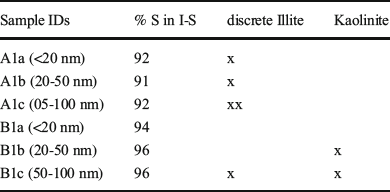
The analytical procedure was already described in detail (Clauer et al., Reference Clauer, Środoń, Aubert, Uysal and Toulkeridis2020). Note that the samples were not ground but rather disaggregated by freezing and thawing. Then, the <2 μm fractions of whole-rock smears were recovered by sedimentation in de-ionized water, and treated with ultra-pure sodium-acetate, sodium dithionite and hydrogen peroxide to remove the soluble minerals, the organic matter and the free cations adsorbed on or hosted by the mineral structures (Jackson, Reference Jackson1975). The <0.2 μm fractions were collected by centrifugation and diluted in large amounts of de-ionized water to ensure a so-called “infinite osmotic swelling” (Środoń et al., Reference Środoń, Elsass, McHardy and Morgan1992). Nanometer-sized separates (<20, 20-50 and 50-100 nm) were, then, obtained by continuous, high-speed ultra-centrifugation of the diluted suspensions, and the composition identified and quantified by X-ray diffraction (Table 1).
XRD data of the <20, 20-50 nm size fractions of the selected bentonite samples

x and xx = traces too small to be amounted
The B and Li analyses were completed on a Cameca IMS 6f secondary ion mass spectrometer (Williams et al., Reference Williams, Clauer, Hervig and Sylvester2012). Each separate was first rinsed in mannitol, and suspended in 5 μL of de-ionized water filtered through Amberlite resin to remove the aqueous B (Hingston, Reference Hingston1964) and Li (Teichert et al., Reference Teichert, Bose and Williams2020) before analysis. As the B and Li isotopic compositions and contents of the separates were expected to be quite close, each aliquot was analyzed three times, or more, with an overall analytical precision of +2σ (Table 1). A standard (IMt-1 illite) was measured systematically between the analyses of the unknowns to detect and correct the instrumental drift. It is probably useful to recall that B and Li cations stored in the interlayers of smectite are not necessarily in equilibrium with the silicate framework (Williams et al., Reference Williams, Turner and Hervig2007), because they can be introduced at any time after equilibration with the original interacting fluid. Therefore, the exchangeable B and Li of the interlayers were removed before analysis by cation exchange with NH4Cl (Zhang et al., Reference Zhang, Chan and Gieskes1998). Also, as many laboratory chemicals contain contaminating trace amounts of Li, trace-pure reagents were systematically used.
During the previous study of the same size fractions, rock chips and powders were also examined by scanning and transmission electron microscopy. The K contents were measured by flame spectrometry with a solid control of the low K contents detailed by Clauer et al. (Reference Clauer, Środoń, Aubert, Uysal and Toulkeridis2020). The sub-fractions of the A1 and B1 samples were also analyzed for their Rb-Sr isotopic systematics after a supplementary gentle 1N HCl leaching that is known to not alter the Rb-Sr and K-Ar systems of clay materials regardless of crystal type and size, or degree of crystallization (Clauer et al., Reference Clauer, Chaudhuri, Kralik and Bonnot-Courtois1993). After tri-acid digestion of the residues and evaporation of the leachates, the Rb and Sr elements were separated by resin chromatography and analyzed by mass-spectrometry.
Results
A brief review of the previous results
The mineral composition of all analyzed size fractions is dominated by a smectite clay-type (Clauer et al., Reference Clauer, Środoń, Aubert, Uysal and Toulkeridis2020). Traces of illite were also identified in the fractions, especially in the two coarser A1 ones, while a trace amount of kaolinite was detected in sample B1, too small to be quantified (Table 1). Overall, the different size fractions of both samples consist mostly of smectite-type I-S also containing 8 to 9% illite layers in the A1 separates, and 4 to 6%, in the B1 ones.
Earlier scanning-electron microscopic observations showed irregular crystal surfaces for the ash shards with imprints of coarse 0.1 mm crystals. These rough surfaces were identified as laminar crystal sheets at the edges of the ash particles with perpendicular micrometer-sized lamellar “booklets”. At high magnification, the 1-μm platy particles appear oriented, suggesting an interaction with flowing pore fluids that could have fueled the crystallization and growth of the new crystals.
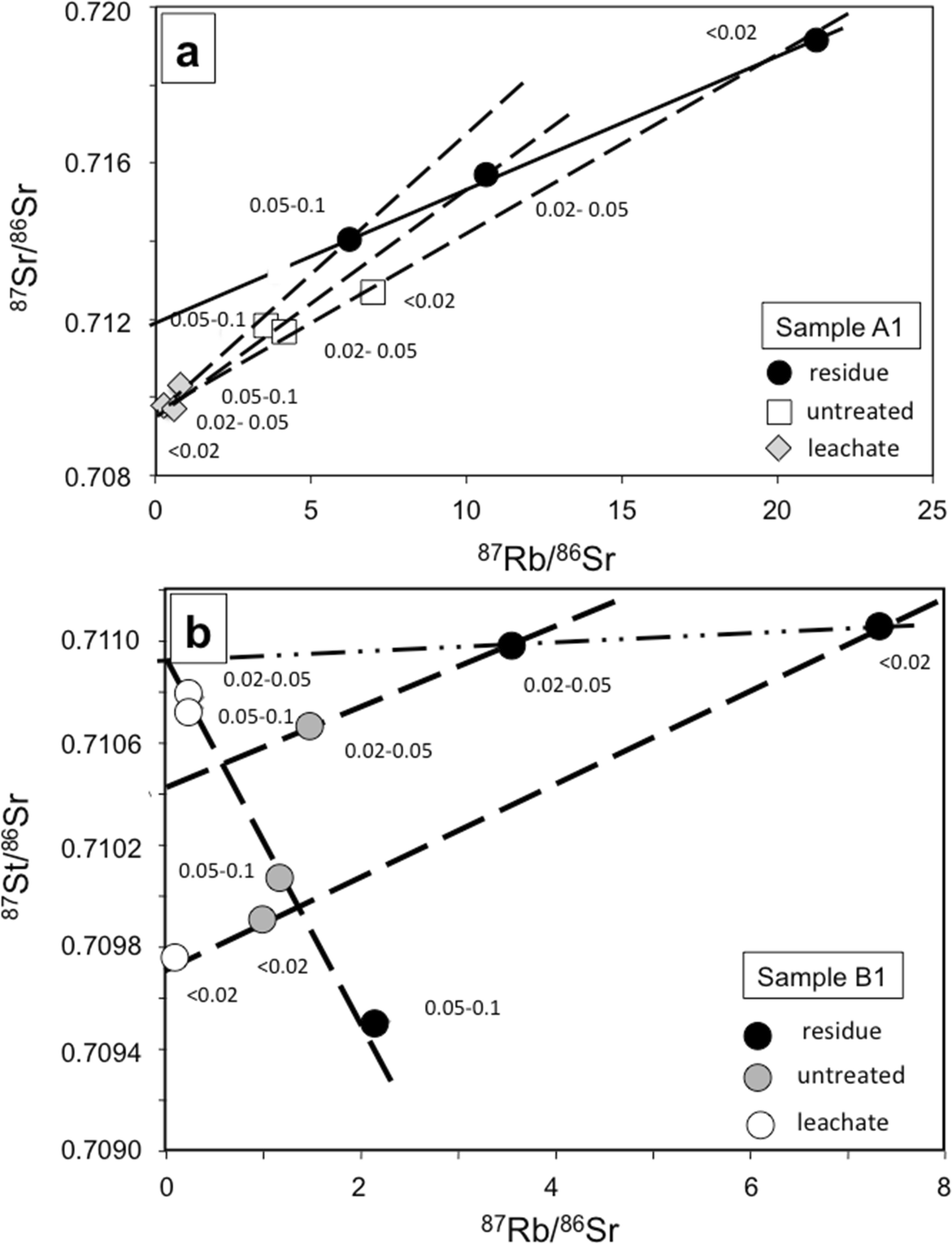
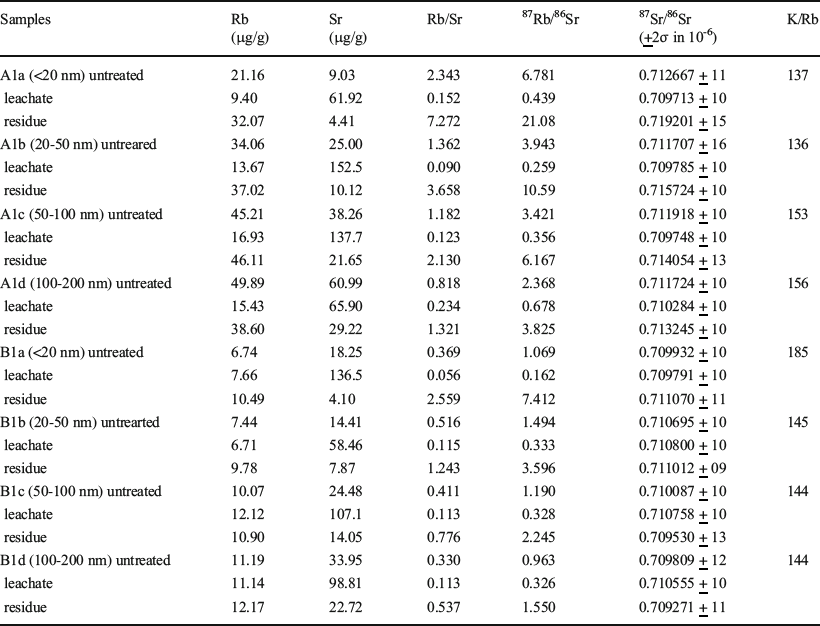
The K-Ar ages confirmed the presence of illite layers in the I-S, some of which being even suspected to have lost radiogenic 40Ar (Clauer et al., Reference Clauer, Środoń, Aubert, Uysal and Toulkeridis2020). After leaching, the Rb-Sr data points of the untreated (U), leachate (L) and residue (R) aliquots of the three A1 fractions fit individual arrays in an isochron pattern (Fig. 2A). The three A1 data points of the residues also plot along a single array with an age date close to 24 Ma for an initial 87Sr/86Sr ratio of ~0.7118. The data points of the B1 fractions give another, more complex pattern with the U-R-L data points of the two finer size fractions fitting two lines with positive slopes, whereas those of the coarsest triplet plot along a line with a negative slope (Fig. 2B). In this case, the 87Sr/86Sr ratio of the leachate is higher than that of the corresponding residue, which is unusual for sedimentary materials (Clauer et al., Reference Clauer, O'Neil, Honnorez and Buatier2011).
(a) Rb-Sr data plot of the untreated, leachate and residue separates of each size fractions of sample A1; (b) Rb-Sr data plot of the untreated, leachate and residue separates of each size fraction of sample B1. These diagrams are from Clauer et al. (Reference Clauer, Środoń, Aubert, Uysal and Toulkeridis2020)

The B and Li contents and isotope compositions
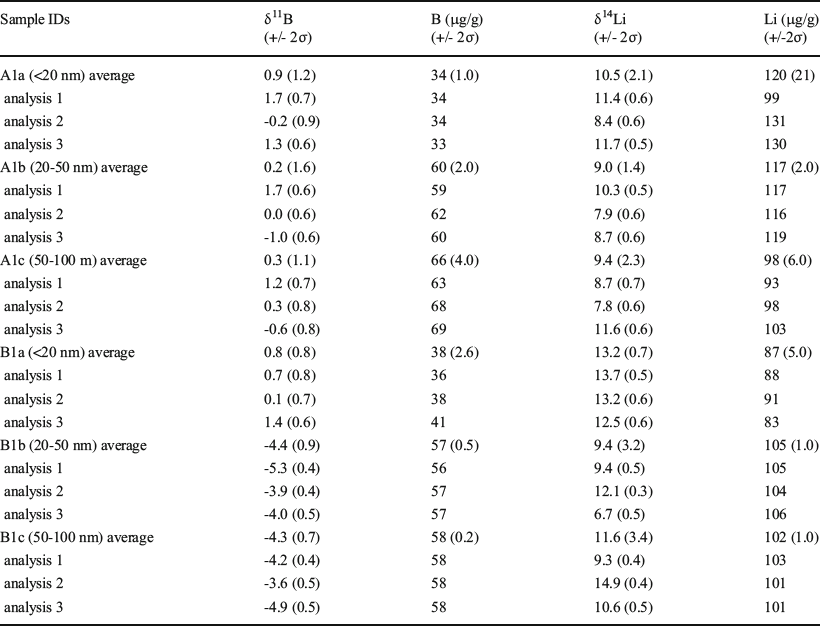
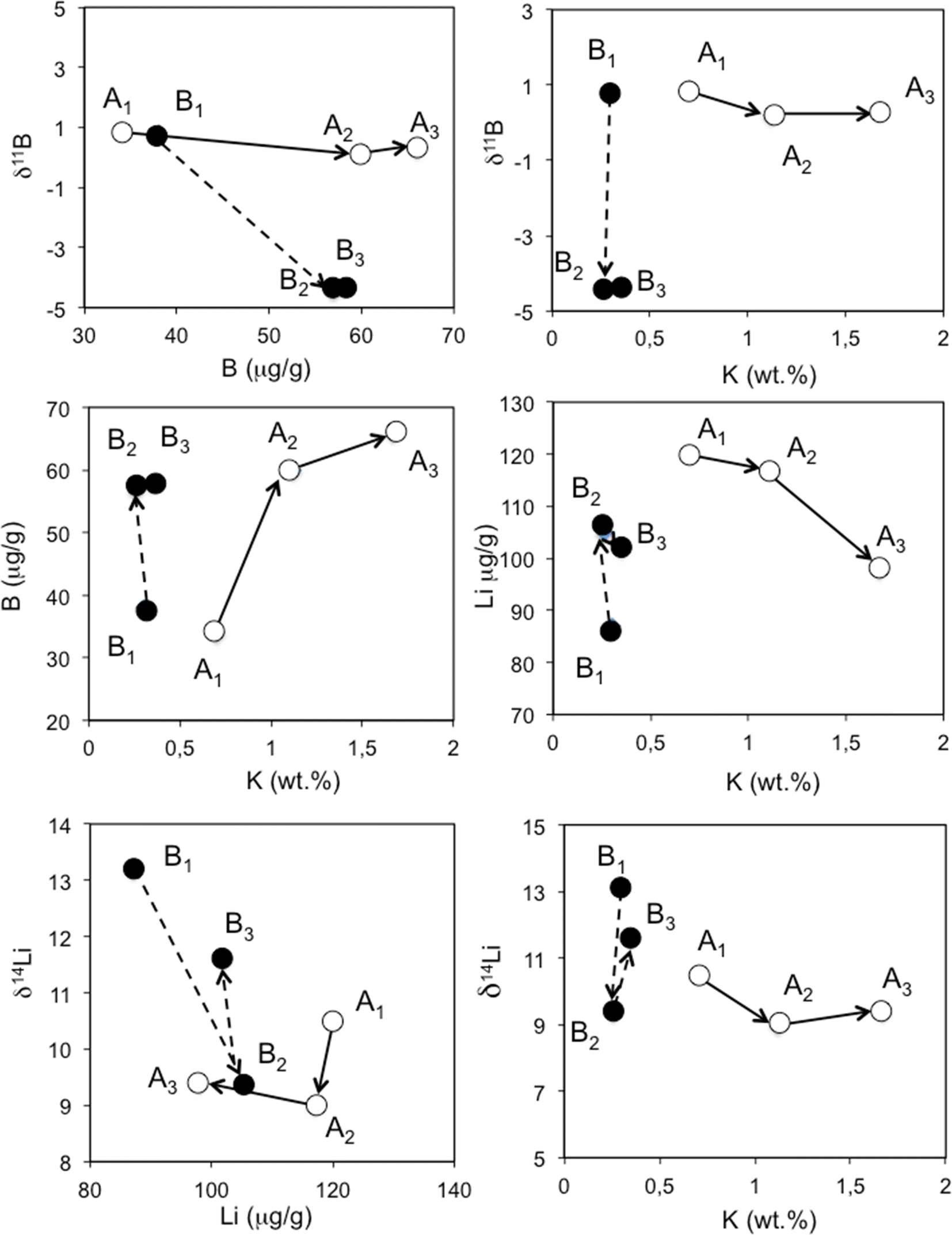
In sample A1, the δ11B remained from 0.9+1.2‰ to 0.3+1.1‰ in the <20 to 50-100 nm aliquots (Table 2), while the B content almost doubled from 34 to 66 μg/g, both being within an analytical uncertainty of <3%. The δ7Li also did not change beyond analytical uncertainty from 10.5+2.1‰ to 9.4+2.3‰ with increasing crystal size, but with decreasing contents from 120 to 98 μg/g (Table 2; Fig. 3). In sample B1, the δ11B went lighter from 0.8+0.8 to -4.3+0.7‰ when the particle size increased, while the contents increased from 38 to 58 μg/g. Its δ7Li remained constant within analytical error at 11.6±3.4‰ with contents increasing from 87 to 104 μg/g in the two coarser size fractions (Table 2; Fig. 3).
δB, δLi and their contents in the <20, 20-50 and 50-100 nm size fractions of the two analyzed bentonite samples

The δ11B and δ14Li values and their contents were compared in the three size fractions (<20, 20-50 and 50-100 nm) of the A1 and B1 bentonite samples. They were also compared to the K contents of the same size fractions

As these two elements do not behave strictly the same during illitization with B substituting Si in the tetrahedral site and Li replacing other cations (e.g., Mg) in the octahedral sites, it is appropriate to compare them with the K contents that represent the determining component of the illite interlayers relative to those of smectite-type in the I-S. The δ11B and B contents of sample A1 are correlated with the K contents and, therefore, are connected. The sketch is different for sample B1, in which K remains quite low and narrow from 0.26 to 0.35%, but which highlights a different behavior for the δ11B of the smallest <20 nm fraction that is significantly heavier than those of the two other separates (Fig. 3). In turn, differences among the δ1B and δ7Li data are obvious in the three fractions of the two samples (Table 2). They need now to be combined into coherent pictures based on the facts that: (1) the coarser A1 fraction contains some illite of probable detrital origin; and (2) the smectite-rich I-S of the coarsest B1 fraction derived from hosting volcanic ash bed, that is to say with no detectable interaction with pore fluids from host sediments.
Discussion
The results, and more precisely the Rb-Sr data already released (Clauer et al., Reference Clauer, Środoń, Aubert, Uysal and Toulkeridis2020; Table 3), raise concerns about the crystal-chemical conditions and, therefore, the processes occurring during smectitization of the bentonite ash. In turn, they suggest two different processes that will tentatively be evaluated below with the B and Li data.
Rb-Sr data of the untreated, leachate, and residue separates from <20, 20-50, 50-100 nm size fractions of the samples A1 and B1. The data are from Clauer et al. (Reference Clauer, Środoń, Aubert, Uysal and Toulkeridis2020)

The thermal history of the bentonite layers
The low content of authigenic illite in the smaller size fractions of the two samples, with an overwhelming smectite content and a parochial amount of kaolinite that can be considered to have no impact on the B and Li signatures, suggests that some K was supplied and fixed when burial temperature increased slightly. The increasing temperature of the bentonite layers apparently reached a maximum value of about 95°C, on the basis of Contreras’ (Reference Contreras2011) data. Relative to present-day burial, this range allows a theoretical gradient close to 37°C/km for the sedimentary sequence, which is within the 24 to 41°C/km regional spread estimated by Cardoso & Hamza (Reference Cardoso and Hamza2014). Therefore, the bentonites were apparently subjected, after deposition, to a moderate diagenetic process powered by a slow and continuous burial.
In summary, the bentonite beds of the Campos Basin underwent a diagenetic event that affected and even dissolved volcanic glass that favored a crystallization of authigenic smectite crystals with a few illite layers that formed either during or after smectite (Clauer et al., Reference Clauer, Środoń, Aubert, Uysal and Toulkeridis2020). At this point, the isotopic ages obtained do not define an evolution of one continuous or of several periodic diagenetic episodes. The smectite-type layers confirm that the temperature was at the lower limit of the ‘illitization window’. Also, the Sr isotopic composition of the leachates systematically higher than that of the seawater during ash deposition and afterwards, excludes an interaction with open seawater, but rather suggests an interaction with evolved pore waters from hosting sediments.
About the contribution of the available Rb-Sr data
On top of a probable mixing of authigenic smectite and detrital illite in, at least, the coarsest A1 fraction, the initial 87Sr/86Sr ratios of the U-R-L triplets at 0.70957+0.00024 (2σ) suggests that the crystals of the separates were in contact with pore fluids characterized by a similar 87Sr/86Sr ratio that were not of seawater origin, which 87Sr/86Sr ratio was of 0.70745+0.00005 (2σ) at deposition time (McArthur et al., Reference McArthur, Howarth and Bailey2001). The fact that the data points of the A1 residues plot also along an array with an homogeneous age of 24.3+1.9 Ma (2σ) for an initial 87Sr/86Sr ratio of 0.71196+0.00033 (2σ) and not a data scatter does not support the earlier evoked mixing of older minerals with newly formed younger and smaller crystals. If that had been the case, the individual isotope data should also be plotting along a hyperbolic trend and not a straight line. This 24-Ma line could, then, be an isochron and the age could be of stratigraphic meaning. In this case, the negative slope of the array of the coarse 50-100 nm U-R-L triplet of sample B1 (Fig. 3) is needed to identify the origin of the illite-type crystals or the illite-consisting I-S layers, and, consequently, the probable interactions with pore fluids of the hosting sediments.
In summary, discrete illitization occurred, either contemporaneously to smectitization or after, due to a limited occurrence of K and Rb supplied by pore fluids from hosting sediments at a temperature also favoring an illite authigenic crystallization. Also, a possible bioturbation effect with the hosting turbidites can also be discarded. In this case, the 87Sr/86Sr ratios of the leachates would correspond to values between 0.7106 and 0.7108, which is again higher than that of a contemporaneous marine supply (Jones and Jenkyns Reference Jones and Jenkyns2001), either during ash deposition or during a further smectite and/or illite crystallizations.
What do the B and Li data add to the concept of smectitization and illitization?
It is certainly appropriate to recall that the interpretations evaluated remain somewhat questionable due to the limited number of samples and size fractions that cannot be increased because of a lack of material and of information about the geographic location and the sampling. On the other hand, B and Li isotopic studies of nanometer-sized smectite-rich separates from various bentonite beds are already available (e.g., Clauer et al., Reference Clauer, Williams, Lemarchand, Florian and Honty2018; Martos-Villa et al., Reference Martos-Villa, Mata, Williams, Nieto, Arroyo Rey and Sainz-Diaz2020; Williams et al., Reference Williams, Środoń, Huff, Clauer and Hervig2013). In the East Slovak Basin, their contents of illite crystals record variations of interacting fluids, while their isotopic ratios are a function of the temperature and fluid isotopic compositions (Clauer et al., Reference Clauer, Honty, Fallick, Šucha and Aubert2014). Also, illite-rich separates of bentonites from the same basin yield low B contents (30-100 μg/g) with a δ11B that decreases from −5 to −17‰ as the B contents increase. In the case of smectite components from bentonites worldwide, the non-exchangeable B concentrations vary widely from 0.2 to 196 μg/g (Köster et al., Reference Köster, Williams, Kudejova and Gilg2019). Most of these smectite crystals also contain small amounts of interstratified illite that requires a varied fluid-mineral B partition. In turn, the δ11B values of the structural B from tetrahedral smectite sites range from −30.1‰ to +12.2‰.
The smectite-rich A1 fractions, for which the K content is very low and narrowly spread, contain illite layers that might be of two origins: mainly diagenetically authigenic in the finer fraction, or detrital of either sedimentary or volcanogenic origin in the coarser fraction. Here, these fractions show no trend in their δ11B values with an average of 0.63±1.0‰ for three analyses of each fraction (n=9). In contrast, there is an increase in the B-content relative to grain size, from 34 μg/g in the finest to 66 μg/g (n=3) in the coarsest fraction. This increase with constant δ11B suggests that the chemical composition of the fluids did not change markedly while contributing to the crystal growth. However, as more B was incorporated the volume of the illite had to increase, which needed also additional K. The selection of the two A1 and B1 samples was two-fold, one resulting supposedly from a different crystallization processes than the second with different δ11B and B trends. The obtained various results suggest that either: (1) temperature increased (assuming the same pore-fluid composition), which decreased the B isotope fractionation (Δmin-water); or (2) a fluid carrying a lighter δ11B equilibrated with the coarser I-S fractions, assuming a constant temperature. As the two samples were collected quite close to each other, the second hypothesis seems more appropriate, being applicable to both samples.
The δ7Li of the three A1 fractions averages +9.6±1.6‰ (n=9) with a content of 112±15 μg/g. Both values are statistically within analytical uncertainty, suggesting again that the illite layers of the smectite-rich size separates formed in equilibrium with a chemically stable fluid, the initial crystals forming with a minimal change in the burial temperature. Similarly, the δ7 Li of the three B1 size fractions yields no significant trends with crystal growth at an average of +11.4±2.6 ‰ (n=9) and a content of 98±8 μg/g, both again within analytical uncertainty. This reasoning begs the question of how one can obtain a change in B without a concomitant change in Li if the minerals precipitated from the same source fluid. One possibility is that there was a mixing with a fluid enriched in B, but not in Li, which may account for the increased B content in the coarser B1 samples, together with a progressively lighter composition for δ11B (-4‰). Once more, the isotopically light samples might still include the detrital illite from outside the bentonite, e.g. from host sediments.
How to integrate the B and Li isotopic trends and the Rb-Sr data
One issue still needs to be addressed, namely the overwhelming occurrence of smectite-rich I-S in the bentonite layers mostly resulting from initial alteration of the volcanic ash, together with low contents of illite layers, while it is not clear yet if the K that generated the illite layers occurred while the smectite interlayers were forming, or later when the temperature was more adequate for a crystallization of illite layers. There is yet no undisputable argument by the K-Ar and Rb-Sr isotopic dating methods as they apply solely to minerals or crystal interlayers having fixed K and Rb its sister element. The only age references are from illite layers, even if they represent less than 10% of the overall smectite-rich particles. One aspect of the process is that the very low content of radiogenic 40Ar, and even its lack in some of the smallest nanometer-sized separates, suggests that illitization could have occurred delayed relative to smectitization, lasting even until present-day.
The δ11B remains almost constant in the A1 fractions relative to a continuously increasing K content with size, strongly suggesting that the illite content in the smectite-type interlayers is related to crystal size. This constant δ11B relative to an increasing K content indicates that the fluids had to remain identical in composition and at an almost constant temperature during illite growth; the K increase following the overall crystal growth. The δ7Li yields a different trend with relatively similar data for the two coarser fractions, which is confirmed by the same δ7Li values relative to the K content. Therefore, if the illite crystals of the coarsest A1 fraction had different δ11B and δ7Li than those of the two finer fractions, one cannot exclude that identified as possibly detrital, they are of sedimentary origin with earlier crystallization conditions that could have been similar to those of the later fine illite crystals. In turn, they should then be considered as early authigenic precipitates of volcanic origin, rather than detrital contaminants from hosting turbidites.
The Rb-Sr data suggest also a different origin for the coarsest B1 fraction, mostly volcanic on the basis of the specific spread of the U-R-L data points in an isochron diagram. This hypothesis is supported by the lower 87Sr/86Sr ratio of the coarsest residue than that of its corresponding leachate. In addition, the δ11B and B contents of that coarser fraction are closer to those of the intermediate size fraction than to those of the finest fraction. They are also close to those of sample A1, which crystals probably interacted with pore fluids of sedimentary origin. The K contents varying only very slightly among the three B1 fractions, the δ11B and B contents may then depend on the size and nature of the crystals. In this context, the δ7Li values that are quite distinct from each other, may relate to the overwhelming occurrence of smectite, as are the δ7Li values relative to the K contents.
The Rb-Sr data of the U-R-L aliquots from the two finer B1 fractions plot along sub-parallel lines with initial 87Sr/86Sr ratios of about 0.70972 for the finer fraction to about 0.71045 for the intermediate fraction, while the data of the coarser size fraction fit a three-point line ending at an even higher initial of 0.71095 (Fig. 2). It looks like the overwhelming smectite interacted with fluids characterized by an 87Sr/86Sr ratio apparently representative of a volcanic Sr isotopic value characteristic of an acidic origin. Interestingly, the line joining the data points of the smallest and intermediate residues in an isochron diagram also yields an initial 87Sr/86Sr value of about 0.71095 (Fig. 2). It is, therefore, plausible that during crystallization of the finer smectite crystals within the volcanic ash, the amount of the interacting pore fluids increased progressively with a stable 87Sr/86Sr signature. Such an evolution explains the distribution of the δ11B with the data of the intermediate and coarse B1 fractions closer to each other than to that of the finer crystals. This differential interaction seems not to have affected the δ7Li with fairly grouped Li contents representative of continuously growing smectite, which suggests a volcanic contribution in the coarser residue and no change in the impact of the pore fluids on the smaller crystals.
In summary, the δ11B and δ7Li values, together with the corresponding B and Li contents of the A1 and B1 size fractions, are varied despite a close location that point to different origins and/or different crystallization conditions. The constant δ11B for the increasing crystal size in sample A1 suggests a stable composition for the interacting pore fluids from sedimentary host rocks, at a likely stable low burial temperature. The case of sample B1 with a different δ11B for the two coarser fractions supports the hypothesis of interacting fluids with a constant δ11B value for the finer crystals, not for the coarser, which maintained the imprint of the volcanic precursors. For Li, the finest and the coarsest B1 fractions yield heavier δ7Li values than the three separates of sample A1 with only a lower Li content for the finest fraction. As an interaction with seawater can be discarded, the decrease in δ7Li could reflect an influx of hydrocarbon-polluted fluids (Williams et al., Reference Williams, Środoń, Huff, Clauer and Hervig2013; Clauer et al., Reference Clauer, Williams and Fallick2022), in an oil-producing region, as is the case here. Indeed, the δ7Li decrease does not coincide with a constant low K content and, therefore, does not seem to be part of the illitization trend. It rather reflects changing origins for the constitutive crystals that necessarily involve changing pore fluids. The zigzaging variation in the δ7Li of the three B1 fractions with the lower value for the intermediate fraction is probably due to the dominant volcanic original reference in the coarser fraction combined with a variable impact of external pore fluids during further crystallization of the fine crystals.
Conclusions
Santonian (85.8-83.5 Ma) nanometer-sized (<20, 20-50 and 50-100 nm) bentonite separates buried presently to approximately 2,800 m in the Campos Basin located offshore the Rio de Janeiro State (Brazil), were studied here for their δ11B and δ7Li compositions, and B and Li contents. In contrast to previous similar mineralogical, chemical, and isotopic studies of nanometer-sized illite-rich mixed layers or pure illite crystals of such kind of bentonite layers, the aim here was to decrypt how illite crystals initiate, either during or after alteration of the initial volcanic ash into smectite, at a burial temperature below 95°C and interacting probably with pore fluids from hosting turbidites.
The smectite-rich mixed layers of sample B1 contain remnants of initial volcanic ash, while illitization remained limited mainly due to a limited supply of alkali elements and partly to the low burial temperature. The δ11B, δ7Li, and B and Li contents of the three size fractions from the two studied samples are quite varied. In the case of sample A1 hosting some illite of plausible early volcanic origin in the coarser fraction, the δ11B is constant relative to the size fractions, while its δ7Li is widely spread, as are the contents of both B and Li. Progressive interactions with pore fluids from hosting turbidites could also be detected, while the crystals grew. Conversely, the repartitions in the coarser size separate of the second B1 sample are different than in the two finer fractions that yield similar B and Li contents suggesting extensive interactions with sedimentary pore fluids, while the coarsest fraction retained some of its initial volcanic signature.
Acknowledgements
We would like to thank Drs. D.B. Alves and F. Pellon de Miranda of the Brazilian Research Development Center (CENPES) for the sample supply, as well as the geographic, stratigraphic information and constructive discussions. The SIMS analyses for B and Li isotopic compositions were conducted at the Arizona State University SIMS Facility supported by the US National Science Foundation grant EAR 1819550. Two reviewers are also sincerely thanked for their comments.
Authors’ contributions
Conceived by Norbert Clauer, performed and written by all authors
Funding
US National Science Foundation grant EAR 1819550.
Availability of data and material
EarthChem Repository; ASU Repository
Code availability
Not applicable
Declarations
Ethics approval
Not required
Consent to participate
Not applicable
Consent for publication
Approved by all authors
Conflict of interest
On behalf of all authors, the corresponding author states that there is no conflict of interest.
Availability of data and material
As above
Funding
As above