


Considering the French cardinals as a community requires a brief discussion of their status. As members of the Sacred College, they were sworn to obedience to the pope and, on account of the wording of the consistorial pronouncement at their proclamation – estote fratres mei et principes mundi – like the pope, they exerted both spiritual and temporal power.Footnote 1 At the same time, as subjects of the king of France and members of the high nobility, cardinals were bound by oath of loyalty to the king, who made them members of the royal council and often appointed them to the country's highest political offices, such as chancellor, Surintendent des finances or Lieutenant general. As a result, French cardinals were at the intersection between two different groups, headed by the pope and by the king of France respectively. This double identity has important consequences when considering the position of French cardinals in Rome.Footnote 2 As members of the Sacred College, they were part of the religious, cultural and political elite, and were active participants in the affairs of the papal court, while as emissaries of the French crown in Rome, they had to take care of their country's political interests and convey the image of magnificence and power of the king of France. Furthermore, although the cultivation of relations with the stable community of French residents in Rome was not a primary objective of their Roman diplomatic sojourns, the cardinals also had to consider this as they fashioned their image within the Eternal City.
In this article French cardinals will be shown as members of multiple communities within which they continually had to negotiate their identity. Such a strategy was pursued by a variety of means, including artistic patronage, the choice of the location of their residences and the promotion of ephemeral events. It will be shown that the presence of French cardinals in Rome from the last decades of the fifteenth century appears to have changed its forms and visible expression during the following century. A process can be detected that moved away from initial investments in large-scale French public projects, such as the ‘national’ churches of San Luigi and Trinità dei Monti, to more individualized commissions in line with the choices of the Roman secular and curial elites. By the 1540s, rather than merging with the vast community of French people living in Rome in the vicinity of San Luigi, some French cardinals seem clearly to have preferred to turn their backs on their compatriots the better to cultivate the Roman and curial elites.Footnote 3
Holding important offices in their country, most French cardinals only came to reside in Rome during the conclaves, and many missed even these important political occasions.Footnote 4 Throughout the period considered in this article, only a few cardinals who served as French representatives to the Holy See – Jean de Bilhères Lagraulas, Guillaume Briçonnet, Jean du Bellay and Georges d'Armagnac – had occasion to stay in Rome for prolonged periods. Excepting the conclaves, the main reason for the French cardinals to be in Rome was to support the regular ambassadors in their management of relations between the pope and their sovereign by taking advantage of the system of favours prevalent at the papal court. While the French cardinals always remained in contact with the centres of the French community in Rome (the churches of San Luigi and Santa Trinità dei Monti), their task was above all to represent the king of France and maintain the alliance with the papacy in good order, especially on those occasions that were outside the situations where the regular ambassadors managed diplomatic contacts. For this reason it was appropriate for the resident French cardinals to be well integrated into the network of the curia as well as the elite Roman and Italian families resident in Rome, and cultural and artistic patronage was one of the means they employed to this end.Footnote 5
Locating the French community in Rome and the engagement of cardinals between the fifteenth and sixteenth century
The French cardinals who resided in Rome during the fifteenth century were more concerned with their connections with the French community present in the city and in defining their identity in relation to their nationality than was later to be the case. Thus, for example, Guillaume d'Estouteville had built the church of Sant'Agostino, near piazza Navona where much of the French community clustered, and contributed to the restoration of the ancient basilica of Santa Maria Maggiore as well as of the French national hospital annex of the ancient church of San Luigi.Footnote 6 He may also have financed works at San Luigi, traditionally the church of the French nation and dedicated to King Louis IX (canonized in 1297), which was located near to his church of Sant'Agostino and adjacent to the French hospital.Footnote 7 Since Sant'Agostino and San Luigi were very close to each other, it is indeed possible that Estouteville had tried to create an area around which the French community was intended to live, although it is not possible to circumscribe a residential area of the French to one area of Rome alone at this time.Footnote 8 As a loyal servant of the king, such patronage choices might nevertheless be understood as an expression of the magnificence and munificence of the French monarchy.
By the end of the fifteenth century, the French cardinals’ patronage appears to have become even more closely associated with the promotion of national and monarchical images. The places chosen for the most important works they commissioned coincided with the locations of the French religious communities in Rome, including the chapel of the French kings in St Peter's, and the churches of San Luigi, which was to become the national church of France, and of Trinità dei Monti, founded by Charles VIII.Footnote 9
On 27 August 1498, for instance, Cardinal Jean de Bilhères Lagraulas, who had arrived in Rome in November 1491 as ambassador to Charles VIII, asked the young Michelangelo to sculpt the magnificent Pietà for his own tomb in the chapel of Santa Petronilla, which was located on the left side of the Constantinian basilica of St Peter's, and was also known as ‘the chapel of French kings’.Footnote 10 The Roman merchant, banker and collector, Jacopo Galli, who had put Lagraulas in contact with Michelangelo, asserted in the contract for the work dated 1498 that the Pietà would be ‘the most beautiful work in marble that is nowadays in Rome’.Footnote 11 As is by now well established in the scholarship, the choice of northern iconography for the grieving Virgin reflected attempts to strengthen the political and cultural image of France in the delicate contemporary political situation.Footnote 12
Following the demolition of the old St Peter's, the attention of potential patrons shifted increasingly to other French foundations and in particular to San Luigi and Trinità dei Monti, above the piazza di Spagna. Interest in the latter began in March 1494 when, by order of Charles VIII who was preparing the French expedition to Naples, Lagraulas bought a site for the new church on the Pincio hill. The king and his wife, Anne of Brittany, who had already founded two convents of friars Minim of Francis of Paola in France, at Plessis and in Paris, were eager to found another convent in Rome.Footnote 13 Following Charles VIII's visit to Rome at the end of 1494, and the official foundation of the convent, it was again Lagraulas who laid the first stone of the building, and offered a large sum of money (1,500 scudi and subsequently an additional 760 ducats) for its construction.Footnote 14 But the cardinal was also interested in the old and small church of San Luigi: even though he did not contribute to the construction of the new Renaissance building (which was begun after his death), he donated many liturgical objects to the chapter and founded a chapel where mass was to be celebrated for the salvation of his soul.Footnote 15
This combined interest in the two churches characterized the patronage of French cardinals into the early sixteenth century. During his permanent stay in Rome, for instance, which started in 1506, Cardinal Guillaume Briçonnet offered large sums – about 3,700 scudi – for the construction of the church of Trinità dei Monti and, remarkably, had the stone for the nave and transept vaults shipped directly from the Languedoc.Footnote 16 It is thought that he also asked the French painter Guillaume Marcillat to paint the stained glass windows there, one of which included the cardinal's portrait.Footnote 17
In the same period, together with Cardinals Jean François de la Tremoille and Robert Guibé, Briçonnet was engaged in obtaining a papal bull to allow the demolition of the ancient church of Saint-Benoît ‘for the enlargement of their church of San Luigi’.Footnote 18 The presence of the stone carver Jean de Chenevières on the building site of San Luigi, the gothic form of the nave and the apse of Trinità dei Monti, and the use there of French stone as well as the presence of a French painter, all reveal patrons’ determination to impose a French manner in Rome at the very time that the French kings were engaged in wars to conquer the Kingdom of Naples and the Duchy of Milan.
During the first half of the sixteenth century, the French cardinals’ relationships with their national community based near San Luigi seem to have gradually loosened and their interests concentrated increasingly on Trinità dei Monti. Not only were they patrons of the latter's renovation, but those among them who died in Rome stipulated that they should be buried in the church on the Pincio: Jean Le Veneur (+1543), Philippe de la Chambre (+1550) and Jean du Bellay (+1560).Footnote 19 Trinità dei Monti was probably considered a more magnificent and dignified site, dominating the city, and away from the artisans’ quarters at the foot of the hill, and throughout the sixteenth century the church continued to attract the patronage of French cardinals, prelates and ambassadors in Rome.Footnote 20
Jean du Bellay and the politics of his Roman residences
However, as was suggested at the outset, cardinals’ attention was by no means restricted exclusively to the patronage of the two churches most closely associated with the French nation, and especially from around 1530, they lavished greater attention on their residence in the city. The interesting case of Cardinal Jean du Bellay, who worked for a long period of his cardinalate as an informal ambassador for Francis I, illustrates the lengths to which cardinals would go to find a suitable residence, and how little they appear to have cared about selecting one in the vicinity of their co-nationals.Footnote 21 Like other French cardinals of the time, including Robert de Lenoncourt,Footnote 22 François de TournonFootnote 23 and Georges d'Armagnac,Footnote 24 du Bellay sought a central location for his residence (Figure 1), where he could easily meet with other cardinals and with the main political actors who had influence over the members of the Sacro Collegio. For these cardinals it seems to have been far from easy to locate themselves near the French community's churches, nor indeed do they appear to have acted in concert with one another in order to characterize any specific part of the city as ‘the French cardinals’ quarter’ (Figure 2). Jean du Bellay was unable to establish his residence close to his national community in Rome; furthermore, as his household accounts clearly show, the few French servants he had in his service had come to Rome with him from France, while most of his other servants and suppliers were Italian.Footnote 25
The Roman residences of Jean du Bellay 1: Tor di Nona (a guest of Rodolfo Pio) 2: palazzo Santi Apostoli (titular Cardinal's palace) 3: palace in Campo Marzio 4: palazzo Farnese (a guest of the Farnese family) 5: palazzo della Rovere in Borgo (rented) 6: Horti Bellayani.

Sites of the French community in Rome and residence of the French cardinals (1495–1560) A: chapel of Santa Petronilla B: Trinità dei Monti C: San Luigi dei Francesi 1–6: Jean du Bellay (see Figure 1) 7: Robert de Lenoncourt (palazzo Sant'Apollinare) 8: François de Tournon (palazzo Madama) 9: Jean de Bilhères and François de Tournon (palazzo Fieschi-Sora) 10: Georges d'Armagnac (Monte Giordano) 11: Georges d'Armagnac (Arco di Portogallo) 12: Georges d'Armagnac (villa Turini-Lante).

On his first visits to Rome, Jean du Bellay had taken up residence with, in turn, the royal ambassador, Cardinal Rodolfo Pio da Carpi and the Farnese family.Footnote 26 When in 1549 he arrived with a retinue of 80 people, he had to look for a new residence.Footnote 27 By good luck, the palace of Santi Apostoli was available and he settled in the heart of Rome, near the Forum, where he sponsored some important excavations.Footnote 28 Shortly thereafter, however, he preferred to move to a palace in the rione Campo Marzio, where he was closer to some of his friends – Rodolfo Pio and other powerful cardinals.Footnote 29 Finally, in 1554, Caterina de’ Medici helped du Bellay to secure the rental of the important palace of Domenico della Rovere in the rione Borgo, near St Peter's, presumably because its location and grandeur were deemed appropriate to his standing as cardinal-bishop of Porto and dean of the Sacred College, Jean du Bellay's last ecclesiastical titles.Footnote 30 This sequence suggests a policy of seeking out the most prominent palace when it became available with little or no interest in maintaining close ties with the permanent French community in the city, which, as we have seen above, clustered in part in the vicinity of the church of San Luigi, near the piazza Navona.
Villas: the Horti Bellayani and its collection of antiquities
Another major strategy for merging with the varied and cosmopolitan community of wealthy and sophisticated cardinals in Rome was the ownership of a suburban villa. This also allowed the cardinals to distinguish themselves clearly from and within the French community. These villas were venues where it was possible to entertain guests informally and display collections of antiquities, which were then so much in vogue, and organize grand ephemeral festivals and celebrations.
In 1548, for instance, Georges d'Armagnac, probably thanks to the mediation of Catherine de’ Medici, rented the villa Turini (now known as villa Lante), built by Giulio Romano on the Gianiculum hill, on a site above the west bank of the Tiber that afforded splendid views over the city.Footnote 31 There, the cardinal would invite Roman scholars and humanists to meet with the poets, artists and intellectuals who lived in his household, including the architect and commentator of Vitruvius, Guillaume Philandrier, the Latin and Greek philologists Pierre Gilles, Guillaume le Blanc and Giovanni Giustiniano of Candia, the author Matteo Bandello and Santi Marmochino, who had translated the bible from Hebrew into Italian.
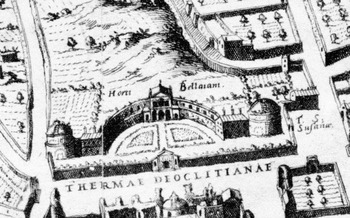
Even more than d'Armagnac, du Bellay distinguished himself for his magnificence, for his grand expenditure on building and decorating his suburban residences and for the festivals he promoted. In 1554, he had built the Horti Bellayani over the ruins of the Baths of Diocletian, exploiting the huge south exedra of the external perimeter wall to display his rich collection of ancient sculptures on two levels. The villa itself anticipated Palladian models, with its central building distributed on two levels, opening on to a series of loggias, crowned with a tympanum, and flanked by symmetrically ordered wings leading to two massive symmetrical circular towers (Figure 3). By building this impressive villa, du Bellay joined a group of cardinals who had their suburban vigne between the Quirinal and the Baths, including Rodolfo Pio, Bonifacio Ferreri, Marino Grimani and Ippolito d'Este, who had settled in a villa built for Cardinal Carafa at the beginning of the sixteenth century.Footnote 32 All these cardinals shared a profound passion for antiquity, promoted excavations and were great collectors of ancient statues.Footnote 33 The inscription on the main portal of the Horti Bellayani declared that the gardens were consecrated to the otium of du Bellay and his friends.Footnote 34
Horti Bellayani, detail from Etienne Dupérac, Pianta di Roma (1577).
The circle of humanists in which he moved was probably larger and more varied than that of Armagnac, with his physician Rabelais and his cousin Joachin du Bellay representing the two most important French literary currents of the moment.Footnote 35 The architect Philibert Delorme received the support of the cardinal during his stay in Rome, during which time he studied ancient ruins and antique works of art. Following the suggestions of Paolo Cortesi's De cardinalatu, du Bellay tried to mark his presence in town as a veritable Maecenas and let numerous artists live at his place.Footnote 36 The painter Antoine Dippre d'Avignon, sculptors such as Jacobus d'Ayla, Claude Lusinier and Jacques d'Erbe, stone carvers Ioannes Maria and Ioannes de Salenis as well as a mason called Bartholomeo de Marco all lived in the cardinal's palace in the Borgo, near St Peter's, or in his villa on the Quirinal, and throughout the 1550s worked almost exclusively for him.Footnote 37 Control over such a large retinue – a true sub-community/microcosm – allowed du Bellay to comply with the requirements of his status and to compete with Italian cardinals, especially with the wealthiest ones, such as Ippolito d'Este, displaying his right to membership of their exclusive community.
Works of art were another means to signal one's appropriation of the taste and interests of the elite. Jean du Bellay loved all ancient artefacts, but was especially fond of sculpture, ‘a subject which I am happy to deal with because I own many’.Footnote 38 By means of his cultural gatherings and his excavation campaigns, he was able to maintain relations with a specific section of the city's network that included cardinals, aristocrats, ambassadors, antiquity dealers, artists and every sort of intermediary. Other French cardinals were also interested in archaeological finds, especially in order to be able to offer exceptional gifts to their king or to the most powerful patrons in France, such as Anne de Montmorency.Footnote 39 The multiple activities of du Bellay as a collector of antiquities have therefore to be read as a means of marking his presence in Rome as a member of the cultivated and hedonistic community of cardinals and aristocrat lovers of ancient art. His collection, put on show in the porticoes and gardens of the Horti Bellayani, was one of the most important in Rome.Footnote 40
Striking a balance between being a personage of unique distinction and belonging to a community of elite collectors was one of du Bellay's principal aims and he dissipated a fortune in sponsoring excavation campaigns, as is related by the architect and antiquarian Pirro Ligorio.Footnote 41 For this reason, he incurred his first debts with Florentine bankers in 1534, during his first stay in Rome and throughout his entire life he continued to search for antiquities and spend money on promoting excavations or buying rare works of art.Footnote 42 In spite of his growing debts, in 1556 he decided to buy a large sculpture collection from the dealer Pietro Stampa: 134 pieces at the price of 1,000 golden scudi, which he was ultimately never able to pay for. Vincenzo Stampa, Pietro's son and heir, was still appearing among the cardinal's creditors several years after the latter's death.Footnote 43
The Sciomachia (mock battle) of 1549 and the ambiguous position of Jean du Bellay
Like many others who enjoyed a long period of prosperity during the reign of Francis I, du Bellay found himself somewhat marginalized with the accession of Henry II, in 1547. His relations with the French cardinals and aristocrats gravitating around the Guise family were very difficult and he was deeply anxious that he would lose the king's favour. Nevertheless, owing to the important relationships established in Rome during his earlier sojourns, and capitalizing on the esteem that he was held in by Pope Paul III Farnese and his family, Jean du Bellay set out to co-operate with, and when possible to outdo, the French ambassador in Rome in the task of representing Henry II and the French royal court in Rome.Footnote 44
The birth of Louis de France, Henry II and Catherine's second son, on 3 February 1549 in the castle of Saint-Germain-en-Laye, became the occasion for du Bellay to compete with his enemies in order to show his power and his social connections in Rome. Since Paul III was terminally ill, Cardinals Armagnac, Antoine Sanguin and Lenoncourt were already in town, waiting for the conclave: the latter was the favoured agent of the Guise family, particularly of Jean de Lorraine, Henry II's preferred candidate for the pontificate. Lenoncourt was so much under the power of the cardinal of Lorraine that Charles V called him ‘the cardinal of Lorraine's cardinal’.Footnote 45
Since no royal messenger was sent to Rome officially to announce the news of the royal birth, French cardinals and aristocrats, prelates and members of the most important Italian families were deeply embarrassed, because everyone wanted to make a public demonstration of thanksgiving, but none dared do anything before news of the birth was confirmed. The stalemate was cleverly used by du Bellay to organize his own celebrations, with the help of Orazio Farnese and Roberto Strozzi.Footnote 46
When, at last, the birth was confirmed, Claude d'Urfé opened the Roman celebrations, followed by the French cardinals, who offered banquets, comedies and other entertainments. Du Bellay reserved for himself the last event for the amusement of all Romans and ordered François Rabelais to give a comprehensive report of the celebrations ‘in the court of Rome’, which he did in a letter addressed to Charles de Guise.Footnote 47 A naumachia to be performed near the Sant'Angelo bridge was to open the games. Captain Guillaume du Bellay, one of the cardinal's brothers, had died on the bridge defending Rome in 1527. By locating the event in this setting, du Bellay intended to insert his own family history into the collective memory of the Roman people, thus upstaging his French colleagues. A flood of the Tiber, however, obliged the cardinal to limit his programme to a sciomachia (a mock battle) staged in front of his residence, on piazza Santi Apostoli, where an elaborate set including a temporary wooden fortress was constructed. Many young Roman and Italian aristocrats, headed by Orazio Farnese and Roberto Strozzi, participated in the mock-battle which took place there.Footnote 48 During the preceding days, the fighters had trained together and rehearsed the show in the interior circuit of the Baths of Diocletian, where du Bellay was in the process of building his villa. Court jesters, musical interludes, bull fights and theatrical entertainments gave rhythm to the different phases of the celebrations and made it possible to multiply the references and the homage to the king and his family (including the royal mistress), but also to Paul III and his court.
After the battle, everybody – aristocrats and people – repaired to the palace, where a splendid banquet had been laid on. At the main table sat du Bellay, surrounded by his compatriots Lenoncourt, Sanguin and Armagnac, by Alessandro and Ranuccio Farnese, nephews of the pope, and by Cardinals Guido Ascanio Sforza, Niccolò Caetani, Rodolfo Pio, Francesco Pisani, Andrea Cornaro and Niccolò Gaddi.Footnote 49 A comedy was performed and, to conclude, a masked ball took place until dawn, when the exhausted guests left the palace. In his account to Charles de Guise, Rabelais reported that the Roman people were extremely pleased by the performances and cried ‘Vive France, Vive Orleans, Vive Horace Farnese’ and, most of all, ‘Vive Paris, Vive Bellay, Vive la coste de Langey’, glorifying the cardinal and his family.Footnote 50 To conclude the celebrations in an appropriate manner, during the following two days fireworks displays were held in the piazza Santi Apostoli.
By means of these public events, du Bellay planned to celebrate the royal family, but intended also to display his own power and taste. Rabelais's account, produced within du Bellay's immediate circle and circulated at the royal court, served to promote precisely these interests. At a moment in which du Bellay's political position with respect to the French court was difficult, and in which the cardinal was deciding whether to move definitively to Rome, the message of self-promotion was directed at both the Roman community and the other French cardinals. Following the new fashion for public events inaugurated in 1534 by Pope Paul III Farnese, and given the cardinal's own priorities, it is no accident that the celebrations interacted more with the pope's family and with the Roman community of cardinals than it did with the French community.Footnote 51
Conclusions
Belonging to the noblest French families, French cardinals were well-cultivated and accustomed to wealth and beauty, and eagerly immersed themselves in the hedonistic atmosphere of Rome, ready to assume
as Joachim du Bellay put it in verse.Footnote 52 They had to negotiate their identity among the multiple communities they belonged to: that of the representatives of the French crown in Rome and that of their highly cultivated cardinal peers.
By focusing on a devotional representation of the monarchy, the patronage of French cardinals contributed to the construction of the French king as defender of Christianity (Cristianissimo was the king's attribute). At the same time, when it was possible, they tried to strengthen the weight of the French political faction in Rome by locating their patronage in places connected with their national community. The different relationships established with San Luigi and Trinità dei Monti, however, show that promoting the royal image and supporting national religious institutions did not necessarily also mean interacting with the French community in Rome. It seems that cardinals used two levels of strategies to mark their own presence in the city. The first aimed at reassuring the crown that they were loyal to the king and would protect the interests of French institutions. The second was meant to win over the Roman elite: the pope, his family, Italian cardinals, scholars and artists. The first strategy showed that they were above all French, the second that they were members of the Sacred College and that they shared with the other cardinals’ aims, passions and taste.
This split identity is particularly evident in the case of du Bellay, who clearly decided to be part of the Roman community of cardinals, choosing to locate his villa near those of his colleagues, to consecrate his life to archaeological excavations, and to organize the great Sciomachia in 1549. By offering three days of celebrations to the whole city (as Rabelais specifies: ‘Le peuple assistant, grans & menuz, nobles & roturiers, reguliers & seculiers, hommes & femmes’) du Bellay eclipsed every other French cardinal in displaying his glory. Using piazza Santi Apostoli, a public space identified with his residence, he marked his presence in the city, giving several messages: he embodied the magnificence of the French monarchy in the eyes of Roman people and he showed off his close relations with the Roman elite in front of his fellow French cardinals.



