Introduction
Nationalism has obscured the past of biomedical knowledge production about malaria and its control in Vietnam. Take for example a history of the medical accomplishments of the Democratic Republic of Vietnam (DRV), published in 1976 by the Institute of Malariology, Parasitology, and Entomology (Viện sốt rét-ký sinh trùng-côn trùng, VSR-KST-CT). This history recounts how the malaria prevention projects of the Institute, led by Đặng Văn Ngữ (1910–67) and Phạm Ngọc Thạch (1909–68), played a key role in the DRV's ability to wage war against the United States and the Republic of Vietnam (RVN). This publication also announced the Institute's intention to eliminate malaria throughout the newly established Socialist Republic of Vietnam (SRV).Footnote 1 While this history rightly celebrates the gains made against malaria between 1958 and 1975, it masks the importance of previous biomedical knowledge generated about malaria during the colonial period. For example, this volume's bibliography does not cite any French publications on malaria that formed the basis for later Vietnamese and Soviet efforts in provinces such as Thai Nguyen.
Starting with the combination of colonial techniques and postcolonial motivations, this essay explores the imbrications of science, medicine, and nation during the creation of malaria control expertise in Vietnam. It argues that Vietnamese scientists drew from a mixture of industrial hygiene and nationalist aspirations in order to fashion their malaria knowledge. In other words, industrial hygiene developed on rubber plantations during the colonial period provided a vocabulary, techniques, structures, and personnel while nationalism gave a patriotic sheen to anti-malaria activities. In order to trace a genealogy of knowledge production, this essay discusses three periods in the making of malaria knowledge. The first period lasted from 1919 until the 1930s when (mostly) French medical researchers at the Pasteur Institute collaborated with rubber planters to reduce the horrendous mortality and morbidity rates on newly established plantations in Cochinchina (southern Vietnam). The second period occurred in the 1930s when Vietnamese and French scientists researching malaria in French Indochina began to incorporate nationalism into their writings about malaria prevention. The third period ran from the 1940s to 1975. During the Second Indochina War (Vietnam War), scientists viewed their activities through a patriotic lens even as they continued to rely on techniques developed during colonial times.
As a recent volume on ‘Vietnamese medicine in the making’ has made clear, many epistemological erasures took place during the construction of colonial and postcolonial medical knowledge. Michele Thompson's chapter shows how southern medicine was overshadowed by its northern neighbour even after Vietnamese independence from Chinese rule starting in 939 C.E. Laurence Monnais's chapter analyses a much later period when ‘modern’ scientific medicine helped shape postcolonial attitudes towards ‘Sino–Vietnamese’ and other Complementary and Alternative Medicines (CAM).Footnote 2 Moreover, words such as hygiene (vệ sinh) were coined to describe malaria prevention efforts viewed as essential for the survival of the Vietnamese ‘race’ and integral to nation-building projects. Both of these chapters in Southern medicine for southern people highlight the importance of the ‘science-isation’ of medicine and the role of place in knowledge-making activities.Footnote 3
These themes echo the experience of biomedicine in other Southeast Asian nations. Warwick Anderson and Hans Pols have shown that starting in the late nineteenth century, the sciences, including the medical sciences, became tied to nationalism and the nation–state in Indonesia and the Philippines. At the same time, the ties forged by anticolonial intellectuals between science and the nation committed these nation–states to the universalism of rationality and empires of empiricism. Anderson and Pols suggest the term ‘neocolonial science’, or an ‘intellectual hegemony of science and technical reason’, to express the initial dependencies created through the uptake of scientific knowledge.Footnote 4 ‘Neocolonial’ rightly points to the past and present empires of rationality, but I argue that more sanguine accounts of the domestication of scientific knowledge may better represent how patriotic scientists viewed their own universalising practices.Footnote 5 Although a reliance on biomedical rationality undergirded efforts to control malaria, an ‘empire of scientific rationality’ was just one component of the ‘place’ of medicine in Vietnam.Footnote 6 Throughout the twentieth century, physical and biological environments provided continuity for vastly different political and social projects. In other words, Vietnam's malarial environments were composed of both biomedical rationality and dynamic mosquito, plasmodia, and human ecologies that encouraged certain responses from knowledge producers.
This essay focuses on biomedicine, but there are limits to such an approach. As a Việt Minh saying from the First Indochina War went: ‘khoa học hoá đông y, địa phương hoá tây y’ (‘scientise Eastern medicine, localise Western medicine’).Footnote 7 Vietnamese plantation labourers and rural residents sought a variety of treatments for malaria outside of a biomedical framework including ‘Eastern medicine’. As Ayo Wahlberg has shown, Vietnamese nationalists reevaluated and retooled a variety of medical traditions, including thuốc nam and thuốc bắc, in order to put them in service of the nation.Footnote 8 Further research is need on, for example, the changing fortunes of Artemisia annua, commonly known as sweet wormwood, which has proven to be especially effective against the plasmodia falciparum. Artemisia (qinghaosu in Chinese; thanh hao hoa in Vietnamese) currently forms the basis for some of the most powerful anti-malarial drug cocktails and represents another hybrid form that proliferated in relation to malaria.Footnote 9
Industrial hygiene, 1919 to 1930s
This article first considers the knowledge production about malaria that took place in French Indochina. Biomedical investigation of malaria began in the second half of the nineteenth century with the French conquest of Vietnam as medical doctors sought ways to keep troops healthy. More systematised and extensive studies of malaria took place in response to post-conquest mise-en-valeur, or development, projects. In a ‘marriage of health and agriculture’, the colonial government and planters together invested money in preventing and treating malaria.Footnote 10 Medical doctors at the Pasteur Institute and in the health services investigated environmental modification techniques and the use of quinine to combat this disease. Furthermore, entomological studies generated knowledge about the distribution of mosquitoes. This research into industrial hygiene mostly took place on the rubber plantations of the south. Once the majority of planters accepted the need to treat their workers for diseases, they tried to shift the costs of such treatments onto a state reluctant to bear the financial burden.
By the 1890s, colonial planters had begun to take notice of eastern Cochinchina's potential for production, especially with respect to coffee, rubber, and other commercial crops. Finding sources of labour presented a problem as local residents suffered from various diseases. While malaria has been commonly associated with low-lying swampy areas, in Vietnam the most virulent forms of the disease have been caused by Plasmodium falciparum that occurred in the forested midland sections rather than the rice-growing deltas. Monthly reports from provincial medical doctors give a sense of the prevalence of malaria in this region.Footnote 11 In 1911 the head of the medical service in the province of Tây Ninh reported treating many people for malaria, including advanced cases of cachexia, or wasting disease. This doctor's patients came from the village of Kédol, populated largely by Cambodians and ‘situated at the foot of the Tây Ninh mountain, in the middle of the forest, [where] almost all of the inhabitants have malaria to one degree or another.’Footnote 12 Three years later, in 1914, another medical doctor wrote of Tây Ninh:
One can say that almost all of the general disease (consultations or hospitalisations) are malaria cases: the majority of villages are situated in the middle of or next to the forest, at places impenetrable, and certain marshy regions swarming with mosquitoes to the degree that each evening the natives are obliged to fill their huts with smoke in order to be able to protect themselves against these insects. This year all of our effort will tend towards anti-malaria prophylaxis as this affliction is the scourge of the province.Footnote 13
Few planters recognised the need to take measures to combat malaria, even as the disease decimated the ranks of labourers in less populated areas. An exception was Emile Girard, director of the Suzannah plantation and vice president of the Syndicat des Planteurs de Caoutchouc de l'Indochine (SPCI). Between 1917 and 1919, Girard undertook a series of experiments with the goal of breaking ‘the intimate relationship between man and mosquito’ and reducing the 100 per cent malaria infection rate on his plantation.Footnote 14 Under the direction of Noël Bernard of the Pasteur Institute, Girard first tried quinine to treat the plantation workers. But when this attempt failed, Girard began to clear vegetation from stream banks to destroy mosquito breeding sites. By 1919, Doctor Bernard stated that the steps taken by Girard had reduced the spleen index, a measure of infection rates, by more than 50 per cent.Footnote 15
As word of the efforts to combat malaria on Girard's holdings spread, some health officials attempted to apply the results of these experiments more widely. In a January 1919 letter to the Governor of Cochinchina, Laurent Gaide, then local head of the health services, discussed Doctor Bernard's findings. This publication, Doctor Gaide argued, should be circulated among both local authorities and planters. Since the question of malaria ‘is directly bound up with the question of native labour’, he continued, prophylactic measures should be ‘obligatory’ and carried out ‘methodically and progressively on all of the plantations, under the technical control of the director of the Pasteur Institute’. Doctor Gaide recommended that he and Doctor Bernard visit the large plantations in order to organise a medical service in the region.Footnote 16
Doctor Gaide's advice went largely unheeded and outbreaks of malaria swept the rubber plantations in the mid-1920s. At one extreme, the Bu-dop plantation in Thu Dau Mot province reported that 237 of its 1,050 workers had died in the first six months of 1927 (a 45 per cent annual death rate).Footnote 17 Plantations such as Bu-dop, deep in the red earth region, experienced the worst outbreaks, but nearly all plantations were affected.
These malaria outbreaks helped to cement knowledge-producing networks connecting industry, the government, and the Pasteur Institute. In 1928, for instance, Michelin partially sponsored the Pasteur Institute's efforts to combat malaria.Footnote 18 A year later, Henri Morin, head of the Pasteur Institute's malaria section, convinced the Governor General of Indochina to adopt the Institute's anti-malaria measures for public works projects. Such endeavours fell, Morin pointed out, within the Institute's tradition of undertaking research with the potential for high economic return.Footnote 19 Altogether, the malaria research conducted under Morin constituted a malarial survey of French Indochina. Researchers at the Pasteur Institute communicated their findings to the public through a series of monographs and articles in journals such as Archives d'Institut Pasteur, Bulletin de la Société de Pathologie Exotique, and Bulletin de la Société médico-chirurgicale de l'Indochine. Among other topics, the Pasteur Institute conducted entomological studies of mosquitoes, which often went into painstaking detail about breeding sites and mosquito parts, in order to determine which species should be the focus of prevention efforts. Researchers justified entomological studies such as a 1928 compendium of mosquito biology in Cochinchina because almost all Anopheles species were seen as potential Plasmodia transmitters.
After having identified the causes of malaria, researchers turned their attention to developing effective control measures. During the 1930s, the Pasteur Institute dedicated much of its writing to treatments and preventative techniques. Rubber plantations were key sites for the Institute and, due to high levels of variation, each plantation would ideally hire a researcher to carry out a study of its lands, whether to propose clean-up measures for existing villages or suggest locations for new villages. Of course, the Institute's research was also pitched at scientific audiences, which meant using empirical studies to address theoretical questions in prevention. In this way, the Institute based its work on the idea that knowing local conditions was crucial to prevent malaria; researchers explored regional differences in the uplands as well, conducting studies in Kontum in the centre and in Lang Son and Cao Bang in the north.
The Pasteur Institute's findings suggested two ways of targeting malaria on plantations: the environment and the body. Many planters focused their attention on biophysical environments and in 1933 Morin co-authored a pamphlet offering a range of such solutions. He argued that chemicals such as Paris Green and oil were an economical way to control the populations of malaria-transmitting mosquitoes when combined with application systems such as the nail and box contraption that targeted running-water environments. Other strategies entailed the management of entire watersheds and involved the placement and design of villages and the engineering of the surrounding landscapes.Footnote 20 Living settlements were to be built one kilometre away from any potential source of Anopheles mosquitoes, yet with access to water for daily use, thereby reducing exposure to Anopheles at night. The Pasteur Institute advised plantations owners to dry out land around the village with either underground or open-air drains, to eliminate certain types of vegetation on stream banks, and to build small dams to create mini-floods that would wash larvae away. All of these methods were based on the idea that environmental modifications could limit Anopheles populations by killing their larvae.
While the Pasteur Institute emphasised anti-malaria measures that targeted environmental vectors, these solutions were expensive and in practice prevention efforts often focused on the body. These solutions promoted individual responsibility and attempted to place the blame for disease on workers. Many owners contented themselves with the concept of ‘salting’ or seasoning, which meant accepting a certain level of morbidity and mortality as the cost of doing business. The more conscientious planters attempted to reduce death and disease through mosquito nets and quinine. Quinine had long been viewed as a treatment for malaria and in 1909, the French colonial state had established the Quinine Service.Footnote 21 But quinine was no miracle cure and the 1911 report on Tây Ninh discussed previously mentioned resistance to quinine among villagers, noting their continued reliance on a ‘sorcerer’ to cure malaria. In addition to its bitter taste, the drug only offered temporary relief. Quinine suppresses fever by preventing the release of merozoites from the liver into the bloodstream that rapidly reproduce and destroy red blood cells. Quinine and synthetic substitutes work by keeping the metabolic wastes of merozoites in a solution thus poisoning their environments. Studies showing the mechanism of quinine's action confirm that while the drug ameliorates symptoms in individuals, it does not break the cycle of transmission.Footnote 22
Of the various approaches to malaria control, plantations preferred propaganda and quinine distribution due to their lower cost and maintenance requirements. Plantation workers were a captive audience as shown in propaganda posters produced by the Pasteur Institute. One such poster depicts three workers including two who have taken quinine and have a good appetite and a third who is hunched over in pain or fatigue. The language of the poster conveys a moral tone, using the term đứa (a person of lower position) for the sick man and người (a neutral term) for the two healthy individuals. Such images placed the blame for illness on workers' moral failings while simultaneously calling into question the ability of workers to control their own bodies.
Some engineers and medical doctors sought to apply to the countryside the more or less successful industrial hygiene methods developed by the Pasteur Institute and the rubber plantations. These scientists attempted to push industrial hygiene techniques out into rural Indochina. For reasons of cost, the colonial government rarely followed through on environmental modifications recommended by experts. As rural residents were freer to choose whether to resist, to submit to, or to actively participate in the imposition of outside surveillance, malaria control spread unevenly. While changing medical theories and rural conditions that differed from well-controlled plantation spaces encouraged researchers to shift their focus away from bodies to mosquito ecology, in practice quinine and newly developed synthetic substitutes such as quinacrine remained the technique of choice. More significantly, race and nationalism began to play a key role in knowledge production, and this article now examines the developing patriotic motivations for malarial knowledge.Footnote 23
Patriotic science, 1930s
During the 1930s, knowledge production about malaria in rural French Indochina took on a patriotic hue. For example, one malariologist working in Indochina was influenced by the minister of health in France, Justin Godart, who wrote: ‘Medicine should be today the adviser of the Nation as it was that of the family in the past, and it is necessary to picture from now on a collective and social medicine that follows the natural evolution of Societies.’Footnote 24 Furthermore, the growing threat of the Japanese military in the 1930s, tourism, and changing regimes of international governance encouraged malaria control experts to view their work through the lens of patriotism. Finally, concepts of racial strength growing out of older theories of climatic determinism encouraged Vietnamese scientists to view malaria as a grave menace to their ‘race’.
Even as most colonial administrators doubted native capacity for self-regulation, and complained about the lack of resources, they sought to adopt a more intrusive health presence in the highland region that formed the geographic centre of French Indochina. The central highland region was a strategic location for economic reasons, as investment in tourism and agriculture grew. Ironically, increased French presence threatened to introduce malaria to new areas such as Dalat where a man-made lake at the centre of town together with increased migration from surrounding areas with endemic malaria promised to bring mosquitoes, humans, and plasmodia together.Footnote 25
Furthermore, in the decade before the Second World War, malaria, like the Japanese military, posed a grave menace to French rule in Indochina. As war appeared more likely, the highlands offered a vital perch from which to fend off potential adversaries. In order to project state power into the countryside, the government created a number of local military outposts (Poste de Garde Indigène, PGI). Mathieu Guérin and Annick Guénel have shown how malaria presented a problem for posts in Haut-Chhlong in Cambodia, since the disease greatly reduced their effective manpower, exposing them to devastating attacks from local groups.Footnote 26 Although these posts were tightly controlled spaces, endemic and hyper-endemic malaria presented significant problems.
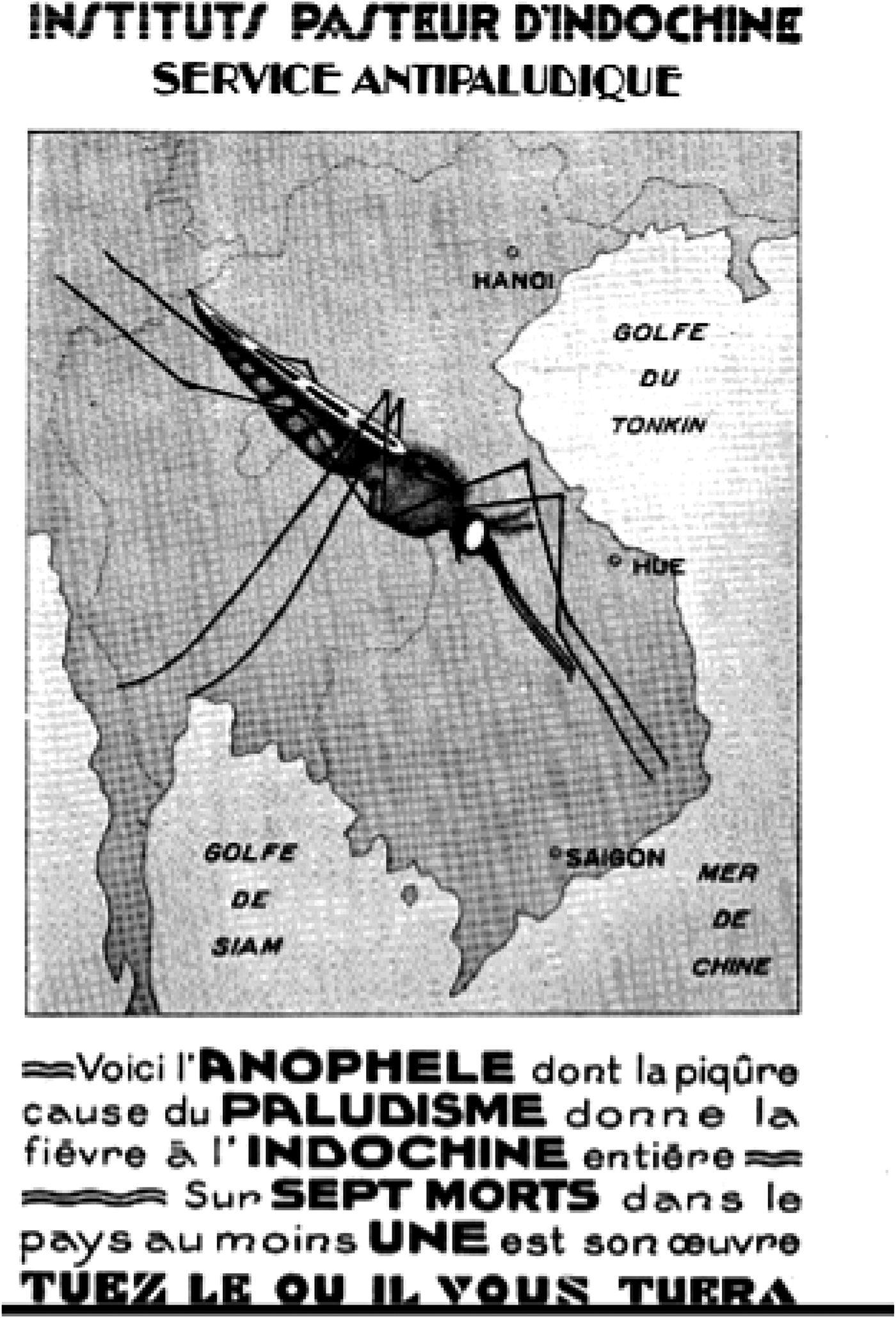
Giant mosquito threatening French Indochina
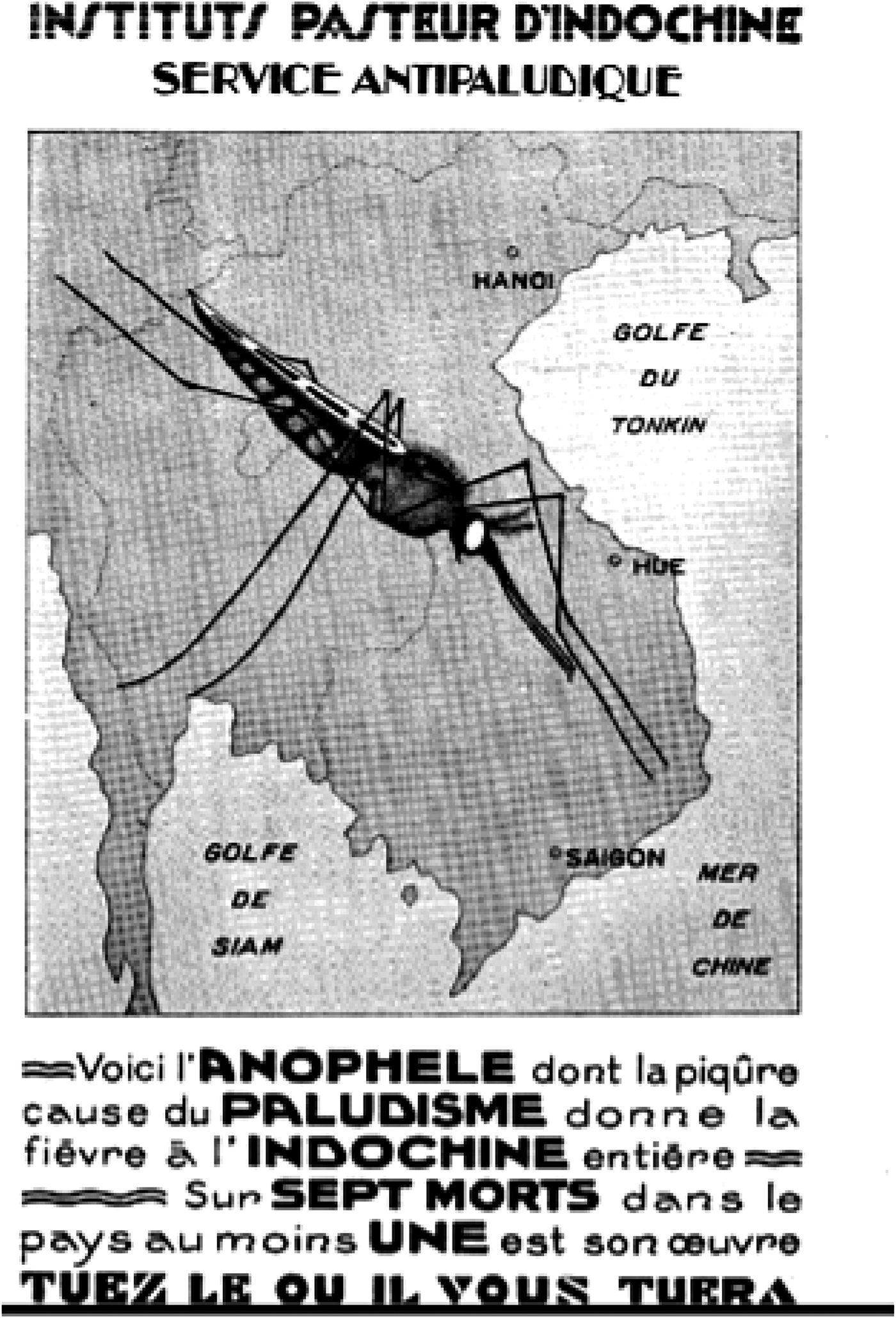
Doctor Moreau, the head of the Pasteur Institute laboratory in Hue, and F.G. Antoine, the head anti-malaria engineer, were given the job of extending prevention methods to rural settlements. In 1934, Moreau embarked on a mission to investigate malaria control in the colonial world and was duly impressed by Doctor Ross Park's efforts to limit malaria outbreaks in South Africa. These methods were quite invasive and included spraying rural housing on a regular basis. Antoine, too, sought to extend anti-malaria measures. At the end of 1935, he was sent on a study mission to Cochinchina in order to prepare for clean-up work planned for Pleiku in the central highlands. While neither the head engineer for Annam nor the Resident Superior d'Annam (RSA) shared his opinion, Antoine expressed his admiration for the work accomplished in the southern plantations and was sanguine about the possibilities of repeating this success in Pleiku.
Attempts to apply malaria knowledge derived from plantations to the countryside met with repeated failure because of four factors. First, anti-malaria measures required local administrators to apply rather specialised knowledge. The design of one drainage system, for instance, was based on the concept of a thalweg, the lowest contour line for a particular location and the path of water flow. Second, administrators had a difficult time managing water sources used by local populations. Third, the state only reluctantly spent resources on the constant surveillance required by such interventions in public health. Fourth, colonial administrators often did not wish to exert too much pressure on rural populations. The RSA, for example, argued that trying to eradicate malaria was unrealistic since ‘it is currently impossible to hope for the necessary cooperation from the local populations’.Footnote 27 Doctor Morin acknowledged that a rational organisation of anti-malaria control must take into account ‘the needs, the resources, and the customs of the country’.Footnote 28
Malaria experts advocated both quinine and synthetic drug use and focused on education that encouraged villagers, like workers, to take individual responsibility for malaria. After noticing a number of deficiencies in malaria prevention measures during his 1937 tour of the central highlands, the RSA commissioned Moreau and Antoine to draft clear, simple prevention instructions for those in command of the PGIs. Malaria prevention in Annam drew on the concept of circles, which divided up the countryside into discrete spatial units, and both pamphlets focused on environmental modifications aimed at protecting the outposts rather than nearby villages from malaria.Footnote 29
Another factor affecting knowledge production about malaria was the increasing influence of international organisations concerned with rural conditions. This development prompted the French Minister of Colonies to call for renewed attention to sanitation projects and to temper an emphasis on individual responsibility for health. Improving biên-être, or well-being, had long been considered as a way to combat malaria and Moreau admitted that the disease was best cured through the cooking pot (marmite) and the rice bowl (cai-bat). In a colourful analogy, he compared quinine to an umbrella, useful for temperate-region rain showers, but not for tropical deluges. Yet many colonial administrators argued that Annam would remain poor for the foreseeable future and while only more economic prosperity would completely eliminate the disease, in the short run, quinine and synthetic substitutes would have to do.Footnote 30
In 1937 the League of Nations' Health Organisation put together an ‘Intergovernmental Conference of Far-Eastern Countries on Rural Hygiene’ in Java, which some historians view as a seminal twentieth-century moment in thinking about global health.Footnote 31 A key theme of the report that the French delegation for Indochina submitted to this meeting was the importance of self-development among peasants, referring to their willingness to participate in economic projects and self-regulation. ‘More may be expected,’ the report read, ‘from measures which appeal directly to the individual. […] Moreover, when improvements have thus been made, there is no need for constant external assistance and supervision; they become part of the life of the rural population and have a deeper and more lasting effect.’ The League of Nations invoked older power networks to encourage villager involvement and the report argued that ‘personal influence, whether that of the mandarin, the doctor, the teacher, the plantation inspector or the sick-attendant, is always the most effective.’ This emphasis on ‘personal influence’ reinforced the position of colonial elites.Footnote 32
As the amount of data on malaria continued to grow, scientists tried to synthesise these findings into more general theories. In this process, they often turned to older concepts of climatic determinism and, as Mark Bradley has shown, ideas about the enervating effects of tropical climates on the ‘annamite race’ structured thinking about inhabitants of French Indochina during the first half of the twentieth century.Footnote 33 Among those articulating a neo-‘geoclimatic determinism’ was the meteorologist Paul Carton, who wrote a series of articles discussing the role of the environment in positive eugenics. For example, in a 1935 book chapter entitled ‘Climate and Man (Climatic factors in human ecology)’, Carton linked older medical authorities and recent advances in research by arguing that ‘climatic factors’ acted ‘upon microbial diseases transmitted to humans by intermediary hosts’.Footnote 34 He concluded ‘that the effect of climatic factors on men of the different races and their influence in the aetiology of diseases constitutes a very great, [and] still unexplored, field of study. Programs of observation, statistics, laboratory experimentation, etc. have been undertaken and followed with the object of resolving the numerous, very complex problems that arise’.Footnote 35
In the 1930s, Vietnamese medical researchers began to author their own works on malaria.Footnote 36 In part because of a growing sense of nationalism, these physicians adopted hierarchical visions of race in malaria prevention. Furthermore, from the French perspective, the ‘civilisational level’ of ethnic minorities was suspect and it remained open to question whether they (as opposed to the Kinh, or majority Viet) could ever meet norms of modernity. In this way, rural public health measures contributed to the consolidation of Kinh control of Vietnam. For example, Đăng Văn Dư, the chief of the Ha Tinh provincial hospital, invoked racial logic as he sought to advertise the value of quinine. Doctor Dư's pamphlets, written in Vietnamese, came to the attention of the RSA in 1938 and were eventually chosen over other booklets for wider distribution (15,000 copies of these pamphlets were circulated throughout the province).Footnote 37
Doctor Dư began one pamphlet by examining some of the general aspects of malaria, pitching his views in racial terms. He argued, for instance, that of all the diseases in Vietnam, malaria was the most harmful for ‘our race’ (dân tộc mình). While there were other diseases such as cholera, plague, and smallpox that killed many and killed quickly, these diseases did not strike often, and did not affect population numbers significantly. Malaria on the other hand had several pernicious effects. Reflecting what the doctor viewed as appropriate roles for children, women, and men, he wrote that malaria prevented children from growing up healthy, prevented women from giving birth, and prevented men from working hard. How much traction such arguments had in the countryside is difficult to say, but Dư's views of gender and age roles seemed to have resonated with his middle and upper class readership.Footnote 38
Furthermore, according to Doctor Dư, malaria had prevented Vietnamese from settling the uplands. This idea evoked the concept of nam tiến, a term describing the gradual spread of Vietnamese out from the Red River Delta, as they expelled, killed off, or absorbed the peoples and cultures of the centre and south. ‘Nước độc’ or poisoned waters in the upland region had prevented migration to the highlands and, although many Vietnamese had already left the coastal plains, Doctor Dư argued that Vietnamese populations continued to be overcrowded in the deltas, eking out a perilous living that made them vulnerable to natural disasters and famines.Footnote 39
The doctor proposed three ways to prevent malaria: a mosquito net, quinine, and mosquito reduction. He claimed mosquito nets were useful, if properly employed, but were unable to prevent transmission since farmers could not continually stay under nets. Environmental modifications, on the other hand, were time-consuming and too costly for almost all villages. Instead, Doctor Dư focused his attention on quinine, perhaps a result of his responsibility to promote the state quinine service. Doctor Dư asserted that quinine was relatively cheap and in any case spending larger amounts of money on this effective drug was more economical than wasting smaller sums of money on thuốc bắc.Footnote 40
In the third version of Doctor Dư's pamphlet completed before July 1938, he discussed in more detail the common assumptions about the causes of malaria. The term used during the colonial period by medical doctors was bẹnh sót rét, which translates as the disease of fevers and chills, with the words ui and ngược, meaning ‘remittent’ or ‘recurring’ sometimes added. This technical term replaced older words for malaria-like diseases. One of Doctor Dư's tasks was to convince the population that Western-trained doctors knew what malaria was and that they knew how to cure it. He had earlier explained the idea of why ‘nước độc’ did not cause malaria, calling such a suggestion ‘completely wrong’. He argued that a better way to understand malaria was ‘poison land’. He went into detail about the links among malaria, mosquitoes, and plasmodia, arguing that Western medicine had demonstrated that germs (vi trùng), i.e., plasmodia, could be found in blood samples of all of those with the disease. Conversely, if the blood sample did not show these plasmodia, then the disease, no matter how similar to malaria, could not be cured by quinine.Footnote 41
In his 1940 thesis, the medical doctor Bui Kien Tin noted the reluctance of Vietnamese to immigrate to the south. He wrote in particular about ‘those who want to emigrate [but] don't dare to repeat the experience that cost the lives of their loved ones, during the construction of the first railroads or the establishment of the hévéa plantations’.Footnote 42 A sense of mistrust about large-scale projects engendered among rural populations during the colonial period was one of the many colonial legacies left to both the Viet Minh and the successive governments of the south, as each state sought to establish its control over the countryside during the Indochinese Wars. Patriotic hygiene became a means for both sides to mobilise rural populations.
Patriotic hygiene, 1940s to 1975
The final section of this article addresses knowledge production about malaria carried out between the 1940s and 1975. While novel techniques such as the use of DDT and synthetic drugs developed in the 1930s were introduced in both the north and the south, most medical doctors attempted to control malaria employing strategies framed during the colonial period. Memories of the colonial period structured experience and approaches throughout Vietnam as malaria knowledge was refashioned to fit wartime needs. Political motivations, rather than specific techniques, separated efforts in the revolutionary north and the anti-Communist south. Overall, dominant wartime realities limited the options available to the Vietnamese, French, and American researchers as aid from China, the United States, and the Soviet Union helped shape knowledge production.
The health of individuals and populations in southern Vietnam had suffered tremendously between 1943 and 1947. The closing years of the Second World War and the first two years of fighting between French and Viet Minh forces had both decimated the medical system and worsened disease conditions. According to an annual government report, a loss of personnel and the destruction of material had impeded health care efforts.Footnote 43 The author emphasised in particular the drastic decrease in European personnel, as there remained a large number of both private and public Vietnamese doctors for several regions, especially urban settings such as Saigon. Malaria continued to be an important challenge facing the countryside as treatment for this disease remained inadequate. For example, Dang Van Cuong, the first Vietnamese minister of health, noted that a lack of medical doctors combined with rural violence had ended inspections of plantations.
During the First Indochina War (1946–54), French military doctors were important producers of malarial knowledge. According to a medical doctor and colonel of the Far East French Forces (Troupes française d'Extrême-Orient), during the first year of combat, malaria infected 37 per cent of the troops, with the rubber plantations listed as a principle source of the disease.Footnote 44 A cartoon-filled military manual illustrates the complex interactions of Vietnamese and French understandings of the disease. A green genie rising from rice fields and looming over a French soldier in khaki shorts recalls colonial-era descriptions of sorcerers protecting the uplands from intrusion. Science did not disappear from this malarial vision, as the sorcerer's crescent shape mimics the falciparum gamete, attacking with its henchman, the mosquito. The cartoon's words invoke the pharmaceutical industry as the soldier is urged to take his prophylactic pills that serve as his shield. Unexpectedly, perhaps, instructions directed at French soldiers were often simpler than those being broadcast by the Viet Minh.Footnote 45
Military anti-malaria propaganda poster

There were efforts to reduce malaria rates among civilian populations, who were especially hard hit because of the disruptions caused by war and migration. Tran Dinh Que, a medical doctor, travelled to Paris in 1949 to speak at the lnstitut Français du Caoutchouc (IFC, French Rubber Institute) on the state of medicine and health in Indochina. He began his speech with a review of the history of medicine in Vietnam and then tried to evaluate the effects of the French presence by comparing his country with others in the region, notably Japan, China, Siam (Thailand), and the Dutch East Indies. Que concluded that, with the exception of Japan, Vietnam's medical system under French colonial rule compared favourably with other Asian societies. Que also offered a program for improving the health of the Vietnamese, noting that while laws protecting workers' rights on plantations and other industrial sites existed, these laws needed to be strengthened and adjusted to current realities. He cited England in particular as a good example of the benefits of the ‘socialisation’ of health. Que closed by pronouncing medical doctors the ‘principal artisans of works of peace’.Footnote 46
Que's view of medicine as important for ‘human capital’, and his emphasis on the commune as the key to introducing health measures, were arguments formed during colonial times. Yet Que did not view these themes as mere French creations. For example, Que cited the work of Hoàng Trọng Phu, a mandarin who instructed farmers in basic hygiene rules. Que further argued that hygiene campaigns would be most efficient if focused on one disease, explaining that peasants would then more clearly comprehend hygiene actions and their effects. Adjusting to Vietnamese society, Que continued, the individual would be responsible for the collective and vice versa and social discipline would be used to enforce norms.Footnote 47
In the Republic of Vietnam (RVN), which was established as a result of the 1954 Geneva Accords, malaria remained a research priority. A 1960 medical thesis at the University of Saigon, for example, noted the high malaria rates in the coastal province of Binh Định, where rural health services had begun only a few years earlier.Footnote 48 International organisations also instituted anti-malaria projects during the late 1950s and throughout the 1960s. In 1958, for example, the World Health Organisation (WHO) began its malaria eradication program in the RVN. Between 1960 and 1963, the WHO carried out two DDT sprayings per year. Together, anti-malaria efforts reduced rates, with a high of 7.2 per cent in 1958 quickly falling to 1 to 2 per cent until 1966. In addition to DDT and dieldrin, synthetic drugs were used to combat malaria. These drugs could be divided into two main types: acridines, which include mépacrine (quinacrine), used since 1930, and quinoléines, which include chloroquine (amodiaquine), proguanil, chlorproguanil, pyriméthamine, primaquine, quinocide, pamaquine.Footnote 49 After 1965, wartime conditions made it impossible to continue with anti-malaria activities, especially in the countryside, with DDT-resistance in Anopheles and drug-resistance in plasmodia adding to the difficulties created by human violence.Footnote 50
RVN medical doctors wrote of the successes of colonial anti-malarial measures, while noting the high costs of such programs. In 1970, Đặng Văn Đang and Nguyễn Đăng Quế reviewed malaria rates between 1930 and 1944 using data from the Pasteur Institute. Malaria rates varied between 15 per cent and 31 per cent and were consistently higher than during the 1958 to 1966 period.Footnote 51 Still, the authors spoke of the success of a few rubber plantations in dealing with malaria:
There were only a few plantations that if they succeeded it was thanks to large-scale organisation. They cleaned up the gloomy places full of vegetation, filled in the muddy lagoons and ponds and applied the medical methods to thoroughly prevent malaria. The plantations mentioned above became prosperous but we had to pay dearly with much sweat and money.
These experiences could offer lessons for the present, they continued:
The brilliant results of the rubber plantations with respect to economy and society mentioned above has shown us that if the development of medicine is implemented in an effective manner in the forested, mountainous or swampy regions, we can exploit a large expanse of land.Footnote 52
These statements echoed efforts of the 1930s when techniques developed for malaria control on plantations were haltingly extended to the countryside. While DRV and RVN medical doctors may have been dependent on the tools of empire, however, they developed their own reason to justify the use of these tools. The production of malaria knowledge by Viet Minh and DRV medical scientists illustrates more clearly a postcolonial rationality. As in the RVN, memories of the colonial period shaped understandings of malaria during the First and Second Indochinese Wars (1946–75), with northern medical doctors judging their own actions and progress against these memories.Footnote 53
One physician in the DRV who directly confronted the question of malaria prevention during the war years was Đặng Văn Ngữ. Although more famous for producing penicillin in the Viet Minh stronghold of Viet Bac, Ngữ spent most of his time combating malaria.Footnote 54 With the formation of the DRV, Ngữ and his colleagues faced a monumental task. Left with an aging colonial infrastructure and the legacy of wartime disruptions that had drastically changed the disease ecologies of the north, the DRV desperately needed updated malaria knowledge. A.Y. Lysenko, a Soviet malaria expert, pointed out:
Most of the studies in malaria epidemiology in Vietnam were performed in the years of colonial dependence of that country 15 to 25 years ago. The techniques of these studies, the goals toward which they were directed, and many of their conclusions have either become obsolete or have become inapplicable to a country which has won its independence and is developing a public health service. Besides this, during the 8-year war of resistance in Vietnam, intensive migration processes occurred which of necessity introduced considerable changes into the regional epidemiology of malaria.Footnote 55
Lysenko's quote highlights the importance of political contexts for public health measures and the role that migration played in transforming malarial ecologies. With the help of experts from the Soviet Union, Ngữ investigated conditions in northern provinces such as Thai Nguyen, as part of an intensive malaria survey that took place between 1955 and 1957. As a result of this survey, Ngữ and Lysenko published several articles along with an atlas of malaria in Vietnam.Footnote 56
In July 1957, Ngữ became head of the newly established Malaria Institute (Viện sốt rét, VSR) which in 1960 was renamed the Institute of Malariology, Parasitology, and Entomology (VSR-KST-CT). As part of his investigations, Ngữ established pilot stations to test the techniques developed in the Soviet Union and by the WHO, which had embarked in 1955 on a program to eliminate malaria worldwide.Footnote 57 Between 1956 and 1961, the DRV, with Soviet aid, carried out research on a monumental scale: 3,000 locations including 646,277 people checked; 435,370 samples of blood tested; 319,087 houses checked for mosquitoes; and 168,084 water spots examined, which was 3.4 times the scale of the Pasteur Institute's investigations between 1927 and 1938.Footnote 58 These investigations led to the creation of a number of programs. In 1960–61, DRV health workers made preparations for anti-malaria campaigns that were carried out starting the following year. With the relative peace of 1961–64, these campaigns achieved many successes, but faced increasing hardships after 1965 due to renewed violence in the north.Footnote 59
Based on malaria surveys, Ngữ and his medical colleagues refashioned techniques used to combat malaria during the colonial period on rubber plantations. The VSR-KST-CT's 1976 review stated that eliminating malaria depended upon:
• characteristics of the malarial region;
• the specific level of malaria each year;
• the malaria season; and
• the object of protection.
During initial periods when malaria was rampant, methods for eradicating it involved:
• eliminating the source of the disease and curing on a wide scale;
• killing mosquitoes and preventing mosquito bites, also on a wide scale; and
• improving lives and living conditions.
After an initial reduction in malaria levels, more targeted measures were called for including:
• eliminating the source of the disease,
• killing mosquitoes and preventing mosquito bites;
• managing the migration of people; and
• managing malaria.Footnote 60
In practice, malarial control involved heavy use of DDT and synthetic drugs when available and manipulating environmental conditions when these chemicals were absent.Footnote 61 In more concrete numbers, between 1958 and 1975 10,633 units of DDT were used, making up 11,482 tons of 30 per cent solution that protected 495 factories and fields. The largest amount of DDT was sprayed between 1965 and 1972, the most intense period of fighting.Footnote 62 At the same time, health workers distributed synthetic drugs first developed during the 1930s. Between 1958 and 1962, the DRV employed acriquine (quinacrine), plasmocid (antimalarine and rhodoquine) and paludrine (proguanil), drugs mostly available during the First Indochina War.Footnote 63 From 1962 onwards, the DRV switched to Delagyl (choloroquine). Finally, beginning in 1969, the DRV relied on pyrimethamine (daraprim), sulfamid slow-acting pills 3 and 2, and Fansidar, a sulfadoxine and pyrimethamine mix, which works for falciparum albeit with serious side effects.Footnote 64
This knowledge production about malaria happened within the context of larger health and political concerns of the DRV state during wartime. The Army Health department made explicit links between war and medicine and campaigns were aimed at ‘fostering the strength of the peasantry, fostering the power to fight the resistance war.’Footnote 65 Health campaigns were carried out by workers at various levels of the state including commune public health cadre (cán bộ y tế xã), neighbourhood hygiene officers (vệ sinh viên xóm), and female nurses (nữ hộ sinh xã). These workers carried out mass education (bình dân học vụ) and study sessions on hygiene and disease prevention (buổi học tập về vệ sinh-phòng bệnh) and used slogans (khẩu hiệu) such as the ‘3 Cleans’ (Ba Sạch) and the ‘3 Kills’ (Ba Diệt) to teach important lessons.Footnote 66
Health workers took advantage of propaganda and education in their efforts to reduce malaria loads. In order to reach its people, the DRV made three films about malaria control that were shown 4,588 times to 3,166,393 people. The DRV set up 36 places for exhibiting malaria science and control with 737,289 people attending. Nineteen books were published with a total of 295,000 copies printed, along with 30,000 posters, 400,000 leaflets, and one million reproductions of seven types of propaganda slogans. Finally, discussions about preventing malaria were held 96,252 times with 11,579,764 people taking part.Footnote 67 These numbers are consistent with DRV statistics for other health programs. Shaun Malarney quotes the Disease Prevention Department of the Ministry of Health, which stated that in 1955, 4 million people participated in study sessions and 3 million participated in chat sessions (buổi nói chuyện) concerning hygiene. In 1956, the ministry noted that these numbers had risen to 13 and 9 million participants respectively, an impressive level considering that the DRV's population at that time was less than 20 million.Footnote 68
Concerns about ‘backwardness’ and attempts to introduce ‘civilised’ ideas to rural northern Vietnam also shaped knowledge production and dissemination about malaria. Malarney has explored campaigns to spread knowledge about germ (vi trùng) theory and to eliminate practices that were deemed ‘unscientific’ (phản khoa học) and ‘unhygienic’ (phản vệ sinh). Changing mentalities, the planners argued, would lead to transformations in hygiene practices and improvements in health.Footnote 69 In the case of malaria, classified as a ‘summer disease’, a 1956 text noted: ‘Malaria is caused by poisonous mosquitoes (muỗi độc) that transfer the malaria germ into the blood and cause the disease … In the past and today we have usually attributed it to ghosts, toxic waters, or miasmas, but in reality it is only because poisonous mosquitoes transmit malaria.’Footnote 70
Despite the best efforts of the DRV and RVN, malaria control remained problematic, especially in southern Vietnam where much of the fighting during the Vietnam War took place. As part of its war effort, the DRV sent malaria experts to the south. The VSR-KST-CT volume noted that many comrades had become heroic revolutionary martyrs while combating malaria in southern Vietnam. In 1967, Ngữ was killed by a B52 bomb around Hue and one year later the Minister of Health, Phạm Ngọc Thạch, also died during a mission to reduce the ravages of the disease.Footnote 71
Conclusion
From 1919 to 1975, both continuity and change existed in the techniques and motivations of those charged with preventing malaria. During the colonial period, the majority of medical doctors were unable to show how poverty and exploitation were mechanisms linking colonialism to malaria. These doctors were limited to models of biological and physical environments that showed plasmodia moving from mosquitoes to humans and back again. At most, these doctors could show how factors such as space, race or ecology contributed to malaria infections. Only during the postcolonial period could medical doctors provide more convincing pathways for malaria infection. Industrial hygiene and patriotic science, in a context of internationalism fostered by the Cold War, informed both malaria control techniques and the narratives about those measures.
This essay has attempted to explain why similar techniques were put to such different ends in colonial and postcolonial Vietnam. It engages with the term ‘neocolonial science’ in order to bridge the politics of knowledge in the colonial and the postcolonial eras and point to the multiple and located universalisms of people linked by disciplinary knowledge. The newly established anti-malaria measures of both the DRV and the RVN fit comfortably into neither the category of ‘neocolonial science’, with a clear genealogy of empire, nor ‘nationalist science’, stemming from patriotism and with a sense of parochialism that clearly Vietnamese scientists did not share.