1. Introduction
The Conceptual Transfer Hypothesis (CTH) assumes that speakers of different languages have somewhat differing patterns of conceptual categorization and construal, and that, in the case of bilinguals and second language learners, these types of conceptualization differences have the potential to transfer across languages – or, more precisely, the conceptual distinctions and patterns of conceptualization that they have acquired as speakers of one language can also affect their use of another language (see, e.g., Jarvis, Reference Jarvis2007; Jarvis & Pavlenko, Reference Jarvis and Pavlenko2008). Although the CTH may seem to be an extension of the Linguistic Relativity Hypothesis (see Odlin, Reference Odlin, Robinson and Ellis2008), the two hypotheses differ in the sense that the CTH does not assume that all conceptual differences found between speakers of different languages are necessarily caused by the grammars of those languages. Such differences may equally be caused by what Lucy (Reference Lucy, Gumperz and Levinson1996) refers to as discursive relativity, which we understand as language-specific cognitive patterns resulting from the conceptual distinctions and patterns of conceptualization that people acquire as members of particular discourse communities, irrespective of the grammars of their languages. Another difference between the two hypotheses is that, whereas work on linguistic relativity emphasizes the effects of language on general cognition as measured by people's performance on non-verbal tasks, the CTH follows the thinking for speaking hypothesis in assuming that many language-specific patterns of conceptualization may arise only in the context of communication (Slobin, Reference Slobin1991, Reference Slobin and Perdue1993, Reference Slobin, Gumperz and Levinson1996), as a person segments, selects, structures and linearly orders elements of a conceptual representation (e.g., of an event) for purposes of verbal expression (e.g., von Stutterheim & Nüse, Reference von Stutterheim and Nüse2003).
Prior work conducted within the thinking for speaking framework – dealing both with cross-linguistic differences among monolingual speakers of different languages (e.g., Berman & Slobin, Reference Berman and Slobin1994) and conceptual transfer in bilinguals and second language learners (e.g., Hohenstein, Eisenberg & Naigles, Reference Hohenstein, Eisenberg and Naigles2006; Negueruela, Lantolf, Rehn Jordan & Gelabert, Reference Negueruela, Lantolf, Rehn Jordan and Gelabert2004) – has tended to focus on conceptualization differences related to the construal of motion events, and has tended to be grounded in theories of cognitive linguistics. The lion's share of this research has investigated how speakers of different languages attend to and express path and manner of motion in their reference to motion events, and this line of research has rested heavily on Talmy's (Reference Talmy2000) theory of cognitive semantics, which deals with the ways in which these notions are differentially encoded into the verbal semantics of different languages.
A separate and rapidly emerging line of inquiry within the thinking for speaking framework deals with conceptual structures that are represented more by the grammar of a language than by its lexical semantics. This area of research has been propelled forwards primarily by von Stutterheim and her associates (e.g., Carroll and von Stutterheim, Reference Carroll, von Stutterheim and Ramat2003; Carroll, von Stutterheim & Nüse, Reference Carroll, von Stutterheim, Nüse, Habel and Pechmann2004; Schmiedtová & Flecken, Reference Schmiedtová, Flecken and Knop2008; von Stutterheim, Reference von Stutterheim, Foster-Cohen and Pekarek Doehler2003; von Stutterheim & Klein, Reference von Stutterheim, Klein, Graumann and Kallmeyer2002; von Stutterheim & Nüse, Reference von Stutterheim and Nüse2003; von Stutterheim, Nüse & Murcia-Serra, Reference von Stutterheim, Nüse, Murcia-Serra, Hasselgård, Johansson, Behrens and Fabricius-Hansen2002), who have focused on cross-linguistic differences and cross-linguistic influence in the ways speakers of different languages tend to view and express motion events, for example, as ongoing activities with no explicit endpoint versus as bounded wholes with an explicit endpoint. The studies that have been conducted within this line of research have found a good deal of compelling evidence for both cross-linguistic differences and cross-linguistic influence of this type, and they have linked these results to the observation that cross-linguistic differences in event construal largely coincide with differences in grammaticalized aspect. That is, speakers of languages (e.g., English) in which the predicate is obligatorily marked for aspect tend to view motion events as ongoing activities with no explicit endpoint, whereas speakers of languages (e.g., German) that lack a grammaticalized distinction between perfective and imperfective aspect tend to view motion events in their entirety, and thus also tend to mention the endpoints of such events. Von Stutterheim and Nüse (Reference von Stutterheim and Nüse2003) account for this finding by “argu[ing] that grammaticalized conceptual categories play a predominant role in deciding how conceptual material is organized for expression”, and by “postulat[ing] that the structural feature [+/−aspect] induces a specific pattern of event construal” (p. 870).
The present paper follows up on these claims in two ways: first, by exploring the theoretical relationship between endpoint encoding and grammatical aspectual distinctions, and second, by testing directly whether bilinguals who are more sensitive to grammatical aspectual contrasts are indeed less likely to refer to event endpoints.
2. Theoretical framework
As mentioned, a good deal of the prior work that has been conducted within the thinking for speaking framework has relied on theories of cognitive linguistics, an approach in which “the formal structures of language are studied not as if they were autonomous, but as reflections of general conceptual organization, categorization principles, processing mechanisms, and experiential and environmental influences” (Geeraerts & Cuyckens, Reference Geeraerts, Cuyckens, Geeraerts and Cuyckens2007, p. 3). Cognitive linguistics comprises many interrelated theories, including cognitive semantics (e.g., Talmy, Reference Talmy2000), cognitive grammar (e.g., Langacker, Reference Langacker1987), metaphor theory (e.g., Lakoff & Johnson, Reference Lakoff and Johnson1980), mental space theory (e.g., Fauconnier, Reference Fauconnier1985), construction grammar (e.g., Fillmore, Reference Fillmore1988) and many others (see, e.g., Langacker, Reference Langacker2008, p. 7). Although previous research in the thinking for speaking framework has focused primarily on questions related to cognitive semantics (Talmy, Reference Talmy2000), the questions we explore in this paper are better understood in relation to cognitive grammar (Langacker, Reference Langacker1987, Reference Langacker2008), which deals directly with the relationship between grammatical aspect and event construal. Von Stutterheim and colleagues have often made reference to other work in cognitive linguistics (e.g., Levelt, Reference Levelt1989) while proposing language-specific principles of information organization that govern conceptual representations as well as language use, but they have not drawn explicitly from cognitive grammar (CG) in order to elucidate these principles. Our first aim in this paper is to do so in an attempt to add theoretical contextualization and explanatory precision to the field's understanding of the principles of information organization that von Stutterheim and colleagues have explored, and in order to properly motivate testable hypotheses regarding the relationship between grammatical knowledge and patterns of conceptualization.
The most complete treatment of CG is found in Langacker (Reference Langacker1987), but here we draw also from the more recent descriptions of the theory by Langacker (Reference Langacker2008) and Radden and Dirven (Reference Radden and Dirven2007). One of the most central notions in CG is that of construal, and Langacker (Reference Langacker2008) describes construal in the following way:
An expression's meaning is not just the conceptual content it evokes – equally important is how that content is construed . . . It is hard to resist the visual metaphor, where content is likened to a scene and construal to a particular way of viewing it . . . In viewing a scene, what we actually see depends on how closely we examine it, what we choose to look at, which elements we pay most attention to, and where we view it from. (Langacker, Reference Langacker2008, p. 55)
An important component of construal is the scope, or viewing frame, that a person adopts when construing a situation. The person may choose to construe the situation with either a maximal or a restricted viewing frame. “Events which are viewed with a maximal viewing frame are seen externally and in their entirety . . . Events which are viewed with a restricted viewing frame are seen internally and in their progression” (Radden & Dirven, Reference Radden and Dirven2007, p. 175). The viewing frame that a person chooses in a particular construal is referred to as the immediate scope, and the immediate scope is foregrounded against the background of the maximal scope. In other words, the immediate scope in the foreground includes the conceptual elements that are being attended to mentally at a particular point in time, whereas the maximal scope in the background includes all related conceptual content that the speaker is concurrently aware of but not attending to (Langacker, Reference Langacker2008, p. 63).
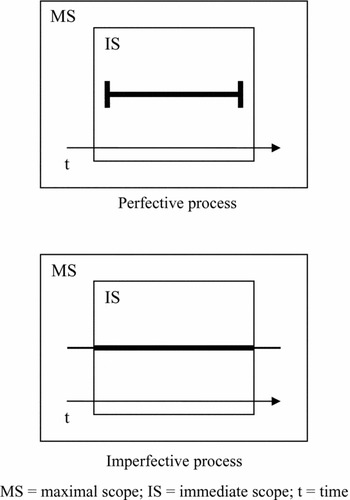
In the construal of events, scope is understood primarily in relation to the domain of time, and aspect is the feature of language that marks the contrast between the immediate temporal scope and the maximal temporal scope of an event. According to CG, in the absence of an aspectual marker, a verb does not distinguish between an immediate or maximal temporal scope. Instead, by default, “the entire bounded event, including its endpoints, appears ‘onstage’ within the temporal scope” (Langacker, Reference Langacker2008, p. 65). The use of an imperfective marker, on the other hand, reflects a construal that “‘zooms in’ and imposes a limited immediate scope that excludes the endpoints of the bounded event” (p. 65).Footnote 1 So, for example, a sentence like Ann cuddled the baby represents a complete act of cuddling where the maximal and immediate temporal scope are indistinguishable, whereas a sentence like Ann was cuddling the baby reflects the construal of an action whose immediate scope is restricted and includes only (part of) the progression of the event, without an endpoint (Langacker, Reference Langacker2008, p. 65; Radden & Dirven, Reference Radden and Dirven2007, pp. 180–181). Figure 1 illustrates the differences between perfective and imperfective in terms of temporal scope.
Perfective processes and imperfective processes (see Langacker, Reference Langacker2000, p. 224).

Another critical notion in CG is that of schematization, which is the process of extracting abstract commonalities – or schemas – from similar experiences. Langacker (Reference Langacker2008) describes schematization in the following way:
Schematization is fundamental to cognition, constantly occurring in every realm of experience. The extraction of a schema is simply the reinforcing of something inherent in multiple experiences at whatever level of granularity their commonality emerges . . . By its very nature, a schema serves a categorizing function: capturing what is common to certain previous experiences, it can be applied to any new experience exhibiting the same configuration. (Langacker, Reference Langacker2008, pp. 56–57, emphasis in the original)
Crucially, according to CG, temporal viewing frames themselves become schematized, meaning that particular combinations of immediate temporal scopes and maximal temporal scopes that are common across multiple events gain the status of mental categories, or concepts, that affect how we categorize new events that we experience, and which are symbolized in grammar with aspectual markers. Radden and Dirven (Reference Radden and Dirven2007, pp. 175–197) refer to these types of concepts as time schemas, and they illustrate these schemas with diagrams very similar to those we have presented in Figure 1. They also emphasize how these time schemas are mapped to grammatical aspect, as we have discussed.
One important issue that has not yet been dealt with adequately in CG is whether speakers of languages that lack grammaticalized imperfective aspect, such as German, acquire the same time schemas as speakers of languages, such as English, that do have imperfective aspect. More specifically, do speakers of so-called non-aspect languages acquire time schemas with restricted immediate temporal scopes? Although this question has not yet been addressed directly in CG, as far as we are aware, it has been addressed at least indirectly. According to Langacker (Reference Langacker2008, pp. 44–54), any mental experience – such as the construal of a particular event – has the potential to be recorded mentally and become activated as part of the set of domains through which future conceptualizations are construed. Thus, the fact that speakers of non-aspect languages do sometimes use lexical means for construing restricted viewing frames that focus on the progression of an event rather than referring to the event holistically, suggests that speakers of such languages may indeed acquire the same or similar time schemas as speakers of aspect languages. Nevertheless, there may still be differences in the likelihood of accessing such schemas. According to Langacker, “the inclination for a given domain [such as a particular time schema] to be activated is probabilistic” (p. 49) and depends on contextual factors as well as the degree to which the domain has become part of a cognitive routine whose corresponding linguistic structure has become progressively entrenched through factors such as frequency of recurrence and cognitive salience (p. 220). Whereas grammaticalized imperfective aspectual markers are excellent examples of such entrenched linguistic structures, one can predict that speakers of languages having a grammaticalized imperfective aspect will be far more likely to access times schemas with restricted viewing frames than will speakers of languages lacking grammaticalized imperfective aspect.
Again, however, CG assumes that schema activation is heavily dependent on and reinforced through recurring usage events (i.e., instances where situations are construed and verbally expressed), which implies that a person's probability of accessing a particular type of time schema versus another could change over time in cases where the nature of the usage events the person is exposed to changes. On this basis, we can predict that people with decreased exposure to the expression of events with restricted viewing frames will become less likely to construe events that way themselves during their own language production. By extension, we can also hypothesize that such people will become less inclined to access restricted time schemas during the decoding of linguistic representations of events even when those linguistic expressions contain overt imperfective aspectual markers. In other words, we can hypothesize that when people move from linguistic environments replete with contrasts between restricted and maximal viewing frames to linguistic environments that are largely devoid of such contrasts, those people will become (a) more likely to view events with maximal viewing frames and (b) less sensitive to grammatical aspectual contrasts. This is the main hypothesis we have set out to test in the present paper, where we investigate whether Spanish–Swedish bilinguals show a connection between (a) the tendency to refer to endpoints (i.e., maximal viewing frames) in their own oral descriptions of (motion) events in Spanish and (b) their level of sensitivity to correct versus incorrect uses of Spanish aspectual markers in aurally presented sentences describing events. Crucially, the bilinguals in the study have moved from a linguistic environment (Spanish-speaking Latin America) where contrasts between restricted and maximal viewing frames in (motion) events are commonly expressed, to a linguistic environment (Swedish-speaking Sweden) where these contrasts are not common (for empirical evidence of these differences, see Bylund, Reference Bylund2008).
3. Previous research
The purpose of the present study is to test the hypothesis that migrating from an L1 environment replete with contrasts between maximal and restricted viewing frames to an L2 environment where such contrasts are not regularly made will result in a reduced likelihood to express such distinctions in one's L1 production as well as a reduced likelihood to recognize such distinctions during L1 comprehension tasks. As far as we are aware, this hypothesis has not been tested directly in previous studies, but some studies are nevertheless highly relevant. To be sure, some of the previous research is problematic for this hypothesis vis-à-vis the finding that the patterns of event conceptualization a person has acquired through the L1 are “highly resistant to reorganization” (Carroll & von Stutterheim, Reference Carroll, von Stutterheim and Ramat2003, p. 393). In one such study, von Stutterheim (Reference von Stutterheim, Foster-Cohen and Pekarek Doehler2003) investigated the construal of events by native speakers of English and German who were also advanced L2 learners of the other language (i.e., German or English). The stimuli were individual events shown to the participants one at a time in brief film clips depicting, for example, two nuns walking down a road toward a house, a boy digging in the sand, and so forth. The film clips ended before the events reached their natural ending point, and in some of the clips the endpoints were not easily inferable from what was shown (e.g., a boy playing in a pile of sand). The participants were asked to provide oral descriptions of the events as soon as they recognized what was happening in the film clip, and data were collected in separate sessions in both the L1 and the L2.
With respect to the subset of stimuli depicting events whose endpoints could not be inferred easily from the film clips, the results were very similar in the L1 and L2, but very different between English speakers and German speakers. The English speakers exhibited a strong tendency not to refer to endpoints in either language, whereas the German speakers showed a strong tendency in both languages to refer to event endpoints, even though this required them to use their imaginations to varying degrees (e.g., saying that the boy who was playing in the sand was building a sandcastle). Given that both the English speakers and German speakers in this study were advanced L2 learners, these results cast some doubt on whether patterns of event construal acquired through the L1 really are susceptible to change during L2 acquisition. On the other hand, the reader is not given much detail about the participants' backgrounds, and if most or all of them learned the L2 in a foreign language context, then these results do not disconfirm the prediction that moving to a different linguistic environment where motion events are construed differently will result in changes to the learners' own patterns of event construal.
For von Stutterheim (Reference von Stutterheim, Foster-Cohen and Pekarek Doehler2003), the results of this and related experiments suggest that languages with the grammatical means for marking imperfective aspect sensitize their speakers to the phasal qualities of events – or qualities related to perceivable movement and change. Among other things, this greater sensitivity to the phasal qualities of ongoing events results in a defocusing of endpoints. It does not prevent speakers of aspect languages from referring to endpoints, but it makes endpoints less relevant and consequently less frequently mentioned in descriptions of certain types of events. Von Stutterheim speculates that these conditioning effects of language on event construal become firmly established by the time a native speaker reaches early adolescence (see, e.g., Sebastián & Slobin, Reference Sebastián, Slobin, Berman and Slobin1994, for an empirical examination of this issue), and concludes that these conditioning effects of the L1 subsequently carry over into the person's reference to events in an L2, as was found in her experiment on advanced learners of English and German.
We see von Stutterheim's interpretation as being compatible with the CG-based explanation that speakers of languages with grammaticalized imperfective aspect have restricted time schemas that are generally more developed, more entrenched and more readily activated than they would be for speakers of languages lacking grammaticalized imperfective aspect. One important advantage of the CG-based explanation is that it provides a somewhat more elaborated account of the underlying mechanisms that cause speakers of aspect languages to attend to and become sensitized to the phasal qualities of events instead of to their endpoints. The two perspectives also have somewhat differing emphases, even though they lead to essentially the same predictions. The CG-based account emphasizes the importance of regular exposure to particular types of viewing frames (or time schemas), whereas von Stutterheim and colleagues have emphasized the importance of grammaticalized morphology. For example, von Stutterheim (Reference von Stutterheim, Foster-Cohen and Pekarek Doehler2003) found that the German-speaking learners of English referred to earlier were more target-like in their L2 construals of motion events than were the English-speaking learners of German. She speculated that this is because the progressive aspect in English “is a salient grammatical form which . . . [points] the learner . . . to the function it serves” (p. 202), whereas there is no overt morphology in German that indicates to the learner that events tend to be construed holistically in this language.
CG also recognizes the importance of grammaticalized categories, but in our interpretation of the theory, the emphasis is placed more on the regularity with which certain notions, such as ongoingness, are expressed through the morphology rather than on whether the relevant morphology exists in a language. In other words, a CG-based interpretation of von Stutterheim's (Reference von Stutterheim, Foster-Cohen and Pekarek Doehler2003) results might be that the German-speaking learners of English in her study may have experienced qualitatively richer and quantitatively more exposure to the event-construal patterns of native English-speaking discourse communities in comparison to the exposure the English-speaking learners of German are likely to have had in relation to German-speaking discourse communities. Both interpretations do lead to a similar prediction concerning the relationship between learners' or bilinguals' reference to endpoints and their sensitivity to aspectual contrasts, but they seem to do so from differing perspectives. Von Stutterheim's explanation seems to suggest that learners' sensitivity to overt grammatical morphology can help them acquire certain patterns of event construal, whereas the CG-based explanation suggests that bilinguals' reference to endpoints and their sensitivity to aspectual morphology are both determined largely by the time schemas they have acquired and by the degree to which those time schemas are accessible in their minds. Neither interpretation can be definitively proven, but one type of evidence that would support the latter interpretation would be evidence for a relationship between sensitivity to aspectual contrasts and endpoint encoding that is independent of a larger sensitivity to grammatical contrasts in general. This is one of the factors that we will examine in the empirical portion of the present study.
Returning to the question of whether patterns of event construal are susceptible to change, some of the most compelling evidence for this comes from studies that have investigated reverse transfer – or the effects of the L2 on the L1 – in bilinguals' reference to motion events. Strong evidence for L2 influence on bilinguals' conceptualization of path and manner of motion can be found not only in bilinguals' language production (Hohenstein, et al., Reference Hohenstein, Eisenberg and Naigles2006) but also in their speech-accompanying gestures (Brown and Gullberg, Reference Brown and Gullberg2008). Regarding reverse transfer in bilinguals' reference to event endpoints, the only study to have investigated this phenomenon so far is Bylund (Reference Bylund2009a). Bylund followed the same methodology used by von Stutterheim (Reference von Stutterheim, Foster-Cohen and Pekarek Doehler2003) in order to investigate whether Spanish–Swedish bilinguals living in Sweden would more closely resemble Spanish speakers or Swedish speakers in relation to the frequencies with which they refer to endpoints in their construal of motion events. All thirty-one of the bilinguals in this study were born in Spanish-speaking countries and were fully functioning speakers of Spanish who had immigrated to Sweden at various points in their lives, from as early as age 1 to as late as age 19. At the time of testing, all participants had lived in Sweden for at least twelve years, and all were deemed to be native-like speakers of Swedish by at least six out of ten native Swedish judges.
The bilinguals were asked to perform the oral event-description task in their native Spanish, and the results showed that many of them referred to endpoints with frequencies that were statistically higher than those of a control group of native Spanish speakers. In other words, they seemed to be affected by the Swedish-like tendency to construe events as bounded wholes. One might predict that the likelihood of adopting a Swedish-like pattern of event construal would increase with their exposure to Swedish, and concomitantly with their length of residence in Sweden. However, all of the participants had lived in Sweden beyond what could be considered a critical threshold (see de Bot & Clyne, Reference de Bot and Clyne1994), and length of residence (henceforth LoR) was not found to be statistically correlated with their endpoint frequencies.
Instead, what did turn out to be a statistically significant predictor of their reference to endpoints was the age at which they moved to Sweden, up until the age of 12. The bilinguals who moved to Sweden after age 12 largely converged with the Spanish control group. However, for the early bilinguals, there was a statistically significant negative correlation between their endpoint frequencies and their age of onset (henceforth AO) of L2 acquisition. The effects of AO on the early bilinguals were furthermore interpreted to be independent of both L1 and L2 proficiency. They were not interpreted to be independent of language exposure, however, and in fact Bylund suggested that the early bilinguals' varying patterns of endpoint encoding might be accounted for in relation to varying levels of L1 Spanish contact in combination with possible maturational factors that might make early bilinguals more susceptible to L1 restructuring in comparison with late bilinguals. It is worth noting that this interpretation is compatible both with Bylund's finding that conceptual construal patterns are subject to change (i.e., among early bilinguals) and with von Stutterheim's (Reference von Stutterheim, Foster-Cohen and Pekarek Doehler2003) finding that L1 event construal patterns (i.e., among adult learners) are highly resistant to change.
In summary, past empirical research has shown that patterns of event construal related to viewing frames and endpoint encoding are subject to transfer from L1 to L2 and also to transfer in the reverse direction. Reverse construal transfer appears to be more common in bilinguals who have moved to the L2 environment before the age of 12 and whose contact with the L1 community has been substantially reduced. Forward construal transfer, from L1 to L2, appears to be more common in late bilinguals, language learners who began learning the L2 after the age of 12, and presumably especially in foreign-language learners who have remained in the L1 environment while learning the L2. Both linguistic environment and AO of L2 acquisition therefore appear to be important factors affecting the likelihood of forward versus reverse construal transfer, and both will be taken into consideration in the design of the present study. Other factors that will be examined for possible modulating effects on the relationship between endpoint encoding and sensitivity to aspectual contrasts include LoR, bilinguals' choice of verb form for referring to motion events (e.g., simple present versus present progressive) and bilinguals' sensitivity to grammatical distinctions beyond those dealing with aspect.
The main research questions (Q) pursued in the current study and their corresponding hypotheses (H) may be summarized in the following way:
Q1: What is the relationship in bilingual speakers between endpoint encoding patterns and sensitivity to grammatically marked aspectual distinctions?
H1: Based on the assumptions of the adopted theoretical framework as well as on previous findings on the relationship between endpoint encoding and grammatical aspect (e.g., von Stutterheim & Nüse, Reference von Stutterheim and Nüse2003), we expected that the frequency with which the bilinguals encoded endpoints would be connected to their intuitions related to aspectual contrasts as measured by a grammaticality judgment test.
Q2: If endpoint encoding and sensitivity to aspectual distinctions are significantly correlated, is this relationship confounded by other variables that might covary with sensitivity to aspectual distinctions, such as age of onset of L2 acquisition, length of residence in the L2 environment and overall L1 grammar knowledge?
H2: Consistent with the findings reported by Bylund (Reference Bylund2009a), we expected that, besides proficiency with aspectual contrasts, age of onset of L2 acquisition would also be correlated with the bilinguals' L1 endpoint encoding frequencies.
4. Method
4.1 Participants
Forty L1 Spanish – L2 Swedish bilinguals participated in the study. The majority of the participants (about 70%) were of Chilean origin, whereas the rest were born in other Latin American countries with no specific concentration. All participants had completed upper-secondary school and the majority also had academic degrees. AO of L2 acquisition (which often coincided with age of arrival in Sweden) ranged from 1 to 23 years (mean = 9.6) and LoR in Sweden ranged from 12 to 34 years (mean = 22.7). The mean chronological age at the time of testing was 32.5 years (range = 19–49). The participants were originally selected to participate in a project on maturational constraints and L2 ultimate attainment in which the primary criteria for participation were Spanish as a mother tongue (independently of variety) and having passed for a native speaker of Swedish by at least three out of ten native listener judges (see Abrahamsson & Hyltenstam, Reference Abrahamsson and Hyltenstam2009). Thus, the common denominator of the participants was that they had reached a proficiency level of Swedish that sometimes allowed them to pass for native speakers in everyday oral conversation.
The bilinguals were functional in Spanish and reported regular use of this language. The majority of them also had elementary knowledge of English, French and/or German, which they had acquired in school. None of them had, however, spent any appreciable length of time in a setting where this foreign language knowledge could be used for daily communicative purposes.
The control group comprised fifteen adult native speakers of L1 Spanish. These people were either recently arrived immigrants or exchange students at Swedish universities. Some people in this group spoke English (skills in this language ranged according to the participants' own estimations from beginner to intermediate) and some of them also knew some Swedish words or phrases. These foreign language skills notwithstanding, this group will be referred to as monolingual controls rather than native controls (because they were born and raised in a monolingual Spanish-speaking setting). The controls were matched with the bilingual speakers with regard to educational level and chronological age. The distribution of the controls' country of origin was also similar to that of the bilingual participants: whereas one person was from Spain, approximately 70% of the controls were Chileans and the rest came from Argentina, Colombia, Uruguay and Venezuela. These participants were recruited by means of an announcement through the newsletter email list of the Department of Spanish and Portuguese, Stockholm University.
4.2 Materials
Endpoint encoding: A set of video clips showing goal-oriented motion events was used to study endpoint encoding. The clips had been compiled by the research team of M. Carroll and C. von Stutterheim and were used in the baseline study on the Swedish and Spanish control groups (Bylund, Reference Bylund2008). The video clips showed an entity (e.g., a vehicle or a person) moving along a trajectory at the end of which there was a possible endpoint (e.g., a village). The scenes were distributed into three main groups according to their degree of goal orientation (Carroll, ms). The first group consisted of scenes with a high level of goal orientation. In these scenes it was shown how the endpoint of the trajectory was reached, for example, a dog entering a green house. The second category contained scenes with an intermediate degree of goal orientation in which there was a visible, possible endpoint for the motion, but the arrival at it was not overtly shown. An example of this is a scene in which a woman is riding a bike on a road towards a building. The third and final category of the video clips comprised scenes depicting the motion of an entity along a trajectory without a clearly discernable endpoint. An example of this is the clip with someone driving a jeep in the middle of the desert: in this scene, the mountains visible in the background could be interpreted as a goal towards which the jeep is heading. Apart from these motion event categories, the video clips included two other types of scenes: first, scenes where the endpoint of the activity was a product; for example, a man carving wood vs. a man carving a sculpture. Since the focus of the current study is set on motion events, this set of scenes was excluded from analysis. The second category contained items showing entities involved in activities without any endpoint orientation, such as a man playing the violin or a machine digging a ditch. These scenes functioned as distracter items and were excluded from analysis.Footnote 2
A breakdown of the 41 clips included in the present study is as follows: 7 clips of a high degree of goal orientation; 9 clips of an intermediate degree of goal orientation; 11 clips of a low degree of goal orientation. The distracters and activity-product clips were 10 and 4, respectively. The intermediate- and low-degree clips were more numerous due to the fact that (cross-linguistic) differences in endpoint encoding were expected to be more salient in these categories (Carroll, ms.).
Formal language skills: An aural grammaticality judgment test (GJT)Footnote 3 was used to measure the participants' formal language skills in L1 Spanish. The GJT included 100 sentences of which 50 were faulty. Faulty sentences contained one error from one of the following categories: gender agreement, verb agreement, verbal clitics or aspectual contrasts (with erroneous use of the simple imperfect). The stimulus sentences had been recorded in an anechoic chamber and were read by a female native speaker of Chilean Spanish.Footnote 4
4.3 Procedure
The test sessions were carried out individually in a sound-treated room. The test administrator was a female speaker of Chilean Spanish. The sessions included two 20-minute breaks with sandwiches, fruit and refreshments and generally lasted 3.5 hours. The sessions took this amount of time because the data collection involved, apart from the event conceptualization material, different measures on the participants' grammatical, lexical and phonological proficiency. The participants were paid in return for their efforts.
Endpoint encoding: The procedure for collecting the data on endpoint encoding was as follows: participants watched the clips on a computer monitor and were asked to describe in their L1 Spanish what was happening in each scene (¿qué pasa en la escena?) as soon as they recognized the type of situation. They were also instructed to focus on the event and not to pay attention to, for example, weather conditions or the protagonists' clothing. The participants' descriptions of the video clips were audio-recorded and transcribed and then quantified in terms of the frequency with which the participants mentioned the endpoints of the events. Locative expressions with the moving entity's arrival at or intention of arriving at a goal were counted as endpoint encodings. Examples of such expressions are ir a una tienda (“to go to a shop”), caminar hacia un molino (“to walk towards a windmill”), meterse en una casa (approx. “to enter  a house”), aterrizar en un farol (“to land on a street lamp”).
Formal language skills: When taking the GJT, the participants were told to focus on the structure of the utterances and not on their content (the difference between these was illustrated with an example). The sentences were presented through earphones in random order and the participants indicated the grammaticality of each sentence by pressing a red button for “incorrect” or a green button for “correct”. The test was designed and run in E-Prime (v1.0).
Prior to testing, all participants underwent a hearing test (OSCILLA SM910 screening audiometer), in which a loss of up to 10 dB for one frequency in one ear was considered acceptable. All participants included in the present study passed the test.
5. Results
A comparison between the number of endpoints (henceforth EP) encoded by the bilingual group and the Spanish-speaking monolingual control group showed that the bilinguals verbalized EP to a higher degree than did the controls. Generally, the bilinguals encoded EPs for 30.9% (SD = 11.4) of the goal-oriented motions events, whereas the Spanish monolingual controls did so for 22.9% (SD = 8.8) of these events. This difference was statistically significant (t(53) = 2.44, p = .018). This means that the bilinguals were prone to describing the motion events in the scenes by making reference to the moving entity's arrival at a goal, for example, “a man is riding a horse-drawn carriage to a village”. The monolingual controls, on the other hand, were more inclined towards describing the same scene as “a man is riding a horse-drawn carriage”, thus leaving out the EP of the motion. A closer look at the scene descriptions revealed that the bilinguals not only differed from the controls with regard to EP frequency, but also to a higher degree used the simple present tense instead of the progressive. The simple present was on average used by the bilinguals in 36.1% (SD = 23.6) of the goal-oriented motion events, and in 13.6% (SD = 7.1) by the monolingual controls. This difference was statistically significant (t(53) = 3.62, p = .0007).
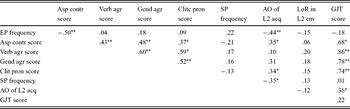
Having established that the predilection for encoding EP was greater among the bilingual group than among the Spanish-speaking controls, we will now turn to the research questions posed in the current study. To reiterate, the first question concerned the relationship between EP encoding patterns and intuitions of well-formedness relating to the use of aspectual morphology, whereas the second research question related to the influence of background variables on EP patterns. In order to be able to draw conclusions about the relative impact of each of these variables on EP frequencies, our initial intention was to perform a multiple regression analysis, with EP frequencies as the dependent variable, and the total GJT score, the scores at each of the four GJT categories (i.e., aspectual contrasts, verbal agreement, gender agreement, verbal clitics), AO of L2 acquisition and LoR in the L2 environment as independent variables. In view of the finding above, simple present (henceforth SP) tense frequency was also included as a factor that could be related to EP encoding frequencies. Table 1 shows a correlation matrix between all these variables.
Correlation matrix showing Pearson's r for all variables.

*p < .05, **p < .01; EP = endpoint; SP = simple present.
As can be seen, several of the independent variables that correlated with EP frequencies, were also correlated with each other. As a consequence of the multi-collinearity found in the data, the multiple regression analysis was not carried out. As an alternative, we chose to correlate EP frequencies with each independent variable, while partialling out all the other variables. The outcome of these partial correlations is laid out in Table 2.
Pearson's r for partial correlations between EP and each variable, controlling for all the other variables.

*p < .05, **p < .01; EP = endpoint; SP = simple present.
As can be seen, decoding proficiency with aspectual contrasts (preterite–imperfect) turned out to be the variable that was most strongly correlated with EP frequencies. This negative correlation shows that the less sensitive a person was to the erroneous use of aspectual contrasts like *cuando su padre era joven, tenía (tuvo) un accidente muy grave (“when his father was young, he was having a serious accident”), the more prone he or she was to verbalizing an EP in the motion event scenes, for example, una gaviota está volando hacia un palo (“a seagull is flying towards a perch”). There was also a statistically significant negative correlation (albeit somewhat weaker) between AO of L2 acquisition and EP encoding in the L1. This means that the older the participant was at the onset of Swedish L2 acquisition the less prone he/she was to encoding EPs. In other words, the later the AO of L2 acquisition the greater the conformity with Spanish monolingual EP patterns (see also Bylund, Reference Bylund2009a, Reference Bylundb). As to the other independent variables (the remaining GJT categories, overall GJT score, LoR in L2 environment and SP frequencies), no significant correlations were found.
With our hypotheses we postulated that the bilinguals' EP encoding would be related to, first, the ability to detect aspectual errors on the GJT, and second, AO of L2 acquisition. This prediction was corroborated by the results, as these two variables turned out to be the only ones that were significantly correlated with EP frequencies. Moreover, it was shown that the correlation between EP frequencies and proficiency with aspectual contrasts was somewhat stronger than the correlation between EP frequencies and AO of L2 acquisition.
6. Discussion
In the preceding section, it was seen that the bilinguals were more inclined to encode EP for goal-oriented motion events than were the Spanish monolingual controls. This finding indicates that there is a difference between the two groups' construal of event structure. Our interpretation of this difference is that the monolingual speakers usually described the events as ongoing, that is, they zoomed in on the object in motion. As a consequence of this zooming in, the boundaries of the event are no longer in focus. This construal of the events suggests that when describing the scenes, the monolinguals conceptualized the events by resorting to time schemas with a restricted viewing scope. This pattern of conceptualization is in contrast with the bilinguals' predilection for mentioning EP: the encoding of EP entails a zooming out of the event to the point that the event endpoint is included in the scope. In addition to the bilinguals' elevated tendency to encode endpoints, it was documented that they also had an elevated use of the simple present form in their event descriptions. The fact that the bilinguals used the aspectually marked progressive to a lesser extent than did the Spanish monolinguals seems to suggest that the bilinguals also at the morphological level were less prone to encoding ongoingness. All in all, the encoding of endpoints and the elevated use of the non-aspectually marked simple present indicate that the bilinguals' construal of goal-oriented events is to a great extent based on time schemas with maximal viewing scope. We consequently suggest that the differences between the monolinguals' and the bilinguals' EP encoding patterns reside in their selection of time schemas.
The central finding of the analysis was the negative correlation between sensitivity to aspectual contrasts and predilection for EP encoding. Following the adopted framework, we suggest that this correlation is adequately interpreted in terms of time schema selection. As proposed above, the mentioning of an EP reflects the selection of a maximal viewing scope of the event. In a similar vein, we suggest that the ability to discriminate erroneous use of imperfective morphology may also be interpreted in terms of maximal viewing scope, in the sense that a person who recurrently accesses maximal time schemas will be less prone to attending to morphology representing restricted time schemas when decoding linguistic expressions.
We would, however, hesitate to claim that one of the variables directly governs the other, i.e. that schema selection preferences for goal-oriented motion events determine the choice of time schema with which the aspectual-contrast sentences are matched during sentence decoding. Rather, we believe the attested correlation is indicative of the bilinguals' general tendency to resort to time schemas with a maximal viewing frame in both production and decoding modalities. These schema selection tendencies may be seen as a continuum in which at the one end there are those participants who conceptualize events with a more restricted viewing scope. This tendency is reflected in a greater sensitivity to erroneous use of the imperfect and in the tendency to construe goal-oriented motion events as ongoing. At the other end of the continuum, there are those participants who view events more holistically and accordingly resort to time schemas with maximal scope. This is manifested in their tendency to overlook grammatical morphology referring to ongoingness as well as in their predilection for encoding EP (and consequently defocusing ongoingness) in motion events.
As an alternative explanation for these results, one might hypothesize that the significant correlation between the bilinguals' frequency of mentioning event endpoints and their scores on the aspectual contrasts section of the grammaticality judgment test is merely an outcome of deficiencies in their knowledge of L1 Spanish. However, the problem with this explanation is that it does not seem to account well for the fact that the more poorly bilinguals performed on the grammatical aspect section of the grammaticality judgment test, the more likely they were to refer to event endpoints. If language deficiencies were the cause, then we would expect the bilinguals whose Spanish is weaker (i.e., the ones with lower GJT scores) to be more likely to resort to structural simplification in their event descriptions and consequently fewer mentions of endpoints. However, the results show the opposite pattern. Actually, the finding that none of the other GJT areas nor total GJT score were significantly correlated with EP frequencies seems to be at variance with the suggestion that the bilinguals' event construal patterns were connected to deficient L1 Spanish knowledge.
The suggestion that morphological sensitivity may be related to conceptual knowledge finds support in a study by Athanasopoulos (Reference Athanasopoulos2007): Setting out to test Lucy's (Reference Lucy1992) hypothesis that there is a link between grammatical categories and classification preferences, Athanasopoulos (Reference Athanasopoulos2007) examined categorization patterns and proficiency with English plural marking in Japanese speakers of L2 English.Footnote 5 The results indicated that the more sensitive the learners were to incorrect plural morphology, the more prone they were to following English monolingual classification patterns.
What, then, are the factors underlying the general preference for maximal temporal scopes attested among the bilingual participants? In order to explain this, two factors probably need to be taken into consideration. The first of these is reduced L1 contact: the role of L1 contact for L1 retention/attainment in a L2 setting has been repeatedly underscored in the attrition literature (e.g., Andersen, Reference Andersen, Lambert and Freed1982; Paradis, Reference Paradis, Köpke, Schmid, Keijzer and Dostert2007; Sharwood Smith & van Buren, Reference Sharwood Smith, van Buren, Seliger and Vago1991), and empirically corroborated in a number of studies (e.g., de Bot, Gommans & Rossing, Reference de Bot, Gommans, Rossing, Seliger and Vago1991; Hakuta & D'Andrea, Reference Hakuta and D'Andrea1992; de Leeuw, Schmid & Mennen, Reference de Leeuw, Schmid and Mennen2010; Schmid, Reference Schmid2002; Yeni-Komshian, Flege and Liu, Reference Yeni-Komshian, Flege and Liu2000). The bilingual participants in the current study had been living in a L2 environment for more than twenty years on average, which means that though they still spoke Spanish, the contexts of use of this language were reduced (compared to those of a person living in a monolingual Spanish-speaking setting) and had been so for an appreciable length of time.
The second factor concerns L2 proficiency: the literature abounds with evidence of L2 effects on the L1 in situations of incomplete acquisition/attrition (e.g., Gürel, Reference Gürel2004; Kaufmann & Aronoff, Reference Kaufman, Aronoff, Seliger and Vago1991; Major, Reference Major, Hyltenstam and Viberg1993; Pavlenko & Jarvis, Reference Pavlenko and Jarvis2002). As pointed out earlier, the bilinguals in the present study were near-native speakers of L2 Swedish, a language that has a predilection for reference to endpoints and, furthermore, does not encode aspectual contrasts on an obligatory scale. The elevated levels of L2 knowledge and use on the part of the bilinguals are an important characteristic because this shows that they presumably have been conditioned to Swedish patterns of event conceptualization. In line with Paradis's (2007) account of L1 attrition in an L2 setting, we suggest that an interaction between reduced L1 contact and L2 proficiency has produced the non-convergent time schema selection tendencies among the bilinguals: the lack of evidence confirming that L1 is the way it is has made the bilinguals' L1 system more susceptible to L2 influence. Under this condition, their L1 schema selection patterns have been affected by the Swedish tendency to resort to event time schemas with maximal viewing scope. The interpretation that conceptualization preferences in one language may be influenced by conceptualization preferences in another language (usually the dominant one) is consistent with previous findings on, e.g., L1 effects on L2 event construal (Carroll & von Stutterheim, Reference Carroll, von Stutterheim and Ramat2003; Schmiedtová, in press; Schmiedtová & Flecken, Reference Schmiedtová, Flecken and Knop2008).
The finding that the bias towards maximal time schemas was more pronounced among the bilinguals with low AO of L2 acquisition suggests that the participants in question probably came into contact with Swedish before their patterns of Spanish event-schema selection were firmly established and before they had developed stable preferences for referring to events with a restricted viewing scope. They were, in other words, at a developmental stage where their Spanish system was more receptive to L2 transfer. In a similar vein, the tendency of the bilinguals with a higher AO of L2 acquisition to resort to restricted time schemas may suggest that these participants already had well-established event-schema hierarchies and schema-selection preferences and, as a consequence, they were less sensitive to changes in linguistic setting and L2 influence.
The last aspect to be treated in the discussion concerns the explanatory potential of the theoretical framework adopted, Cognitive Grammar. As we discussed in our literature review, von Stutterheim (Reference von Stutterheim, Foster-Cohen and Pekarek Doehler2003) and colleagues (e.g., Schmiedtová & Flecken, Reference Schmiedtová, Flecken and Knop2008; von Stutterheim & Nüse, Reference von Stutterheim and Nüse2003) have observed that speakers of languages that have grammaticalized progressive/imperfective aspect tend to construe events as ongoing and unbounded, whereas speakers of languages that do not have grammaticalized progressive/imperfective aspect tend to construe events as bounded. The explanation for the latter is clear because these languages do not offer a means in their grammatical morphology for referring to unboundedness. In the case of the former, however, the reason for the preference for unbounded over bounded construals is unclear because the speakers of these languages have both grammatical options at their disposal (e.g., Russian, Arabic and Spanish).Footnote 6 The explanation offered in von Stutterheim (Reference von Stutterheim, Foster-Cohen and Pekarek Doehler2003) is that progressive/imperfective aspectual morphology tends to be salient and therefore draws speakers of the language to the function it serves (p. 202). This seems to imply that the mere existence of progressive/imperfective morphology in a language will cause speakers of that language to prefer unbounded construals of motion events. Alternatively, one could interpret von Stutterheim's claim as suggesting that the frequency with which progressive/imperfective morphology is used in a language will enhance its salience and therefore increase the likelihood that speakers and learners of that language will be drawn to its function.
In a general sense, this is what our adopted CG-based framework predicts as well, with the additional caveat that the CG-based account holds that patterns of event construal depend less on linguistic salience and more on how entrenched a particular time schema has become in the mind of a person in relation to a particular type of event. According to the CG-based account, these construal patterns become entrenched through the regular and frequent interpretation of events in certain ways, rather than as a result of the salience of grammatical morphology per se. Grounded in patterns of interpretation, the CG-based account therefore predicts that entrenched event construal patterns will be found in both receptive tasks (in this case, an aural grammaticality judgment task) and productive tasks (in this case, oral film-clip descriptions), which is precisely what we have found in this study. That is, we found that the Spanish–Swedish bilinguals who seemed to have developed an entrenched Swedish-like pattern of viewing motion events as bounded during the film description task, were also more likely to overlook the salient but ungrammatical use of imperfective morphology in the grammaticality judgment task, presumably because they found plausible interpretations of the ungrammatical sentences within their most readily accessible time schemas. The alternative explanation based on the presence/absence of grammaticalized aspectual morphology does not seem to predict this relationship.
We recognize that the CG framework (or any other framework, for that matter) is not fully developed in relation to the conceptual status of time schemas or their role in the conceptualization of motion events. However, we find that this framework offers a more explicit account of the relationship between language structure and event conceptualization than any of the currently existing alternative frameworks. Our purpose in this paper has not been to develop the theory further, but rather to test the hypotheses that it already generates concerning the relationship between bilinguals' sensitivity to progressive/imperfective grammatical morphology during language reception and their tendency to construe motion events as having endpoints during language production. We interpret the results of the present study as confirming that a cognitive (i.e., schema-based) explanation is better able to account for our data than a structural explanation (i.e., dealing with which structures are grammaticalized in a particular language and how salient they are).
7. Conclusions
The current study has followed up on earlier findings concerning the relationship between grammatical aspect and endpoint encoding by drawing hypotheses from the theory of Cognitive Grammar related to the relationship between time schemas, grammatical aspect and endpoint encoding, and by investigating whether endpoint encoding in the L1 production of Spanish–Swedish bilinguals correlates with their sensitivity to L1 aspectual contrasts. The results have shown a negative correlation between the ability to discriminate aspectual errors and the predilection for mentioning endpoints. This correlation provides converging evidence to support the view that the way that a language is configured in relation to grammatical aspect tilts its speakers in a predictable direction with respect to preferred patterns of event construal, as postulated by, e.g., von Stutterheim and Nüse (Reference von Stutterheim and Nüse2003). Additionally, this result also illustrates that there is a certain methodological advantage to studying bilingual speakers since it provides a unique opportunity to correlate conceptualization patterns and proficiency with a specific grammatical structure. This would by definition be impossible in monolingual adult speakers (Athanasopoulos, Reference Athanasopoulos2007, Reference Athanasopoulos2009). These findings together suggest that the bilinguals are affected by the Swedish tendency to construe events with maximal time schemas, with the consequence that they are less attentive to features of ongoingness. An important question we leave for future research is whether bilinguals maintain separate schema selection preferences in each language, or whether these preferences and the schema hierarchies they rely on become fused into a single system in bilinguals' minds.