1 Introduction
The literature on dispute processing has explored how ordinary citizens perceive situations as injustices, how they express grievances and how they pursue their rights and mobilise the law. This process has been termed the ‘dispute pyramid’, since not all injurious experiences lead to legal mobilisation (Felstiner et al., Reference Felstiner, Abel and Sarat1981; Miller and Sarat, Reference Miller and Sarat1981; Nielsen and Nelson, Reference Nielsen, Nelson, Nielsen and Nelson2005). However, we argue that this scholarship has not paid close enough attention to two dimensions: first, how the dispute pyramid differs depending on a set of social characteristics of the plaintiffs involved in these conflicts and, second, what factors increase or reduce inequalities among plaintiffs when they raise disputes and, in particular, the role played by legal intermediaries, who are primarily legal professionals (lawyers, notaries, legal advisers), but can also be non-legal professionals (trade unionists, association activists, work colleagues, etc.) (Billows et al., Reference Billows, Buchter, Pélisse and Sarat2019).
Because of the prevalence of a ‘colour-blind’ Republican model and a deeply rooted Marxist heritage in France, social sciences have long represented society primarily in terms of social class (Bourdieu, Reference Bourdieu and Nice1984). However, since the 1990s, alternative approaches have integrated ethnic origin, religion and gender into the analysis of social and economic inequalities. These changes were influenced by various collective movements and by the adoption of several legal norms, such as the law on gender parity in 2000 (Bereni, Reference Bereni2007) or the antidiscrimination policy of 2008 (Fassin, Reference Fassin2002; Chapman and Frader, Reference Chapman and Frader2004). Gender and ethnicity have gradually become two main variables in understanding and interpreting judges’ decisions, and have mostly been explored through ethnographic observation and quantitative analysis of a large number of court decisions (Collectif Onze, 2013; Chappe and Keyhani, Reference Chappe and Keyhani2018; Hajjat et al., Reference Hajjat, Keyhani and Cécile2019; Bessière et al., Reference Bessière2018).
For the first time in France, this paper aims to quantitatively measure inequalities among litigants at each stage of the dispute, from the identification of a conflict through to satisfaction with the outcome of this conflict. It follows the legal mobilisation model, developed by Felstiner, Abel and Sarat (Reference Felstiner, Abel and Sarat1981) and by Blankenburg (Reference Blankenburg1994), which identifies everyday conflicts and tracks them until the problem is considered to be resolved. However, our methodology differs from that used in many previous studies, as our statistical analysis relies on the data collected through a large and representative quantitative survey (ELIPSS panel, N = 2,660) on ordinary citizens’ representations of and practices within the legal system in France.
The originality of the paper lies in its aim to explore under which conditions the contact with legal intermediaries, both legal professionals and non-legal professionals, increases or reduces inequalities among plaintiffs when they raise disputes. Two main results can be highlighted. First, depending on their social characteristics, there are differences in the way those involved in conflicts perceive, react and obtain satisfaction with the outcome of their conflict. Second, there is a correlation between the type of legal intermediary that people contact (a legal professional vs. a non-legal professional) and inequalities that occur among plaintiffs at each stage of the dispute process. These results are important because they demonstrate that the choice of a particular type of legal intermediary plays a crucial role in the way the legal system is used.
2 Theoretical framework: inequalities, access to justice and the construction of disputes
Research on ordinary people's access to justice has so far developed along two main lines. The first has explored the emergence and transformation of disputes (section 2.1); the second has focused on social inequalities in access to civil justice (section 2.2). Our theoretical framework draws on these two approaches and is situated at the intersection of these fields in order to explore inequalities at each stage of the construction of disputes (section 2.3).
2.1 The dispute pyramid
The first approach that we build upon is that of the ‘dispute pyramid’, which describes the emergence and the transformation of disputes as a step-by-step process (Felstiner et al., Reference Felstiner, Abel and Sarat1981). There are significant filters for legal action, because a disagreement can only become a legal case brought before a court if the person who experienced an offence has named, blamed and claimed in order to pursue their rights or to redress a rights violation. Miller and Sarat (Reference Miller and Sarat1981) made two major observations about dispute pyramids. First, the propensity to take a dispute to court depends more on the type of dispute than on the characteristics of the individual involved in the dispute, such as their race, income or level of education. Second, the most selective stage (in the sense that most potential cases are ‘filtered’ out) varies from one type of conflict to another: in some cases, the decision to contact (or not) a legal professional is the most selective stage, while for other types of dispute, the decision to turn to the courts is more selective.
Various studies have explored how the social characteristic of those involved in the conflicts influence legal mobilisation. They have shown that some specific groups have a lower ability to assert their rights, such as those who experience discrimination (Bumiller, Reference Bumiller1987; Clermont and Schwab, Reference Clermont and Schwab2004), women in situations of sexual harassment (Marshall, Reference Marshall2005) or people with disabilities (Engel and Munger, Reference Engel and Munger2003; Lejeune and Ringelheim, Reference Lejeune and Ringelheim2019). Later, Nielsen (Reference Nielsen2000) and Morrill, Edelman, Tyson and Arum (Reference Morrill2010) showed that people react differently to an offence depending on their race or gender. Most of these works have criticised the pyramid model because they consider it to be too simple and too linear. Recently, the metaphor of the dispute tree (Albiston et al., Reference Albiston, Edelman and Milligan2014) has been developed in order to highlight the various branches or paths that a conflict can follow, some of them through legal means and others through non-legal means, with a focus on grievances that can be resolved through alternative dispute resolution. Although the dispute pyramid has been largely criticised, we consider this model to be useful for exploring inequalities in the process of legal mobilisation because it allows us to explore how legal intermediaries reduce or increase inequalities among plaintiffs at each stage of this process and thus to explore unequal access to the civil legal system. However, we also take into account some criticisms addressed to this pyramid model and include a dimension that still needs to be better documented: plaintiffs’ unequal satisfaction with the legal decision or the out-of-court solution.
Concerning the role of legal intermediaries, it seems useful to recall that socio-legal scholars have created this concept of ‘legal intermediaries’ to designate actors – lawyers or non-legal professionals – who assist ordinary people in transforming their grievance into an appeal to the courts (Sarat and Felstiner, Reference Sarat and Felstiner1989; Kritzer, Reference Kritzer1990; Spire and Weidenfeld, Reference Spire and Weidenfeld2011; Lejeune and Orianne, Reference Lejeune and Orianne2014; Billows et al., Reference Billows, Buchter, Pélisse and Sarat2019; Pélisse, Reference Pélisse2019; Talesh and Pélisse, Reference Talesh and Pélisse2019). A new field of research has emerged that studies the wide range of people who, although they are not legal professionals, perform the function, roles and activities of legal intermediaries – for example, insurers (Talesh, Reference Talesh2015), safety engineers in research laboratories (Pélisse, Reference Pélisse2017) or union delegates (Guillaume, Reference Guillaume2018b). Our theoretical approach draws on this literature, but it differs from previous works in two ways. First, we examine whether there are differences between litigants who contact a legal professional, such as a lawyer, conciliation officer or notary, and those who contact a non-legal professional, such as a trade unionist, labour inspector, unpaid non-governmental organisation activist or street-level bureaucrat. This is particularly relevant in France, where a wide variety of legal intermediaries assist ordinary people involved in conflicts. In the case of divorces, Biland (Reference Biland2019) studied three types of separations that are anchored in class and gender patterns: the use of legal-aid lawyers and limited adjudication for working-class couples; family mediation and out-of-court settlements for middle-class ones; and the use of private lawyers and other legal professionals to help upper-class couples to go to court. Second, instead of aiming to understand how legal intermediaries shape the interpretation of the law, our goal is to explore whether and how their intervention produces inequalities among plaintiffs.
Concerning unequal satisfaction with the legal decision or out-of-court solution, we argue that socio-legal research has overlooked the likelihood of obtaining satisfaction with the outcome, whether inside or outside the courtroom. We consider the pyramid model to be useful for exploring how each stage of the disputes is likely to influence the plaintiffs’ satisfaction with the outcome. As demonstrated by Albiston, satisfaction with a legal decision is only partially related to the content of the concerned decision. Some litigants win their case, from their lawyers’ point of view, but lose it from their own perspective (Albiston, Reference Albiston1999).
2.2 Unequal access to civil justice
Socio-legal studies have shown that there are very significant inequalities in access to justice based on race, gender and social class (Sandefur, Reference Sandefur2008). Various phenomena contribute to reproducing and reinforcing inequalities in access to the civil judicial system. We will focus on three of them that are particularly relevant for our study. The first dimension is the unequal supply of legal services and legal professionals. In the 1960s, socio-legal scholars explored what they called the ‘unmet legal needs of the poor’ (Curran, Reference Curran1977, p. 848), arguing that legal professionals were less likely to view poor people's problems as legal issues (Carlin et al., Reference Carlin, Howard and Messinger1966). The second dimension is unequal access to legal services and the legal system from the plaintiffs’ perspective. Although class patterns have long been considered the main barrier to access to legal services and professionals, other factors might play a more significant role, such as gender (Collectif Onze, 2013), unequal evaluation of the cost of a lawyer (Kritzer, Reference Kritzer2008) and legal consciousness in organisational and institutional contexts (Merry, Reference Merry1990; Marshall and Barclay, Reference Marshall and Barclay2003). The third dimension is the differentiated subjective evaluation of plaintiffs’ experience with the legal system. Tyler (Reference Tyler1988) observed that satisfaction with the legal process varies according to the degree of acceptance of decisions and the degree of trust in the legal system. Other studies have criticised this approach, arguing that people evaluate the fairness of legal procedures differently depending on their social status, race, gender or legal training (O'Barr and Conley, Reference O'Barr and Conley1988; Greene, Reference Greene2016).
Two main criticisms can be addressed to these works. First, this literature has mostly focused on one particular group, but it has paid less attention to comparing differences in the conditions and opportunities of access between different groups (Sandefur, Reference Sandefur2008). Second, it has focused on instances when people have already made the decision to take their case to court and has not paid enough attention to the process that leads some people to go to court and others not to. Since the 1990s, scholars have attempted to address this question by examining how some ordinary situations are transformed, or not, into legal action (Genn, Reference Genn1999; Pleasence et al., Reference Pleasence2006; Reference Pleasence, Balmer and Sandefur2016). Our approach takes into account the criticisms addressed to research on unequal access to civil justice (Albiston et al., Reference Albiston, Edelman and Milligan2014): rather than focusing on civil legal categories, we consider all situations that lay people perceive as conflicts, whether these conflicts involve or do not involve civil legal issues (Ewick and Selbey, Reference Ewick and Silbey1998).Footnote 1
2.3 Under which conditions does the contact with legal intermediaries reduce or increase inequalities among plaintiffs at each stage of the dispute?
Our research project relies on two main hypotheses. First, we explore each stage of the construction of the dispute process, in order to determine whether and to what extent we observe inequalities among respondents. Throughout the process of mobilisation of the law, do individuals differ in their perception of situations as conflicts, in their mobilisation of legal intermediaries and in their access to the legal system?
H1: The construction of a dispute is an unequal process at each stage, from the identification of a conflict through to satisfaction with the outcome of the conflict, depending on a set of social characteristics of the respondents.
Second, we explore under which conditions the contact with legal intermediaries reduces or increases inequalities among plaintiffs at each stage of the dispute pyramid, including the likelihood of eventually being satisfied with the outcome of the conflict – a stage that the literature on the dispute process has not taken into account. We aim to compare the differences between respondents who had been in contact with a legal professional, those who had been advised by a non-legal professional and those who did not contact anyone to help resolve their problem.
H2: Differences in the type of legal intermediary contacted are likely to increase inequalities among plaintiffs at the different stages of the dispute pyramid.
3 Data collection and analysis
After a presentation of the survey (section 3.1), we will explain the decision to focus on three types of conflict (section 3.2) and the choice of the criteria used to explore inequalities in France (section 3.3).
3.1 Presentation of the survey
Our study is based on an original quantitative survey ‘Practices and Representations Toward the State’, which is part of the ELIPSS (Longitudinal Internet Studies for the Social Sciences) panel representative of the population living in France. Panel members were randomly selected by the French National Institute of Statistics and Economic Studies (INSEE) and provided with a touchscreen tablet and a mobile Internet subscription so that they could participate in a survey each month. The survey was administered in January 2017 to a sample of 2,970 respondents, representative of the population living in mainland France and aged between eighteen and seventy-five years. Unlike Internet opinion polls, ELIPSS includes people who do not have Internet access and guarantees a much higher response rate because the panellists risk losing the tablet and Internet subscription if they do not respond. With a response rate of around 90 per cent, our survey includes 2,631 respondents. By including all those who have experienced a conflict and those who have not experienced one, this method allowed us to highlight the likelihood of going to court depending on the type of conflict and the social characteristics of the people concerned.
Following the method used in previous research (Genn, Reference Genn1999; Miller and Sarat, Reference Miller and Sarat1981; Pleasence et al., Reference Pleasence2006), we asked the respondents whether they had previously experienced different types of conflict in their life,Footnote 2 how they resolved each of them and whether they were satisfied with the outcome of the conflict.
3.2 Selection of three types of conflict
The survey addressed six types of experiences of conflict that are commonly reported in France: with family members (concerning childcare, inheritance, etc.); with employers or colleagues; with one's tenant or landlord; with a public service or an administration; with a neighbour; and with a private company supplying goods and services (phone operator, bank, etc.). All of these conflicts can be taken to court or resolved outside the courtroom.
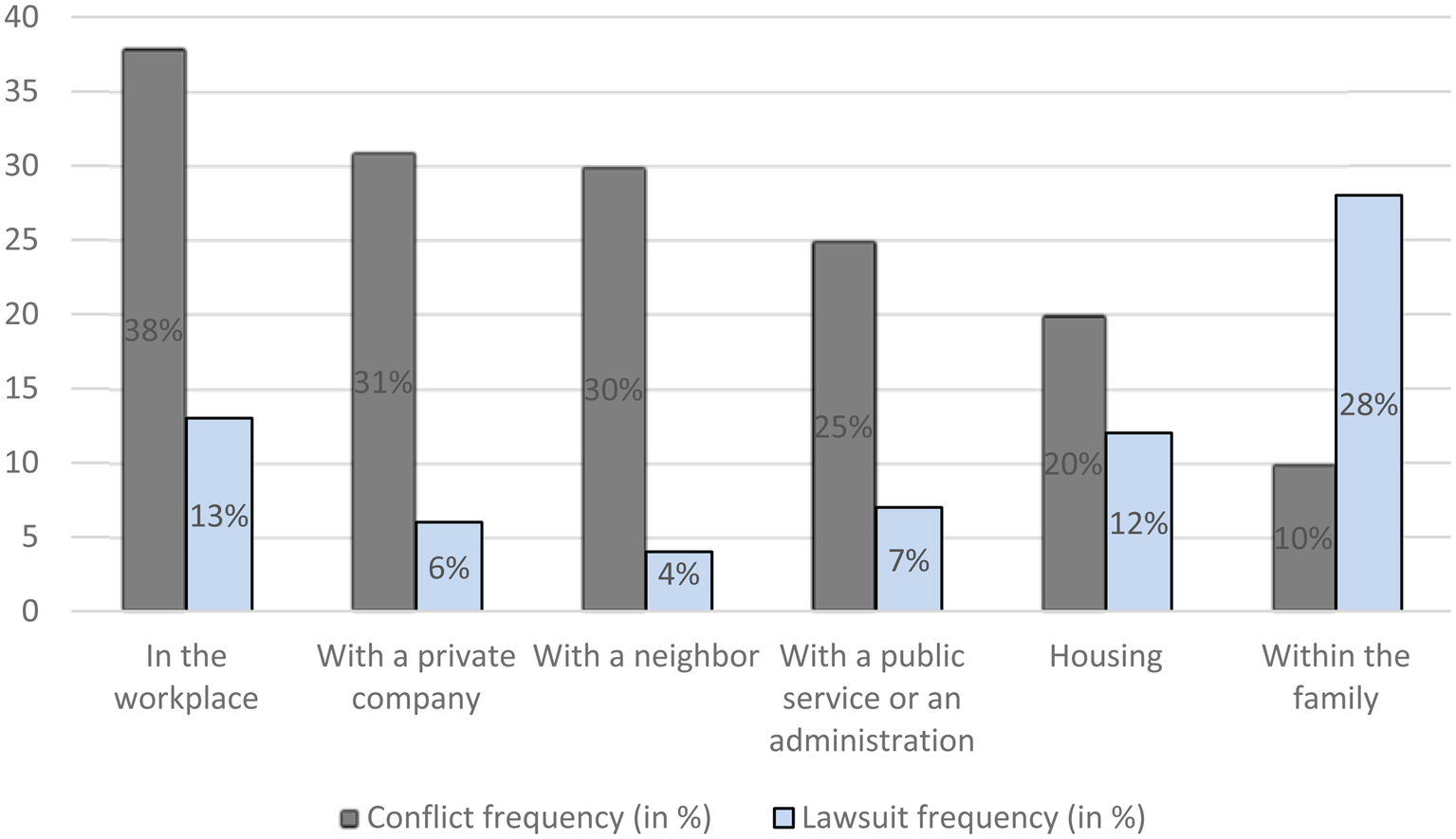
Among the six types of conflict, we focused on the three most frequently reported conflicts (Figure 1). Thirty-eight per cent of respondents had previously had a conflict with an employer or a colleague; 31 per cent with a private company supplying goods and services; and 30 per cent with a neighbour. Respondents who had experienced these conflicts reported that they turned to the courts in 13 per cent of cases of a conflict with an employer or colleague; in 6 per cent of cases of a conflict with a private company supplying goods and services; and in 4 per cent of cases of a conflict with a neighbour. We excluded conflicts with a family member, which lead to legal action in a high percentage of cases but are less frequent among the whole population (10 per cent).
Conflict frequency and lawsuit frequency. Population: respondents who answered the questions about conflicts (N = 2,631). Note: 30 per cent of respondents had a conflict with a neighbour and, among them, 4 per cent brought the conflict to court. Source: PREFACE survey, ‘Pratiques et représentations face à l’État’, January 2017 (ELIPSS/CDSP).

The three types of conflict that we investigated are very different. On the one hand, conflicts with an employer or with a private company involve an asymmetrical relationship between the parties and have historically been constructed as political causes in France, where various social movements have promoted the rights of consumers in the face of large private companies (Pinto, Reference Pinto1989) and the rights of workers in the face of their employers (Willemez, Reference Willemez, Sarat and Scheingold2005). On the other hand, there was no social mobilisation of this kind for conflicts with a neighbour, which involve a more symmetrical relationship between the parties.
3.3 How to measure inequalities in the context of the French legal system
We explore the influence of nine dimensions: gender, income, education, occupational group, context of employment, age, area of residence, nationality and country of birth (European/non-European). Our approach slightly differs from that used in the majority of previous studies on inequalities in access to justice in three main ways.
First, in contrast with many surveys on experiences with the legal system (Genn, Reference Genn1999; Pleasence et al., Reference Pleasence2006), we did not use skin colour or racial self-identification to explain the formation of disputes and access to the courts. For a long time, France was considered a colour-blind society in which ethnicity was not a legitimate criterion for group description. As a result, there is no official categorisation of ethnic or racial groups in the national census. The two criteria used by statisticians are nationality of the respondents and their country of birth. It has recently been possible to include questions about perceived ethnicity in some surveys, but only if the authors of the research obtain authorisation to collect these data by proving that information about ethnicity is crucial for their study (i.e. in studies specifically focusing on the influence of ethnicity). Because our research looked at practices and representations of the state for the whole population and thus did not focus specifically on issues related to ethnicity, we were not allowed to ask questions about race or skin colour. In this context, we used the two criteria available in our data – nationality and country of birth – but both appeared to be non-significant variables in the three types of conflict, probably owing to the small number of respondents in our sample with a foreign nationality and/or born outside of Europe.
Second, we included in our analysis the occupational group variable – namely technicians, blue-collar employees, professionals, service employees, managerial self-employed and agricultural workers. This criterion has always played a structuring role in defining social inequalities in France. For those who are in the active population, we used their current professional position; for those who are retired or unemployed, we used their last professional position. The relevance of the variable of professional position is not limited to the analysis of conflicts with an employer or a colleague. In France, this criterion determines distinct social practices in many different fields, such as the education system (Bourdieu and Passeron, Reference Bourdieu and Passeron1990), cultural tastes (Coulangeon, Reference Coulangeon2015) and food consumption (Plessz and Gojard, Reference Plessz and Gojard2015).
Third, our survey has taken into account the context of employment – namely the self-employed, private-sector employees and public-sector employees – because, in France, each status involves different systems of social protection and appears to be an important criterion for comparing social groups (Hugrée et al., Reference Hugrée, Etienne, Spire and Matthews2015).
4 Analysis: inequalities at each stage of the dispute process
This section analyses how inequalities are produced at each stage of the dispute process, when people identify situations as conflicts (section 4.1), try to resolve these conflicts (section 4.2), decide whether or not they take them to court (section 4.3) and obtain satisfaction or not with the outcome of the conflict (section 4.4).
4.1 Who experiences conflict? Inequalities at the bottom of the dispute pyramid
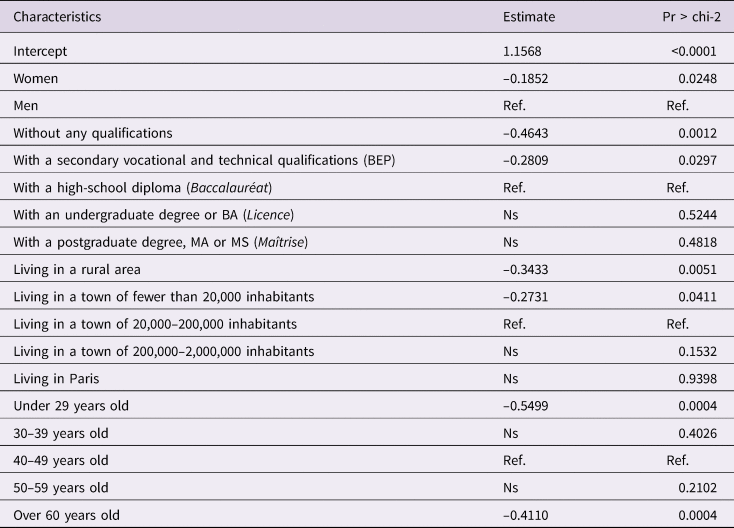
The first stage in the process of legal mobilisation is identifying a problem and considering it an offence or an injurious experience (naming). In order to take this stage into account in our survey, we asked questions about previous experiences of conflicts in different areas. As mentioned above, we will focus here on conflicts with employers or colleagues, with neighbours and with private companies supplying goods and services. We consider the three types of conflict together and we explore the propensity to experience at least one of these conflicts. The logistic regression highlights the characteristics of those who do not engage in conflicts or who do not consider harm to be an injustice (Table 1).
Logistic regression on the probability of experiencing at least one conflict

Ns, not significant; Ref., reference. Source: PREFACE survey, ‘Pratiques et représentations face à l’État’, January 2017 (ELIPSS/CDSP).
Among the respondents, the first common trend is the difference according to gender. Women are less likely than men to perceive an experience as a conflict. This result can be explained by sexist norms of acceptable behaviour for men and women; the decision to trigger a conflict is often guided by shared understandings, beliefs and expectations about how we believe men and women should act (Davis and Greenstein, Reference Davis and Greenstein2009, p. 100). We can make the hypothesis that women experience as many or even more contentious situations than men, but that they do not necessarily describe the situations as conflicts. In conflicts with employers, we can assume that, even if their rights are violated, they do not consider that they are in a position to pursue their rights because they are more likely than men to work in subordinate positions (Savage and Witz, Reference Savage and Witz1992) and they are more rarely unionised (Guillaume, Reference Guillaume2018a) or because they are less likely to perceive injuries as harm. For instance, women do not often view sexual comments from male colleagues as a rights violation (Marshall, Reference Marshall2005). However, in some situations of conflict, the gender difference is blurred. In cases of conflict with a neighbour, perhaps because these conflicts often involve the entire household instead of individuals, the gender difference is less significant than for other types of conflict.
The second common trend is the difference in the level of education. People with a low level of education are less likely to declare a conflict. The most significant difference here is in conflicts with private companies supplying goods and services: 42 per cent of those who have an MA or MS degree (maîtrise) have experienced conflicts of this kind, while only 24 per cent of those without any qualifications have done so. Previous work has demonstrated that the companies involved in these conflicts are not the same: studies have shown that consumers at the top of the social hierarchy have more conflicts with banks and insurance companies (Pinto, Reference Pinto1989, p. 72), while those with a lower level of education have more conflicts with commercial companies such as telecommunication companies. Our survey brings a new element to the analysis: it is not only the type of companies that differs depending on social position, but also the probability of experiencing a conflict with these private organisations. There is also a significant difference for conflicts with an employer or colleague. Forty-three per cent of those with a baccalauréat (a high-school leaving certificate at the age of eighteen) have experienced conflicts at work compared with just 31 per cent of those without any qualifications. The difference is less significant in cases of conflicts with neighbours: 34 per cent of those with a baccalauréat have experienced this type of conflict compared with 28 per cent of those without one. We can assume that those who have obtained a baccalauréat and university degrees experience more conflicts because they consider that they have more legitimacy to define what a conflict is.
We observe a third variation depending on the area of residence. Respondents living in rural areas and small towns of fewer than 20,000 inhabitants are less likely to declare conflicts than others. In such cases, we can assume that it may be more costly to engage in conflict when living in a small, close-knit community: some situations between local actors may be seen as disputes and not as conflicts.
Age is also a significant factor, particularly because respondents aged under twenty-nine or over sixty are less exposed to conflicts than other respondents. For those aged between thirty and fifty-nine, the probability of experiencing conflicts is greater. Two elements can explain this difference. First, in relation to conflicts with employers or colleagues in the workplace, people aged between thirty and fifty-nine are those most likely to be in work: in France, many of those aged under twenty-nine are still in training or occupy temporary positions, which makes it harder to react to labour conflicts. Second, concerning conflicts with neighbours, age is correlated to housing-occupation status: among those who have experienced neighbourhood conflicts, 19 per cent of those aged under twenty-nine are homeowners (and 81 per cent are tenants), whereas 69 per cent of those aged over twenty-nine are homeowners (and 31 per cent are tenants). It is between the ages of thirty and fifty-nine that people tend to become the owners of their main homes, which can lead to conflicts related to noise, property boundaries or lifestyle.
These variations in the propensity to name a situation as a conflict reveal that the first stage in the process of legal mobilisation is related to a set of social characteristics that contribute to the feeling of being entitled to consider a dispute as a conflict. The four relevant characteristics – namely gender, level of education, area of residence and age – suggest a divide between respondents with sufficient resources to engage in a conflict and those who do not feel legitimate to place themselves in a conflict situation.
4.2 The implications of respondents’ first reactions to their conflicts
Once people have identified conflicts, they may have various reactions. We now focus on the subpopulation of the 1,690 respondents who have experienced at least one conflict with a private company, with employers or colleagues, or with a neighbour: 890 have experienced one of these conflicts, 556 have experienced two of them and 244 have experienced three of them. We distinguish four reactions: to do nothing; to manage their conflict by themselves; to get advice from a non-legal professional, such as a trade unionist, a labour inspector, a psychologist, an insurance provider or a mediator; or to turn to a legal professional, such as a private lawyer, a conciliation officer or a notary. These different options are of course not exclusive, and each respondent may, for the same conflict, solicit several people to advise and support them. We will highlight the influence of respondents’ social characteristics on their first reaction to their conflict and on their propensity to contact legal intermediaries. We will examine in the next section how the first response shapes the decision of whether to turn to the courts.
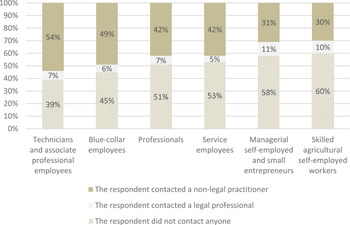
When we consider all types of conflict together, three main criteria influence how respondents react and resolve their conflicts. The first criterion is occupational group. Respondents who work in low-paying jobs and who lack security in employment are those who most often turn to non-legal professionals to help them (a nonprofit organisation, a public administration, a labour union, etc.). But they make relatively little use of legal professionals. Significantly, blue-collar employees and service employees stand out from the other groups because they are those who use legal professionals the least. By contrast, respondents who work as managerial self-employed and small entrepreneurs are less frequently helped by non-legal professionals but are the most likely to seek the help of legal professionals (see Figure 2).
The first response according to occupational group. N = 1,610. Source: PREFACE Survey, ‘Pratiques et représentations face à l’État’, January 2017 (ELIPSS/CDSP).

The distinction between public-sector employees, private-sector employees and the self-employed (context of employment) is also significant in explaining the type of intermediary the plaintiff contacted: more than half of the public-sector employees contacted a non-legal professional, whereas this was the case for 43 per cent of the private-sector employees and only 35 per cent of the self-employed. But when it comes to contacting a legal professional, the self-employed were much more likely to use a legal professional (12 per cent) than employees from the public (7 per cent) and private (6 per cent) sectors were. This difference in the propensity to contact a legal professional can be explained by the fact that the self-employed and small entrepreneurs are the most likely to have previously been in contact with a legal professional or to personally know a lawyer. In a study conducted among taxpayers, it was found that the self-employed deferred to their accountant or lawyer as soon as they had the least conflict with the tax administration (Spire, Reference Spire2018). Significantly, 10 per cent of them turn to a specialist to fill in their tax form, while only 2 per cent of the whole population does this. Symmetrically, they are also the most likely to turn to a legal professional when they experience a conflict.
The third criterion is age. Younger respondents are less likely to turn to legal intermediaries when they face a conflict than older respondents. This is not only true for contact with a legal professional, but also for advice from a non-legal professional. Indeed, 31 per cent of respondents aged under twenty-nine turned to a non-legal professional compared with 49 per cent of those aged over fifty. Similarly, 3 per cent of respondents aged under thirty-nine turned to a legal professional to resolve their conflict compared with 12 per cent of respondents aged between fifty and fifty-nine.
When respondents experience a conflict, contact with a legal intermediary varies significantly depending on their social characteristics. We observe a clear divide between those who are networked and have had previous connections with legal professionals, namely the self-employed, managers and small entrepreneurs or the oldest respondents, and those who lack these types of resources, namely blue-collar workers, private-sector employees and the youngest respondents.
4.3 Going to court or finding another way to resolve a conflict
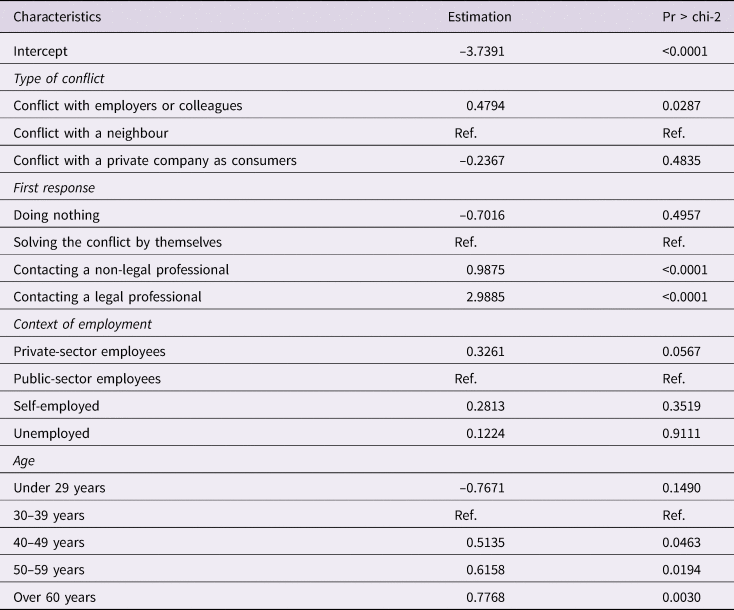
We will now focus on who turns to the courts and who does not. As previously, we consider the three types of conflict together and we explore the propensity to initiate, or not, legal action in at least one of these conflicts. It is important to mention here that the propensity to take legal action varies depending on the type of conflict, as respondents who experienced a conflict with employers or colleagues more frequently turned to the courts than those who experienced other types of conflict (see Table 2).
Logistic regression on the probability of initiating at least one legal action

Ref., reference. Source: PREFACE survey, ‘Pratiques et représentations face à l’État’, January 2017 (ELIPSS/CDSP).
4.3.1 The decisive influence of contact with a legal intermediary
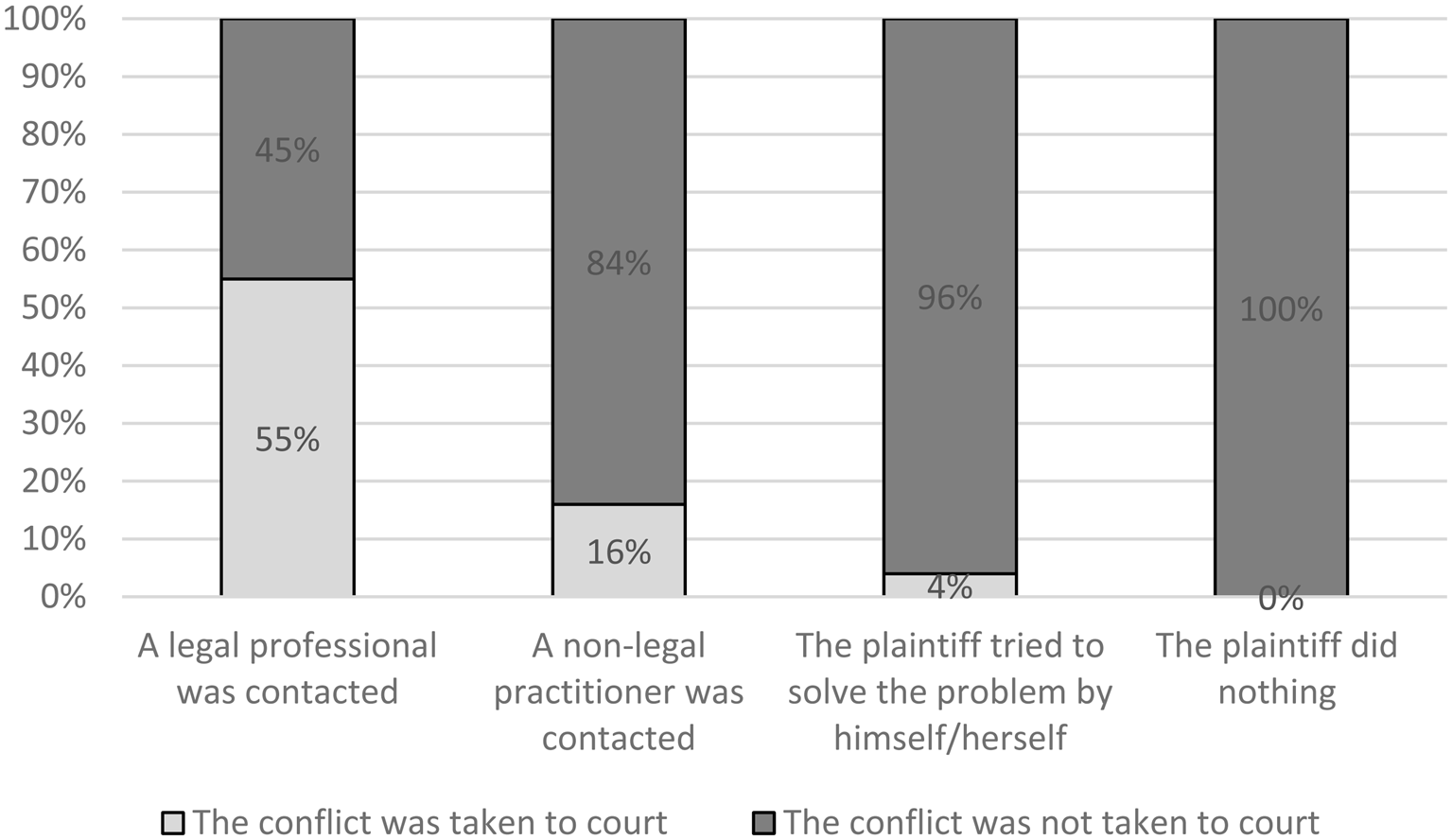
All other things being equal, contact with a legal intermediary, who may be a legal professional or a non-legal professional, has a very significant impact on the decision to take the case to court. As expected, the probability of turning to the courts is the highest when respondents contacted a legal professional: 55 per cent of conflicts in which respondents contacted a legal professional were taken to court (Figure 3). More importantly, our survey shows that getting advice from a non-legal professional is also significant. Conflicts that individual claimants first tried to resolve by turning to a non-legal professional are much more likely to be taken to court (16 per cent) than conflicts that respondents first tried to resolve by themselves (4 per cent) and, obviously, those in which respondents did nothing (0 per cent). These non-legal professionals may refer to different types of actors: in a conflict with an employer, it may be a union delegate or a work inspector; in a conflict with a neighbour, a local administration or nonprofit organisation; in a conflict with a private company, a consumer association or a mediator. In France, most of these intermediaries are not legal professionals, but they often have legal knowledge and expertise, and they are used to going to court. They thus usually consider the use of the law as a relevant tool for solving a conflict.
Probability of a conflict being taken to court. N = 1,681 (number of conflicts reported by respondents). Source: PREFACE Survey, ‘Pratiques et représentations face à l’État’, January 2017 (ELIPSS/CDSP).

These figures show that contact with a non-legal professional, or even more significantly with a legal professional, is the most important step in the decision to take legal action. Knowing how to seek advice, how to choose the right intermediary and how to adapt one's strategy according to the advice received are all factors that facilitate or impede use of the courts and, as a consequence, that amplify pre-existing social inequalities among plaintiffs.
4.3.2 Negotiating a settlement or going to court? The influence of claimants’ social characteristics
The claimant's social characteristics may also affect the propensity to use the court system or to avoid it, independently of his or her contact with a legal intermediary. Three results of our survey are important in explaining the unequal propensity to go to court.
First, all other things being equal, context of employment significantly influences the decision to take legal action in all types of conflict. Private-sector employees who have experienced a conflict are more likely to go to court than public-sector employees (Table 2). To explain why being self-employed is not a significant variable, we can assume that the self-employed are those who are the most likely to turn to a legal professional and to negotiate a good settlement outside the courtroom, because they know that going to court is not necessarily the best way to defend one's interests. Significantly, as demonstrated in the next section, many self-employed people seek advice from a legal professional and obtain a satisfactory solution without going to court.
Second, another difference among respondents is based on age. Older respondents are more likely to turn to a legal intermediary and to resolve their conflicts in the courtroom than younger respondents. Besides the influence of contact with a legal intermediary, two main factors may explain their higher propensity to take legal action. On the one hand, older people have a better knowledge of the possibilities of legal actions due to a longer experience of conflicts. On the other hand, they feel more secure to litigate than younger respondents, who consider litigation as too costly in a context in which they occupy a temporary position in the labour market and live in temporary rental housing. The propensity to take legal action increases, all other things being equal, when respondents reach their thirties: when they have a more stable employment position, become owners of their property and have more routinised relationships with private companies supplying goods and services, such as their bank or insurance provider.
Third, in contrast with the assessment made in many other studies on inequalities in access to the legal system, another important result of our survey is that income does not play a significant and direct role in using the courts. The wealthiest respondents do not turn more frequently to the courts than others.
These three results taken together suggest that lay people who experience a conflict have a third option, in addition to going to court or doing nothing: they can obtain satisfaction through an informal negotiation or a settlement. In some cases, those who turned to the courts were those who had no other option: they did not have the means to negotiate using the advice of a legal professional or could not negotiate a good settlement. We make the hypothesis that the best-advised and most skilled respondents were able to obtain satisfaction, both inside and outside the courtroom. To confirm this hypothesis, we will explore in the next section unequal satisfaction with the outcome of the conflict.
4.4 Unequal satisfaction with the outcome of the conflict
Inequalities among litigants are not limited to their unequal access to the civil justice system. Satisfaction with the outcome of the conflict is also a key element, whether the conflict was resolved through a trial or through an extralegal mechanism. Our analysis demonstrates three main dimensions of unequal satisfaction with the outcome.
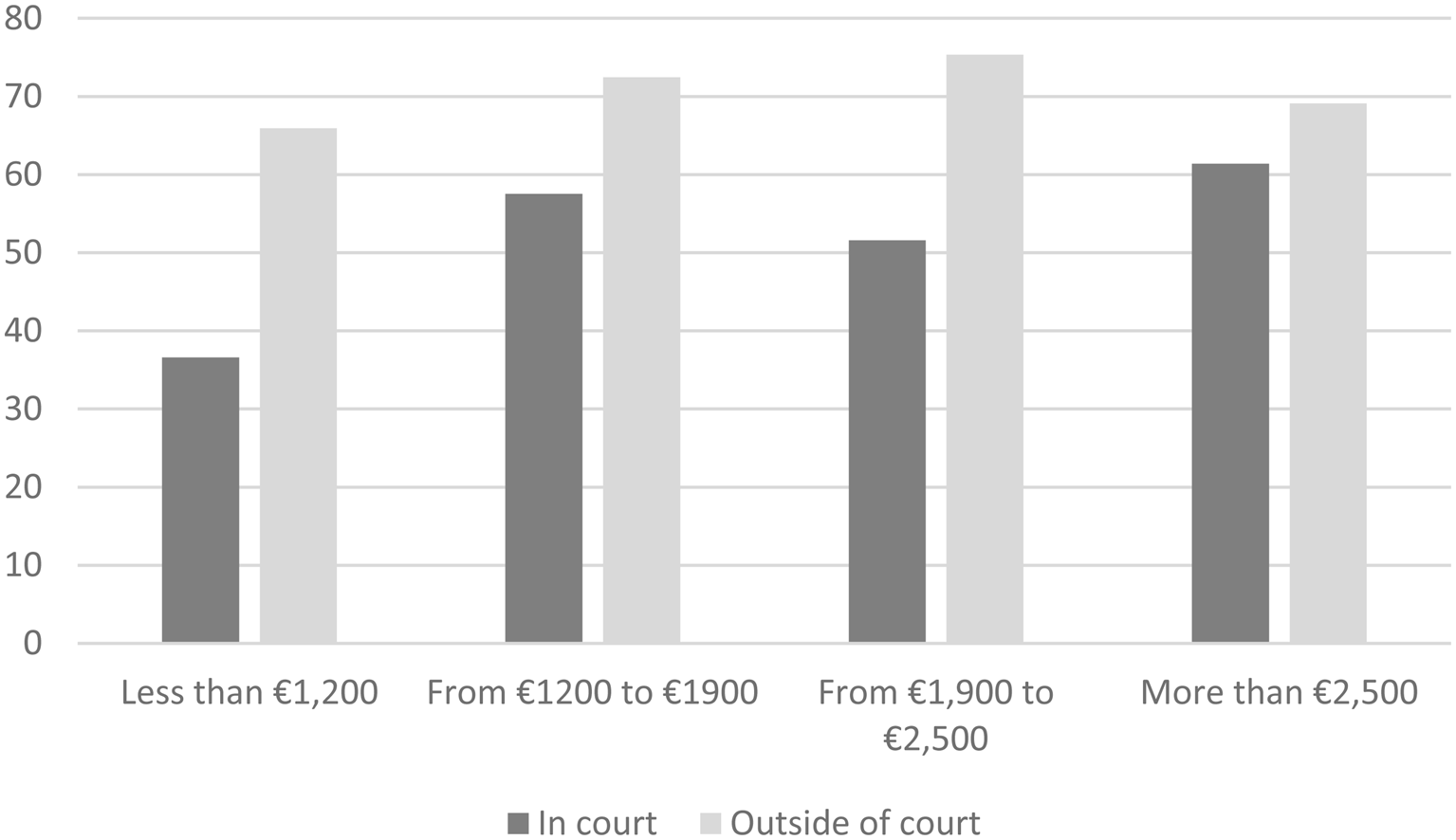
First, satisfaction with the outcome of the conflict is higher among respondents who did not turn to the courts. Indeed, if we compare respondents’ satisfaction with the outcome of the conflict, those who were the most satisfied are those who did not turn to the courts and who found an extralegal solution to their conflict. This result is important because it shows that going to court is not necessarily the best way to enforce one's rights: 49 per cent of those who resolved their conflicts in courtFootnote 3 were satisfied with the outcome of their conflict compared with 69 per cent of those who resolved their conflict outside of court. Such a significant gap can probably be explained by two reasons. First, respondents who decided to turn to the courts spent money, time and energy in their trial. Throughout this process, they nurtured higher expectations and hopes regarding the outcome of their trial than those who resolved their conflicts outside the courtroom. As a result, they are less likely to be satisfied with the decision because of their personal involvement in the conflict. Second, once they decided to take legal action, they gave the judge the power to make a decision to resolve their conflict and were no longer involved in its resolution. Thus, they were more likely to feel dispossessed of their conflict and the decision associated with it than those who negotiated a solution with the other party.
Second, contact with a legal intermediary influences satisfaction with the outcome, but not in the same way for all plaintiffs. If we focus only on respondents who contacted a legal professional, whether they turned to the courts or resolved their conflict outside of court, we observe that satisfaction with the outcome of the conflict seems to vary depending on context of employment. Although our sample of respondents who contacted a legal professional is too small to make general statements (N = 122), it is relevant to highlight that 90 per cent of the self-employed respondents who got in contact with a lawyer were satisfied with the outcome of the conflict, while this rate falls to 70 per cent for private-sector employees and to 67 per cent for public-sector employees. This difference suggests that contact with a legal professional does not influence the dispute process in the same way for all plaintiffs: the assistance of a lawyer seems more useful in obtaining satisfaction for the self-employed than for employees.
Third, satisfaction with the outcome of the conflict depends on plaintiffs’ economic capital and, more precisely, on their income (Figure 4). The higher their household income, the more likely people are to be satisfied with the outcome of the conflict. Interestingly, we observe a more significant impact for litigated conflicts: income is a more determining factor in satisfaction with the outcome when the judge makes a decision than when a solution is found outside the courtroom. This result sheds light on the unequal experiences with the legal system (Spire and Weidenfeld, Reference Spire and Weidenfeld2011): when people turn to the courts, the wealthiest respondents are much more likely to be satisfied with the legal decision than low-income respondents.
Satisfaction with the outcome depending on monthly income. Population: respondents who have experienced at least one conflict (N = 1,690). Source: PREFACE survey, ‘Pratiques et représentations face à l’État’, January 2017 (ELIPSS/CDSP).

5 Discussion
In this section, we will focus on two of our results that challenge or complement existing explanations of inequalities in access to the civil justice system. First, there are inequalities among plaintiffs at each stage of the dispute and the contact with a legal intermediary significantly increases inequalities among plaintiffs. Second, further attention has to be paid to the differentiated role and influence of legal and non-legal professionals in France.
5.1 The choice of legal intermediary creates inequalities among plaintiffs at each stage of the dispute pyramid
Our quantitative data show that once a situation has been identified as an injustice, the type of legal intermediary contacted contributes to creating, or increasing, inequalities among respondents.
At the bottom of the pyramid, respondents view themselves as having more or less legitimacy to perceive an experience as an injury. Naming a conflict is always an early stage in a dispute and the statistical measure of this injurious experience is a way to ‘identify the social structure of disputing’ (Felstiner et al., Reference Felstiner, Abel and Sarat1981, p. 636). For all types of conflict, the propensity to name an injurious experience as a conflict is higher among men than women; among those who have an MA or MS degree than among those without any qualifications; among those who live in urban areas than among those who live in rural areas; and among the oldest respondents than among the youngest. These results are particularly important because they allow us to better understand the social characteristics of those who do not experience conflicts or disagreements in any area of their lives. The respondents who do not name any injuries have been analysed less by the literature on the dispute pyramid, primarily due to the methodological difficulties of getting access to this population. At the second level of the pyramid, the type of legal intermediary that people contact becomes a key factor that creates inequalities among those who have experienced a conflict. Depending on their occupational group, context of employment and age, French people turn to different legal intermediaries. Indeed, small entrepreneurs and managerial self-employed, as well as older respondents, are more likely to turn to a legal intermediary, such as a lawyer, than other respondents. The link between social position and the use of a legal intermediary (e.g. a private lawyer) is a significant dimension of inequality before the law. At the third level of the pyramid, namely the decision to take legal action, the type of legal intermediary contacted reinforces inequalities among litigants: the likelihood of a conflict being taken to court is much higher if the legal intermediary contacted was a legal professional than if it was a non-legal professional.
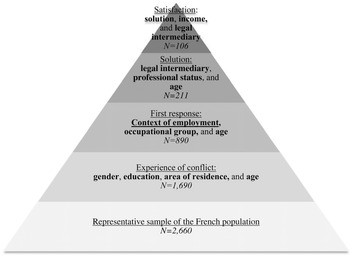
In other words, these results show that social inequalities are cumulative and occur at each level of the dispute pyramid: at the point when people identify conflicts, when they decide to take an action and when they turn to the civil legal system (Figure 5). More precisely, the role played by legal intermediaries varies depending on the social position of those who call upon them. On the one hand, respondents with a lower educational level, lower income or a subordinate professional position are less likely to turn to a legal professional and to decide to take legal action than other respondents. On the other hand, even if they contact a legal professional and decide to take legal action, they are less likely to be satisfied by the outcome of the conflict.
Inequalities at each stage of the dispute pyramid. Population: respondents who answered the survey (N = 2,660). Source: PREFACE survey, ‘Pratiques et représentations face à l’État’, January 2017 (ELIPSS/CDSP).

Finally, our study's introduction into the dispute pyramid of the final stage of legal proceedings, that of obtaining satisfaction with the outcome, nuances the view, found in many socio-legal studies, that the courtroom is the best place to pursue and achieve rights (Felstiner et al., Reference Felstiner, Abel and Sarat1981, p. 654). Our study reveals that recourse to the law and the legal system does not necessary lead to a higher satisfaction rate than other methods of dispute resolution. It contradicts an implicit idea commonly shared within the socio-legal literature that going to court is the best way to redress situations of injustice. Satisfaction does not necessarily require taking the case to court, but depends on the ability to choose the most efficient legal intermediary. The intervention of a legal intermediary plays a key role, both inside and outside the courtroom, and explains to a large extent why satisfaction with the outcome varies depending on social group.
5.2 The role of legal intermediaries in the French dispute process
Although the socio-legal approach has increasingly influenced empirical research in France in recent years (Commaille, Reference Commaille2015; Israël, Reference Israël2013), until now there has been no quantitative investigation that has tested the dispute pyramid model, originally developed in the US, in the French context. Our survey on ordinary people's experiences of the civil legal system is the first study of this kind conducted in France.
Our analysis reveals that the dispute process takes different forms depending on the national context and, more precisely, on the characteristics of the legal system, of the role of legal intermediaries and of the structure of social inequalities. In line with previous studies conducted in other countries (Blankenburg, Reference Blankenburg1994; Genn, Reference Genn1999; Hertogh, Reference Hertogh2004), we have also observed that, in France, only a minority of disputes progress into becoming legal claims. However, the law does not affect ordinary French citizens’ experiences of conflicts in the same way as it does in other national contexts. Three main specificities of the French context may explain the different role played by legal intermediaries.
First, people living in France who experience a conflict are much less likely to turn to a legal professional in comparison with people living in other countries. In France, legal professionals are conceived of as possessing knowledge of the state, rather than as serving the needs of the population, as in the US (García Villegas, Reference García2006, p. 369). In this context, the propensity to contact a legal professional when a conflict arises is relatively low in France, at around 7 per cent (according to the PREFACE survey). The small number of lawyers relative to the population, in comparison with other countries, reflects this specificity. Significantly, in 2016, there were only ninety-three lawyers per 100,000 inhabitants in France compared with 147 for the same population in Belgium, 201 in Germany, 263 in Spain and even 4,000 in the US.Footnote 4
Second, although the propensity to turn to a legal professional is low for the whole French population, there are significant inequalities in the probability of contacting a legal professional depending on the plaintiffs’ social characteristics. Our study shows that unequal access to a legal professional is closely linked to social groups: respondents with a lower level of education, lower income or a subordinate professional position are less likely to turn to a legal professional than others. Working-class and middle-class individuals do not usually use lawyers to advise them of their rights before a dispute arises (Abel, Reference Abel, Abel and Lewis1989; Boigeol and Willemez, Reference Boigeol, Willemez and Felstiner2005); they usually get in contact with legal professionals after they have already made the decision to go to court (Salin, Reference Salin2020). This is not the case for managers and the self-employed, who frequently use legal professionals in the normal course of their work. This result can also be observed in other areas of law, such as in family civil justice cases, for which the inequalities between social groups are more significant than those related to gender (Bessière and Gollac, Reference Bessière and Gollac2017). In comparison with the proliferation in the US of public-interest law firms and legal-aid services that aim to assist claimants with low economic resources, in France, lay people with few resources have only two options: hiring a private lawyer or contacting a non-legal professional. Those who meet the conditions to benefit from legal-aid programmes can turn to a private lawyer, but the majority will prefer to contact a non-legal professional. For instance, our study shows that after a conflict in the workplace, 56 per cent of respondents contacted a non-legal professional, such as a union delegate or a work inspector.
More importantly, a third specificity of the French system is the institutional infrastructure of legal services that filter disputes at the pretrial stage (Blankenburg, Reference Blankenburg1994). These institutions are unions, social services or community legal services known as ‘Maisons de justice et du droit’. They employ non-legal professionals who also assist plaintiffs. However, they do not influence the dispute process in the same way as the services provided by lawyers do. Indeed, our findings show that the propensity to take a conflict to court significantly increases if a lawyer was contacted. In France, non-legal professionals provide legal advice to people involved in legal proceedings who cannot afford a lawyer, but rarely encourage them to turn to the civil legal system. In other words, although the low number of lawyers in relation to the population is compensated for by the presence of these non-legal professionals, they do not play the same role. These non-legal professionals are more likely to filter plaintiffs out of the court system and to avoid civil litigation than legal professionals.
6 Conclusion
Based on a representative sample of the population, and tracing each stage of the conflict-resolution process, this paper has improved our understanding of the dispute pyramid in three ways. First, our research has shown how inequalities are produced and exacerbated at each stage of this process. Our results show that there are social inequalities among plaintiffs when people identify situations as conflicts; when they try to resolve the problem; when they decide to take their conflict to court; and when they obtain satisfaction from the court decision. Second, we showed that the type of legal intermediary that people contacted to resolve their conflict creates inequalities. The contact with a legal professional (e.g. a private lawyer) increases not only the propensity to turn to the courts, but also the likelihood of obtaining satisfaction with the outcome of the conflict. Third, our survey conducted in France reminds us that the observations made in the US and in other countries concerning the conditions of access to the legal system are not universal and need to be adapted to the characteristics of each national context. In the case of France, when a conflict occurs, the choice to contact a legal professional is relatively rare because most people turn to non-legal professionals first. Our study demonstrates that inequalities before the civil legal system depend not only on unequal awareness of the law and legal procedures, but also on unequal contact with legal professionals and on the trust that ordinary people have in them. It would be relevant to broaden this analysis to other countries, in order to highlight how the experiences and representations of the legal system vary from one country to another, depending on the characteristics of the legal system, access to legal intermediaries and the structure of inequalities.
Conflicts of Interest
None
Acknowledgements
This publication is part of a broader project entitled ‘The Ordinary Practices and Representations of the Governed in their Dealings with the State’, co-ordinated by Alexis Spire and supported by the French National Research Agency (ANR-15-CE28–0009). Previous versions of this paper were presented at the Law & Society Association Annual Meeting in Washington, DC, in May 2019, at the conference ‘Inequalities in the Practices of the Legal Institution’, organised at the University of Lille in June 2019, and at the conference ‘Facing the State’ at Columbia University Paris in January 2020. The authors gratefully acknowledge Fabien Jobard, Anna-Maria Marshall, Etienne Penissat, Cécile Rodrigues and Susan Silbey for their useful comments on earlier drafts. We also would like to thank Sam Ferguson for his careful work in editing the text of this paper prior to submission.