1 Introduction
The current paper examines the adaptation of the English obstruents /ʃ ʧ ʤ/ to Contemporary Korean (1890–present) and investigates how the adaptation pattern evolved from Enlightenment Period Korean (1890–1910), which marked the beginning of Contemporary Korean and also the onset of substantial contact between English and Korean, through 1930s Korean, to Present-day Korean (1990–present). While the demarcation of PDK is driven by the loanword data we examine, 1990s is also the decade when South Korea began to encounter substantial direct contact with English after hosting the Olympic Games in 1988 and with the lifting of restrictions on foreign travel in 1989.
The English posterior coronal obstruents /ʃ ʧ ʤ/ are often adapted with a /j/ or /w/.Footnote 1 The palatal glide /j/ mimics the posterior constriction and the accompanying fronted tongue-body position in the English posterior coronals (Lass Reference Lass1976, Ladefoged & Maddieson Reference Ladefoged and Maddieson1996, Stevens Reference Stevens1998, among others), whereas /w/ reflects the lip-rounding gesture that often accompanies the same consonants in English (Jones Reference Jones1950, Gimson Reference Gimson1980, Rogers Reference Rogers2000, among others). However, Korean has a series of co-occurrence restrictions involving glides, and as a result, the distribution of the glides is conditioned by the interaction of the native language's phonotactic constraints and the demand for faithful preservation of the particular characteristics of the sound in the input language. The primary empirical focus of the current study is the distribution of the labial-velar glide /w/. Since the lip-rounding gesture in the English posterior coronal consonants is considered to be a surface enhancement, an analysis of the loanword data can inform the debate on whether the input to adaptation includes these kinds of phonetic details or not.
The lip-rounding gesture in English posterior coronal consonants is a surface enhancement of the primary place feature and does not itself constitute a phonologically distinctive feature (Keyser & Stevens Reference Keyser and Stevens2006). Differing views on the nature of the input to loanword adaptation make different predictions about how such surface phonetic attributes are treated in adaptation. Some have argued that the input is the phonological representation in the source language, devoid of redundant phonetic details (Paradis & LaCharité Reference Paradis and LaCharité1997, Reference Paradis and LaCharité2008, Reference Paradis and LaCharité2009, Shinohara Reference Shinohara, Kager, Pater and Zonneveld2004, LaCharité & Paradis Reference LaCharité and Paradis2005, Paradis & Tremblay Reference Paradis, Tremblay, Calabrese and Wetzels2009), and they predict the lip-rounding gesture to be unrepresented in the loanword adaptation. One cannot evaluate this view without a definitive statement on what counts as being part of the phonological representation and what counts as being redundant phonetic details (see Y. Kang Reference Kang2008a for related discussion). However, it seems reasonable to assume that most theories of phonology that make a distinction between abstract phonological features and surface phonetic details would treat the lip rounding in these consonants as being external to the phonological representation proper.
Others, on the other hand, have assumed that the input to adaptation is the acoustic representation in the source language, including all phonetic details of the source language sounds, regardless of their phonological status in the input language (Silverman Reference Silverman1992, Yip Reference Yip1993, Peperkamp Reference Peperkamp2005, Iverson & Lee Reference Iverson and Lee2006, Peperkamp et al. Reference Peperkamp, Vendelin and Nakamura2008, Boersma & Hamann Reference Boersma, Hamann, Calabrese and Wetzels2009, among others), and this latter view predicts that the lip rounding will be represented in the adaptation.
However, as has been pointed out by Rose & Demuth (Reference Rose and Demuth2006), some of the disagreements in the debate on the nature of loanword phonology may stem from the different methodological approaches used by researchers and, in a related manner, differing assumptions regarding what counts as a loanword. Some linguists focus on online adaptations (by monolinguals or bilinguals), which would correspond to the initial stage of loanword adaptation, whereas others focus on established loanwords which have been sanctioned by norms of the community. Although these two endpoints are expected to be closely related, we find varying degrees of variability and sometimes different patterns of adaptation (cf. Haugen Reference Haugen1950, Y. Kang Reference Kang2009). Also, given the same two languages, depending on the sociolinguistic circumstances of the contact and the channel of borrowing, the outcome of adaptation can differ significantly (Yip Reference Yip2002, Smith Reference Smith, Vance and Jones2006, Heffernan Reference Heffernan2007, Friesner Reference Friesner2009a, Y. Kang, forthcoming). Moreover, adaptations of both types – phonological and phonetic – are often attested within a single contact situation (Friesner Reference Friesner2009a, Reference Friesner, Calabrese and Wetzelsb, Chang, to appear, Y. Kang, forthcoming). In other words, there is growing awareness of the multi-faceted nature of loanword phenomena in the field, and in order to gain a comprehensive understanding of loanwords, it is informative to examine how adaptation forms are transmitted through the community (cf. Poplack & Sankoff Reference Poplack and Sankoff1984, Davidson Reference Davidson2007 and Friesner Reference Friesner2009a, among others) and are transformed over time (cf. Sicoli Reference Sicoli2000, Crawford Reference Crawford2007, Reference Crawford2008, Y. Kang et al. Reference Kang, Kenstowicz and Ito2008, among others). The current study contributes toward this end.
Specifically, I examine how lip rounding in English posterior coronals is treated in the adaptation process during different periods of Contemporary Korean: Enlightenment Period Korean (EPK), 1930s Korean and Present-day Korean (PDK). We will see that in PDK loans the rounding in English posterior coronal affricates is mostly unrepresented, in agreement with previous studies (Iverson & Lee Reference Iverson and Lee2006, H. Kim Reference Kim, Calabrese and Wetzels2009); thus this appears to be a good example of ‘phonological’ adaptation. However, when we examine data from earlier stages of the adaptation, we will see that the rounding was actually often represented. Based on this data, I propose a model of how an apparent case of ‘phonological’ adaptation can arise over time from what was essentially a ‘phonetic’ adaptation.
The paper is organised as follows: §2 provides background on Korean phonology, §3 presents the empirical findings of the study, §4 provides a discussion of the results and §5 concludes the paper.
2 Background
In this section, I will provide an overview of the relevant aspects of Korean phonology. Except for the minor changes that will be discussed below, the phonology of Korean has not changed significantly from Enlightenment Period Korean, which marked the beginning of Contemporary Korean, to Present-day Korean. The phoneme inventory of Korean is provided in (1).Footnote 2
(1)


Korean has a three-way laryngeal distinction of lenis, aspirated and fortis obstruents. In PDK, the English voicing contrast in stops and affricates is adapted as an aspiration contrast, as in date→/teithɨ/. In 1930s Korean, voiced stops and affricates were adapted as their Korean fortis counterparts word-initially, and this pattern persisted into PDK for certain lexical items, such as game→/k'eim/ (Choi Reference Choi2001, Reference Choi2002, Y. Kang Reference Kang2008b). The voicing contrast in coronal fricatives, however, is adapted as a manner contrast in PDK – the English voiceless fricative /s/ is adapted as one of the Korean fricatives /s/ or /s'/, whereas the voiced fricative /z/ is adapted as the lax affricate /ts/, as in size→[s'aitsɨ]. Unlike the general pattern in PDK, /z/ was often adapted as /s/ or /s'/ in EPK and the 1930s (Y. Kang Reference Kang2009). See Kenstowicz (Reference Kenstowicz and Rhee2005), Iverson & Lee (Reference Iverson and Lee2006) and H. Kim (Reference Kim, Calabrese and Wetzels2009) for an overview of consonant adaptation from English to PDK. The adaptation of posterior affricates and fricatives of English, which is the focus of this paper, will be discussed in detail below.
The syllable template of Korean is CGVC. There are various co-occurrence restrictions on the glide and its adjacent segments. The restrictions on glide+vowel (GV) sequences are summarised in (2). The high central vowel /ɨ/ is not allowed with either glide – */jɨ/, */wɨ/. In addition, /j/ cannot occur with /i/, and /w/ cannot occur with /u/ or /o/. These restrictions hold categorically as morpheme-structure constraints and surface level constraints both in native words and loanwords.
(2)
There are also co-occurrence restrictions against certain consonant+glide (CG) sequences. For example, there are morpheme-structure constraints against sequences of a labial consonant and /w/ and sequences of a coronal obstruent and /j/, as summarised in (3). These sequences may nevertheless arise in the output via morphophonological derivation.
(3)
In addition to these categorical restrictions, glides are frequently deleted in casual speech in postconsonantal position. The palatal glide is systematically deleted postconsonantally before a front vowel (Hong Reference Hong1994, H.-S. Kang Reference Kang1997, Choi Reference Choi2002, Chung Reference Chung2002, Cha & Ahn Reference Cha and Ahn2004); H.-S. Kang (Reference Kang1997) found that /j/ is deleted before /e/ 90% of the time postconsonantally in PDK. Chung (Reference Chung2002) analysed recordings of news broadcasts from the 1950s to 2000s, and found that the rate of /j/-deletion before a front vowel was as high as 80% even in the 1950s, which indicates that postconsonantal /j/-deletion before a front vowel is not a recent change. In fact, this deletion was also attested in 1930s Korean (Han Reference Han2005) and EPK (Y.-B. Kim Reference Kim and Jong-Sun2000). Henceforth, I will refer to this restriction against postconsonantal /j/ before a front vowel as *Cje.
The labial-velar glide /w/ is frequently deleted postconsonantally and most notably following a labial consonant (Silva Reference Silva1991, H.-S. Kang Reference Kang1997, J. Lee Reference Lee2004, Cha & Ahn Reference Cha and Ahn2004). H.-S. Kang (Reference Kang1997) reports an 81% rate of /w/-deletion following a labial consonant, but a much lower rate of deletion following coronal consonants: 11% for affricates and 23% for other coronal consonants. There is disagreement as to whether the backness feature of the following vowel has any effect on the rate of postconsonantal /w/-deletion. Silva (Reference Silva1991) and J. Lee (Reference Lee2004) found that /w/-deletion was more likely to occur before front vowels than before back vowels, whereas H.-S. Kang (Reference Kang1997) found a statistically non-significant trend in the opposite direction. Whatever the following vowel effect may be (if any), we can safely assume that /w/-deletion following non-labial consonants is not as systematic as the postconsonantal /j/-deletion that occurs before front vowels (*Cje). For our purposes, we can simply note that there are no systematic restrictions against coronal obstruent+/w/ sequences, nor are there any systematic co-occurrence restrictions against /w/ and any following vowels, other than the categorical restrictions noted in (2).
Before we turn to the diachronic data on the adaptation of English posterior coronal obstruents, I will discuss how current normative conventions dictate how these consonants should be adapted and transcribed (Ministry of Education 1986).Footnote 3 In Hangul, the native Korean alphabet, letters are written in blocks, each block roughly correspondingly to a syllable. The separation of blocks is represented by a period in this paper, and orthographic representations are given in < >.
First, English /ʃ/ is adapted as Korean <s> before /i/ and as <sj> before other vowels. Both are pronounced as [ʃ] on the surface, due to an allophonic palatalisation rule in Korean (Hwang Reference Hwang2004, K.-S. Kang Reference Kang2009, H. Kang Reference Kang2010). Examples are provided in (4a). Korean does not allow fricatives in non-prevocalic position; when /ʃ/ occurs word-finally an epenthetic vowel /i/ is inserted, and when /ʃ/ occurs before /ɹ/ an epenthetic vowel /u/ is inserted, as shown in (4b). It is notable that sequences of a coronal fricative and /j/, not found within native morphemes (cf. *Tj in (3)), are nevertheless allowed in loanwords.Footnote 4
(4)
According to the convention, English /ʧ/ is adapted as Korean /tsh/ and English /ʤ/ and /ʒ/ are both adapted as Korean /ts/. As with /ʃ/, in non-prevocalic position an epenthetic vowel /i/ is added following these consonants. Some examples are provided in (5).
(5)
Previous descriptions of the adaptation of English posterior coronal obstruents in the literature generally agree with normative conventions (Oh Reference Oh1992, Hahn Reference Hahn2005, Iverson & Lee Reference Iverson and Lee2006, H. Kim Reference Kim, Calabrese and Wetzels2009, H. Kang Reference Kang2010, Heo Reference Heo2010, among others), but there are some important exceptions.Footnote 7 First, many observe that /ʃ/ is adapted as /sw/, with a labial-velar glide, before /i/, and as /sj/ elsewhere (Hahn Reference Hahn2005, Iverson & Lee Reference Iverson and Lee2006). A slightly different generalisation is given by H. Kim (Reference Kim, Calabrese and Wetzels2009), who states that /ʃ/ is adapted as /sj/ before all back vowels, and as /sw/ before all front vowels.
The pattern for affricates found in loanwords is somewhat ambiguous. Contrary to normative conventions, in actual usage these affricates are often transcribed with palatal glides (i.e. <tsj> and <tshj>) (Shin Reference Shin1998, K.-S. Kang Reference Kang2006), as the examples in (6) illustrate.Footnote 8
(6)
The phonological and phonetic status of <j> in these words is unclear, and slightly different descriptions of the facts are found in the literature. H. Kim (Reference Kim, Calabrese and Wetzels2009) states that English posterior coronal affricates are adapted as sequences of affricates and /j/ before back vowels. K.-S. Kang (Reference Kang2006, Reference Kang2009), on the other hand, argues that the affricate+<j> sequences are acoustically and perceptually indistinguishable from their corresponding simple affricates. As we will see below in Fig. 2, there is a clear asymmetry between the adaptation of the posterior coronal fricative /ʃ/ and affricates in terms of the distribution of <j>, but at the same time, <j> occurs substantially often enough not to be dismissed as a spurious spelling effect. For the purposes of the present study, I will simply assume that the <j> spelling in the adaptation of these affricates has some phonological reality. As for /w/, the literature is in agreement that it does not occur in affricate adaptations in PDK. Given this background, we will now examine the distribution of glides, in particular <w>, in the adaptation of English posterior coronals in the three time periods of Contemporary Korean.
3 Data
3.1 Data sources
During the Enlightenment Period, many Western words entered Korean. Many of the borrowings during this period were transmitted to Korean through Japanese or Chinese and transliterations based on Sino-Korean characters were quite common, as in Spain /sʌpana/ ( ) and Turkey /thoiki/ (
 ) (M.-R. Kim Reference Kim and Jong-Sun2000). Purely sound-based transliterations were also found, and increased over time (J.-Y. Lee Reference Lee2008). For the purposes of the present study, we will focus on cases of sound-based transliterations only. The data for EPK come from three loanword lists: Y.-H. Kang (Reference Kang1971), Y.-S. Park (Reference Park1997) and Han (Reference Han2007a).
Y.-H. Kang (Reference Kang1971) provides a list of Western, mostly English, sound-based loans used in 37 textbooks published during the Enlightenment Period. The list contains over 900 items and provides the source language's input word for each item. Y.-S. Park (Reference Park1997) gives a book-length list of loanwords compiled from textbooks, newspapers and novels published during the Enlightenment Period. From this list, I selected purely sound-based loanwords for which the source language input word was clearly indicated. Han (Reference Han2007a) provides a list of loanwords gathered from three major newspapers published during EPK.Footnote 9 Here also, I selected only the sound-based loanwords for which the source language's input word was clearly specified. There were very few examples of /ʒ/ adaptations in these lists and in the lists from other periods, so we leave aside the adaptation of /ʒ/ in the present study.
The data for the 1930s loanwords come from the Modern Chosun loanword dictionary (J.-K. Lee Reference Lee1937). This dictionary is a compilation of over 18,000 loanwords found in written materials published in the 1930s. The dictionary was published before the establishment of the first systematic guidelines on foreign word transcription, Conventions for loanword transcription, by the Korean Language Society in 1941 (Chosun Hakhoy Reference Chosun1941). Thus the influence of normative conventions is assumed to be relatively small (Yu Reference Yu1988, M.-R. Kim Reference Kim and Jong-Sun2000).
The data from PDK were drawn from two sources: A survey of current loanword usage, published by the National Institute of the Korean Language (NIKL 1991), and Google searches (July–August 2009). NIKL (1991) is a compilation of loanwords used in major newspapers and magazines published in 1990. The list contains some 5000 loanwords, mostly of English origin. While the loanwords in the NIKL list tend to adhere to normative conventions on foreign language transcription (Ministry of Education 1986), there is a substantial degree of deviation as well (see also Y. Kang Reference Kang2003).
To complement the NIKL (1991) list, which was largely influenced by normative conventions, I also conducted Google searches (July–August 2009) of loan forms of 183 English words containing one of the three posterior coronal obstruents under investigation, controlling for context, i.e. the following vowel. For each English input word, the rates of adaptation with <j> and <w> were calculated (see the Appendix for the full list of search results). To minimise the number of homophones being included in the total count, words with native or loanword homophones were avoided, and the English input word was entered along with the search term. For example, searches for jazz consisted of the following: ‘jazz <tsæ.tsɨ>  ’, without any glides, ‘jazz <tsjæ.tsɨ>
 ’, with the glide <j>, and ‘jazz <tswæ.tsɨ>
 ’, with the glide <w>. The Internet contains writings of various degrees of formality, and, as expected, Google search results showed more deviations from the norm than NIKL (1991). It is also possible that the loanwords may have undergone changes during the two decades between the publication of NIKL (1991) and the Google searches reported here. However, given the expected disparity between the two types of data sources, it is hard to make inferences about any actual changes that may have taken place during this period. Here, we will be mainly interested in changes from earlier periods to PDK.
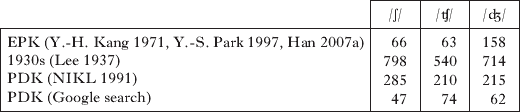
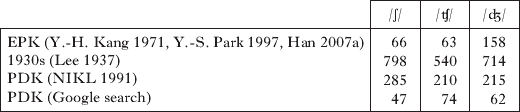
All data were entered into a spreadsheet, and loan forms from these sources containing one of the English posterior obstruents were further coded for various characteristics. The number of relevant forms from each source is summarised in Table I.
Number of loan forms in the four sources containing a posterior coronal obstruent.
3.2 Results
Based on normative conventions on loanword transcriptions, we would not expect <w> to occur in adaptations of English posterior coronal consonants. However, it has been observed that /w/ often occurred in adaptations of /ʃ/ before front vowels in PDK (Hahn Reference Hahn2005, Iverson & Lee Reference Iverson and Lee2006, H. Kim Reference Kim, Calabrese and Wetzels2009). In this section, we will see that <w> indeed occurs quite frequently in /ʃ/ adaptations throughout Contemporary Korean. <w> also occurred in affricate adaptations in earlier periods (EPK and 1930s Korean), but in PDK the affricates are rarely transcribed with <w>. Examples of transcriptions with <w> in different time periods are given in (7).
(7)
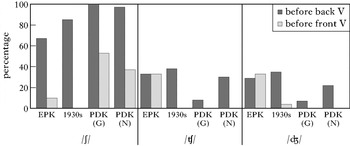
The rate of <w> spellings was calculated for cases where the following vowel allows <w> orthographically and phonologically, i.e. when the following vowel in the Korean adapted form is one of /a ʌ i e æ/. Data from all time periods are summarised in Fig. 1 by input consonant, time period and backness of the following vowel. Three general trends can be observed. First, in earlier periods, i.e. EPK and the 1930s, <w> was attested at substantial rates for /ʧ/ and marginally for /ʤ/, but in PDK <w> is categorically absent in affricate adaptations. The rate of <w> occurrences has also decreased for /ʃ/ adaptations in PDK compared to earlier periods, but not to the same degree. Secondly, <w> occurs more frequently for the fricative /ʃ/ than for the English affricates, and <w> occurs more often for the voiceless affricate /ʧ/ than for the voiced affricate /ʤ/. The only exception is found for /ʃ/ and /ʧ/ before a back vowel in the 1930s (23% vs. 38%), which is likely due to the fact that /ʃ/ was adapted with <j> at a very high rate, and thus the co-occurrence restriction limited the possibility of <w> in the /ʃ/ adaptations. Thirdly, the distribution of <w> for /ʃ/ shows a systematic effect for vowel backness; <w> is found at a higher rate before a front vowel than before a back vowel in EPK and the 1930s, and <w> is found exclusively before a front vowel in PDK. However, the distribution of <w> in affricate adaptations does not show any systematic effect for vowel backness.
The rate of occurrence of <w> in the adaptation of English /ʃ ʧ ʤ/ in different time periods of Contemporary Korean. PDK (G) gives the average of rates for individual English input words from the Google search; PDK (N) the rate across all items from NIKL (1991). EPK and 1930s also give the rates across all items.

Before we turn to the proposed explanation for the drastic decrease in the occurrences of <w> in affricate adaptations, I will consider some possible alternative explanations, which will be rejected in turn.
The first possibility is that the categorical absence of <w> in affricate adaptations in the PDK data is due to normative conventions in spelling introduced in the latter half of the 20th century (cf. (4a, b)). However, this explanation is inadequate, given that <w> continued to occur at a substantial rate for /ʃ/, despite not being sanctioned by convention. Moreover, there is evidence that the absence of <w> in the spelling reflects the actual pronunciation of the loanword. In a survey of loanword pronunciations for the National Institute of the Korean Language (Choi Reference Choi2001), English posterior coronal affricates were almost never pronounced with lip rounding. The survey included 13 English words with English affricates in contexts where <w> potentially could have occurred; out of the 5343 (13 words×411 speakers) responses, only 14 responses (0·3%) reflected the lip rounding. This is in contrast with English /ʃ/, which was often produced with lip rounding before a front vowel (Choi Reference Choi2001, Reference Choi2002). Thus we can be fairly certain that the absence of <w> in the written data for affricate adaptations reflects the actual pronunciation of the loanword, and cannot be attributed solely to normative spelling conventions.
Secondly, the drastic decrease in the occurrence of <w> for the English affricates can also not be explained by any phonotactic restrictions or diachronic changes internal to Korean. An anonymous reviewer suggests the possibility that the distribution of <w> in affricate adaptation may be constrained by vowel backness, but there is no systematic vowel backness effect in the distribution of <w> in the affricate adaptations, as can be seen in Fig. 1, nor is there any clear effect for vowel backness on the distribution of [w] in native words, as discussed in §2. In addition, although [w] optionally deletes postconsonantally in casual speech in PDK, the rate of deletion following affricates is lowest (at 11%) compared to following other consonants (H.-S. Kang Reference Kang1997). Therefore, the native process of [w]-deletion in casual speech is not systematic enough to account for the categorical absence of <w> in affricate adaptations in PDK.
A third possibility is that the decrease in the occurrence of <w> in the adaptation of these consonants is an epiphenomenon of an increase in the occurrence of <j> in the adaptation of the same consonants. Since Korean does not allow two glides to occur in the same syllable, an increase in the occurrence one glide can lead to a decrease in the other. To test this hypothesis, I examined diachronic trends of the occurrence of <j> in these consonants, which is summarised in Fig. 2. The rate of <j> spellings was calculated for cases where the following vowel allows <j> orthographically and phonologically, i.e. when the following vowel in the Korean adapted form is one of /a ʌ o u æ e/. For /ʃ/, occurrences of <j> increased over time and there was also a strong tendency to avoid <j> before a front vowel (cf. *Cje, discussed in §2). In other words, <w> and <j> seem to be in complementary distribution in /ʃ/ adaptations. Thus the interpretation that the decrease in <w> occurrences in /ʃ/ adaptations is due to the increase in <j> occurrences is viable. The drastic decrease in the occurrence of <w> for affricates, on the other hand, cannot be explained by changes in the occurrence of <j>, since, if anything, <j> also decreased in PDK as compared to earlier periods. In addition, the overall higher occurrence of <w> in fricative /ʃ/ vs. affricate /ʧ ʤ/ adaptations cannot be attributed to the difference in rates of <j> occurrence either; <j> occurred more consistently for /ʃ/ than for affricates, and <w> also occurred more frequently for /ʃ/ than for affricates.
The rate of occurrence of <j> in the adaptation of English /ʃ ʧ ʤ/ in different time periods of Contemporary Korean. PDK (G) gives the average of rates for individual English input words from the Google search; PDK (N) the rate across all items from NIKL (1991). EPK and 1930s also give the rates across all items.

Finally, I consider the possibility that the change in Korean loanwords reflects changes in the English input from the early 20th century to PDK. In other words, it may be the case that the lip rounding accompanying the English posterior coronal obstruents used to be much stronger and consistent in the dialect(s) of English in contact with Korean in the early 20th century than in dialect(s) in contact with PDK. Also, it might be the case that British English, which was likely the dominant dialect of English in the late 19th and early 20th centuries, has stronger lip rounding than American English, which is the dominant influence on loanwords in PDK.
Unfortunately, instrumental studies of labialisation in posterior coronal consonants are limited to the English voiceless fricative [ʃ] (Perkell et al. Reference Perkell, Boyce, Stevens, Wolf and Klatt1979, cited in Keyser & Stevens Reference Keyser and Stevens2006) and there are no instrumental studies of diachronic changes or dialectal variation in lip rounding in English posterior coronal obstruents that I am aware of. I therefore examined the impressionistic descriptions of the consonants in different time periods; these are summarised below. In short, there is no evidence that the change in the dialect of English used as the input for loanwords in Korean is responsible for the changes in the Korean adaptation.
Descriptions of lip rounding in posterior coronal consonants in the late 19th and early 20th centuries, many of which are comparative descriptions of English vs. German and French, vary significantly. Scholle & Smith (Reference Scholle and Smith1907) do not mention any lip gesture for these consonants, whereas Lloyd (Reference Lloyd1899) and Viëtor (Reference Viëtor1899) explicitly note that, for English /ʃ/, lips are ‘passive’, unlike for German sch (/ʃ/). On the other hand, Soames (Reference Soames1891), Grandgent (Reference Grandgent1892), Sweet (Reference Sweet1908) and Jones (Reference Jones1914) note that a lip gesture is present for the posterior coronal fricatives /ʃ ʒ/, but most still acknowledge the existence of inter-speaker variation and the fact that the rounding is less pronounced than that found in German sch. None of the descriptions examined explicitly mention lip rounding for the affricates at all in this time period.Footnote 10
Descriptions in the latter part of the 20th century are similarly variable, and there is no indication that the rounding gesture became any less noticeable over time. In later literature, lip rounding is explicitly mentioned for affricates (Hubbell Reference Hubbell1950, Jones Reference Jones1950, Kurath Reference Kurath1964, Gimson Reference Gimson1980, Rogers Reference Rogers2000, Liker et al. Reference Liker, Gibbon, Wrench and Horga2007, Collins & Mees Reference Collins and Mees2008, among others), as well as fricatives (Jones Reference Jones1950, Bronstein Reference Bronstein1960, Kurath Reference Kurath1964, Gimson Reference Gimson1980, Ladefoged 1975, Ladefoged & Maddieson Reference Ladefoged and Maddieson1996, Small Reference Small1999, Roach Reference Roach2000, Rogers Reference Rogers2000, Keyser & Stevens Reference Keyser and Stevens2006, Collins & Mees Reference Collins and Mees2008). Many mention the variability of rounding in these consonants. As mentioned above, Keyser & Stevens (Reference Keyser and Stevens2006: 40) note that ‘the degree of rounding of /ʃ/ is more variable than that in a featurally initiated rounding such as that in /u/’. Ladefoged (Reference Ladefoged1982) and Roach (Reference Roach2000) also note inter-speaker variation. Ladefoged (Reference Ladefoged1982: 59) states that ‘most people find that their lips move … quite considerably in any word containing /ʃ/ … and /ʒ/’ (emphasis added). Roach (Reference Roach2000) mentions that most ‘BBC speakers’ produce lip rounding for the posterior coronal fricatives.
As for the issue of British vs. American varieties of English, lip rounding is observed in descriptions of both dialects (British English: Soames Reference Soames1891, Sweet Reference Sweet1908, Jones Reference Jones1914, Reference Jones1950, Kurath Reference Kurath1964, Gimson Reference Gimson1980, Rogers Reference Rogers2000; American English: Grandgent Reference Grandgent1892, Hubbell Reference Hubbell1950, Bronstein Reference Bronstein1960, Rogers Reference Rogers2000, Keyser & Stevens Reference Keyser and Stevens2006). Kurath (Reference Kurath1964) and Rogers (Reference Rogers2000) observe dialectal differences, but their observations are contradictory. Kurath (Reference Kurath1964) notes that rounding is found in British English, but is absent in American English. Rogers (Reference Rogers2000: 49), on the other hand, observes that ‘commonly in RP, and usually in GA, the postalveolars /ʧ ʤ ʃ ʒ/ … have inherent rounding which is independent of the context’ (emphasis added). In short, there is no evidence that the lip rounding is more systematic in British English than it is in American English.
To summarise, there is no evidence that the lip rounding in posterior coronal obstruents of English became any less systematic or overt in the variety of English that PDK came in contact with, and thus we cannot account for the diachronic shift in the adaptation pattern based on changes in characteristics of the input. With these various alternatives ruled out as plausible explanations, I now present a model for how variable phonetic details reflected in earlier loans may become lost in later stages of the language contact situation.
4 The emergence of phonemic uniformity
The adaptation of English posterior coronal obstruents presents an interesting testing ground for hypotheses about the nature of the input to loanword adaptation, because these English consonants not only have a posterior coronal constriction as their primary place of articulation, but they also have a lip-rounding gesture phonetically. The lip-rounding gesture in the posterior fricatives of English has received a lot of attention as an enhancement of the primary ‘feature-defining’ gesture in coronal fricatives (Keyser & Stevens Reference Keyser and Stevens2006) – namely, lip rounding has the effect of lowering the frequency of the frication noise, further enhancing the low-frequency noise cue of the posterior coronal fricatives. As we have just seen, lip rounding is also found in English posterior coronal affricates, as well as fricatives.
In descriptions of these consonants, however, the lip-rounding gesture is mostly mentioned only in passing, if at all, and is never proposed as a distinctive feature of the consonants. As noted above, Keyser & Stevens (Reference Keyser and Stevens2006: 40) specifically mention that the lip rounding for /ʃ/ is ‘more variable than that in a featurally initiated rounding such as that in /u/’. We would thus expect most theories of phonology which make a distinction between abstract phonological features and surface phonetic details to treat the lip rounding in these consonants as being external to the phonological representation proper. Thus, if only phonological representations devoid of redundant surface-level details are visible to the loanword-adaptation process, we would not expect the lip rounding to be reflected in the Korean loans. However, as we have seen, <w> occurs quite frequently in the adaptation of English posterior coronal consonants, especially in the earlier periods of Contemporary Korean.
The entire situation is much more complex than a simple choice of phonetic vs. phonological adaptations, however. Occurrences of <w> have decreased drastically in PDK, when compared to earlier periods. In the case of /ʃ/, <j> occurs categorically in back vowel contexts, pre-empting the use of <w>, and <w> occurs in front vowel contexts, which is the only context where <j> is strongly dispreferred. More strikingly, in the case of affricates, <w> is never found in the PDK data. There is no obvious native phonotactic restriction that can account for this change. As mentioned above, given that Korean phonology is predisposed to disfavour the palatal glide in this position due to phonotactic constraints against sibilant+/j/ sequences, if anything, <j> would be expected to disappear, but not <w>. Why, then, did <w> disappear in affricate adaptations in PDK?
In the initial stages of adaptation, where there are no established norms, each adapter is left to their own devices to carry out an online adaptation. These initial borrowings are unaffected by tendencies in pre-existing loans, since there are few or no pre-existing loans at this stage. As a result, the adaptation is more variable, and if a phonetic attribute is present inconsistently in the input, as in the case of lip rounding in English posterior coronal obstruents, we expect more variation to occur. At this initial stage, if, for example, an input posterior coronal obstruent has lip rounding that is robust enough to trigger adaptations with /w/ about 30% of the time, and if there are no other factors militating against the occurrence of /w/, we would expect /w/ to occur at a rate of 30%. Put in OT terms, a constraint promoting the matching of the input with the output, which has been variously referred to as Match (Davidson & Noyer Reference Davidson and Noyer1997), Mimic (Yip Reference Yip2006) or BeSimilar (Y. Kang Reference Kang2003) in the literature, dominates the adaptation. At this stage, variation in characteristics of the input produces corresponding variation in the outcomes of adaptation.
This initial variation is not stable, however. Languages are generally intolerant of true synonyms (cf. the blocking effect described by Aronoff Reference Aronoff1976), and as initial borrowings gain currency and become established loans, variation is likely to be reduced or eliminated, unless variants take on different functions (cf. Zuraw Reference Zuraw2000: 119, Y. Kang Reference Kang2003: 254). All else being equal, the more frequent variant (i.e. in the current discussion, the form without <w>) is more likely to be adopted as the norm. The process of standardisation can occur not only at the level of individual lexical items, but also at a more general level. Subsequent adaptations of new words continue to be conditioned by similarity to the input signal, but also by analogy to existing loan forms, which further strengthens the majority pattern. Crucially, such analogy to existing forms can be mediated by the adapters' knowledge of the phonological categories of the native language. In other words, when adapting a new word containing /ʧ/, for example, adapters may examine examples of English /ʧ/ adaptations in their lexicon and prefer to follow the dominant pattern in the current existing lexicon (i.e. the form without <w>). In OT terms, this regularising tendency can be modelled as another constraint, which we can refer to as Uniformity, promoting the existing majority adaptation pattern for a given input language phoneme, and eventually promoting the uniform exponence of that phoneme category. The addition of this normalising factor would further tip the scales toward the majority pattern, and all else being equal, each subsequent stage of adaptation would further increase the dominance of the majority form. Eventually, phonetic details which were reasonably well represented in earlier loans could essentially disappear, as we observed in the rounding of affricates, resulting in what would appear to be a phonological adaptation. In other words, this is a possible scenario of how what may appear to be a ‘phonological’ adaptation can arise from an essentially ‘phonetic’ adaptation through regularisation by analogy to the dominant pattern in pre-existing loans.
In the literature, we find the related observation of a diachronic shift in loanword adaptation patterns from more variable and more ‘phonetic’ ones to less variable and more ‘phonological’ ones. Haugen (Reference Haugen1950: 216–217) observes that in the initial stage of loanword adaptation (his ‘pre-bilingual period’) words are adapted ‘with great irregularity in the phonetic results’; he refers to such a state as ‘erratic substitution’. A subsequent stage (his ‘period of adult bilingualism’) exhibits ‘a more systematic substitution, in which the same [native language] phoneme is consistently employed for new [input language] loans’. In a diachronic study of English loanwords in Quebec French, Paradis & LaCharité (Reference Paradis and LaCharité2008, Reference Paradis and LaCharité2009) found that the rate of non-phonological adaptations decreased from 17·5% (70 out of 401 cases) in Old Quebec French (late 19th–early 20th century Quebec City) to 9·5% in recent Quebec City French and to 7·1% in recent Montreal French. In particular, the rate of ‘phonetic approximation’ decreased from 5·5% in Old Quebec French to 1·1% and 0·4% in recent Quebec City French and recent Montreal French respectively. Here, we can observe a diachronic trend from ‘more variable’ to ‘less variable’, and from ‘less phonological’ to ‘more phonological’.Footnote 11
Peperkamp et al. (Reference Peperkamp, Vendelin and Nakamura2008), who are proponents of the ‘phonetic’ adaptation view, make a somewhat similar suggestion: the gap between the perception data in laboratory experiments, which is usually quite variable, and established adaptation patterns, which tend to be more systematic and regular, suggests that a process of ‘standardisation’ takes place as established loanwords develop.
However, it is also important to note that I am not proposing that the input-language phonology is irrelevant in loanword adaptations. On the contrary, the proposed process of regularisation essentially assumes that adapters utilise their knowledge of the phonemic, and possibly other more abstract, categories of the input language. For example, they should be able to identify English words containing /ʧ/. In this sense, I disagree with the purely phonetic view of adaptation, where the input to loanword adaptation consists of the unstructured acoustic signal (cf. Silverman Reference Silverman1992, Peperkamp et al. Reference Peperkamp, Vendelin and Nakamura2008, Boersma & Hamann Reference Boersma, Hamann, Calabrese and Wetzels2009).
At the same time, I do not assume that adapters are fluent bilinguals who have native-like knowledge of English (cf. Paradis & LaCharité Reference Paradis and LaCharité1997). All that is required to make this regularisation process possible is minimal knowledge of English phoneme categories. In fact, there is ample evidence that the adaptation is often guided (or misled) by input-language orthography (Dohlus Reference Dohlus2005, Smith Reference Smith, Vance and Jones2006, Vendelin & Peperkamp Reference Vendelin and Peperkamp2006, Detey & Nespoulous Reference Detey and Nespoulous2008). An orthography effect seems to play a role when the adapters' knowledge of the input language is imperfect, leading them to resort to orthography to help them determine the correct English category in the input. For example, Y. Kang (Reference Kang2009) found that in 1930s Korean the adaptation of English /z/ varied between /ts/ and /s/~/s'/. /ts/, which is voiced intervocalically in Korean, occurred in contexts where English /z/ was more likely to remain voiced, whereas /s/~/s'/ occurred in contexts where English /z/ was more likely to be devoiced. Overall, /ts/ was the majority pattern in the 1930s, and in PDK the pattern became phonemically more uniform, favouring /ts/, the majority pattern in earlier periods, in all phonological contexts. Interestingly, the 1930s adaptations reflect a strong influence from orthography. In other words, all else being equal, English /z/ was more likely to be adapted as /ts/ if it was written with a <z>, rather than with an <s>, regardless of the context. Thus, adapters of the 1930s appear to have been implicitly aware that the English phoneme /z/ should preferably be adapted as /ts/, but their knowledge of English appears to have been imperfect. As a result, they may not necessarily have been certain as to whether an alveolar fricative in any given word in English was /z/ or /s/. This problem was particularly acute in cases where English /z/ was devoiced or when it was written with an <s> and not <z>.
The proposed model also does not link the rise in ‘phonological’ adaptations to the level of bilingualism or the input language proficiency of the adapters necessarily. On the contrary, regularisation portrayed in this model is more likely to take place if the level of direct contact with English is held relatively low, which keeps the Match constraint ranked relatively low. In fact, in PDK there is marginal evidence that the rate of /w/ pronunciations for the English posterior coronal consonants, which is a symptom of ‘phonetic’, not ‘phonological’, adaptations, is higher for more educated speakers. Choi (Reference Choi2002) asked 210 Seoul Korean speakers to pronounce various English loanwords. Of interest to us is the pronunciation of three English loanwords where /ʃ/ occurred before a mid-front vowel /e/ or /ε/, which are adapted as /e.i/ and /e/ respectively: Shakespeare, milkshake and shepherd. The study found that the likelihood of English /ʃe/ or /ʃε/ being pronounced with /w/ was positively correlated with the level of education of the speakers (primary school: 0·00%, middle school: 2·57%, high school: 10·78%, university: 19·87%). In another survey involving 411 Seoul speakers (Choi Reference Choi2001), the English affricates were rarely pronounced with /w/ overall, as discussed above, but news broadcasters, who likely had a greater level of knowledge of English than the general population, had a slightly higher rate of /w/ pronunciations at 1·6% (9 out of 572 cases (44 speakers×13 words)) than the general population at 0·1% (5 out of 4771 cases (367 speakers×13 words)). In other words, it appears that, if anything, beyond a certain level, a higher level of input language knowledge works counter to phonemic levelling.
Another important aspect of the proposed model is that it does not predict that all non-feature-defining phonetic details will be completely lost as the contact situation matures in the same way that lip rounding for affricates disappeared in PDK or the contextual variation of /z/ adaptation disappeared in PDK. In fact, it is not the phonetic vs. phonological status of particular characteristics of the input but the consistency in the early stages of adaptation that is a key factor in determining whether characteristics will be eventually retained in the established norm. If an attribute is salient and consistent enough to show up in the adaptation in the majority of cases in the early stages, it is expected to survive. Minority patterns are expected to die out. In fact, however, if a given phonetic attribute occurs consistently and is salient, it is generally the case that that attribute can be analysed as a phonologically contrastive feature. Hence it is expected that most attributes that are consistently represented in established loans are also likely phonologically distinctive features in the input language.
This model also allows for the possibility that phonemic uniformity is not necessarily achieved. There is ample evidence that not all segmental adaptations become phonemically uniform (see Y. Kang, forthcoming, for a review). Even for /ʃ/ adaptations in PDK (Google), /w/ occurs in over 50% of the cases before front vowels (Fig. 1), but in back vowel contexts /j/ pre-empts the occurrence of /w/, which is categorically absent. In the proposed model, the push toward phonemic uniformity (Uniformity) and the drive to preserve input characteristics (Match/Mimic/BeSimilar) are formulated as constraints which are violable and in conflict with each other. The former does not necessarily override the latter. Depending on the ranking between these constraints, uniformity may or may not be achieved.Footnote 12
It is not clear whether we can predict which ranking will prevail in any given situation, but it seems that phonetic saliency is a relevant factor, as well as the level of direct contact with the input language, as discussed above. In Korean, the lip rounding in affricates has almost completely been eliminated in PDK adaptations, but the lip rounding for /ʃ/ has been retained in front vowel contexts, defying complete regularisation.
Assuming that the primary cue for rounding is found during the frication noise, the cue for the lip-rounding gesture is likely more salient in sounds with longer frication noise. As a result, we expect that lip rounding is more likely to be retained in the Korean adaptation for consonants with longer frication duration. The phonetic facts are certainly compatible with this interpretation. One of the key perceptual cues for the distinction between English voiceless affricates and fricatives is the longer frication duration of the fricative as compared to the affricate (Dorman et al. Reference Dorman, Raphael and Isenberg1980, Hedrick Reference Hedrick1997). The voiceless affricate also tends to have a longer constriction than the voiced affricate (Crystal & House Reference Crystal and House1982), which may explain the asymmetry in occurrences of <w> between the two affricates in EPK and 1930s Korean, i.e. <w> occurs at a substantial rate for the voiceless affricate /ʧ/ but not for the voiced affricate /ʤ/.
All in all, the pattern of <w> occurrences and their evolution in the adaptation of English posterior coronals shows that loanword adaptation is sensitive to phonetic details. However, phonetic details which do not constitute underlying phonological contrasts in the input language and are therefore less consistently present may be lost over time. Thus, in established loanwords, we can end up with a ‘cleaned-up’ version of the earlier adaptation, and the established pattern preferentially retains phonological information of the input language but not variable phonetic details. It is also worth pointing out that if one only examined the EPK data, one would be led to the conclusion that the input to loanword adaptation is phonetic and all phonetic details are reflected in the adaptation, regardless of their phonological status. If one only examined the PDK data, one would be led to the conclusion that only the phonologically contrastive aspects of the input language are reflected in the adaptation, which would also be incorrect.
5 Conclusion
The diachronic change in the distribution of <w> in the adaptation of English posterior coronal obstruents provides a good illustration of the complexity of the loanword-adaptation phenomenon. In earlier stages of contact, the distribution of <w> reflected phonetic details and the variability of the input fairly closely, but in PDK the norm of eliminating the <w> in affricate adaptations has been established. It is proposed that the development of the distribution of <w> is a case where what appears to be a phonological adaptation can arise from what is essentially a phonetic adaptation, as the loanwords undergo the process of standardisation and regularisation. But this process of regularisation crucially involves reference to the input language's phonological categories, i.e. phonemes. If the two factors, (i) faithful representation of input phonetic details (Match) and (ii) uniform representation of input language categories (Uniformity), are in conflict with each other, depending on how the conflict is resolved (i.e. their relative ranking in OT terms), the end result may be what appears to be a phonological adaptation (Uniformity≫Match) or the persistence of phonetic adaptations (Match≫Uniformity). The current study contributes to the body of literature recognising the multi-faceted nature of loanword adaptation, and has examined how the diachronic shift in adaptation patterns can shed light on the interaction of phonological and phonetic factors in shaping the overall process.
Appendix: Google search list