Introduction
In Bill T. Jones's series of works commemorating Abraham Lincoln, the constitutive role of Black people, and particularly Black women, in US democracy grounds his representation of the sixteenth president. The Lincoln works’ dramaturgical focus on Black womanhood culminates most clearly and effectively in the 2009 concert dance Fondly Do We Hope … Fervently Do We Pray (hereafter FDWH), commissioned by the Ravinia Festival for the Lincoln bicentennial. This work begins and ends with performer Shayla-Vie Jenkins. Its opening moments include a projection of a Lincolnesque silhouette strolling by, stovepipe hat in hand, on a gauze curtain that enrobes the oval stage. Jenkins walks in his shadow, hands clasped behind her back. She takes measured, deliberate steps that lead to a satellite stage thrust into the audience where she performs her opening solo. At the work's end, Jenkins stands inside the oval stage with the rest of the cast and slowly closes the curtain, obscuring access to the historical past that the oval represents throughout the performance. But Jenkins is not our guide through the past, an instrument for the audience's political awakening. Instead, her performance exists for her, and locates the site of social activism outside the walls of the theater as she moves through the world.
Although Bill T. Jones/Arnie Zane Company's (BTJ/AZ) revisionist representation of national history could be understood as activist in terms of its desire to activate the spectator, this article centers on what performance might do for Black women and their personal practices of artistry and activism over what impulses toward social justice Black women's performances might galvanize in their audiences. I analyze both the representational and experiential possibilities for liberatory Black womanhood mobilized within Shayla-Vie Jenkins's performance in FDWH.Footnote 1 For Jenkins, making and performing FDWH also energized a personal activist practice informed by the choreographic process. I attribute the work's transformative potential to two uncommon pairings: on the level of story, a coupling of erotic relationships and US national history; and on the level of aesthetics, a combination of postmodernism and sentimentalism. Using FDWH as its case study, this essay aims to demonstrate the viability of dance as a form of doing history and historiography, and to elaborate the possible liberatory gains of these aesthetic modes for minoritarian artists and citizens, as Jenkins's experience shows.
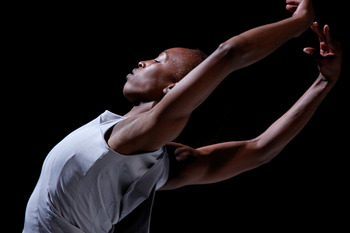
Shayla-Vie Jenkins performs the opening solo of Fondly Do We Hope … Fervently Do We Pray. Photograph by Paul B. Goode.

Jenkins's description of a task that Jones assigned to the company for generating the movement anchor of an earlier Lincoln work, Serenade/The Proposition (2008), summarizes FDWH's content and method: “Put dancing material on the path and then be open to exchanges or meeting points with different people along that path” (Jenkins Reference Jenkins2019). In my reading, the primary cultural work of FDWH encompasses putting dancing material onto the path of historical inquiry, and thus promoting movement as constitutive of that path. As I position dance as history, I argue for dance and movement-based performance's capacity to make claims about the historical past. I also make a case for Jones's dances as historiography, wherein the methods of movement composition intervene in the methods of history's composition—in other words, how Jones and Jenkins make dances about the historical past not only revises particular historical narratives in content and form, but also speaks back to how history is made, circulated, received, and reimagined by its publics. In the introduction to her 1995 collection Choreographing History, Susan Leigh Foster establishes the many formal similarities between choreographic and historical practice and suggests that revisionist historical impulses might learn much from the field of dance, as “to approach the body as capable of generating ideas … is to approach it as a choreographer might” (Foster Reference Foster1995, 15).Footnote 2 As a result of my encounters with Jones's Lincoln repertory, I seek here to account for dance as theory but also, extending from Foster, as history and as historiography.Footnote 3 Importantly, I am not working with a narrower definition of historiography as the history of historical writing. I instead think with Michel-Rolph Trouillot's insistence that “what history is matters less than how history works” (Reference Trouillot2015, 28). As I chart the historical representations that BTJ/AZ engage in their creative process, the ways those representations show up in the composition of duets, and the experiential dimensions of Shayla-Vie Jenkins's performance, I explore how forms that prioritize communication through embodied motion might contribute in specific ways to revealing the political purposes of history's procedures. Positioning FDWH as history and historiography ascertains the enormously creative strategies of survival and flourishing that Black artists have developed through movement-based praxes and the myriad tactics dominant culture proliferates in response in order to suppress minoritarian history making.
Historical Representation and the Stakes of Character
FDWH emphasizes character rather than event or setting in its storytelling. The evening-length work is jam-packed with different design elements: the set consists of two performance spaces, an oval proscenium and a satellite thrust, connected by a runway and enrobed by a sheer gauze curtain that serves as a projection surface. Live narration, instrumentals, and sung music abounds, much of it original and devised from historical texts. The relationship between the oval and satellite stages is one of the past and the present. Jones developed characters as a way for audiences to chart the themes of the work, explaining, “Once I embraced the fact that I was going to have characters—Mary, Lincoln—what was the poetry of the characters? They are superstars in history. It had to be provocative, it had to be sensual, it had to have some truth to it” (American Masters 2011). Choreographing the Lincolns as lovers became the primary revisionist tactic for both recognizing and subverting their “superstar” status. This choice challenges the typical Lincoln historiography while simultaneously functioning historiographically to demonstrate the political investments of certain narrative tropes that guide history making, namely, investments in denying the domain of the erotic as a space of intimacy and care for Black subjects.
Characterizing Lincoln as a romantic partner, engaged in physical negotiations of desire and intimacy, performs a radical commemorative practice that recognizes Lincoln's birth by centering the lives and deaths of Black people. Lincoln's figure as synecdoche for ideals of freedom, compromise, and equality circulates regularly in American histories as those ideals continue to be contested, claimed, and denied. In a television program chronicling the creation of FDWH, Bill Moyers remarked to Jones, “Every generation must negotiate with his ghost” (Moyers Reference Moyers2009). Whereas Lincoln appears as a danced figure in both Serenade/The Proposition and FDWH, the latter more radically negotiates the spectral Lincoln by reimagining him first and foremost as a fleshly lover. The work's choreography prioritizes physical intimacy and Lincoln's embodied desires as narrative drivers in a story that has historically been articulated through the heroic mode. Highlighting certain aspects of Lincoln's biography over others is part of the selection process typical of history making; expressing these choices choreographically asks the viewer to engage with Lincoln's history as a matter of time, space, and force—of bodies in motion making decisions that tangibly influence others’ possibilities and trajectories in unequal ways. BTJ/AZ's emphasis on romance pushes Lincoln's social world to the fore, proposing dynamic ranges of representation for Black women that both define and exceed white masculine supremacy as a national value.
The endurance of Lincoln's ghost is partially due to his untimely and dramatic death. Frederick Douglass put it powerfully and succinctly when he termed Lincoln “the first martyr President of the United States” ([1876] Reference Douglass and Foner1999, 618). Albert Furtwangler, summarizing accounts of Lincoln's life, asserts, “Here, certainly, is the pattern of high tragedy: the isolation of a unique good man, his immolation in a catastrophe he helped initiate, and his survival in deeds and utterances that remain incomparably noble” (Reference Furtwangler1991, 7). Douglass and Furtwangler interpret Lincoln's identity within the narrative modes of the heroic and sacrificial. Narratologist Patrick Hogan claims that a transhistorical and cross-geographical study of stories as meaning-making practices reveals three primary narrative prototypes: heroic, sacrificial, and romantic (2011). The company's choice to represent Lincoln through the romantic mode intervenes in ideological investments in masculinity, whiteness, and the family as signatures of Americanness. Whereas romantic plots can certainly be created and circulated to serve social elites, in Hogan's formulation this is not a determinant element of the prototype in the way that it is for heroic and sacrificial plots.Footnote 4 In their depiction of romantic desires and erotic intimacies, BTJ/AZ locate battles of ideas in the entanglements of human bodies, refusing to separate private and public life.
In Jones's revision, desire and intimacy not only chart a route through Lincoln's narrative by physicalizing his ghost, they also characterize a broader history of race, power, and pleasure in which Lincoln is cast as a pivotal figure. “Shadow family”—a term that refers to common practices during chattel slavery of the rape of enslaved women and the subsequent birth of mixed-race children—responds to the 1998 DNA confirmation of Thomas Jefferson and Sally Hemings's sexual relationship (Dillon Reference Dillon2018; Spillers Reference Spillers2018). In a more removed application, the term can register the often invisible but nonetheless enduring presence of Black people in American histories. Although there is no evidence to suggest Lincoln had a shadow family in the first sense, the Lincolns, as they exist in the universe of FDWH, are shadowed by Black figures who both ghost and generate their movement repertoires. Reading this dance as a history suggests, as much current scholarship does, that US American slavery and democracy are mutually constitutive.Footnote 5 Importantly, this shift, as Salamishah Tillet describes, implies that slavery is “the mnemonic property of the entire nation, and not … the exclusive intellectual property of blacks” (2012, 11). FDWH does not broach miscegenation as a narrative element, however, I want to note that it is a romantic narrative (Jefferson and Hemings) that made visible, at least in a more mainstream national historiography, “how intertwined the lives of white people and black people were in the making of this nation” (Harris and Baum Reference Harris, Baum, Baum and Harris2009, 44).Footnote 6 Intertwining and entangling are central choreographic motifs for FDWH's romantic characters, yet the work resists a simplistic reading of romance as a liberatory mode. The company's romantic scan of the Lincoln historiography takes place within a representational structure forged through, as it pushes against, legacies of racial violence. FDWH's performances of erotic relationships heat up along racial fault lines and cannot avoid being haunted by performative tropes of Blackness inherited from Lincoln's time. This haunting offers a productive tension between postmodernism and sentimentalism that links the company's historical inquiry to aesthetic practices.
Many of the tropes that inform historical and contemporary representations of Blackness and of Black people as romantic partners trace back to Harriet Beecher Stowe's 1852 novel Uncle Tom's Cabin; or, Life among the Lowly. The novel and its extended afterlives on the minstrel stage and screen emblematize, if they do not originate, ways of being Black in the US public sphere that are rechoreographed throughout FDWH. These profoundly limited representational and experiential possibilities are, as Hortense Spillers argues, visited particularly brutally upon Black women and are ontologically necessary for the US nation-state. Spillers determines that the Black woman in the United States is “a locus of confounded identities, a meeting ground of investments and privations in the national treasure of rhetorical wealth. My country needs me, and if I were not here, I would have to be invented” (1987, 65). Stereotypes of Black womanhood are necessary inventions for the United States’ foundational investment in white masculine supremacy. As generated and reinforced through cultural production, stereotypes call attention to what Dorinne Kondo characterizes as “the imbrications of genre in making/unmaking racial hierarchy” (Reference Kondo2018, 48). This article advocates for the critical role of the moving body in an aesthetic-political project of (re)inventing Black womanhood as it describes dancer Shayla-Vie Jenkins's choreographed negotiations of inherited repertoires of relation. These racialized and gendered repertoires manifest in both historical and aesthetic registers. In the contemporary moment of the Lincoln works, Black artists working in concert dance often confront and repurpose postmodern aesthetics. BTJ/AZ's approach to FDWH as a character-driven work revisits their own archive, utilizing aesthetic modes of representation rooted not only in Stowe's sentimentalism but also in postmodernism.
FDWH's focus on characters partakes of a kind of genre mixing that grows out of, rather than recapitulates, postmodernism. In part, this shift is due to self-citation: the archive for FDWH not only includes historical persons and texts but also, crucially, incorporates the repertory as archive. Frequently included on syllabi and considered an exemplar of US-based postmodern dance, BTJ/AZ's Last Supper at Uncle Tom's Cabin/The Promised Land (1990) interrogates both the narrative of Uncle Tom's Cabin and its enduring influence on sentimental representations and lived experiences of Blackness, religion, and witnessing.Footnote 7 Last Supper eschewed sentimentalism for satire and adopted self-consciously avant-garde performance strategies.Footnote 8 Conversely, within FDWH's universe, romantic partnerships as relations of sincerity are not undermined by parody, irony, or reversals; rather, they are mobilized as sites of deep feeling. Caroline Levine's theorization of forms and genres as representational designs with ranges of limits and affordances, wherein “each shape or pattern, social or literary, lays claim to a limited range of potentialities” suggests the possibility for postmodernism and sentimentalism to productively intertwine (Reference Levine2015, 6). Attending to the Lincoln dances marks a formal evolution in BTJ/AZ's work that incorporates both sentimental romance and postmodern avant-garde aesthetic values to exceed the limitations of both. When Jones speaks of choosing to have characters, part of what he is acknowledging is the significance of romantic characterization that is sentimental and sincere, and thus a recognizable departure from the aesthetic codes that governed much of the company's work after Last Supper. This characterization invites criticism, however, as it activates a contemporary interpretation of the sentimental as an apolitical form.
Stowe's deployment of the sentimental has been particularly formative for representations of Blackness in the US imagination. Sentimentalism derives from the novel form, wherein, as Margaret Cohen writes, “Sentimentality's primal scene is a spectacle of suffering that solicits the spectator's sympathy” (Reference Cohen, Cohen and Denver2002, 108). Hogan's storytelling formulation positions romantic plots as the least explicitly engaged in the public sphere of the political; this is precisely the critique of sentimentalism, and its use of romance, undertaken by Lauren Berlant, Saidiya Hartman, and others.Footnote 9 In her analysis of the continued influence of Uncle Tom's Cabin, Berlant delineates the limits of sentimentalism as a genre that purports to effect social change by affectively engaging its readers or spectators through spectacles of suffering wherein “the ethical imperative toward social transformation is replaced by a civic-minded but passive ideal of empathy” (Reference Berlant1998, 641). Much of the sentimental critique is aimed at cultural producers who enjoy particular privileges or elite status: in the case of the legacy of Uncle Tom's Cabin, the elite status of whiteness and white womanhood as established through nineteenth-century aesthetic and social norms. Cohen complicates the alleged apoliticism of sentimentalism, claiming the genre often engages the domestic or private in order to examine “the uses and abuses of the nation as the unit of collective identification” (Reference Cohen, Cohen and Denver2002, 107). By activating the sentimental, FDWH directly addresses the viability of “Americanness” as expressed through Lincoln's heroic historiography as a collective identification that extends across racial lines. FDWH suggests sentimentalism's usefulness for Black cultural producers, demonstrating how sentimentalism, as a set of tactics, might offer representational and experiential possibilities that usefully exceed or amend those canonized, in part by BTJ/AZ's own repertory, as the postmodern avant-garde.
Duets
FDWH's duets are sites of sentimental and postmodern world making that directly represent romantic narrative modes and erotic choreographies. Through its dramaturgical primacy, FDWH radically charges the sentimental field with Black female self-knowledge rather than collective identification. I understand the erotic through Audre Lorde's germinal formation of affect in action: “For the erotic is not a question only of what we do; it is a question of how acutely and fully we can feel in the doing” (Reference Lorde2007, 54). In FDWH, the aesthetic frame of sentimental romance opens the door to eroticized movement, necessary for moving beyond sentimentalism's alleged apolitical sympathy. For Imani Perry, Lorde's precise yet capacious definition of the erotic engenders the possibility of an ethical, if not outright activist, praxis, wherein “seeking good relations with the world around us by answering the desire for intimacy, joy, and meaning is indeed a pathway toward transformative relations with ourselves and others” (Reference Perry2018, 200). FDWH, a dance-as-history, invests in feeling as an aesthetic and historical mode. BTJ/AZ choreograph the relationship between the romantically revised Lincoln and the continuing conditions of participation in civic life for Black women in the United States as circumscribed yet constantly moving.
FDWH centers Black women within the commemorative project of the Lincoln bicentennial through what Joseph Roach has called “the dramaturgy of doubling” (1996, 1). In his analysis of circum-Atlantic performance cultures, Roach describes a common pattern in which, for white subjects “to perform as protagonists of gendered whiteness they must rely on an unnamed black antagonist, who … remains forgotten but not gone” (1996, 31). In FDWH, variations on this pattern, executed through a series of duets, offer sites of intervention resulting from a paired narrative commitment to romance and choreographic commitment to the erotic. Jones makes this pattern explicit in his choice to double Asli Bulbul and Paul Matteson, as Mary Todd and Abraham Lincoln, with Shayla-Vie Jenkins and LaMichael Leonard Jr., who ghost the Lincolns’ movements throughout the performance.
Jenkins and Leonard, who identify and read as Black, softly mirror Bulbul and Matteson's choreographies, often in the shadows of the lighting; Bulbul and Matteson read as white. I believe this doubling of romantic characters is crucial to the work's political stakes, and its significance begins with its casting. Other BTJ/AZ works have incorporated cross-racial casting, including Last Supper, in which four women perceived to be of different racial identities performed the role of Eliza Harris. This earlier casting choice had the effect of highlighting the tragic octoroon's hybridity and the social construction of race (Nereson Reference Nereson2015). For the Lincoln works, created over fifteen years later, choosing not to cross-racially cast identifiable historical figures foregrounds racialization as a constitutive and persistent element of national history making. Casting a white man as Lincoln, whose only visible shared physical characteristic is his race, pushes Lincoln's whiteness to the forefront of understanding his legacy, effectively naming dominance rather than assuming its invisibility. This choice supports a choreographic inquiry into the representational limits of Blackness in the US public sphere, particularly the ongoing dominance of Black suffering and corporeal pain as representational tropes.
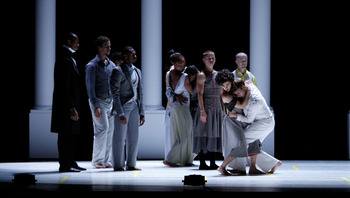
Asli Bulbul and Paul Matteson, foreground, as the Lincolns. Shayla-Vie Jenkins and LaMichael Leonard, Jr., upstage, ghost the Lincolns' choreography, with company. Photograph by Paul B. Goode.

Jenkins and Leonard's performances, too, are haunted—sentimental stereotypes, such as those from Uncle Tom's Cabin and its long stage history, shade BTJ/AZ's characterization. Jenkins and Leonard dance a variation on the romantic lovers of Lincoln and Mary Todd that in my viewing conjures Eliza and George Harris, Stowe's sentimental protagonists. The Lincolns’ historical identities are confirmed through FDWH's use of text, while the erotic nature of their relationship is developed primarily through movement. In contrast, Jenkins and Leonard's characterization occurs almost entirely through movement, embodying Robin Bernstein's claim that “Uncle Tom's Cabin is best understood as a repertoire” (Reference Bernstein2011, 14). Jenkins's performance is the pivot upon which this characterization turns; her duets with Leonard contrast not only with the Lincolns’ but also with her partnership with the white dancer Peter Chamberlin. As a trio of duets (Bulbul/Matteson, Jenkins/Chamberlin, Jenkins/Leonard), these choreographies rely upon, in order to subvert, an inherited relational repertoire wherein, as Saidiya Hartman describes, “the pleasures of inviolate and nonpunitive embodiment” lay beyond the reach of Black women (1997, 104). Given these repertoires, FDWH's most impactful choreographies are those of Black love, care, and sensuality, embodied through Jenkins's performance of a dynamic range of characters—more than any other performer—that centers the commemorative project on multifaceted Black womanhood.
Duets offer insight into characterization because they focus, clarify, and intensify characters’ desires and aims. Comparing the three central duets (Bulbul/Matteson, Jenkins/Chamberlin, Jenkins/Leonard) reveals how racialized and gendered identities shape those desires and aims. In a significant departure from Lincoln's typically heroic historiography, FDWH initially represents the Lincolns as a unit before they appear as individuals, suggesting that it is their partnership that defines their characters. What historian Jean Baker describes as the historical Lincolns’ likely courtship of “gaiety and fun” is borne out in their opening choreography: Matteson and Bulbul rush down the platform onto the satellite stage, performing a duet of fiery, ambitious equals accompanied by an allegro score (2009, 111). They toss and fling their bodies toward and away from each other; at one moment, they lunge together deeply, arms wrapped behind each other's backs, and, as they hit the depth of the lunge, energetically turn their heads toward each other, effectively creating an inner world with their gaze. At the duet's end, Bulbul lunges forward, catches her momentum, and flings her body back into Matteson, who watches her from a low squat. As he lifts her body, now a vertical line with her arms extended above, they look out in the same direction, surveying the stage world with a single gaze. Throughout, they watch each other closely, see each other clearly, as they move quickly in and out of brief moments of weight sharing and establish a reciprocal relationship that is intense yet playful. They exit the platform running swiftly, with their arms wrapped around each other's waists. The couple appear through their choreography as youthful, vibrant, and energetic.Footnote 10
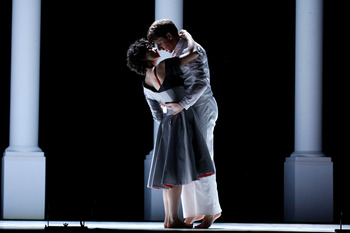
A later duet bridges sentimental and postmodern movement repertoires as it activates romantic tropes alongside erotic choreography. The Lincolns’ “superstar” status places this duet within the stage oval, performing for “the crowd” of other performers and underscoring the public nature of their romance. The duet begins with an acknowledgment of this performance within a performance as the pair's choreography references the social dance conventions of the historical Lincolns’ time, including a waltz closed hold.Footnote 11 The closed hold establishes an intimate connection that continues as an ever-present cradling action when the choreography departs from its historical social dance referents and into a more consistent modern vocabulary.
The gentle softness of much of the duet's choreography is balanced with moments of strong sensuality that make clear that this is a romantic union. Bulbul and Matteson's limbs stretch apart and snap back toward each other with the pleasure of desire deferred. In one sequence, Matteson kneels before Bulbul, pressing his forehead into her belly as she runs her hands down his head and neck. He then slides his hands down her back, pressing his palms against her buttocks. She playfully flicks her leg, reminding him that they are being watched. This sequence suggests that, within historical representations of the Lincolns’ relationship, sensuality and indeed sexual desire are curtailed by the “publicness” of Lincoln's career and legacy. When Jones stresses the physical intimacy within the Lincolns’ marriage, he introduces a model for understanding their story that radically departs from the dominant depiction of an unhappy marriage between a heroic martyr and his spiteful wife, while simultaneously critiquing the Lincoln historiography's dismissal of the erotic as a meaningful category of human experience.
Asli Bulbul and Paul Matteson as the Lincolns. Photograph by Paul B. Goode.

By dramaturgically centering Black women, the company reorients the gains of this critique toward Black perspectives. The intense yet playful choreography that characterizes the duets of the Lincolns gives way to combative sequences for Jenkins and Chamberlin, characterized by quick, forceful movements of attack and retreat, their aggression thrust into the audience in their staging on the satellite. In the first of their two exchanges, Jenkins runs down the runway, pursued by Chamberlin. She reaches the satellite first and grounds her feet, facing the audience and raising her arms, framing her head as she grasps her elbows. She establishes a strong central line, holding her center as she repeatedly slashes her arms and legs to evade Chamberlin's grip. As she spirals back and forth, he repeatedly attempts to enter her space, inserting his arms into the shapes she creates, grabbing a wrist or an elbow. The short but powerful sequence ends with Chamberlin dragging Jenkins down the runway by the hand. This duet is a fairly simplistic activation of the image of “violated slave woman” that spectators likely bring to their viewing as part of their “crucible of association” surrounding the figure of Lincoln (Jones quoted in Moyers Reference Jones and Wong2009).
A later duet between Jenkins and Chamberlin offers a more explicit representation of violation as the condition of Black female enslavement. The second act, like the first, opens with Jenkins, this time reprising her duet with Chamberlin. In rehearsal footage, Jones tells the dancers, “Let's go from Uncle Tom's Cabin—she's the beautiful octoroon, you're the evil slave master, she's trying to run away. Let's suggest that!” (American Masters 2011) Jenkins acknowledged that her racialized and gendered body invited this choice, and was “representative of the vulnerable female black body at that time and even now” (2019). In performance, Jenkins walks to the satellite stage with Chamberlin crawling behind her, nipping at her heels. This choreography obliquely references Stowe's Simon Legree and his dogs, a reference that becomes explicit for the spectator familiar with Last Supper; in that work's second act, titled “Eliza on the Ice,” the male company members, muzzled and holding dog masks, clearly represent the dogs chasing Eliza.Footnote 12 Having reached the satellite, Chamberlin stands behind Jenkins, grabbing at her throat, shoulders, and breasts. He reaches around her head, wrapping his palm over her forehead, eyes, and mouth. Jenkins's availability for this kind of embodied interaction is made possible, the choreography suggests, by her race. She stands uncomfortably during these gestures, though with more fatigue and resignation than outrage, before eventually kicking Chamberlin off; he crawls up the platform.
Peter Chamberlin and Shayla-Vie Jenkins. Photograph by Paul B. Goode.

Chamberlin's grab of Jenkins's breast is a stark variation on an earlier gesture by Bulbul as Mary Todd Lincoln that imbricates race with sexuality. In Bulbul's choreography of mourning, she responds to news of Lincoln's assassination by grasping her breast, sparking the ancient association of beating one's breast with grief while also, in the context of prior sequences, implying a sensual intimacy that contextualizes her grief as the stuff of tragic romance. This repetition and revision of Bulbul's gesture in Jenkins and Chamberlin's duet is critical to understanding the company's mobilization of romantic narrative.Footnote 13 It is not a simple humanizing tactic by which, brought down from their pedestals, the Lincolns become more easily interchangeable with Black subjects, thereby performing Blackness into historical significance. The choreographies are not identical. Indeed, their variations perform the sustained inequities between white and minoritized US democratic subjects that are still required for participation in the public sphere. Through this dramaturgy of doubling, BTJ/AZ's dance-as-history proposes that Mary Lincoln's romantic partnership is conceptually and materially facilitated by the systematized violation of Black women. In her critique of sentimentality's invitation to empathy, particularly through its valorization of romance, Hartman argues that “terms like ‘protection,’ ‘domesticity,’ and ‘honor’ need to be recognized as specific articulations of racial and class location. The captive female does not possess gender as much as she is possessed by gender” (1997, 100). Hazel Carby similarly determines that, while “existing outside the definition of true womanhood, black female sexuality was nevertheless used to define what those boundaries were” (Reference Carby1988, 30). The choreographic connection between Bulbul and Jenkins demonstrates the definitional role of Black women in the formation and enactment of sentimental romance.
Jenkins and Bulbul's doubling was also inspired by the relationship between Mary Lincoln and her dressmaker and confidante Elizabeth Keckley, a relationship framed historically as one of female friendship and domestic labor.Footnote 14 Aligning the domestic and private with the erotic proves a nimble strategy. Whereas FDWH emphasizes romantic narratives and the possible historiographic gains from considering the private sphere as a relational space with equal determinative power to the public sphere, the work's complex enactment of sentimentality allows it to simultaneously suspect these gains. Jenkins does not ghost Bulbul's grasp of her breast; rather, Chamberlin grabs her. By carefully reprising choreographic material, BTJ/AZ consider how the domestic “produces political meanings specifically by disavowing its own material and historical contingency and the tendency of that disavowal to protect norms of racial and gendered political power” (Adams Reference Adams2001, 50). Engaging the racialized mechanisms of sentimental romance by way of choreography, particularly gesture, politicizes both the domestic and the aesthetic as sites of doing and making social relations.
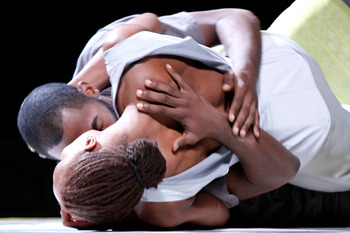
The playfulness and sensuality of the Lincoln's duets meet their opposite in Jenkins and Chamberlin's duets, but FDWH choreographs another partnership as well. Jenkins's duets with Chamberlin are paired with her duets with LaMichael Leonard Jr. In the first act duet, Jenkins returns to the satellite after fleeing Chamberlin to join Leonard. Following a frantic trio for three men (Leonard, Antonio Brown, and Erick Montés) that picks up after Jenkins's duet with Chamberlin, the pace shifts completely as she reenters. The allegro that accompanied Jenkins and Chamberlin, musically representing a heroic historiography (its lyrical signature is from Lincoln's second inaugural address, “every drop of blood drawn with the lash shall be repaid”), comes to an abrupt halt as Jenkins joins Leonard, aurally signaling a dramatic tonal shift. An adagio is introduced, cued by the lyric “arise, my love,” devised from the biblical Song of Solomon. Jenkins and Leonard meet each other's gaze, form an agreement, and slowly join hands. He touches his head to her head, chest, and belly, folding himself into her upright figure, as she softens over him. Importantly, the rest of the stage is completely still. Although there has been much activity happening in the oval and on its apron during the previous duets, the entire stage world has paused for Jenkins and Leonard. Silky transitions characterize the pair's tactile series of supportive gestures, constant contact, and attentive care. They descend to the floor, rolling, with Jenkins placing her entire length against Leonard's. Time seems to stop.
Jenkins described this duet as representing “black love, black sensuality, black caring for one another” (2019). The dramaturgical significance of this idea to FDWH as a whole is clear in its placement within the set and sound design, as well as in its establishment of choreographic motifs of intimacy that are later revised on Matteson and Bulbul as the Lincolns. Jenkins and Leonard's duets demand time, energy, and space for doing and representing Black care that exceed what Lincoln's historiography has allowed. Their intervention takes place within the erotic, a set of relations perhaps more urgently in need of redress than others, like the heroic, that are readily ascribed to the public sphere. Foregrounding romantic relationships points to the roles that material sexual terror and ideological tropes of Black female sexuality play both in the establishment of national identity and as ongoing reactions to the persistence of Black care in the lived world.Footnote 15 In her study of Black-authored romances, Belinda Edmondson determines that within the racial politics of genre formation, “Black people weren't a romantic subject.… The genre wasn't ours” (Reference Edmondson2007, 191).Footnote 16 Edmondson argues, similarly to BTJ/AZ's choreographic thesis, that simply rewriting romantic plots with Black characters is not enough; rather, “it is precisely the eroticism of the conventional romance that must be recovered and highlighted, because it is the black erotic that has long been taboo in the conventional black romantic script” (Reference Edmondson2007, 194; emphasis in original). By mobilizing the conventions of sentimental romance, BTJ/AZ perform this critical recovery. Racialized stereotypes of character and choreographies of intimacy co-shape the work's dramaturgy, acknowledging the commitment to feeling shared by, though expressed differently within, sentimental romance and the erotic.
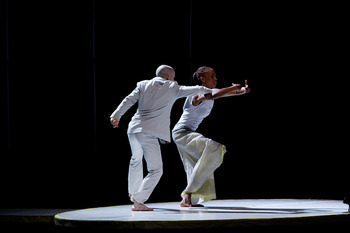
LaMichael Leonard, Jr., and Shayla-Vie Jenkins. Photograph by Paul B. Goode.

The world building of Jenkins and Leonard's duets and their valuation of Black care are not, however, disconnected from historiographic valorizations of white masculinity that affiliate Lincoln with the nation and burden Black representation. During the second act reprise of Jenkins and Leonard's duet, Matteson, as Lincoln, watches the pair dance from the shadow of the walkway. The duet concludes with Leonard's arms lingering on Jenkins's as he is pulled away from her, down the walkway, by an invisible force. Their separation has a finality to it that is confirmed by Jenkins's accusatory look and stance toward Matteson, who remains on the walkway. Jenkins then dances directly at Matteson, with force and anger. In contrast to her stillness with Chamberlin, here Jenkins dances in full, slicing exquisitely through the space with urgent and purposeful movements. At the end of this sequence, Jenkins's eyes pierce Matteson's, and she walks by him slowly, each foot feeling the earth, with her spine and head erect and her hands clasped behind her back as she exits the platform. The spectator sees that Matteson's hands are red, a crucial detail. Here is when the work's play with temporality pays off. Within the narrative sequencing of FDWH, Lincoln has already died. Yet the duets between Jenkins/Leonard and Jenkins/Chamberlin place us temporally during his lifetime through choreographies reiterating and responding to representational tropes of chattel slavery: the Lincoln with blood on his hands is both ghost and live spectator. The “red hand of violence” that Frederick Douglass described as responsible for Lincoln's assassination appears here as part of Matteson's very alive body, implicating Lincoln in repertoires of violence that enact social as well as biological death ([1876] Reference Douglass and Foner1999, 624). BTJ/AZ utilize the compositional role of characterization in both the ordering of movement and the ordering of the past to disorder temporality, revealing the ideological ends of narrative.
Myself, Dancing
Erotic choreographies in FDWH respond to a broader racialized reception of Black artists’ work that enforces particular modes of embodied relation. In the case of sentimental romance, investments in violated Black female sexuality as the foil to the cult of true womanhood came to define culturally acceptable romantic relationships. As Jones articulates, similarly limited and essentialist interpretations frame the critical reception of his company as alleged standard-bearers of Black postmodernism and avant-garde concert dance: “For years the reviews would be ‘Bill T. Jones, animal-like.’ And there's this kind of overweening sexuality and seducing [emphasized in the reviews]. There was this whole fear of sentimentality, and I said are you afraid of sentiment or are you afraid of sentimentality. And people didn't even bother to differentiate.… I'm a feeling person” (Reference Jones2015). Jones references critical tendencies to interpret the company's eroticism within a racist logic of deviant Black sexuality. He remembers that many Black artists responded, in an effort to minimize stereotyping of their work, by turning away from feeling, from sentiment, toward satire's distancing effects. The Lincoln works were developed after a period in the mid-1990s through the mid-2000s when BTJ/AZ were more committed to “pure movement,” unattached to narrative, and Jones implicates himself in the broader trend he perceives. Yet whether the company's aesthetic deployed satire and intertextuality or purported to be about “pure movement,” as Jones notes, the interpretive frame through which the work was understood remained limited by stereotypes. The postmodern choice in Last Supper that “exchanges Stowe's sentimental novel with [Jones's] avant-garde dance aesthetic” does not, from Jones's perspective, retain its efficacy in 2009, however innovative it was in 1990 (Tillet Reference Tillet2012, 74). By the time of FDWH, the company's aesthetic had circled back to the use of text, song, narrative, and character that Last Supper canonized, but introduced feeling, by way of the erotic, as necessary to the work's political project.
BTJ/AZ's use of the erotic as a choreographic set of movement relationships pushes Jenkins to the fore as the work's protagonist. Her duets with Leonard and Chamberlin reflect what Hartman terms “the ambivalent formation of pleasure” available to Black female subjects, and it is the analysis of these duets as parts of a whole, as representative of Jenkins's abundant self, that reveals the work's most liberatory possibilities (1997, 78). The aesthetic recombination of postmodernism and sentimental romance provides the structure within which these possibilities are realized. Comparing the company's representation of the Eliza figure in the satirical, anti-sentimental Last Supper with FDWH is instructive on this point. Both works are invested in fragmentation and the multiplicity of truths as hallmarks of postmodernism. In Last Supper, Eliza is the whole that becomes fragmented by five different performers; as a type, she contains multitudes. Yet in FDWH, Jenkins encompasses Eliza and Keckley and herself and various other identifications. Both choices are methods of revisionist history. In the first, the history itself is altered, fragmented and magnified for the purposes of expansion and critique. In the second, fifteen years later, it is the Black female self's relation to that history that receives greater attention and care. Focusing on what limits and affordances the twinned aesthetic approach of postmodernism and sentimental romance offers to a Black female performer in the making and performing of the work destabilizes sentimentalism's fairly straightforward mapping of audience identification with scenes of suffering. Instead, the performer's self-identification, growth, and knowledge—not those of the audience—become the sites of political action.
Attention to how performers experience FDWH acknowledges that performers do not simply represent racial identities, but also, as Anthea Kraut notes, race “mediates dancers’ relationships to what their bodies produce” (Reference Kraut2016, 34). Jenkins is abundantly aware that she has “two strikes against me, being born black and a woman” (2019). The world of contemporary dance, including concert postmodern dance, is far from immune to the influence of racialized hierarchies of value, as is evident from analyzing its means of production as well as its reception.Footnote 17 Utilizing sentimental romance would seem to encourage, rather than critique, these hierarchies by way of eliciting emotional responses that in themselves are taken as political ends for the individual spectator, thus absolving them of taking public action to address systemic injustice. Berlant's critique of the sentimental project ends with an out that she is skeptical any work engaged in sentimental aesthetics can actually take: “whatever transformation we might imagine being wrought from the world-making effects of identification must start right here, in the place of corporeal self-knowledge” (Reference Berlant1998, 665). Berlant's critique focuses on the permutations of Uncle Tom's Cabin that reinforce as they attempt to subvert its legacy; yet it seems to me that dance, as a set of methods of inquiry within which embodiment is epistemology, might be especially capable of activating “corporeal self-knowledge.” Jenkins left BTJ/AZ in 2015 after dancing with the company for over ten years. One of its continuing influences on her own practice is precisely heightened self-knowledge and self-articulation: “I feel like I have a responsibility in the work that I make now to speak because of … the history that is on my body. My black body has to speak its own history.… It has to be in my words, and this body has to do more than just be at the pleasure and consumption of someone else's gaze” (2019). Jenkins's doing and feeling her way through the company's practices resulted in the corporeal self-knowledge that Berlant posits as a method of moving beyond the objectification of the body on which sentimental identification depends.
Jenkins's artistic praxis as developed in BTJ/AZ's Lincoln works contributed to an activist praxis centered on protesting state violence against Black people. Jenkins remembered Jones's frustration with what he perceived as the apolitical orientation of the (comparatively) younger company members during the making of FDWH. When her communities began organizing around “Eric Garner and Michael Brown and Trayvon Martin,” Jenkins “felt charged by that climate and called out for my non-involvement in the world” (2019). For Jenkins, creating and performing her dynamic roles in the Lincoln works forged an aesthetic praxis that offered a sense of embodied action, motivated by political ideals, that also found activist expression: “[I was] really wanting to lend my body to a cause in a different way than performing, wanting to lend my body to the masses of bodies that were outside in the cold walking and chanting and marching. Going to rehearsal and then going and meeting up, enduring that. I felt a call to action” (2019). The endurance of Jenkins's body in motion as both art and activism was catalyzed in part by Jones's repeated question to the company during the creation of FDWH: “What is your commitment to the world aside from your own self?” (2019) Critically, Jenkins remembers this question as the world aside from, rather than outside, the self. Adjacency rather than removed distance characterizes the self in the world, and being a self in motion onstage, as well as representing a character, supported Jenkins's activism.
Jenkins experienced the Lincoln repertory as part of an ongoing project of self-knowledge. When I asked Jenkins about her personal stance toward Lincoln and if it shifted, she replied, “That question of what does Lincoln mean to me … I don't think that I ever really got closer to answering that during the performance” (2019). Instead, Jenkins remembers the significance of her participation as one of being and representing Black women, of her own self as creator being welcomed into the process and invited to share her multiple virtuosities in service of self-knowledge: “Something that I love … is that I was myself on stage. I was only myself. I wasn't Elizabeth Keckley. I wasn't a slave woman, or the octoroon, I was always myself, dancing” (2019). FDWH's use of characters enabled the imperfect mimesis of performance to offer Jenkins consistent opportunities to disidentify, to momentarily affiliate with rather than inherit these historical figures and tropes, regardless of what identificatory possibilities present themselves to the audience.Footnote 18 In this way, FDWH's use of characterization resists a dominant mode wherein, as Tressie McMillan Cottom describes, “At every turn, black women have been categorically excluded from being expert performers of persuasive speech acts in the public that adjudicates our humanity” (Reference Cottom2019, 20). This categorical exclusion is bolstered by stereotypical characterization, a way of limiting complexity and controlling eroticism, as Barbara Christian has powerfully shown.Footnote 19 Indeed, what this article aims to describe is the complexity of Jenkins's performance, in which my reading of the multiple layers of representation and Jenkins's recollection of her interior experience of the sole, whole self, are in a relation of mutual support.
Moving is the site of self-articulation for Jenkins, and the sentimental/postmodern frame of the work's erotic choreographies shapes that motion. Jenkins, as a collaborator within BTJ/AZ, participates in a network of Black concert dance artists whose praxis embodies experience as a contribution to discourse (DeFrantz Reference DeFrantz2004; George-Graves Reference George-Graves2010, 3–7), extending that praxis into the somewhat unexpected domain of the sentimental by way of the erotic. Jenkins's understanding of her professional experience as one of self-knowledge aligns with Lorde's theorization of the erotic as self-connection, and demonstrates the political stakes of this self-connection for Black women navigating representational and experiential constraints: “That self-connection shared is a measure of the joy which I know myself to be capable of feeling, a reminder of my capacity for feeling” (Reference Lorde2007, 57). Jenkins's labor as an artist and performer embodies self-connection shared. Feeling, as interconnected with moving, becomes in FDWH a critical function of performance that offers the potential for a liberatory experience within the limitations of representation.
Representation and its limits—of casting, of character and narrative tropes—continue to influence artistic and cultural production alongside hollow “quota” approaches that are taken as ends in themselves. Thirty years after asserting Black women's definitional role in the national project, Hortense Spillers addressed the increasing prevalence of Black women in media, specifically film and television: “The stories as types do not, to my mind, challenge our imaginative and intellectual powers, but cross terrain with which we are already overfamiliar; I would like to see this narrative and imagistic overdetermination demolished so that we might begin to plunge down into the depths of human feeling and response rather than dwell on the comfortable surfaces” (Reference Spillers and duCille2018, 12). BTJ/AZ acknowledge and subvert the “narrative and imagistic overdetermination” of the sentimental romance by way of dramaturgically prioritizing the erotic. Their choreographic choices perform a historical inquiry into Lincoln's legacy and its potentialities for racialized subjects. Although the work's representational dynamics may draw in the spectator and offer opportunities for both identification and critical distance, ultimately FDWH approaches its commissioned project of commemorating Lincoln by offering Black female performers time and space to feel deeply in public—to be themselves, dancing.