Introduction
Rapid population ageing has made older adults’ care a major policy topic across Europe. In 2050, approximately 30 per cent of the European population is expected to be 65 years and older, whereas this was just 15 per cent in 2000 (United Nations 2002). Despite vast differences in culture and welfare regimes, all European countries are struggling about how to allocate the responsibility of care and help for a quickly increasing proportion of older adults within their populations (Motel-Klingebiel, Tesch-Roemer and von Kondratowitz Reference Motel-Klingebiel, Tesch-Roemer and von Kondratowitz2005). In Europe today, the majority of care provided to older adults is informal in nature, i.e. provided by family and other network members. A significant amount is also provided by formal services like home care and residential care that can be both public and private in nature (Litwin and Attias-Donfut Reference Litwin and Attias-Donfut2009).
Recently, cross-national studies concerning the use of formal and informal home care among older adults have become a booming field (Bolin, Lindgren and Lundborg Reference Bolin, Lindgren and Lundborg2008; Brandt, Haberkern and Szydlik Reference Brandt, Haberkern and Szydlik2009; Broese van Groenou et al. Reference Broese van Groenou, Glaser, Tomassini and Jacobs2006; Haberkern and Szydlik Reference Haberkern and Szydlik2010; Litwin and Attias-Donfut Reference Litwin and Attias-Donfut2009; Lowenstein, Katz and Gur-Yaish Reference Lowenstein, Katz, Gur-Yaish, Szinovacz and Davey2009; Motel-Klingebiel, Tesch-Roemer and von Kondratowitz Reference Motel-Klingebiel, Tesch-Roemer and von Kondratowitz2005; Pommer, Woittiez and Stevens Reference Pommer, van Gameren, Stevens and Woittiez2007; Pommer et al. Reference Pommer, van Gameren, Stevens and Woittiez2007). These studies showed that variation in older adult's formal and informal care use between European countries is pervasive. On one side of the spectrum, in the Scandinavian countries as well as the Netherlands and Belgium, relatively many older adults receive formal home care, whether or not in combination with informal care. In contrast, in Mediterranean countries like Spain and Greece, and to a lesser extent, in Germany, many older adults receive informal care only. In Austria and France, the percentage of older adults receiving informal care only and formal care only are roughly equal and more often a combination of formal and informal care is used.
Previous studies showed that cross-national variation in care use is only in part explained by older adults’ individual characteristics (e.g. Motel-Klingebiel, Tesch-Roemer and von Kondratowitz Reference Motel-Klingebiel, Tesch-Roemer and von Kondratowitz2005; Pommer, Woittiez and Stevens Reference Pommer, van Gameren, Stevens and Woittiez2007). Recently more attention has been devoted to the effects of societal conditions on older adults care use. Studies on intergenerational solidarity in Europe have shown that societal characteristics relating to culture and welfare state policies are important for explaining patterns of help between parents and children. In more familialistic cultures, for example, older adults receive more care from children (Haberkern and Szydlik Reference Haberkern and Szydlik2010; Kalmijn and Saraceno Reference Kalmijn and Saraceno2008). Concerning welfare state arrangements, it was found that stronger welfare states decrease personal care assistance from children, but increase help with the household chores and dealing with paperwork (Brandt, Haberkern and Szydlik Reference Brandt, Haberkern and Szydlik2009; Haberkern and Szydlik Reference Haberkern and Szydlik2010). Regarding cross-national differences in the use of formal home care, empirical evidence of the impact of societal characteristics is still lacking.
The present study aims to increase understanding of the effects of societal context on older adults’ care use in several ways. First, we study the effects of societal characteristics on both older adults’ informal as well as formal care use, restricted to the care received in one's own home and excluding residential care. It is possible that various societal characteristics impact informal and formal care use in different ways. Second, next to studying the effects of culture and different welfare state policies relating to care use, compositional factors are likely to affect the use of care, e.g. countries differ with respect to the ageing of the population and larger proportions of older people may limit the use of public services for individuals. Moreover, instead of using welfare state typologies (cf. Esping-Andersen Reference Esping-Andersen1990; Ferrera Reference Ferrera1996) or care regimes (Anttonen and Sipilä Reference Anttonen and Sipilä1996; Rostgaard Reference Rostgaard2002), we study the relative impact of various care-related characteristics of the welfare state context, culture and composition. This allows us to conclude which of the various societal characteristics are most important. Finally, we explore whether functional limitations of older adults are addressed differently by informal and formal care in different societies. It is generally assumed that those who are in need of care (as indicated by e.g. functional limitations) do receive the amount of formal and/or informal care they require. Yet, societies may differ in the degree to which the need for care is addressed. Scarcity in home-based services or lack of support for informal care-givers may limit the use of (in)formal home care by those who need it the most. Exploring interaction effects between individual health and societal characteristics will increase understanding under which societal conditions frail older adults receive the care they need. In sum, two research questions will be answered in the study:
1. To what extent are societal context and composition, in addition to individual characteristics, related to older adults’ informal and formal home-care use in Europe?
2. Under which societal contextual and compositional conditions are older adults with functional limitations most likely to receive informal and/or formal home care?
Societal determinants of care use
Cultural context: preferences concerning older adult care and legal obligation to care for relatives
At the societal level, cultural norms concerning care are likely to impact on older adult's care use. Culture can be defined as ‘a system of collective constructions of meaning by which humans define reality’ (Neidhardt Reference Neidhardt, Neidhardt, Lepsius and Weiβ1986). This includes shared knowledge, norms, values and preferences of members in a given society. Applied to care for older adults, culture refers among others to ideas about who should care for older adults: the family, the welfare state or both (Pfau-Effinger Reference Pfau-Effinger2005). Societal cultural norms and preferences are likely to guide the caring behaviour of members of respective societies (Daatland and Herlofson Reference Daatland and Herlofson2006). Previous studies showed that in countries with a more familialistic culture, parents receive more assistance from children than in countries with a less familialistic culture, particularly when they have health problems, a low level of education and are widowed (Haberkern and Szydlik Reference Haberkern and Szydlik2010; Kalmijn and Saraceno Reference Kalmijn and Saraceno2008). In addition, in some European countries, the norm of providing care to older parents in need is also enforced by law (Blackman Reference Blackman2000). Mostly, this consists of an obligation to finance costs for care that the relative cannot pay himself or herself. In these countries, state-funded services are only available if relatives cannot afford to pay for care (Gori Reference Gori2000; Haberkern and Szydlik Reference Haberkern and Szydlik2010). As a legal obligation can be seen as an institutionalisation of a societal norm of primacy of family care, we can assume that in these countries older adults more often receive informal care only. In addition, we expect that in countries where cultural preferences for family care are stronger, more often only informal care will be received by older adults. Finally, a stronger preference for co-residence is likely to decrease formal care use, since these services are likely to be less accepted and desired by the population. A legal obligation to provide care to older adults does not necessarily have to decrease formal care use, but could stimulate the use of both informal and formal care among older adults with many functional limitations.
Welfare state context: home-based services, informal care support, residential care and pensions
Next to cultural context, we focus on the welfare state context. The welfare state is most commonly referred to as it involves state responsibility for securing some basic necessities for its citizens (Esping-Andersen Reference Esping-Andersen1990). As we study care for older adults, we focus on several different welfare state policies that are most likely to be related to care for older adults: home-based services, residential care, informal care support schemes and the generosity of pensions.
Home-based services refer to care services delivered to older people in their own homes, like home help, respite care at home, meals on wheels (Eurofamcare 2005). Previous studies have given contradictory evidence on whether home-based services substitute or complement informal care. Some studies studying the hours of informal and home care received have indicated that the receipt of informal care decreases the use of home-care services, corroborating the ‘crowding out hypothesis’ of informal and formal care (Bolin, Lindgren and Lundborg Reference Bolin, Lindgren and Lundborg2008; Van Houtven and Norton Reference Van Houtven and Norton2004). Other studies, however, indicated that formal home care does not crowd out informal care, but is complementary, particularly among the most severely disabled (Bonsang Reference Bonsang2009; Broese van Groenou et al. Reference Broese van Groenou, Glaser, Tomassini and Jacobs2006; Lowenstein, Katz and Gur-Yaish Reference Lowenstein, Katz, Gur-Yaish, Szinovacz and Davey2009; Motel-Klingebiel, Tesch-Roemer and von Kondratowitz Reference Motel-Klingebiel, Tesch-Roemer and von Kondratowitz2005). Countries differ highly with respect to the degree to which home-based services are public or private in nature. For example, in the Netherlands and France, much of the home-based services is public in nature (although private schemes are increasing), whereas in Germany and Italy, private services are more widely available. Due to equivocal evidence on the relation between informal and formal care, it remains an open question whether the availability of home-based services results in a ‘crowding in’ or ‘crowding out’ of informal care.
Residential care is an important care service provided to older people as it targets the frailest among the older adults population (Reher Reference Reher1998; Rostgaard Reference Rostgaard2002). There is some controversy about whether the relation between home care and residential care is supplementary or substitutive (Bettio and Plantenga Reference Bettio and Plantenga2004). However, residential care provides care to the most frail older adults that, when living at home, would be likely to have to rely on a combination of informal and formal care. Therefore, a low level of residential care should increase both the use of informal and formal care at home.
Variation in support and facilities provided to informal care-givers could provide an alternative explanation for differences in care use among older adults. Most European countries increasingly pay attention to carers’ needs and problems, acknowledging their valuable contributions (Sundström et al. Reference Sundström, Malmberg, Castiello, Del Barrio, Castejon, Tortosa, Johansson, Szinovacz and Davey2009). Informal carers support nowadays includes respite care, support groups, financial compensation as well as leave schemes. Informal care support decreases care-giver burden and depression (Sörensen, Pinquart and Duberstein Reference Sörensen, Pinquart and Duberstein2002). If informal care support is also effective in terms of care provided, these policies should increase informal care given to older adults. More indirectly, supporting informal care-givers may decrease or at least delay the use of formal care. However, this would depend also on the possibilities of substituting formal care by informal care in a given situation.
Lastly, in the welfare state context, national differences in the pension generosity could influence care use. If countries invest more in old-age pensions, this could enable older adults to buy more formal care, particularly on the private market but also public formal care subsidised (partly) by the government (Glaser Reference Glaser1997). A higher pension would enable older adults to maintain independence and impose fewer burdens on their children or other network members in terms of informal care when preferred. Therefore, more spending on pensions should increase the use of formal care and decrease the use of informal care.
Socio-economic and demographic compositional factors: women's labour market participation and age structure
Additional to the welfare state context the socio-economic and demographic composition of a country is expected to impact on care use. In particular, concerns have been expressed about the extent to which increasing labour market participation of women will reduce the informal care-giver pool (Glaser, Tomassini and Grundy Reference Glaser, Tomassini and Grundy2004). Despite apprehension, evidence on the relation between daughter's paid work and care use of their older parents is equivocal. Some studies show no effect of women's labour market participation on care use, whereas other studies confirmed that full-time work, but not part-time work, decreases informal care provided to older adults and increases the latter's paid formal care use (Dautzenberg et al. Reference Dautzenberg, Diederiks, Philipson, Stevens, Tan and Vernooij-Dassen2000; Evandrou and Glaser Reference Evandrou and Glaser2004; Scharlach, Gustavson and Dal Santo Reference Scharlach, Gustavson and Dal Santo2007). When translated to the country level, we can expect that in countries in which more women work full time, the use of informal care only is lower than in countries in which a smaller percentage of women work full time.
Finally, the rapid ageing of the population is likely to result in an immense increase in care demand (Silverstein, Bengston and Litwak Reference Silverstein, Bengtson, Litwak, Biggs, Lowenstein and Hendricks2003; Uhlenberg and Cheuk Reference Uhlenberg, Cheuk, Szinovacz and Davey2009). At the same time, population ageing is likely to reduce the availability of family and other social network members for caring. Subsequently, the ratio between potential informal care-givers to older persons is expected to decline. In societies that are more aged, this could result in a scarcity of available informal care (Lowenstein, Katz and Gur-Yaish Reference Dautzenberg, Diederiks, Philipson, Stevens, Tan and Vernooij-Dassen2009). This could increase the necessity to use formal care in order to cope with older adults’ care needs. However, holding the availability of formal care constant in the face of population ageing, formal care could also become scarcer. In addition, in more aged societies, everyday life could be more geared towards the experiences of older adults. For example, helping parents could be a more integral part of normal family functioning, and buildings and shops might be better accessible to those with functional limitations. Due to scarcity of care and due to a better adjustment to the needs of older adults in everyday life, we expect that in countries in which the proportion of older adults is relatively high, the likelihood of using informal and/or formal care is likely to decrease.
Individual-level determinants of care use: need, predisposition and enablement
As our focus is on the societal level, we do not elaborate on individual-level determinants of care use that are control variables in our study. Three types of individual determinants will be considered: (a) need factors that show the necessity of care due to illness (functional limitations, subjective health), (b) predisposing factors, which point at the propensity of an individual to ask and receive care (sex, age, education) and (c) enabling factors that specify the possibility to receive care due to resources (partner status, children living proximate) (Andersen and Newman 2004).
Method
Sample
The data for this research are drawn from the second wave of the European project Survey of Health, Ageing and Retirement (SHARE), collected in 2006–07. National probability household samples of those 50 years and older and their partners (irrespective of their age) were drawn in each participating country (Börsch-Supan and Jürges Reference Börsch-Supan and Jürges2005). Respondents were interviewed with Computer Assisted Personal Interview questionnaires in their home. Data are used from the following 11 European countries: Austria, Belgium, the Czech Republic, Denmark, France, Germany, Greece, Italy, the Netherlands, Spain and Sweden. After careful consideration, we decided to exclude two countries that were incorporated in this wave of SHARE, to be specific Switzerland and Poland. In Switzerland, care policies differ highly between Swiss cantons and policy making on care at the national level is relatively absent (Eurofamcare 2005). We were not able to find a clear description of the national availability of care schemes which made it impossible to code reliable measures for Switzerland at the national level. In addition, for Poland, information concerning informal care and formal care received at home was not available. As our focus is on informal and formal care use of community-residing older adults that are likely to have care needs, two selection criteria were imposed on the sample: respondents (a) should be 65 years of age or above and (b) should not permanently live in a nursing home. Due to these criteria, our total sample consists of 12,952 respondents.
Measurements
Individual characteristics
Questions with regard to informal and formal care use of respondents concerned: (a) informal care received from inside the household, (b) informal care received from outside the household and (c) formal care delivered to the house of the respondent. For informal care from within the household, a dichotomous variable is based on the response to the following question: ‘Is there someone living in this household who has helped you regularly during the time since the last interview/the last 12 months with personal care, such as washing, getting out of bed, or dressing?’ (0 ‘no’, 1 ‘yes’). The interviewer clarified that the question concerns long-term care rather than short-term help necessary due to illness. Although it was asked whether the respondent receives informal care from household members, no questions on exact hours were posed. Informal care received from outside the household measure was calculated from several questions. Respondents were asked: ‘Has any family member from outside the household, any friend or neighbour given you or your partner any kind of help?’ Subsequently, they were asked to specify, for up to three informal carers, the type of the relationship with the carer and indicate the type of help they received (household help or personal care). As personal care is given to individuals, we assigned personal care to the partner with most limitations in activities of daily living (not for household help).
For formal care, a dichotomous variable specifies whether the respondent has received either professional or paid nursing for personal care and/or professional or paid home-help for domestic tasks that could not be performed due to health problems (0 ‘no’, 1 ‘yes’). For the descriptive statistics of between-country differences in care use, the three dichotomous variables for the use of informal care inside the household, informal care from outside the household and formal care were combined in a measure specifying the ‘pattern of formal and informal care use’. The four patterns are: 0 ‘no care use’, 1 ‘only informal care (inside or outside the household) use’, 2 ‘only formal care use’ and 3 ‘a combination of formal and informal care use’.
Functional limitations are indicated by the amount of difficulties in performing six activities of daily living (dressing, bathing, eating, getting out of bed, walking across the room and toileting) and six instrumental activities of daily living (preparing a hot meal, shopping, making telephone calls, taking medications, work around the house or garden and managing money) and thus ranges from 0 to 12. Subjective health is coded into a binary variable on the basis of a question on how respondents feel about their health with values 0 ‘good’ (combining response alternatives excellent, very good and good health) or 1 ‘poor’ (combining fair and poor health). Age of the respondent is measured at the time of the interview. Gender is a dichotomy (0 ‘men’, 1 ‘women’). Years of education specifies the years that the respondent has spent in full-time education. Partner status is measured by a dichotomy whether or not the respondent has a partner or spouse living in the household (0 ‘no spouse or partner in the household’, 1 ‘spouse or partner in the household’). Finally, a binary variable specifies whether the respondent has at least one child living proximate, i.e. living within a range of 25 kilometres.
Societal characteristics
The degree of familialism in the countries is derived from the Eurobarometer Survey (Eurobarometer 2004) in which the following question was posed: ‘Let's suppose you had an elderly father or mother who lived alone. What do you think would be best if this parent could no longer manage to live on his/her own?’ The responses were: ‘he/she should come live with one of his/her children’, ‘one of his/her children should move into his/her house in order to provide him/her with the necessary care’, ‘one of his/her children should regularly visit his/her home, in order to provide him/her with the necessary care’, ‘public or private service providers should visit his/her home and provide him/her with appropriate health care and services’ and ‘he/she should move to an old people's home or a nursing home’. The percentage of persons in a country that think that frail parents should co-reside with their children (in their own homes or in their children's house) is used as the indicator of a familialistic culture. In addition, we added a dichotomous variable that specifies whether adult children have a legal obligation to care for parents in need in the 11 European countries under study (0 ‘no’, 1 ‘yes’) (Eurofamcare 2005).
For the ‘home-based services’ measure, information from Eurofamcare (2005) specifies the extent to which different types of home-based services are available in European countries. We consider home help, day care centres, home health services, dementia services and respite care at home. For each home-based service, we coded whether the service was: 0 ‘not available’, 1 ‘partly available’ and 2 ‘available’. The sum score is used to indicate the availability of home-based services, ranging from 0 to 10. To indicate ‘residential care’, the amount of long-term care beds in the year 2000 per 1,000,000 inhabitants is utilised (Organisation for Economic Cooperation and Development 2005). ‘Informal care support and recognition’ is derived from the Eurofamcare (2005) country descriptions about types of informal care support in the realms of advice, training and support groups (counselling and advice, self-help support groups, practical training), respite care (weekend breaks, respite care services), care leave/pension credits and financial compensation. Each support or recognition is coded as 0 ‘not available’, 1 ‘partly available’ and 2 ‘available’. The sum score was taken as representative for the availability of informal care support, ranging between 0 and 12. As indicator for the broader welfare state context, we employed a measure concerning spending of the Gross Domestic Product (GDP) on pensions for each European country in 2004 (Eurostat 2009a). However, as the percentage of the GDP spend on pensions might differ according to the size of the older population, we corrected this measure for the percentage of persons 65 years and older in each country to indicate the generosity of the respective pension systems. We created this measure by taking the percentage of the GDP spent on pensions and dividing it by the percentage of persons 65 years and over in the population.
To indicate women's labour market participation, a measure based on data of the second wave of the European Social Survey (ESS, 2004/2005) was used to specify the percentage of women between 15 and 64 years that work full time (⩾30 hours a week) (Jowell and the Central Co-ordinating Team Reference Jowell2005). The proportion of 65 years and over in the population in 2004 indicates the age structure of the respective European countries (Eurostat 2009b).
Procedure
In order to answer our research questions, several steps will be taken. First, we describe differences between the 11 European countries under study in the pattern of informal and formal care use. Second, we determine between-country differences in individual and societal determinants. Finally, we employ multi-level multinomial logistic regression analyses to assess the relations between individual, societal determinants and the four patterns of care use. Multi-level multinomial logistic regression is appropriate when the response variable consists of two or more unordered categories (Goldstein Reference Goldstein1995). In multinomial logistic regression, one of the response categories is taken as the reference category.
In our multinomial logistic multi-level regression analyses, we differentiate between the four patterns of informal and formal care use: (a) no care (reference category), (b) only informal care, (c) only formal care and (d) a combination of informal and formal care. We distinguish between two levels: countries at level 2 and respondents at level 1. Each societal characteristic is modelled separately (in model 1 ‘preference for co-residence’, in model 2 ‘availability of home-based services’ and so on). This stepwise procedure is used as the number of units at the country level is too small (N=11) to yield reliable results if multiple societal characteristics are included into a single model. This is partly so because of possible high correlations between the different societal characteristics in this study with a small amount of countries.
We determined correlations between societal determinants at the country level (table not shown). A very strong negative correlation (−0.92) was found between the preference for co-residence and the availability of home-based services. Given the substantial congruence between preference for co-residence and the availability of home-based services, we decided to only incorporate the availability of home-based services in our multi-level analyses. Only two other correlations exceeded the threshold of 0.60 for moderate correlations. First, we observed a strong positive correlation (0.67) between the two measures for the cultural context, legal obligation to care for older parents in need and a preference for co-residence. Second, a correlation of 0.68 was observed between a legal obligation to care and the percentage of 65 years and older. As our aim was to determine which contextual and compositional conditions impact on care use, all societal determinants, except for preference for co-residence, were studied individually.
Results
Between-country differences in the use of care
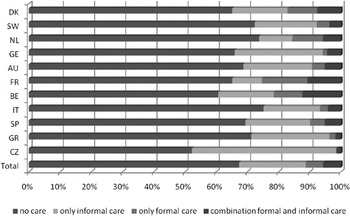
The pattern of care use in each of the 11 countries is presented in Figure 1. Three different patterns stand out in this figure. There are two countries (the Czech Republic and Greece) with large proportions of older adults receiving informal care and very low proportions receiving formal care. There are five countries in which the proportion of people using informal care exceeds the proportion of people using formal care or a combination of formal and informal care: Sweden, Germany, Austria, Spain and Italy. Finally, there are four countries in which the proportion using informal care is smaller compared to the proportion of people using formal care or a combination of formal and informal care: Denmark, the Netherlands, France and Belgium. There is also a large variation in the percentage of older adults that receive no care at all; this percentage is largest in Italy, Spain, Greece, the Netherlands and Sweden (about 75%) and smallest in the Czech Republic, Belgium, Denmark and France (between 52 and 65%). Thus, the use of only formal care and the combination of formal and informal care is most prevalent in some of the Continental European and Scandinavian countries, whereas in the Mediterranean countries and the Czech Republic, older adults are often reliant on informal care only.
Between-country differences in the relation between formal and informal care in 11 European countries.

Cross-national differences in older adults' characteristics
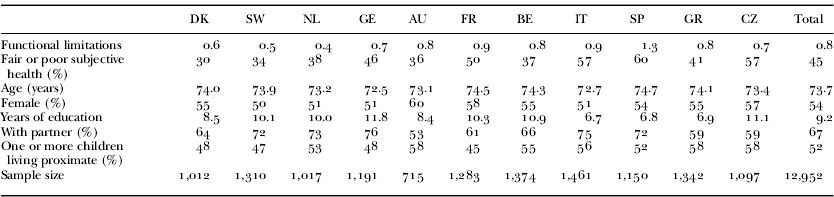
Table 1 shows large cross-national differences in the individual determinants of care use. Concerning the need for care, older adults in the Mediterranean countries and particularly Spain suffer most from functional limitations and a poor subjective health, yet also report the highest average age, the largest proportion of women and the lowest level of education. Respondents from the Netherlands and Sweden report, on average, the least functional limitations, yet also have a lower average age and report a higher level of education. There are also countries in which median scores on health and level of education seem to coincide with high age and a larger proportion of women (e.g. Czech Republic, Germany and Denmark). The availability of a spouse varies across countries, but is relatively high in both Sweden and the Netherlands, on the one hand, and low in Italy and Spain, on the other hand. In the Mediterranean countries and the Czech Republic, there are relatively many older adults that have at least one child living within 25 kilometres. These descriptive results suggest that the need for care (as indicated by the amount of functional limitations and poor subjective health) and the disposition to use care (as indicated by a higher age, being female and having a lower level of education) are relatively high in the Mediterranean countries and smaller in the Scandinavian and Continental European countries, however regarding the availability of informal care-givers (partners, children living proximate) the differences are not that large.
Descriptive statistics of individual need, predisposition and enabling characteristics in 11 European countries
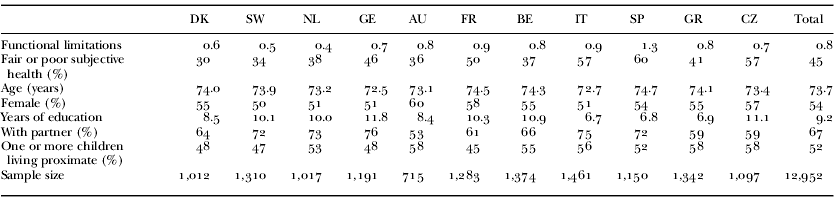
Notes: DK: Denmark. SW: Sweden. NL: Netherlands. GE: Germany. AU: Austria. FR: France. BE: Belgium. IT: Italy. SP: Spain. GR: Greece. CZ: Czech Republic.
Source: SHARE 2006, release 1.
Significance levels: Based on χ2 and ANOVA tests. All between-country differences in individual determinants are significant at p<0.001 at the individual level.
Cross-national differences in societal determinants
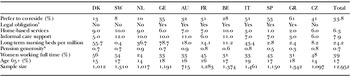
Table 2 shows that differences in societal characteristics between European countries are noteworthy. In the Mediterranean countries and the Czech Republic, attitudes that older parents should co-reside with their children when they become frail are upheld by a majority of the population. By contrast, in Sweden and the Netherlands, less than 10 per cent of the population argues in favour of co-residence when parents become frail, indicating less familialistic attitudes in these countries. A legal obligation to take care of parents in need is ingrained in the law in Spain, Italy, Germany, Austria, France and Belgium. Home-based services are most elaborate in the Scandinavian countries, the Netherlands and Belgium. The other Continental European countries and the Czech Republic take in middle positions and in the Mediterranean countries home-based services are least available. As expected, informal care support is most elaborate in Germany and Austria, although also widely available in Sweden, Belgium and the Netherlands. The availability of residential care is highest in Germany, with 78.7 beds per one million inhabitants. Italy and Denmark also have extensive residential care with more than 40 beds per one million inhabitants. In Sweden, residential care is almost absent (0.4 per million) and Greece and Spain have little residential care as well. Related to the socio-economic composition, full-time work (more than 30 hours per week) among women is most prevalent in Denmark and Sweden, with 56 and 53 per cent, respectively, of the women between 15 and 64 years working full time. The percentage of full-time working women is lowest in the Netherlands (24%), followed by Belgium and Greece (both 31%). Regarding the demographic composition, in the Mediterranean countries, Italy and Greece, slightly less than 20 per cent of the population is 65 years of age or older. In contrast, in the Czech Republic and the Netherlands, this is only 14 per cent.
Descriptive statistics of country-differences in culture, welfare state context, socio-economic and demographic composition

Notes: DK: Denmark. SW: Sweden. NL: Netherlands. GE: Germany. AU: Austria. FR: France. BE: Belgium. IT: Italy. SP: Spain. GR: Greece. CZ: Czech Republic.
1. Legal obligation to care for parents by adult children.
2. The percentage of the Gross Domestic Product (GDP) spent on pensions has been corrected with respect to the percentage of older adults living in the respective European countries in order to give a more accurate indication of the generosity of the different pension systems (formula:% of the GDP spent on pensions/% 65+).
Multivariate findings: the impact of societal characteristics
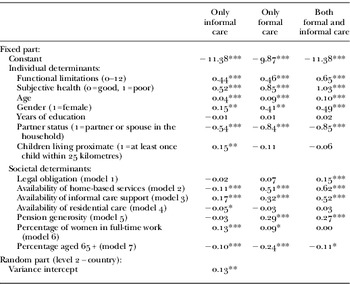
Using multinomial logistic multi-level analyses, we examined to what degree differences in societal characteristics explain cross-national patterns of informal and formal care use (see Table 3). Due to the relatively small sample of countries (N=11), each of the contextual and compositional conditions was modelled separately. We observed significant variation between the 11 European countries under study with respect to the four patterns of care use (no care, only informal care, only formal care and a combination of formal and informal care) among older adults (σ2 country=0.13, standard error=0.02, p⩽=0.001).
Informal and formal care use of older adults in 11 European countries, individual and societal determinants (main effects model, logit)

Notes: Sample size 12,952 respondents. Coefficients of the individual characteristics and variance intercept refer to those found for model 2 incorporating the ‘availability of home-based services’. ‘No care use’ is the reference category.
Source: SHARE 2006, release 1.
Significance levels:
* p⩽0.05,
** p⩽0.01,
*** p⩽0.001 (two-tailed tests).
The variation in use of informal care only is driven by individual need and enablement as well as several societal characteristics. At the individual level, having functional limitations and a poor subjective health significantly increases the likelihood of receiving informal care, whereas having a partner decreases this probability. In addition, those with at least one child living within 25 kilometres more often received only informal care (instead of no care). In countries in which the availability of home-based services and residential care is higher and a larger percentage of the population is 65 years and older, the likelihood of receiving informal care only is lower. In countries in which the availability of informal care support and the percentage of women working full time is higher, older adults are more likely to receive informal care only.
Our results show that societal determinants are also important for understanding between-country differences in the use of formal care only. In line with our expectations, in countries with a higher availability of home-based services and more generous pensions, the likelihood of using formal care only is significantly higher. A higher availability of informal care support is also related to more formal care use only. In countries in which a larger percentage of the population is 65 years and older, it is less likely to receive only formal care. At the individual level, the use of only formal care is strongly driven by a need for care, since having more functional limitations as well as a poor subjective health increases the probability of using formal care substantially. Formal care use is more likely at a higher age and when female. Having a partner decreases the probability of using formal care only.
Finally, a combination of formal and informal care is more often used in countries that have specified a legal obligation to care for parents in need, have a higher availability of home-based services, a higher availability of informal care support and a higher degree of pension generosity. In countries in which a larger percentage of older adults resides, the likelihood of using a combination of formal and informal care is substantially lower. At the individual level, a higher need for care due to functional limitations and a poor subjective health increases the probability of using a combination of informal and formal care. Being female, older and having no partner increases the odds of both formal and informal care use substantially.
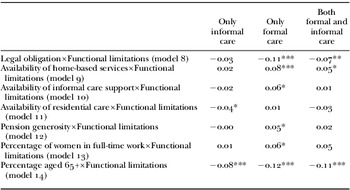
Table 4 reports to what extent functional limitations are addressed by informal and formal care in different societies. The results show that those with many functional limitations are less likely to receive informal care only in countries with more residential care. Legal obligation and home-care services do not impact the use of informal care, but they do interact with functional limitations on the use of formal care only and a combination of formal and informal care. In countries with no legal obligation and more home-care facilities, older adults with many functional limitations are more likely to receive only formal care or a combination of formal and informal care. In addition, a higher availability of informal care support and pension generosity are also positively associated with using formal care only for older adults with functional limitations. In countries in which the percentage of 65 years and older in the population is large, functional limitations are less often addressed by any type of care, i.e. informal care only, formal care only or a combination of formal and informal care.
Informal and formal care use of older adults in 11 European countries, individual and societal determinants (interaction effects model, logit)

Notes: Sample size 12,952 respondents. ‘No care use’ is reference category. Coefficients of individual need, predisposition and enablement as well as main effects of societal determinants are not displayed.
Source: SHARE 2006, release 1.
Significance levels:
* p⩽0.05,
** p⩽0.01,
*** p⩽0.001 (two-tailed tests).
Conclusion and discussion
In this study, societal characteristics, besides individual characteristics, are employed to explain cross-national variation in care use in 11 European countries. A wide array of societal determinants was taken into account, related to cultural context, welfare state context as well as socio-economic and demographic composition. By doing so, we tested a range of societal characteristics suggested in previous studies as possible explanations for the remaining variation between European countries in older adult's care use after taking into account older adult's individual characteristics (e.g. Litwin and Attias-Donfut Reference Litwin and Attias-Donfut2009; Motel-Klingebiel, Tesch-Roemer and von Kondratowitz Reference Motel-Klingebiel, Tesch-Roemer and von Kondratowitz2005; Pommer, Woittiez and Stevens Reference Pommer, van Gameren, Stevens and Woittiez2007).
Three major conclusions can be drawn from this study. First, societal determinants do add to individual characteristics in our understanding of care use among older adults, but have a stronger impact on the use of formal care (whether or not in a combination with informal care) than on the use of only informal care. Second, compositional as well as contextual societal characteristics are important for all types of care patterns, showing that the incorporation of different societal contextual and compositional determinants rather than the utilisation of welfare state or care regime classifications yields additional understanding of the conditions that determine informal and formal care use. Third, these contextual and compositional societal characteristics matter in particular for care use of older people that have many functional limitations. Notwithstanding the established significance of societal contextual and compositional determinants on formal care use, individual determinants of care use relating to need (functional limitations and subjective health) and enablement (partner status) remain more important for explaining older adults’ care use.
Our first question concerned the effect of societal determinants on patterns of informal and formal care use. For the cultural context, we observed that a legal obligation to care for older parents increases the odds of receiving a combination of informal and formal care. In addition, for the welfare state context, we found that a higher availability of home-based services translates in a lower probability of only informal care use, but in an increase in the use of both formal and informal care use as well as formal care only. These findings concerning the cultural and welfare state context corroborate previous studies that concluded that the availability of welfare state arrangements stimulates mixed responsibilities and therefore does not necessarily endanger family solidarity (Lowenstein, Katz and Gur-Yaish Reference Lowenstein, Katz, Gur-Yaish, Szinovacz and Davey2009; Motel-Klingebiel, Tesch-Roemer and von Kondratowitz Reference Motel-Klingebiel, Tesch-Roemer and von Kondratowitz2005). In addition, these results suggest that institutional regulations concerning informal care-giving do not necessarily decrease use of formal care. In line with our expectations, we also found that in countries with higher pension generosity, older adults are more likely to receive formal care only or a combination of formal and informal care. In countries with more informal care support, the odds of receiving informal care only or a combination of informal and formal care are higher, which suggests that these services indeed help to support informal carers. However, as in these countries there is also a higher likelihood of receiving formal care (whether or not in combination with informal care), we find no evidence that informal carer support decreases or delays formal care use.
Concerning women's labour market participation, we observed that the percentage of women working full time is both positively related to use of only informal care and only formal care use, but not related to a combination of formal and informal care use. Therefore, we can conclude that there is little evidence that women's labour market participation endangers informal care-giving. Given the absence of a clear direction in the effect of women's labour market participation on care use in this study as well as contradictory findings in previous studies (e.g. Dautzenberg et al. Reference Dautzenberg, Diederiks, Philipson, Stevens, Tan and Vernooij-Dassen2000; Evandrou and Glaser Reference Evandrou and Glaser2004; Scharlach, Gustavson and Dal Santo Reference Scharlach, Gustavson and Dal Santo2007), it is likely that there is no direct causal relation from women's labour market participation to the provision of care. Rather, it is possible that the effect of women's labour market participation is more indirect and dependent on what is expected from informal carers and work–care combination in different cultures. Some countries in our study, like for example the Czech Republic and Spain, combine high rates of participation of women in full-time work with a strong reliance on informal care-giving, suggesting that in these cultures a combination of full-time work and informal care is more likely to be considered the normal state of affairs than in other countries, like Sweden and the Netherlands. Such a hypothesis should be explored in subsequent research in order to capture the complex interrelation between women's labour market participation and care-giving.
For the demographic composition, we found that when the proportion of older adults in the population is higher, older adults are more likely to receive no care. As suggested in our theoretical framework, two explanations can be given for this finding that are not necessarily exclusive. First, the odds of receiving care might become lower when population ageing progresses in a society due to scarcity. Second, it could be that societies that have a higher proportion of older adults are more accustomed to adjusting normal everyday life to the needs of older people (for example by making buildings available to wheelchairs and people with functional limitations), making it less necessary for older adults to obtain care.
Due to the incorporation of societal determinants relating to cultural and welfare state context as well as socio-economic and demographic composition, the country differences in informal and formal care use observed in this study as well as previous studies can be understood. In Belgium and France, a combination of informal and formal care is more frequently used due to high availability of home-based services as well as a relatively strong familialistic culture and a legal obligation to take care of parents in need. The more frequent use of only informal care by older adults (with functional limitations) in the Mediterranean countries, the Czech Republic and also Germany can be understood by the strong sense of familialism in these societies that is entrenched in the law and the limited access to formal home-based services. In the Netherlands and Denmark, there is a clear preference for state support and there is a large availability of home-based services, rendering it possible for relatively many older adults to rely on formal care services only. In Sweden, however, there is a less familialistic culture and the availability of home-based services seems high, but compared to the Netherlands and Denmark, not many older adults in Sweden receive only formal care, partly due to relatively good health. In general, we found that there is a strong congruence between cultural preference for specific types of care and the actual take up of care.
Our second question entailed in which type of society older adults' need for care is most adequately addressed. In countries with more non-acute long-term care beds and a larger percentage that is 65 years and older, older adults' functional limitations are less likely to be addressed by informal care only. In countries that have more home-based services and a smaller percentage of older adults, more often formal care only or a combination of informal and formal care is provided to older adults with functional limitations. In countries with higher pension generosity and more informal care support more often only formal care is received. Thus, in societies with elaborate welfare arrangements in terms of home-based services and pensions, formal care is appointed to older adults who are most in need. The finding that need for care is less likely to be addressed by informal or formal care when the population is more aged corroborates the idea that increased care demand due to population ageing might result in unmet care needs if everyday life does not become more geared to the needs and experiences of older adults.
We have several suggestions for future research as a result of limitations. As a result of the relatively small amount of countries in our sample, we were not capable of incorporating multiple societal characteristics in a single multi-level model (Snijders and Bosker Reference Snijders and Bosker1999). Nevertheless, we were able to make a tentative conclusion about the relative strength of culture, welfare arrangements and composition for older adults' care use. In future research, more attention could be drawn to expanding cross-national databases by including more countries (possibly also non-European countries). This would allow us to determine the relative strength of the different types of societal determinants on older adults' care use more accurately.
Second, studying both public and private formal care separately could yield more insight in patterns of care use of older adults as there is known to be large country variation with respect to the degree to which care is either public or private in nature (Eurofamcare 2005). We found that in countries that have predominantly public home-based services (like Denmark, France, the Netherlands), older adults are more likely to use formal care than in countries in which home-based services are more often private (Germany, Italy). Clearly, home-based services subsidised by the government are likely to make formal care available to a wider range of older adults, also to those who cannot afford private home care.
Third, in this research, we studied the effects of societal context and composition on the incidence of informal and formal care. We did not address how societal characteristics impact on the intensity of care used by older adults. It could be that societal characteristics impact differently on the incidence than on the intensity of informal and formal care use. Previous studies based on SHARE data have indicated that older adults from Southern European countries are less likely to receive informal care than individuals from Northern European countries, but that the reverse is observed for the intensity of informal care: the quantity of informal care received by older adults is higher in Southern European countries than in Northern European countries (Pommer, Woittiez and Stevens Reference Pommer, van Gameren, Stevens and Woittiez2007, Pommer et al. Reference Pommer, van Gameren, Stevens and Woittiez2007). Consequently, an additional study on the effects of societal characteristics on the intensity of informal and formal care use might prove fruitful.
Fourth, during our study, we observed a scarcity of comparable macro-level indicators of cultural norms concerning care-giving. Therefore, we were only capable of employing measures of preferences for care and legal obligation to capture the cultural context in European societies. We observed a strong correspondence between preferences for care and the availability of home-based services in this study. In the model of planned behaviour of Azjen (Reference Azjen1991), it is argued that preferences of individuals are also conditioned by opportunity structures. As a result, our preference measure is also likely to have captured actual availability of informal and formal care. In subsequent research, it might therefore be preferable to also adopt a measure that merely captures social norms concerning care-giving as soon as it becomes available.
Our final suggestion for subsequent research on care use among older adults in Europe is the upcoming possibility of adding a longitudinal dimension to the study of societal characteristics and care use once more waves of SHARE are completed. In this study, linking changes in culture, welfare state context and composition to individual changes in care use was not yet possible due to the relatively short time-span of two years between the first and second wave of SHARE and the absence of comparable measures of societal characteristics at both points in time. Therefore, it is still impossible to make reliable claims about the impact of changes in societal characteristics on care use, which could greatly add to our knowledge, particularly from the viewpoint of causality.
Our results have implications for social policy. The finding that the gradient in informal care and formal care use due to functional limitations decreases when a larger proportion of the population is older could suggest that given the current trend of population ageing in Europe, the likelihood that older adults' need for care will not be adequately addressed will increase in the near future. Particularly in the Mediterranean countries and the Czech Republic, in which older adults' need for care is highest and relatively many older adults do not receive any form of care or only informal care, expansion of home-based services or informal care support should be considered. In all countries, more attention should be given to adjusting everyday life to needs of older adults. However, it is important to initiate policies that are in line with the cultural norms and preferences for care to facilitate the acceptance and utilisation of such arrangements.
Previous studies observed that informal care support reduces care-giver burden and depression (e.g. Sörensen, Pinquart and Duberstein Reference Sörensen, Pinquart and Duberstein2002). Based on our data, we reach the tentative conclusion that the availability of informal care support increases the likelihood that informal care (either solely or in combination with formal care) is provided to older adults. A study in the Netherlands indicated that the actual knowledge and take up of these schemes is very limited (De Boer, Broese van Groenou and Timmermans Reference De Boer, Broese van Groenou and Timmermans2009). It is feasible that informal care support will even more strongly affect the hours of care provided to older adults than whether or not it is provided at all. Therefore, providing more knowledge and promoting the use of informal care support among care-givers could yield advantages for both the care-giver and care recipient.
To conclude, the study added to our understanding of cross-national differences in care use among European older populations. Differences in care use between countries that are generally clustered in the same care regime (e.g. Sweden and Denmark, or Italy and Greece) are better understood by taking specific combinations of context and composition into account. At the country level, social policy should tune institutional care arrangements in accordance with the cultural context, but also with its population composition, as population ageing increases the need for care substantially in the near future.
Acknowledgements
This paper uses data from SHARE Wave 2, as of December 2008. SHARE data collection in 2004–07 was primarily funded by the European Commission through its fifth and sixth framework programmes (project numbers QLK6-CT-2001-00360; RII-CT-2006-062193; CIT5-CT-2005-028857). Additional funding by the US National Institute on Aging (grant numbers U01 AG09740-13S2; P01 AG005842; P01 AG08291; P30 AG12815; Y1-AG-4553-01; OGHA 04-064; R21 AG025169) as well as by various national sources is gratefully acknowledged (see http://www.share-project.org for a full list of funding institutions).